
India Electrical Insulation Tape Market Size, Share, Trends and Forecast by Product Type, End Use, and Region, 2026-2034
India Electrical Insulation Tape Market Summary:
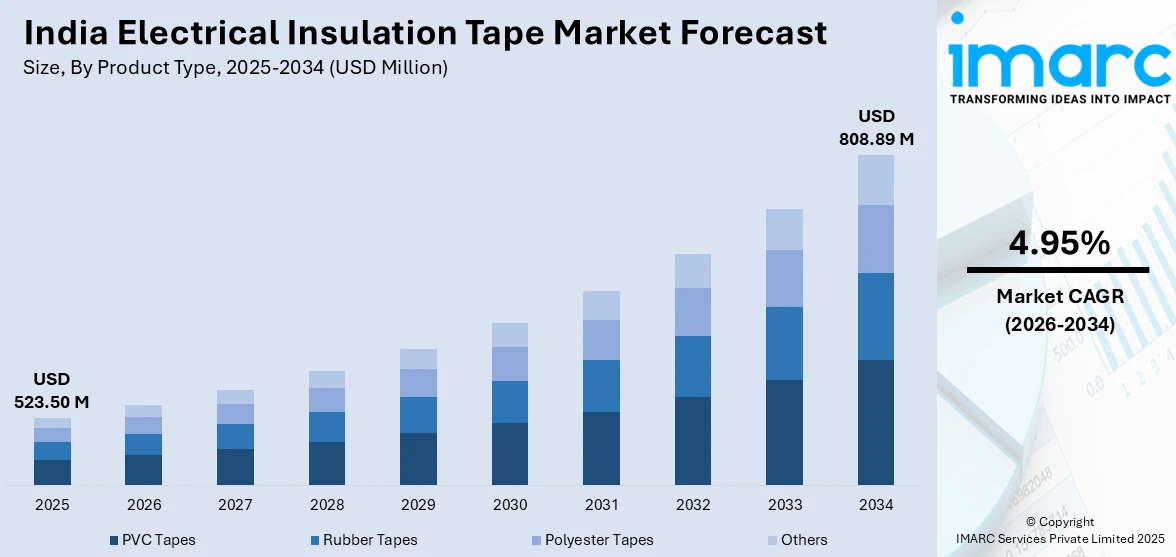
The India electrical insulation tape market size was valued at USD 523.50 Million in 2025 and is projected to reach USD 808.89 Million by 2034, growing at a compound annual growth rate of 4.95% from 2026-2034.
The India electrical insulation tape market is advancing rapidly as the nation accelerates power grid modernization, expands renewable energy infrastructure, and strengthens domestic electronics manufacturing through production-linked incentive schemes. Rising electric vehicle adoption, growing construction activity under national development programs, and increasing investments in telecommunications are collectively enhancing demand for insulation solutions across industrial and commercial applications, driving the India electrical insulation tape market share.
Key Takeaways and Insights:
- By Product Type: PVC tapes dominated the market with a revenue share of 61.3% in 2025, driven by superior dielectric strength, moisture resistance, flame retardant characteristics, and cost-effectiveness that make them the preferred choice across general electrical wiring and cable bundling applications.
- By End Use: Electrical and electronics accounts for the largest segment in the market with a share of 47.8% in 2025, fueled by India's six-fold growth in electronics production and expanding domestic manufacturing ecosystem supported by government incentive programs.
- By Region: West India leads the market with 35.9% revenue share in 2025, anchored by Maharashtra and Gujarat's robust industrial clusters, world-class port infrastructure, and favorable policy frameworks that concentrate manufacturing activity.
- Key Players: The India electrical insulation tape market is moderately competitive, with established multinational manufacturers and regional producers differentiating through product innovation, thermal performance enhancements, and expanding distribution networks across industrial and retail channels.
To get more information on this market Request Sample
The India electrical insulation tape market is positioned for sustained expansion as the country's infrastructure modernization programs. In line with this, electronics manufacturing growth, and energy transition initiatives converge are driving market demand across diverse industrial applications. India's total installed power generation capacity reached 475.2 GW as of March 2025, with renewables accounting for 78.9% of new capacity additions in Q1 2025, creating substantial demand for insulation materials in transmission and distribution networks. The convergence of government-led infrastructure investments, production-linked incentive schemes in realized investments across manufacturing sectors, and rapid urbanization are strengthening the consumption base for electrical insulation tapes across product categories, end-use industries, and regional markets. Moreover, rising investments in smart grids, EV charging networks, and renewable integration are further accelerating insulation tape demand across high-growth segments.
India Electrical Insulation Tape Market Trends:
Accelerating Power Grid Modernization and Transmission Expansion
India’s power infrastructure is expanding rapidly to support the national target of 500 GW renewable energy capacity by 2030. Major investments in transmission and distribution upgrades are increasing the need for reliable insulation materials in high-voltage applications. Accordingly, the Central Electricity Authority’s Transmission Master Plan requires around USD 30 Billion in investment to strengthen intra-state transmission networks, driving sustained demand for electrical insulation tapes in grid expansion, renewable integration, and improved power reliability across industrial and utility projects nationwide.
Rapid Electronics Manufacturing Growth Under PLI Schemes
India’s electronics manufacturing sector is witnessing strong growth, positioning it as a key contributor to industrial development and exports. Similarly, rising domestic production of components and devices is increasing the requirement for insulation tapes in printed circuit boards, wiring, and assembly processes. As such, the Electronics Component Manufacturing Scheme notified in April 2025, with an INR 22,919 Crore outlay, is expected to accelerate investments, strengthening demand across consumer electronics, telecom equipment, and industrial electronics manufacturing.
Electric Vehicle Production Surge Driving Automotive Wiring Demand
India’s electric vehicle market is expanding quickly, creating significant opportunities for insulation tape consumption in automotive electrical systems. Likewise, growing EV adoption is increasing demand for high-performance insulation in wiring harnesses, battery packs, and power electronics. As per an industry report, electric vehicle sales grew 16.9% in FY25 to 1.97 million units, highlighting strong momentum in the sector. This surge is driving higher insulation requirements across passenger vehicles, two-wheelers, and commercial EV segments.

Market Outlook 2026-2034:
The India electrical insulation tape market demonstrates strong revenue growth potential throughout the forecast period, highlighted by irreversible infrastructure modernization trends and expanding manufacturing capabilities. Growth will also be driven by continued government capital expenditure in power transmission infrastructure, accelerating electronics production under PLI schemes, rising electric vehicle manufacturing volumes, and expanding construction activity under national development programs. Automotive Manufacturing Solutions (AMS) reports that by the end of 2024, nearly USD 40 Billion in investments had been announced for EV manufacturing in India through 2030. Furthermore, the convergence of India's energy transition goals, digital infrastructure build-out, and Make in India manufacturing initiatives will sustain robust demand for insulation tapes across product categories and end-use industries throughout the forecast horizon. The market generated a revenue of USD 523.50 Million in 2025 and is projected to reach a revenue of USD 808.89 Million by 2034, growing at a compound annual growth rate of 4.95% from 2026-2034.
India Electrical Insulation Tape Market Report Segmentation:
|
Segment Category |
Leading Segment |
Market Share |
|
Product Type |
PVC Tapes |
61.3% |
|
End Use |
Electrical and Electronics |
47.8% |
|
Region |
West India |
35.9% |
Product Type Insights:
- PVC Tapes
- Rubber Tapes
- Polyester Tapes
- Others
The PVC tapes segment accounts for the largest portion, representing 61.3% of the total India electrical insulation tape market in 2025.
PVC-based insulation tapes are the most widely utilized electrical insulation product in India, offering an optimal combination of dielectric strength, moisture resistance, and flame-retardant properties that meet the requirements of residential, commercial, and industrial electrical installations. These tapes provide excellent conformability around irregular shapes and cable bundles, enabling efficient installation in diverse wiring configurations. Their adhesive properties ensure reliable long-term adhesion under varying temperature and humidity conditions encountered across India's climatic zones.
The segment's market leadership reflects strong alignment with India's economic realities and infrastructure priorities. PVC tapes offer the most cost-effective insulation solution, with per-unit costs significantly lower than specialty rubber or polyester alternatives, making them accessible across price-sensitive segments. India's construction market reached INR 22.77 Trillion in 2024 and is expected to grow 11.2% to reach INR 25.31 trillion in 2025, generating substantial demand for PVC insulation tapes in electrical wiring installations across residential, commercial, and industrial building projects.
End Use Insights:
Access the comprehensive market breakdown Request Sample
- Electrical and Electronics
- Automotive
- Aerospace
- Construction
- Telecommunication
- Others
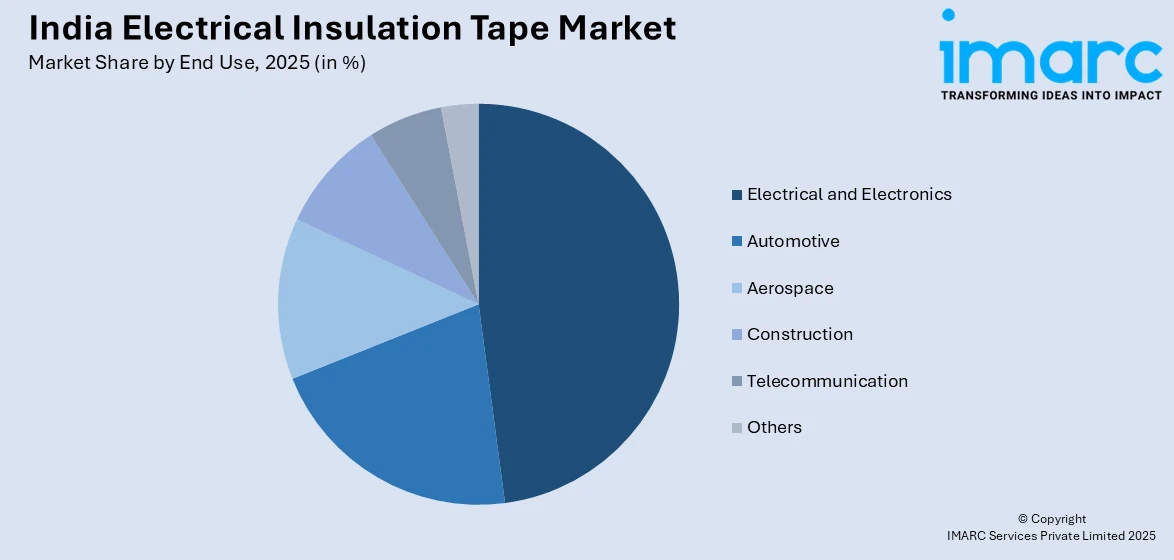
The electrical and electronics leads the market, capturing 47.8% of the total India electrical insulation tape market in 2025.
The electrical and electronics sector represents the primary consumption base for insulation tapes in India, driven by rapid advancements in technology and the increasing complexity of electrical systems across power generation, transmission, distribution, and consumer electronics applications. India's electronics production grew from INR 1.9 Lakh Crore in FY 2014-15 to INR 11.3 Lakh Crore in FY 2024-25, marking a six-fold increase that has expanded the domestic manufacturing ecosystem and intensified demand for insulation materials.
The sector's dominance is reinforced by government incentive frameworks that are catalyzing manufacturing expansion. As such, the Electronics Component Manufacturing Scheme notified in April 2025 attracted 249 applications representing INR 1.15 Lakh Crore in investment commitments by October 2025, with the first batch of seven component-manufacturing projects worth over INR 5,532 Crore approved for multi-layer PCB and camera-module plants. This manufacturing surge directly translates to increased insulation tape consumption in assembly processes and quality assurance applications.
Regional Insights:
- North India
- South India
- East India
- West India
West India emerges as the top regional contributor, holding 35.9% of the total India electrical insulation tape market in 2025.
West India's market leadership is anchored by Maharashtra and Gujarat, which together form the nation's most concentrated industrial manufacturing corridor. Industry reports state that, Gujarat accounted for 30.7% of all Indian exports in FY 2024-25, the highest among all states. Likewise, the region's installed power generation capacity reached 57,886.85 MW as of February 2025, generating sustained demand for insulation tapes across power infrastructure maintenance, industrial manufacturing, and construction applications.
Additionally, West India benefits from strong growth in automotive, petrochemical, and electronics clusters, supported by large-scale industrial parks and port-led logistics advantages. Expanding urban infrastructure projects, renewable energy installations, and rising investments in smart manufacturing are further strengthening the consumption base for electrical insulation tapes. With its combination of export-driven industries, robust power networks, and ongoing industrial expansion, the region is expected to remain a key demand hub for insulation materials.
Market Dynamics:
Growth Drivers:
Why is the India Electrical Insulation Tape Market Growing?
Government Infrastructure Investment and National Development Programs
India’s rising public infrastructure spending is creating strong long-term demand for electrical insulation tapes across construction, utilities, and industrial installations. Capital expenditure for FY 2024–25 increased to INR 11.11 Lakh Crore, reflecting the government’s continued focus on expanding power distribution, urban infrastructure, and transportation networks. Alongside this, the National Infrastructure Pipeline earmarked INR 111 Lakh Crore through 2025 for investments in energy, roads, railways, and urban services. These large-scale programs are accelerating grid upgrades, building electrification, and industrial connectivity projects, all of which require reliable insulation materials for wiring safety, equipment protection, and network maintenance across India.
Renewable Energy Integration and Smart Grid Development
India’s renewable energy push is strengthening demand for insulation tapes across transmission, distribution, and grid modernization projects. Industry research found that, renewables accounted for 78.9% of new capacity additions in Q1 2025, highlighting the rapid pace of clean energy deployment. Supporting this transition, the Ministry of Power India’s Revamped Distribution Sector Scheme released around INR 37,000 Crore (38% of sanctioned support) to modernize power distribution. Moreover, expanding renewable integration, smart substations, and advanced distribution networks require durable insulation materials, driving sustained consumption of electrical insulation tapes in high-voltage and outdoor applications.
Rising Construction and Urban Housing Electrification Demand
India’s rapid urban expansion is increasing the need for safe and efficient electrical wiring solutions, supporting higher consumption of insulation tapes in residential and commercial construction. As such, the Smart Cities Mission allocated INR 2.05 Lakh Crore across 5,151 projects, driving widespread development of modern housing, public utilities, and transport infrastructure. Additionally, 94% of 8,067 Smart Cities projects were completed by June 2025, accelerating electrification requirements in new buildings and upgraded urban services. This growth in construction activity is boosting demand for insulation tapes used in internal wiring, cable bundling, and electrical safety applications across cities.
Market Restraints:
What Challenges the India Electrical Insulation Tape Market is Facing?
Raw Material Cost Volatility and Supply Chain Dependencies
Fluctuations in petroleum-derived raw materials, including PVC resins and plasticizers, create pricing instability that challenges manufacturers' ability to maintain competitive margins. Copper price volatility further impacts wire harness and electrical component producers who are major insulation tape consumers. Import dependencies on specialty adhesive compounds and polymer additives expose the supply chain to global commodity swings and geopolitical disruptions, complicating long-term procurement planning and inventory management.
Stringent Regulatory Compliance and Environmental Standards
Evolving environmental regulations, including formaldehyde content restrictions under REACH Annex XVII effective 2026 and low-VOC mandates for industrial applications, require manufacturers to reformulate adhesive systems from solvent-based to water-based or hot-melt chemistries. Converting production processes necessitates capital investment in new ovens, chillers, and coating equipment, while increasing production downtime and compliance testing costs that disproportionately burden smaller manufacturers.
Infrastructure Execution Gaps and Logistics Challenges
Despite ambitious government infrastructure plans, execution lags in the National Infrastructure Pipeline constrain near-term market growth potential until bandwidth, rail sidings, and last-mile road linkages are fully operational. Cross-border e-way bill requirements and state-level labor rule heterogeneity add compliance overhead for multi-state supply chains. Escalating land and logistics costs in primary industrial hubs, combined with slow on-ground project execution timelines, create near-term headwinds for insulation tape demand realization.
Competitive Landscape:
The India electrical insulation tape market is moderately competitive, characterized by the presence of established multinational corporations alongside regional and domestic manufacturers competing across product quality, pricing, and distribution reach. Market participants are investing in advanced adhesive technologies, high-temperature performance enhancements, and flame-retardant formulations to differentiate their offerings. Distribution strategies spanning industrial distributors, electrical wholesale channels, and emerging e-commerce platforms are reshaping competitive positioning. Strategic partnerships with OEM manufacturers and participation in government infrastructure procurement programs are becoming critical competitive advantages as the market continues expanding.
Recent Developments:
- In May 2025, YC Group announced that its subsidiary Achem Technology’s Yangmei Plant has obtained BIS certification for PVC insulation tape, confirming compliance with India’s strict quality and safety standards. The achievement of this milestone allows for legal product distribution in India while it enhances consumer trust and boosts international supply chain efficiency and enables faster market entry into South Asia's adhesive tape sector.
- In September 2024, Silver Shine Adhesive launched a premium PVC insulation tape line, designed for durable electrical wire insulation and protection against moisture, heat, and wear. Suitable for low- and high-voltage use, the tapes are available in bulk rolls, multiple sizes, and colors, supporting electricians and contractors nationwide.
India Electrical Insulation Tape Market Report Coverage:
|
Report Features |
Details |
|
Base Year of the Analysis |
2025 |
|
Historical Period |
2020-2025 |
|
Forecast Period |
2026-2034 |
|
Units |
USD Million |
|
Scope of the Report |
Exploration of Historical Trends and Market Outlook, Industry Catalysts and Challenges, Segment-Wise Historical and Future Market Assessment:
|
|
Product Types Covered |
PVC Tapes, Rubber Tapes, Polyester Tapes, Others |
|
End Uses Covered |
Electrical and Electronics, Automotive, Aerospace, Construction, Telecommunication, Others |
|
Regions Covered |
North India, South India, East India, West India |
|
Customization Scope |
10% Free Customization |
|
Post-Sale Analyst Support |
10-12 Weeks |
|
Delivery Format |
PDF and Excel through Email (We can also provide the editable version of the report in PPT/Word format on special request) |
Frequently Asked Questions About the India Electrical Insulation Tape Market Report
The India electrical insulation tape market size was valued at USD 523.50 Million in 2025.
The market is expected to grow at a compound annual growth rate of 4.95% from 2026-2034 to reach USD 808.89 Million by 2034.
PVC tapes, holding the largest revenue share of 61.3%, dominate the India electrical insulation tape market due to their superior dielectric strength, cost-effectiveness, flame retardant properties, and widespread applicability across residential, commercial, and industrial electrical installations.
Key factors driving the India electrical insulation tape market include government infrastructure investments, expanding electronics manufacturing under PLI schemes, rising electric vehicle production, power grid modernization initiatives, and growing construction activity under national development programs.
Major challenges include raw material cost volatility affecting PVC resin and plasticizer pricing, stringent environmental compliance requirements necessitating adhesive reformulation, infrastructure execution gaps delaying project completions, and logistics challenges across multi-state supply chains.
Need more help?
- Speak to our experienced analysts for insights on the current market scenarios.
- Include additional segments and countries to customize the report as per your requirement.
- Gain an unparalleled competitive advantage in your domain by understanding how to utilize the report and positively impacting your operations and revenue.
- For further assistance, please connect with our analysts.
 Request Customization
 Speak to an Analyst
 Request Brochure
 Inquire Before Buying
Benefits of Customization
- Personalize this research
- Triangulate with your data
- Get data as per your format and definition
- Gain a deeper dive into a specific application, geography, customer, or competitor
- Any level of personalization
Get in Touch With Us
UNITED STATES
Phone: +1-201-971-6302
INDIA
Phone: +91-120-433-0800
UNITED KINGDOM
Phone: +44-753-714-6104
Email: [email protected]
Client Testimonials




.webp)




.webp)













Related Reports

Choose your plan
*Please note that the prices mentioned below are starting prices for each bundle type. Kindly contact our team for further details.*
Single User License
- 1 User License, Access on 2 Devices
- PDF Report + Excel Dataset (Password Protected)
- Lifetime Access
- No Printing Rights
- 10% Free Report Customization
- 10–12 Weeks of Analyst Support
Five User License
- Access for 5 Users, 2 Devices per User
- PDF Report + Excel Dataset (Password Protected)
- Lifetime Access
- Dedicated Account Manager
- 12–14 Weeks of Analyst Support
- No Printing Rights
- 15% Free Report Customization
- 25% Discount on Your Next Purchase
Corporate User License
- Unlimited User Access (Within Your Organization)
- PDF Report + Excel Dataset
- Lifetime Access
- Dedicated Account Manager
- 14–20 Weeks of Analyst Support
- No Printing Rights
- 20% Free Report Customization
- 30% Discount on Your Next Purchase
Essential Insights
What's included:
3 reports
- Lifetime Access
- PDF Reports
- Excel Datasets
- 2 Weeks of Free Analyst Support
- 2 User Licenses
- Access on 2 Devices
- Printing Rights
- Complimentary PowerPoint (PPT) Version
- Complimentary License Upgrade
Professional Access
What's included:
5 reports
- Lifetime Access
- PDF Reports
- Excel Datasets
- 8 Weeks of Free Analyst Support
- 2 User Licenses
- Access on 2 Devices
- Printing Rights
- Complimentary PowerPoint (PPT) Version
- Complimentary License Upgrade
Business Advantage
What's included:
8 reports
- Lifetime Access
- PDF Reports
- Excel Datasets
- 14 Weeks of Free Analyst Support
- 2 User Licenses
- Access on 2 Devices
- Printing Rights
- Complimentary PowerPoint (PPT) Version
- Complimentary License Upgrade
Enterprise Intelligence
What's included:
10 reports
- Lifetime Access
- PDF Reports
- Excel Datasets
- 20 Weeks of Free Analyst Support
- 2 User Licenses
- Access on 2 Devices
- Printing Rights
- Complimentary PowerPoint (PPT) Version
- Complimentary License Upgrade