
India Electrolyzer Market Size, Share, Trends and Forecast by Product, Capacity, Application, and Region, 2026-2034
India Electrolyzer Market Size, Share, Trends & Forecast (2026-2034)
The India electrolyzer market grew from USD 52.28 Million in 2025 to USD 56.72 Million in 2026 and is projected to reach USD 94.79 Million by 2034, growing at a CAGR of 6.63% during 2026-2034. The Strategic Interventions for Green Hydrogen Transition (SIGHT) Scheme, with a financial outlay of INR 17,490 Crore through 2029–30, provides incentives for domestic electrolyzer manufacturing and green hydrogen production. The scheme is driving the market by reducing manufacturing costs, encouraging capacity expansion, and attracting investments in domestic production facilities. Alkaline electrolyzers lead product share at 55.5%, above 2 MW systems dominate capacity at 45.5%, and West India commands the highest regional share at 31.5%.
Market Snapshot
|
Metric |
Value |
|
Base Year Market Size (2025) |
USD 52.28 Million |
|
Market Size (2026) |
USD 56.72 Million |
|
Forecast Market Size (2034) |
USD 94.79 Million |
|
CAGR (2026-2034) |
6.63% |
|
Base Year |
2025 |
|
Historical Period |
2020-2025 |
|
Forecast Period |
2026-2034 |
|
Dominant Product |
Alkaline Electrolyzer (55.5%, 2025) |
|
Dominant Capacity |
Above 2 MW (45.5%, 2025) |
|
Leading Region |
West India (31.5%, 2025) |
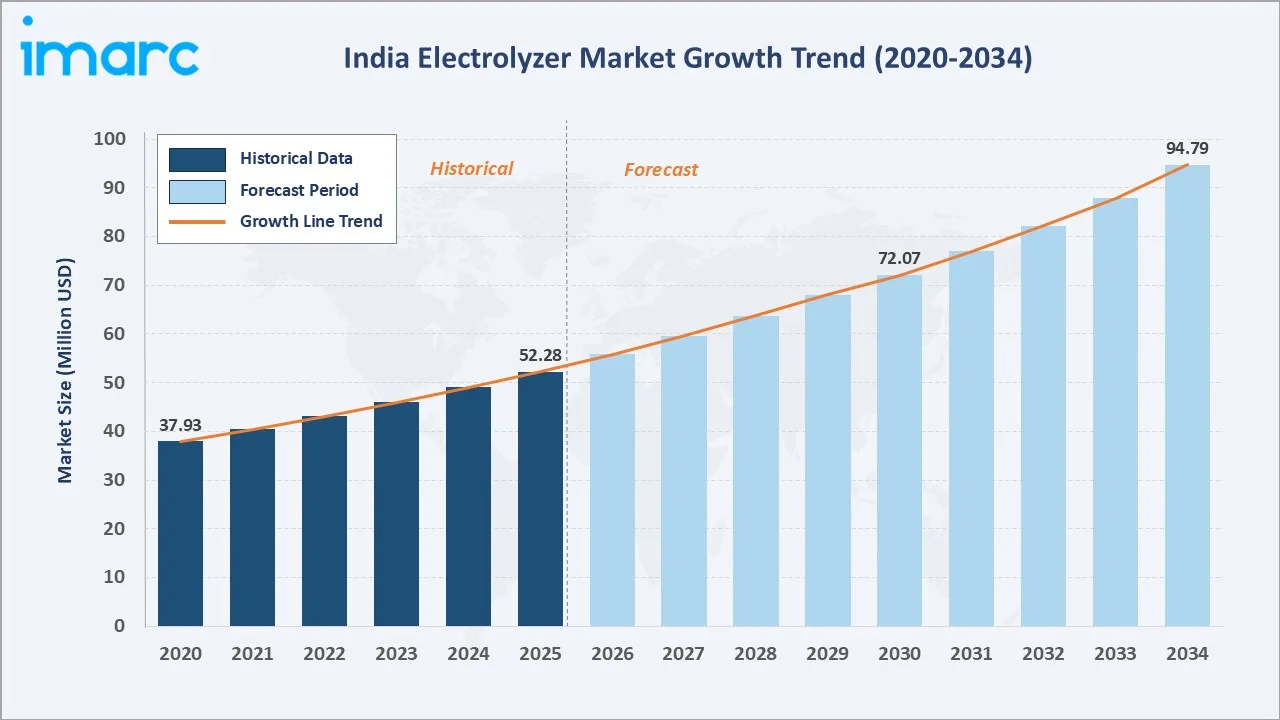
The India electrolyzer market size grew from USD 37.93 Million in 2020 to USD 52.28 Million by 2025 and is estimated to reach USD 56.72 Million in 2026. The market is projected to reach USD 72.07 Million by 2030 and USD 94.79 Million by 2034.
To get more information on this market, Request Sample
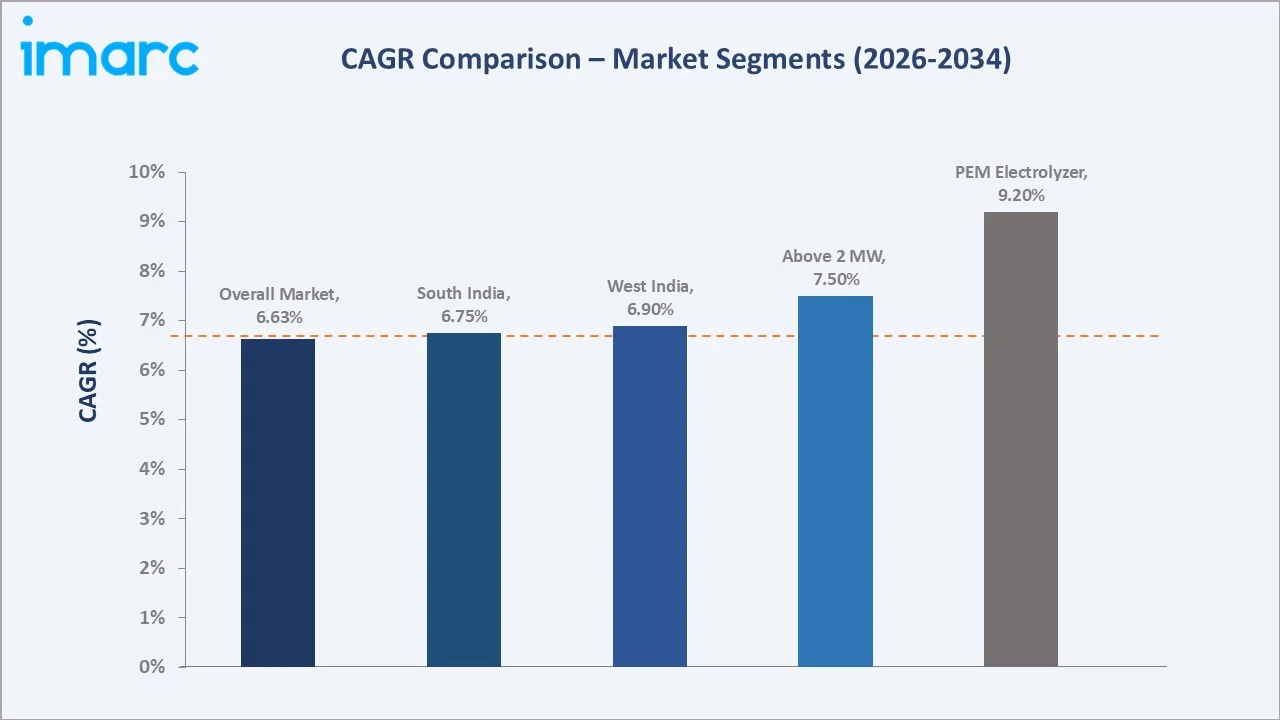
PEM electrolyzers are the fastest-growing product segment at ~9.2% CAGR through rapidly declining PEM stack costs and their superior dynamic response characteristics for variable renewable power inputs. Above 2 MW capacity systems grow at ~7.5% CAGR through large industrial and utility-scale green hydrogen project deployment. West India leads regional growth at ~6.9% CAGR through Reliance's Jamnagar mega-project and Gujarat's solar-powered electrolyzer pipeline.
Executive Summary
The India electrolyzer market share is at the early-growth inflection point of its development trajectory, transitioning from pilot-scale and demonstration projects toward the first wave of commercially funded utility-scale green hydrogen plants that will establish the reference LCOH (Levelized Cost of Hydrogen) and technology reliability benchmarks driving subsequent market acceleration.
Alkaline electrolyzers command 55.5% product share through their proven technology maturity, lower capital costs, and suitability for the steady-state industrial green hydrogen applications dominating India's near-term pipeline. Above 2 MW systems lead capacity at 45.5% through the project economics advantages of large-scale centralized electrolysis. West India leads at 31.5%, anchored by a renewable-powered green hydrogen export pipeline.
Key Market Insights
|
Insight |
Data |
|
Dominant Product |
Alkaline Electrolyzer - 55.5% share (2025) |
|
Dominant Capacity |
Above 2 MW - 45.5% share (2025) |
|
Leading Region |
West India - 31.5% (2025) |
|
Key Market Opportunity |
Expansion of domestic electrolyzer manufacturing, declining renewable energy costs, development of green hydrogen hubs, rising industrial decarbonization demand, export potential, technology localization, and integration with renewable energy projects. |
Key Analytical Observations Supporting the Above Data:
- Alkaline Electrolyzer at 55.5%: Alkaline electrolyzers dominate through a combination of technology maturity advantages, the lowest capital cost of any electrolyzer technology, and their proven reliability for the continuous, steady-state operation profile favored by India's large industrial green hydrogen applications in refineries, fertilizer plants, and ammonia synthesis.
- Above 2 MW Capacity at 45.5%: Above 2 MW electrolyzer system deployments dominate the India market through the structural emphasis on large-scale centralized green hydrogen production for industrial feedstock supply and export. Large capacity systems benefit from significant economies of scale in civil works, balance-of-plant systems, renewable power connectivity, and hydrogen compression and storage infrastructure, making per-kg hydrogen production economics materially superior at scale.
- West India at 31.5%: Gujarat's renewable energy infrastructure, port connectivity for green ammonia export, green finance ecosystem for project financing, and state government green hydrogen policy support collectively create the most developed enabling environment for large electrolyzer project deployment of any Indian state.
India Electrolyzer Market Overview
The India electrolyzer market encompasses water electrolysis systems that use electrical energy, preferably from renewable sources, to split water molecules into hydrogen (H2) and oxygen (O2) through electrochemical reactions. The market covers three primary electrolyzer technology types: alkaline electrolyzers (using a liquid alkaline electrolyte, typically 25-30% KOH solution, with nickel-based electrodes and polysulfone diaphragm separators), proton exchange membrane (PEM) electrolyzers (using a solid polymer Nafion membrane as both electrolyte and separator with iridium oxide anode and platinum cathode catalysts), and solid oxide electrolyzers.
Market Dynamics
To evaluate market opportunities, Request Sample
Market Drivers
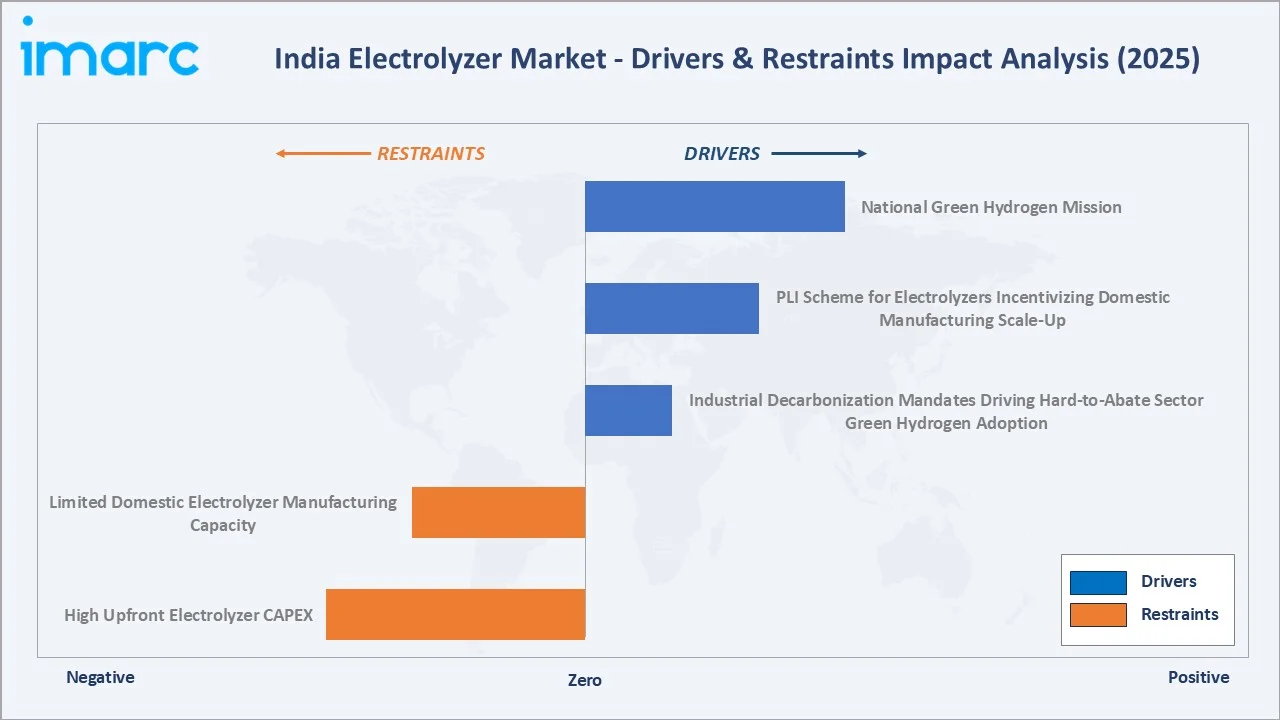
- National Green Hydrogen Mission: India’s target of developing green hydrogen production capacity of 5 Million Metric Tons (MMT) per annum by 2030 is driving substantial demand for electrolyzers, a core technology for producing green hydrogen using renewable electricity. The target is encouraging large-scale project development, domestic manufacturing capacity expansion, and investments in advanced electrolyzer technologies. Growing deployment across refining, fertilizers, steel, and other industrial applications is further supporting market expansion.
- PLI Scheme for Electrolyzers Incentivizing Domestic Manufacturing Scale-Up: The Ministry of Heavy Industries is implementing the National Programme on Advanced Chemistry Cell (ACC) Battery Storage, with an outlay of INR 18,100 Crore to develop 50 GWh of domestic ACC manufacturing capacity. The initiative supports the market by strengthening energy-storage infrastructure required to manage intermittent renewable power. Improved storage availability can enable more stable renewable electricity supply for electrolyzers, supporting reliable and scalable green hydrogen production.
- Industrial Decarbonization Mandates Driving Hard-to-Abate Sector Green Hydrogen Adoption: India's largest industrial green hydrogen end-users, petroleum refineries, fertilizer plants, and the nascent green steel sector, are facing increasing pressure from export market carbon border adjustment mechanisms, emission reduction commitments to international investors and lenders, and green hydrogen purchase obligations mandating a specific percentage of green hydrogen procurement from eligible industrial consumers.
Market Restraints
- High Upfront Electrolyzer CAPEX: High initial capital requirements for electrolyzer systems are hampering the growth of the market, particularly for large-scale green hydrogen projects. Significant expenditure on electrolyzer stacks, balance-of-plant equipment, renewable power integration, and supporting infrastructure increases overall project costs. This can extend project payback periods and discourage adoption among cost-sensitive industrial users.
- Limited Domestic Electrolyzer Manufacturing Capacity: Insufficient domestic electrolyzer production capacity increases dependence on imported technologies, components, and critical materials. Import reliance can raise equipment costs, expose projects to supply chain disruptions, and extend procurement timelines. Moreover, limited local manufacturing capabilities can constrain rapid deployment as green hydrogen projects scale across the country.
Market Opportunities
- Green Hydrogen for Refinery Feedstock Replacement at Indian Public Sector Refineries: Refineries require substantial hydrogen volumes for processes such as hydrotreating and desulfurization, creating potential for large-scale electrolyzer installations. Increasing decarbonization efforts and green hydrogen procurement initiatives can further accelerate electrolyzer deployment across refinery operations.
- Hydrogen Mobility and Distributed Electrolysis Applications: India's emerging hydrogen fuel cell vehicle ecosystem creates a distributed electrolysis demand for on-site electrolyzer installations at fueling stations and bus depots. While small relative to utility-scale projects, hydrogen mobility electrolyzer applications provide higher margin opportunities for electrolyzer manufacturers and create reference installations for technology demonstrations in new application segments.
Market Challenges
- Hydrogen Safety Regulatory Framework Development Lagging Project Requirements: India's hydrogen safety regulatory framework, covering hydrogen production plant licensing, hydrogen pipeline transportation standards, storage safety standards, and end-use safety codes, is still under development, creating regulatory uncertainty that delays project commissioning approvals and complicates insurance underwriting for greenfield green hydrogen plants.
- Green Hydrogen Off-Take Price Negotiation Complexity in Industrial Sector: Structuring bankable long-term green hydrogen supply agreements between electrolyzer project developers and industrial off-takers (refineries, fertilizer plants) requires resolution of complex commercial terms including hydrogen quality specifications, supply reliability obligations, force majeure provisions for renewable power intermittency, and price indexation mechanisms that protect both buyer and seller.
Emerging Market Trends
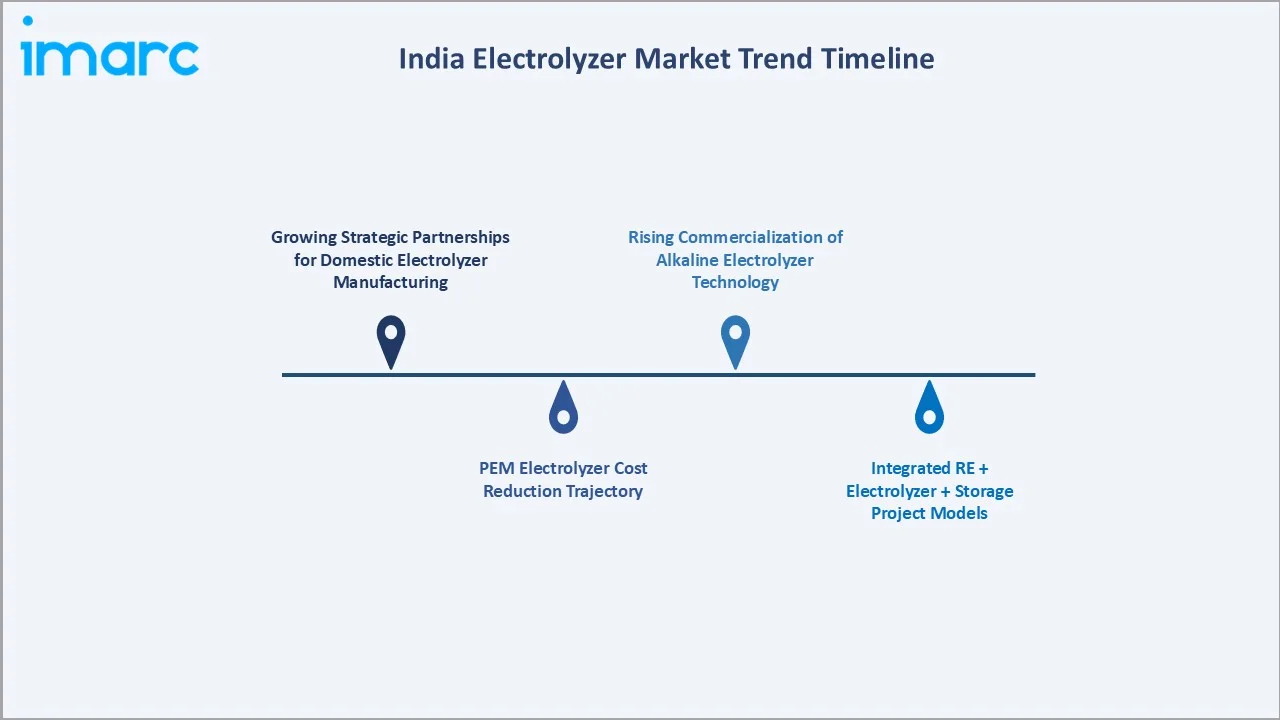
1. Growing Strategic Partnerships for Domestic Electrolyzer Manufacturing
In July 2026, thyssenkrupp nucera and Bharat Heavy Electricals Limited (BHEL) entered into a Strategic Collaboration Agreement to support alkaline water electrolyzer manufacturing for green hydrogen projects in India. The partnership aims to strengthen domestic electrolyzer production capabilities while expanding thyssenkrupp nucera’s presence in India’s growing green hydrogen market. Such partnerships are facilitating technology transfer, strengthening domestic manufacturing capabilities, and reducing reliance on imported systems. This trend is expected to support large-scale green hydrogen projects and strengthen India’s electrolyzer supply chain.
2. PEM Electrolyzer Cost Reduction Trajectory
PEM electrolyzer technology is undergoing the most rapid cost reduction of any electrolyzer type, driven by global capacity scale-up at gigawatt-scale manufacturing facilities. PEM stack costs are projected to decline, driven by iridium catalyst loading reduction, membrane cost reduction through Nafion alternative development, and automated stack assembly scale. This PEM cost trajectory, combined with PEM's superior dynamic response for variable solar and wind power inputs, is projected to drive PEM's India market share, with PEM becoming the preferred technology for variable renewable-powered electrolyzer applications.
3. Rising Commercialization of Alkaline Electrolyzer Technology
In March 2026, Advait Greenergy, a subsidiary of Advait Energy Transitions Ltd., commissioned a 30 MW alkaline electrolyzer assembly facility in Gujarat, strengthening domestic green hydrogen equipment manufacturing in India. The facility establishes local assembly capabilities for electrolyzer systems intended for large-scale green hydrogen production, supporting the expansion of India’s domestic electrolyzer supply chain. The establishment of a dedicated alkaline electrolyzer assembly facility indicates the increasing commercial adoption of alkaline technology for green hydrogen production in India. Its suitability for large-scale hydrogen projects is encouraging manufacturers to build specialized assembly and production capabilities.
4. Integrated RE + Electrolyzer + Storage Project Models
India's green hydrogen project developers are increasingly structuring projects as integrated renewable energy plus electrolyzer plus hydrogen storage plus off-take platforms, rather than procuring electrolyzer systems as standalone equipment, creating a project-driven procurement model where electrolyzer selection is embedded in holistic project optimization. This integrated project model shifts electrolyzer procurement toward turnkey project delivery contracts where alkaline and PEM technology selection, multi-vendor qualification, and performance guarantees are managed within an EPC framework rather than as direct buyer-manufacturer equipment procurement.
Industry Value Chain Analysis
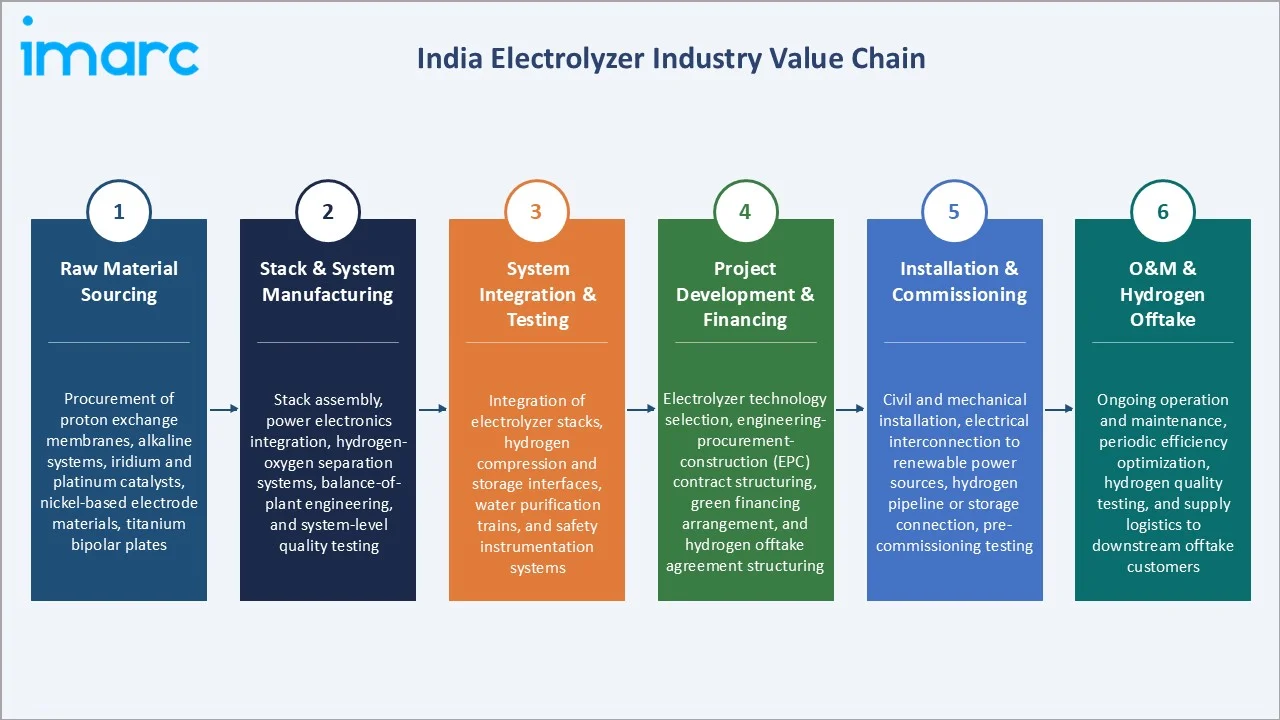
The India electrolyzer market value chain spans six distinct stages from raw material and component sourcing through operational hydrogen offtake, with each stage representing critical technology and commercial competencies that determine project economics.
|
Stage |
Description |
|
Raw Material Sourcing |
Procurement of proton exchange membranes, alkaline systems, iridium and platinum catalysts, nickel-based electrode materials, titanium bipolar plates. |
|
Stack & System Manufacturing |
Stack assembly, power electronics integration, hydrogen-oxygen separation systems, balance-of-plant engineering, and system-level quality testing. |
|
System Integration & Testing |
Integration of electrolyzer stacks, hydrogen compression and storage interfaces, water purification trains, and safety instrumentation systems. |
|
Project Development & Financing |
Electrolyzer technology selection, engineering-procurement-construction (EPC) contract structuring, green financing arrangement, and hydrogen offtake agreement structuring. |
|
Installation & Commissioning |
Civil and mechanical installation, electrical interconnection to renewable power sources, hydrogen pipeline or storage connection, pre-commissioning testing. |
|
O&M & Hydrogen Offtake |
Ongoing operation and maintenance, periodic efficiency optimization, hydrogen quality testing, and supply logistics to downstream offtake customers. |
The project development and financing stage represents the most critical bottleneck in India's electrolyzer value chain, where the combination of long-duration renewable power purchase agreement negotiation, green hydrogen offtake agreement structuring with industrial buyers, green project financing from development finance institutions, and incentive disbursement claim processes creates project development timelines before electrolyzer procurement commences.
Technology Landscape in the India Electrolyzer Industry
Alkaline Electrolyzer Technology Evolution
Alkaline electrolyzer technology is undergoing significant performance improvements that are narrowing the efficiency gap with PEM while maintaining alkaline's capital cost advantage. Advanced alkaline electrolyzer designs achieve high system efficiencies versus older designs' range, driven by cell gap reduction, advanced nickel-iron and nickel-cobalt electrode coatings, and optimized electrolyte circulation designs. Pressurized alkaline electrolyzers are gaining preference in Indian refinery and industrial applications where medium-pressure hydrogen delivery reduces balance-of-plant CAPEX.
PEM Electrolyzer Technology and Cost Reduction
PEM electrolyzer technology improvements relevant to India's market focus on three parallel development tracks. First, iridium catalyst loading reduction is advancing through IrO2 nanoparticle engineering and alternative iridium-free catalyst research. Second, Nafion membrane cost reduction through alternate ionomer membrane development. Third, stack pressure increases eliminate external compression stages and improve PEM total system economics for compressed hydrogen delivery applications.
Solid Oxide Electrolyzer Development and Future Potential
Solid oxide electrolyzers (SOEC), operating at 700-900°C with electrical efficiencies of 80-90% (LHV) through exploitation of high-temperature waste heat, represent the highest-efficiency electrolyzer technology but face significant technical barriers to commercial deployment scale. SOEC's brittle ceramic cell materials limit stack lifetime versus alkaline, and thermal cycling from load variations causes accelerated degradation. India's SOEC opportunity is most relevant for co-electrolysis applications, high-temperature industrial process integration, and concentrated solar power-paired electrolysis where high-temperature process heat is available.
Market Segmentation Analysis
The report covers the following segments:
|
Segment Category |
Leading Segment |
Market Share |
Year |
|
Product |
Alkaline Electrolyzer |
55.5% |
2025 |
|
Capacity |
Above 2 MW |
45.5% |
2025 |
|
Application |
🔒 |
🔒 |
2025 |
|
Region |
West India |
31.5% |
2025 |

By Product
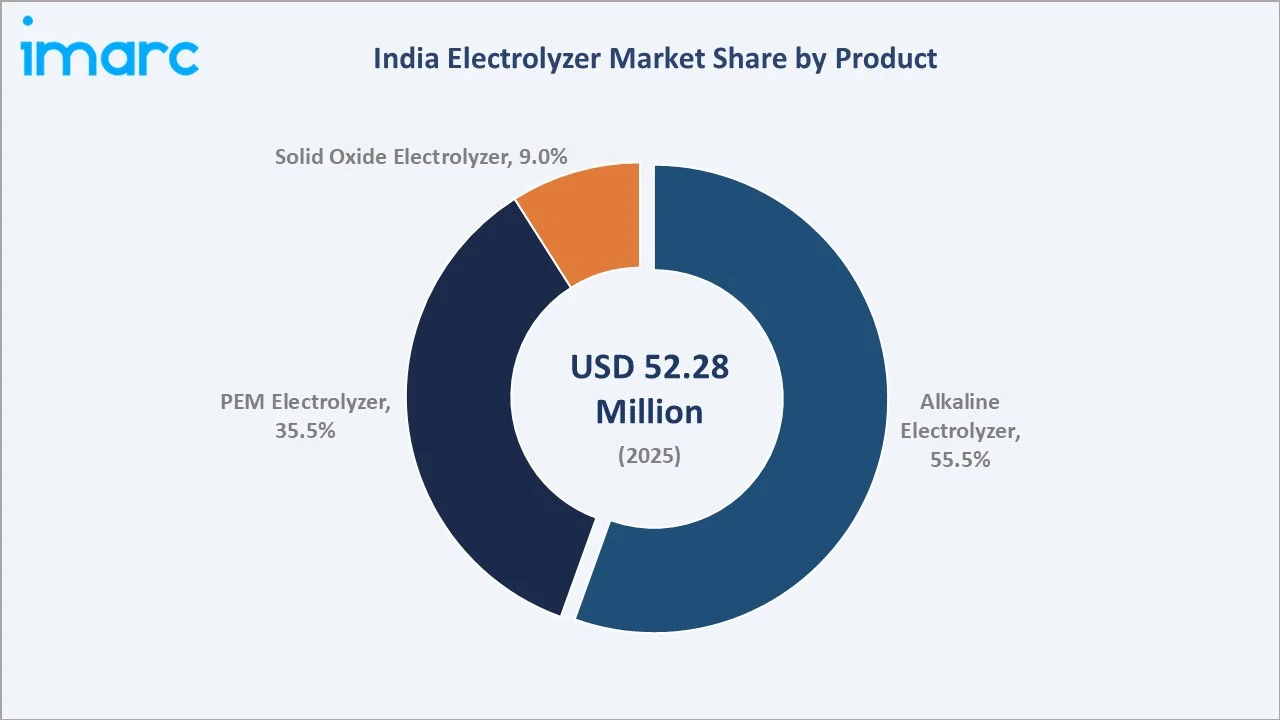
Alkaline electrolyzers command 55.5% in 2025, driven by their established technology track record, lowest capital cost, and suitability for the continuous steady-state industrial green hydrogen applications dominating India's near-term demand pipeline.
To access detailed market analysis, Request Sample
PEM electrolyzers at 35.5% represent the fastest-growing segment (~9.2% CAGR), driven by rapidly declining PEM system costs, PEM's dynamic response advantage for variable solar and wind power inputs, compact footprint advantages for space-constrained project sites, and the establishment of Indian PEM manufacturing facilities creating domestic supply chain development. Solid oxide electrolyzers at 9.0% remain at the early commercial stage, primarily in pilot and demonstration projects.
By Capacity
Above 2 MW electrolyzer systems dominate at 45.5% share, reflecting the project economics advantage of large-scale centralized green hydrogen production for industrial feedstock and export targets.
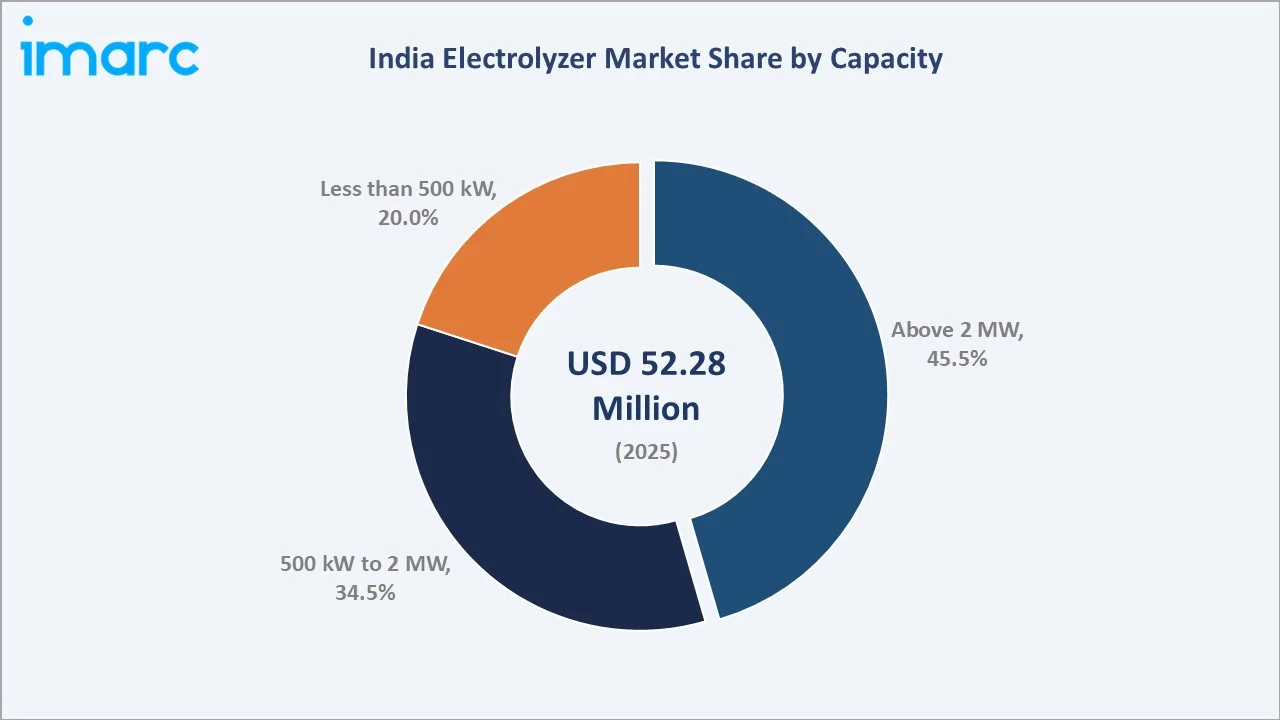
500 kW to 2 MW systems at 34.5% serve mid-scale industrial and commercial applications, including refinery on-site green hydrogen substitution pilots, industrial gas supply for food processing and electronics manufacturing, and hydrogen refueling station on-site production. Less than 500 kW systems at 20.0% serve research institutions, pilot projects, and small-scale distributed hydrogen applications, including mobility fueling prototypes.
Regional Market Insights
|
Region |
Share (2025) |
Key India Electrolyzer Market Drivers & Characteristics |
|
West India |
31.5% |
Leads through the convergence of green hydrogen electrolyzer announcements, outstanding solar and wind renewable power resources complementing electrolyzer operations with low-cost renewable electricity, and India's Western coast as the primary green hydrogen and green ammonia export gateway. |
|
South India |
28.5% |
Reflects the region's exceptional renewable power resource, providing the low-cost renewable electricity that is the primary cost input for competitive green hydrogen production. |
|
North India |
23.5% |
Anchored by a massive solar power resource, which provides the most competitive renewable electricity input cost for green hydrogen production of any Indian region. |
|
East India |
16.5% |
The smallest regional segment represents a growing opportunity driven by the industrial corridor's green hydrogen for steel production potential. |
West India's 31.5% market leadership is structurally underpinned by Reliance Industries' announcement of the most ambitious single-company electrolyzer deployment commitment. South India at 28.5%, through project pipeline concentration, driven by exceptional renewable resource quality and Green Energy's project development mandate, makes it the second largest and most active near-term electrolyzer procurement region.
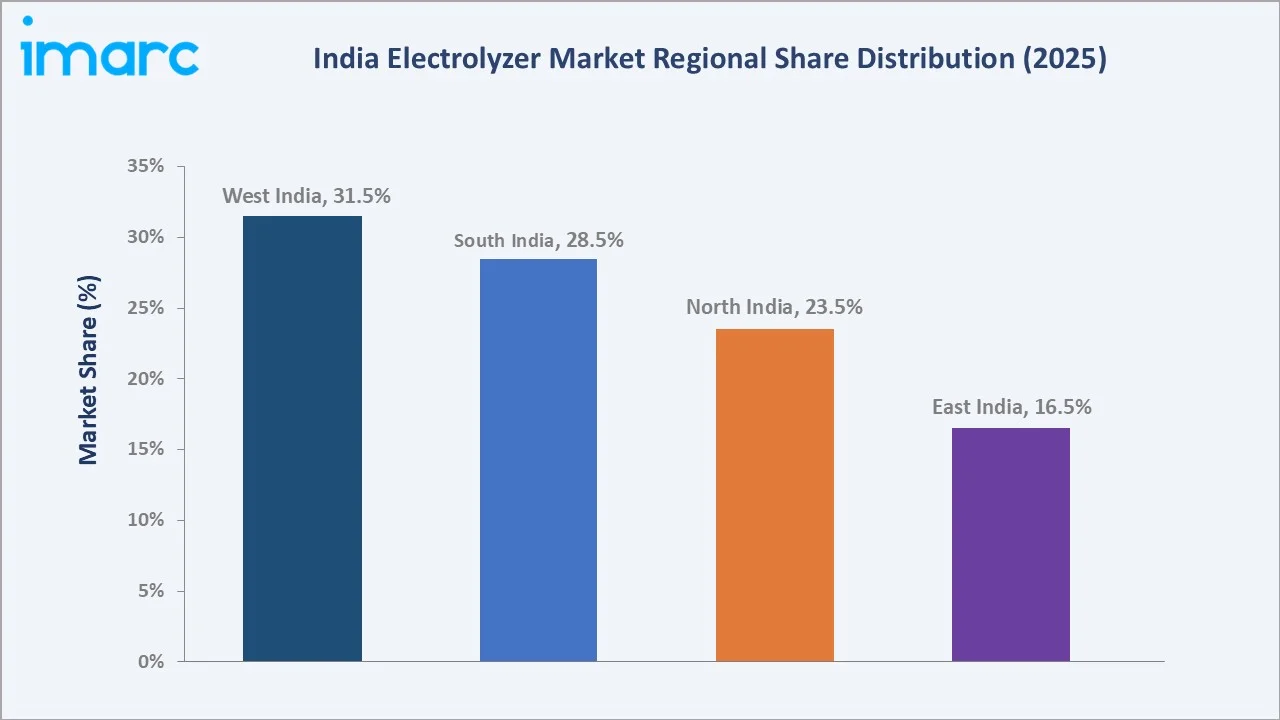
North India at 23.5%, with solar resource and refinery hydrogen replacement opportunity, positions it as a significant growth market. East India at 16.5%, through green steel potential, creates a long-term electrolyzer demand driver as India's steel sector decarbonization investment accelerates toward 2034.
Competitive Landscape
India electrolyzer market features an international technology leader tier supplying advanced alkaline and PEM systems through India offices and project engagements, an established domestic player tier providing project development and system integration capabilities, and an innovator tier offering next-generation technology differentiation.
|
Company |
Key Products |
Market Position |
Core Strength |
|
ITM Power plc |
TRIDENT, NEPTUNE II, NEPTUNE V, POSEIDON |
Market Leader |
ITM Power plc acts as a recognized international technology provider in the Indian proton exchange membrane (PEM) electrolyzer market, specializing in equipment for green hydrogen production. |
|
thyssenkrupp nucera |
scalum Electrolyzer, BiTAC family, Oxygen-depolarized Cathode Process Electrolyzer |
Market Leader |
thyssenkrupp nucera is advancing green hydrogen development in India through strategic local manufacturing partnerships, large-scale design studies, and alkaline water electrolysis technology. |
|
John Cockerill |
Pressurized Alkaline Electrolyzers |
Market Leader |
John Cockerill is a key technology and manufacturing partner in India's green hydrogen ecosystem, driving large-scale alkaline electrolyzer production and landmark green energy projects |
|
Bharat Heavy Electricals Limited |
PEM Electrolyzer Systems, Alkaline Electrolyser Systems |
Established Player |
Bharat Heavy Electricals Limited (BHEL) acts as a major domestic manufacturer and project execution partner for green hydrogen electrolyzers in India. |
|
LARSEN & TOUBRO LIMITED |
Pressurized Alkaline Electrolyzers |
Established Player |
Larsen & Toubro Limited (L&T) plays a pioneering role in India's green hydrogen economy through its subsidiary, L&T Electrolysers Limited, focusing on the indigenous manufacturing of advanced pressurized alkaline electrolyzers. |
Electrolyzer manufacturers in India are defined by technology qualification requirements, large-project EPC contractor preferred technology lists, and the PLI scheme's domestic manufacturing content requirements, creating competitive differentiation between imported systems and domestically manufactured alternatives.
Key Company Profiles
ITM Power plc
ITM Power plc is a global energy technology company specializing in electrolyzer systems for green hydrogen production. In the India electrolyzer market, the company’s technology portfolio is relevant to industrial decarbonization, renewable energy integration, and large-scale hydrogen applications. It primarily focuses on proton exchange membrane (PEM) electrolysis solutions designed for efficient and flexible hydrogen production. Its technological expertise and experience in electrolyzer development support its participation in the evolving green hydrogen ecosystem.
- Key Products: TRIDENT, NEPTUNE II, NEPTUNE V, POSEIDON.
- Strategic Focus: Advancing PEM electrolyzer technology, improving system efficiency, and scaling manufacturing capabilities to address growing green hydrogen demand. In the India electrolyzer market, its strategic emphasis centers on supporting large-scale industrial decarbonization, renewable energy integration, and reliable green hydrogen production.
thyssenkrupp nucera
thyssenkrupp nucera is a global electrolysis technology company specializing in solutions for green hydrogen and industrial applications. In the India electrolyzer market, the company provides alkaline water electrolysis technology suited to large-scale green hydrogen production. Its technological expertise, engineering capabilities, and experience in industrial-scale electrolysis support its presence in the market. The company also emphasizes partnerships and localization initiatives to address India’s expanding green hydrogen ecosystem.
- Key Products: scalum Electrolyzer, BiTAC family, Oxygen-depolarized Cathode Process Electrolyzer.
- Strategic Focus: Expanding large-scale alkaline water electrolysis solutions to support India’s growing green hydrogen requirements. Its strategy emphasizes technology localization, strategic collaborations with domestic manufacturers, and scalable electrolyzer deployment to strengthen its presence across industrial decarbonization and renewable hydrogen projects.
Market Concentration Analysis
The India electrolyzer market exhibits high concentration among international technology suppliers for the premium large-scale segment, with ITM Power plc, thyssenkrupp nucera, John Cockerill, and Bharat Heavy Electricals Limited collectively holding an estimated 65-75% of India's organized electrolyzer procurement value through their technology specifications. Domestic players contribute EPC integration and project delivery capabilities rather than electrolyzer technology supply.
Long-term market concentration will depend on the speed of domestic electrolyzer manufacturing scale-up under PLI: successful domestic manufacturing at gigawatt scale could shift most of India's electrolyzer procurement value to domestic suppliers by 2030-2034, significantly altering the competitive landscape from the current import-dominated structure.
Investment & Growth Opportunities
Highest Growth Segments
PEM electrolyzer technology (~9.2% CAGR), above-2-MW capacity systems, domestic PEM manufacturing under PLI, green ammonia export project development, refinery green hydrogen replacement, and hydrogen mobility distributed electrolysis represent the highest-return investment opportunities in the India electrolyzer market through 2034.
Investment Themes
- Green Hydrogen Project Development and SIGHT Offtake Optimization: India's SIGHT program allocates significant production-linked incentives to green hydrogen and green ammonia producers that can be monetized by project developers with renewable power assets, electrolyzer offtake agreements, and green hydrogen industrial supply contracts. Investment in project development platforms, combining renewable energy portfolios, electrolyzer procurement frameworks, and industrial hydrogen offtake relationships, can capture SIGHT incentive streams that structurally improve project returns above what standalone electrolyzer procurement or green hydrogen production could achieve independently.
- Electrolyzer Operation and Maintenance Services for India's Growing Installed Base: As India's SIGHT Phase I projects achieve commissioning, a growing installed base of alkaline and PEM electrolyzers will require professional O&M services including stack monitoring, electrolyte management, membrane replacement, and performance optimization that international electrolyzer suppliers' India service infrastructure is not currently scaled to deliver.
Future Market Outlook (2026-2034)
The India electrolyzer market is projected to grow from USD 52.28 Million in 2025 to USD 56.72 Million in 2026, reaching USD 94.79 Million by 2034, exhibiting a CAGR of 6.63% during 2026-2034. The market is projected to reach USD 72.07 Million by 2030, the critical milestone year when India targets 5 MMTPA domestic green hydrogen production and the project portfolios reach operational status, establishing India's electrolyzer technology fleet performance benchmarks and generating the operational data required to calibrate subsequent commercial project investment decisions.
Three transformative forces will shape the India electrolyzer market trajectory through 2034. First, the National Green Hydrogen Mission (NGHM) execution acceleration will determine whether India's electrolyzer market achieves the high-growth scenario or the base-case, making policy execution quality the most important variable in India's electrolyzer market development. Second, the domestic manufacturing breakthrough will dramatically reduce India's electrolyzer import dependency, lower system costs through elimination of import duty and freight and create a domestic technology industrial ecosystem that supports India's long-term green hydrogen export competitiveness. Third, the industrial green hydrogen offtake market development will sustain India's electrolyzer demand growth through 2034 and beyond the current incentive program's expiry.
Research Methodology
Primary Research
Primary research comprised structured interviews with electrolyzer technology vendors' India business development teams, program managers, green hydrogen project developers, Indian EPC contractors engaged in green hydrogen plant engineering, research institute electrolyzer scientists, and industrial off-takers evaluating green hydrogen integration. Interview insights provided validation of market sizing, technology adoption trends, project pipeline assessment, and competitive positioning data.
Secondary Research
Secondary research incorporated National Green Hydrogen Mission policy documents, tender specifications and award announcements, global electrolyzer market reports for benchmarking, company annual reports and investor presentations, import data for electrolyzer equipment, patent landscape analysis for PEM and alkaline technology innovation, and electrolyzer research publication databases.
Forecasting Models
Forecasting models integrated program project pipeline delivery timeline analysis, electrolyzer technology cost reduction trajectory modeling, India LCOH projection modeling linking renewable power cost trajectories and electrolyzer CAPEX reduction curves, macro-level correlation with target achievement scenarios, and primary project developer capex commitment timelines.
India Electrolyzer Market Report Coverage:
| Report Features | Details |
|---|---|
| Base Year of the Analysis | 2025 |
| Historical Period | 2020-2025 |
| Forecast Period | 2026-2034 |
| Units | Million USD |
| Scope of the Report |
Exploration of Historical Trends and Market Outlook, Industry Catalysts and Challenges, Segment-Wise Historical and Future Market Assessment:
|
| Products Covered | Alkaline Electrolyzer, PEM Electrolyzer, Solid Oxide Electrolyzer |
| Capacities Covered | Less than 500 kW, 500 kW to 2 MW, Above 2 MW |
| Applications Covered | Power Generation, Transportation, Industry Energy, Industry Feedstock, Building Heat and Power, Others |
| Regions Covered | North India, South India, East India, West India |
| Companies Covered | ITM Power plc, thyssenkrupp nucera, John Cockerill, Bharat Heavy Electricals Limited, LARSEN & TOUBRO LIMITED, etc. |
| Customization Scope | 10% Free Customization |
| Post-Sale Analyst Support | 10-12 Weeks |
| Delivery Format | PDF and Excel through Email (We can also provide the editable version of the report in PPT/Word format on special request) |
Key Benefits for Stakeholders:
- IMARC’s industry report offers a comprehensive quantitative analysis of various market segments, historical and current market trends, market forecasts, and dynamics of the India electrolyzer market from 2020-2034.
- The research report provides the latest information on the market drivers, challenges, and opportunities in the India electrolyzer market.
- Porter's five forces analysis assist stakeholders in assessing the impact of new entrants, competitive rivalry, supplier power, buyer power, and the threat of substitution. It helps stakeholders to analyze the level of competition within the India electrolyzer industry and its attractiveness.
- Competitive landscape allows stakeholders to understand their competitive environment and provides an insight into the current positions of key players in the market.
Frequently Asked Questions About the India Electrolyzer Market Report
The India electrolyzer market reached USD 56.72 Million in 2026, driven by the National Green Hydrogen Mission program project pipeline, PLI scheme domestic manufacturing incentives, green hydrogen tenders, and industrial green hydrogen pilot investments.
The market is projected to grow at a CAGR of 6.63% during 2026-2034, driven by green hydrogen production incentives, PEM electrolyzer rapid cost reduction, PLI-supported domestic manufacturing scale-up, and industrial green hydrogen adoption in refineries, fertilizer, and steel sectors.
The market is projected to reach USD 72.07 Million by 2030, India's NGHM target year, when projects reach operational status, PEM electrolyzer market share grows, and domestic manufacturing capacity expands under PLI.
Alkaline electrolyzers lead with a 55.5% share in 2025, driven by the lowest capital cost, proven technology maturity, suitability for steady-state industrial green hydrogen applications, and preference in large-scale projects where established technology reliability is the primary procurement criterion.
Above 2 MW systems lead with a 45.5% share in 2025, reflecting NGHM's emphasis on large-scale centralized green hydrogen production, tender minimum project scale requirements, and the per-kg hydrogen production economics advantage of large-scale electrolyzer deployment versus distributed small-scale installations.
West India leads with a 31.5% share in 2025, anchored by electrolyzer commitments, Gujarat's outstanding renewable power resource, green ammonia export infrastructure, and refinery green hydrogen integration pipeline.
Key players include ITM Power plc, thyssenkrupp nucera, John Cockerill, Bharat Heavy Electricals Limited, and LARSEN & TOUBRO LIMITED, among others.
The market is projected to reach USD 94.79 Million by 2034, driven by commercial green hydrogen market development, domestic manufacturing breakthroughs reducing import dependency, PEM electrolyzer cost parity with alkaline systems, industrial decarbonization mandate expansion, and India emerging as a global green ammonia export hub.
Key investment opportunities include domestic PEM electrolyzer manufacturing under the PLI scheme, green hydrogen project development platforms capturing incentive streams, electrolyzer O&M service companies for India's growing installed base, green ammonia export project development targeting premium markets, and refinery green hydrogen replacement project development for Indian public sector refineries.
Need more help?
- Speak to our experienced analysts for insights on the current market scenarios.
- Include additional segments and countries to customize the report as per your requirement.
- Gain an unparalleled competitive advantage in your domain by understanding how to utilize the report and positively impacting your operations and revenue.
- For further assistance, please connect with our analysts.
 Request Customization
 Speak to an Analyst
 Request Brochure
 Inquire Before Buying
Benefits of Customization
- Personalize this research
- Triangulate with your data
- Get data as per your format and definition
- Gain a deeper dive into a specific application, geography, customer, or competitor
- Any level of personalization
Get in Touch With Us
UNITED STATES
Phone: +1-201-971-6302
INDIA
Phone: +91-120-433-0800
UNITED KINGDOM
Phone: +44-753-714-6104
Email: [email protected]
Client Testimonials




.webp)




.webp)













Related Reports

Choose your plan
*Please note that the prices mentioned below are starting prices for each bundle type. Kindly contact our team for further details.*
Single User License
- 1 User License, Access on 2 Devices
- PDF Report + Excel Dataset (Password Protected)
- Lifetime Access
- No Printing Rights
- 10% Free Report Customization
- 10–12 Weeks of Analyst Support
Five User License
- Access for 5 Users, 2 Devices per User
- PDF Report + Excel Dataset (Password Protected)
- Lifetime Access
- Dedicated Account Manager
- 12–14 Weeks of Analyst Support
- No Printing Rights
- 15% Free Report Customization
- 25% Discount on Your Next Purchase
Corporate User License
- Unlimited User Access (Within Your Organization)
- PDF Report + Excel Dataset
- Lifetime Access
- Dedicated Account Manager
- 14–20 Weeks of Analyst Support
- No Printing Rights
- 20% Free Report Customization
- 30% Discount on Your Next Purchase
Essential Insights
What's included:
3 reports
- Lifetime Access
- PDF Reports
- Excel Datasets
- 2 Weeks of Free Analyst Support
- 2 User Licenses
- Access on 2 Devices
- Printing Rights
- Complimentary PowerPoint (PPT) Version
- Complimentary License Upgrade
Professional Access
What's included:
5 reports
- Lifetime Access
- PDF Reports
- Excel Datasets
- 8 Weeks of Free Analyst Support
- 2 User Licenses
- Access on 2 Devices
- Printing Rights
- Complimentary PowerPoint (PPT) Version
- Complimentary License Upgrade
Business Advantage
What's included:
8 reports
- Lifetime Access
- PDF Reports
- Excel Datasets
- 14 Weeks of Free Analyst Support
- 2 User Licenses
- Access on 2 Devices
- Printing Rights
- Complimentary PowerPoint (PPT) Version
- Complimentary License Upgrade
Enterprise Intelligence
What's included:
10 reports
- Lifetime Access
- PDF Reports
- Excel Datasets
- 20 Weeks of Free Analyst Support
- 2 User Licenses
- Access on 2 Devices
- Printing Rights
- Complimentary PowerPoint (PPT) Version
- Complimentary License Upgrade