
India Employee Engagement Software Market Size, Share, Trends and Forecast by Deployment Mode, Enterprise Size, Function, Industry, and Region, 2026-2034
India Employee Engagement Software Market Summary:
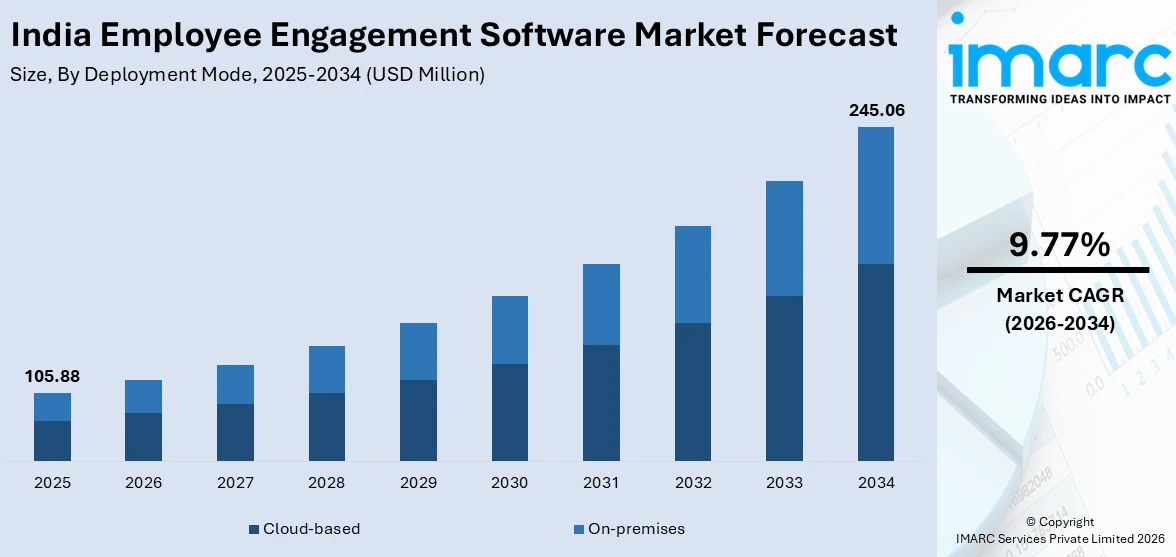
The India employee engagement software market grew from USD 105.88 Million in 2025 to USD 116.25 Million in 2026 and is projected to reach USD 245.06 Million by 2034, growing at a compound annual growth rate of 9.77% from 2026-2034.
The market is growing steadily as organizations prioritize workforce retention, productivity enhancement, and digital transformation of human resource functions. Apart from this, the increasing adoption of hybrid and remote work models is compelling enterprises to invest in cloud-based platforms that facilitate real-time communication, continuous feedback, and performance tracking. Additionally, growing awareness about the correlation between employee satisfaction and organizational performance is expanding the India employee engagement software market share.
Key Takeaways and Insights:
- By Deployment Mode: Cloud-based deployment dominates the market with a share of 65% in 2025, driven by its scalability, cost-efficiency, and ability to support geographically dispersed workforces across hybrid work environments.
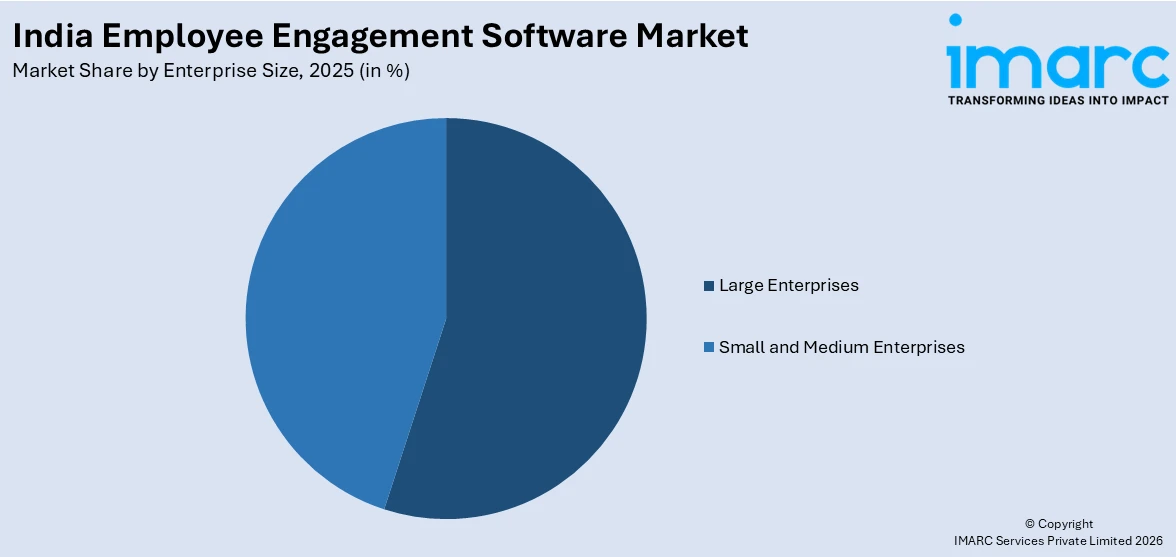
- By Enterprise Size: Large enterprises lead the market with a share of 54% in 2025, owing to their complex organizational structures, large workforces, and strategic focus on talent retention through advanced digital engagement platforms.
- By Function: Collaboration and interaction hold the largest share at 22% in 2025, reflecting the growing emphasis on team connectivity, knowledge sharing, and real-time communication in increasingly distributed work settings.
- By Industry: BFSI represents the largest industry segment with an 18% share in 2025, supported by the sector’s extensive workforce, regulatory compliance demands, and increasing investments in digital HR transformation.
- Key Players: The India employee engagement software market exhibits a dynamic competitive landscape, with both domestic HR technology innovators and global enterprise solution providers competing through cloud-native platforms, AI-driven analytics, and integrated human capital management offerings.
To get more information on this market Request Sample
The India employee engagement software market is growing at a very rapid pace as organizations across various sectors realize the importance of employee engagement as a key driver of productivity and a means of fostering a resilient organizational culture. The trend of adopting digital HR solutions is also gaining momentum as organizations increasingly opt for software solutions that combine pulse surveys, recognition initiatives, performance management, and collaboration platforms. Mobile HR apps are also becoming increasingly popular, and this trend is opening up employee engagement solutions to both blue-collar and white-collar workers. For example, in March 2025, Hyderabad-based HR technology firm Darwinbox raised USD 140 million in funding from Partners Group and KKR, indicating strong investor interest in the India HR technology market and its ability to innovate in the employee engagement space.
India Employee Engagement Software Market Trends:
Integration of Artificial Intelligence (AI) and Generative AI in Engagement Platforms
The integration of AI-enabled functionalities in employee engagement solutions is gaining momentum in Indian companies. Organizations are using generative AI for sentiment analysis, predictive attrition modeling, personalized feedback tools, and automated survey creation. These solutions help HR leaders in organizations make informed decisions and act on the concerns of the employees. For example, in January 2025, Kotak Mahindra Life Insurance launched Kavya, a generative AI-enabled HR virtual assistant that aims to improve the employee experience, promote open communication, and offer confidential support to employees throughout their life cycle, thereby propelling the India employee engagement software market.
Rising Demand for Mobile-First and Cloud-Native HR Solutions
Indian companies are increasingly turning to mobile-first engagement platforms to engage with a young, tech-savvy, and geographically dispersed workforce. Cloud-native solutions provide effortless scalability, real-time data availability, and easy integration with existing enterprise systems. The development of digital infrastructure in Tier-2 and Tier-3 cities is further widening the adoption base. For example, in 2024, Darwinbox was named a Challenger in Gartner’s Magic Quadrant for Cloud HCM Suites for companies with more than 1,000 employees, making it the youngest and the only Asian company to achieve this status, indicating the maturity of the Indian cloud-based HR technology market. Darwinbox is leading the charge in the shift towards agentic AI in HCM, becoming the first platform globally to roll out a Model Context Protocol (MCP) server, enabling seamless interaction with any MCP-compliant AI agent used by its clients. The newly launched Super Agent, boasting more than 12 in-built AI agents for talent, analytics, payroll, and employee services, is already reaping benefits for its pilot clients.
Growing Focus on Employee Recognition and Wellness Programs
Indian companies are also incorporating recognition, reward, and wellness modules into their engagement strategies. Recognition models based on behavioral science and wellness programs with a gaming element are becoming popular as companies look for better results in terms of employee morale. For example, in June 2025, Vantage Circle, an employee engagement platform based in India, partnered with Great Place To Work India to publish a research report based on the voices of over 5.7 million employees in 2,000 organizations, emphasizing the strategic role of recognition in trust, agility, and retention.
Market Outlook 2026-2034:
The India employee engagement software market is poised for sustained expansion as enterprises accelerate their digital HR transformation strategies. Increasing investments in AI-powered analytics, agentic AI capabilities, and multi-system workflow orchestration are expected to redefine how organizations manage employee experiences. The growing formalization of India’s gig economy, expansion of IT and BFSI sectors, and rising adoption of engagement tools by small and medium enterprises in emerging business hubs are expected to create significant growth opportunities. The market generated a revenue of USD 105.88 Million in 2025, which is expected to reach USD 116.25 Million in 2026 and further grow to USD 245.06 Million by 2034, at a compound annual growth rate of 9.77% from 2026-2034.
India Employee Engagement Software Market Report Segmentation:
| Segment Category | Leading Segment | Market Share |
|---|---|---|
|
Deployment Mode |
Cloud-based |
65% |
|
Enterprise Size |
Large Enterprises |
54% |
|
Function |
Collaboration and Interaction |
22% |
|
Industry |
BFSI |
18% |
Deployment Mode Insights:
- Cloud-based
- On-premises
Cloud-based dominates with a market share of 65% of the total India employee engagement software market in 2025.
Cloud-based deployment represents the largest segment in the market, driven by rapid digital transformation and the growing adoption of remote and hybrid work models. Organizations across sectors are increasingly shifting toward cloud-based platforms due to their scalability, flexibility, and lower upfront costs. Unlike traditional systems, cloud solutions operate on a subscription-based model, eliminating the need for significant hardware investments and reducing IT maintenance expenses. This makes them particularly attractive to small and medium-sized enterprises (SMEs) as well as large enterprises seeking cost efficiency.
Cloud-based employee engagement software enables real-time communication, continuous feedback, performance tracking, pulse surveys, recognition programs, and advanced analytics from any location. The accessibility of these platforms through web and mobile applications supports distributed workforces and enhances overall employee experience. Additionally, automatic updates ensure businesses always have access to the latest features, security patches, and compliance standards without operational disruptions. As Indian businesses increasingly embrace SaaS-based HR technologies, cloud-based deployment continues to dominate the market due to its agility, innovation, and long-term cost benefits.
Enterprise Size Insights:
Access the comprehensive market breakdown Request Sample
- Large Enterprises
- Small and Medium Enterprises
Large enterprises lead with a share of 54% of the total India employee engagement software market in 2025.
Large enterprises account for the largest segment in the market, driven by their extensive workforce size, complex organizational structures, and strong focus on talent management strategies. These organizations typically operate across multiple locations, departments, and even countries, making employee engagement a critical factor in maintaining productivity, alignment, and workplace culture. As a result, large enterprises invest significantly in advanced employee engagement software to streamline communication, monitor performance, and enhance overall employee experience. The need for real-time analytics, continuous feedback mechanisms, employee recognition programs, and pulse surveys is particularly high among large corporations.
Large enterprises also prioritize scalable and customizable solutions that can support thousands of employees while maintaining data security and regulatory compliance. With higher IT budgets and a stronger emphasis on digital transformation, these organizations are early adopters of AI-driven insights, predictive analytics, and automation features within engagement platforms. As competition for skilled talent intensifies in India, large enterprises continue to lead market demand by investing in sophisticated engagement solutions to boost employee satisfaction, productivity, and long-term organizational performance.
Function Insights:
- Onboarding
- Training
- Collaboration and Interaction
- Customer Service
- Rewards and Recognitions
- Others
Collaboration and interaction exhibit a clear dominance with a 22% share of the total India employee engagement software market in 2025.
Collaboration and interaction represent the largest segment in the India Employee Engagement Software Market, driven by the growing need for seamless communication and teamwork across organizations. With the rise of hybrid and remote work models, businesses are increasingly prioritizing digital platforms that enable employees to stay connected, aligned, and productive regardless of location. Collaboration-focused engagement tools provide features such as instant messaging, team discussion forums, virtual meeting integration, project tracking, and social intranet capabilities, fostering a more interactive and inclusive work environment.
Indian enterprises recognize that effective collaboration directly influences innovation, employee satisfaction, and overall performance. By facilitating transparent communication and cross-functional teamwork, these platforms help break down organizational silos and encourage knowledge sharing. Real-time feedback and interactive engagement features also allow employees to voice opinions, contribute ideas, and participate actively in decision-making processes, strengthening organizational culture. Additionally, collaboration and interaction tools often integrate with HR systems, workflow management platforms, and productivity applications, ensuring a unified digital workspace. Advanced features such as AI-driven insights, employee sentiment analysis, and engagement analytics further enhance workforce connectivity and responsiveness. As companies continue to focus on building agile and digitally connected workplaces, collaboration and interaction solutions remain central to engagement strategies, solidifying their position as the leading functional segment in the market.
Industry Insights:
- Retail
- BFSI
- Government
- Healthcare
- IT and Telecom
- Hospitality
- Manufacturing
- Others
BFSI leads with a share of 18% of the total India employee engagement software market in 2025.
The BFSI sector represents the largest segment in the India employee engagement software market, driven by its large workforce base, high customer interaction levels, and strong focus on performance management. Organizations in this sector operate in highly competitive and regulated environments, making employee productivity, compliance, and service quality critical to success. As a result, BFSI companies heavily invest in advanced employee engagement solutions to enhance workforce efficiency, monitor performance metrics, and maintain high service standards.
Employee engagement platforms in the BFSI sector are widely used for real-time communication, goal tracking, training management, compliance updates, and recognition programs. Given the dynamic nature of financial services, continuous learning and upskilling are essential, and engagement software helps streamline training initiatives while tracking employee progress. Additionally, feedback tools and pulse surveys enable HR teams to measure employee sentiment, reduce attrition, and improve workplace morale in high-pressure environments. Data security and regulatory compliance are particularly important in BFSI, and modern engagement platforms offer secure data management, role-based access controls, and integration with core banking and HR systems. With increasing digital transformation initiatives and the rapid expansion of fintech services in India, BFSI organizations continue to prioritize employee engagement technologies to drive operational excellence, customer satisfaction, and long-term business growth, solidifying their dominance in the market.
Regional Insights:
- North India
- South India
- East India
- West India
North India holds a significant share in the India Employee Engagement Software Market due to the strong presence of corporate headquarters, government institutions, and large enterprises in cities like Delhi, Gurugram, and Noida. Growing digital transformation initiatives and expanding service sectors are driving adoption of advanced employee engagement platforms across the region.
South India is a key growth region due to its robust IT, telecom, and startup ecosystem. High technology penetration and a large skilled workforce encourage widespread adoption of cloud-based employee engagement solutions. Moreover, organizations prioritize digital collaboration, performance tracking, and real-time feedback tools to manage dynamic work environments effectively.
East India is experiencing steady growth as enterprises increasingly invest in digital HR technologies. Apart from this, the expanding infrastructure, rising industrial activities, and supportive government initiatives are encouraging adoption of employee engagement platforms. Businesses in the region are focusing on improving workforce satisfaction, operational efficiency, and long-term employee retention strategies.
West India demonstrates strong market potential, supported by its concentration of financial institutions, manufacturing companies, and large enterprises. Growing emphasis on workforce optimization and digital transformation is driving demand for advanced engagement software. Apart from this, the companies in this region actively adopt integrated solutions to strengthen organizational culture and productivity.
Market Dynamics:
Growth Drivers:
Why is the India Employee Engagement Software Market Growing?
Accelerating Digital Transformation of Human Resource Functions
Indian enterprises across sectors are undergoing a fundamental shift from traditional, manual HR processes to technology-driven workforce management systems. The adoption of cloud-based HRMS platforms, AI-powered analytics, and mobile-first solutions is enabling organizations to automate routine HR tasks while focusing on strategic employee engagement initiatives. This digital transformation is being driven by the need for real-time workforce insights, streamlined compliance management, and improved operational efficiency. The proliferation of SaaS-based HR solutions is making advanced engagement tools accessible to organizations of varying sizes. For instance, over 6 million people are working in the tech and AI ecosystem and India has around 1.8 lakh startups and almost 89% of new startups launched last year used AI in their products or services, demonstrating the scale of digital HR adoption that is creating a strong foundation for employee engagement software deployment.
Intensifying Talent Competition and Rising Attrition Rates
India’s competitive labor market, particularly in high-growth sectors such as IT, BFSI, e-commerce, and retail, is compelling organizations to invest significantly in employee engagement as a strategic retention tool. High attrition rates and the rising cost of employee turnover are driving demand for software solutions that provide continuous feedback mechanisms, recognition programs, and career development pathways. Organizations are increasingly recognizing that engaged employees demonstrate higher productivity and lower turnover rates.
Expansion of Hybrid and Remote Work Models
The widespread adoption of hybrid and remote work arrangements in India has fundamentally altered how organizations approach employee engagement. Maintaining team cohesion, ensuring transparent communication, and fostering organizational culture in distributed work environments require dedicated digital tools. Employee engagement platforms offering virtual check-ins, collaborative workspaces, feedback loops, and wellness programs are becoming essential for organizations managing dispersed teams. The growing formalization of flexible work policies and the expansion of technology infrastructure are reinforcing this trend.
Market Restraints:
What Challenges the India Employee Engagement Software Market is Facing?
Data Privacy and Cybersecurity Concerns
The increasing collection and processing of sensitive employee data through engagement platforms raises significant concerns around data privacy, cybersecurity, and regulatory compliance. Organizations face challenges in ensuring secure storage, encryption, and adherence to India’s evolving data protection regulations. These concerns create adoption barriers, particularly among enterprises in regulated industries that require robust assurances of data integrity and confidentiality.
Integration Complexities with Legacy Systems
Many Indian enterprises, particularly in traditional sectors, continue to operate legacy HR systems that are not readily compatible with modern cloud-based engagement platforms. The complexity and cost of integrating new software with existing IT infrastructure, payroll systems, and enterprise resource planning tools create friction in adoption. Incomplete or inaccurate data migration from legacy systems further compounds implementation challenges.
Limited Awareness and Budget Constraints Among SMEs
While large enterprises are actively investing in engagement solutions, small and medium enterprises often face limited awareness of available tools and constrained budgets for HR technology investments. Many SMEs continue to rely on manual or spreadsheet-based approaches to workforce management, and the perceived complexity of implementing specialized engagement software can deter adoption among resource-constrained organizations.
Competitive Landscape:
The India employee engagement software market features an increasingly competitive landscape characterized by the presence of both established global enterprise solution providers and rapidly scaling domestic HR technology platforms. Companies are differentiating through AI-driven analytics, mobile-first design, multilingual support, and seamless integration with broader human capital management ecosystems. Strategic partnerships, product innovation, and investment in generative AI capabilities are shaping competitive dynamics. Domestic players are gaining significant traction through solutions tailored to India’s unique regulatory environment and diverse workforce requirements, while global providers leverage their established enterprise client relationships and comprehensive product portfolios.
Recent Developments:
- In October 2025, Hunar.AI, the top AI platform in India for managing frontline workers, has officially introduced the country's first Self-Serve AI HR solutions tailored for Small and Medium Businesses (SMBs). This innovative solution is enabling rapidly expanding companies to implement Voice AI HRs (Agents) in crucial workforce engagement situations, including hiring & onboarding as well as employee retention, all without requiring specialized technical assistance.
India Employee Engagement Software Market Report Coverage:
| Report Features | Details |
|---|---|
| Base Year of the Analysis | 2025 |
| Historical Period | 2020-2025 |
| Forecast Period | 2026-2034 |
| Units | Million USD |
| Scope of the Report |
Exploration of Historical Trends and Market Outlook, Industry Catalysts and Challenges, Segment-Wise Historical and Future Market Assessment:
|
| Deployment Modes Covered | Cloud-based, On-premises |
| Enterprise Sizes Covered | Large Enterprises, Small and Medium Enterprises |
| Functions Covered | Onboarding, Training, Collaboration and Interaction, Customer Service, Rewards and Recognitions, Others |
| Industries Covered | Retail, BFSI, Government, Healthcare, IT And Telecom, Hospitality, Manufacturing, Others |
| Regions Covered | North India, South India, East India, West India |
| Customization Scope | 10% Free Customization |
| Post-Sale Analyst Support | 10-12 Weeks |
| Delivery Format | PDF and Excel through Email (We can also provide the editable version of the report in PPT/Word format on special request) |
Frequently Asked Questions About the India Employee Engagement Software Market Report
The India employee engagement software market size increased from USD 105.88 Million in 2025 to USD 116.25 Million in 2026.
The India employee engagement software market is expected to grow at a compound annual growth rate of 9.77% from 2026-2034 to reach USD 245.06 Million by 2034.
Cloud-based deployment, holding the largest revenue share of 65% in 2025, leads the India employee engagement software market, driven by its scalability, cost-efficiency, seamless remote access capabilities, and ability to support geographically dispersed workforces across hybrid environments.
Key factors driving the India employee engagement software market include accelerating digital transformation of HR functions, intensifying talent competition and rising attrition rates, expansion of hybrid and remote work models, growing AI integration, and increasing enterprise focus on employee well-being and retention.
Major challenges include data privacy and cybersecurity concerns, integration complexities with legacy HR systems, limited awareness and budget constraints among small and medium enterprises, and varying compliance requirements across states and industries.
Need more help?
- Speak to our experienced analysts for insights on the current market scenarios.
- Include additional segments and countries to customize the report as per your requirement.
- Gain an unparalleled competitive advantage in your domain by understanding how to utilize the report and positively impacting your operations and revenue.
- For further assistance, please connect with our analysts.
 Request Customization
 Speak to an Analyst
 Request Brochure
 Inquire Before Buying
Benefits of Customization
- Personalize this research
- Triangulate with your data
- Get data as per your format and definition
- Gain a deeper dive into a specific application, geography, customer, or competitor
- Any level of personalization
Get in Touch With Us
UNITED STATES
Phone: +1-201-971-6302
INDIA
Phone: +91-120-433-0800
UNITED KINGDOM
Phone: +44-753-714-6104
Email: [email protected]
Client Testimonials




.webp)




.webp)













Related Reports

Choose your plan
*Please note that the prices mentioned below are starting prices for each bundle type. Kindly contact our team for further details.*
Single User License
- 1 User License, Access on 2 Devices
- PDF Report + Excel Dataset (Password Protected)
- Lifetime Access
- No Printing Rights
- 10% Free Report Customization
- 10–12 Weeks of Analyst Support
Five User License
- Access for 5 Users, 2 Devices per User
- PDF Report + Excel Dataset (Password Protected)
- Lifetime Access
- Dedicated Account Manager
- 12–14 Weeks of Analyst Support
- No Printing Rights
- 15% Free Report Customization
- 25% Discount on Your Next Purchase
Corporate User License
- Unlimited User Access (Within Your Organization)
- PDF Report + Excel Dataset
- Lifetime Access
- Dedicated Account Manager
- 14–20 Weeks of Analyst Support
- No Printing Rights
- 20% Free Report Customization
- 30% Discount on Your Next Purchase
Essential Insights
What's included:
3 reports
- Lifetime Access
- PDF Reports
- Excel Datasets
- 2 Weeks of Free Analyst Support
- 2 User Licenses
- Access on 2 Devices
- Printing Rights
- Complimentary PowerPoint (PPT) Version
- Complimentary License Upgrade
Professional Access
What's included:
5 reports
- Lifetime Access
- PDF Reports
- Excel Datasets
- 8 Weeks of Free Analyst Support
- 2 User Licenses
- Access on 2 Devices
- Printing Rights
- Complimentary PowerPoint (PPT) Version
- Complimentary License Upgrade
Business Advantage
What's included:
8 reports
- Lifetime Access
- PDF Reports
- Excel Datasets
- 14 Weeks of Free Analyst Support
- 2 User Licenses
- Access on 2 Devices
- Printing Rights
- Complimentary PowerPoint (PPT) Version
- Complimentary License Upgrade
Enterprise Intelligence
What's included:
10 reports
- Lifetime Access
- PDF Reports
- Excel Datasets
- 20 Weeks of Free Analyst Support
- 2 User Licenses
- Access on 2 Devices
- Printing Rights
- Complimentary PowerPoint (PPT) Version
- Complimentary License Upgrade