
India Encoder Market Size, Share, Trends and Forecast by Technology, Type, End User, and Region, 2026-2034
India Encoder Market Size, Share, Trends & Forecast (2026-2034)
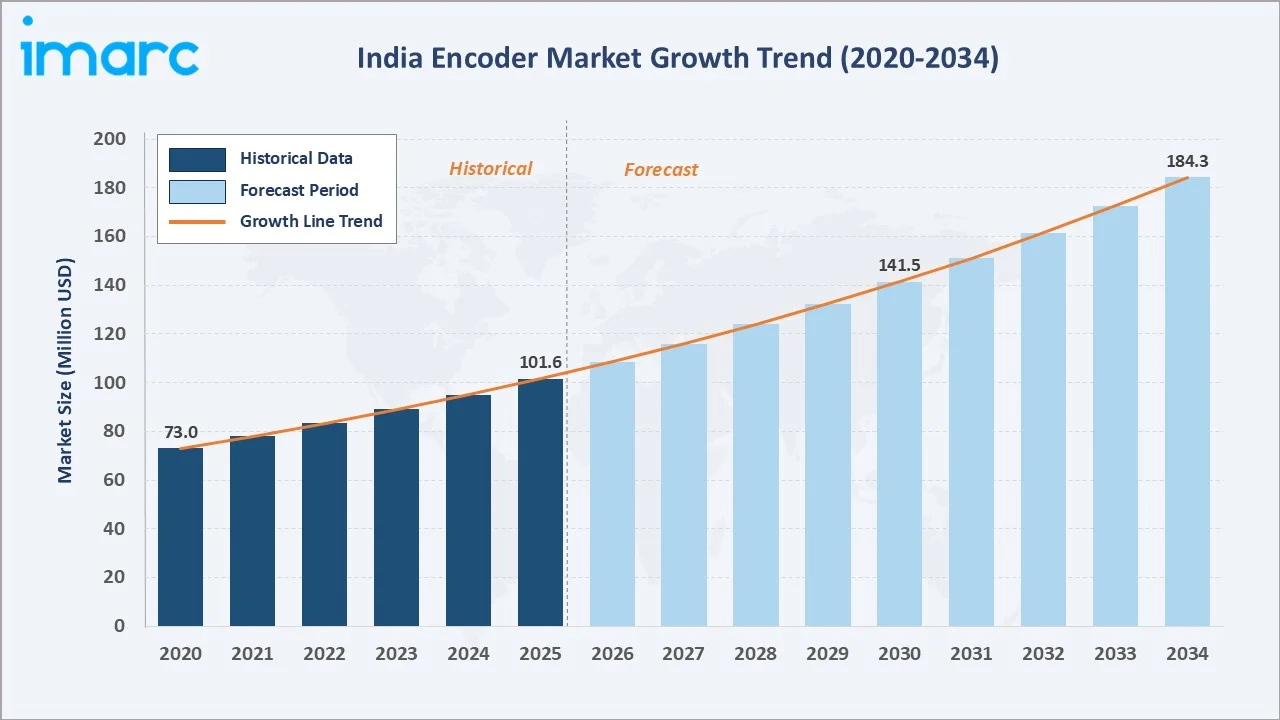
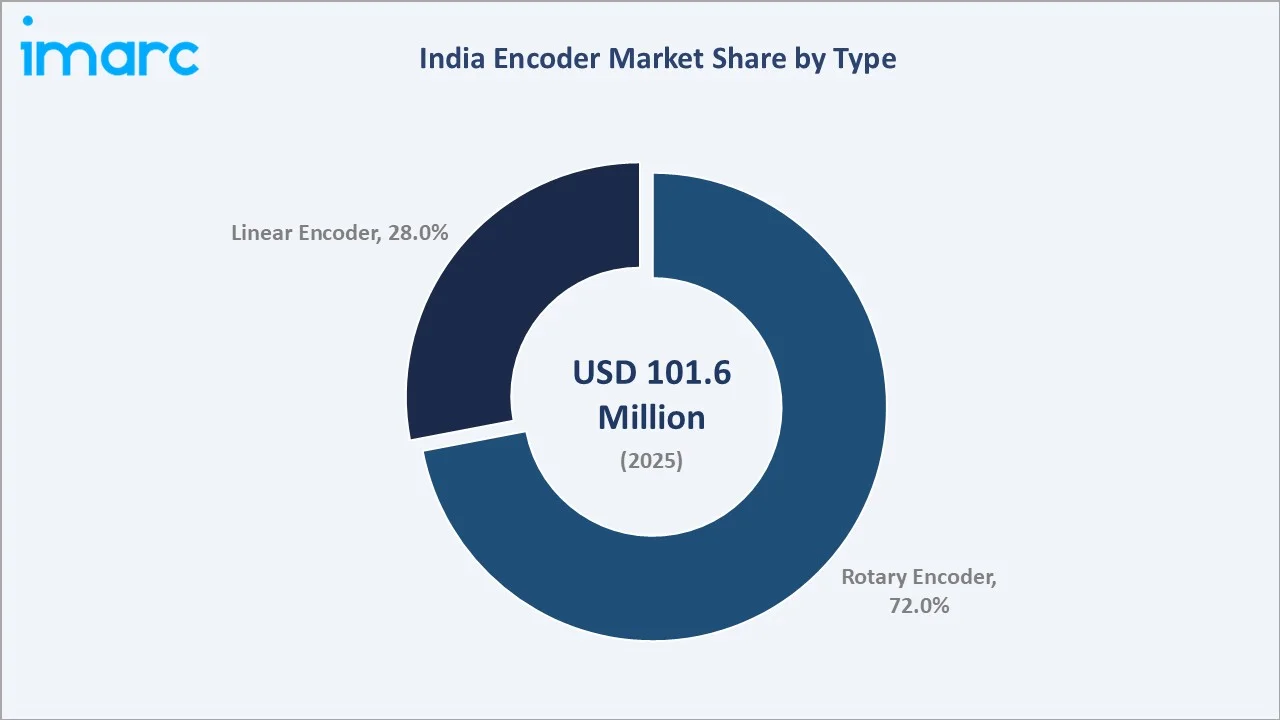
The India encoder market grew from USD 101.6 Million in 2025 to USD 108.6 Million in 2026 and is projected to reach USD 184.3 Million by 2034, growing at a CAGR of 6.84% during 2026-2034. The market is driven by accelerating industrial automation adoption, the rollout of Industry 4.0 initiatives, and growing demand for precision motion control across manufacturing, automotive, and infrastructure sectors. According to the World Robotics 2025 Report, India installed a record 9,120 industrial robots in 2024, representing a 7% increase from the previous year and making India the sixth-largest market globally for annual installations. The rapid adoption of industrial robots is increasing demand for encoders used for position, speed, and motion feedback in robotic arms, motors, and automated production systems. Rotary encoders lead at 72.0% by type, optical technology dominates at 62.0% by technology, and West India commands the largest regional share at 32.0% in 2025.
Market Snapshot
|
Metric |
Value |
|
Base Year Market Size (2025) |
USD 101.6 Million |
|
Market Size (2026) |
USD 108.6 Million |
|
Forecast Market Size (2034) |
USD 184.3 Million |
|
CAGR (2026-2034) |
6.84% |
|
Base Year |
2025 |
|
Historical Period |
2020-2025 |
|
Forecast Period |
2026-2034 |
|
Dominant Type |
Rotary Encoder (72.0%, 2025) |
|
Dominant Technology |
Optical (62.0%, 2025) |
|
Leading Region |
West India (32.0%, 2025) |
The India encoder market grew from USD 73.0 Million in 2020 to USD 101.6 Million in 2025, and further to USD 108.6 Million in 2026, reflecting sustained demand from industrial automation, CNC machine tools, robotic systems, and precision manufacturing applications. The market is projected to reach USD 141.5 Million by 2030 before reaching USD 184.3 Million by 2034.
To get more information on this market, Request Sample
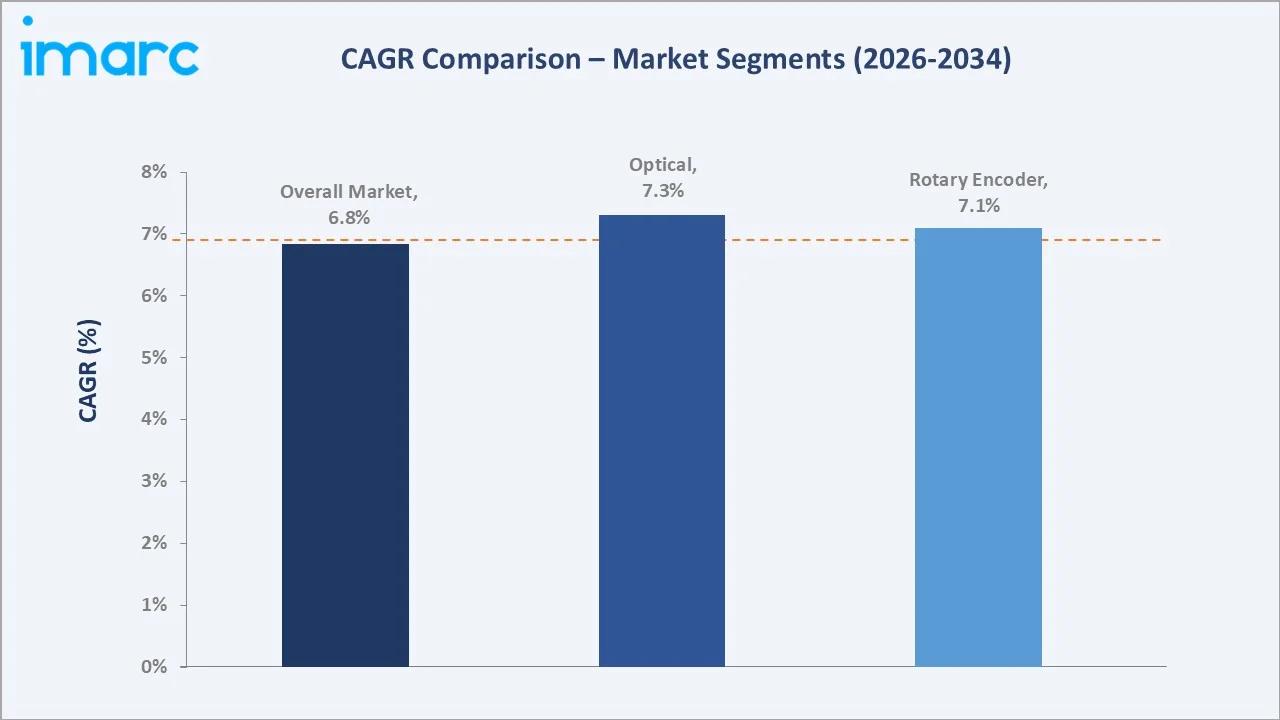
Rotary encoders are projected to grow at 7.1% CAGR, driven by their widespread adoption in servo motor feedback, robotics, and CNC machine tools. Optical encoders at approximately 7.3% CAGR reflect the superior resolution and accuracy they provide for high-precision manufacturing applications. The overall market CAGR of 6.84% reflects India industrial automation trajectory and the progressive modernization of its manufacturing sector.
Executive Summary
The India encoder market is on a sustained growth trajectory, underpinned by accelerating industrial automation across manufacturing, automotive, textile, and infrastructure sectors, the progressive adoption of Industry 4.0 technologies, and the growing deployment of AI-integrated robotics and precision motion control systems. The market has expanded steadily, supported by increasing CNC machine tool installations, expanding robotic system deployments in automotive assembly, growing semiconductor and electronics manufacturing investments, and smart factory adoption.
Rotary encoders at 72.0% constitute the dominant encoder type, reflecting their universal adoption in servo drives, AC motors, CNC spindles, and robotic joint feedback applications across virtually all manufacturing and automation use cases. Optical encoders at 62.0% of technology demand reflect the market preference for high-resolution, high-accuracy feedback solutions in precision manufacturing applications where measurement errors directly impact product quality. West India leads regionally at 32.0%, driven by the concentration of manufacturing, automotive, and automation investments.
Key Market Insights
|
Insight |
Data |
|
Dominant Type |
Rotary Encoder - 72.0% share (2025) |
|
Dominant Technology |
Optical - 62.0% share (2025) |
|
Leading Region |
West India - 32.0% (2025) |
|
Key Market Opportunity |
AI-integrated robotics, EV manufacturing, and semiconductor fab investments are creating high-precision encoder demand across emerging industrial applications. |
Key Analytical Observations Supporting the Above Data:
- Rotary Encoder at 72.0%: Rotary encoders dominate because they are the standard feedback device in virtually all rotary motion applications, including servo motors, AC drives, CNC machine spindles, conveyor systems, and robotic joints. The near-universal adoption of servo drive technology in modern manufacturing equipment ensures rotary encoders remain the primary encoder type across all industrial sectors.
- Optical Technology at 62.0%: Optical encoders lead because they deliver the highest resolution and accuracy among all encoder technologies, with modern optical encoders achieving position resolutions in the sub-micron range essential for CNC machining, semiconductor manufacturing, and precision metrology. The growing adoption of high-precision manufacturing across India PLI-supported sectors is specifically driving optical encoder demand.
- West India at 32.0%: West India regional leadership reflects the concentration of India largest automotive OEM assembly plants, precision engineering clusters, textile manufacturing facilities, and pharmaceutical manufacturing zones in Maharashtra and Gujarat, all of which are intensive consumers of encoder-based motion control and automation systems.
India Encoder Market Overview
The India encoder market encompasses the production, distribution, and application of electromechanical feedback devices that convert mechanical motion, rotary or linear, into digital or analog electrical signals for position, speed, direction, and count measurement in control systems. Core product categories include rotary encoders (incremental and absolute), linear encoders, angle encoders, and magnetic encoders, serving applications ranging from CNC machine tool axis feedback to robotic joint position sensing, conveyor speed control, elevator position monitoring, and medical device actuation control.
The market ecosystem spans raw material and component suppliers providing optical discs, magnetic scales, ASIC chips, and precision housings; encoder design and manufacturing companies including global multinationals and domestic specialists; distributors and automation system integrators who provide application engineering support; OEMs that embed encoders in CNC machines, robots, and automation systems; and end-user industries that operate finished automated equipment.
Market Dynamics
To evaluate market opportunities, Request Sample
Market Drivers
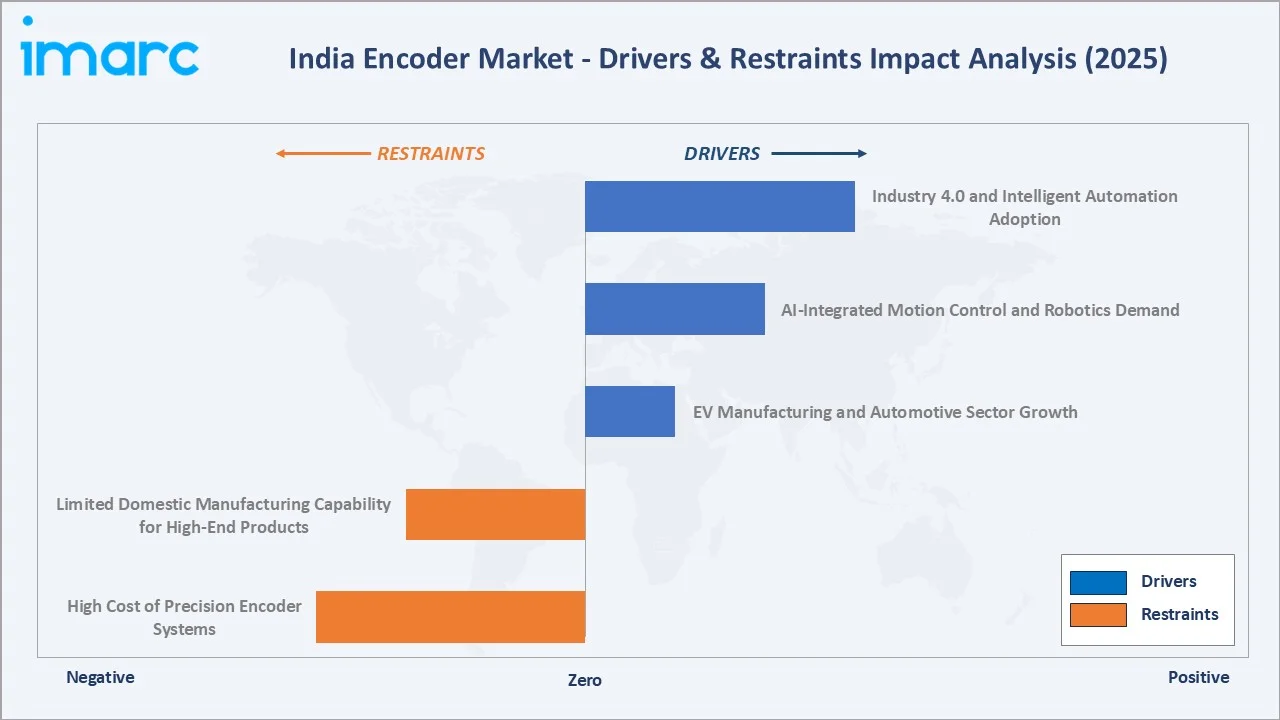
- Industry 4.0 and Intelligent Automation Adoption: India SAMARTH Udyog Bharat 4.0 initiative, the government's Industry 4.0 program under the Ministry of Heavy Industry, is driving technology adoption across Indian manufacturing, creating growing demand for precision encoder feedback systems as manufacturers integrate automated production lines, CNC machine tools, and robotic systems. Industrial robot installations in India reached a new record of 9,120 units in 2024, directly expanding the installed base of encoder-equipped automation equipment.
- AI-Integrated Motion Control and Robotics Demand: Growing adoption of AI-powered robotic systems across automotive assembly, electronics manufacturing, and pharmaceutical production is creating demand for high-resolution encoder feedback that enables precise joint position control, torque monitoring, and real-time motion correction. AI-based diagnostic systems in healthcare are also deploying encoders for imaging equipment positioning accuracy.
- EV Manufacturing and Automotive Sector Growth: India’s electric vehicle (EV) sales increased to 2.66 million units in FY26, compared with 2.05 million units in FY25. Growing electric vehicle production in India, with multiple OEMs establishing domestic EV assembly and battery manufacturing operations, is generating incremental encoder demand for traction motor feedback, battery management, steering control, and precision assembly automation systems that enable the quality-intensive production requirements of EV manufacturing.
Market Restraints
- High Cost of Precision Encoder Systems: High-resolution optical linear and rotary encoders from leading global manufacturers are priced at premium levels that represent significant capital expenditure for small and medium manufacturers. This cost barrier constrains adoption rates among the large base of Indian MSMEs that represent the majority of the manufacturing sector by unit count but operate on limited automation budgets.
- Limited Domestic Manufacturing Capability for High-End Products: While companies manufacture cost-competitive rotary encoders domestically, high-precision linear encoders and absolute multi-turn encoders with sub-micron resolution are almost entirely imported. This limits the ability of the market to offer competitive pricing in the highest-performance encoder segments that are growing fastest.
Market Opportunities
- Medical Device and Healthcare Equipment Manufacturing: Growing domestic medical device manufacturing investment is creating demand for precision encoder systems in imaging equipment, surgical robots, diagnostic laboratory automation, and rehabilitation devices, representing a high-value market segment where encoder specifications and reliability requirements command premium pricing.
- Renewable Energy and Infrastructure Automation: Solar tracker positioning systems, wind turbine yaw and pitch control, and large-scale infrastructure automation are creating new application areas for cost-effective rotary encoders outside traditional manufacturing verticals, expanding the addressable market for encoder products toward renewable energy and civil infrastructure sectors.
Market Challenges
- Competitive Pressure from Low-Cost Asian Imports: Low-cost rotary encoders from Chinese manufacturers compete aggressively on price in the standard industrial segments, constraining the pricing power of both established global brands and domestic manufacturers in applications where ultra-high precision is not required, and cost sensitivity is the primary purchasing criterion.
- Customer Awareness and Application Engineering Gaps: Selecting the optimal encoder type, resolution, and interface protocol for a specific application requires specialized engineering knowledge that many Indian machine builders and end-users lack, leading to sub-optimal encoder specification choices that result in performance issues and negative purchasing experiences.
Emerging Market Trends
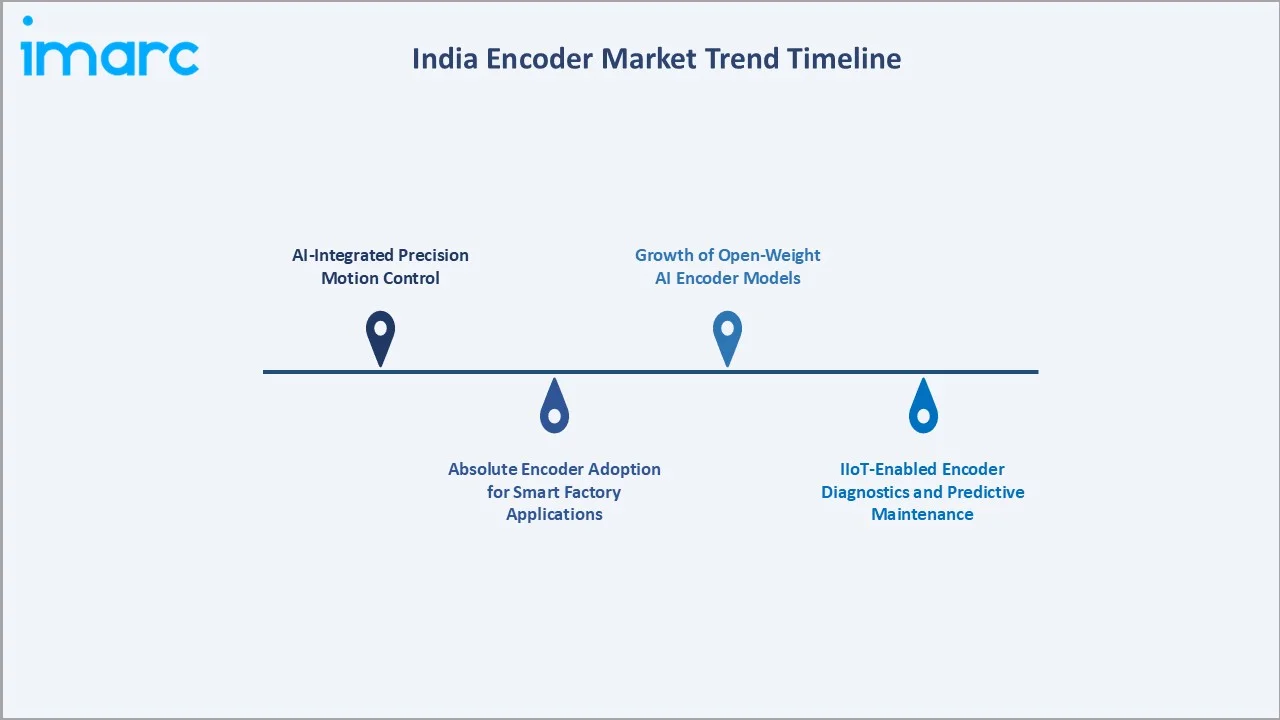
1. AI-Integrated Precision Motion Control
The growing deployment of AI-integrated industrial systems is creating demand for encoders that provide high-frequency, high-resolution feedback data streams compatible with AI-based motion control algorithms. AI-powered robotic cells in automotive and electronics assembly require encoder feedback at sampling rates that enable real-time adaptive motion adjustment, driving demand for high-speed serial communication interface encoders that are progressively replacing traditional analog and parallel digital encoder outputs in new automation system deployments.
2. Absolute Encoder Adoption for Smart Factory Applications
Absolute multi-turn encoders are gaining adoption in India smart factory deployments because they retain position information through power cycles without requiring homing routines, reducing machine downtime and enabling more flexible automated production scheduling. The shift from incremental to absolute encoders is supported by India growing investment in fully automated production cells where operator intervention for homing operations is undesirable, and where integration with factory MES systems requires continuous real-time position data from all axes without reference cycle dependency.
3. Growth of Open-Weight AI Encoder Models
In July 2026, Liquid AI introduced two open-weight bidirectional encoder models, LFM2.5-Encoder-230M and LFM2.5-Encoder-350M, on Hugging Face. Built on the LFM2 architecture, they support 8,192-token contexts, 65,536-token vocabularies, and 15 languages, with the models designed for tasks requiring efficient language understanding. The launch reflects the growing shift toward open-weight, compact AI encoder models that can be customized and deployed for specialized language-understanding applications. Multilingual support and longer context windows are also driving demand for efficient AI models across diverse enterprise and consumer use cases.
4. IIoT-Enabled Encoder Diagnostics and Predictive Maintenance
Smart encoders with embedded diagnostics, temperature monitoring, signal quality assessment, and communication interface health reporting are gaining traction in India Industry 4.0 deployments where predictive maintenance programs require continuous health monitoring of all critical motion control components. Encoder manufacturers are adding IIoT-compatible Ethernet-based communication interfaces and diagnostic output signals that enable plant maintenance teams to track encoder performance degradation and schedule replacement before failure, reducing unplanned downtime costs in continuous production environments.
Industry Value Chain Analysis
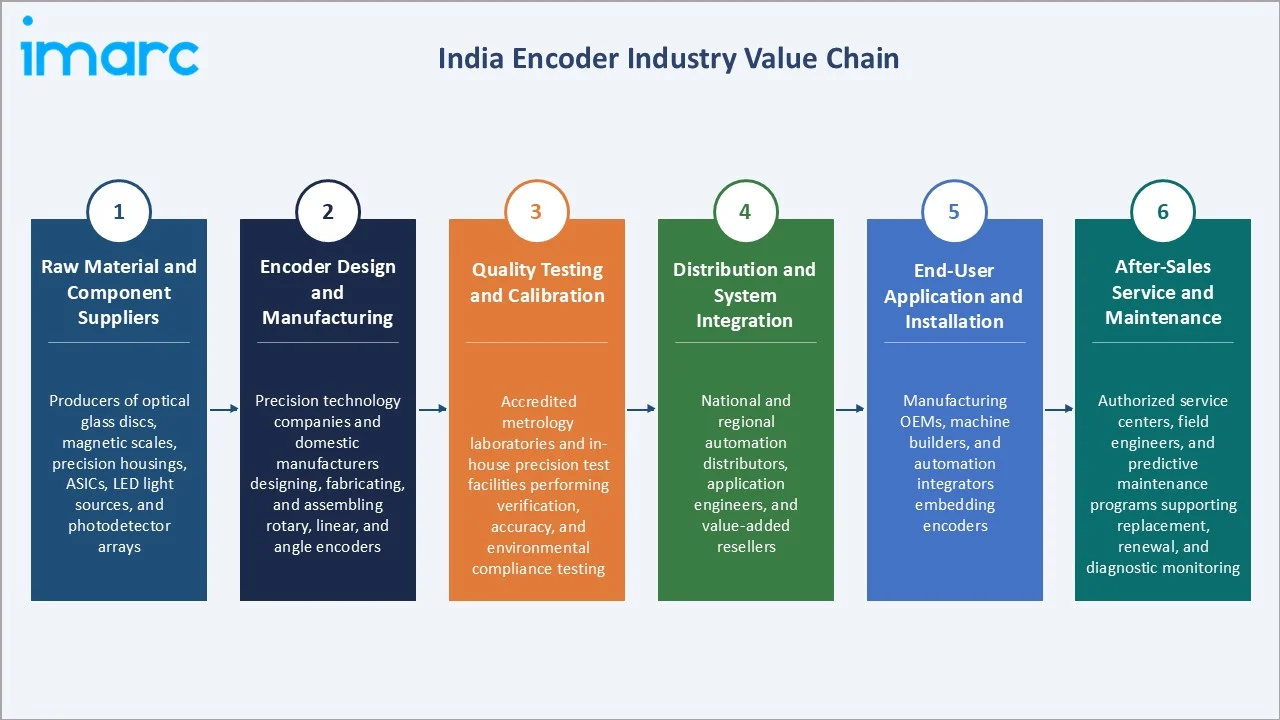
The India encoder market value chain spans six integrated stages from raw material sourcing through end-user maintenance. The encoder design and manufacturing stage captures the highest value addition in the chain, as proprietary optical disc fabrication, precision machining, ASIC development, and signal processing software create durable intellectual property advantages that sustain premium pricing and preferred specification status across global precision motion control applications.
|
Stage |
Key Participants |
|
Raw Material and Component Suppliers |
Producers of optical glass discs, magnetic scales, precision housings, ASICs, LED light sources, and photodetector arrays. |
|
Encoder Design and Manufacturing |
Precision technology companies and domestic manufacturers designing, fabricating, and assembling rotary, linear, and angle encoders. |
|
Quality Testing and Calibration |
Accredited metrology laboratories and in-house precision test facilities performing verification, accuracy, and environmental compliance testing. |
|
Distribution and System Integration |
National and regional automation distributors, application engineers, and value-added resellers. |
|
End-User Application and Installation |
Manufacturing OEMs, machine builders, and automation integrators embedding encoders. |
|
After-Sales Service and Maintenance |
Authorized service centers, field engineers, and predictive maintenance programs supporting replacement, renewal, and diagnostic monitoring. |
The encoder design and manufacturing stage is the highest value-added stage in the value chain. Companies holding proprietary optical disc manufacturing capability, ASIC design IP, and precision calibration technology create product performance advantages that customers specify into machine designs and maintain through long-running procurement programs, delivering durable revenue streams that generic component suppliers cannot replicate.
Technology Landscape in the India Encoder Industry
Optical Encoder Technology
Optical encoder technology demand represents the dominant and highest-performance category, using light-emitting diodes, glass-coded discs, and photodetector arrays to achieve position resolutions down to nanometer levels in linear encoders and arc-second levels in rotary encoders. High-resolution optical encoders are the standard specification for CNC machine tool axes, coordinate measuring machines, semiconductor wafer handling systems, and precision optics manufacturing, all applications requiring the measurement accuracy that optical technology uniquely provides.
Magnetic Encoder Technology
Magnetic encoder technology offers robust operation in harsh industrial environments, including high temperature, vibration, contamination, and humidity conditions where optical encoders are vulnerable to performance degradation. Magnetic encoders using magnetized rings, linear scales, and Hall-effect or magnetoresistive sensor elements are specified for heavy-duty industrial applications, including construction equipment, marine systems, steel plant automation, and outdoor infrastructure, where the encoder installation environment precludes the use of optical sensing technology.
Communication Interface Technology
Modern encoders increasingly feature digital serial communication interfaces that enable high-speed position data transmission, bidirectional diagnostic communication, and direct integration with digital servo drives without analog signal conditioning. The transition from traditional incremental TTL and HTL pulse outputs toward digital serial protocols is accelerating in India new automation system installations, driven by the superior noise immunity, diagnostic capability, and resolution of serial interface encoders.
Market Segmentation Analysis
The report covers the following segments:
|
Segment Category |
Leading Segment |
Market Share |
Year |
|
Technology |
Optical |
62.0% |
2025 |
|
Type |
Rotary Encoder |
72.0% |
2025 |
|
End User |
🔒 |
🔒 |
2025 |
|
Region |
West India |
32.0% |
2025 |

By Type
Rotary encoders dominate at 72.0% in 2025, reflecting their fundamental role as the standard feedback device in all rotary motion control applications. Every servo motor-driven axis in CNC machines, industrial robots, conveyor systems, packaging equipment, printing machinery, and textile machines requires a rotary encoder for position and speed feedback to the drive controller.
To access detailed market analysis, Request Sample
Linear encoders at 28.0% serve the precision linear axis feedback requirements of CNC machine tools, coordinate measuring machines, semiconductor processing equipment, and precision stage systems where the position accuracy of linear motion directly determines the dimensional accuracy of manufactured parts or measurement results.
By Technology
Optical encoders lead at 62.0% in 2025, delivering the highest position resolution and accuracy that precision manufacturing applications require. The optical sensing principle, using light diffraction or transmission through high-resolution glass-coded discs or linear scales, enables position resolutions that magnetic or capacitive alternatives cannot match for the most demanding applications.
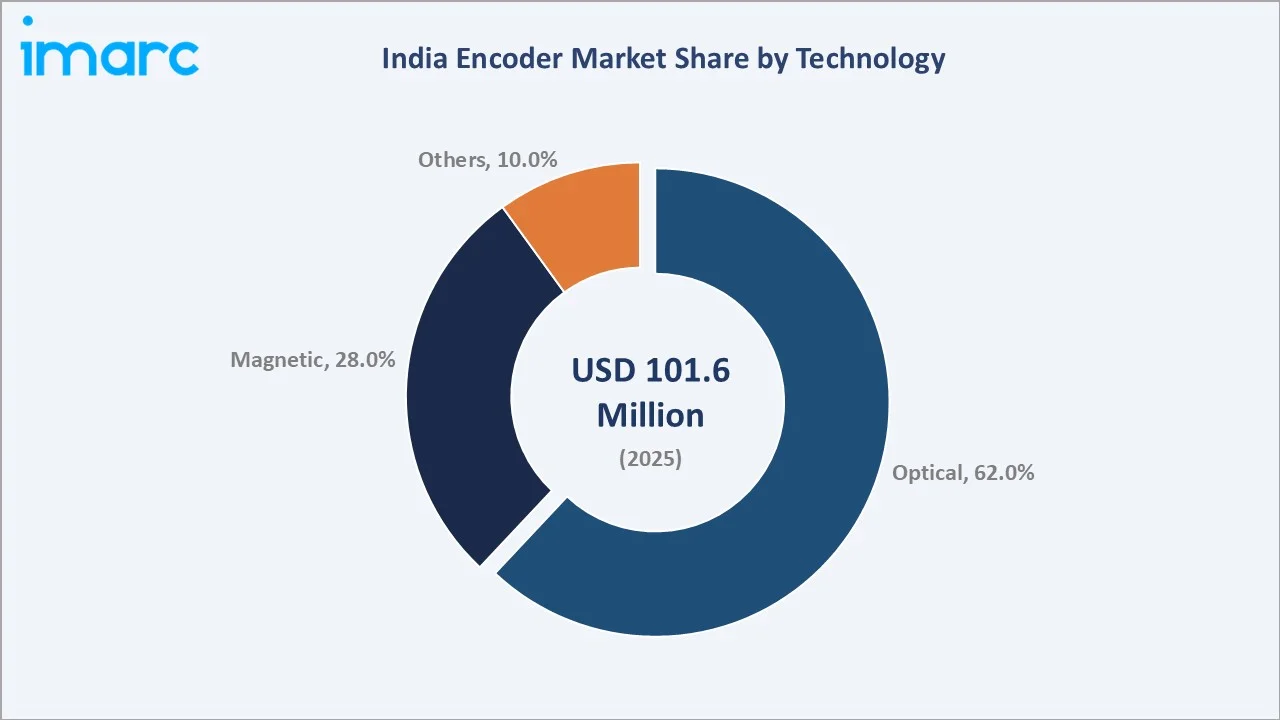
Magnetic encoders at 28.0% serve harsh-environment applications where optical encoders are inappropriate due to contamination, vibration, or temperature extremes. The growing adoption of magnetic encoders in heavy industrial, construction equipment, and outdoor infrastructure automation is expanding this segment beyond its traditional niche into mainstream industrial applications. Others at 10.0% include capacitive, inductive, and hybrid encoder technologies serving specialized application requirements in medical, metrology, and aerospace sectors.
Regional Market Insights
|
Region |
Share (2025) |
Key India Encoder Market Drivers & Characteristics |
|
West India |
32.0% |
Reflecting concentration of automotive OEM assembly plants, precision engineering SMEs, pharmaceutical manufacturing, and industrial corridor development that generate India highest regional density of encoder-consuming automation equipment. |
|
South India |
29.0% |
Reflecting technology and automotive manufacturing base, including vehicle assembly plants, aerospace component manufacturing, electronics production, and a growing robotics integration ecosystem that drives consistent optical and rotary encoder demand. |
|
North India |
23.0% |
Reflecting auto-component manufacturing, machine tool cluster, and textile manufacturing that generate encoder demand across servo drives, CNC machines, and industrial automation systems. |
|
East India |
16.0% |
Reflecting industrial base, growing steel sector automation, mining and heavy industry, and packaging and food processing automation that generate demand for ruggedized industrial encoders. |
West India regional leadership at 32.0% reflects the combination of automotive manufacturing scale, including major passenger vehicle, commercial vehicle, and two-wheeler OEM assembly operations, and the concentration of precision engineering, tooling, and automation companies in the industrial belt that generates India highest regional density of CNC machine tool and servo automation installations requiring encoder feedback systems.
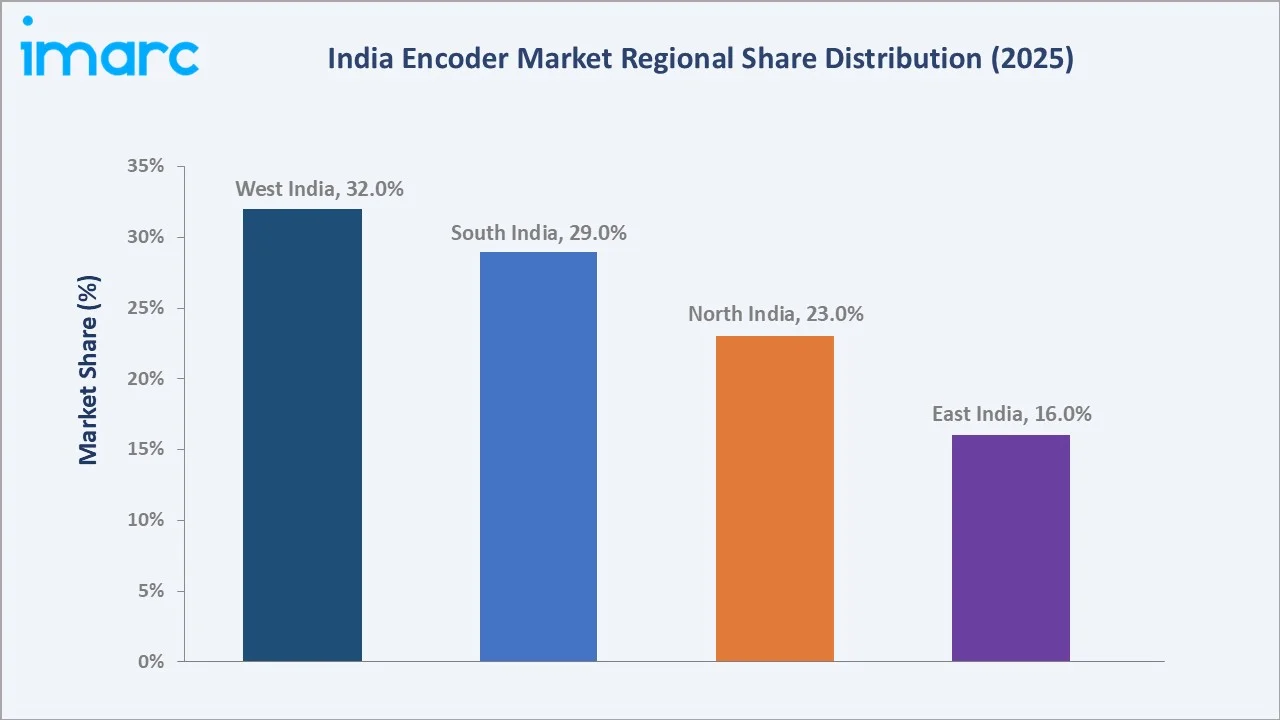
South India at 29.0% benefits from the aerospace and electronics manufacturing ecosystem, automotive cluster, and pharmaceutical and defense manufacturing base, all of which operate high-precision automation equipment with above-average encoder specification requirements. North India at 23.0% draws demand from the machine tool cluster, auto-component manufacturing, and growing factory automation in UP industrial corridors. East India at 16.0% is the smallest regional contributor but is experiencing growth from steel sector automation and new manufacturing investments.
Competitive Landscape
The India encoder market is dominated by subsidiaries and authorized distributors of global precision technology leaders. Domestic manufacturers compete in the cost-competitive rotary encoder segment. Competition is primarily driven by encoder accuracy and resolution specifications, communication interface compatibility, application engineering support quality, and after-sales service capability.
|
Company |
Key Products |
Market Position |
Core Strength |
|
HEIDENHAIN |
Linear encoders, Angle encoders, Rotary encoders |
Market Leader |
HEIDENHAIN encoders measure linear and angular positions with high precision and deliver dynamic motor feedback in demanding industrial applications. |
|
Renishaw plc |
AksIM-2 absolute magnetic encoder, ATOM optical incremental encoders, LinACE absolute magnetic encoder, RM08 miniature rotary magnetic encoder |
Market Leader |
Renishaw plc (operating locally through Renishaw Metrology Systems Ltd) plays a vital role in India's expanding advanced manufacturing, semiconductor, defense, and robotics sectors by providing high-precision position feedback and motion control encoder systems. |
|
OMRON Corporation |
Rotary Encoders |
Established Player |
Omron Corporation encoders convert mechanical rotation into electrical signals to measure speed, position, and direction in industrial systems. |
|
Encoders India Private Limited |
Rotary Encoders, Linear Encoders |
Established Player |
Encoders India Private Limited (EIPL) acts as a primary manufacturer, exporter, and indigenous solution provider for rotary motion transducers and industrial measurement devices in India. |
|
Baumer |
Linear magnetic encoders, Rotary encoders |
Innovator |
Baumer (operating via Baumer Technologies India Pvt. Ltd.) supplies high-precision rotary, heavy-duty, and magnetic encoders to power industrial automation and manufacturing across India. |
The competitive landscape is characterized by strong incumbent positions of global precision technology leaders in high-value CNC and robotics segments, with competitive pressure from cost-effective Asian imports and domestic manufacturers in standard industrial encoder applications. The Industry 4.0 technology transition is creating new competition around digital interface compatibility, IIoT diagnostic capability, and functional safety certification that is differentiating leading global suppliers from commodity alternatives.
Key Company Profiles
HEIDENHAIN
HEIDENHAIN is a technology company specializing in precision measurement and control solutions for industrial applications. Its product portfolio includes linear and rotary encoders, angle encoders, CNC controls, and motion-control systems. The company serves industries such as machine tools, automation, semiconductor manufacturing, and robotics. In India, HEIDENHAIN’s precision encoder technologies support applications requiring accurate position, speed, and motion measurement.
- Key Products: Linear encoders, Angle encoders, Rotary encoders.
- Strategic Focus: Focuses on advancing high-precision encoder and motion-control technologies to support industrial automation, machine tools, robotics, and advanced manufacturing. In India, its strategic focus centers on expanding applications for precision measurement, digital manufacturing, and automated production systems.
Renishaw plc
Renishaw plc is an engineering and technology company specializing in precision measurement, metrology, and manufacturing technologies. Its portfolio includes position encoders, machine-tool probing systems, measurement solutions, and additive manufacturing technologies. The company serves industries including automotive, aerospace, electronics, healthcare, and industrial automation. In India, Renishaw’s encoder and metrology solutions support applications requiring high-accuracy motion measurement and process control.
- Key Products: AksIM-2 absolute magnetic encoder, ATOM optical incremental encoders, LinACE absolute magnetic encoder, RM08 miniature rotary magnetic encoder.
- Strategic Focus: Focuses on developing high-precision encoder and metrology technologies for automation, advanced manufacturing, and motion-control applications. In India, its strategic focus includes supporting precision engineering, machine tools, robotics, and automated manufacturing through advanced measurement solutions.
Market Concentration Analysis
The India encoder market is moderately concentrated, with global precision technology leaders HEIDENHAIN, Renishaw plc, OMRON Corporation, and Baumer, together accounting for the majority of organized market revenue through their India subsidiaries and authorized distributors. These companies dominate the high-precision and industrial automation segments through superior product performance, application engineering support, and long-established customer specification relationships with CNC machine tool OEMs and automation integrators.
The cost-sensitive standard industrial encoder segment is more competitive and fragmented through local automation trading companies. This lower-price segment is experiencing the most intense competitive pressure as Chinese encoder manufacturers increase their product quality and expand India market presence. Market concentration is expected to remain stable at the high-precision end through 2034 as market players maintain their technical specification advantages in CNC and robotic applications, while the standard industrial encoder segment becomes more competitive as domestic manufacturing capabilities improve and the organized distribution networks for alternative brands mature.
Investment & Growth Opportunities
Highest Growth Segments
Optical absolute encoders for CNC machine tools, robotic joint feedback, and semiconductor equipment represent the highest-precision and highest-value growth opportunity within the market, driven by India PLI scheme manufacturing investment and semiconductor fab ambitions. IIoT-enabled smart encoders with diagnostic communication capabilities represent the highest technology differentiation growth segment.
Investment Themes
- Semiconductor and Advanced Manufacturing Encoder Supply: India-approved semiconductor manufacturing investments will create demand for ultra-high-precision optical linear encoders in photolithography, wafer inspection, and precision stage systems. Establishing local distribution, stocking, and technical support capabilities for semiconductor-grade encoder products represents a significant growth opportunity ahead of fab commissioning timelines.
- IIoT and Predictive Maintenance Service Platform Development: Investment in IIoT-enabled encoder product variants and associated remote monitoring and predictive maintenance service platforms creates a recurring revenue model in addition to one-time encoder hardware sales, improving customer retention and creating data-driven competitive differentiation as India manufacturing sector adopts digital factory management systems.
Future Market Outlook (2026-2034)
The India encoder market stood at USD 101.6 Million in 2025 and is projected to grow from USD 108.6 Million in 2026 to USD 184.3 Million by 2034, exhibiting a CAGR of 6.84% during the forecast period. The market is expected to reach an intermediate milestone of approximately USD 141.5 Million by 2030, as PLI scheme manufacturing investments commission production capacity, EV manufacturing scales to commercial volumes, and semiconductor fab projects begin equipment installation programs that generate significant high-precision encoder procurement requirements.
Three structural forces will define India encoder market through 2034. First, the progressive automation of India manufacturing sector will systematically expand the installed base of servo-driven automation equipment that constitutes the primary demand source for rotary and linear encoder feedback systems. Second, the emergence of India as a significant semiconductor manufacturing location and high-technology manufacturing hub will create demand for ultra-high-precision encoder technology that currently has very limited India market presence, opening a new high-value market segment that global precision encoder manufacturers will compete intensively to supply. Third, the digital transformation of India manufacturing sector through Industry 4.0 and IIoT adoption will drive the transition from legacy incremental encoders toward smart absolute encoders with digital serial interfaces, diagnostic capabilities, and safety certifications, improving the average selling price and value per encoder unit installed across India automation equipment base through 2034.
Research Methodology
Primary Research
Primary research comprised structured consultations with encoder product managers and application engineers at India subsidiaries of global manufacturers, domestic encoder producers, industrial automation distributors, CNC machine tool OEM procurement managers, robotic system integrators, and end-user automation engineering teams across India key industrial regions. These discussions validated market sizing, assessed technology adoption trends, identified application growth areas, and provided competitive intelligence on market share dynamics.
Secondary Research
Secondary research drew on IMARC Group market data, India encoder market reports, manufacturing sector investment data, PLI scheme progress reports, company annual reports and product catalogs, industry publications covering Indian and global automation markets, and technical publications on encoder technology development. Historical market data spanning 2020 through 2025 was cross-validated across multiple sources.
Forecasting Models
Market forecasts incorporated historical encoder market growth trends, industrial automation investment projection models based on PLI scheme disbursements and capital goods sector PMI data, application-segment demand modeling for CNC, robotics, EV, and semiconductor verticals, technology mix shift assumptions from incremental to absolute encoder adoption, and macroeconomic indicators including India manufacturing sector GDP growth through 2034.
India Encoder Market Report Coverage:
| Report Features | Details |
|---|---|
| Base Year of the Analysis | 2025 |
| Historical Period | 2020-2025 |
| Forecast Period | 2026-2034 |
| Units | Million USD |
| Scope of the Report |
Exploration of Historical Trends and Market Outlook, Industry Catalysts and Challenges, Segment-Wise Historical and Future Market Assessment:
|
| Technologies Covered | Optical, Magnetic, Others |
| Types Covered | Rotary Encoder, Linear Encoder |
| End Users Covered | Industrial, Consumer Electronics, Textiles, Automotive, Packaging, Food and Beverages, Others |
| Regions Covered | North India, South India, East India, West India |
| Companies Covered | HEIDENHAIN, Renishaw plc, OMRON Corporation, Encoders India Private Limited, Baumer, etc. |
| Customization Scope | 10% Free Customization |
| Post-Sale Analyst Support | 10-12 Weeks |
| Delivery Format | PDF and Excel through Email (We can also provide the editable version of the report in PPT/Word format on special request) |
Key Benefits for Stakeholders:
- IMARC’s industry report offers a comprehensive quantitative analysis of various market segments, historical and current market trends, market forecasts, and dynamics of the India encoder market from 2020-2034.
- The research report provides the latest information on the market drivers, challenges, and opportunities in the India encoder market.
- Porter's five forces analysis assist stakeholders in assessing the impact of new entrants, competitive rivalry, supplier power, buyer power, and the threat of substitution. It helps stakeholders to analyze the level of competition within the India encoder industry and its attractiveness.
- Competitive landscape allows stakeholders to understand their competitive environment and provides an insight into the current positions of key players in the market.
Frequently Asked Questions About the India Encoder Market Report
The India encoder market reached USD 108.6 Million in 2026, driven by industrial automation investment, CNC machine tool adoption, robotic system deployment, and the growing integration of precision motion control across manufacturing sectors.
The market is projected to grow at a CAGR of 6.84% during 2026-2034, supported by Industry 4.0 adoption, PLI scheme manufacturing investment, EV production growth, semiconductor manufacturing ambitions, and progressive smart factory automation deployment.
The market is projected to reach approximately USD 141.5 Million by 2030, driven by PLI scheme capacity commissioning, EV manufacturing automation scale-up, and the early-phase encoder procurement requirements of India semiconductor manufacturing investments.
Rotary encoders lead with a 72.0% share in 2025, reflecting their universal role as the standard feedback device in servo motors, CNC machine tools, industrial robots, and all rotary motion control applications across India manufacturing and automation sectors.
Optical encoders lead with a 62.0% share in 2025, delivering the highest position resolution and accuracy essential for CNC machining, semiconductor equipment, coordinate measuring machines, and precision manufacturing applications where measurement accuracy directly determines product quality.
West India leads with a 32.0% share in 2025, driven by the concentration of automotive OEM assembly, precision engineering, pharmaceutical manufacturing, and industrial automation investment that generates India highest regional density of encoder-consuming equipment.
Key players include HEIDENHAIN, Renishaw plc, OMRON Corporation, Encoders India Private Limited, and Baumer, among others.
The market is projected to reach USD 184.3 Million by 2034, driven by sustained manufacturing automation investment, smart encoder adoption for IIoT and predictive maintenance programs, semiconductor fab equipment encoder requirements, and domestic encoder manufacturing expansion.
Need more help?
- Speak to our experienced analysts for insights on the current market scenarios.
- Include additional segments and countries to customize the report as per your requirement.
- Gain an unparalleled competitive advantage in your domain by understanding how to utilize the report and positively impacting your operations and revenue.
- For further assistance, please connect with our analysts.
 Request Customization
 Speak to an Analyst
 Request Brochure
 Inquire Before Buying
Benefits of Customization
- Personalize this research
- Triangulate with your data
- Get data as per your format and definition
- Gain a deeper dive into a specific application, geography, customer, or competitor
- Any level of personalization
Get in Touch With Us
UNITED STATES
Phone: +1-201-971-6302
INDIA
Phone: +91-120-433-0800
UNITED KINGDOM
Phone: +44-753-714-6104
Email: [email protected]
Client Testimonials























Related Reports

Choose your plan
*Please note that the prices mentioned below are starting prices for each bundle type. Kindly contact our team for further details.*
Single User License
- 1 User License, Access on 2 Devices
- PDF Report + Excel Dataset (Password Protected)
- Lifetime Access
- No Printing Rights
- 10% Free Report Customization
- 10–12 Weeks of Analyst Support
Five User License
- Access for 5 Users, 2 Devices per User
- PDF Report + Excel Dataset (Password Protected)
- Lifetime Access
- Dedicated Account Manager
- 12–14 Weeks of Analyst Support
- No Printing Rights
- 15% Free Report Customization
- 25% Discount on Your Next Purchase
Corporate User License
- Unlimited User Access (Within Your Organization)
- PDF Report + Excel Dataset
- Lifetime Access
- Dedicated Account Manager
- 14–20 Weeks of Analyst Support
- No Printing Rights
- 20% Free Report Customization
- 30% Discount on Your Next Purchase
Essential Insights
What's included:
3 reports
- Lifetime Access
- PDF Reports
- Excel Datasets
- 2 Weeks of Free Analyst Support
- 2 User Licenses
- Access on 2 Devices
- Printing Rights
- Complimentary PowerPoint (PPT) Version
- Complimentary License Upgrade
Professional Access
What's included:
5 reports
- Lifetime Access
- PDF Reports
- Excel Datasets
- 8 Weeks of Free Analyst Support
- 2 User Licenses
- Access on 2 Devices
- Printing Rights
- Complimentary PowerPoint (PPT) Version
- Complimentary License Upgrade
Business Advantage
What's included:
8 reports
- Lifetime Access
- PDF Reports
- Excel Datasets
- 14 Weeks of Free Analyst Support
- 2 User Licenses
- Access on 2 Devices
- Printing Rights
- Complimentary PowerPoint (PPT) Version
- Complimentary License Upgrade
Enterprise Intelligence
What's included:
10 reports
- Lifetime Access
- PDF Reports
- Excel Datasets
- 20 Weeks of Free Analyst Support
- 2 User Licenses
- Access on 2 Devices
- Printing Rights
- Complimentary PowerPoint (PPT) Version
- Complimentary License Upgrade