
India Fabric Wash and Care Market Size, Share, Trends and Forecast by Product Type, Application, Distribution Channel, and Region, 2026-2034
India Fabric Wash and Care Market Summary:
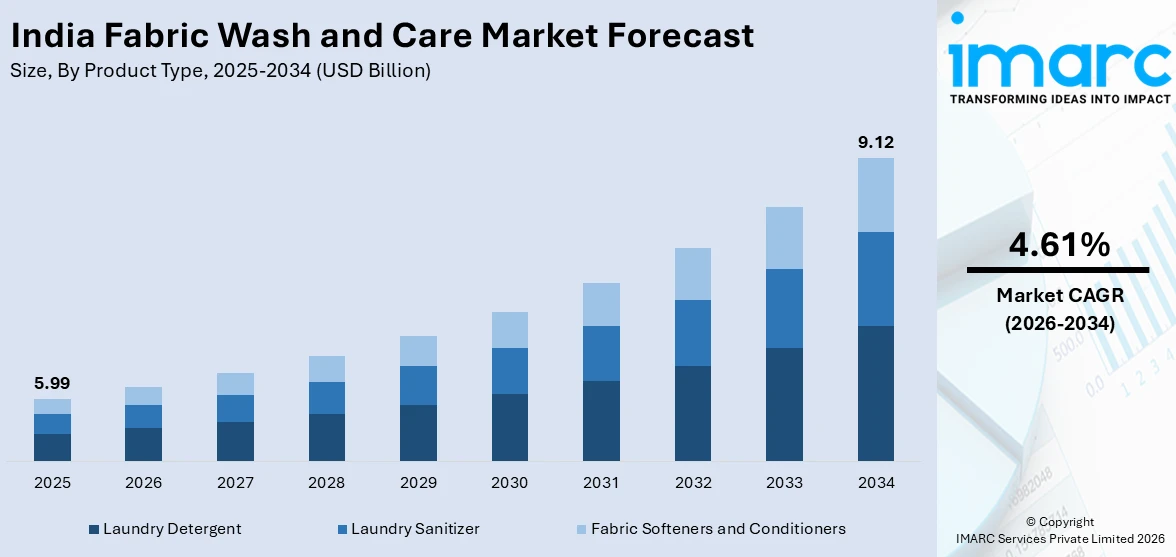
The India fabric wash and care market grew from USD 5.99 Billion in 2025 to USD 6.36 Billion in 2026 and is projected to reach USD 9.12 Billion by 2034, growing at a compound annual growth rate of 4.61% from 2026-2034.
India's fabric wash and care market is expanding steadily, driven by rapid urbanization, rising household incomes, and deepening washing machine penetration across both urban and semi-urban regions. Evolving consumer lifestyles are shifting demand toward premium liquid detergents, fabric conditioners, and antibacterial laundry sanitizers, while growing environmental consciousness is accelerating the adoption of biodegradable and plant-based formulations. The expansion of organized offline retail networks and increasing digital commerce penetration are further broadening product accessibility, sustaining the India fabric wash and care market share.
Key Takeaways and Insights:
- By Product Type: Laundry detergent dominates the market with a share of 77.0% in 2025, driven by its versatility across handwash and machine-wash applications, broad price-point accessibility, and dominant shelf presence in both urban and rural retail outlets.
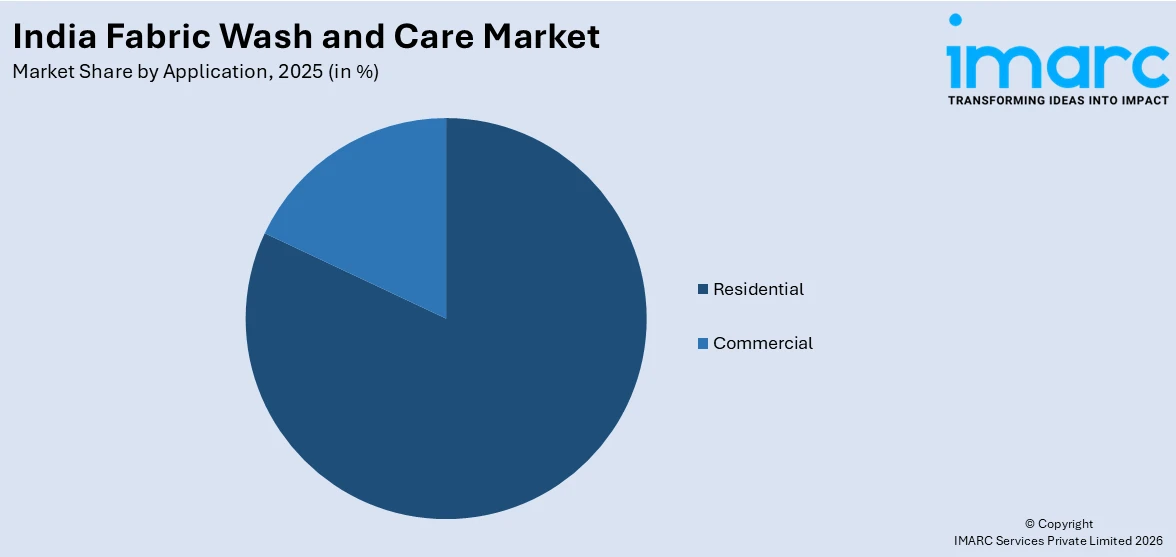
- By Application: Residential leads the market with a share of 82.0% in 2025, reflecting the fundamental, everyday nature of household laundry care across India's diverse population segments and income groups.
- By Distribution Channel: Offline represent the largest share of 86.0% in 2025, underpinned by India's deep-rooted retail infrastructure, strong consumer preference for in-store product selection, and the widespread presence of kirana stores and supermarkets.
- By Region: North India dominates the market with a share of 32.0% in 2025, reflecting the region's high population density, well-developed urban centers, and relatively higher consumer spending on household care products.
- Key Players: The India fabric wash and care market is moderately to highly competitive, with multinational consumer goods corporations and strong domestic players, including value-focused regional brands and premium-positioned global firms, competing across price tiers and product formats.
To get more information on this market Request Sample
India's fabric wash and care market reflects a dynamic interplay between deep-rooted consumption habits and rapidly evolving consumer aspirations. The market is characterized by a vast and heterogeneous consumer base spanning premium urban households, value-conscious semi-urban families, and rural consumers relying on basic detergent bars and powders. The ongoing expansion of the Indian middle class, supported by consistent GDP growth and government-backed financial inclusion programs, is enabling broader access to fabric care products across income tiers. The premiumization trend, driven by increasing household incomes and growing awareness of fabric care and hygiene, is boosting demand for liquid detergents and fabric conditioners. Reflecting this shift, leading brands have introduced high-performance liquid detergents designed to enhance the machine-wash laundry experience, demonstrating strong confidence in the long-term growth potential of the premium fabric care segment. This evolution highlights consumers’ preference for advanced, convenient, and effective laundry solutions that combine superior cleaning performance with gentle fabric care. For instance, in October 2024, Syensqo launched Mirapol Hygiene Boost, a cutting-edge ingredient aimed at addressing growing consumer demand for long-lasting freshness in fabric care. The polymer is engineered to interact effectively with fabric fibers, helping to inhibit the formation of stubborn odors over multiple washes, a challenge often referred to as “permastink.”
India Fabric Wash and Care Market Trends:
Premiumization and Growing Preference for Liquid Detergents
India’s fabric wash and care market is experiencing a strong premiumization trend, as consumers increasingly shift from traditional powder detergents to higher-value liquid formulations. Liquid detergents provide better solubility, are compatible with automatic washing machines, and offer gentler care for fabrics, features that appeal to busy, urban households. Rising consumer focus on quality and convenience is driving demand for premium products. Reflecting this trend, leading brands have been relaunching and upgrading formulations, targeting discerning consumers who prioritize advanced performance and enhanced fabric care in their laundry routines.
Rising Demand for Eco-Friendly and Sustainable Fabric Care
Environmental awareness among Indian consumers is reshaping fabric care purchasing decisions, with growing preference for biodegradable formulations, plant-based surfactants, recyclable packaging, and chemical-free softeners. Regulatory pressure alongside consumer consciousness, particularly among younger urban demographics, is accelerating green product development across the fabric wash segment. For instance, in December 2024, Nirjay Impex Pvt Ltd announced a partnership with Equator Pure Nature to launch the PiPPER STANDARD line of natural and eco-friendly fabric care products in India, reflecting the deepening commercial opportunity in sustainable laundry solutions.
E-Commerce and D2C Expansion Transforming Fabric Care Distribution
Online platforms are transforming how Indian consumers explore and buy fabric care products, fueled by increasing internet access, digital payments, and the convenience of home delivery. Direct-to-consumer approaches and subscription-based detergent services are gaining popularity, allowing brands to connect directly with users while offering exclusive online variants. Leading companies are actively expanding their digital presence, launching products specifically for e-commerce channels, and strengthening dedicated online platforms. This shift reflects a growing trend toward digital-first engagement, enhancing accessibility, personalized offerings, and overall convenience in the fabric care market. For instance, in October 2025, Godrej Enterprises Group’s Appliances Business unveiled its latest innovation, AI-Powered Turbidity Sensing Technology in front-load washing machines. The company emphasizes its commitment to addressing everyday laundry challenges through intelligent, sustainable, and Made-in-India engineering, showcasing a focus on consumer-centric and environmentally conscious product design.
Market Outlook 2026-2034:
India’s fabric wash and care market is poised for steady growth, driven by urbanization, increasing washing machine penetration, and the shift toward premium, high-performance products. Rising consumer focus on hygiene, fabric care, and sustainability is further supporting demand. The retail environment is also evolving, with e-commerce channels expanding rapidly alongside traditional offline outlets, reflecting improving digital infrastructure and changing shopping habits. These trends collectively create a robust and diversified growth trajectory for fabric care products across urban and semi-urban markets. The market generated a revenue of USD 5.99 Billion in 2025, which is expected to reach USD 6.36 Billion in 2026 and further grow to USD 9.12 Billion by 2034, growing at a compound annual growth rate of 4.61% from 2026-2034.
India Fabric Wash and Care Market Report Segmentation:
| Segment Category | Leading Segment | Market Share |
|---|---|---|
|
Product Type |
Laundry Detergent |
77.0% |
|
Application |
Residential |
82.0% |
|
Distribution Channel |
Offline |
86.0% |
|
Region |
North India |
32.0% |
Product Type Insights:
- Laundry Sanitizer
- Laundry Detergent
- Fabric Softeners and Conditioners
Laundry detergent leads the market with a share of 77.0% of the total India fabric wash and care market in 2025.
Laundry detergent commands the dominant position across India's fabric wash and care market, driven by its universal applicability across handwash, semi-automatic, and fully automatic machine-wash cycles. Available in powder, liquid, bar, and increasingly pod formats, laundry detergents address the full spectrum of India's price sensitivity and consumer sophistication. The sustained penetration of detergent bars and powder in rural and semi-urban markets ensures consistent volume demand, while liquid variants capture incremental value from urbanizing middle-class households seeking fabric-friendly, machine-compatible solutions.
Premium product innovation is fueling value growth in the laundry detergent segment. Iconic brands are enhancing traditional detergent offerings with advanced cleaning technologies, moving beyond basic commodity positioning. At the same time, manufacturers are introducing concentrated, enzyme-enriched formulations designed for cold-water and short-cycle washes, catering to consumers seeking efficient, time-saving laundry solutions. These innovations are particularly relevant for urban households, where water and energy conservation are increasingly important, driving demand for high-performance, convenient, and eco-conscious fabric care products that align with modern lifestyles and sustainable living priorities.
Application Insights:
Access the comprehensive market breakdown Request Sample
- Residential
- Commercial
Residential represents the highest revenue share with 82.0% of the total India fabric wash and care market in 2025.
The residential segment forms the backbone of India's fabric wash and care demand, spanning a wide demographic spectrum, from rural households relying on handwashing with basic detergent bars and powders, to urban families using semi-automatic and fully automatic machines and preferring liquid detergents, fabric conditioners, and antibacterial washes. The growing nuclear family structure, rising female workforce participation, and increased time-consciousness among urban consumers are reinforcing demand for convenient, high-performance residential laundry products across diverse geographies.
India’s growing urban population is providing a strong structural boost to the residential fabric care segment, as city dwellers typically spend more on laundry products than rural households. Increasing disposable incomes and a rising middle-income cohort are driving consumers to shift from basic detergent bars to liquid detergents and fabric softeners, prioritizing fabric care and hygiene. Heightened awareness of antibacterial protection and germ-free laundering is also fueling demand for laundry sanitizers, reinforcing growth in the residential category and encouraging manufacturers to expand and innovate their product offerings for urban households.
Distribution Channel Insights:
- Online
- Offline
Offline leads the market with a share of 86.0% of the total India fabric wash and care market in 2025.
Offline channels dominate India's fabric wash and care distribution, underpinned by the country's vast and deeply entrenched retail infrastructure. From neighbourhood kirana stores and general trade outlets in rural and semi-urban areas, to organized supermarkets and hypermarkets in urban centers, offline retail ensures unparalleled product accessibility across all geographies and income segments. Consumer behavior in fabric care, largely habitual and experience-driven, further reinforces physical retail's primacy, where in-store visibility, promotional schemes, and product sampling shape purchase decisions effectively.
While offline channels remain structurally dominant, organized modern trade is strengthening its role in urban fabric care distribution, particularly for premium and new-format products like liquid detergents, fabric conditioners, and laundry sanitizers. Supermarket chains serve as key launch platforms for premium SKUs, enabling brands to secure prominent shelf placement and consumer trial. The offline environment also facilitates bulk and value-pack purchase behavior, which remains prevalent among India's price-conscious middle and lower-income consumer segments, driving consistent volume through traditional trade.
Regional Insights:
- North India
- South India
- East India
- West India
North India represents the largest share with 32.0% of the total India fabric wash and care market in 2025.
North India’s fabric wash and care market is primarily driven by growing urbanization and rising disposable incomes in key states, which are expanding the consumer base for premium and mid-tier detergent and fabric care products. The growing awareness regarding hygiene, longevity of fabrics, and care of garments is making households embrace the use of superior wash detergent, fabric conditioner, and laundry additives. The quick growth of organized retail, modern trade stores, and e-commerce systems is also contributing to the easy availability of a greater variety of products to consumers, which contributes to the increasing demand in both urban and semi-urban areas.
The dynamic shift in lifestyles and more people joining the workforce, particularly women, is growing faster towards adopting convenient and efficient fabric care solutions in North India. An increase in demand for ready-to-use liquid detergents, washing machine-compatible powders, and fabric softeners is in line with a rise in washing appliance penetration. Moreover, the hygiene campaigns led by the government and the increased awareness of cleanliness after the pandemic have increased the demand for antibacterial detergents and laundry sanitizers. All these reasons are leading to steady growth in the region, and manufacturers are now more than ever innovating and creating product portfolios that meet the demands of the North Indian consumer.

Market Dynamics:
Growth Drivers:
Why is the India Fabric Wash and Care Market Growing?
Rapid Urbanization and Rising Disposable Incomes Elevating Fabric Care Standards
India's accelerating urbanization is one of the most consequential structural drivers of the fabric wash and care market. As millions of households transition from rural to urban settings, lifestyle expectations shift significantly, driving increased adoption of washing machines, growing preference for convenient liquid detergents, and heightened interest in specialized fabric care such as softeners and laundry sanitizers. According to World Bank projections, India's urban population is expected to reach approximately 600 million by 2036, equivalent to around 40% of total population, up from 31% in 2011. This demographic shift directly expands the addressable consumer base for mid-to-premium fabric care products. Concurrently, per capita disposable income in India increased by approximately 8% in FY2024, enabling more households to trade up from basic powder detergents and bars to higher-value liquid formulations and fabric conditioners, sustaining the market's consistent value growth over the forecast horizon.
Rising Washing Machine Penetration Driving Demand for Specialized Detergent Formats
The expanding penetration of washing machines across India's urban and semi-urban households is fundamentally reshaping product demand within the fabric wash and care market. As households upgrade from manual handwashing to semi-automatic and fully automatic machines, they require detergents specifically formulated for machine compatibility, including low-sudsing liquid detergents, concentrated powders, and pod formats. Rising adoption of washing machines in urban India has directly boosted the consumption of liquid detergents. Increased appliance usage is creating a feedback loop, where growing demand for specialized detergents encourages manufacturers to develop machine-compatible products. Innovations such as enzyme-enriched formulations and fast-dissolving powders are being introduced to suit high-efficiency washing machines, enhancing cleaning performance while maintaining fabric care. This synergy between appliance penetration and detergent innovation is driving sustained growth in both the laundry appliance and fabric care markets across urban regions.
Government-Led Hygiene Initiatives and Heightened Consumer Health Consciousness
Rising consumer awareness around fabric hygiene, influenced by health concerns and reinforced by national cleanliness initiatives, is driving strong demand for antibacterial detergents, laundry sanitizers, and deep-clean fabric care products across India. Increased focus on personal and household hygiene has led consumers to prioritize products that offer verified antibacterial and antiviral protection, in addition to effective cleaning. Laundry sanitizers have emerged as a rapidly growing segment, catering to clothing worn in shared environments such as schools, workplaces, and public transport. This shift in consumer preference is shaping product innovation and fueling growth in the fabric care market.
Market Restraints:
What Challenges the India Fabric Wash and Care Market is Facing?
Price Sensitivity Limiting Premium Product Penetration
India's fabric wash and care market encounters significant headwinds from the price sensitivity that characterizes a substantial portion of the consumer base, particularly in rural and lower-income urban segments. Despite rising incomes, many households remain anchored to value-tier detergent bars and powders, making premium liquid detergents, fabric softeners, and laundry sanitizers difficult to penetrate without strong promotional support and accessible price-point architecture that balances affordability with performance positioning.
Proliferation of Counterfeit and Substandard Products
The prevalence of counterfeit and substandard fabric care products, particularly in rural and smaller-town markets, poses a persistent challenge for established brands. These unbranded or imitation products are sold at significantly lower price points, eroding market share from genuine brands and creating consumer trust issues that collectively undermine category development. This dynamic restrains value growth potential and forces legitimate manufacturers to invest in anti-counterfeiting measures and consumer education initiatives.
Rising Regulatory Compliance Costs Related to Environmental Standards
India's evolving environmental regulatory landscape, including stricter wastewater treatment norms, chemical use restrictions, and sustainability disclosure requirements, is increasing compliance costs for fabric care manufacturers. Meeting these standards demands investment in reformulation, effluent management infrastructure, and sustainable packaging solutions. These expenses compress margins for mid-tier and regional producers and can temporarily constrain product development speed and pricing competitiveness in already cost-sensitive market segments.
Competitive Landscape:
India's fabric wash and care market is highly competitive, characterized by the coexistence of multinational consumer goods corporations and strong domestic players competing across price tiers, product formats, and distribution channels. The competitive landscape is defined by continuous product innovation, premiumization strategies, and aggressive distribution network expansion into rural and semi-urban markets. Multinational firms pursue premium liquid formulations, sustainable product lines, and machine-compatible innovations, while domestic value players maintain strong positions in detergent bar, powder, and fabric whitener categories. Innovation in eco-friendly formulations, enzyme-based stain removal, fragrance technology, and smart delivery formats is becoming an increasingly important differentiator shaping competitive repositioning across the market.
Recent Developments:
- January 2026: Godrej Appliances highlighted India’s handloom heritage with its ‘Tested for Handlooms’ initiative this Republic Day. Using AI-enabled front-load washing machines, the brand made caring for delicate handloom fabrics easier, encouraging wider use and greater appreciation of traditional textiles.
- December 2024: Hindustan Unilever executed a dual relaunch initiative in India's fabric care segment—relaunching the iconic Rin detergent bar with superior polymer-based cleaning technology while simultaneously overhauling Comfort fabric conditioner with comprehensive formulation and positioning improvements aimed at reinforcing the brand's leadership position.
India Fabric Wash and Care Market Report Coverage:
| Report Features | Details |
|---|---|
| Base Year of the Analysis | 2025 |
| Historical Period | 2020-2025 |
| Forecast Period | 2026-2034 |
| Units | Billion USD |
| Scope of the Report |
Exploration of Historical Trends and Market Outlook, Industry Catalysts and Challenges, Segment-Wise Historical and Future Market Assessment:
|
| Product Types Covered | Laundry Sanitizer, Laundry Detergent, Fabric Softeners and Conditioners |
| Applications Covered | Residential, Commercial |
| Distribution Channels Covered | Online, Offline |
| Regions Covered | North India, South India, East India, West India |
| Customization Scope | 10% Free Customization |
| Post-Sale Analyst Support | 10-12 Weeks |
| Delivery Format | PDF and Excel through Email (We can also provide the editable version of the report in PPT/Word format on special request) |
Frequently Asked Questions About the India Fabric Wash and Care Market Report
The India fabric wash and care market size increased from USD 5.99 Billion in 2025 to USD 6.36 Billion in 2026.
The India fabric wash and care market is expected to grow at a compound annual growth rate of 4.61% from 2026-2034 to reach USD 9.12 Billion by 2034.
Laundry detergent segment dominates the India fabric wash and care market with a 77.0% share in 2025, driven by its versatility across handwash and machine-wash applications, wide price-point availability, and deep penetration across both urban and rural retail channels throughout India.
Key factors driving the India fabric wash and care market include rapid urbanization and rising disposable incomes elevating demand for premium fabric care products, increasing washing machine penetration creating demand for specialized machine-compatible detergent formats, and government-led hygiene initiatives sustaining consumer demand for antibacterial and sanitizing laundry solutions.
Major challenges include persistent price sensitivity limiting premium product penetration in rural and lower-income segments, the proliferation of counterfeit and substandard products eroding established brand market share, and rising environmental regulatory compliance costs increasing operational expenses for fabric care manufacturers across India.
Need more help?
- Speak to our experienced analysts for insights on the current market scenarios.
- Include additional segments and countries to customize the report as per your requirement.
- Gain an unparalleled competitive advantage in your domain by understanding how to utilize the report and positively impacting your operations and revenue.
- For further assistance, please connect with our analysts.
 Request Customization
 Speak to an Analyst
 Request Brochure
 Inquire Before Buying
Benefits of Customization
- Personalize this research
- Triangulate with your data
- Get data as per your format and definition
- Gain a deeper dive into a specific application, geography, customer, or competitor
- Any level of personalization
Get in Touch With Us
UNITED STATES
Phone: +1-201-971-6302
INDIA
Phone: +91-120-433-0800
UNITED KINGDOM
Phone: +44-753-714-6104
Email: [email protected]
Client Testimonials




.webp)




.webp)













Related Reports

Choose your plan
*Please note that the prices mentioned below are starting prices for each bundle type. Kindly contact our team for further details.*
Single User License
- 1 User License, Access on 2 Devices
- PDF Report + Excel Dataset (Password Protected)
- Lifetime Access
- No Printing Rights
- 10% Free Report Customization
- 10–12 Weeks of Analyst Support
Five User License
- Access for 5 Users, 2 Devices per User
- PDF Report + Excel Dataset (Password Protected)
- Lifetime Access
- Dedicated Account Manager
- 12–14 Weeks of Analyst Support
- No Printing Rights
- 15% Free Report Customization
- 25% Discount on Your Next Purchase
Corporate User License
- Unlimited User Access (Within Your Organization)
- PDF Report + Excel Dataset
- Lifetime Access
- Dedicated Account Manager
- 14–20 Weeks of Analyst Support
- No Printing Rights
- 20% Free Report Customization
- 30% Discount on Your Next Purchase
Essential Insights
What's included:
3 reports
- Lifetime Access
- PDF Reports
- Excel Datasets
- 2 Weeks of Free Analyst Support
- 2 User Licenses
- Access on 2 Devices
- Printing Rights
- Complimentary PowerPoint (PPT) Version
- Complimentary License Upgrade
Professional Access
What's included:
5 reports
- Lifetime Access
- PDF Reports
- Excel Datasets
- 8 Weeks of Free Analyst Support
- 2 User Licenses
- Access on 2 Devices
- Printing Rights
- Complimentary PowerPoint (PPT) Version
- Complimentary License Upgrade
Business Advantage
What's included:
8 reports
- Lifetime Access
- PDF Reports
- Excel Datasets
- 14 Weeks of Free Analyst Support
- 2 User Licenses
- Access on 2 Devices
- Printing Rights
- Complimentary PowerPoint (PPT) Version
- Complimentary License Upgrade
Enterprise Intelligence
What's included:
10 reports
- Lifetime Access
- PDF Reports
- Excel Datasets
- 20 Weeks of Free Analyst Support
- 2 User Licenses
- Access on 2 Devices
- Printing Rights
- Complimentary PowerPoint (PPT) Version
- Complimentary License Upgrade