
India False Ceiling Market Size, Share, Trends and Forecast by Material, Cost Range, Installation, Application, and Region, 2026-2034
India False Ceiling Market Summary:
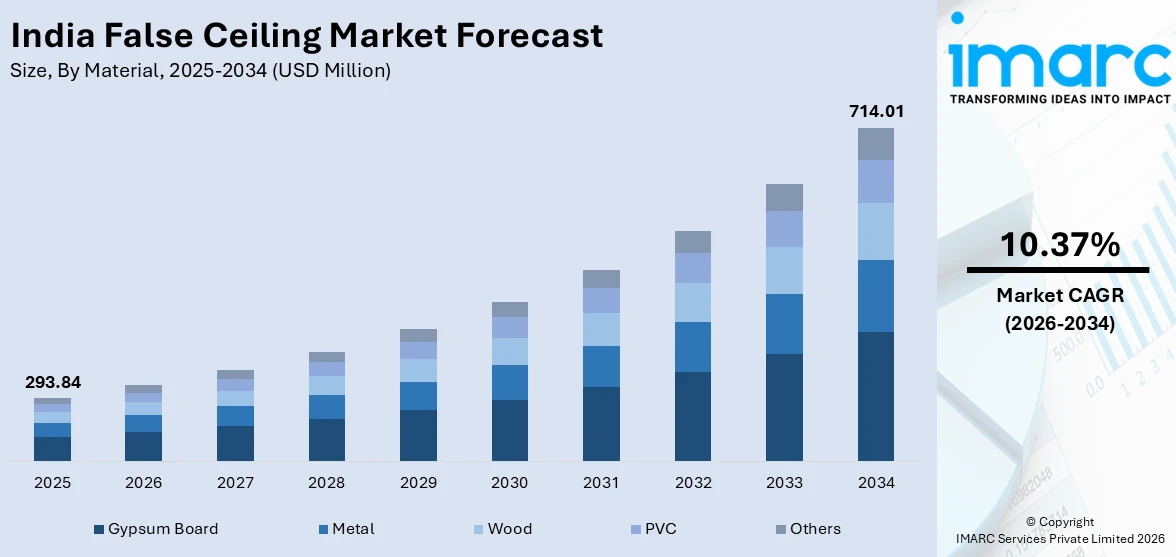
The India false ceiling market size was valued at USD 293.84 Million in 2025 and is projected to reach USD 714.01 Million by 2034, growing at a compound annual growth rate of 10.37% from 2026-2034.
The market growth is primarily driven by India's rapid urbanization and expanding commercial real estate sector, with rising demand for aesthetically appealing and energy-efficient interior solutions across corporate offices, retail spaces, and residential developments. The convergence of government-led infrastructure initiatives, sustainability-focused building practices, and the growing user preference for modular and acoustically optimized ceiling systems is fundamentally reshaping the competitive landscape and contributing to the India false ceiling market share.
Key Takeaways and Insights:
- By Material: Gypsum board dominates the market with a share of 39% in 2025, driven by its lightweight composition, fire-retardant properties, and superior compatibility with LED lighting and HVAC integration in modern commercial and residential spaces.
- By Cost Range: Medium-cost leads the market with a share of 50% in 2025, owing to its optimal balance of quality and affordability that appeals to mid-income residential consumers and cost-conscious commercial developers.
- By Installation: Drywall represents the largest segment with a market share of 35% in 2025, supported by faster construction timelines, cleaner installation processes, and the growing adoption in corporate office fit-outs.
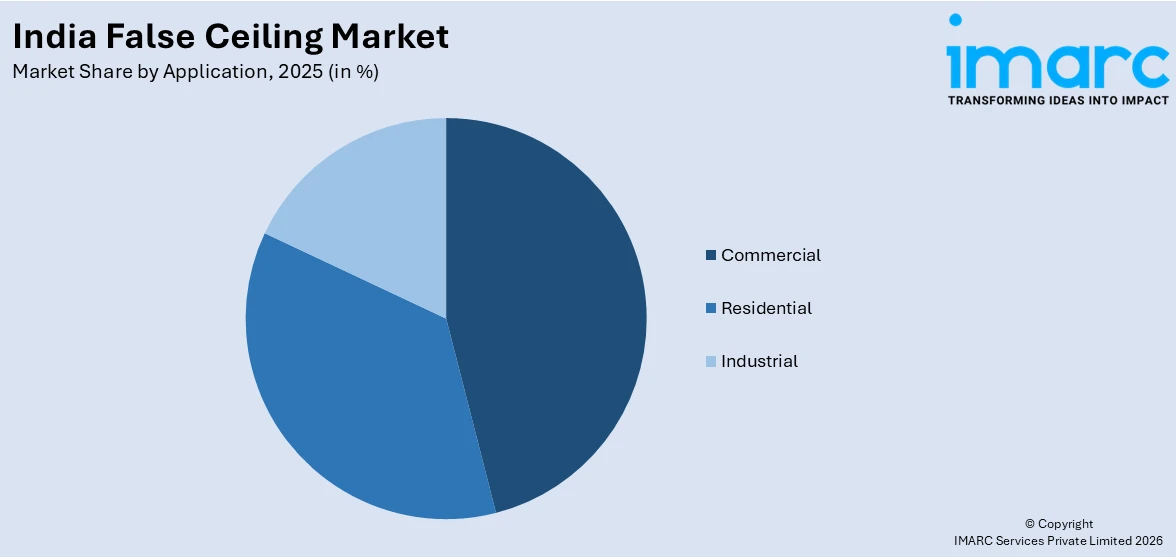
- By Application: Commercial dominates the market with a share of 46% in 2025, fueled by unprecedented office space expansion and retail infrastructure development across metropolitan and tier-II cities.
- Key Players: The India false ceiling market exhibits a moderately fragmented competitive landscape, with established multinational building material corporations competing alongside regional manufacturers across diverse material and price segments.
To get more information on this market Request Sample
The Indian false ceiling market is advancing steadily as structural changes in construction patterns, rising urban aspirations, and improving household incomes reshape interior design priorities. The growing preference for organized, visually refined, and functionally efficient indoor spaces is encouraging wider adoption of modern ceiling systems across residential and commercial developments. Higher disposable incomes are enabling property buyers and tenants to allocate greater budgets toward aesthetic upgrades and comfort-enhancing features, such as integrated lighting and acoustic solutions. Reflecting this shift, the Ministry of Statistics reported that per capita Net National Income increased to INR 2,05,324 in FY2024–25 from INR 1,88,892 in FY2023–24, signaling stronger purchasing power. As individual spending capacity expands, demand for premium finishes and value-added interior components rises correspondingly. This income-led improvement in spending behavior is reinforcing the role of false ceilings as a standard feature in contemporary construction and renovation projects across urban India.
India False Ceiling Market Trends:
Increasing Focus on Energy Efficiency
The increasing emphasis on energy-efficient and sustainable construction practices is driving the adoption of advanced false ceiling systems in India. Ceiling installations contribute to improved thermal insulation, optimized air circulation, and integration of energy-efficient lighting, thereby reducing overall building energy usage. Developers are aligning material choices with green building norms and indoor environmental quality standards to achieve long-term operational savings. This focus is reflected in 2025 when Knauf India introduced DewBloc Gypsum Plasterboard, a moisture-resistant solution for drywall and ceiling applications certified under IS 2095 (Part 1): 2023 Type H2 and BS EN 520:2004 standards. Designed for high-humidity environments, the lightweight and eco-friendly board supports durable performance and energy-conscious construction across residential and commercial developments.
Product Diversification and Innovation in Decorative Ceiling Solutions
Manufacturers are introducing advanced wall and ceiling panel systems that combine aesthetic appeal with durability and low maintenance, catering to evolving architectural preferences. The demand for versatile materials suitable for both indoor and outdoor applications is increasing across residential and commercial developments. In line with this trend, in 2024, VOX India expanded its portfolio with the launch of three new wall and ceiling panels, including Infratop Four Lamella SV26, Fronto SV24, and Welo SV22. The panels were designed for residential and commercial spaces, offering modern aesthetics, durability, and low maintenance for indoor and outdoor use. Such product diversification reflects the industry’s response to rising demand for sustainable, design-oriented building materials, thereby strengthening competitive differentiation and supporting market expansion.
Rise of Renovation and Interior Refurbishment Activities
The growing renovation and refurbishment activities across residential, commercial, and public infrastructure segments are catalyzing the demand for false ceiling in India. Property owners and authorities are upgrading interiors to enhance functionality, lighting efficiency, and overall visual appeal without undertaking major structural reconstruction. False ceilings provide a practical solution for concealing services, improving acoustics, and modernizing ageing spaces in a cost-effective manner. This trend is evident in 2025, when the Delhi government announced plans to launch over 100 Urban Ayushman Arogya Mandirs, with renovation works across 108 identified sites including plastering, waterproofing, tile upgrades, and false ceiling installations. Such large-scale refurbishment initiatives underscore the recurring demand generated by periodic interior modernization across urban facilities.
Market Outlook 2026-2034:
The India false ceiling market demonstrates strong growth potential throughout the forecast period, underpinned by sustained commercial construction activity, government-led infrastructure initiatives, and rising user preference for modern interior solutions. The market generated a revenue of USD 293.84 Million in 2025 and is projected to reach a revenue of USD 714.01 Million by 2034, growing at a compound annual growth rate of 10.37% from 2026-2034. The growth trajectory is supported by increasing adoption of gypsum-based and modular ceiling systems across commercial, residential, and industrial applications, alongside accelerating urbanization in tier-II and tier-III cities driving new construction and renovation activity nationwide.
India False Ceiling Market Report Segmentation:
| Segment Category | Leading Segment | Market Share |
|---|---|---|
|
Material |
Gypsum Board |
39% |
|
Cost Range |
Medium-Cost |
50% |
|
Installation |
Drywall |
35% |
|
Application |
Commercial |
46% |
Material Insights:
- Gypsum Board
- Metal
- Wood
- PVC
- Others
The gypsum board exhibits a clear dominance with a 39% share of the total India false ceiling market in 2025.
Gypsum board leads the market because of its lightweight structure, ease of installation, and cost effectiveness. It allows faster project completion compared to traditional plaster-based ceilings, making it suitable for residential, commercial, and institutional buildings. The material offers a smooth finish that supports various design treatments, including paint, texture, and decorative elements. Gypsum board also provides fire resistance and basic sound insulation, meeting building safety requirements in urban developments. With rapid construction growth across metros and tier two cities, contractors prefer gypsum systems for their consistent quality and ready availability through organized supply chains.
Gypsum board is further favored for its adaptability in modern interior layouts, including concealed lighting and HVAC integration. The material allows customized layouts across offices, retail outlets, and hospitality spaces while offering lower maintenance and improved indoor thermal performance compared to alternatives. Stable domestic production further supports consistent supply and competitive pricing. Reflecting the growing emphasis on sustainability, in 2024,Saint-Gobain Gyproc India began manufacturing low-carbon gypsum plasters at its Tiruvallur facility, achieving over 40% reduction in Global Warming Potential, reinforcing gypsum’s relevance in environmentally responsible construction practices.
Cost Range Insights:
- Low-Cost
- Medium-Cost
- High-Cost
The medium-cost dominates with a market share of 50% of the total India false ceiling market in 2025.
Medium-cost holds the biggest market share driven by its balance between affordability and design appeal. Homeowners, offices, retail outlets, and educational institutions often seek solutions that enhance aesthetics without significantly increasing project budgets. Medium cost options, commonly using gypsum board and standard metal grid systems, provide durability, acceptable acoustic performance, and fire resistance at reasonable prices. These systems are suitable for both new constructions and renovation projects, expanding their addressable base. Builders prefer this range as it aligns with mid segment housing and commercial developments, which account for a substantial share of overall construction activity.
The segment also benefits from the growing urbanization and rising demand for organized residential projects in tier one and tier two cities. Developers targeting middle income buyers focus on functional yet visually appealing interiors, driving adoption of medium cost ceiling solutions. Standardized installation processes and widespread availability of materials reduce labor and procurement challenges. Medium-cost ceilings offer faster turnaround and lower maintenance expenses, improving overall project feasibility. Contractors can customize designs within controlled budgets, making this range suitable for apartments, offices, and retail chains. This widespread applicability secures its leading position in the India false ceiling market.
Installation Insights:
- Drywall
- Suspended
- Stretch Ceilings
- Others
The drywall leads with a market share of 35% of the total India false ceiling market in 2025.
Drywall represents the largest segment owing to its speed, efficiency, and minimal on-site complexity. Prefabricated gypsum boards mounted on metal frameworks allow quicker completion compared to traditional wet plaster methods. This reduces construction timelines, which is critical for commercial projects, offices, and retail spaces operating under tight schedules. Drywall generates less dust and requires limited curing time, enabling faster finishing and occupancy. Contractors favor this method as it demands standardized tools and trained labor that are widely available across urban centers. Its adaptability to different ceiling heights and layouts further strengthens preference.
Drywall installation also supports seamless integration of lighting fixtures, air conditioning ducts, and fire safety systems, making it suitable for modern building designs. This method enables seamless integration of lighting, HVAC ducts, and fire safety infrastructure while ensuring uniform surface finish and structural consistency across large spaces. Its predictable costs and established supply chains make it suitable for commercial complexes, IT parks, healthcare facilities, and organized housing developments. Reflecting growing industry focus, in 2025, Gyproc India launched “Beyond Dimensions,” a national design challenge promoting sustainable interior solutions using advanced drywall technology, reinforcing innovation and wider adoption across architectural communities.
Application Insights:
Access the comprehensive market breakdown Request Sample
- Commercial
- Residential
- Industrial
The commercial exhibits a clear dominance with a 46% share of the total India false ceiling market in 2025.
Commercial leads the market due to sustained development of office spaces, retail outlets, hospitality projects, and healthcare facilities. For example, in 2025, Suraj Estate Developers launched One Business Bay, a Grade-A commercial project on Senapati Bapat Marg in Mumbai with an estimated GDV of INR 1,200 Crore, featuring 182 office units along with retail, dining and breakout spaces. These establishments require functional ceilings that accommodate lighting systems, air conditioning ducts, fire sprinklers, and acoustic solutions. False ceilings enhance interior aesthetics while concealing structural elements, making them essential in modern commercial design. Developers prioritize materials that ensure durability, fire resistance, and sound control to meet regulatory and operational requirements.
Commercial spaces also undergo periodic renovation and layout modifications, driving recurring demand for ceiling replacements and upgrades. Corporate offices and branded retail chains invest in visually consistent interiors to strengthen customer experience and brand identity. Acoustic performance is particularly important in conference rooms, hospitals, hotels, and educational institutions, further supporting adoption. Larger project sizes result in bulk procurement of ceiling materials, strengthening supplier relationships and organized distribution channels. Compared to individual housing units, commercial buildings require more extensive ceiling coverage per project. This higher installation intensity secures commercial application as the leading segment in the India false ceiling market.
Regional Insights:
- North India
- South India
- East India
- West India
North India holds a significant share in the India false ceiling market driven by rapid urban development in Delhi NCR, Punjab, and Haryana. Expansion of commercial complexes, educational institutions, and healthcare facilities supports steady demand. Growth in organized housing projects and renovation activities further contributes to increased adoption of gypsum and drywall ceiling systems across major cities.
South India represents a strong market supported by IT parks, corporate offices, and retail expansion in cities, such as Bengaluru, Chennai, and Hyderabad. High commercial construction activity and rising premium residential developments drive installation demand. Preference for modern interior designs and efficient cooling solutions further strengthens false ceiling adoption across the region.
East India is witnessing growth in the false ceiling market due to infrastructure development and urban expansion in Kolkata and surrounding cities. Increasing investments in commercial buildings, hospitality projects, and institutional spaces are supporting demand. Rising awareness about aesthetic interiors and organized retail growth contribute to steady regional market demand.
West India is a crucial segment in the market owing to large scale commercial and residential construction in Maharashtra and Gujarat. Mumbai and Pune drive significant installation volumes across offices, malls, and housing complexes. Strong developer presence, infrastructure projects, and renovation trends support consistent adoption of gypsum and drywall ceiling systems in the region.
Market Dynamics:
Growth Drivers:
Why is the India False Ceiling Market Growing?
Digitalization of Interior Execution and Service Transparency
The increasing digitalization of interior design and execution services is supporting the growth of the India false ceiling market by improving accessibility, transparency, and project efficiency. Technology-enabled platforms are streamlining contractor selection, cost estimation, and workflow management, reducing uncertainty for homeowners and commercial clients. Structured execution models help address delays, pricing inconsistencies, and labor coordination challenges that traditionally affect interior projects. For example, in 2025, Pune-based SEEB Design Private Limited launched the SEEB platform, enabling users to book more than 200 interior services, including gypsum false ceiling installations, with transparent pricing and real-time progress tracking. Such digital integration enhances customer confidence, accelerates project completion, and encourages wider adoption of organized false ceiling solutions across residential and commercial segments.
Growth in Commercial Real Estate and Office Spaces
Office spaces, retail environments, and hospitality establishments increasingly require organized, brand-aligned interiors that support employee comfort and operational efficiency. False ceilings enable seamless integration of HVAC systems, concealed cabling, lighting grids, and acoustic solutions, making them essential in contemporary workspace design. This trend is reinforced by the growth of flexible office formats, as seen in 2026, when House of Hiranandani entered the co-working segment with a 160-seat pilot facility at Hiranandani Gardens, Powai, with plans to scale to 500 seats and expand to other locations. Such developments highlight rising demand for adaptable, professionally finished interior spaces across major business districts.
Rising Residential Construction and Housing Demand
The increasing preference for well-designed and functionally optimized residential interiors is supporting the growth of the India false ceiling market. Homebuyers are seeking enhanced lighting layouts, concealed service lines, and improved acoustic and thermal comfort within modern housing developments. Developers are responding by integrating refined ceiling systems as part of premium interior specifications to strengthen property positioning. Reflecting this direction, in 2026, Brigade Enterprises Ltd launched ‘Brigade Stellaris’ on a 5.19-acre site along Velachery Road, Chennai, offering signature residences with contemporary amenities and sustainable design features. Such large-scale premium housing projects highlight how aesthetic detailing and interior finishing elements, including false ceilings, are becoming standard components in urban residential construction across expanding metropolitan and semi-urban regions.
Market Restraints:
What Challenges the India False Ceiling Market is Facing?
Raw Material Price Volatility and Import Dependency Constraints
Fluctuations in raw material costs, particularly for gypsum, aluminum, and PVC, create pricing instability that constrains market growth and compresses manufacturer margins. India's partial reliance on imported gypsum and specialized ceiling components exposes the industry to global commodity price variations and currency exchange fluctuations, making consistent pricing strategies challenging for both manufacturers and end users.
Shortage of Skilled Installation Workforce Across Emerging Markets
The false ceiling industry faces a persistent shortage of trained installation professionals, particularly in tier-II and tier-III cities where construction activity is accelerating. Drywall and suspended ceiling installations require specialized technical knowledge regarding metal framing alignment, acoustic sealing, and integration with building services. This skills gap results in inconsistent installation quality, project delays, and increased labor costs that collectively impede broader market penetration.
Continued Preference for Traditional Plastered Ceilings in Semi-Urban Areas
Deeply entrenched construction practices favoring conventional plaster-of-Paris and cement plastered ceilings remain prevalent across semi-urban and rural India, limiting false ceiling adoption. Many small-scale contractors and homeowners perceive false ceilings as unnecessary premium additions rather than functional building components, while limited user awareness about acoustic, thermal, and energy-efficiency benefits reduces willingness to invest in modern ceiling solutions.
Competitive Landscape:
The India false ceiling market exhibits a moderately fragmented competitive landscape characterized by the presence of established multinational building material corporations alongside a diverse ecosystem of regional and local manufacturers. Market dynamics reflect strategic positioning across material categories, with key participants differentiating through product innovation, sustainability credentials, distribution network expansion, and technical service capabilities. The competitive environment is increasingly shaped by green building compliance requirements, modular system development, and digital marketing strategies targeting architects, interior designers, and construction professionals. Premium segment competition centers on advanced acoustics, fire ratings, and smart building integration, while the mid-market and value segments are driven by cost optimization, supply chain efficiency, and geographic distribution reach across India's rapidly expanding urban construction landscape.
Recent Developments:
- December 2025: The inaugural ZAK Walls & Ceilings Expo will be held at the Bombay Exhibition Centre in Mumbai as India’s first dedicated exhibition for walls and ceiling systems. Organized by Zak Trade Fairs & Exhibitions, the four-day event showcased drywall technologies, gypsum boards, metal and PVC ceilings, acoustic panels and related construction solutions. Co-located with glass, doors, windows and aluminum expos, the event aimed to connect architects, developers, contractors and manufacturers for networking and business growth.
- September 2025: Saint-Gobain Gyproc India inaugurated a skill training center at ITI Sambhaji Nagar to develop talent in drywall and false ceiling trades. Set up in collaboration with the institute, the facility planned to offer structured vocational training in lightweight and gypsum-based construction. The initiative aimed to equip students with hands-on skills aligned with modern construction practices and industry requirements.
India False Ceiling Market Report Coverage:
| Report Features | Details |
|---|---|
| Base Year of the Analysis | 2025 |
| Historical Period | 2020-2025 |
| Forecast Period | 2026-2034 |
| Units | Million USD |
| Scope of the Report |
Exploration of Historical Trends and Market Outlook, Industry Catalysts and Challenges, Segment-Wise Historical and Future Market Assessment:
|
| Materials Covered | Gypsum Board, Metal, Wood, PVC, Others |
| Cost Ranges Covered | Low-Cost, Medium-Cost, High-Cost |
| Installations Covered | Drywall, Suspended, Stretch Ceilings, Others |
| Applications Covered | Commercial, Residential, and Industrial |
| Regions Covered | North India, South India, East India, West India |
| Customization Scope | 10% Free Customization |
| Post-Sale Analyst Support | 10-12 Weeks |
| Delivery Format | PDF and Excel through Email (We can also provide the editable version of the report in PPT/Word format on special request) |
Frequently Asked Questions About the India False Ceiling Market Report
The India false ceiling market size was valued at USD 293.84 Million in 2025.
The India false ceiling market is expected to grow at a compound annual growth rate of 10.37% from 2026-2034 to reach USD 714.01 Million by 2034.
The gypsum board dominates the India false ceiling market with 39% revenue share in 2025, driven by its lightweight composition, fire-retardant properties, and compatibility with modern commercial and residential interior specifications.
Key factors driving the India false ceiling market include the rising focus on energy-efficient and sustainable construction, supported by advanced materials such as Knauf India’s 2025 DewBloc Gypsum Plasterboard, certified under IS 2095 (Part 1): 2023 Type H2 and BS EN 520:2004 standards for moisture-resistant applications.
Major challenges include raw material price volatility and import dependency for specialized components, shortage of skilled installation professionals particularly in tier-II and tier-III cities, continued consumer preference for traditional plastered ceilings in semi-urban areas, and limited awareness about acoustic and energy-efficiency benefits among smaller construction segments.
Need more help?
- Speak to our experienced analysts for insights on the current market scenarios.
- Include additional segments and countries to customize the report as per your requirement.
- Gain an unparalleled competitive advantage in your domain by understanding how to utilize the report and positively impacting your operations and revenue.
- For further assistance, please connect with our analysts.
 Request Customization
 Speak to an Analyst
 Request Brochure
 Inquire Before Buying
Benefits of Customization
- Personalize this research
- Triangulate with your data
- Get data as per your format and definition
- Gain a deeper dive into a specific application, geography, customer, or competitor
- Any level of personalization
Get in Touch With Us
UNITED STATES
Phone: +1-201-971-6302
INDIA
Phone: +91-120-433-0800
UNITED KINGDOM
Phone: +44-753-714-6104
Email: [email protected]
Client Testimonials




.webp)




.webp)













Related Reports

Choose your plan
*Please note that the prices mentioned below are starting prices for each bundle type. Kindly contact our team for further details.*
Single User License
- 1 User License, Access on 2 Devices
- PDF Report + Excel Dataset (Password Protected)
- Lifetime Access
- No Printing Rights
- 10% Free Report Customization
- 10–12 Weeks of Analyst Support
Five User License
- Access for 5 Users, 2 Devices per User
- PDF Report + Excel Dataset (Password Protected)
- Lifetime Access
- Dedicated Account Manager
- 12–14 Weeks of Analyst Support
- No Printing Rights
- 15% Free Report Customization
- 25% Discount on Your Next Purchase
Corporate User License
- Unlimited User Access (Within Your Organization)
- PDF Report + Excel Dataset
- Lifetime Access
- Dedicated Account Manager
- 14–20 Weeks of Analyst Support
- No Printing Rights
- 20% Free Report Customization
- 30% Discount on Your Next Purchase
Essential Insights
What's included:
3 reports
- Lifetime Access
- PDF Reports
- Excel Datasets
- 2 Weeks of Free Analyst Support
- 2 User Licenses
- Access on 2 Devices
- Printing Rights
- Complimentary PowerPoint (PPT) Version
- Complimentary License Upgrade
Professional Access
What's included:
5 reports
- Lifetime Access
- PDF Reports
- Excel Datasets
- 8 Weeks of Free Analyst Support
- 2 User Licenses
- Access on 2 Devices
- Printing Rights
- Complimentary PowerPoint (PPT) Version
- Complimentary License Upgrade
Business Advantage
What's included:
8 reports
- Lifetime Access
- PDF Reports
- Excel Datasets
- 14 Weeks of Free Analyst Support
- 2 User Licenses
- Access on 2 Devices
- Printing Rights
- Complimentary PowerPoint (PPT) Version
- Complimentary License Upgrade
Enterprise Intelligence
What's included:
10 reports
- Lifetime Access
- PDF Reports
- Excel Datasets
- 20 Weeks of Free Analyst Support
- 2 User Licenses
- Access on 2 Devices
- Printing Rights
- Complimentary PowerPoint (PPT) Version
- Complimentary License Upgrade