India Farm Implements Market Size, Share, Trends and Forecast by Type, Application, and Region, 2026-2034

India Farm Implements Market Size, Share, Trends and Forecast by Type, Application, and Region, 2026-2034

Report Format: PDF+Excel | Report ID: SR112026A29591

India Farm Implements Market Size, Share, Trends & Forecast (2026-2034)

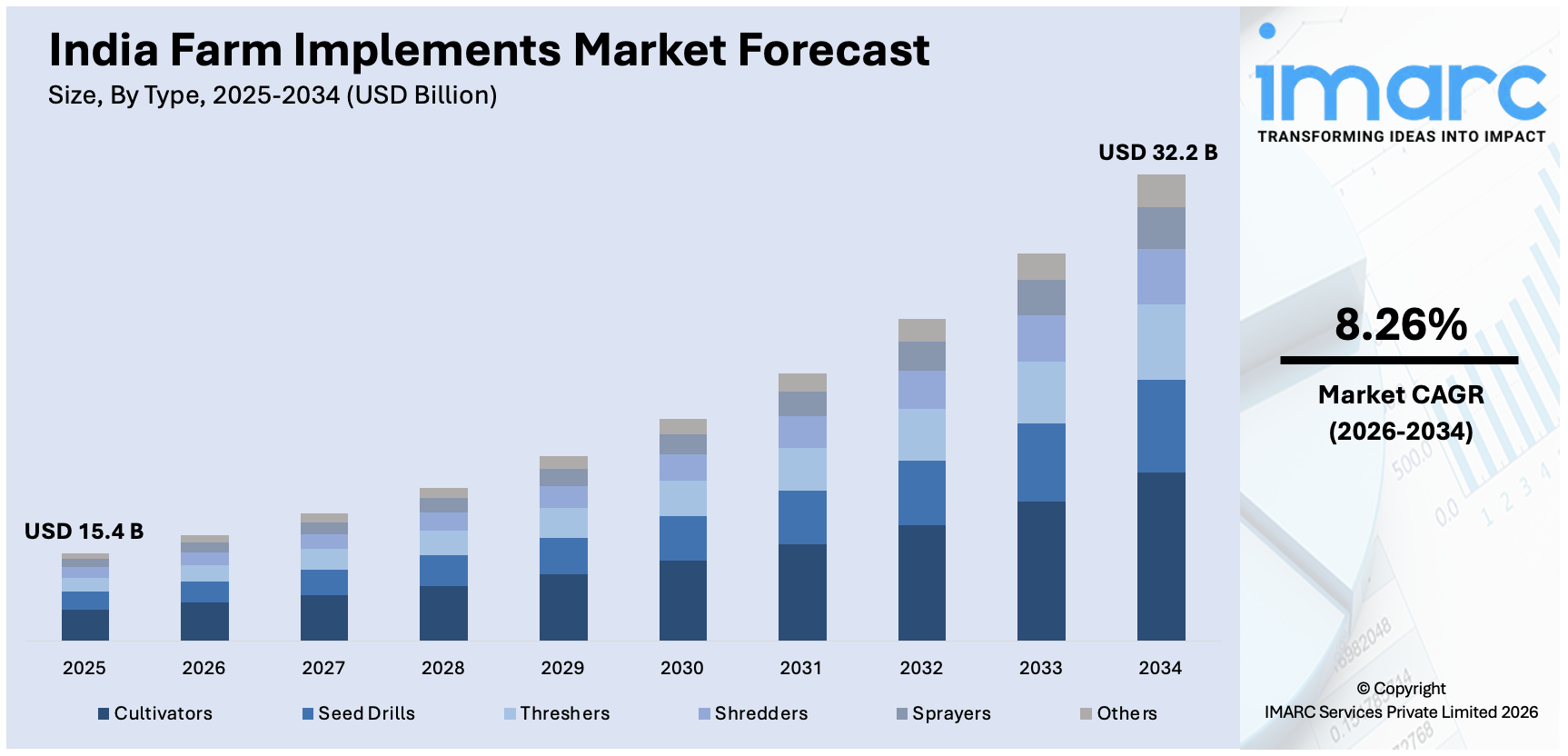
The India farm implements market reached USD 15.42 Billion in 2025 and is projected to reach USD 32.17 Billion by 2034, growing at a CAGR of 8.26% during 2026-2034. The market is driven by rural labor scarcity, government subsidies under SMAM and PM-KISAN, rising farmer income, and precision farming technology adoption. Cultivators dominate by type at 28.5%. Plowing and Cultivating leads application at 30.5%. North India commands 32.5% of the market share.

Market Snapshot

Metric

Value

Market Size (2025)

USD 15.42 Billion

Forecast Market Size (2034)

USD 32.17 Billion

CAGR (2026-2034)

8.26%

Base Year

2025

Historical Period

2020-2025

Forecast Period

2026-2034

Dominant Type Segment

Cultivators (28.5%, 2025)

Dominant Application

Plowing and Cultivating (30.5%, 2025)

Leading Region

North India (32.5%, 2025)

The market expanded from USD 10.37 Billion in 2020 to USD 15.42 Billion in 2025, anchored at USD 22.93 Billion in 2030 and forecast to reach USD 32.17 Billion by 2034. SMAM subsidies, Custom Hiring Centres (CHCs), and Farm Machinery Banks (FMBs) drove mechanization across India's smallholder farming base, sustaining above-GDP demand growth through the historical period.

India Farm Implements Market Growth Trend

To get more information on this market, Request Sample

Seed Drills grow fastest at ~9.4% CAGR, driven by precision sowing adoption and zero-till mandates for crop residue management. Sprayers follow at ~9.1% CAGR, propelled by rising agrochemical usage and the shift from manual to mechanized application. Sowing and Planting application grows at ~9.0% CAGR through transplanter and precision seed drill adoption.

India Farm Implements Market CAGR Comparison

Executive Summary

The India farm implements market reached USD 15.42 Billion in 2025, representing one of South Asia's highest-growth agricultural mechanization markets driven by government-led mechanization programs, rural labor scarcity, and rising farmer income across India's 140+ million farming households. The market is projected to reach USD 32.17 Billion by 2034.

Cultivators at 28.5% dominate by serving the broadest range of soil preparation and inter-cultivation operations across India's diverse cropping systems. Plowing and Cultivating at 30.5% leads application through the highest frequency of implement usage across all cropping cycles. North India at 32.5% leads regionally through the highest concentration of mechanized agriculture in Uttar Pradesh, Punjab, and Haryana.

Key Market Insights

Insight

Data

Dominant Type Segment

Cultivators – 28.5% share (2025)

Dominant Application

Plowing and Cultivating – 30.5% market share (2025)

Leading Region

North India – 32.5% market share (2025)

Market Opportunity

Precision implements; electric tractor ecosystem; East India mechanization; export market development

Key Analytical Observations Supporting the Above Data:

  • Cultivators at 28.5%: Cultivators dominate as they serve soil preparation, weed control, and inter-cultivation across all major cropping systems from wheat and paddy in the north to cotton and pulses in central India. Their compatibility with the full tractor HP range of 25–75 HP and near-universal dealer availability reinforces their leading market position across all four regions.
  • Plowing and Cultivating at 30.5%: This application leads due to the non-substitutable role of primary tillage in every cropping cycle. With India's net sown area exceeding 140 million hectares and two annual cropping seasons, Kharif and Rabi crop preparation operations create high-frequency recurring implement usage that no other application category can match in volume or regularity.
  • North India at 32.5%: North India dominates through Uttar Pradesh's 17.7 million hectare cultivated area, Punjab and Haryana's high-intensity mechanized farming with the country's highest implement-to-land ratios, and the region's dense CHC and FMB network under SMAM that makes premium implements accessible to smallholder farmers with sub-two-acre holdings.

India Farm Implements Market Overview

The India farm implements market encompasses the design, manufacture, distribution, and servicing of all non-traction mechanical tools including cultivators, sprayers, threshers, seed drills, shredders, and ancillary equipment used across primary, secondary, and post-harvest crop operations across India's 15 agro-climatic zones.

India Farm Implements Market Industry Value Chain

The ecosystem integrates raw material suppliers, component manufacturers, implement OEM assemblers, government policy bodies, financial institutions, distribution networks including dealerships and CHC operators, and end users comprising individual farmers, cooperative farming bodies, and custom hiring operators.

Market Dynamics


India Farm Implements Market Drivers & Restraints

To evaluate market opportunities, Request Sample

Market Drivers

  • Government Subsidies under SMAM and PM-KISAN Accelerating Mechanization: Government initiatives such as the Sub-Mission on Agricultural Mechanization (SMAM) provide financial assistance for the purchase of agricultural machinery and equipment, supporting demand for cultivators, seed drills, sprayers, threshers, and other implements. PM-KISAN income support further strengthens farmers' ability to invest in agricultural inputs and machinery. The expansion of Custom Hiring Centres (CHCs) and other shared-equipment models is also improving access to mechanized equipment among small and marginal farmers who may not be able to afford individual ownership.
  • Rising Rural Labor Scarcity Driving Demand for Labor-Saving Implements: Increasing rural-to-urban migration and changing employment patterns are contributing to labor shortages in several agricultural regions, while rising farm wages are encouraging farmers to adopt mechanized alternatives. Labor-intensive activities such as land preparation, sowing, harvesting, and threshing are increasingly being mechanized through labor-saving implements. This trend is expected to continue as rural labor availability remains constrained, making mechanization an increasingly important tool for improving farm productivity and reducing dependence on manual labor.
  • Precision Farming and Smart Implement Technology Adoption Expanding the Market: The growing adoption of GPS-guided equipment, variable-rate application systems, sensors, and IoT-enabled machinery is supporting the transition toward precision agriculture in India. These technologies help farmers improve the efficiency of seed, fertilizer, pesticide, and water use while enabling better monitoring of field operations. As technology costs decline and awareness increases, precision-enabled implements are gradually becoming more accessible beyond large commercial farms, creating additional opportunities for manufacturers of technologically advanced agricultural equipment.
  • Increasing Farmer Income Driving Rising Aspirations for Modern Equipment: Improvements in farm productivity, crop prices, government income-support programs, and greater access to agricultural finance are encouraging farmers to invest in modern machinery and implements. Farmers with relatively larger landholdings are increasingly considering equipment ownership where higher utilization can justify the investment, while smaller farmers continue to rely on Custom Hiring Centres and equipment-rental models. This combination of rising purchasing capacity and growing awareness of mechanization is expected to support continued expansion of the self-financed agricultural implements market.

Market Restraints

  • High Initial Capital Cost of Implements Limiting Smallholder Farmer Adoption: India's average farm holding size remains below 1.1 hectares, making individual ownership of multi-function implements economically non-viable without subsidy or financing. Capital cost barriers suppress premium implement ownership among farmers with less than two acres, while rural credit penetration for agricultural equipment remains below 40% in eastern India, limiting the addressable market for organized implement manufacturers.
  • Fragmented Landholdings Reducing Economic Viability and Implement Utilization Rates: Fragmented plots across eastern India and the Deccan plateau reduce continuous utilization hours per implement, weakening cost recovery from individual ownership. Low utilization rates disincentivize investment in high-cost mechanized implements in states with sub-one-hectare average farm sizes, where the CHC rental model remains structurally dominant over individual ownership and the economics of mechanization are inherently challenging.
  • Inadequate Rural Credit Access and Post-Sale Service Infrastructure: Financing constraints limit implement purchases even when subsidy eligibility exists, as rural NBFC and cooperative bank networks remain underpenetrated in eastern and central India. Post-sale service networks for specialized implements are concentrated in district headquarters, leaving remote clusters with high equipment downtime. The combined credit and service gap creates a growth ceiling that organized manufacturers are addressing through phased dealer expansion programs.

Market Opportunities

  • Electric Tractor Ecosystem Creating Premium Compatible Implement Demand: AutoNxt Automation's January 2025 launch of India's first commercial electric tractor at 45 HP with 60–70% fuel savings creates new premium implement categories requiring torque-matched, lower-RPM-optimized cultivators and seed drills. Manufacturers investing in electric-compatible implement platforms in 2025–2028 position for first-mover advantage as electric tractor adoption scales, with PLI scheme support and SMAM subsidy allocation accelerating commercial viability.
  • Export Market Development for Cost-Competitive India-Manufactured Implements: Indian implement manufacturers are increasingly competitive in Southeast Asian, Sub-Saharan African, and South Asian export markets. Cost-competitive manufacturing, improving quality standards, and PLI scheme support create a viable export vector. Cultivators, multi-crop threshers, and sprayers manufactured in India are gaining acceptance in Bangladesh, Nepal, Kenya, and Vietnam, diversifying revenue beyond India's domestic demand cycle.

Market Challenges

  • Unorganized Sector Competition Creating Pricing Pressure on Organized Manufacturers: The unorganized sector, comprising 500+ regional fabricators across Punjab, Rajasthan, and Maharashtra, accounts for an estimated 25–35% of market volume. These manufacturers offer basic cultivators, disc ploughs, and threshers at 30–50% discounts versus organized player products, compressing margins and limiting after-sales service investment. This pricing pressure is most acute in the mid-market segment where quality differentiation has limited traction among cost-sensitive smallholder buyers.
  • Seasonal Demand Cyclicality Creating Working Capital and Inventory Management Challenges: Implement demand concentrates in pre-Kharif (April–June) and pre-Rabi (October–November) windows, creating significant working capital strain for manufacturers and dealers maintaining large inventory buffers. This cyclicality increases financing costs, creates dealer channel pressure during off-season periods, and complicates capacity planning for manufacturers seeking production efficiency improvements across the full annual cycle.

Emerging Market Trends


India Farm Implements Market Trend Timeline

1. Drone-Based Spraying Scaling from Pilots to Commercial Adoption

Drone spraying is transitioning to commercial scale across Punjab, Haryana, and Andhra Pradesh, supported by SMAM subsidies covering 40–50% of drone sprayer costs and the January 2025 Drone Didi scheme expansion. Drone sprayers deliver 30–40% pesticide savings versus manual methods. The government target of 100,000 agricultural drones by 2026 under the Namo Drone Didi scheme is accelerating commercial market expansion.

2. CHC-Led Service Economy Expanding Implement Access Across Low-Mechanization States

CHC and FMB expansion under SMAM is creating a structured service economy for farm implements in eastern India's low-mechanization states through state government matching grant programs. CHC operators are investing in rotavators, happy seeders, and zero-till seed drills, making premium equipment accessible without individual ownership capital, driving utilization rates higher and supporting premium implement adoption.

3. Crop Residue Management Mandates Driving Shredder and Happy Seeder Demand

State-level paddy straw burning bans in Punjab, Haryana, and western Uttar Pradesh are creating regulatory-driven demand for shredders, mulchers, and happy seeders, with compliance subsidies of up to 50% financing adoption. The Supreme Court of India's 2023 directive mandating state action against crop residue burning has provided durable policy tailwind for this implement category, with happy seeder demand growing at above-market CAGRs.

4. Multi-Crop Thresher Innovation Expanding Geographic and Crop Applicability

Single-crop threshers are being replaced by multi-crop variants compatible with wheat, maize, soybean, and pulses at sub-USD 2,000 price points, expanding market reach into eastern and central India. Combined mini-harvester-threshers targeting sub-five-acre smallholder segments are emerging as a new product category relevant to Bihar, Jharkhand, and West Bengal's paddy cultivation landscape.

Industry Value Chain Analysis

The India farm implements value chain integrates raw material sourcing, component manufacturing, implement assembly and quality testing, dealer and CHC distribution, end-user adoption, and after-sales service and spare parts provision.

Stage

Key Participants

Raw Material & Input Sourcing

Procurement of steel sheets, rubber gaskets, aluminum castings, bearings, and hydraulic components from domestic mills and casting units

Component Manufacturing

Fabrication of blades, frames, disc gangs, and gears by specialized vendors supplying organized OEMs and unorganized regional assemblers

Implement Assembly & Quality Testing

OEM assembly plants performing welding, painting, quality testing, and tractor compatibility validation before dealer dispatch

Distribution & Dealer Networks

Authorized tractor-implement dealerships, CHC operators, Farm Machinery Banks, and agri-equipment retail networks

End User Adoption

Individual farmers, CHC operators, Farm Machinery Bank managers, and cooperative farming bodies

After-Sales & Spare Parts

OEM service centers, independent mechanics, and spare parts distributors at district and block levels

The raw material sourcing tier is subject to domestic steel price volatility directly impacting manufacturing costs. The distribution tier is the most commercially decisive stage, as dealer network depth, service quality, and financing availability determine purchase decisions in rural markets more than product specifications.

Technology Landscape in the India Farm Implements Industry

Precision Seed Drill Technology

Precision seed drills with GPS guidance and variable-rate seeding are transitioning from large commercial farms to medium-sized holdings above five acres, supported by Digital Agriculture Mission 2025 subsidies. These implements improve seed placement accuracy and reduce seed wastage by 15–20%. Zero-till variants target Punjab and Haryana markets for crop residue management compliance under state-level burning ban mandates.

Variable-Rate Sprayer Technology

Variable-rate boom sprayers with pressure-regulated nozzles reduce pesticide and fertilizer usage by 20–30% relative to manual methods. Drone-mounted sprayer technology, commercially launched in India in 2024–2025 with DGCA regulatory clearance, is the fastest-growing sub-segment within sprayer technology and is supported by the government's 100,000 agricultural drone deployment target.

Electric and Battery-Powered Implement Technology

Battery-powered small implements including e-weeders and battery backpack sprayers are entering the market through domestic startup manufacturers targeting sub-five-acre smallholders. AutoNxt Automation's January 2025 commercial electric tractor launch signals an emerging electric implement compatibility market that will grow through the forecast period as compatible implement design standards are established.

Market Segmentation Analysis


The report covers the following segments:

Segment Category

Leading Segment

Market Share

Year

Type

Cultivators

28.5%

2025

Application

Plowing and Cultivating

30.5%

2025

Region

North India

32.5%

2025


India Farm Implements Market - Request Full Report


By Type

Cultivators lead at 28.5% in 2025, driven by universal applicability across soil preparation, weed control, and inter-cultivation operations across India's diverse cropping systems spanning wheat, paddy, cotton, pulses, and oilseeds.

India Farm Implements Market By Type

To access detailed market analysis, Request Sample

Sprayers at 22.7% represent the second-largest segment, propelled by rising agrochemical usage and the shift to mechanized boom and drone sprayers. Threshers at 18.6% capture post-harvest mechanization demand driven by labor shortages during peak threshing seasons. Seed Drills at 14.8% are the fastest-growing type segment at ~9.4% CAGR through precision agriculture adoption and zero-till mandates across northern India.

By Application

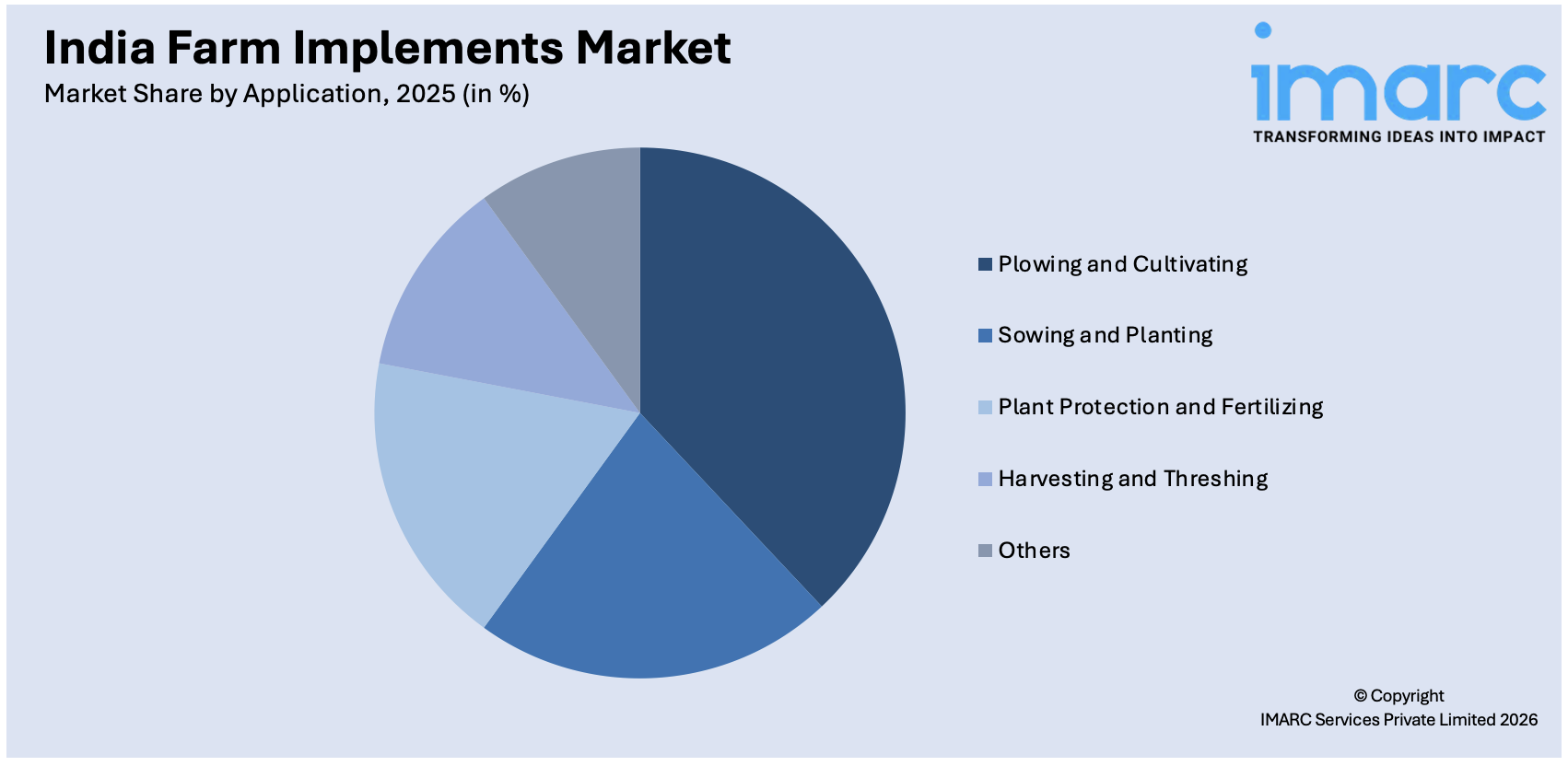
Plowing and Cultivating leads at 30.5% in 2025, encompassing primary and secondary tillage and inter-row cultivation across every cropping cycle on India's 140+ million hectare net sown area.

India Farm Implements Market By Application

Plant Protection and Fertilizing at 25.7% captures mechanized spraying demand driven by rising agrochemical usage and transition to drone technologies. Harvesting and Threshing at 20.8% reflects strong post-harvest mechanization demand from labor scarcity. Sowing and Planting at 17.6% grows fastest at ~9.0% CAGR as precision seed drill and transplanter adoption accelerates.

Regional Market Insights

Region

Share (2025)

Key Market Drivers & Characteristics

North India

32.5%

Largest cultivated area; highest mechanization intensity; dense CHC/FMB network; crop residue management mandates driving shredder and happy seeder demand in Punjab, Haryana, and UP

South India

28.7%

Precision sprayer adoption in Karnataka and Andhra Pradesh plantation crops; sugarcane and banana mechanization; rising horticulture implement demand in Tamil Nadu and Telangana

West India

23.6%

Maharashtra and Gujarat commercial farming driving thresher and rotavator demand; Madhya Pradesh soybean cultivation supporting seed drill growth; CHC model expanding in tribal belts

East India

15.2%

Emerging mechanization market with highest growth potential; paddy cultivation dominance; government CHC investment accelerating thresher and transplanter adoption in Bihar, Jharkhand, and West Bengal

North India, at 32.5%, leads through Uttar Pradesh's 17.7 million hectare cultivated area, Punjab and Haryana's high-intensity mechanized farming, and the dense CHC and FMB network. Crop residue management mandates create additional regulatory-driven demand for shredders and happy seeders across northern India.

India Farm Implements Market By Region

South India, at 28.7%, reflects high precision sprayer adoption in Karnataka's and Andhra Pradesh's plantation and horticultural crops. West India, at 23.6%, is driven by Maharashtra's commercial cotton and soybean mechanization and Gujarat's expanding custom hiring economy. East India, at 15.2%, represents the highest-growth region at ~10.5% CAGR through accelerating government-sponsored CHC deployment.

Competitive Landscape

The India farm implements market competitive landscape is moderately fragmented with established domestic manufacturers and multinational players competing through tractor-implement bundling, dealer network depth, financing tie-ups, and after-sales service quality.

Company Name

Key Products

Market Position

Core Strength

Mahindra&Mahindra Ltd.

Rotavators, cultivators, seed drills, boom sprayers

Market Leader

Largest tractor-implement bundled distribution; operating through Mahindra Farm Equipment

Escorts Kubota Limited

Cultivators, disc ploughs, rotavators, straw reapers, threshers

Market Leader

Strong North India network; Kubota JV providing advanced technology integration and export market access

Amalgamations Group

Multi-crop threshers, seed drills, sprayers, rotavators, paddy weeders

Strong Challenger

Operating through Tractors and Farm Equipment Limited, second-largest tractor manufacturer; strong South and West India presence with TAFE and Massey Ferguson brands

VST Group

Power tillers, paddy weeders, small cultivators, rotary tillers

Niche Leader

Dominant in small-farm and paddy segment; Various partnership expanding HP range and product portfolio

AutoNxt Automation Pvt. Ltd.

Electric tractor-compatible implements, e-weeders, battery sprayers

Emerging Player

First-mover in India's electric tractor ecosystem; innovating electric-compatible implements with PLI scheme backing

Key players Mahindra&Mahindra Ltd., Escorts Kubota Limited, Amalgamations Group, VST Group, AutoNxt Automation Pvt. Ltd., and others.

India Farm Implements Market By Competitive Positioning Matrix

Key Company Profiles

Mahindra&Mahindra Ltd.

Mahindra&Mahindra, operating in the Farm Equipment Sector, is India's largest agricultural implement and tractor manufacturer, with a dominant position across all major implement categories, underpinned by India's largest tractor dealer network nationwide.

  • Key Products: Rotavators, disc cultivators, precision seed drills, boom sprayers, and shredders compatible with Mahindra's full tractor HP range from 25 HP to 75 HP, serving smallholder, medium, and commercial farming segments across all four regions of India.
  • Strategic Focus: Expanding tractor-implement bundled financing programs with partnered NBFCs and cooperative banks, strengthening CHC-operator channel relationships through dedicated implement leasing programs, and developing electric tractor-compatible implement platforms aligned with the emerging EV agriculture roadmap for the Indian farming sector.

Escorts Kubota Limited

Escorts Kubota Limited is a leading Indian multinational agricultural machinery manufacturer operating through the Kubota Corporation technology partnership, with strong market presence in cultivators, disc ploughs, rotavators, straw reapers, and post-harvest implements across North and Central India.

  • Key Products: Cultivators, disc harrows, rotavators, straw reapers, and multi-crop threshers across the Farmtrac and Powertrac tractor-compatible range, spanning 25 HP to 90 HP to cover diverse farm size segments from smallholder to large commercial farms.
  • Recent Developments: In August 2025, YEIDA allotted approximately 200 acres of land to Escorts Kubota in Sector-10 for a phased INR 4,500 crore integrated tractor and agricultural equipment manufacturing plant expected to create 4,000 jobs and significantly expand implement production capacity in North India.
  • Strategic Focus: Leveraging Kubota Corporation technology for advanced precision seed drills and sprayer systems, expanding manufacturing capacity through the new YEIDA facility, and growing the CHC-operator channel as a high-volume organized implement procurement segment across eastern and central India markets.

Market Concentration Analysis

The India farm implements market is moderately fragmented with the key players collectively accounting for an estimated 55–65% of organized market revenue. The unorganized sector accounts for 25–35% by volume, particularly in basic cultivators, disc ploughs, and threshers where entry barriers are low and regional fabricators compete primarily on price with limited after-sales service capability.

Market concentration is highest in the precision seed drill and GPS-guided sprayer segments, where technology investment and service infrastructure create significant barriers. Concentration is declining in post-harvest implements as TAFE and Escorts Kubota expand multi-crop thresher portfolios into eastern India's underpenetrated mechanization market.

Investment & Growth Opportunities

Highest Growth Segments

Seed Drills (~9.4% CAGR), Sprayers (~9.1% CAGR), Sowing and Planting (~9.0% CAGR), East India region (~10.5% CAGR), electric tractor-compatible implements (~15%+ CAGR from near-zero base), and drone sprayer integration (~20%+ CAGR) represent the highest-growth investment vectors through 2034.

Emerging Investment Opportunities

East India farm implement distribution infrastructure represents the highest-growth emerging opportunity. Bihar, Jharkhand, and West Bengal's government-funded CHC expansion programs create structured procurement channels for threshers, transplanters, and paddy-specific implements at above-market growth rates, with subsidized financing reducing adoption barriers across low-income farming communities.

Investment Themes

  • Electric Tractor-Compatible Implement Manufacturing: The commercialization of India's first electric tractor creates new premium implement requirements for torque-matched, lower-RPM-optimized rotavators, cultivators, and seed drills. First-mover manufacturers investing in electric-compatible platforms in 2025–2028 will benefit from PLI scheme support, SMAM subsidy allocation for electric equipment, and the rapidly scaling electric tractor adoption curve expected to exceed 10,000 annual units by 2028.
  • Precision Implement Development for Sub-Five-Acre Farmer Segment: India's largest underserved mechanization opportunity lies in affordable precision implements for the 2–5-acre farmer segment representing 60%+ of the farming population. GPS-guided seed drills below USD 1,500 and battery-powered precision sprayers below USD 800 represent commercially viable entry price points, with SMAM subsidy coverage of 40–50% reducing effective farmer cost and creating a high-volume addressable market.

Future Market Outlook (2026-2034)

The India farm implements market is projected to grow from USD 15.42 Billion in 2025 to USD 32.17 Billion by 2034, delivering an 8.26% CAGR. The market's anchor value of USD 22.93 Billion in 2030 reflects a mechanization industry at a transformative commercial inflection point, with precision implements, drone-integrated spraying, and electric tractor-compatible equipment emerging as premium growth segments.

Three structural forces define market growth through 2034. Government mechanization policy infrastructure representing over INR 5,000 crore in annual SMAM and PM-KISAN spending creates non-cyclical durable demand stimulation. Rural labor scarcity creates permanent economic motivation for mechanization that deepens as urbanization accelerates. Rising farmer incomes expand the self-financed mechanization market beyond the subsidy-dependent base, creating a growing premium implement adoption segment.

Research Methodology

Primary Research

Primary research comprised structured interviews with 50+ industry stakeholders (2025), including agricultural equipment OEM executives, implement dealer network managers, CHC and FMB operators, state government SMAM program administrators, and farmer cooperative representatives across North, South, West, and East India regions.

Secondary Research

Secondary research encompassed company annual reports; Ministry of Agriculture and Farmers Welfare reports; SMAM implementation data; Agricultural Census of India; PM-KISAN utilization data; state government mechanization subsidy scheme documents; CMIE agricultural database; FICCI Agriculture Committee and ICAR reports; and over 60 secondary sources covering implement technology, pricing, and regional adoption patterns.

Forecasting Models

Market revenue forecasts developed using a bottom-up model integrating: (i) net sown area and cropping intensity by state; (ii) mechanization penetration rate by implement category and farm size; (iii) average implement retail price by technology tier; (iv) CHC rental revenue contribution; (v) government subsidy-driven demand adjustment; and (vi) technology premium for precision and electric implement segments.

India Farm Implements Market Report Coverage:

Report Features Details
Base Year of the Analysis 2025
Historical Period 2020-2025
Forecast Period 2026-2034
Units Billion USD
Scope of the Report

Exploration of Historical Trends and Market Outlook, Industry Catalysts and Challenges, Segment-Wise Historical and Future Market Assessment:

  • Type
  • Application
  • Region
Types Covered Cultivators, Seed Drills, Threshers, Shredders, Sprayers, Others
Applications Covered Plowing and Cultivating, Sowing and Planting, Plant Protection and Fertilizing, Harvesting and Threshing, Others 
Regions Covered North India, South India, East India, West India
Companies Covered Mahindra&Mahindra Ltd., Escorts Kubota Limited, Amalgamations Group, VST Group, AutoNxt Automation Pvt. Ltd., etc.
Customization Scope 10% Free Customization
Post-Sale Analyst Support 10-12 Weeks
Delivery Format PDF and Excel through Email (We can also provide the editable version of the report in PPT/Word format on special request)

Key Benefits for Stakeholders:

  • IMARC’s industry report offers a comprehensive quantitative analysis of various market segments, historical and current market trends, market forecasts, and dynamics of the India farm implements market from 2020-2034.
  • The research report provides the latest information on the market drivers, challenges, and opportunities in the India farm implements market.
  • Porter's five forces analysis assist stakeholders in assessing the impact of new entrants, competitive rivalry, supplier power, buyer power, and the threat of substitution. It helps stakeholders to analyze the level of competition within the India farm implements industry and its attractiveness.
  • Competitive landscape allows stakeholders to understand their competitive environment and provides an insight into the current positions of key players in the market.

Frequently Asked Questions About the India Farm Implements Market Report

The India farm implements market reached USD 15.42 Billion in 2025, driven by Cultivators at 28.5%, Plowing and Cultivating application at 30.5%, North India at 32.5%, government SMAM subsidies, CHC deployment, and rural labor scarcity driving mechanization across India's 140+ million hectare net sown area.

The India farm implements market grows at 8.26% CAGR during 2026-2034, reaching USD 32.17 Billion by 2034. This growth reflects sustained government mechanization policy support, structural rural labor scarcity, rising farmer incomes, and precision farming technology adoption across India's diverse agro-climatic zones.

Cultivators lead at 28.5%, capturing the widest range of soil preparation and cultivation operations. Seed Drills grow fastest at ~9.4% CAGR through precision sowing adoption and zero-till seed drill mandates for crop residue management across Punjab, Haryana, and western Uttar Pradesh.

Plowing and Cultivating leads at 30.5% through the highest frequency of usage across all cropping cycles. Sowing and Planting grows fastest at ~9.0% CAGR as precision seed drill and transplanter adoption accelerates under government subsidy support and rising farmer income growth.

North India leads at 32.5% through Uttar Pradesh's largest cultivated area, Punjab and Haryana's high mechanization intensity, and the dense CHC and FMB network. East India represents the highest-growth region at ~10.5% CAGR through government-sponsored mechanization programs in Bihar, Jharkhand, and West Bengal.

Leading companies include Mahindra&Mahindra Ltd., Escorts Kubota Limited, Amalgamations Group, VST Group, AutoNxt Automation Pvt. Ltd., and others.

The India farm implements market is projected to reach USD 22.93 Billion by 2030, with precision seed drills and drone-assisted sprayers emerging as premium growth segments, CHC-operator procurement becoming a dominant demand channel, and East India's mechanization convergence driving the fastest regional growth rate.

Need more help?

  • Speak to our experienced analysts for insights on the current market scenarios.
  • Include additional segments and countries to customize the report as per your requirement.
  • Gain an unparalleled competitive advantage in your domain by understanding how to utilize the report and positively impacting your operations and revenue.
  • For further assistance, please connect with our analysts.
India Farm Implements Market Size, Share, Trends and Forecast by Type, Application, and Region, 2026-2034
Purchase Options Discount
Offer
Benefits of Customization
  • Personalize this research
  • Triangulate with your data
  • Get data as per your format and definition
  • Gain a deeper dive into a specific application, geography, customer, or competitor
  • Any level of personalization

Get in Touch With Us

UNITED STATES

Phone: +1-201-971-6302

INDIA

Phone: +91-120-433-0800

UNITED KINGDOM

Phone: +44-753-714-6104

Email: [email protected]

Client Testimonials

Choose your plan

*Please note that the prices mentioned below are starting prices for each bundle type. Kindly contact our team for further details.*

Single User License

$3999.00$2499.00
Buy Now
  • 1 User License, Access on 2 Devices
  • PDF Report + Excel Dataset (Password Protected)
  • Lifetime Access
  • No Printing Rights
  • 10% Free Report Customization
  • 10–12 Weeks of Analyst Support

Corporate User License

$5999.00$4499.00
Buy Now
  • Unlimited User Access (Within Your Organization)
  • PDF Report + Excel Dataset
  • Lifetime Access
  • Dedicated Account Manager
  • 14–20 Weeks of Analyst Support
  • No Printing Rights
  • 20% Free Report Customization
  • 30% Discount on Your Next Purchase

Essential Insights

What's included:

3 reports

  • Lifetime Access
  • PDF Reports
  • Excel Datasets
  • 2 Weeks of Free Analyst Support
  • 2 User Licenses
  • Access on 2 Devices
  • Printing Rights
  • Complimentary PowerPoint (PPT) Version
  • Complimentary License Upgrade

Professional Access

What's included:

5 reports

  • Lifetime Access
  • PDF Reports
  • Excel Datasets
  • 8 Weeks of Free Analyst Support
  • 2 User Licenses
  • Access on 2 Devices
  • Printing Rights
  • Complimentary PowerPoint (PPT) Version
  • Complimentary License Upgrade

Business Advantage

What's included:

8 reports

  • Lifetime Access
  • PDF Reports
  • Excel Datasets
  • 14 Weeks of Free Analyst Support
  • 2 User Licenses
  • Access on 2 Devices
  • Printing Rights
  • Complimentary PowerPoint (PPT) Version
  • Complimentary License Upgrade

Enterprise Intelligence

What's included:

10 reports

  • Lifetime Access
  • PDF Reports
  • Excel Datasets
  • 20 Weeks of Free Analyst Support
  • 2 User Licenses
  • Access on 2 Devices
  • Printing Rights
  • Complimentary PowerPoint (PPT) Version
  • Complimentary License Upgrade