
India Fasteners Market Size, Share, Trends and Forecast by Product, Sales Channel, End Use, and Region, 2026-2034
India Fasteners Market Size, Share, Trends & Forecast (2026-2034)
The India fasteners market size increased from USD 11.24 Billion in 2025 to USD 11.76 Billion in 2026 and is projected to reach USD 16.95 Billion by 2034, growing at a CAGR of 4.67% during 2026-2034. The market is driven by expanding automotive and construction sectors, rising demand for high-performance and lightweight fasteners, and the "Make in India" initiative. Externally threaded fasteners dominate at 54.8%, the offline channel leads at 86.4%, and West India commands 33.6% of the national market share.
Market Snapshot
|
Metric |
Value |
|
Base Year Market Size (2025) |
USD 11.24 Billion |
|
Market Size (2026) |
USD 11.76 Billion |
|
Forecast Market Size (2034) |
USD 16.95 Billion |
|
CAGR (2026-2034) |
4.67% |
|
Base Year |
2025 |
|
Historical Period |
2020-2025 |
|
Forecast Period |
2026-2034 |
|
Dominant Product |
Externally Threaded (54.8%, 2025) |
|
Dominant Sales Channel |
Offline (86.4%, 2025) |
|
Leading Region |
West India (33.6%, 2025) |
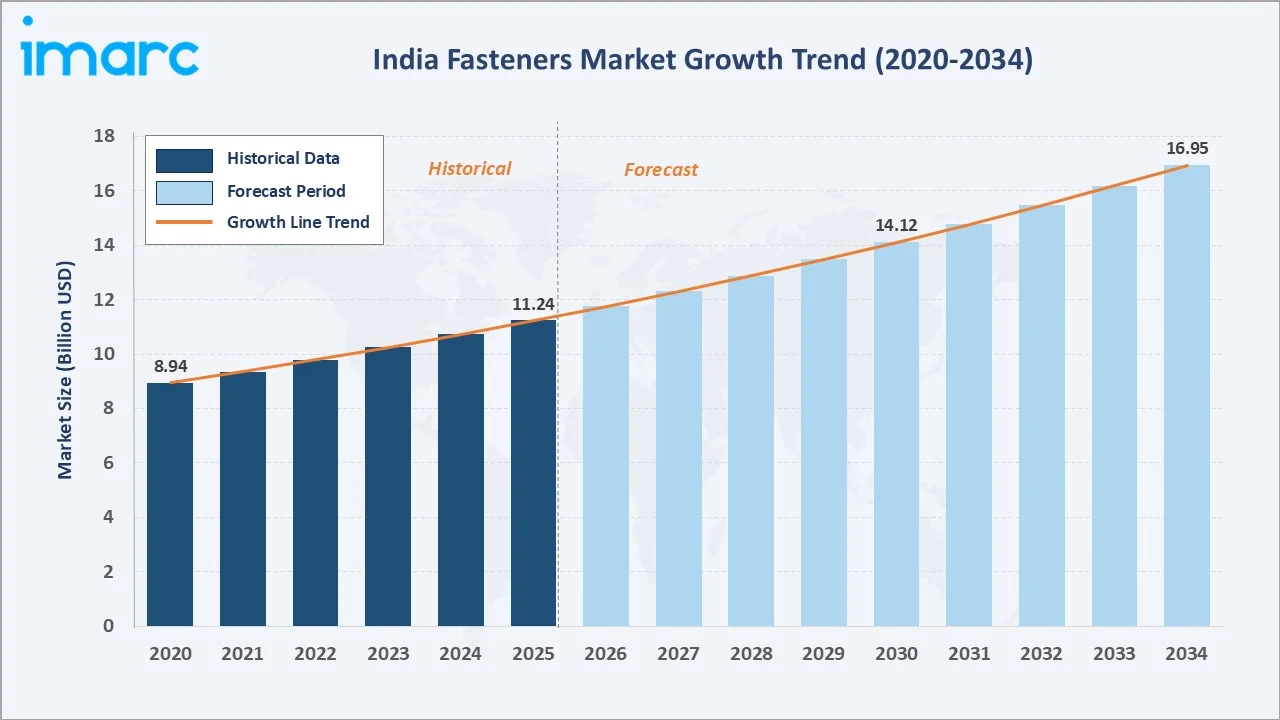
The market expanded from USD 8.94 Billion in 2020 to USD 11.24 Billion in 2025 and an estimated USD 11.76 Billion in 2026 - growing steadily over five years - anchored at USD 14.12 Billion in 2030 and forecast to reach USD 16.95 Billion by 2034. The automotive sector expansion under PLI schemes has been a primary demand driver throughout the historical period.
To get more information on this market, Request Sample
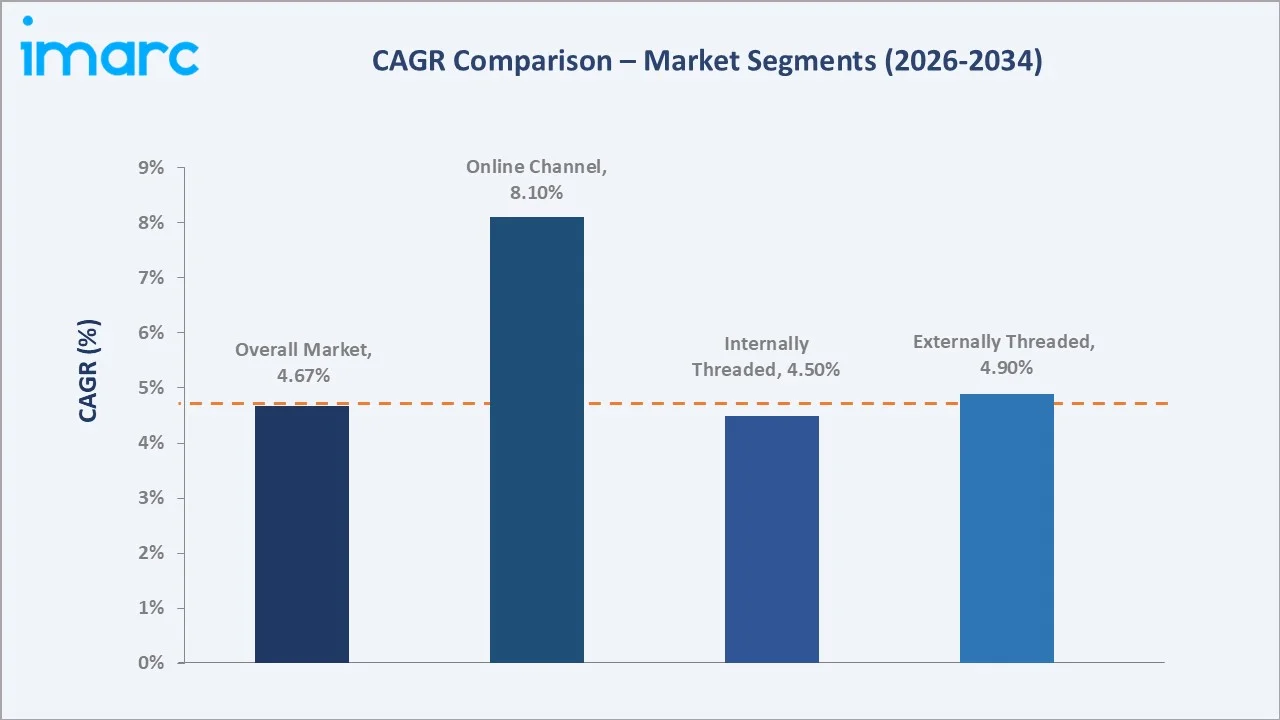
The externally threaded segment grows steadily, driven by automotive OEM assembly expansion. The online sales channel grows fastest at ~8.1% CAGR as B2B digital procurement platforms gain adoption across India manufacturing and MRO sectors.
Executive Summary
The India fasteners market, which increased from USD 11.24 Billion in 2025 to an estimated USD 11.76 Billion in 2026, representing one of India most strategically critical industrial component markets driven by the automotive sector growth, infrastructure expansion, and aerospace manufacturing development. Fasteners are indispensable joining elements across all manufacturing sectors. The market is projected to reach USD 16.95 Billion by 2034.
Externally threaded fasteners at 54.8% dominate by serving the broadest industrial applications. Offline channel at 86.4% leads through established OEM-direct and distributor networks. West India at 33.6% commands the largest regional share through Pune and Mumbai concentrated automotive and industrial manufacturing clusters.
Key Market Insights
|
Insight |
Data |
|
Dominant Product |
Externally Threaded - 54.8% share (2025) |
|
Dominant Sales Channel |
Offline - 86.4% market share (2025) |
|
Leading Region |
West India - 33.6% market share (2025) |
|
Market Opportunity |
Aerospace-grade fasteners; stainless steel and coated products; smart fasteners; export market expansion |
Key Analytical Observations Supporting the Above Data:
- Externally Threaded at 54.8%: Bolts, studs, and screws dominate as they serve the widest cross-section of industrial applications, particularly automotive OEM assembly. Their universal adoption across machinery, construction, and aerospace drives sustained procurement volumes. The segment serves the highest volume demand across all regions and end-use sectors, making it the market primary commercial category.
- Offline Channel at 86.4%: Established distributor networks and OEM-direct supply relationships sustain offline dominance. Manufacturers rely on authorised distributors for just-in-time delivery of diverse fastener specifications, technical support, and quality assurance throughout the supply chain. The technical complexity of fastener specification selection sustains the offline channel advantage for critical OEM and construction applications.
- West India at 33.6%: The Pune-Mumbai-Nashik industrial corridor hosts India largest concentration of automotive OEMs and tier-1 suppliers, generating the country highest per-region fastener procurement volumes. The region consistent above-average demand growth reflects ongoing automotive capacity expansion and infrastructure investment, maintaining its leading position throughout the forecast period.
India Fasteners Market Overview
The India fasteners market encompasses the design, manufacture, and supply of all fastening elements used to join and secure components across automotive, construction, aerospace, machinery, and electronics sectors. Fasteners include externally threaded (bolts, screws, studs), internally threaded (nuts, inserts), and non-threaded (rivets, pins, washers) product categories.
The ecosystem integrates raw material producers, fastener manufacturers, surface treatment specialists, quality certification bodies, OEM procurement teams, and MRO distributors. Macroeconomic factors include India GDP growth, government infrastructure spending, automotive production volumes, and export market development.
Market Dynamics
To evaluate market opportunities, Request Sample
Market Drivers
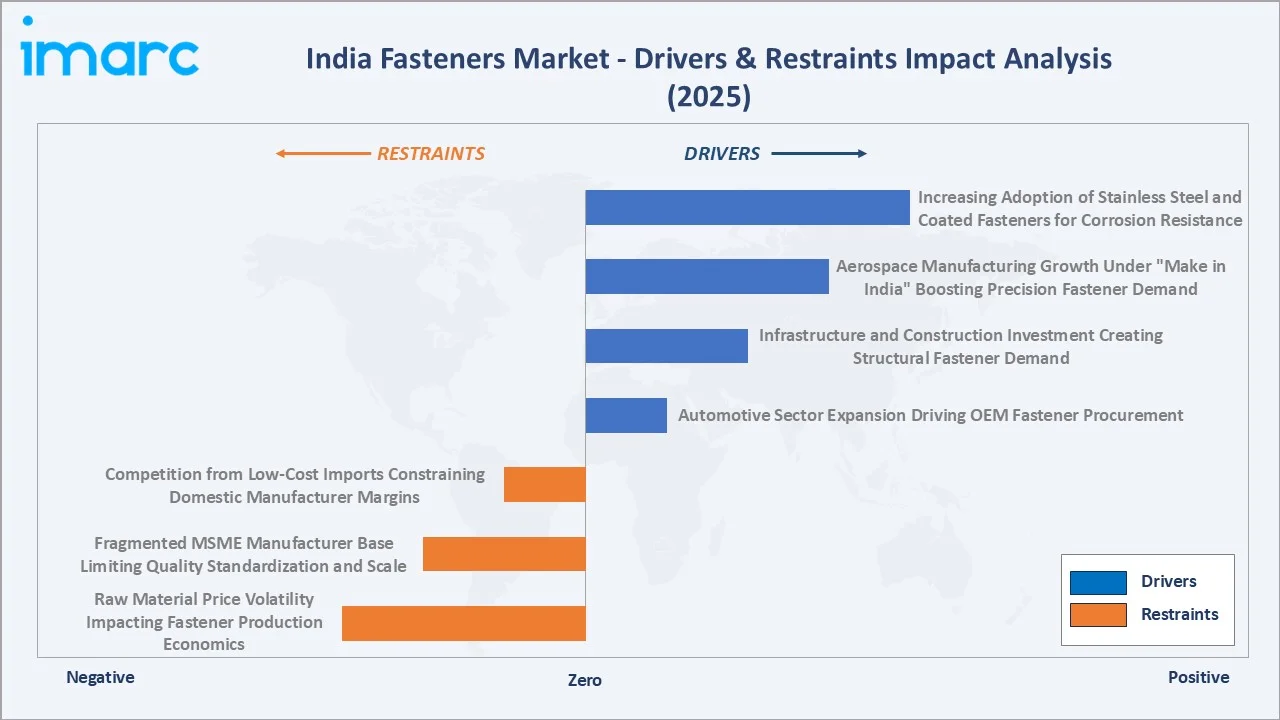
- Automotive Sector Expansion Driving OEM Fastener Procurement: India automotive industry is a primary demand driver, with expanding passenger vehicle and two-wheeler production generating consistent high-volume fastener demand. PLI schemes are scaling domestic auto component manufacturing, directly boosting fastener consumption across chassis, engine, and body assembly applications. India two-wheeler and passenger vehicle production growth creates multi-year procurement visibility for fastener suppliers serving Tier-1 OEM supply chains, supporting above-market volume growth for high-precision automotive fastener categories through the forecast period.
- Infrastructure and Construction Investment Creating Structural Fastener Demand: Government spending on national highways, metro rail, smart cities, and affordable housing programs is expanding demand for anchor bolts, structural fasteners, and construction-grade screws. The National Infrastructure Pipeline multi-trillion-rupee investment program creates a sustained long-term fastener demand base. Ongoing metro rail expansion and the Bharatmala Pariyojana highway program generate consistent large-volume structural fastener procurement, creating stable revenue streams for organized manufacturers with certified product offerings.
- Aerospace Manufacturing Growth Under "Make in India" Boosting Precision Fastener Demand: India growing aerospace manufacturing capability, including partnerships with Airbus and Boeing, is creating demand for high-precision, aerospace-grade fasteners meeting international quality standards. Dynamatic Technologies and Aequs Airbus A220 Door Program exemplifies this structural trend. The expansion of India aerospace manufacturing sector is generating a new premium-value fastener demand segment that rewards manufacturers with AS9100 certification and precision manufacturing capability.
- Increasing Adoption of Stainless Steel and Coated Fasteners for Corrosion Resistance: Renewable energy installations (solar and wind) and infrastructure projects require corrosion-resistant fasteners for long-life outdoor performance. Growing adoption of stainless steel and Dacromet-coated fasteners is expanding unit values across the market. India target of 500 GW renewable energy capacity by 2030 creates a structurally growing procurement pool for specialty-coated fasteners used in solar panel mounting, wind tower assembly, and electrical substation structural connections.
Market Restraints
- Competition from Low-Cost Imports Constraining Domestic Manufacturer Margins: Low-cost fastener imports, primarily from China, pressure domestic manufacturers on pricing in commodity bolt and screw segments. Import competition limits smaller Indian manufacturers' ability to pass on raw material cost increases, compressing profit margins and limiting investment in quality upgrading. The anti-dumping duty framework provides partial protection, but Chinese import competitiveness in standard-grade commodity categories remains a structural challenge constraining domestic manufacturers' pricing power.
- Raw Material Price Volatility Impacting Fastener Production Economics: Steel price volatility directly impacts fastener manufacturing costs, as steel constitutes 60-70% of production input costs. Unpredictable raw material pricing creates margin uncertainty and complicates long-term OEM supply contract pricing. The inability to hedge steel price exposure, combined with OEMs' preference for fixed-price annual contracts, creates a structural margin compression risk that disproportionately affects smaller MSME manufacturers with limited financial reserves.
- Fragmented MSME Manufacturer Base Limiting Quality Standardization and Scale: India's fastener industry is dominated by MSMEs, many operating below modern quality certification standards (IATF 16949, ISO 9001). Fragmented production limits economies of scale, creates quality inconsistencies, and reduces competitiveness in premium segments. The MSME dominance constrains the industry ability to invest in advanced cold-forging machinery, automated thread-rolling equipment, and digital quality management systems that are prerequisites for securing export market contracts and premium OEM supplier positions.
Market Opportunities
- Export Market Development for Precision and Aerospace-Grade Fasteners: India competitive manufacturing cost base and growing quality certification levels create opportunities to expand fastener exports to Europe and North America. Leading Indian fastener exporters are already supplying to Tier-1 automotive OEMs in Europe at competitive quality and cost levels. FASTNEX 2024 and international trade shows demonstrate the industry growing export ambition, with organized manufacturers targeting premium-value aerospace and industrial fastener categories.
- Smart Fasteners and IoT-Enabled Structural Health Monitoring: Emerging demand for smart fasteners integrating sensors for real-time load and torque monitoring in critical infrastructure and aerospace applications presents a premium technology growth opportunity. This emerging segment commands 5-10x the unit value of conventional fasteners, creating a path for Indian manufacturers with R&D capability to access high-margin, technology-differentiated product categories beyond commodity bolt and nut manufacturing.
Market Challenges
- Skilled Workforce Gap in Advanced Fastener Manufacturing: Precision fastener manufacturing requires specialized skills in cold forging, thread rolling, and quality control. The shortage of technically qualified workers limits capacity expansion and quality upgrading, particularly for smaller MSME manufacturers competing for automotive OEM supply positions. The mismatch between ITI curriculum and modern fastener manufacturing technology requirements creates a persistent skills gap across India vocational training programs.
- Energy Cost Pressures on MSME Fastener Manufacturers: Energy-intensive manufacturing processes (forging, heat treatment, plating) expose smaller manufacturers to electricity price volatility, creating margin pressure that limits investment in quality improvement. Industrial electricity tariffs vary significantly across states, creating cost disadvantages for MSME manufacturers in high-tariff states. The energy cost differential discourages optimal geographic clustering of fastener manufacturing near automotive OEM assembly plants.
Emerging Market Trends
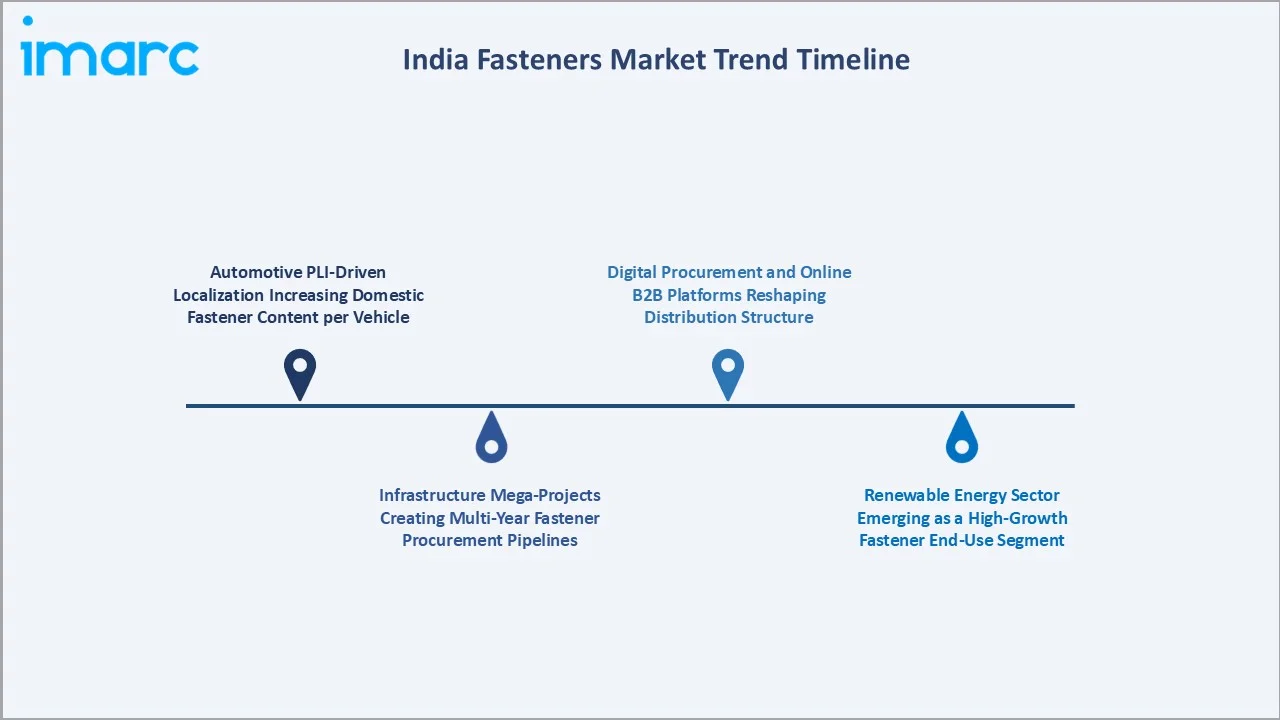
1. Automotive PLI-Driven Localization Increasing Domestic Fastener Content per Vehicle
India PLI scheme for automotive and auto components is driving OEMs to increase domestic sourcing of precision-engineered components, directly benefiting fastener manufacturers. As EV production scales, new fastener specifications for battery pack and motor mounting create premium product opportunities. The localization trend creates multi-year supply agreements with OEMs, providing revenue visibility and justifying investment in capacity expansion and quality certification upgrades at organized fastener manufacturers.
2. Infrastructure Mega-Projects Creating Multi-Year Fastener Procurement Pipelines
National highway expansion, metro rail network development, and port modernization programs are creating multi-year, high-volume structural fastener procurement programs. These infrastructure-linked demand streams provide supply chain visibility, enabling fastener manufacturers to invest in capacity and quality certification. The Bharatmala Pariyojana highway program and metro rail network expansions collectively represent a decade-long structural fastener demand pipeline.
3. Digital Procurement and Online B2B Platforms Reshaping Distribution Structure
Online B2B platforms and OEM-specific digital procurement portals are gradually shifting MRO and replacement fastener purchasing online. The 13.6% online share is growing rapidly as industrial buyers benefit from product comparison, pricing transparency, and logistics efficiency. The digital procurement trend enables smaller industrial buyers to access a broader range of fastener specifications directly from manufacturers and distributors, improving supply chain efficiency.
4. Renewable Energy Sector Emerging as a High-Growth Fastener End-Use Segment
India solar and wind energy installation targets (500 GW by 2030) create structural demand for corrosion-resistant stainless steel and specialty-coated fasteners. This new demand vertical adds a non-cyclical growth driver beyond automotive. Renewable energy fasteners require elevated corrosion resistance specifications (typically 1,000+ hour salt spray testing), driving adoption of premium stainless steel and Geomet-coated products that generate higher per-unit revenue than conventional fasteners.
Industry Value Chain Analysis
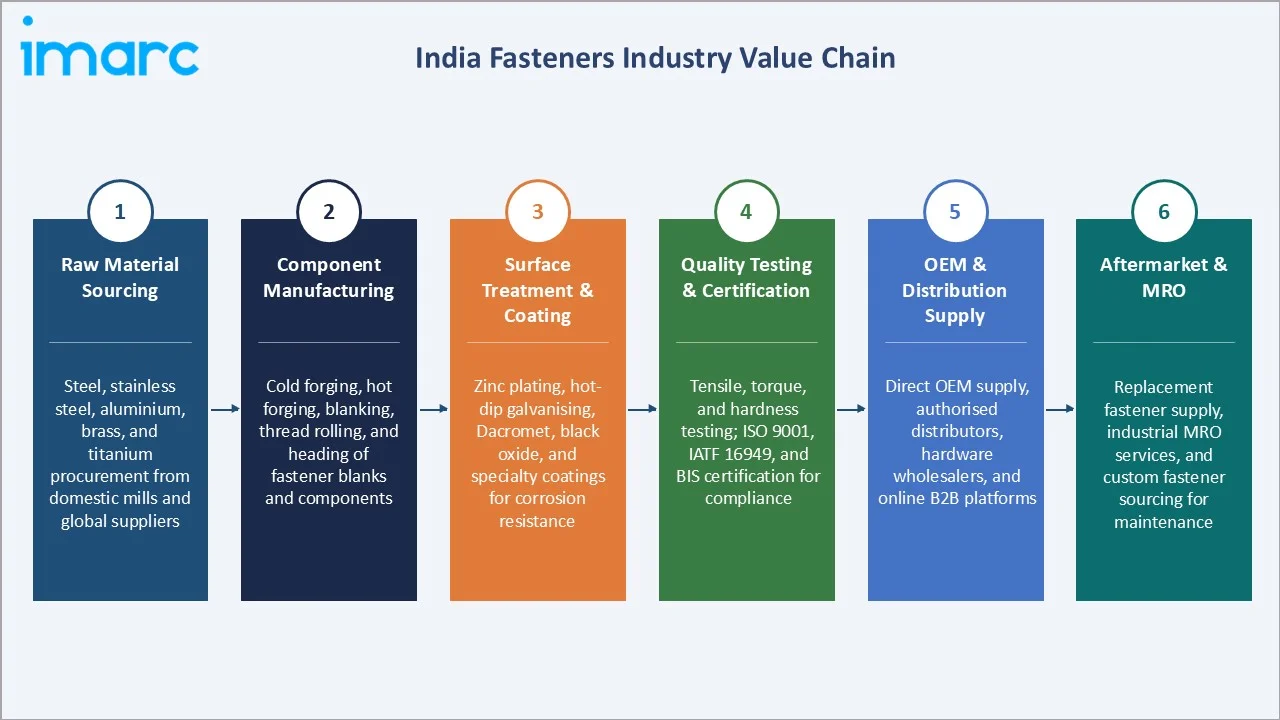
The India fasteners value chain integrates raw material procurement, forging and forming, surface treatment, quality testing, OEM supply integration, and aftermarket distribution. The commercial architecture has been progressively consolidating toward direct OEM supply relationships for automotive-grade products, while the distribution model remains dominant for MRO and construction applications.
|
Stage |
Key Activities |
|
Raw Material Sourcing |
Steel, stainless steel, aluminium, brass, and titanium procurement from domestic mills and global suppliers |
|
Component Manufacturing |
Cold forging, hot forging, blanking, thread rolling, and heading of fastener blanks and components |
|
Surface Treatment & Coating |
Zinc plating, hot-dip galvanising, Dacromet, black oxide, and specialty coatings for corrosion resistance |
|
Quality Testing & Certification |
Tensile, torque, and hardness testing; ISO 9001, IATF 16949, and BIS certification for compliance |
|
OEM & Distribution Supply |
Direct OEM supply, authorised distributors, hardware wholesalers, and online B2B platforms |
|
Aftermarket & MRO |
Replacement fastener supply, industrial MRO services, and custom fastener sourcing for maintenance |
The surface treatment and coating stage is experiencing the most rapid technology transition as OEM quality specifications for corrosion resistance are escalating. The online distribution tier is the value chain fastest-growing commercial channel, driven by B2B procurement digitalization across India industrial SME base.
Technology Landscape in the India Fasteners Industry
Cold Forging Technology
Cold forging is the primary manufacturing process for standard fasteners, enabling high-volume production with superior material strength and surface finish. Advanced multi-stage cold forging machines improve dimensional accuracy, reduce material waste, and lower per-unit manufacturing costs, making Indian manufacturers more competitive in export markets.
Automated Thread Rolling Technology
Automated thread rolling delivers superior thread quality, higher fatigue strength, and faster production throughput versus thread cutting. Adoption of CNC thread rolling machines is improving Indian manufacturers compliance with automotive and aerospace thread tolerance specifications for OEM supply programs.
Advanced Surface Coating Technologies
Dacromet, Geomet, and zinc-nickel alloy coating technologies are replacing conventional zinc electroplating for high-corrosion-resistance applications in automotive and renewable energy sectors. These coating technologies extend fastener service life, meet RoHS compliance requirements, and command premium pricing in export markets.
Market Segmentation Analysis
The report covers the following segments:
|
Segment Category |
Leading Segment |
Market Share |
Year |
|
Product |
Externally Threaded |
54.8% |
2025 |
|
Sales Channel |
Offline |
86.4% |
2025 |
|
End Use |
🔒 |
🔒 |
2025 |
|
Region |
West India |
33.6% |
2025 |

By Product
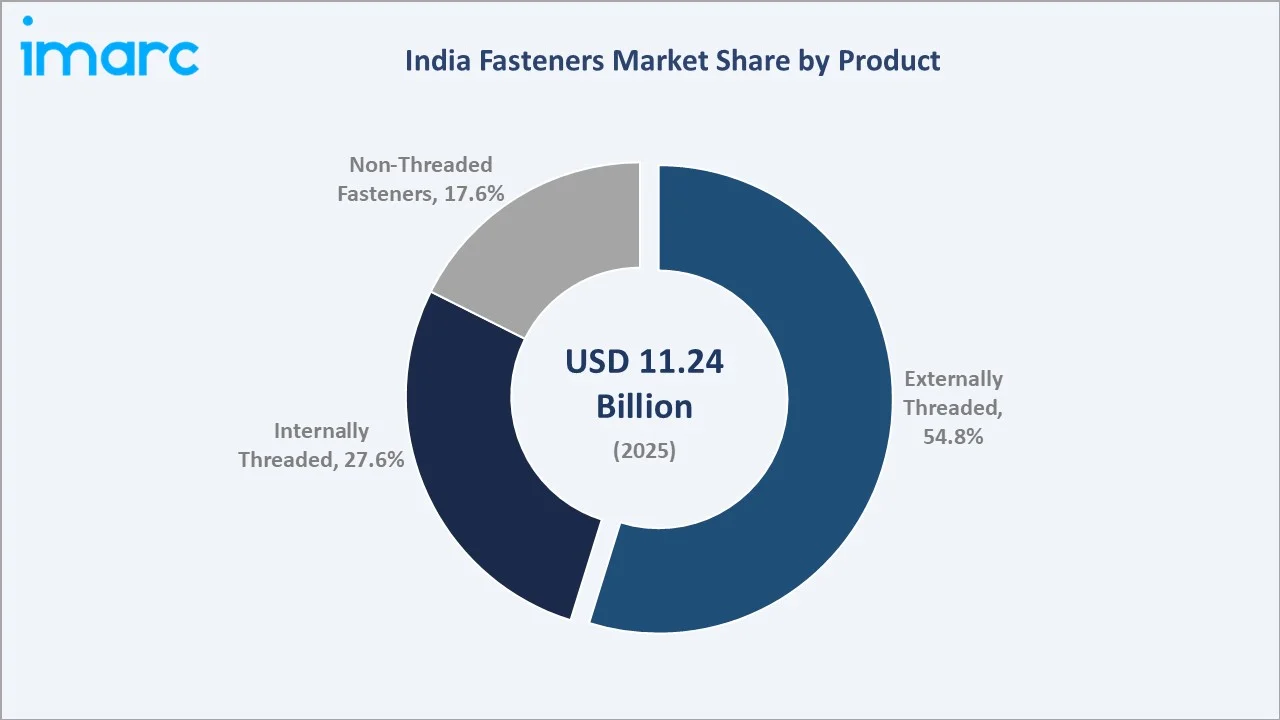
Externally threaded fasteners lead at 54.8% in 2025, encompassing bolts, screws, and studs that serve the widest range of industrial assembly applications, particularly in automotive OEM manufacturing, the market highest-volume procurement category.
To access detailed market analysis, Request Sample
Internally threaded fasteners (nuts and inserts) at 27.6% are paired components consumed in proportion with externally threaded items across assembly lines. Non-threaded fasteners (rivets, pins, washers, and clips) at 17.6% serve aerospace, electronics, and automotive body panel applications where vibration resistance and blind installation are required.
By Sales Channel
Offline channel leads at 86.4% through established OEM-direct supply relationships and authorised distributor networks that deliver just-in-time fastener supply. Online B2B platforms at 13.6% are the fastest-growing channel as digital procurement gains traction for MRO fasteners.
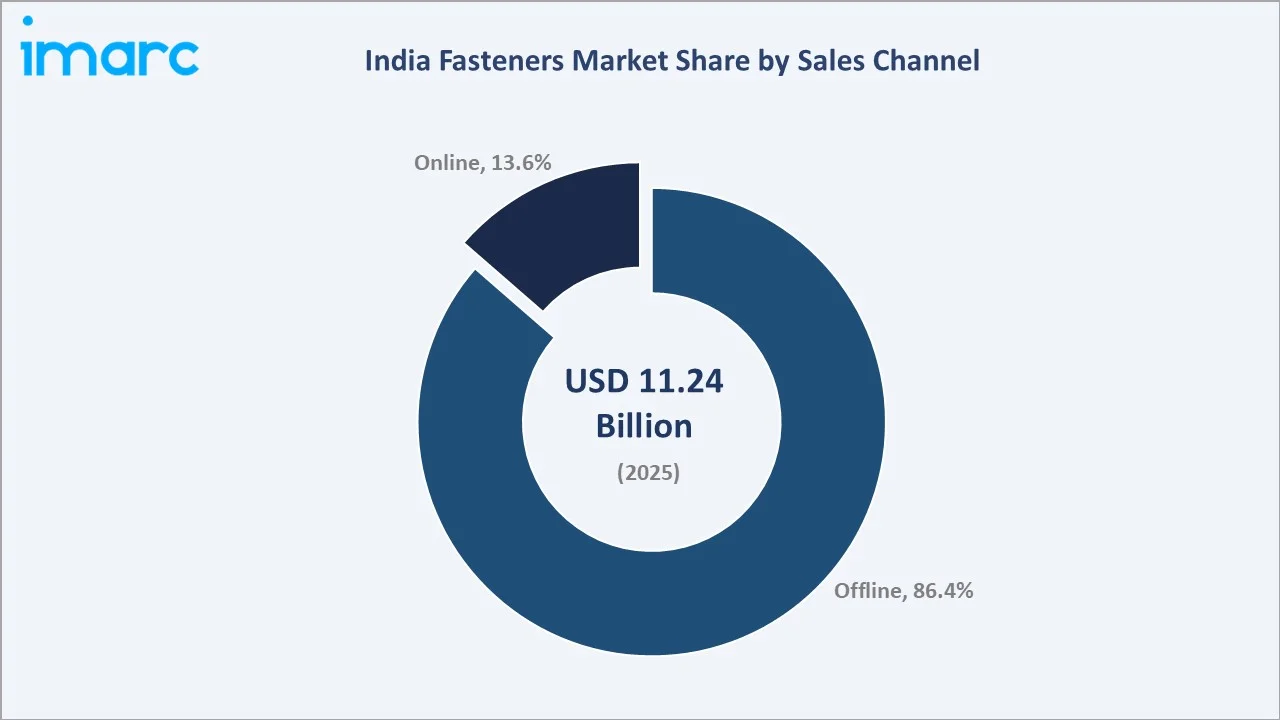
The offline channel dominance reflects the engineering specification complexity of industrial fasteners. Buyers require technical assistance in selecting correct grades, coatings, and tolerances for each application, interaction that is better served through distributor technical sales teams than digital catalogues for critical applications.
Regional Market Insights
|
Region |
Share (2025) |
Key Fastener Market Drivers & Characteristics |
|
West India |
33.6% |
Driven by large-scale automotive manufacturing hubs in Pune and Mumbai, strong industrial base, and high construction activity |
|
North India |
27.5% |
Supported by automotive OEM clusters in Gurgaon and Manesar, heavy engineering sector, and infrastructure development programs |
|
South India |
25.8% |
Driven by growing auto components industry in Chennai, aerospace manufacturing in Bengaluru, and expanding electronics production |
|
East India |
13.1% |
Emerging with steel industry-linked demand, growing construction activity, and increasing industrial investment in the region |
West India, at 33.6%, leads through the Pune-Mumbai-Nashik industrial corridor, which hosts India largest concentration of automotive OEMs (Tata Motors, Mahindra, Mercedes-Benz, Volkswagen) generating the country highest per-region fastener procurement volumes. North India, at 27.5%, reflects the Gurgaon-Manesar automotive hub and large infrastructure project pipelines.
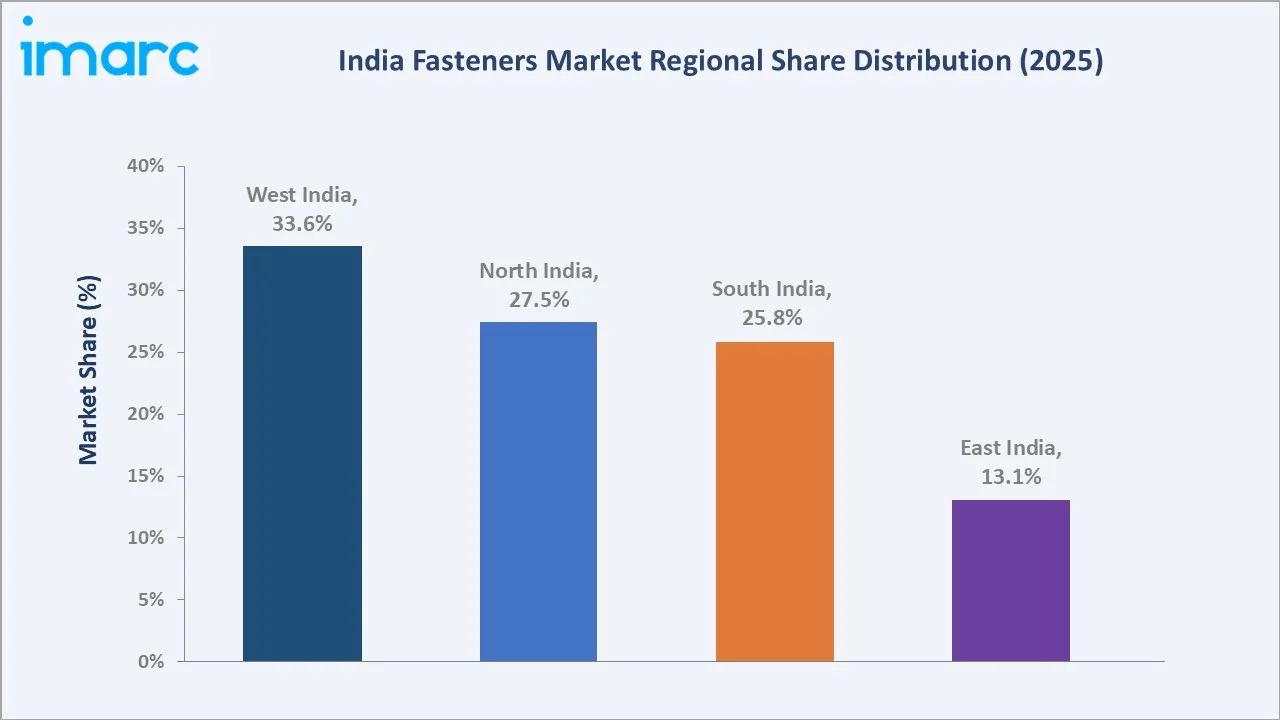
South India, at 25.8%, is experiencing above-average growth driven by Chennai automotive cluster, Bengaluru aerospace and electronics manufacturing, and Tamil Nadu growing auto component export base. East India, at 13.1%, represents the market highest-growth emerging region as steel industry proximity and rising industrial investment accelerate fastener demand.
Competitive Landscape
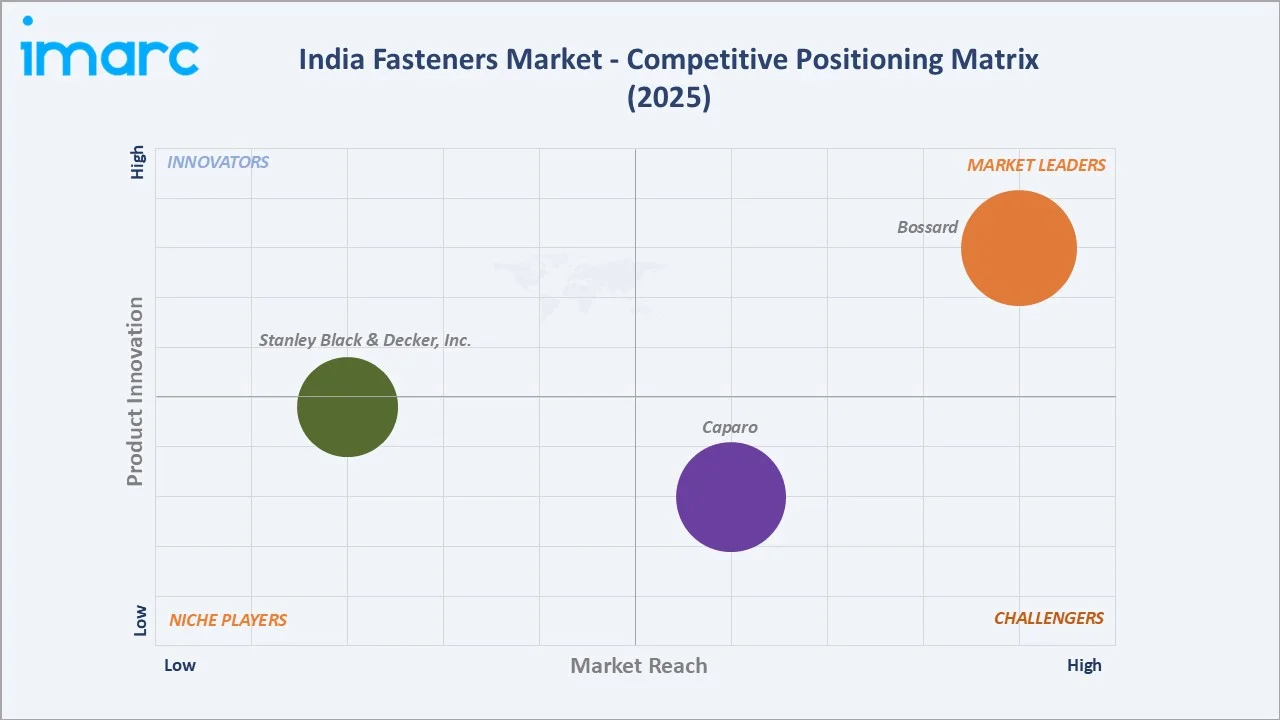
The India fasteners market competitive landscape is moderately fragmented with a mix of large, organized manufacturers, global MNC subsidiaries, and a large base of MSME producers. Three distinct competitive tiers operate: global-affiliated precision fastener suppliers, established domestic organized manufacturers, and the MSME commodity fastener segment.
|
Company Name |
Key Products |
Market Position |
Core Strength |
|
Bossard |
Industrial bolts, nuts, screws, and fasteners for automotive, construction, and general engineering |
Market Leader |
Well-established brand with wide product range serving automotive, construction, and engineering sectors |
|
Caparo |
Automotive and structural fasteners, precision-engineered components for domestic and international OEMs |
Strong Challenger |
Strong R&D and large-scale manufacturing capability serving both domestic and international markets |
|
Stanley Black & Decker, Inc. |
Blind rivets, threaded inserts, weld fasteners, and precision bolts across multiple industries |
Emerging Player |
Division of a global technology leader offering advanced fastening solutions with broad industry coverage |
Key players include Bossard, Caparo, Stanley Black & Decker, Inc., and others.
Key Company Profiles
Caparo
Caparo is a leading India-based high-tensile fastener manufacturer and part of the Caparo Group (UK), with a strong presence in the India fasteners market through its automotive-grade and industrial fastener portfolio serving domestic and international OEMs across multiple sectors.
- Key Products: High-tensile bolts, wheel bolts, cylinder head bolts, axle bolts, transmission bolts, studs, nuts, and cold-forged precision fasteners for automotive OEM and general engineering applications
- Strategic Focus: Strengthening its zero-defects policy and OEM direct supply relationships across the automotive and heavy engineering sectors while expanding its special fastener range for windmill, construction, and infrastructure applications. The company is also investing in advanced cold-forging, heat treatment, and surface coating capabilities targeting premium-value fastener segments and above-market growth through new product development and export market expansion.
Bossard
Bossard is a well-established brand in the Indian fasteners market, offering a comprehensive range of industrial fasteners for automotive, construction, and general engineering applications across domestic and international markets.
- Key Products: Industrial bolts, nuts, screws, and rivets for automotive, construction, and engineering applications across multiple end-use sectors.
- Strategic Focus: Expanding high-corrosion-resistance product range for renewable energy and infrastructure applications while growing its authorised distributor network across Tier-2 and Tier-3 industrial cities. The company is focusing on value-added coated fastener categories that command premium pricing versus commodity zinc-plated products, while investing in digital order management systems to improve distributor service levels and online channel capability.
Market Concentration Analysis
The India fasteners market is fragmented at the commodity level, with an estimated 3,000+ active manufacturers dominated by MSMEs, while moderately concentrated at the precision and automotive-grade segment level. Organized manufacturers (including MNC subsidiaries) account for approximately 30-40% of total market revenue. MSME manufacturers account for an estimated 60-70% of total market volume, primarily in commodity bolt and nut categories. Market concentration is expected to increase over the forecast period as OEM supplier consolidation and quality certification requirements favor organized manufacturers.
Investment & Growth Opportunities
Highest Growth Segments
Online sales channel (fastest-growing at ~8.1% CAGR), aerospace-grade precision fasteners (premium value growth), stainless steel and specialty-coated corrosion-resistant fasteners (renewable energy-driven growth), and South India regional expansion represent the highest-growth investment vectors through 2034.
Emerging Investment Opportunities
Renewable energy fastener systems represent the India fasteners market highest-value emerging opportunity, with solar panel mounting and wind tower assembly fasteners requiring corrosion-resistant, long-lifecycle products at premium pricing. India 500 GW renewable energy target by 2030 creates a structurally growing procurement pool through the forecast period.
Investment Themes
- Quality Certification Investment for IATF 16949 and Aerospace AS9100 Compliance: Investment in quality management system certification enables access to OEM direct supply programs and aerospace manufacturing contracts, unlocking premium pricing and higher revenue stability for manufacturers with advanced precision fastener manufacturing capability.
- Export Market Development Targeting European and North American Precision Fastener Buyers: India cost-competitive precision manufacturing base, combined with rising quality standards, creates an opportunity to capture a larger share of global precision fastener imports as supply chains diversify away from China-centric sourcing.
Future Market Outlook (2026-2034)
The India fasteners market is projected to grow from USD 11.24 Billion in 2025 to USD 11.76 Billion in 2026, reaching USD 16.95 Billion by 2034, delivering a 4.67% CAGR over the forecast period. Automotive sector growth, infrastructure investment, and aerospace manufacturing expansion provide the structural demand foundation.
Three structural forces define fastener market growth through 2034. Automotive EV transition creates new fastener specifications for battery and motor assembly applications, generating premium product opportunities. Infrastructure mega-project pipelines create multi-year structural fastener procurement programs with supply visibility. Renewable energy installations expand corrosion-resistant fastener demand beyond traditional industrial end-uses, adding a non-cyclical growth driver.
Research Methodology
Primary Research
Primary research comprised structured interviews with 45+ industry stakeholders (2025), including fastener manufacturing heads, automotive OEM procurement managers, aerospace manufacturing specialists, infrastructure project procurement leads, and industrial distributor representatives across India.
Secondary Research
Secondary research encompassed company annual reports; Ministry of Heavy Industries data; Society of Indian Automobile Manufacturers (SIAM) production statistics; Fastener Manufacturers Association of India (FMAI) publications; Bureau of Indian Standards (BIS) certification data; IMARC market databases. Over 50 secondary sources reviewed.
Forecasting Models
Market revenue forecasts developed using end-use demand-based bottom-up model: (i) automotive production forecast by vehicle type; (ii) average fastener content per vehicle by type; (iii) construction and infrastructure spend forecast multiplied by fastener intensity coefficients; (iv) aerospace and industrial machinery production growth rates applied to segment-specific fastener demand; (v) online channel penetration growth modelled separately from offline channel distribution.
India Fasteners Market Report Coverage:
| Report Features | Details |
|---|---|
| Base Year of the Analysis | 2025 |
| Historical Period | 2020-2025 |
| Forecast Period | 2026-2034 |
| Units | Billion USD |
| Scope of the Report | Exploration of Historical Trends and Market Outlook, Industry Catalysts and Challenges, Segment-Wise Historical and Future Market Assessment:
|
| Products Covered | Internally Threaded, Non Threaded, Externally Threaded |
| Sales Channels Covered | Online, Offline |
| End Uses Covered | Automotive, Building and Construction, Aerospace, Machinery, Electronics, Others |
| Regions Covered | North India, South India, East India, West India |
| Companies Covered | Bossard, Caparo, Stanley Black & Decker, Inc., etc. |
| Customization Scope | 10% Free Customization |
| Post-Sale Analyst Support | 10-12 Weeks |
| Delivery Format | PDF and Excel through Email (We can also provide the editable version of the report in PPT/Word format on special request) |
Key Benefits for Stakeholders:
- IMARC’s industry report offers a comprehensive quantitative analysis of various market segments, historical and current market trends, market forecasts, and dynamics of the India fasteners market from 2020-2034.
- The research report provides the latest information on the market drivers, challenges, and opportunities in the India fasteners market.
- Porter's five forces analysis assist stakeholders in assessing the impact of new entrants, competitive rivalry, supplier power, buyer power, and the threat of substitution. It helps stakeholders to analyze the level of competition within the India fasteners industry and its attractiveness.
- Competitive landscape allows stakeholders to understand their competitive environment and provides an insight into the current positions of key players in the market.
Frequently Asked Questions About the India Fasteners Market Report
The India fasteners market size is estimated at USD 11.76 Billion in 2026, driven by externally threaded fasteners dominant at 54.8%, offline sales channel leading at 86.4%, automotive sector generating the highest fastener procurement volumes, and West India commanding 33.6% regional market share through the Pune-Mumbai industrial corridor.
The India fasteners market grows at 4.67% CAGR during 2026-2034, reaching USD 16.95 Billion by 2034. This growth reflects steady automotive production expansion, infrastructure investment programs, aerospace manufacturing growth, and increasing adoption of premium corrosion-resistant fasteners for renewable energy applications.
Externally threaded fasteners lead at 54.8%, capturing the largest share through universal application across automotive assembly, construction, machinery, and general engineering. This segment serves the broadest customer base and generates the highest volume demand in the India fasteners market.
Offline channel leads at 86.4% through established OEM-direct supply relationships and authorised distributor networks. The online channel at 13.6% is the fastest-growing route, driven by B2B digital procurement platform adoption for MRO and replacement fastener purchasing across India industrial base.
West India leads at 33.6% through the Pune-Mumbai-Nashik automotive and industrial corridor. North India at 27.5% reflects the Gurgaon-Manesar automotive hub, while South India at 25.8% is growing rapidly through the Chennai automotive cluster and Bengaluru aerospace manufacturing expansion.
Leading companies include Bossard, Caparo, Stanley Black & Decker, Inc., and others.
The India fasteners market is estimated to reach approximately USD 14.12 Billion by 2030, with automotive EV production driving new fastener specifications, infrastructure mega-projects sustaining structural fastener demand, and renewable energy installations expanding corrosion-resistant product volumes across the market.
Need more help?
- Speak to our experienced analysts for insights on the current market scenarios.
- Include additional segments and countries to customize the report as per your requirement.
- Gain an unparalleled competitive advantage in your domain by understanding how to utilize the report and positively impacting your operations and revenue.
- For further assistance, please connect with our analysts.
 Request Customization
 Speak to an Analyst
 Request Brochure
 Inquire Before Buying
Benefits of Customization
- Personalize this research
- Triangulate with your data
- Get data as per your format and definition
- Gain a deeper dive into a specific application, geography, customer, or competitor
- Any level of personalization
Get in Touch With Us
UNITED STATES
Phone: +1-201-971-6302
INDIA
Phone: +91-120-433-0800
UNITED KINGDOM
Phone: +44-753-714-6104
Email: [email protected]
Client Testimonials




.webp)




.webp)













Related Reports

Choose your plan
*Please note that the prices mentioned below are starting prices for each bundle type. Kindly contact our team for further details.*
Single User License
- 1 User License, Access on 2 Devices
- PDF Report + Excel Dataset (Password Protected)
- Lifetime Access
- No Printing Rights
- 10% Free Report Customization
- 10–12 Weeks of Analyst Support
Five User License
- Access for 5 Users, 2 Devices per User
- PDF Report + Excel Dataset (Password Protected)
- Lifetime Access
- Dedicated Account Manager
- 12–14 Weeks of Analyst Support
- No Printing Rights
- 15% Free Report Customization
- 25% Discount on Your Next Purchase
Corporate User License
- Unlimited User Access (Within Your Organization)
- PDF Report + Excel Dataset
- Lifetime Access
- Dedicated Account Manager
- 14–20 Weeks of Analyst Support
- No Printing Rights
- 20% Free Report Customization
- 30% Discount on Your Next Purchase
Essential Insights
What's included:
3 reports
- Lifetime Access
- PDF Reports
- Excel Datasets
- 2 Weeks of Free Analyst Support
- 2 User Licenses
- Access on 2 Devices
- Printing Rights
- Complimentary PowerPoint (PPT) Version
- Complimentary License Upgrade
Professional Access
What's included:
5 reports
- Lifetime Access
- PDF Reports
- Excel Datasets
- 8 Weeks of Free Analyst Support
- 2 User Licenses
- Access on 2 Devices
- Printing Rights
- Complimentary PowerPoint (PPT) Version
- Complimentary License Upgrade
Business Advantage
What's included:
8 reports
- Lifetime Access
- PDF Reports
- Excel Datasets
- 14 Weeks of Free Analyst Support
- 2 User Licenses
- Access on 2 Devices
- Printing Rights
- Complimentary PowerPoint (PPT) Version
- Complimentary License Upgrade
Enterprise Intelligence
What's included:
10 reports
- Lifetime Access
- PDF Reports
- Excel Datasets
- 20 Weeks of Free Analyst Support
- 2 User Licenses
- Access on 2 Devices
- Printing Rights
- Complimentary PowerPoint (PPT) Version
- Complimentary License Upgrade