
India Feminine Hygiene Products Market Size, Share, Trends and Forecast by Product Type, Distribution Channel, and Region, 2026-2034
India Feminine Hygiene Products Market Size, Share, Trends & Forecast (2026-2034)
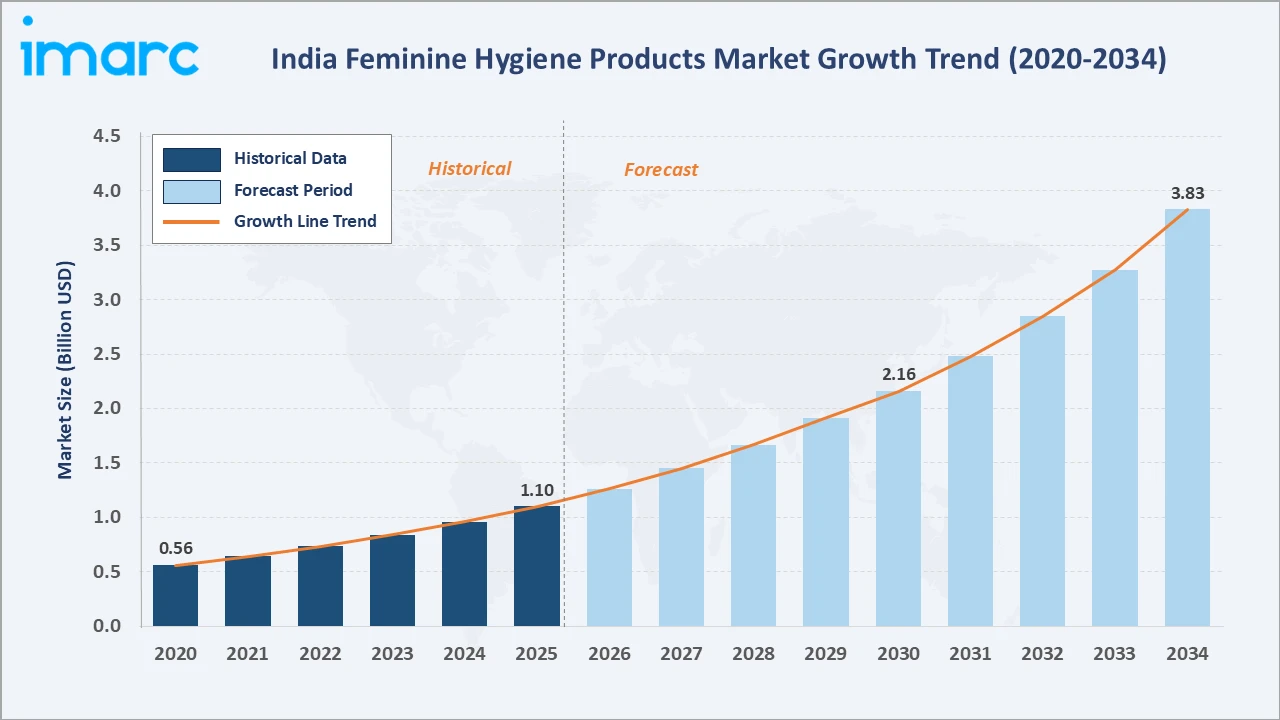
The India feminine hygiene products market grew from USD 1.10 Billion in 2025 to USD 1.26 Billion in 2026 and is projected to reach USD 3.83 Billion by 2034, growing at a CAGR of 14.43% during 2026-2034. Market expansion is driven by rising female workforce participation, government menstrual hygiene schemes, growing e-commerce penetration, and increasing awareness of personal hygiene. Sanitary pads lead product type at 52.8% (2025). Supermarkets and hypermarkets account for 34.7% of distribution. North India commands the largest regional share at 31.4%.
Market Snapshot
|
Metric |
Value |
|
Base Year Market Size (2025) |
USD 1.10 Billion |
|
Market Size (2026) |
USD 1.26 Billion |
|
Forecast Market Size (2034) |
USD 3.83 Billion |
|
CAGR (2026-2034) |
14.43% |
|
Base Year |
2025 |
|
Historical Period |
2020-2025 |
|
Forecast Period |
2026-2034 |
|
Market Size (2020) |
USD 0.56 Billion |
|
Market Size (2030) |
USD 2.16 Billion |
|
Dominant Product Type |
Sanitary Pads (52.8%, 2025) |
|
Leading Distribution Channel |
Supermarkets & Hypermarkets (34.7%, 2025) |
|
Leading Region |
North India (31.4%, 2025) |
To get more information on this market, Request Sample
The India feminine hygiene products market expanded from USD 0.56 Billion in 2020 to USD 1.10 Billion in 2025 and an estimated USD 1.26 Billion in 2026, is projected to reach USD 2.16 Billion by 2030, and is forecast to reach USD 3.83 Billion by 2034. The Government of India's Menstrual Hygiene Scheme (MHS) under the National Health Mission has been pivotal, sanitary pad usage rose from 15% of menstruating women in 2010 to 78% in 2019-21, per NFHS-5 data, creating a robust demand foundation.
Executive Summary
The India feminine hygiene products market expanded from USD 1.10 Billion in 2025 to USD 1.26 Billion in 2026 and is projected to reach USD 3.83 Billion by 2034, expanding at a CAGR of 14.43% during the forecast period. The market is commercially distinct, combining one of the world's largest unserved menstrual hygiene populations with a rapidly expanding urban consumer base.
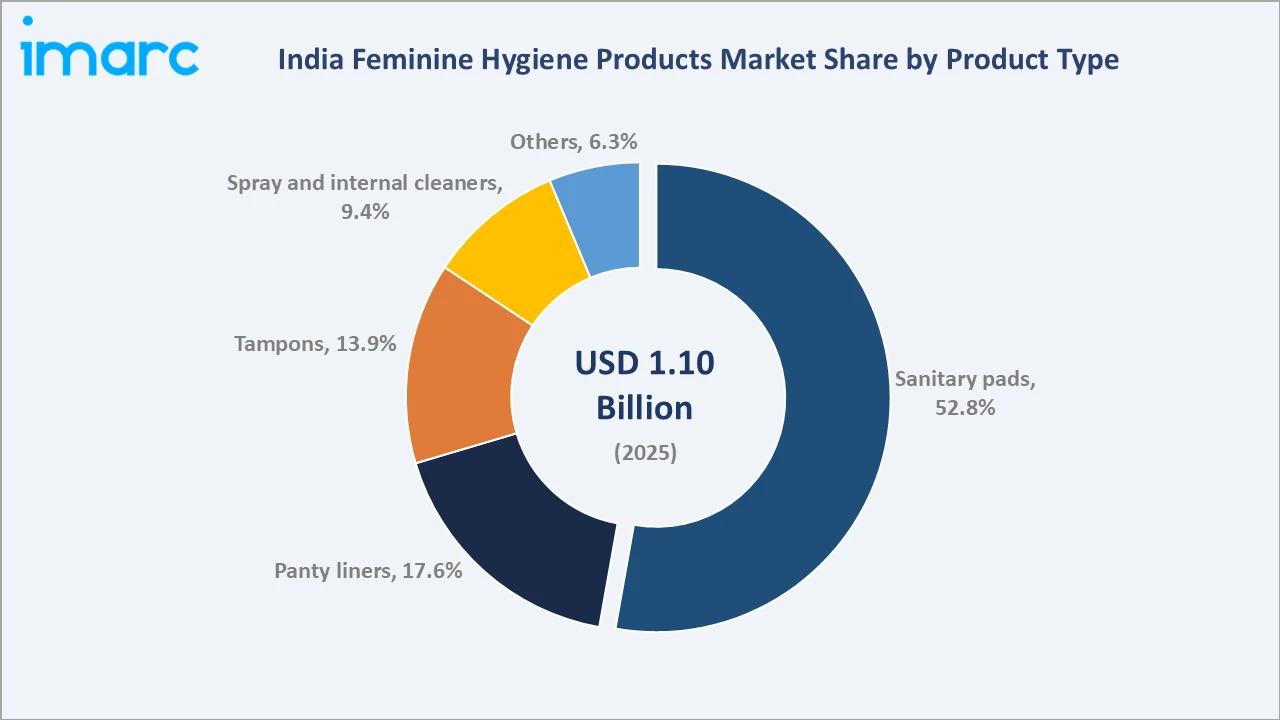
Sanitary pads dominate at 52.8% product share in 2025. Growing awareness of alternatives, panty liners (17.6%), tampons (13.9%), and spray and internal cleaners (9.4%), indicates premiumization. Supermarkets and hypermarkets lead distribution at 34.7%, while online stores (18.5%) represent the fastest-growing channel, driven by discreet purchasing behavior among Indian consumers.
North India commands the largest regional share at 31.4%, supported by higher urbanization and retail density. The market outlook remains strongly positive through 2034, supported by India's 350+ million menstruating women, rising disposable income, increasing female literacy, and the structural shift from cloth to commercial products. The market presents significant investment opportunity across product innovation, sustainable hygiene solutions, and rural distribution expansion.
Key Market Insights
|
Insight |
Data |
|
Dominant Product Type |
Sanitary Pads - 52.8% share (2025) |
|
Fastest Growing Product |
Tampons (~16.5% CAGR, 2026-2034) |
|
Leading Distribution Channel |
Supermarkets & Hypermarkets - 34.7% (2025) |
|
Fastest Growing Channel |
Online Stores (~19% CAGR, 2026-2034) |
|
Leading Region |
North India - 31.4% share (2025) |
|
Top Companies |
The Procter & Gamble Company (P&G), Unicharm Corporation, and Kimberly-Clark Corporation |
|
Market Opportunity |
Rural distribution, eco-friendly products, corporate menstrual leave policy beneficiary brands |
Key Analytical Observations Supporting the Above Data:
- Sanitary Pads at 52.8%: Mass-market adoption driven by affordability post-GST exemption and government distribution through health workers under the National Health Mission, reaching rural and semi-urban populations at scale.
- Tampons-Growing Fastest (~16.5% CAGR): Rising awareness among urban working women, growing acceptance in metro cities, and D2C brand marketing are expanding the tampon segment from a low base.
- Supermarkets & Hypermarkets at 34.7%: Organized retail provides extensive product range, promotional offers, and trusted retail environments that drive high foot traffic for feminine hygiene categories.
- Online Stores-Fastest Growing (18.5% share): Discreet purchasing, subscription models, and wider product accessibility in Tier-2 and Tier-3 cities with improving logistics infrastructure are powering digital channel growth.
- North India at 31.4%: Delhi-NCR's dense modern retail infrastructure, higher urban female workforce participation rate, and strong brand marketing presence support market leadership in 2025.
India Feminine Hygiene Products Market Overview
Feminine hygiene products encompass sanitary pads, panty liners, tampons, menstrual cups, and spray and internal cleaners. These products are essential personal care items designed to maintain cleanliness, comfort, and confidence during menstruation. The India market integrates domestic manufacturing, multinational subsidiary operations, government distribution networks, organized retail, and rapidly growing e-commerce platforms. Macroeconomic drivers include rising female workforce participation, growing urbanization, expanding middle-class purchasing power, and favorable government policy - notably the GST exemption on sanitary napkins from July 2018.
India's 350+ million menstruating women represent one of the world's largest addressable markets. NFHS-5 data confirms that 78% of women aged 15-24 used hygienic menstrual protection in 2019-21, up from 57% in 2015-16. This transition from cloth to commercial products is the market's primary structural growth engine. The market spans mass-market sanitary pads priced below INR 50 per pack to premium organic and biodegradable options exceeding INR 400.
Market Dynamics
To evaluate market opportunities, Request Sample
Market Drivers
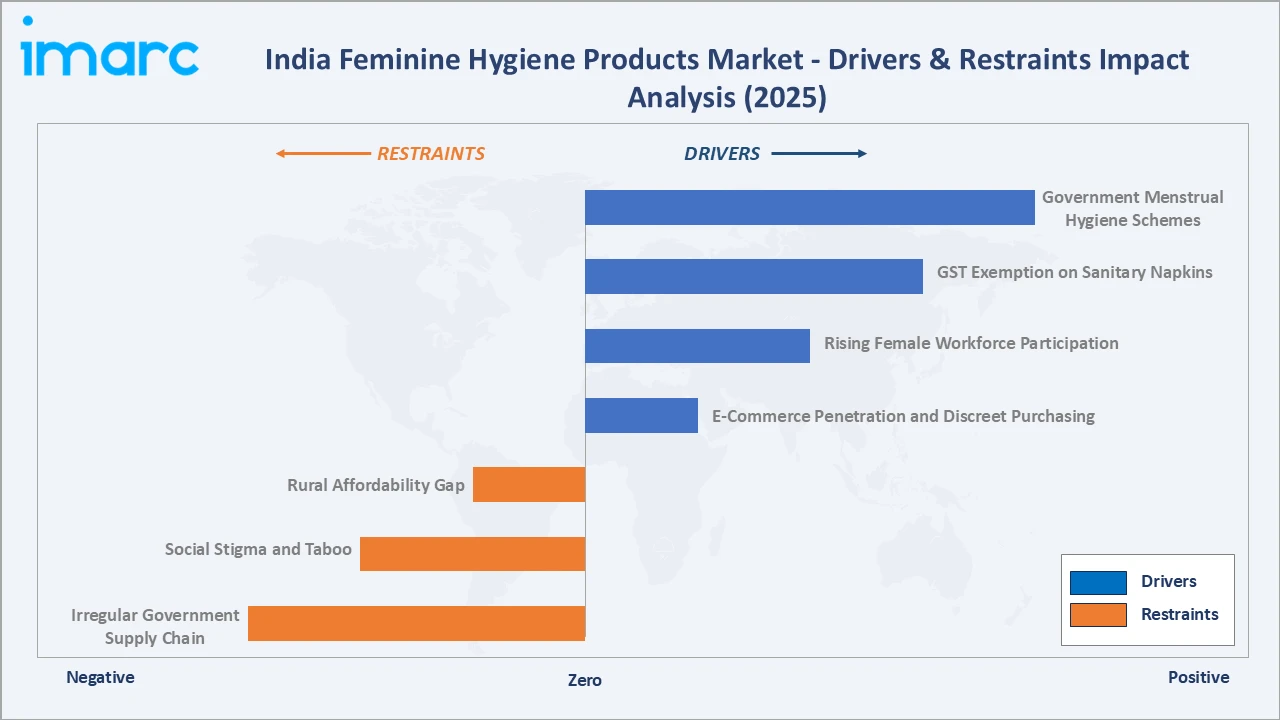
- Government Menstrual Hygiene Schemes: The National Health Mission's Menstrual Hygiene Scheme, launched in 2011 and targeting 15 million adolescent girls aged 10-19 years across 152 districts in 20 states, has been the foundational demand-creation initiative. Pad usage among women aged 15-24 rose from 57% (NFHS-4, 2015-16) to 78% (NFHS-5, 2019-21), directly expanding the addressable commercial market.
- GST Exemption on Sanitary Napkins: The GST Council's decision to exempt sanitary napkins from the 12% GST in July 2018 reduced end-consumer prices and improved affordability, particularly benefiting lower-income households. This policy change was a direct demand stimulus and remains a cornerstone of market expansion.
- Rising Female Workforce Participation: India's female labor force participation rate improved to 41.7% in 2023-24, per the Ministry of Labour's Periodic Labour Force Survey (PLFS), versus 23.3% in 2017-18. Working women exhibit significantly higher usage rates of commercial hygiene products, driving consistent demand growth in urban and semi-urban markets.
- E-Commerce Penetration and Discreet Purchasing: Online platforms provide anonymous access to a wider product range, overcoming social stigma barriers that constrain in-store purchases in traditional retail settings. Digital subscription models and rural logistics improvement are expanding reach to Tier-2 and Tier-3 cities.
Market Restraints
- Rural Affordability Gap: Despite government schemes, a significant rural affordability gap persists. In states like Bihar and Uttar Pradesh, 81-82% of women still used cloth-based alternatives as of recent surveys, reflecting price sensitivity that limits commercial market penetration even with improved awareness.
- Social Stigma and Taboo: Menstruation-related taboos and cultural stigma continue to suppress open discussion and in-store purchasing in conservative communities, particularly in rural and semi-urban India, constraining market conversion rates below the level of stated awareness.
- Supply Chain and Distribution Challenges in Remote Areas: India's geographic diversity and underdeveloped rural retail infrastructure create last-mile distribution bottlenecks, limiting product availability and increasing logistics costs for manufacturers targeting lower-income rural markets.
Market Opportunities
- Eco-Friendly and Biodegradable Product Segment: Growing urban consumer awareness of plastic waste and environmental sustainability is creating demand for biodegradable pads, menstrual cups, and reusable cloth pads. This segment offers premium pricing and strong brand differentiation opportunity as younger, educated consumers prioritize sustainable consumption.
- Corporate Menstrual Leave Policy and Workplace Hygiene Programs: India's expanding corporate sector is adopting menstrual leave policies. Several states and companies provide paid menstrual leave, creating institutional demand for quality hygiene products through workplace channels and B2B distribution models.
- Rural Market Conversion: The gap between awareness (~78%, NFHS-5) and commercial product usage among rural women represents the market's largest untapped conversion opportunity. Affordable product variants and social entrepreneurship distribution models targeting rural India offer substantial long-term growth potential.
Market Challenges
- Irregular Government Supply Chain: Inconsistent distribution of government-subsidized sanitary pads under the Menstrual Hygiene Scheme has been flagged in India's Parliament, creating reliability concerns that affect market formalization and brand building in scheme-target geographies.
- Counterfeit and Unbranded Products: The presence of low-quality unbranded products in price-sensitive markets undermines consumer trust and challenges established brands on price, particularly in rural and semi-urban distribution channels.
Emerging Market Trends
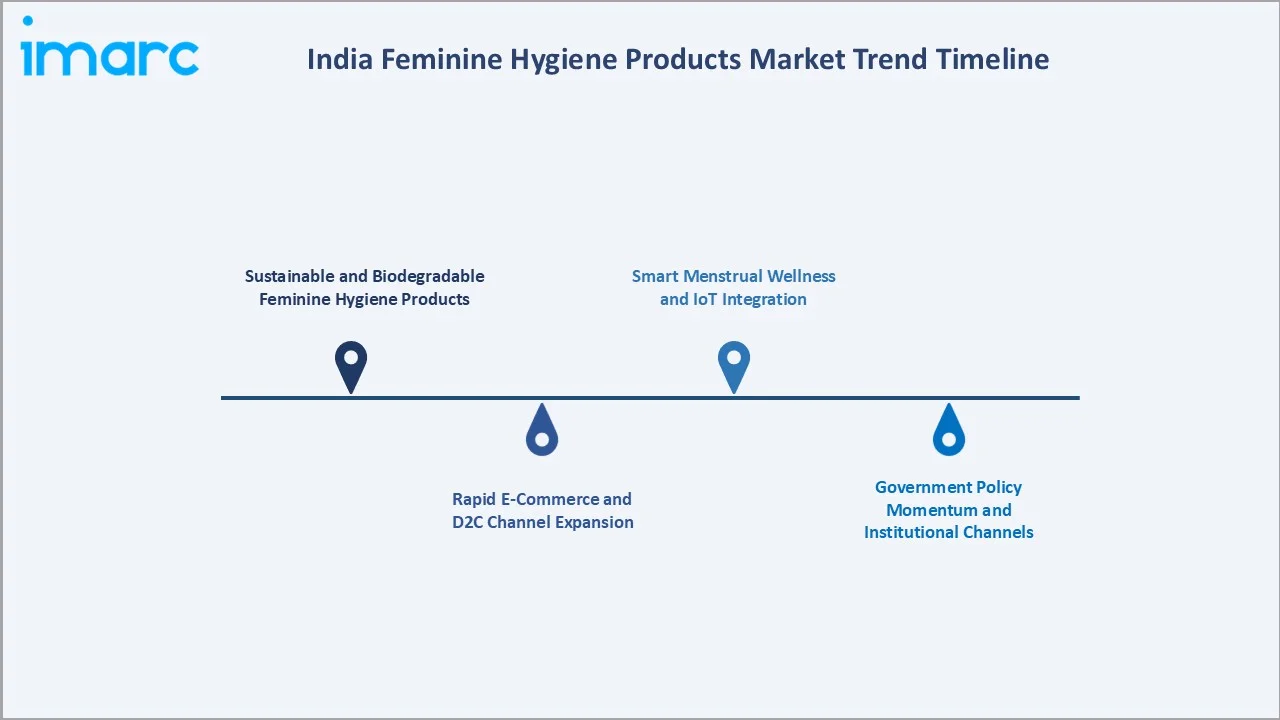
1. Sustainable and Biodegradable Feminine Hygiene Products
Consumer demand for eco-friendly menstrual products is accelerating among India's urban, educated female demographic. Organic cotton pads, bamboo fiber-based products, and biodegradable packaging are gaining commercial traction. Manufacturers are responding with sustainable product lines priced at a 30-50% premium over conventional pads. This trend aligns with India's broader sustainability movement and is expected to create a distinct premium segment by 2028.
2. Rapid E-Commerce and D2C Channel Expansion
Online platforms contributed 18.5% of total distribution in 2025 and are growing at an estimated 19% CAGR through 2034. D2C feminine hygiene brands are leveraging digital-first strategies, subscription delivery models, and social media marketing to bypass traditional retail. The anonymity of online purchasing is particularly valuable in India, where cultural stigma around menstruation still inhibits in-store purchasing behavior in many markets.
3. Smart Menstrual Wellness and IoT Integration
Technology-integrated feminine hygiene is an emerging frontier. Smart pads with biosensors and AI-driven menstrual health apps are in early development phases, targeting India's tech-savvy urban consumer segment. Companies are partnering with gynecologists to develop wellness platforms that integrate cycle tracking, health monitoring, and product recommendations. This convergence of healthcare technology and hygiene products is expected to create a new premium sub-segment through 2030.
4. Government Policy Momentum and Institutional Channels
Multiple state governments - including Maharashtra, Kerala, Rajasthan, and Uttar Pradesh - have expanded pad distribution programs for schoolgirls beyond the central scheme. In April 2023, India's Supreme Court advocated for a uniform national menstrual hygiene policy, including free sanitary pads for girls in Classes 6-12. This institutional demand channel is creating a structured parallel market that drives unit volume growth independent of commercial pricing dynamics.
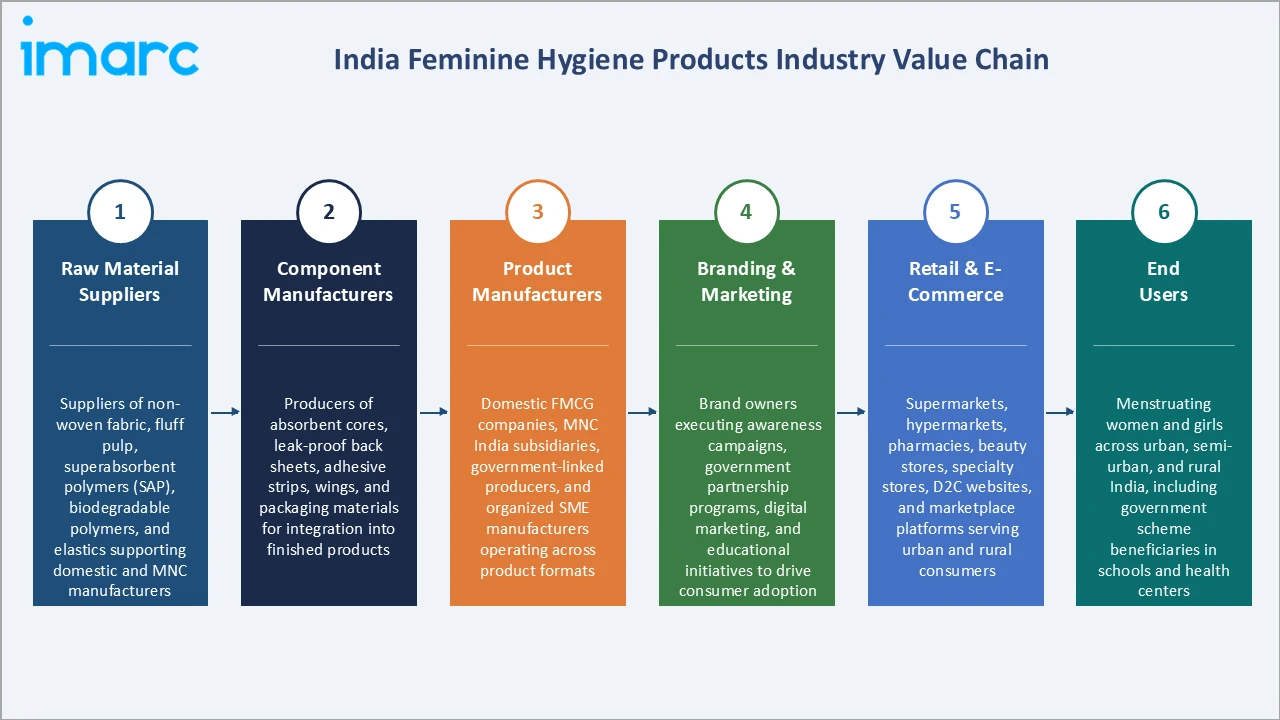
Industry Value Chain Analysis
The India feminine hygiene products value chain spans raw material production to end-consumer delivery across organized retail, pharmacy, and digital channels. Each stage involves distinct participants and commercial dynamics that collectively shape product cost, availability, and consumer access.
|
Stage |
Key Participants |
|
Raw Material Suppliers |
Suppliers of non-woven fabric, fluff pulp, superabsorbent polymers (SAP), biodegradable polymers, and elastics supporting domestic and MNC manufacturers |
|
Component Manufacturers |
Producers of absorbent cores, leak-proof back sheets, adhesive strips, wings, and packaging materials for integration into finished products |
|
Product Manufacturers |
Domestic FMCG companies, MNC India subsidiaries, government-linked producers, and organized SME manufacturers operating across product formats |
|
Branding & Marketing |
Brand owners executing awareness campaigns, government partnership programs, digital marketing, and educational initiatives to drive consumer adoption |
|
Retail & E-Commerce |
Supermarkets, hypermarkets, pharmacies, beauty stores, specialty stores, D2C websites, and marketplace platforms serving urban and rural consumers |
|
End Users |
Menstruating women and girls across urban, semi-urban, and rural India, including government scheme beneficiaries in schools and health centers |
The distribution stage is commercially the most consequential. Organized retail and pharmacy chains provide product visibility and consumer trust, while e-commerce is democratizing access beyond traditional distribution geographies.
Technology Landscape in the India Feminine Hygiene Products Industry
Advanced Absorbent Materials and Product Innovation
Superabsorbent polymer (SAP) technology and non-woven fabric innovation have significantly improved pad absorption efficiency and comfort. Manufacturers are investing in ultra-thin designs with enhanced leak protection, addressing consumer demand for discretion during active lifestyles. Organic cotton and bamboo fiber alternatives are gaining traction as skin-friendly, biodegradable options. Innovation in back-sheet materials is enabling breathable, rash-reducing products for tropical climate conditions prevalent across India.
E-Commerce Technology and Digital Distribution
AI-driven personalization engines on e-commerce platforms are enabling targeted product recommendations based on purchase history and health preferences. Subscription management technology, real-time inventory tracking, and cold-chain logistics for organic product variants are enhancing digital channel reliability. Mobile-first purchasing interfaces optimized for India's smartphone user base - 750 million+ as of 2025 - are reducing digital barriers for first-time online buyers of feminine hygiene products.
Smart Menstrual Health Technologies
Wearable and app-based menstrual health tracking represents the industry's frontier technology segment. AI-powered cycle prediction apps, symptom monitoring platforms, and IoT-integrated product prototypes are in development. These technologies target India's growing urban professional demographic and are supported by increasing smartphone penetration and improved digital health literacy. Integration with health insurance platforms represents a medium-term commercial opportunity as menstrual health gains recognition as a core healthcare domain.
Market Segmentation Analysis
The report additionally covers product type, distribution channel, region, and other micro-segments with full market sizing and share data in the complete report.
|
Segment Category |
Leading Segment |
Market Share |
Year |
|
Product Type |
Sanitary Pads |
52.8% |
2025 |
|
Distribution Channel |
Supermarkets & Hypermarkets |
34.7% |
2025 |
|
Region |
North India |
31.4% |
2025 |

By Product Type
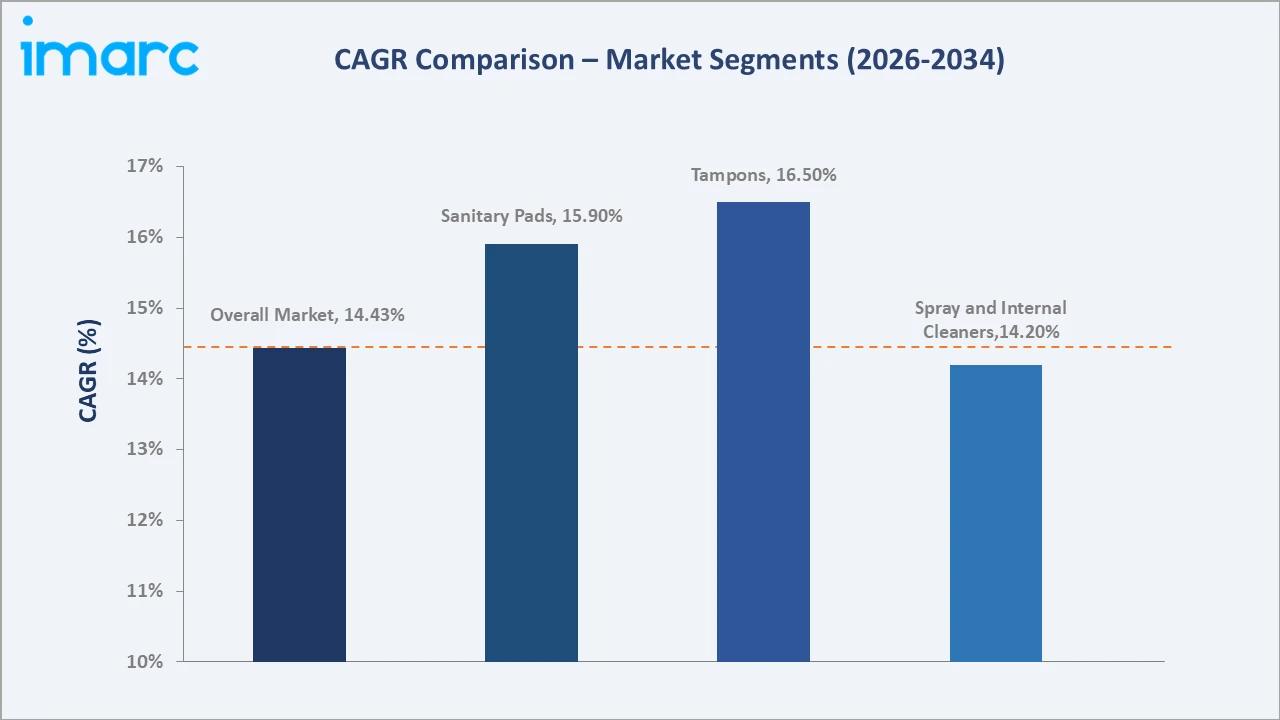
Sanitary pads lead the India feminine hygiene products market with a 52.8% share in 2025. This dominance reflects wide consumer familiarity, government-supported distribution, post-GST affordability improvement, and availability across mass-market to premium price points. Government initiatives under the National Health Mission have specifically promoted sanitary pads, creating a usage culture across rural and semi-urban India. The segment is estimated to grow at ~13.8% CAGR through 2034.
To access detailed market analysis, Request Sample
Panty liners hold 17.6% share in 2025, growing with increasing urban adoption and product awareness. Tampons at 13.9% represent a fast-growing segment (~16.5% CAGR), driven by metro cities and working women. Spray and internal cleaners account for 9.4%, appealing to consumers with hygiene-premium preferences. The 'Others' category (6.3%) includes menstrual cups and reusable cloth pads, growing rapidly from a small base as sustainability awareness increases.
By Distribution Channel
Supermarkets and hypermarkets lead distribution at 34.7% in 2025. Organized retail provides broad product access, promotional visibility, and trusted purchase environments. Beauty stores and pharmacies hold 27.8%, benefiting from healthcare-adjacent purchasing behavior and professional product recommendations. Online stores account for 18.5%, growing fastest as digital adoption and discreet delivery address social stigma barriers.
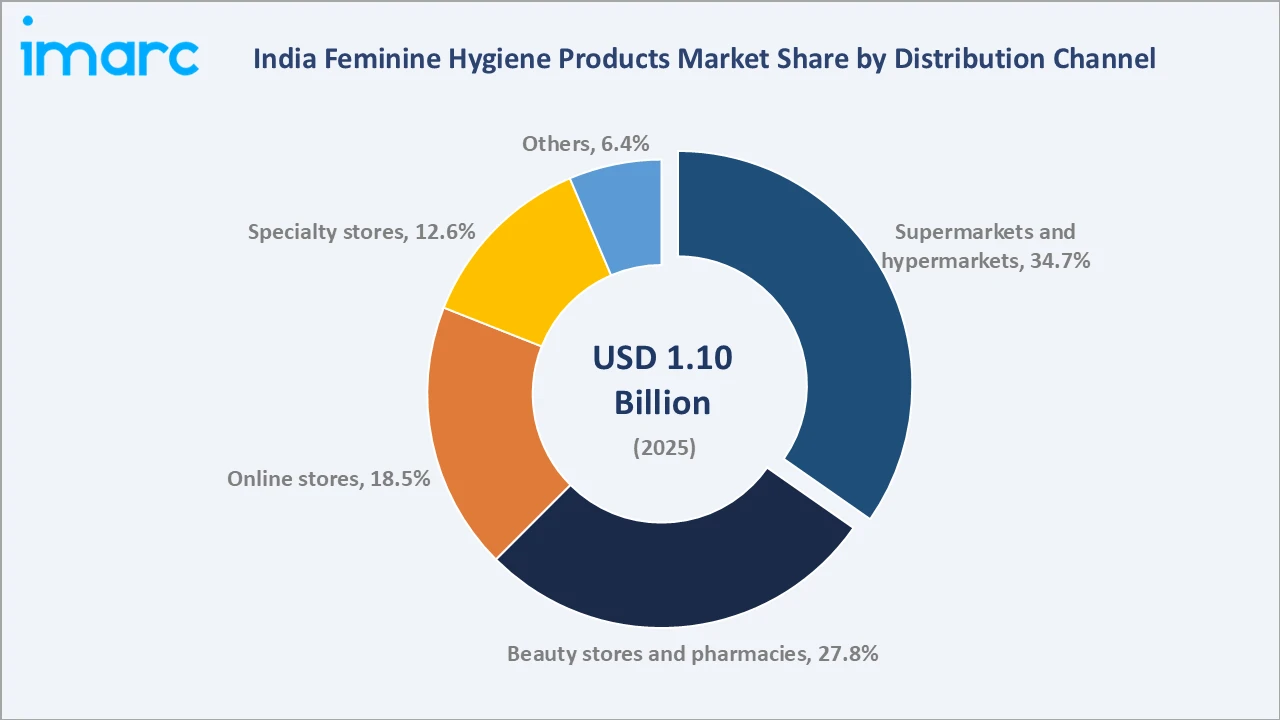
Specialty stores represent 12.6% of distribution, serving premium and niche product segments in urban markets. The 'Others' category (6.4%) includes government health center distribution and rural direct-sales channels. Online channel growth is supported by major e-commerce platforms' category investment, improved rural logistics, and D2C brand expansion targeting Tier-2 and Tier-3 cities.
Regional Market Insights
|
Region |
Share (2025) |
Key Market Characteristics |
|
North India |
31.4% |
Highest urban density and retail infrastructure. Strong organized retail presence in Delhi-NCR. Higher female workforce participation and brand awareness. Government scheme distribution well-developed across Uttar Pradesh, Rajasthan, and Punjab. |
|
West & Central India |
29.2% |
Mumbai's affluent consumer base drives premium product demand. Maharashtra and Gujarat contribute strong supermarket and pharmacy channel volumes. Central India sees growing rural adoption through health mission distribution networks. |
|
South India |
24.1% |
Bengaluru, Hyderabad, and Chennai's IT-sector workforce drives highest premium product adoption. South India exhibits the highest hygienic product usage rate (90.7% coverage, per NFHS-5 regional data). Strong D2C and online purchasing culture among tech-savvy consumer segment. |
|
East & Northeast India |
15.3% |
Fastest-growing emerging region as Kolkata expands organized retail and Northeast states benefit from government scheme pad distribution. Northeast India coverage at 69-71% (NFHS-5) indicates significant conversion opportunity. Rising urban incomes are driving first-time commercial product adoption. |
North India's 31.4% leadership reflects the highest modern retail density and female workforce participation among all regions. West and Central India's 29.2% is anchored by Mumbai's premium consumer market and Maharashtra's large female population with strong awareness of commercial hygiene products. South India's 24.1% is distinguished by the highest adoption rates nationally, driven by higher education levels and urban professional incomes.
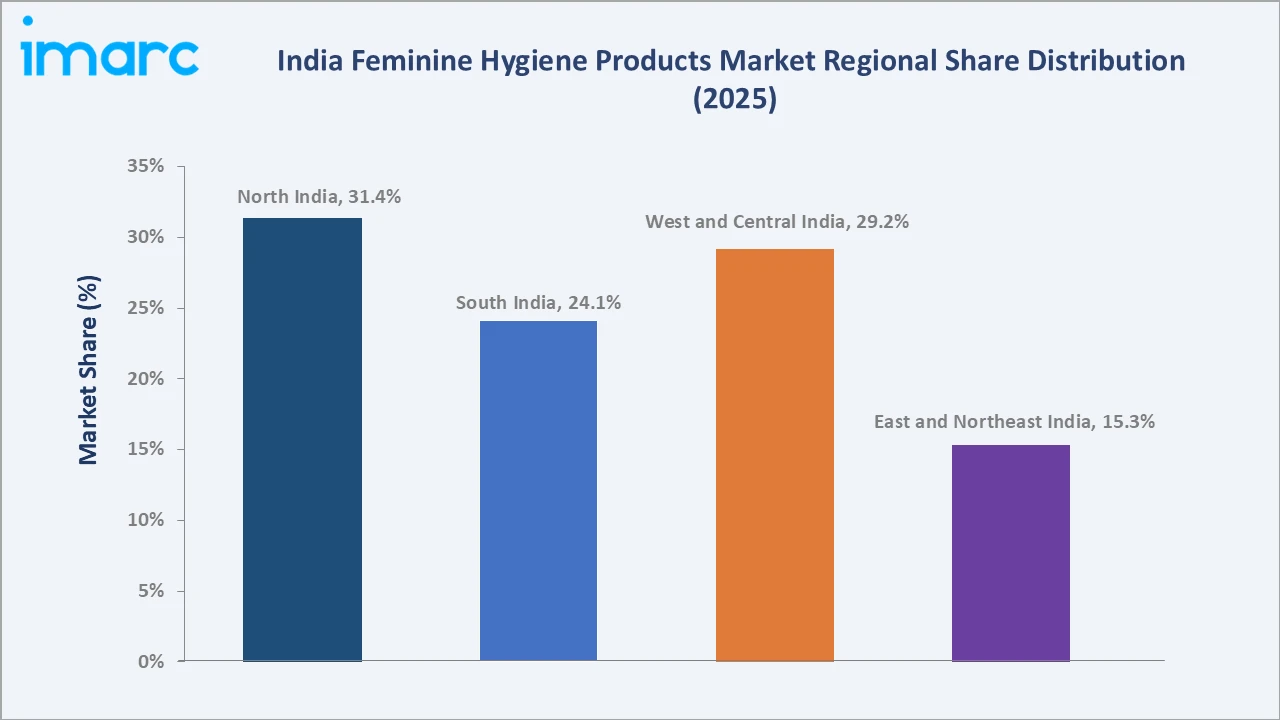
East and Northeast India at 15.3% represents the most commercially underserved region with the highest potential for government-supported market development. States like Assam and Tripura - designated as treatment states under the Menstrual Hygiene Scheme - have seen significant pad usage increases, demonstrating that targeted policy intervention can rapidly convert awareness to commercial consumption in previously underserved geographies.
Competitive Landscape
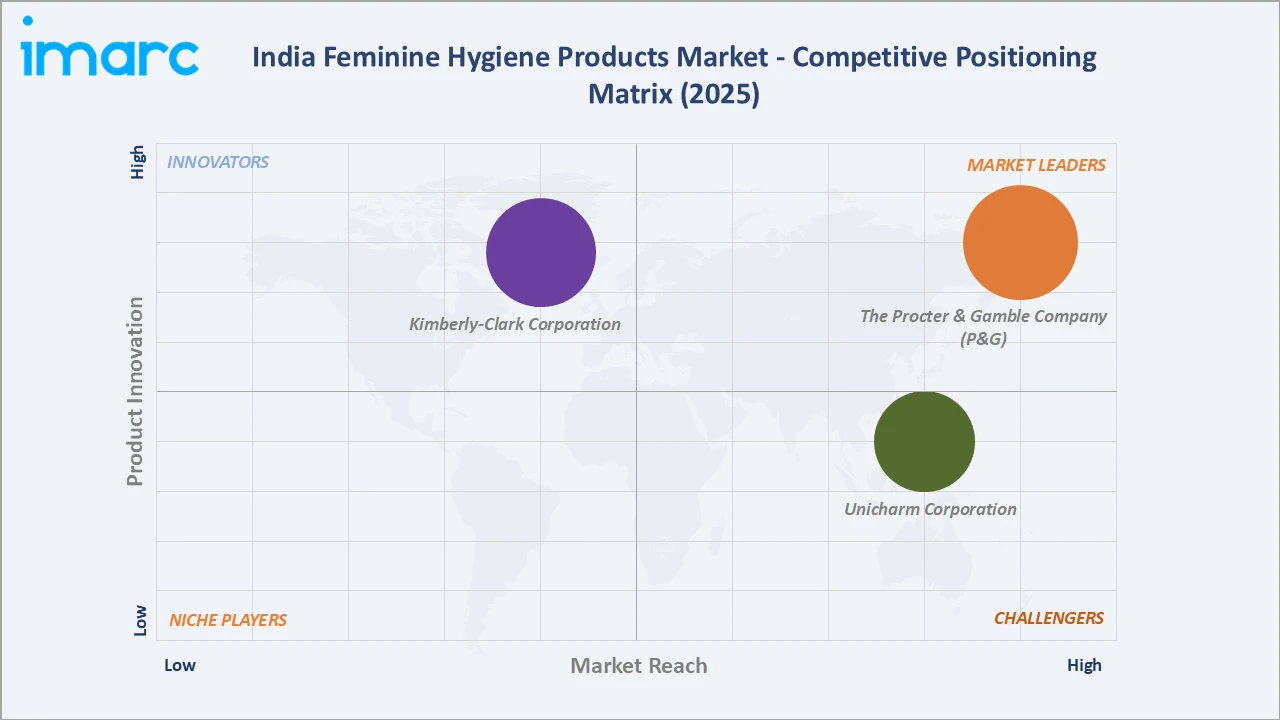
The India feminine hygiene products market is moderately concentrated at the premium end, led by P&G and Kimberly-Clark Corporation, with increasing fragmentation at the mass-market level from domestic manufacturers and D2C entrants. Competition is intensifying through e-commerce, sustainable product innovation, and rural distribution expansion. Digital-first brands are challenging established players with targeted marketing and subscription models.
|
Company |
Key Brands |
Market Position |
Core Strength |
|
The Procter & Gamble Company (P&G) |
Whisper |
Market Leader |
Pan-India distribution network, mass-market and premium product range, strong government scheme partnerships |
|
Unicharm Corporation |
Sofy |
Strong Challenger |
Japanese manufacturing quality, premium comfort proposition, growing urban consumer adoption |
|
Kimberly-Clark Corporation |
Kotex |
Innovator |
Premium and lifestyle-oriented product positioning, active in urban organized retail and specialty channels |
P&G (Whisper) commands the market's largest share through its extensive distribution network, consistent brand investment, and product range spanning INR 25 entry packs to premium overnight and ultra-thin variants. Unicharm (Sofy) is gaining share through premium comfort positioning in urban markets. The competitive landscape is evolving with D2C entrants introducing organic, biodegradable, and subscription-based products targeting digital-first urban consumers.
Key Company Profiles
The Procter & Gamble Company (P&G)
The Procter & Gamble Company (P&G), operates Procter & Gamble Hygiene and Health Care Limited which is India’s market leader in feminine hygiene. The company manufactures and markets branded packaged FMCG products in femcare and healthcare categories across India.
- Key Brands: Whisper (sanitary pads - mass to premium range, overnight and ultra-thin variants)
- Recent Developments: In January 2026, P&G’s Whisper launched an innovative line of period panties, designed with 360-degree protection and alleviating the discomfort of traditional pads.
- Strategic Focus: Sustaining market leadership through broad distribution, affordable product access, and premium product upgrades targeting India's expanding middle class.
Kimberly-Clark Corporation
Kimberly-Clark Corporation operates Kimberly-Clark India Private Limited, a leading global personal care company with a focused presence in India's feminine hygiene market through its Kotex brand.
- Key Brands: Kotex (sanitary pads: premium and overnight variants, period panties)
- Strategic Focus: Premium and lifestyle-oriented product positioning targeting urban, younger Indian consumers; active in organized retail and specialty channels, and emphasis on breaking period stigma through bold,
Market Concentration Analysis
The India feminine hygiene products market exhibits moderate-to-high concentration at the organized branded product level. The top three players - P&G (Whisper), Kimberly-Clark Corporation (Kotex), and Unicharm (Sofy) - collectively account for an estimated 55-65% of the organized branded market by value in 2025. P&G commands the largest single-company share, supported by the widest distribution network and Whisper's strong mass-market equity built over 30+ years.
Market fragmentation is increasing from two directions: premium D2C brands targeting eco-conscious urban consumers with organic and biodegradable products, and low-cost domestic manufacturers competing on price in Tier-3 and rural markets. The government institutional channel further de-concentrates effective commercial market share by delivering subsidized products outside brand-controlled distribution. Consolidation is occurring at the mid-market level as organized retail scale advantages favor national brands over regional players.
The market's unorganized segment - including unbranded domestic manufacturers and informal distribution - is estimated to account for 20-25% of total unit volume, particularly in rural and low-income segments. GST compliance pressure is gradually formalizing portions of this segment into the organized market, contributing to above-GDP reported market growth for the leading national brands.
Investment & Growth Opportunities
Highest Growth Segments
Tampons (~16.5% CAGR) represent the market's fastest-growing product segment, growing from a small base as urban working women adopt tampon use. Eco-friendly and biodegradable products (~18% CAGR from small base) are the premium opportunity segment. Online distribution (~19% CAGR) is the fastest-growing channel investment opportunity. East and Northeast India offers above-market-average regional growth as awareness-to-adoption conversion accelerates.
Emerging Investment Opportunities
- Sustainable Feminine Hygiene: Organic cotton, bamboo, and biodegradable product development targeting the fast-growing eco-conscious urban consumer segment, with premium pricing of 30-50% above conventional products providing strong margin opportunity.
- Rural Distribution Innovation: Social enterprise and last-mile distribution models serving India's 250+ million rural women, supported by government scheme convergence and micro-enterprise distribution networks, offer high-volume growth with improving unit economics.
- Digital Health Integration: AI-powered menstrual wellness platforms, cycle tracking apps with product integration, and workplace menstrual health programs represent the emerging technology investment frontier with high consumer lifetime value potential.
- D2C Brand Opportunity: Digital-first feminine hygiene brands can access India's 750 million smartphone users through targeted social media and subscription e-commerce models, bypassing traditional distribution constraints.
Future Market Outlook (2026-2034)
The India feminine hygiene products market is projected to grow from USD 1.10 Billion in 2025 to an estimated USD 1.26 Billion in 2026 and further to USD 3.83 Billion by 2034 at a 14.43% CAGR, anchored at USD 2.16 Billion in 2030. Three structural forces define the market's growth trajectory: India's female population scale creating the world's largest conversion opportunity, favorable government policy supporting demand creation, and rising income and education levels driving premiumization.
Technology will increasingly define market differentiation through 2034. Smart menstrual wellness platforms, biodegradable product mainstream adoption, and AI-driven health monitoring integration will create new premium sub-segments. E-commerce is expected to represent 30%+ of distribution by 2030, displacing traditional pharmacy channels for urban consumers. Rural market formalization, driven by continued government scheme expansion and improving logistics, will be the primary volume growth driver for mass-market products.
The market's structural outlook is strongly positive. India's menstruating women population of 350+ million, the continuing transition from cloth to commercial products, rising female workforce participation, and the Supreme Court's 2023 advocacy for a uniform national menstrual hygiene policy collectively support sustained above-average market growth through the forecast period.
Research Methodology
Primary Research
Primary research comprised structured interviews with India feminine hygiene market stakeholders including brand managers, organized retail category directors, pharmacy distributors, rural healthcare workers, government scheme coordinators, and consumer groups across North, South, West, and East India. Consumer surveys covered urban, semi-urban, and rural women across income segments.
Secondary Research
Secondary research encompassed National Family Health Survey (NFHS-5) data from the Ministry of Health and Family Welfare, Periodic Labour Force Survey (PLFS) data from the Ministry of Labour, company annual reports, industry association reports, GST Council notifications, and National Health Mission program documentation. Over 40 secondary sources were reviewed.
Forecasting Models
Market revenue forecasts were developed using a female population segmentation model: India's menstruating women population by income and geographic segment multiplied by product adoption rates and average annual spend per user, adjusted for government scheme penetration and e-commerce channel growth, creating total market revenue through segment aggregation.
India Feminine Hygiene Products Market Report Coverage:
| Report Features | Details |
|---|---|
| Base Year of the Analysis | 2025 |
| Historical Period | 2020-2025 |
| Forecast Period | 2026-2034 |
| Units | Billion USD |
| Scope of the Report | Exploration of Historical Trends and Market Outlook, Industry Catalysts and Challenges, Segment-Wise Historical and Future Market Assessment:
|
| Product Types Covered | Sanitary Pads, Panty Liners, Tampons, Spray and Internal Cleaners, Others |
| Distribution Channels Covered | Supermarkets and Hypermarkets, Specialty Stores, Beauty Stores and Pharmacies, Online Stores, Others |
| Regions Covered | North India, West and Central India, South India, East and Northeast India |
| Companies Covered | The Procter & Gamble Company (P&G), Unicharm Corporation, Kimberly-Clark Corporation, etc. |
| Customization Scope | 10% Free Customization |
| Post-Sale Analyst Support | 10-12 Weeks |
| Delivery Format | PDF and Excel through Email (We can also provide the editable version of the report in PPT/Word format on special request) |
Key Benefits for Stakeholders:
- IMARC’s industry report offers a comprehensive quantitative analysis of various market segments, historical and current market trends, market forecasts, and dynamics of the India feminine hygiene products market from 2020-2034.
- The research report provides the latest information on the market drivers, challenges, and opportunities in the India feminine hygiene products market.
- Porter's five forces analysis assist stakeholders in assessing the impact of new entrants, competitive rivalry, supplier power, buyer power, and the threat of substitution. It helps stakeholders to analyze the level of competition within the India feminine hygiene products industry and its attractiveness.
- Competitive landscape allows stakeholders to understand their competitive environment and provides an insight into the current positions of key players in the market.
Frequently Asked Questions About the India Feminine Hygiene Products Market Report
The India feminine hygiene products market size is estimated at USD 1.26 Billion in 2026, driven by government hygiene schemes, rising female workforce participation, and growing urban awareness.
The market is projected to reach USD 3.83 Billion by 2034, supported by rural market conversion and e-commerce expansion.
The India feminine hygiene products market CAGR is 14.43% during 2026-2034, making it one of the fastest-growing consumer health markets in Asia.
Sanitary pads lead at 52.8% share in 2025, driven by government scheme distribution, post-GST affordability, and mass-market brand availability.
Supermarkets and hypermarkets hold the largest share at 34.7% in 2025, followed by beauty stores and pharmacies at 27.8%, reflecting organized retail dominance.
North India leads at 31.4% in 2025, driven by Delhi-NCR's modern retail density, higher female workforce participation, and strong brand marketing investment.
The India feminine hygiene products market stood at USD 0.56 Billion in 2020, with growth accelerating post-GST exemption and expanded government hygiene scheme coverage.
The market is projected to reach USD 2.16 Billion by 2030, with e-commerce, sustainable product adoption, and rural market conversion driving above-GDP expansion.
Leading companies include The Procter & Gamble Company (P&G), Unicharm Corporation, Kimberly-Clark Corporation, and others.
Key drivers include the National Health Mission's Menstrual Hygiene Scheme, GST exemption on sanitary napkins since 2018, rising female workforce participation at 41.7% (PLFS 2023-24), and e-commerce expansion.
Key opportunities include eco-friendly product innovation, rural distribution expansion, digital health integration, and D2C brand development targeting India's 750 million smartphone users.
Major trends include sustainable and biodegradable product adoption, e-commerce and D2C channel growth, smart menstrual wellness technology, and government institutional channel expansion through state-level policy initiatives.
Need more help?
- Speak to our experienced analysts for insights on the current market scenarios.
- Include additional segments and countries to customize the report as per your requirement.
- Gain an unparalleled competitive advantage in your domain by understanding how to utilize the report and positively impacting your operations and revenue.
- For further assistance, please connect with our analysts.
 Request Customization
 Speak to an Analyst
 Request Brochure
 Inquire Before Buying
Benefits of Customization
- Personalize this research
- Triangulate with your data
- Get data as per your format and definition
- Gain a deeper dive into a specific application, geography, customer, or competitor
- Any level of personalization
Get in Touch With Us
UNITED STATES
Phone: +1-201-971-6302
INDIA
Phone: +91-120-433-0800
UNITED KINGDOM
Phone: +44-753-714-6104
Email: [email protected]
Client Testimonials




.webp)




.webp)













Related Reports

Choose your plan
*Please note that the prices mentioned below are starting prices for each bundle type. Kindly contact our team for further details.*
Single User License
- 1 User License, Access on 2 Devices
- PDF Report + Excel Dataset (Password Protected)
- Lifetime Access
- No Printing Rights
- 10% Free Report Customization
- 10–12 Weeks of Analyst Support
Five User License
- Access for 5 Users, 2 Devices per User
- PDF Report + Excel Dataset (Password Protected)
- Lifetime Access
- Dedicated Account Manager
- 12–14 Weeks of Analyst Support
- No Printing Rights
- 15% Free Report Customization
- 25% Discount on Your Next Purchase
Corporate User License
- Unlimited User Access (Within Your Organization)
- PDF Report + Excel Dataset
- Lifetime Access
- Dedicated Account Manager
- 14–20 Weeks of Analyst Support
- No Printing Rights
- 20% Free Report Customization
- 30% Discount on Your Next Purchase
Essential Insights
What's included:
3 reports
- Lifetime Access
- PDF Reports
- Excel Datasets
- 2 Weeks of Free Analyst Support
- 2 User Licenses
- Access on 2 Devices
- Printing Rights
- Complimentary PowerPoint (PPT) Version
- Complimentary License Upgrade
Professional Access
What's included:
5 reports
- Lifetime Access
- PDF Reports
- Excel Datasets
- 8 Weeks of Free Analyst Support
- 2 User Licenses
- Access on 2 Devices
- Printing Rights
- Complimentary PowerPoint (PPT) Version
- Complimentary License Upgrade
Business Advantage
What's included:
8 reports
- Lifetime Access
- PDF Reports
- Excel Datasets
- 14 Weeks of Free Analyst Support
- 2 User Licenses
- Access on 2 Devices
- Printing Rights
- Complimentary PowerPoint (PPT) Version
- Complimentary License Upgrade
Enterprise Intelligence
What's included:
10 reports
- Lifetime Access
- PDF Reports
- Excel Datasets
- 20 Weeks of Free Analyst Support
- 2 User Licenses
- Access on 2 Devices
- Printing Rights
- Complimentary PowerPoint (PPT) Version
- Complimentary License Upgrade