
India Fencing Market Size, Share, Trends and Forecast by Material, Distribution Channel, Installation, Application, End Use, and Region, 2026-2034
India Fencing Market Summary:
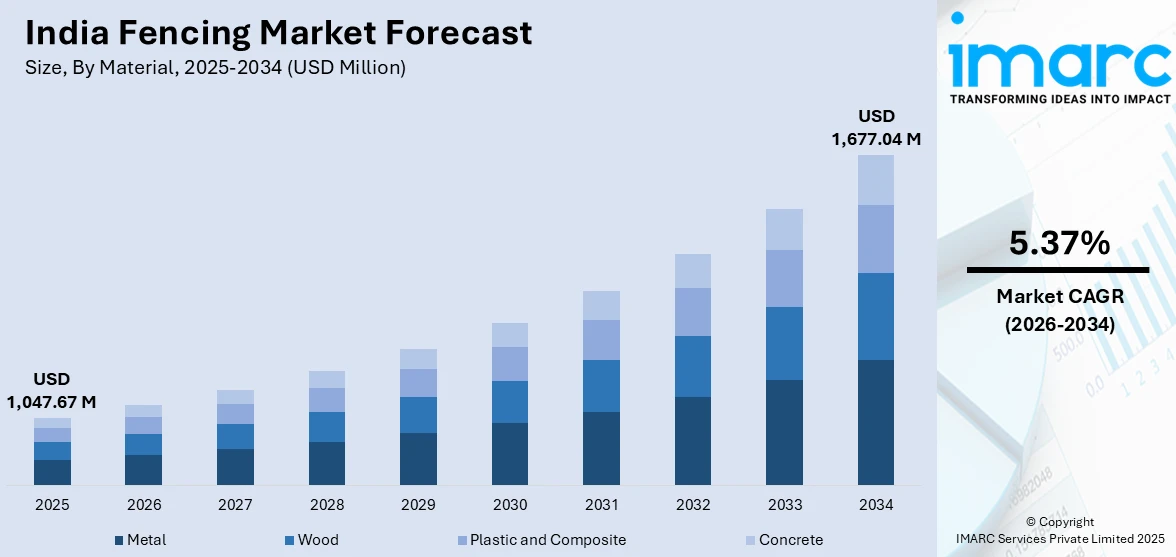
The India fencing market size was valued at USD 1,047.67 Million in 2025 and is projected to reach USD 1,677.04 Million by 2034, growing at a compound annual growth rate of 5.37% from 2026-2034.
The India fencing market is experiencing sustained momentum driven by large-scale government investments in border infrastructure, rapid urbanization, and expanding construction activities across residential, commercial, and industrial sectors. Rising security concerns, coupled with the growing demand for perimeter protection in energy, transport, and mining applications, are strengthening adoption. Advancements in smart fencing technologies, increased agricultural fencing needs, and the emergence of composite and solar-powered fencing solutions are further reshaping the competitive landscape, contributing to the India fencing market share.
Key Takeaways and Insights:
- By Material: Metal holds the largest share in the market with 44.8% share in 2025, due to its superior durability, weather resistance, and wide applicability across security and infrastructure projects.
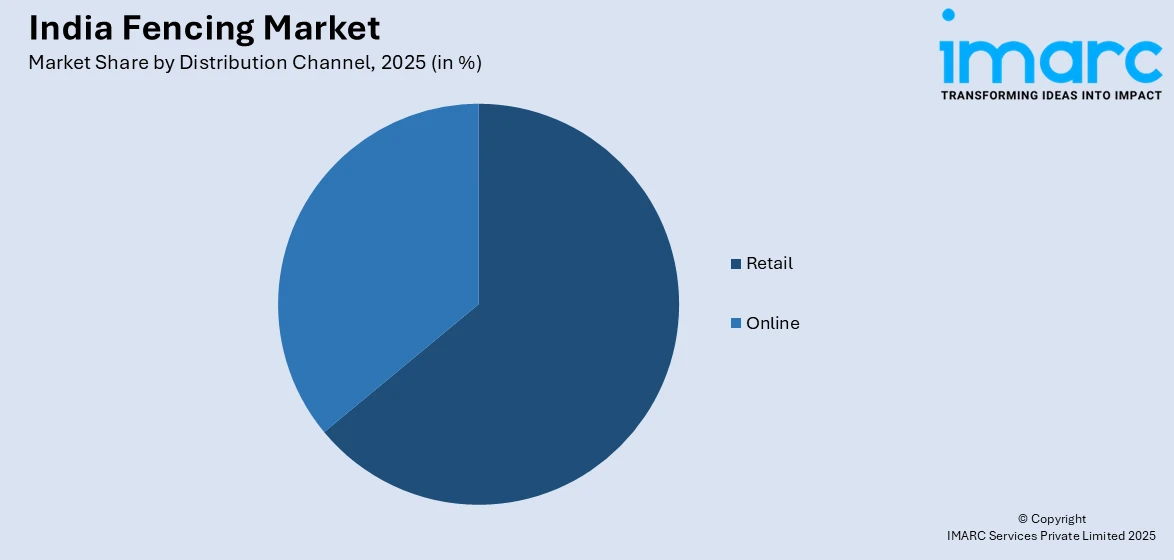
- By Distribution Channel: Retail dominates the market with a share of 63.5% in 2025, driven by the extensive network of hardware stores, building material dealers, and organized retail outlets serving residential and commercial fencing demand across India.
- By Installation: Contractor leads the market with a share of 69.2% in 2025, reflecting the preference for professional installation services for complex fencing projects in industrial, government, and commercial applications.
- By Application: Residential holds the biggest market share with a share of 38.7% in 2025, fueled by rapid urbanization, the rise of gated communities, and growing demand for privacy and security fencing in India's expanding housing sector.
- By End Use: Government accounts for the highest share in the market with a share of 31.4% in 2025, supported by massive border security investments and public infrastructure projects requiring perimeter protection across defense, transportation, and municipal applications.
- By Region: West India represents the extensive segment in the market with a 35.6% share in 2025, driven by the concentration of industrial hubs, commercial establishments, and major infrastructure projects across Gujarat and Maharashtra.
- Key Players: The market features a competitive mix of established manufacturers, regional specialists, and emerging technology-integrated solution providers. Key companies are expanding product portfolios, investing in advanced manufacturing, and forming strategic partnerships to strengthen their market positioning.
To get more information on this market Request Sample
The India fencing market is advancing steadily as infrastructure development, security requirements, and urbanization continue to accelerate demand across multiple sectors. A key factor shaping this progress is the government's substantial commitment to border modernization and infrastructure spending. For instance, in September 2024, India's Cabinet Committee on Security approved an INR 31,000 crore project for fencing and road construction along the 1,643-km India-Myanmar border over the next decade. Additionally, increasing focus on industrial safety and perimeter protection in warehouses, logistics hubs, and manufacturing facilities is emerging as a major growth driver, strengthening demand for durable fencing solutions across organized industrial zones. Apart from this, policy encouragement through smart city initiatives, expanding industrial corridors, and rising investment in residential and commercial construction are contributing to a more favorable environment for fencing adoption across the country.
India Fencing Market Trends:
Integration of Smart and Technology-Enabled Fencing Systems
India is witnessing growing adoption of smart fencing systems that integrate surveillance, intrusion detection, and IoT-enabled monitoring capabilities for enhanced perimeter security. For instance, the India Fence Expo 2025, held in November 2025 at Yashobhoomi, New Delhi, showcased advanced fencing systems with integrated motion and vibration sensors, smart technologies for defense and urban applications, and live demonstrations by leading manufacturers such as A-1 Fence Products. Moreover, government agencies, border security forces, and infrastructure developers are increasingly adopting technology-integrated fencing, supporting India fencing market growth.
Rising Adoption of Solar-Powered Electric Fencing in Agriculture
Solar-powered electric fencing is gaining significant traction across India's agricultural sector as farmers seek cost-effective and sustainable solutions for crop protection from stray cattle and wildlife. For example, the Uttar Pradesh government allocated INR 50 crore under the Mukhyamantri Khet Suraksha Yojana in its February 2024 budget to provide solar fencing machines to farmers at a 60-80% subsidy for fields up to two hectares. This initiative reflects the broader national push toward solar-powered agricultural fencing, reducing crop damage while supporting renewable energy adoption.
Growing Demand for Aesthetic and Composite Fencing Solutions
IBEF reported that India’s per capita disposable income rose from USD 2.11 thousand in FY19 to an estimated USD 2.69 thousand in FY24 and is forecast to increase further to USD 4.21 thousand by FY29. With rising disposable incomes and changing consumer preferences, there is increasing demand for visually appealing fencing solutions that complement residential and commercial architectural designs. Similarly, the ongoing shift toward innovative materials, including PVC, aluminum, and composite options, is driving product diversification and premium segment growth.

Market Outlook 2026-2034:
India's fencing market is positioned for sustained expansion, underpinned by continued government investment in border security, rising urbanization, and growing demand across industrial and agricultural sectors. In 2025, about 36% of India’s population is estimated to reside in urban areas, and UN DESA forecasts this share will rise to nearly 50% by 2050. In line with this, increasing adoption of smart fencing technologies, expanding construction activities in tier-2 and tier-3 cities, and supportive policy frameworks for infrastructure development are expected to drive higher revenue streams. Moreover, the convergence of security requirements, sustainable fencing innovations, and digital transformation is poised to foster a more competitive and mature fencing landscape across the country. The market generated a revenue of USD 1,047.67 Million in 2025 and is projected to reach a revenue of USD 1,677.04 Million by 2034, growing at a compound annual growth rate of 5.37% from 2026-2034.
India Fencing Market Report Segmentation:
|
Segment Category |
Leading Segment |
Market Share |
|
Material |
Metal |
44.8% |
|
Distribution Channel |
Retail |
63.5% |
|
Installation |
Contractor |
69.2% |
|
Application |
Residential |
38.7% |
|
End Use |
Government |
31.4% |
|
Region |
West India |
35.6% |
Material Insights:
- Metal
- Wood
- Plastic and Composite
- Concrete
Metal leads with a share of 44.8% of the total India fencing market in 2025.
Metal fencing remains the most widely adopted material in India's fencing market, driven by its superior durability, corrosion resistance, and adaptability across diverse applications, from border security to residential perimeter protection. Chain link fences and ornamental metal fences are particularly popular across government, industrial, and commercial installations due to their strength and ability to withstand varying climatic conditions. The increasing demand for high-security anti-cut and anti-climb steel designs for critical infrastructure, including defense installations, highways, and energy facilities, continues to reinforce the segment's leading position.
The metal fencing segment also benefits from the presence of a robust domestic manufacturing ecosystem, with companies such as Tata Wiron, A-1 Fence Products, and Bansal Wire Industries producing a wide range of galvanized iron, stainless steel, and welded mesh fencing products. Advancements in hot dip galvanizing technology and the introduction of premium products like knotted fences and 3D weld mesh panels are expanding the application scope of metal fencing. Growing construction activities across residential complexes, industrial zones, and transport corridors are also sustaining strong demand for metal fencing solutions in both organized retail and contractor-driven channels.
Distribution Channel Insights:
Access the comprehensive market breakdown Request Sample
- Online
- Retail
Retail dominates the market holding a share of 63.5% in the total India fencing market in 2025.
The retail distribution channel holds the dominant position in India's fencing market, driven by the country's extensive network of hardware stores, building material dealers, and organized home improvement outlets that serve as the primary purchasing points for fencing products. The preference for physical retail stores is particularly strong in India, where customers rely on in-person product evaluation, dealer guidance on material selection, and established relationships with local suppliers.
Retail outlets continue to benefit from the growing construction and home improvement activities across India's urban and semi-urban areas, with consumers seeking fencing products for residential security, garden enclosures, and property demarcation. The organized retail segment is expanding through branded experience centers and building material superstores, while traditional dealer networks maintain strong penetration in tier-2 and tier-3 cities and rural markets. The ability to offer installation guidance, bulk purchasing options, and localized product availability positions retail as the preferred channel for the majority of fencing buyers in India.
Installation Insights:
- Do-It-Yourself
- Contractor
Contractor accounts for the highest share of 69.2% of the total India fencing market in 2025.
Professional contractor-based installation dominates India's fencing market, reflecting the complexity of most fencing projects that require specialized expertise, proper tooling, and adherence to structural and safety standards. Large-scale installations for government border security projects, industrial perimeter fencing, and commercial property enclosures necessitate contractor involvement to ensure compliance with design specifications and regulatory requirements. For instance, the Border Roads Organisation (BRO) was assigned the construction of a 20.862-km fence and road along the India-Myanmar border in February 2024, highlighting the critical role of professional contractors in executing complex government fencing infrastructure projects in challenging terrains.
Contractor-based installation also benefits from the growing demand for integrated fencing solutions that combine physical barriers with surveillance and access control systems. Industrial facilities, energy installations, and large residential developments increasingly require customized fencing configurations that demand professional planning and execution. The rising participation of contractors in organized tendering processes for public infrastructure, railway fencing, highway barriers, and smart city projects is further strengthening this segment's share, while the availability of skilled labor and contractor networks across India's regional markets supports widespread adoption.
Application Insights:
- Residential
- Agricultural
- Industrial
Residential represents the leading category with a 38.7% share of the total India fencing market in 2025.
The residential application segment leads India's fencing market, driven by rapid urbanization, the proliferation of gated communities, and growing consumer demand for privacy, security, and aesthetic boundary solutions. India's residential construction market is estimated at approximately USD 268.40 Billion in 2025, with strong demand across metropolitan areas and emerging tier-2 and tier-3 cities, directly fueling the need for residential fencing products. For instance, the Pradhan Mantri Awas Yojana-Urban (PMAY-U) sanctioned 1.18 crore houses, with over 85.5 lakh completed as of August 2024, generating substantial demand for perimeter fencing in new housing developments nationwide.
The growing emphasis on home improvement and property value enhancement is driving demand for aesthetically appealing fencing options, including decorative metal fences, PVC panels, and composite solutions. Rising disposable incomes, evolving consumer preferences, and the expansion of organized real estate developments are encouraging homeowners and builders to invest in premium fencing products that combine functionality with visual appeal. Furthermore, the increasing availability of fencing products through retail channels and online platforms is making residential fencing more accessible, further supporting segment growth across India's rapidly expanding housing sector.
End Use Insights:
- Government
- Petroleum and Chemicals
- Military and Defense
- Mining
- Energy and Power
- Transport
- Others
Government holds the largest share at 31.4% of the total India fencing market in 2025.
The government segment commands the largest revenue share in India's fencing market, supported by extensive border security investments, public infrastructure projects, and perimeter protection requirements across government buildings, parks, and municipal facilities. India shares land borders with six countries spanning over 15,106.7 km, and the government has committed substantial resources to border fencing and security modernization.
Government fencing demand is further bolstered by investments in railway corridor fencing, national highway barriers, airport perimeter security, and smart city infrastructure projects. The Smart Cities Mission, with a total investment of INR 1.64 lakh crore across 100 cities, has driven demand for modern fencing systems as part of urban infrastructure development, including public parks, pedestrian zones, and government building upgrades. Central Armed Police Forces and defense establishments are increasingly specifying high-security fencing with integrated surveillance capabilities, creating sustained procurement pipelines for premium fencing products across multiple government agencies and departments.
Regional Insights:
- North India
- South India
- East India
- West India
West India dominates the market with a 35.6% share of the total India fencing market in 2025.
West India’s prominence is driven by the concentration of industrial establishments, commercial developments, and major infrastructure projects across Gujarat and Maharashtra. The region benefits from a robust manufacturing base, the presence of key industrial corridors, and significant government investment in infrastructure modernization. Gujarat's expanding petrochemical complexes, special economic zones, and port infrastructure require extensive perimeter fencing, while Maharashtra's booming real estate sector and urban expansion drive residential and commercial fencing demand. For instance, in September 2024, the Maharashtra government signed MoUs with various companies with a combined value of INR 475 Billion (approximately USD 5.7 Billion) to develop multiple energy projects in the state by 2030, creating substantial demand for industrial and security fencing across project sites and facilities in the region.
Market Dynamics:
Growth Drivers:
Why is the India Fencing Market Growing?
Massive Government Investment in Border Security and Infrastructure
India’s strong focus on border security and infrastructure modernization is a major driver of the fencing market. Similarly, government-backed initiatives to strengthen border protection through large-scale fencing and road development are strengthening demand for advanced, durable solutions. These projects often require high-security designs with anti-cut and anti-climb features, supporting sustained growth in fencing installations across sensitive and strategically important regions. Additionally, the Border Infrastructure and Management (BIM) scheme, with an approved outlay of INR 13,020 crore for 2021-22 to 2025-26, encompasses construction of fences, roads, floodlights, border outposts, and deployment of technological solutions along India's borders with Pakistan, Bangladesh, China, Nepal, Bhutan, and Myanmar. These large-scale government procurement programs create sustained demand for diverse fencing products and professional installation services.
Rapid Urbanization and Booming Construction Activity
India's accelerating urbanization and construction boom are driving substantial demand for fencing products across residential, commercial, and infrastructure projects. The country's construction market is projected for continued expansion, supported by strong government capital expenditure. PIB reported that, in the fiscal year 2024-25, the government allocated INR 11.11 Lakh Crore toward capital expenditure. Additionally, the National Infrastructure Pipeline targets investments of INR 111 Lakh Crore across energy, roads, rail, and urban services, generating extensive demand for perimeter fencing across new developments. Besides this, growing construction of gated communities, commercial complexes, industrial parks, and smart city projects necessitates robust fencing systems for security, privacy, and boundary demarcation, directly benefiting the fencing market.
Expanding Agricultural Fencing Demand and Solar Technology Adoption
India's vast agricultural sector, which supports hundreds of millions of livelihoods, is driving growing demand for fencing solutions to protect crops from stray cattle, wild boars, and wildlife intrusion. Likewise, the increasing adoption of solar-powered electric fencing offers farmers a cost-effective and sustainable alternative to traditional crop protection methods. State-level subsidies and initiatives promoting solar fencing are expanding across multiple Indian states, reflecting the broader national push toward sustainable agricultural practices and renewable energy integration. Furthermore, the growing awareness of solar fencing benefits, combined with government financial support, is broadening the addressable market for fencing products in rural and semi-urban India.
Market Restraints:
What Challenges the India Fencing Market is Facing?
High Installation and Material Costs
The upfront cost of fencing installation, particularly for high-security metal and composite solutions, remains a significant barrier for price-sensitive consumers and small-scale buyers in India. Professional contractor-based installation adds to the overall project expenditure, while premium fencing materials such as stainless steel and advanced composites command higher prices. For smaller residential and agricultural users, these cost factors can deter adoption, especially in rural and semi-urban areas where budget constraints are more pronounced. Limited access to affordable financing options for fencing projects further restricts broader market penetration.
Raw Material Price Volatility
Fluctuations in the prices of key raw materials, including steel, aluminum, PVC, and cement, create uncertainty for fencing manufacturers and contractors. Steel prices remain significantly above pre-pandemic baselines, while global commodity swings continue to affect input costs for domestic producers. These price variations compress profit margins, complicate project cost estimation, and can delay or defer fencing investments by end users. Manufacturers with limited backward integration face particular vulnerability to sudden raw material price spikes, impacting their competitive positioning and pricing strategies.
Fragmented Market and Limited Awareness in Rural Areas
India's fencing market remains highly fragmented, with numerous small and medium-sized regional manufacturers competing alongside established national players. This fragmentation leads to inconsistent product quality, limited standardization, and challenges in building consumer trust. In many rural and semi-urban areas, awareness of modern fencing solutions remains low, with traditional methods such as thorn bushes, stone walls, and bamboo barriers still prevalent. The lack of organized distribution networks in remote regions further limits the reach of quality fencing products and professional installation services.
Competitive Landscape:
The India fencing market is characterized by a mix of large domestic manufacturers, specialized regional players, and technology-focused solution providers competing across multiple product categories. Companies are investing in advanced manufacturing capabilities, product innovation, and distribution network expansion to strengthen their market presence. The market is witnessing growing consolidation as established players acquire niche capabilities and expand geographic reach. Strategic partnerships between fencing manufacturers, technology providers, and government agencies are fostering innovation in smart fencing and integrated security solutions. Competitive differentiation is increasingly driven by product quality, brand recognition, technological integration, after-sales service capabilities, and the ability to offer customized solutions for diverse end-use applications.
Recent Developments:
- In January 2026, Calcutta High Court directed the West Bengal government to transfer land parcels to the BSF by March 31 for fencing the India-Bangladesh border across nine districts. The order followed a PIL citing security threats from unfenced stretches due to delayed land acquisition. Further affidavits and hearings are scheduled.
- In January 2026, Madhya Pradesh cabinet approved INR 390 Crore for buffer zone development across nine tiger reserves from 2026–27 to 2030–31. The plan includes chain-link fencing, water sources, fire safety, and wildlife protection measures to reduce human–wildlife conflict, with around 500 km fencing proposed in sensitive areas.
India Fencing Market Report Coverage:
|
Report Features |
Details |
|
Base Year of the Analysis |
2025 |
|
Historical Period |
2020-2025 |
|
Forecast Period |
2026-2034 |
|
Units |
USD Million |
|
Scope of the Report |
Exploration of Historical Trends and Market Outlook, Industry Catalysts and Challenges, Segment-Wise Historical and Future Market Assessment:
|
|
Materials Covered |
Metal, Wood, Plastic and Composite, Concrete |
|
Distribution Channels Covered |
Online, Retail |
|
Installations Covered |
Do-It-Yourself, Contractor |
|
Applications Covered |
Residential, Agricultural, Industrial |
|
End Uses Covered |
Government, Petroleum and Chemicals, Military and Defense, Mining, Energy and Power, Transport, Others |
|
Regions Covered |
North India, South India, East India, West India |
|
Customization Scope |
10% Free Customization |
|
Post-Sale Analyst Support |
10-12 Weeks |
|
Delivery Format |
PDF and Excel through Email (We can also provide the editable version of the report in PPT/Word format on special request) |
Frequently Asked Questions About the India Fencing Market Report
The India fencing market size was valued at USD 1,047.67 Million in 2025.
The India fencing market is expected to grow at a compound annual growth rate of 5.37% during 2026-2034 to reach USD 1,677.04 Million by 2034.
Metal, holding the largest revenue share of 44.8%, remains the dominant material in the market due to its durability, corrosion resistance, and wide applicability across security, residential, and industrial fencing applications.
Key factors driving the India fencing market include massive government investments in border security infrastructure, rapid urbanization and construction activity, expanding agricultural fencing demand, rising security concerns, and growing adoption of smart and solar-powered fencing technologies.
Major challenges include high installation and material costs, raw material price volatility affecting manufacturers and buyers, fragmented market structure with inconsistent quality standards, and limited awareness of modern fencing solutions in rural areas.
Need more help?
- Speak to our experienced analysts for insights on the current market scenarios.
- Include additional segments and countries to customize the report as per your requirement.
- Gain an unparalleled competitive advantage in your domain by understanding how to utilize the report and positively impacting your operations and revenue.
- For further assistance, please connect with our analysts.
 Request Customization
 Speak to an Analyst
 Request Brochure
 Inquire Before Buying
Benefits of Customization
- Personalize this research
- Triangulate with your data
- Get data as per your format and definition
- Gain a deeper dive into a specific application, geography, customer, or competitor
- Any level of personalization
Get in Touch With Us
UNITED STATES
Phone: +1-201-971-6302
INDIA
Phone: +91-120-433-0800
UNITED KINGDOM
Phone: +44-753-714-6104
Email: [email protected]
Client Testimonials




.webp)




.webp)













Related Reports

Choose your plan
*Please note that the prices mentioned below are starting prices for each bundle type. Kindly contact our team for further details.*
Single User License
- 1 User License, Access on 2 Devices
- PDF Report + Excel Dataset (Password Protected)
- Lifetime Access
- No Printing Rights
- 10% Free Report Customization
- 10–12 Weeks of Analyst Support
Five User License
- Access for 5 Users, 2 Devices per User
- PDF Report + Excel Dataset (Password Protected)
- Lifetime Access
- Dedicated Account Manager
- 12–14 Weeks of Analyst Support
- No Printing Rights
- 15% Free Report Customization
- 25% Discount on Your Next Purchase
Corporate User License
- Unlimited User Access (Within Your Organization)
- PDF Report + Excel Dataset
- Lifetime Access
- Dedicated Account Manager
- 14–20 Weeks of Analyst Support
- No Printing Rights
- 20% Free Report Customization
- 30% Discount on Your Next Purchase
Essential Insights
What's included:
3 reports
- Lifetime Access
- PDF Reports
- Excel Datasets
- 2 Weeks of Free Analyst Support
- 2 User Licenses
- Access on 2 Devices
- Printing Rights
- Complimentary PowerPoint (PPT) Version
- Complimentary License Upgrade
Professional Access
What's included:
5 reports
- Lifetime Access
- PDF Reports
- Excel Datasets
- 8 Weeks of Free Analyst Support
- 2 User Licenses
- Access on 2 Devices
- Printing Rights
- Complimentary PowerPoint (PPT) Version
- Complimentary License Upgrade
Business Advantage
What's included:
8 reports
- Lifetime Access
- PDF Reports
- Excel Datasets
- 14 Weeks of Free Analyst Support
- 2 User Licenses
- Access on 2 Devices
- Printing Rights
- Complimentary PowerPoint (PPT) Version
- Complimentary License Upgrade
Enterprise Intelligence
What's included:
10 reports
- Lifetime Access
- PDF Reports
- Excel Datasets
- 20 Weeks of Free Analyst Support
- 2 User Licenses
- Access on 2 Devices
- Printing Rights
- Complimentary PowerPoint (PPT) Version
- Complimentary License Upgrade