
India Foam Market Size, Share, Trends and Forecast by Category, Type, Application, and Region, 2026-2034
India Foam Market Size, Share, Trends & Forecast (2026-2034)
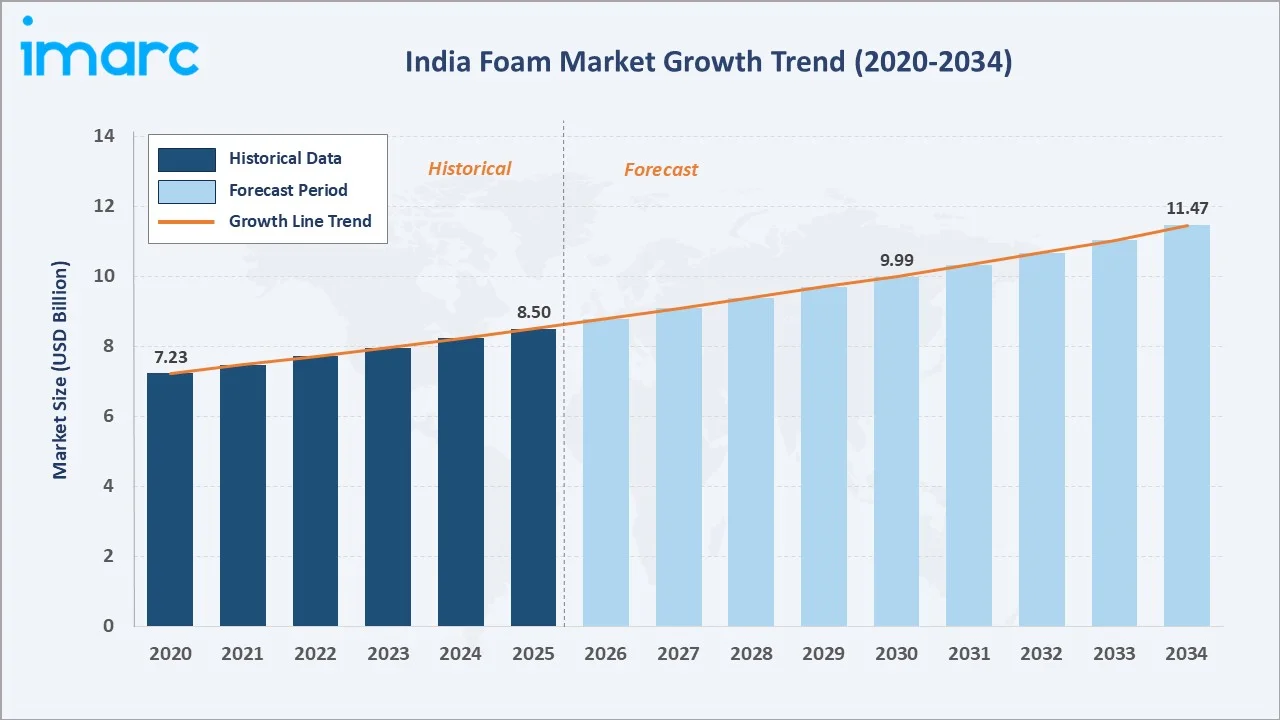
The India foam market grew from USD 8.50 Billion in 2025 to USD 8.78 Billion in 2026 and is projected to reach USD 11.47 Billion by 2034, exhibiting a CAGR of 3.28% during 2026-2034. Expanding construction and real estate activities, rising demand across furniture and automotive sectors, and growing consumer preference for comfort-oriented products are the primary forces driving market growth.
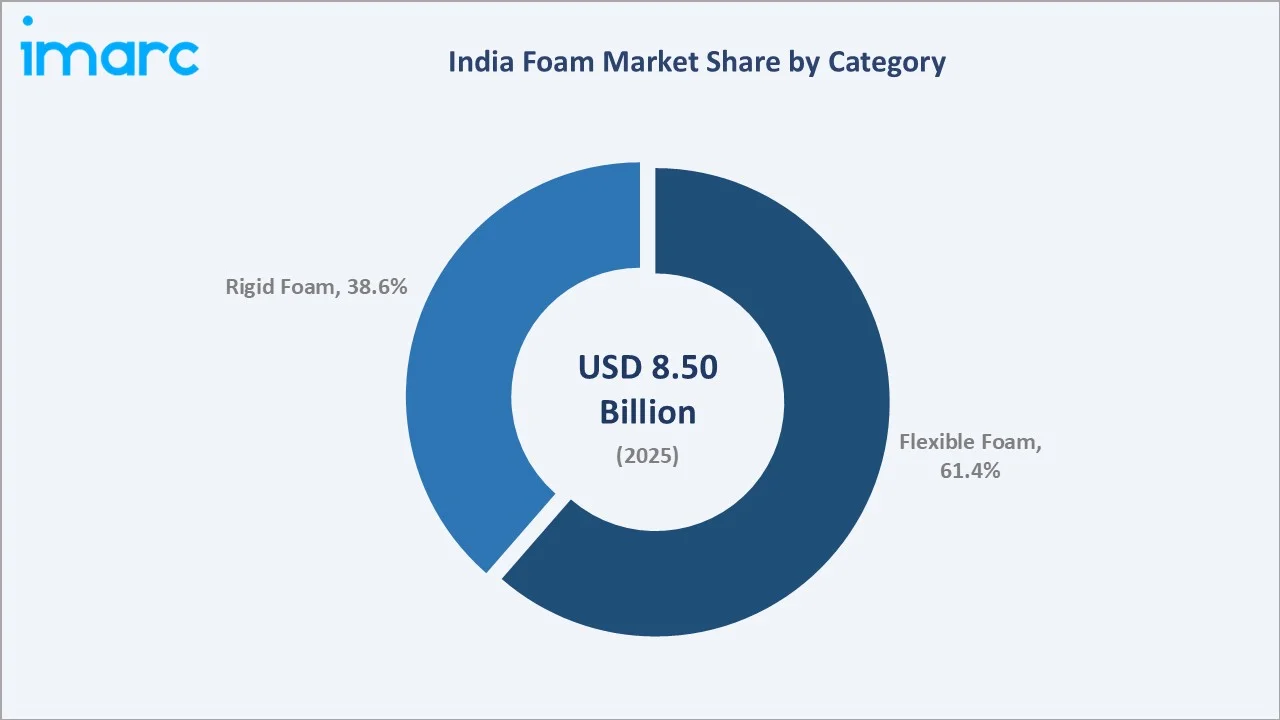
Flexible foam dominates the category mix at 61.4% in 2025, while polyurethane leads the type segment at 54.8%.
South India commands a dominant 31.7% regional share in 2025, reflecting the region's strong manufacturing base and urbanization momentum.
Market Snapshot
|
Metric |
Value |
|
Base Year Market Size (2025) |
USD 8.50 Billion |
| Market Size 2026 | USD 8.78 Billion |
|
Forecast Market Size (2034) |
USD 11.47 Billion |
|
CAGR (2026-2034) |
3.28% |
|
Base Year |
2025 |
|
Historical Period |
2020-2025 |
|
Forecast Period |
2026-2034 |
|
Leading Category |
Flexible Foam (61.4% share, 2025) |
|
Leading Type |
Polyurethane (54.8% share, 2025) |
|
Largest Region |
South India (31.7% share, 2025) |
|
Second Largest Region |
West and Central India (27.5% share, 2025) |
The India foam market growth trajectory from 2020 through 2034, with the historical expansion to USD 8.50 Billion in 2025 and an estimated USD 8.78 Billion in 2026, reflects consistent infrastructure-driven demand, while the forecast to USD 11.47 Billion captures accelerating construction investment, automotive sector growth, and consumer premiumization.
To get more information on this market, Request Sample
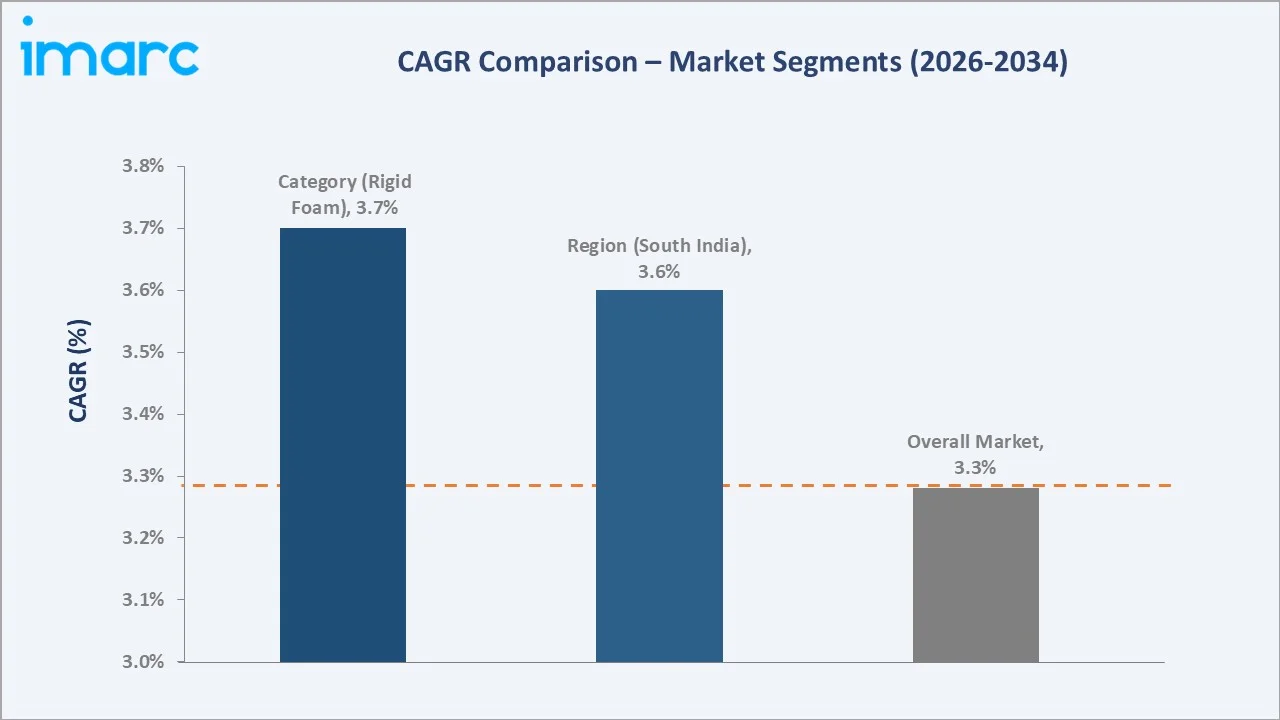
The CAGR trajectories across key category, type, and regional sub-segments, with rigid foam at ~3.7% CAGR and South India at ~3.6% CAGR, are the fastest-growing categories within the India foam industry analysis through 2034.
Executive Summary
The India foam market is on a sustained growth trajectory from USD 8.50 Billion in 2025 to an estimated USD 8.78 Billion in 2026 and is projected to reach USD 11.47 Billion by 2034. Foam, an essential material deployed across furniture, automotive, construction, packaging, and appliances, benefits from non-discretionary demand across multiple end-use industries.
Flexible foam dominates category share at 61.4% in 2025, owing to its widespread application in mattresses, upholstered furniture, automotive seating, and apparel padding. Rigid foam (38.6%) commands significant demand in thermal insulation and building construction.
Polyurethane leads type share at 54.8% in 2025, reflecting its versatility across furniture, automotive, and construction end uses. Polystyrene (16.7%) serves packaging and insulation, while polyolefin (11.5%) addresses automotive and protective packaging applications.
South India dominates at 31.7% in 2025, driven by a strong manufacturing ecosystem and rapid urbanization. West and Central India (27.5%) and North India (24.2%) follow, supported by infrastructure investment and growing consumer markets.
Key Market Insights
|
Insight |
Data |
|
Leading Category |
Flexible Foam – 61.4% share (2025) |
|
Second Category |
Rigid Foam – 38.6% share (2025) |
|
Leading Type |
Polyurethane – 54.8% share (2025) |
|
Second Type |
Polystyrene – 16.7% share (2025) |
|
Leading Region |
South India – 31.7% share (2025) |
|
Second Largest Region |
West and Central India – 27.5% share (2025) |
|
Top Companies |
Goldcoin Foam Private Limited, IreTex Premier India Pvt. Ltd., Sarva Foam, Ankit Polymers, Jumax Foam Private Limited. |
Key Analytical Observations Expanding On The Above Data:
- Flexible foam, with 61.4% in 2025, dominates because of its superior comfort properties and versatility across mattresses, cushions, automotive seating, and apparel padding applications across India's large consumer market.
- Polyurethane foam, with 54.8% in 2025, leads all types because of its outstanding balance of mechanical performance, thermal insulation, and cost-effectiveness across the widest range of end-use applications.
- South India's 31.7% dominance in 2025, reflects the region's well-established foam manufacturing cluster in Tamil Nadu, Karnataka, and Kerala, hosting India's largest mattress and upholstered furniture manufacturing base.
- West and Central India, with 27.5% in 2025, benefits from proximity to India's petrochemical production centers in Gujarat and Pune's automotive manufacturing hub, generating significant foam demand.
India Foam Market Overview
Foam is a lightweight, cellular material manufactured by encapsulating gas bubbles within a polymer matrix, creating a structure with unique cushioning, insulation, and structural properties. Products range from flexible polyurethane mattress foams to rigid EPS insulation boards and specialized technical foams.
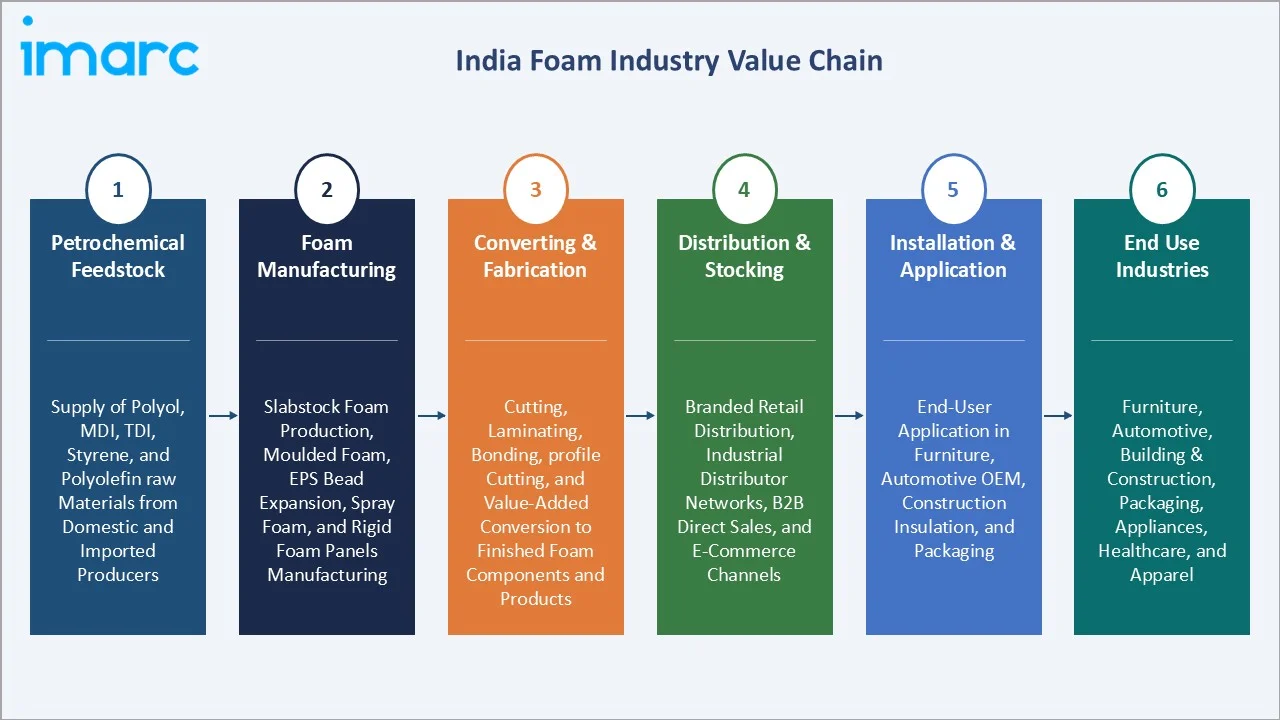
The Indian foam ecosystem integrates petrochemical raw material suppliers, polymer producers, foam manufacturers, downstream converters, distributors, and diverse end-use industries spanning furniture, automotive, construction, packaging, and consumer goods.
Market Dynamics
To evaluate market opportunities, Request Sample
Market Drivers
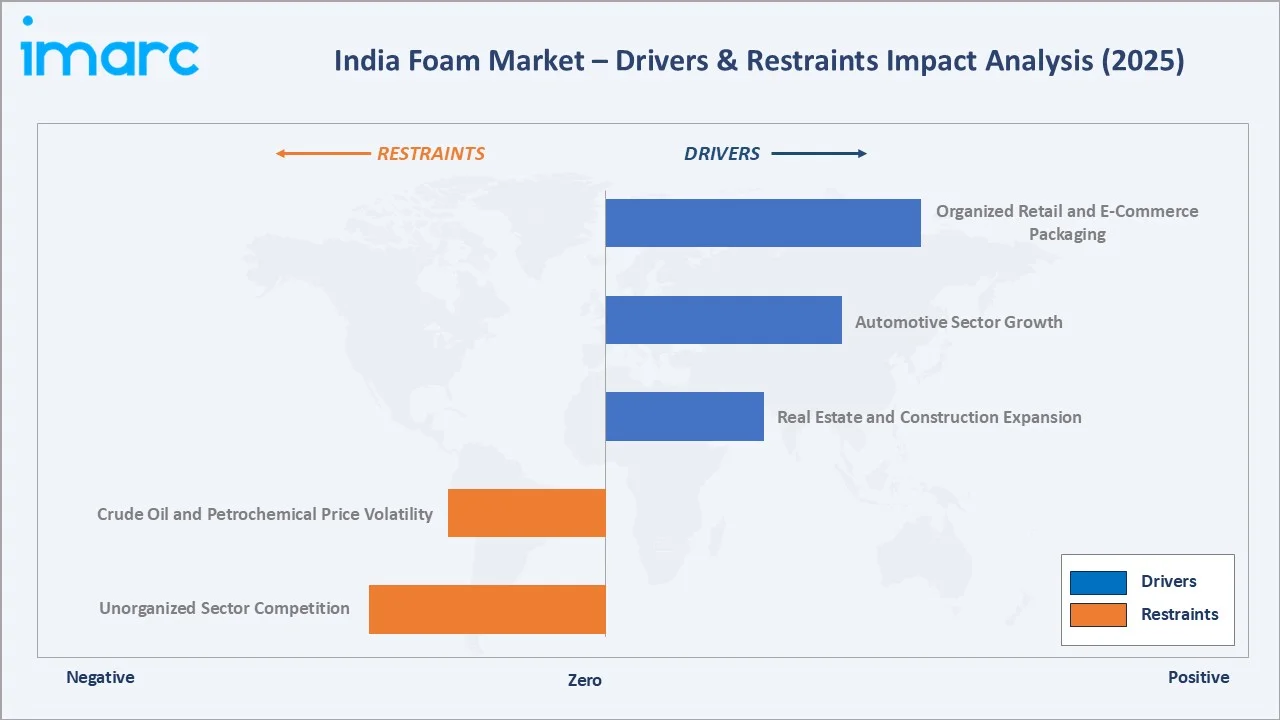
- Real Estate and Construction Expansion: India's PM Awas Yojana and Smart Cities Mission are driving large-scale housing and commercial construction, significantly increasing demand for rigid foam insulation panels and flexible foam flooring underlays.
- Automotive Sector Growth: India's vehicle production surpassed over 28 million units manufactured in 2023–24 alone, driven by expanding passenger vehicle and two-wheeler segments. Rising EV adoption also accelerates demand for lightweight polyurethane and polyolefin foam components.
- Organized Retail and E-Commerce Packaging: India's e-commerce gross merchandise value exceeded USD 60 Billion in 2024, generating robust protective foam packaging demand across electronics, appliances, pharmaceuticals, and consumer goods.
Market Restraints
- Crude Oil and Petrochemical Price Volatility: Polyol and isocyanate feedstocks used in polyurethane foam are petroleum derivatives, exposing manufacturers to fluctuations in crude oil and petrochemical prices. This volatility affects input costs, leading to margin uncertainty and challenges in maintaining stable pricing, particularly in competitive markets. To mitigate these risks, companies are increasingly adopting strategies such as diversified sourcing, cost optimization, and selective backward integration. Additionally, some players are exploring alternative raw materials and improving operational efficiencies to cushion the impact of price swings.
- Unorganized Sector Competition: India’s foam market is characterized by a significant presence of unorganized manufacturers operating with lower regulatory and compliance costs, enabling them to offer products at highly competitive prices. This intensifies price competition, especially in commoditized segments, limiting the pricing power of organized players. As a result, established manufacturers face pressure on margins and market share in price-sensitive categories.
Market Opportunities
- Green Building Insulation Demand: India's Bureau of Energy Efficiency's Energy Conservation Building Code mandates thermal insulation in commercial buildings, creating a large and growing addressable market for rigid foam insulation products with regulatory tailwind.
- Bio-Based and Recycled Foam Development: Consumer and regulatory preference for sustainable materials is driving investment in bio-polyol-based polyurethane and recycled polystyrene foam, opening premium market segments with higher margins and export potential.
Market Challenges
- Environmental Regulations on Blowing Agents: Phasedown of HFC blowing agents under India's Kigali Amendment commitments increases rigid foam production costs, requiring capital investment to transition to lower-GWP alternative blowing technologies.
- Raw Material Import Dependence: Key inputs such as MDI and TDI for polyurethane foam are predominantly imported, exposing manufacturers to INR depreciation risk and supply chain disruptions from global geopolitical events.
Emerging Market Trends
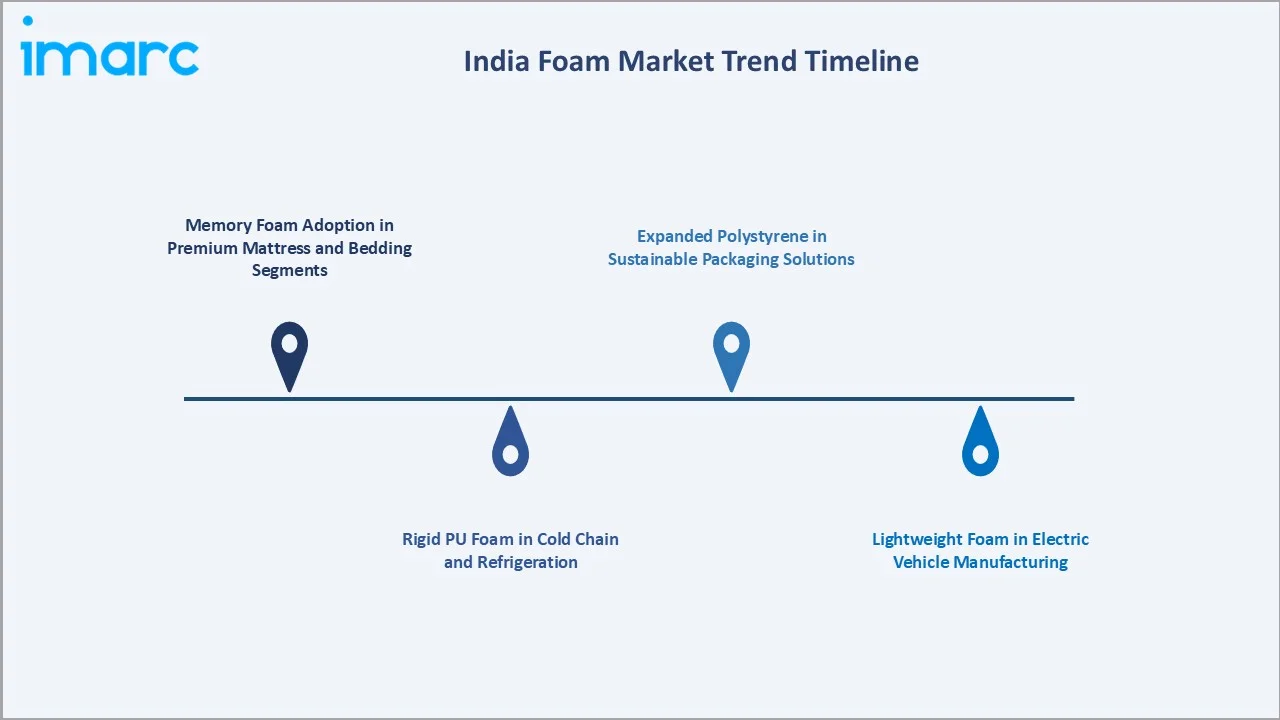
1. Memory Foam Adoption in Premium Mattress and Bedding Segments
Rising disposable incomes and health awareness are accelerating premiumization in India's mattress market. Memory foam and latex foam products command 3-4x price premiums over conventional foam mattresses, with organized brands expanding retail and digital distribution networks nationally.
2. Rigid PU Foam in Cold Chain and Refrigeration
India's cold chain logistics sector, growing at approximately 14% CAGR, is generating accelerating demand for closed-cell rigid polyurethane foam insulation in refrigerated transport, cold storage panels, and commercial refrigeration manufacturing.
3. Lightweight Foam in Electric Vehicle Manufacturing
India's EV push under FAME-II and PLI schemes is reshaping automotive foam demand. EV manufacturers prioritize ultra-lightweight polyolefin and polyurethane composite foams for battery encapsulation, acoustic management, and interior weight reduction applications.
4. Expanded Polystyrene in Sustainable Packaging Solutions
EPS foam packaging continues expanding in temperature-sensitive pharmaceutical and food supply chains. Manufacturers are investing in EPS recyclability infrastructure to align with Extended Producer Responsibility regulations and reduce lifecycle environmental impact.
Industry Value Chain Analysis
The India foam value chain spans six stages from petrochemical feedstock through end-use application. Foam formulation and conversion capture the highest value-add margins, while distribution and brand equity generate significant competitive differentiation for organized players.
|
Stage |
Key Activities / Description |
|
Petrochemical Feedstock |
Supply of polyol, MDI, TDI, styrene, and polyolefin raw materials from domestic and imported chemical producers |
|
Foam Manufacturing |
Slabstock continuous foam production, moulded foam, EPS bead expansion, spray foam systems, and rigid foam panel manufacturing |
|
Converting & Fabrication |
Cutting, laminating, bonding, profile cutting, and value-added conversion to finished foam components and products |
|
Distribution & Stocking |
Branded retail distribution, industrial distributor networks, B2B direct sales, and e-commerce channel sales |
|
Installation & Application |
End-user application in furniture manufacturing, automotive OEM assembly, construction insulation installation, and packaging |
|
End Use Industries |
Furniture, Automotive, Building & Construction, Packaging, Appliances, Healthcare, and Apparel |
Technology Landscape in the India Foam Industry
Continuous Slab Foam Production Technology
Continuous slabstock polyurethane foam production lines are the dominant manufacturing technology for flexible foam in India. Modern continuous lines achieve output rates of 4-8 metres per minute with automated thickness control and density monitoring, producing uniform foam slabs subsequently cut and converted into finished products.
Spray and Injected Rigid Foam Systems
Two-component spray polyurethane foam systems, applying expanding foam directly onto construction surfaces, are growing in adoption for building envelope insulation. Injection foam systems are specified for cavity-fill applications in prefabricated panels, cold storage room construction, and refrigeration equipment manufacturing.
EPS and EPE Bead Expansion Technology
Expanded polystyrene production uses pre-expanded bead steam moulding technology to produce custom-shaped packaging and insulation products. Expanded polyethylene foam manufacturing uses extrusion-based processes producing rolls and sheets for protective cushioning and packaging applications across e-commerce and industrial markets.
Market Segmentation Analysis
The report covers the following segments:
| Segment Category | Leading Segment | Market Share | Year |
|---|---|---|---|
| Category | Flexible Foam | 61.4% | 2025 |
| Type | Polyurethane | 54.8% | 2025 |
| Application | Furniture | 🔒 | 2025 |
| Region | South India | 31.7% | 2025 |

By Category
Flexible foam commands a 61.4% majority share in 2025 owing to its dominant position across India's largest foam end-use applications. India's furniture and bedding sector, automotive seating, and consumer goods applications make flexible foam the default material specification for the majority of foam end uses.
To access detailed market analysis, Request Sample
Rigid foam at 38.6% in 2025, growing at the fastest CAGR of ~3.7%, is driven by construction thermal insulation, cold chain logistics infrastructure, and refrigeration applications where dimensional stability and thermal performance are non-negotiable.
By Type
Polyurethane foam dominates the type segment at 54.8% in 2025, reflecting its versatility and performance across the broadest range of applications. PU foam's ability to be formulated in flexible, semi-rigid, and rigid forms makes it the universal specification across furniture, automotive, construction, and appliance end uses.
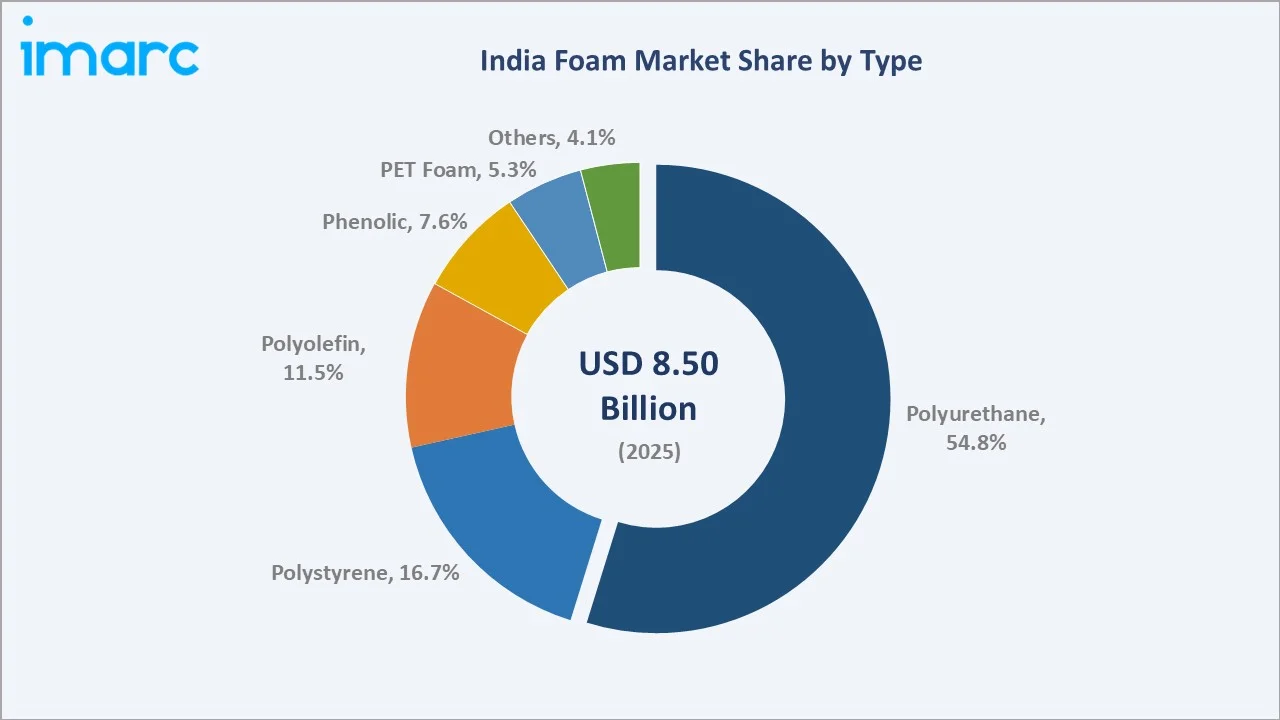
Polystyrene foam at 16.7% in 2025 serves packaging and rigid insulation applications. Polyolefin foam (11.5%) addresses automotive and protective packaging; phenolic foam (7.6%) serves high-temperature industrial insulation; PET foam (5.3%) is emerging in wind energy and transport composite structural applications.
Regional Market Insights
|
Region |
Share (2025) |
Key Growth Drivers |
|
South India |
31.7% |
Manufacturing clusters; furniture and mattress production; IT-sector real estate growth |
|
West and Central India |
27.5% |
Automotive hubs; packaging demand; petrochemical supply proximity in Gujarat |
|
North India |
24.2% |
Construction activity in Delhi-NCR; MSME furniture manufacturing; residential demand |
|
East and North-East India |
16.6% |
Emerging construction; packaging sector growth; government infrastructure investment |
South India's 31.7% market dominance in 2025 is driven by a well-established foam manufacturing ecosystem concentrated in Tamil Nadu, Karnataka, and Kerala. The region hosts India's largest mattress and upholstered furniture manufacturing cluster, supported by a strong consumer market and export-oriented furniture production.
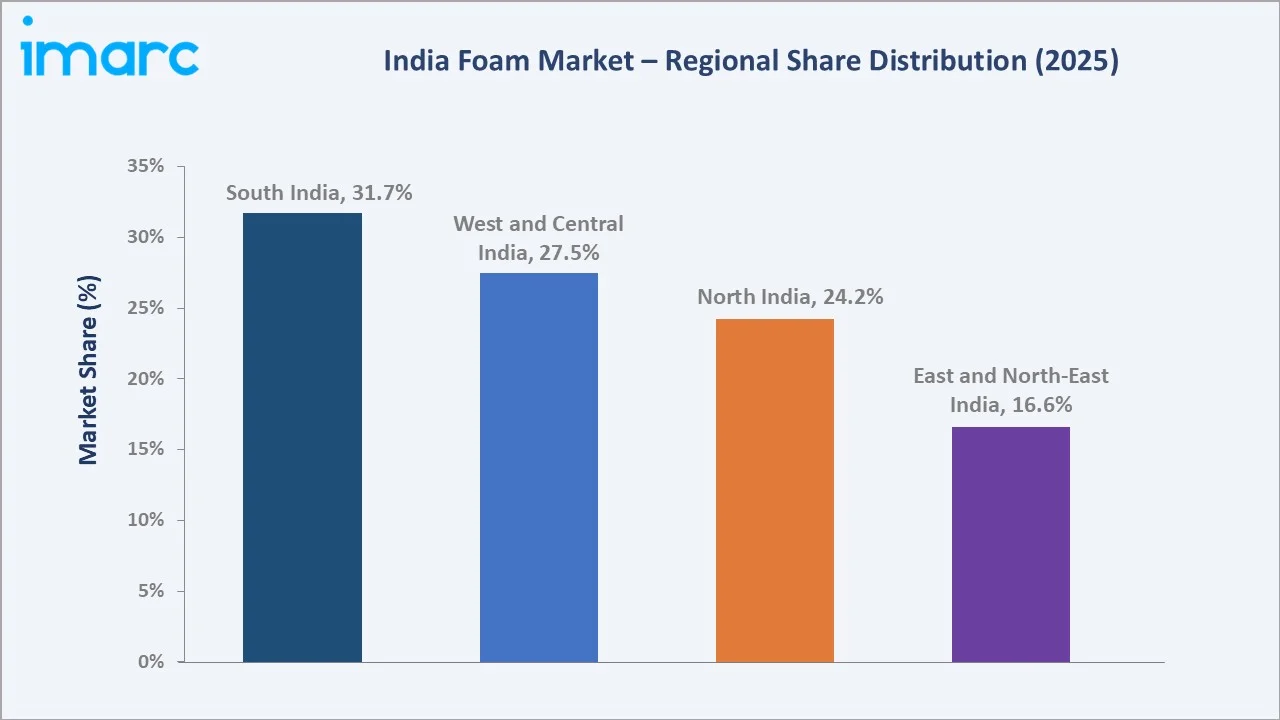
West and Central India, with 27.5% in 2025, benefits from proximity to India's petrochemical production centers in Gujarat, reducing raw material logistics costs. Pune and Mumbai's automotive manufacturing hubs generate significant automotive foam demand, while India's largest consumer market drives retail foam product sales.
Competitive Landscape
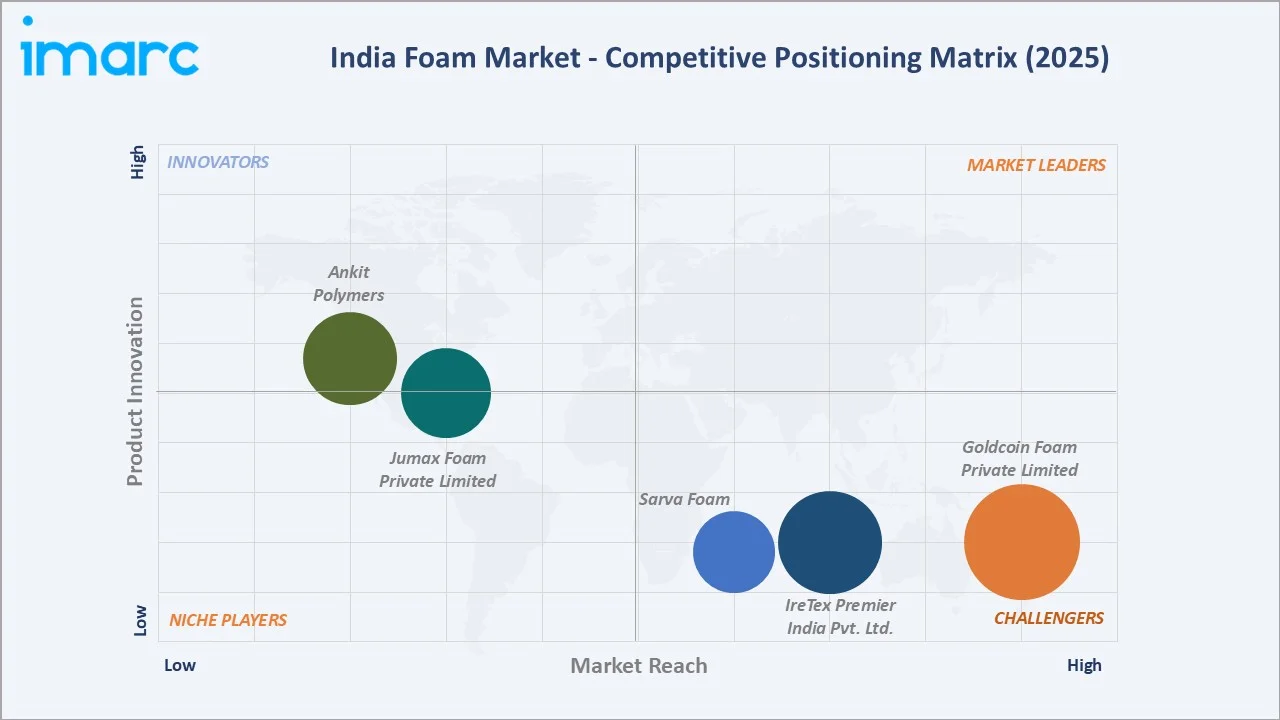
The India foam market is moderately fragmented, with organized national players competing alongside a large unorganized manufacturing sector. National brands dominate the premium consumer segment while regional players serve industrial and commodity foam demand across diverse end-use sectors.
|
Company Name |
Key Products |
Market Position |
Strategic Focus |
|
Goldcoin Foam Private Limited |
EPE Foam Sheets, EPE Foam Rolls, EPE Foam |
Challenger |
West India (Gujarat) EPE packaging and insulation foam; protective packaging and construction insulation applications |
|
IreTex Premier India Pvt. Ltd. |
EPE Foam & Cushion Packing Rolls or Sheets |
Challenger |
South India (Bengaluru) EPE foam packaging specialist; large-scale exporter serving global clients including Dell |
|
Sarva Foam |
Rebonded Foam |
Challenger |
India's largest rebonded foam manufacturer; preferred supplier to Sheela Foam, Kurl-on, and Duroflex; 7 plants nationwide |
|
Ankit Polymers |
EVA Foam Sheet |
Emerging |
Technical and specialty foam segments; niche application focus |
|
Jumax Foam Private Limited |
Thermoformable Foam, Rigid Foam, Moulded Foam, Rebonded Foam |
Emerging |
North India; automotive, footwear, and furnishings foam; ISO certified since 1984 |
Key players include Goldcoin Foam Private Limited, IreTex Premier India Pvt. Ltd., Sarva Foam, Ankit Polymers, Jumax Foam Private Limited, and others.
Key Company Profiles
Goldcoin Foam Private Limited
Goldcoin Foam is a West India-based foam manufacturer producing EPE Foam Sheets, EPE Foam Rolls, and Precision EPE Foam Products for packing, construction, and insulation.
- Product Portfolio: EPE Foam Sheets, EPE Foam Rolls, EPE Foam, and others.
- Strategic Focus: Goldcoin Foam's strategy focuses on consolidating its position as a leading EPE foam manufacturer in India through capacity expansion across its Gujarat facilities, broadening its export reach for protective packaging applications, and extending its product range into higher-value XLPE insulation and precision-fabricated EPE solutions targeting construction, cold chain, and industrial packaging end users..
Sarva Foam
Sarva Foam is India's leading recycler of Polyurethane Foam Trims. The company is a preferred raw material supplier to major mattress brands including Sheela Foam, Kurl-on, and Duroflex, and has expanded internationally with operations in the UK and Australia.
- Product Portfolio: Rebonded Foam
- Strategic Focus: Sarva Foam's strategy centres on consolidating its position as India's largest rebonded foam manufacturer through circular innovation, recycling PU foam trims into high-density rebonded foam, while expanding B2B supply partnerships with national mattress brands and scaling its own consumer mattress brands internationally.
Ankit Polymers
Ankit Polymers, established in 2009, is one of the prominent manufacturers and suppliers of a wide range of Sheets and Foam, with a product range inclusive of EVA Roll Tape, EVA Sheet, Joint Expansion Filler Board, LD Sheet, EVA Foam, and Fitness Mat.
- Product Portfolio: EVA Foam Sheet
- Strategic Focus: Ankit Polymers' strategy focuses on maintaining its North India market position in EVA and specialty foam through competitive pricing, broad product grade availability, and customised EVA formulations for footwear sole, sports flooring, and industrial packaging applications targeting MSME converters and OEM buyers.
Market Concentration Analysis
The India foam market is moderately fragmented at the national level. Organized players including Sheela Foam, Alpha Foam, and Tirupati Foam collectively hold significant value share in their respective regional markets, while a large unorganized sector serves commodity foam demand.
Consolidation is progressing primarily in the branded consumer foam segment, where Sheela Foam's Sleepwell brand leads national market share. Regional concentration is highest in South India, where established manufacturers maintain cost and distribution advantages over new entrants. Private equity interest in India's branded foam companies is growing.
Investment & Growth Opportunities
Fastest-Growing Segments
Rigid foam at ~3.7% CAGR through 2034 is the highest-growth category segment, driven by India's construction energy efficiency mandates, cold chain expansion, and refrigeration equipment manufacturing growth. South India at ~3.6% CAGR represents the fastest-growing regional opportunity.
Emerging Markets
East and North-East India, historically underserved by organized foam manufacturers, represents a high-growth frontier. Government infrastructure programs under the Act East Policy and growing consumer markets are creating untapped foam demand accessible to manufacturers willing to invest in regional distribution infrastructure.
Venture & Investment Trends
Private equity interest in India's branded consumer foam companies is growing, given their brand equity, organized distribution networks, and exposure to India's premiumizing consumer market. Sustainability investment in bio-based polyol development and EPS recycling infrastructure is gaining regulatory and consumer tailwind.
Future Market Outlook (2026-2034)
The India foam market is forecast to expand from USD 8.50 Billion in 2025 to an estimated USD 8.78 Billion in 2026 and further to USD 11.47 Billion by 2034 at a CAGR of 3.28%, adding USD 2.97 Billion in incremental annual market value. Infrastructure investment, automotive sector growth, and consumer premiumization will sustain this consistent trajectory throughout the forecast period.
Three structural forces will most significantly shape India's foam market through 2034: the USD 1.4 Trillion National Infrastructure Pipeline driving construction insulation demand; PLI scheme-backed automotive sector expansion generating technical foam demand; and organized retail growth and e-commerce expansion driving packaging and consumer foam growth.
Research Methodology
Primary Research
Primary research encompassed structured interviews with foam industry stakeholders including manufacturers, distributors, furniture industry buyers, automotive Tier-1 suppliers, and construction sector procurement managers, validating market sizing, segment shares, and regional demand estimates.
Secondary Research
Secondary sources include Ministry of Commerce and Industry trade data, DPIIT investment reports, ACMA sector publications, CREDAI market reports, BIS standards documentation, company annual reports, and trade publications covering India's chemicals, polymer, and construction industries.
Forecasting Models
Market estimations use combined top-down and bottom-up models incorporating GDP growth rates, urbanization indices, construction investment data, automotive production forecasts, and historical foam demand patterns. Base, optimistic, and conservative scenario analysis was applied to account for input cost and policy uncertainties.
India Foam Market Report Scope:
| Report Features | Details |
|---|---|
| Base Year of the Analysis | 2025 |
| Historical Period | 2020-2025 |
| Forecast Period | 2026-2034 |
| Units | Billion USD |
| Scope of the Report | Exploration of Historical and Forecast Trends, Industry Catalysts and Challenges, Segment-Wise Historical and Predictive Market Assessment:
|
| Categories Covered | Flexible Foam, Rigid Foam |
| Types Covered | Polyurethane, Polystyrene, Polyolefin, Phenolic, PET, Others |
| Applications Covered | Furniture, Automotive, Building and Construction, Apparels, Packaging, Appliances, Others |
| Regions Covered | South India, North India, West and Central India, East and North East-India |
| Companies Covered | Goldcoin Foam Private Limited, IreTex Premier India Pvt. Ltd., Sarva Foam, Ankit Polymers, Jumax Foam Private Limited, etc. |
| Customization Scope | 10% Free Customization |
| Post-Sale Analyst Support | 10-12 Weeks |
| Delivery Format | PDF and Excel through Email (We can also provide the editable version of the report in PPT/Word format on special request) |
Key Benefits for Stakeholders:
- IMARC’s report offers a comprehensive quantitative analysis of various market segments, historical and current market trends, market forecasts, and dynamics of the India foam market from 2020-2034.
- The research study provides the latest information on the market drivers, challenges, and opportunities in the India foam market.
- Porter's five forces analysis assist stakeholders in assessing the impact of new entrants, competitive rivalry, supplier power, buyer power, and the threat of substitution. It helps stakeholders to analyze the level of competition within the India foam industry and its attractiveness.
- Competitive landscape allows stakeholders to understand their competitive environment and provides an insight into the current positions of key players in the market.
Frequently Asked Questions About the India Foam Market Report
The India foam market size is estimated at USD 8.78 Billion in 2026, reflecting strong demand from furniture, automotive, construction, and packaging end-use sectors across the country.
The market is projected to reach USD 11.47 Billion by 2034, growing at a CAGR of 3.28% during 2026-2034, driven by infrastructure investment, automotive sector growth, and consumer premiumization.
Flexible foam leads with 61.4% category share in 2025, valued for its versatility across mattresses, furniture upholstery, automotive seating, and apparel padding applications serving India's large consumer market.
Polyurethane foam leads at 54.8% in 2025, owing to its outstanding performance balance, formulation flexibility across rigid and flexible applications, and broad availability through established Indian manufacturing infrastructure.
South India commands 31.7% market share in 2025, driven by its well-established foam manufacturing cluster, strong furniture and mattress industry, and rapid urbanization generating construction foam demand.
Rigid foam is the fastest-growing category at ~3.7% CAGR through 2034, driven by India's construction energy efficiency mandates, cold chain logistics expansion, and refrigeration equipment manufacturing growth.
Leading companies include Goldcoin Foam Private Limited, IreTex Premier India Pvt. Ltd., Sarva Foam, Ankit Polymers, Jumax Foam Private Limited, and others.
Key applications include mattresses and bedding, upholstered furniture, automotive seating and interiors, building thermal insulation, cold chain packaging, protective packaging for electronics, healthcare products, and apparel padding.
Need more help?
- Speak to our experienced analysts for insights on the current market scenarios.
- Include additional segments and countries to customize the report as per your requirement.
- Gain an unparalleled competitive advantage in your domain by understanding how to utilize the report and positively impacting your operations and revenue.
- For further assistance, please connect with our analysts.
 Request Customization
 Speak to an Analyst
 Request Brochure
 Inquire Before Buying
Benefits of Customization
- Personalize this research
- Triangulate with your data
- Get data as per your format and definition
- Gain a deeper dive into a specific application, geography, customer, or competitor
- Any level of personalization
Get in Touch With Us
UNITED STATES
Phone: +1-201-971-6302
INDIA
Phone: +91-120-433-0800
UNITED KINGDOM
Phone: +44-753-714-6104
Email: [email protected]
Client Testimonials




.webp)




.webp)













Related Reports

Choose your plan
*Please note that the prices mentioned below are starting prices for each bundle type. Kindly contact our team for further details.*
Single User License
- 1 User License, Access on 2 Devices
- PDF Report + Excel Dataset (Password Protected)
- Lifetime Access
- No Printing Rights
- 10% Free Report Customization
- 10–12 Weeks of Analyst Support
Five User License
- Access for 5 Users, 2 Devices per User
- PDF Report + Excel Dataset (Password Protected)
- Lifetime Access
- Dedicated Account Manager
- 12–14 Weeks of Analyst Support
- No Printing Rights
- 15% Free Report Customization
- 25% Discount on Your Next Purchase
Corporate User License
- Unlimited User Access (Within Your Organization)
- PDF Report + Excel Dataset
- Lifetime Access
- Dedicated Account Manager
- 14–20 Weeks of Analyst Support
- No Printing Rights
- 20% Free Report Customization
- 30% Discount on Your Next Purchase
Essential Insights
What's included:
3 reports
- Lifetime Access
- PDF Reports
- Excel Datasets
- 2 Weeks of Free Analyst Support
- 2 User Licenses
- Access on 2 Devices
- Printing Rights
- Complimentary PowerPoint (PPT) Version
- Complimentary License Upgrade
Professional Access
What's included:
5 reports
- Lifetime Access
- PDF Reports
- Excel Datasets
- 8 Weeks of Free Analyst Support
- 2 User Licenses
- Access on 2 Devices
- Printing Rights
- Complimentary PowerPoint (PPT) Version
- Complimentary License Upgrade
Business Advantage
What's included:
8 reports
- Lifetime Access
- PDF Reports
- Excel Datasets
- 14 Weeks of Free Analyst Support
- 2 User Licenses
- Access on 2 Devices
- Printing Rights
- Complimentary PowerPoint (PPT) Version
- Complimentary License Upgrade
Enterprise Intelligence
What's included:
10 reports
- Lifetime Access
- PDF Reports
- Excel Datasets
- 20 Weeks of Free Analyst Support
- 2 User Licenses
- Access on 2 Devices
- Printing Rights
- Complimentary PowerPoint (PPT) Version
- Complimentary License Upgrade