
India Fruit Powder Market Size, Share, Trends and Forecast by Fruit Type, Technology, Distribution Channel, Application, and Region, 2026-2034
India Fruit Powder Market Size, Share, Trends & Forecast (2026-2034)
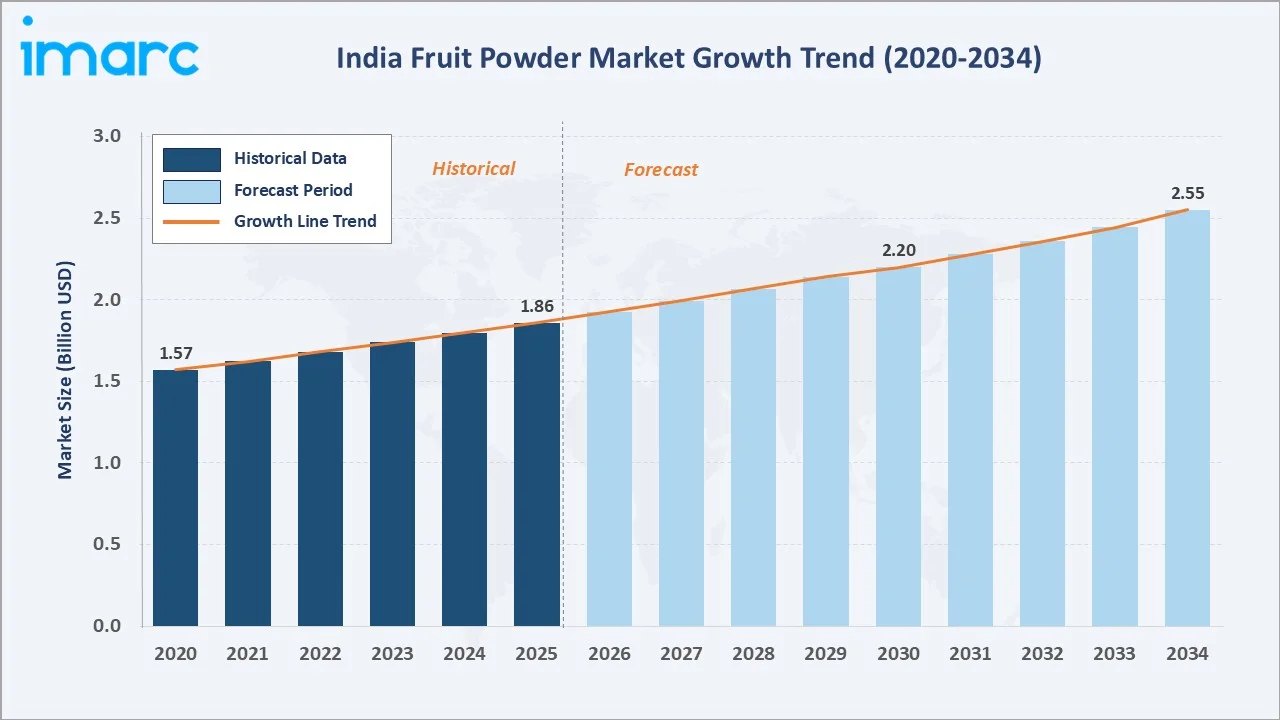
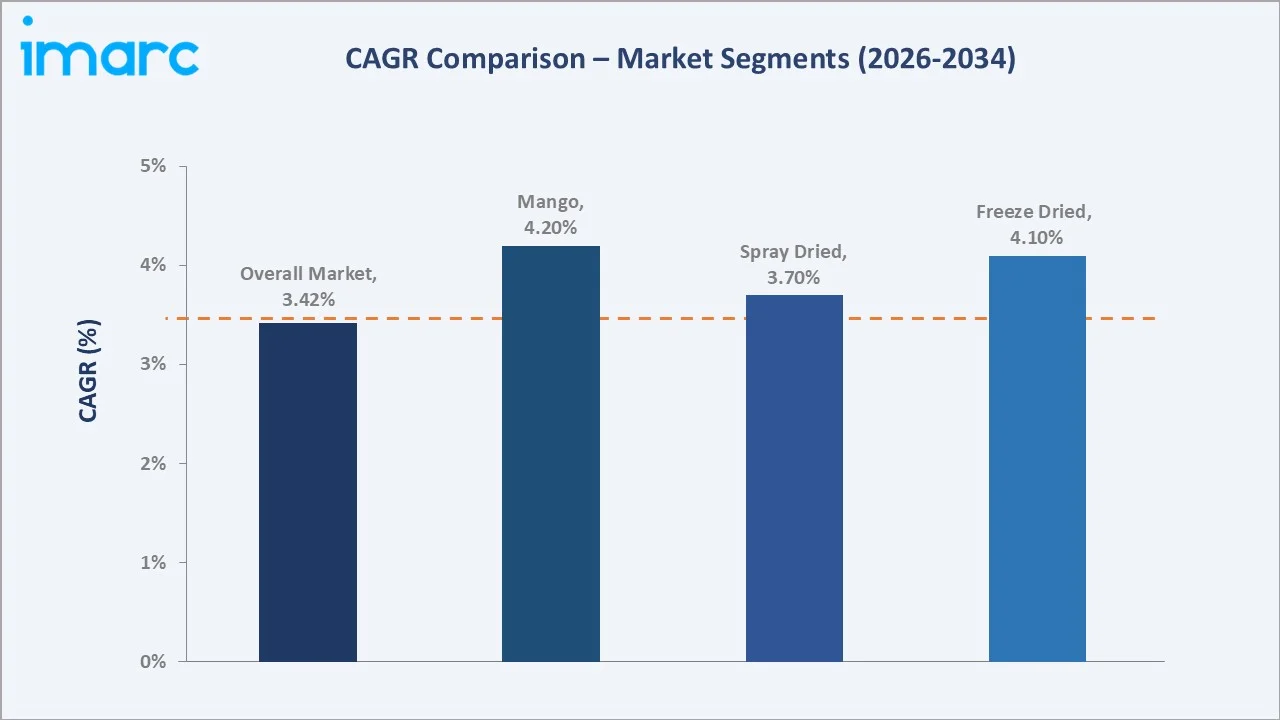
The India fruit powder market grew from USD 1.86 Billion in 2025 to USD 1.95 Billion in 2026 and is projected to reach USD 2.55 Billion by 2034, growing at a CAGR of 3.42% during 2026-2034. The market is driven by rising health consciousness, expanding food and beverage processing, and growing demand for natural, convenient, and shelf-stable fruit-based ingredients. Mango leads at 27.8%. Spray Dried dominates technology at 38.5%. West India commands 34.5% of national market share.
Market Snapshot
|
Metric |
Value |
|
Base Year Market Size (2025) |
USD 1.86 Billion |
| Market Size (2026) | USD 1.95 Billion |
|
Forecast Market Size (2034) |
USD 2.55 Billion |
|
CAGR (2026-2034) |
3.42% |
|
Base Year |
2025 |
|
Historical Period |
2020-2025 |
|
Forecast Period |
2026-2034 |
|
Dominant Fruit Type |
Mango (27.8%, 2025) |
|
Dominant Technology |
Spray Dried (38.5%, 2025) |
|
Leading Region |
West India (34.5%, 2025) |
The fruit powder market in India expanded from USD 1.57 Billion in 2020 to USD 1.86 Billion in 2025 and an estimated USD 1.95 Billion in 2026, anchored at USD 2.20 Billion in 2030 and forecast to reach USD 2.55 Billion by 2034. Rising consumer preference for natural, nutritious, and convenient food ingredients and expanding food processing infrastructure are the primary structural growth drivers.
To get more information on this market, Request Sample
Mango at 27.8% leads fruit type through its versatile application across beverages, dairy, confectionery, and nutraceutical products. Spray Dried at 38.5% dominates technology through its cost efficiency and scalability. West India at 34.5% commands regional leadership through its concentrated food processing clusters and raw material proximity.
Executive Summary
The fruit powder market in India reached USD 1.86 Billion in 2025 to an estimated USD 1.95 Billion in 2026, driven by rising health awareness, expanding food and beverage manufacturing, and growing demand for clean-label, natural ingredients. The market is projected to reach USD 2.55 Billion by 2034.
Mango at 27.8% leads through its dominant role in India's processed food and beverage industry. Spray Dried technology at 38.5% dominates through cost-efficiency and versatility for large-scale food manufacturers. West India at 34.5% leads regionally through concentrated food processing clusters in Maharashtra and Gujarat.
Key opportunities include organic and superfruit powder development, freeze-dried premium segment growth, pharma-grade fruit ingredient formulations, and e-commerce direct-to-consumer channels targeting health-conscious urban consumers across Tier 1 and Tier 2 markets.
Key Market Insights
|
Insight |
Data |
|
Dominant Fruit Type |
Mango – 27.8% share (2025) |
|
Dominant Technology |
Spray Dried – 38.5% market share (2025) |
|
Leading Region |
West India – 34.5% market share (2025) |
|
Market Opportunity |
Organic fruit powders, freeze-dried superfruits, pharma-grade formulations, e-commerce channels |
Key Analytical Observations Supporting the Above Data:
- Mango at 27.8%: Mango dominates as India's largest produced and consumed fruit, with abundant raw material availability across Maharashtra, Andhra Pradesh, and Uttar Pradesh. Mango powder's versatility across beverages, yogurt, confectionery, bakery, and nutraceutical applications reinforces its leading position. Its year-round availability in powder form addresses the seasonal constraints of fresh mango supply for industrial food manufacturers.
- Spray Dried at 38.5%: Spray drying dominates as the most established and cost-effective fruit powder production technology, enabling high-volume, continuous processing with consistent particle size and solubility. Its relatively lower capital and operational costs compared to freeze drying make it the preferred choice for large-scale food manufacturers supplying commodity fruit powders to the Indian bakery, beverage, and dairy sectors.
- West India at 34.5%: West India leads through Maharashtra's and Gujarat's concentration of food processing industries, FMCG manufacturers, and mango and grape processing clusters. Mumbai, Pune, and Ahmedabad serve as primary commercial hubs for fruit powder procurement. The region's proximity to major mango and grape-producing belts reduces input procurement costs for large-scale processors.
India Fruit Powder Market Overview
The fruit powder market size in India reflects the production, processing, and supply of dehydrated fruit-based powders across spray drying, freeze drying, vacuum drying, and drum drying technologies, serving food and beverage, nutraceutical, pharmaceutical, personal care, and foodservice industries.
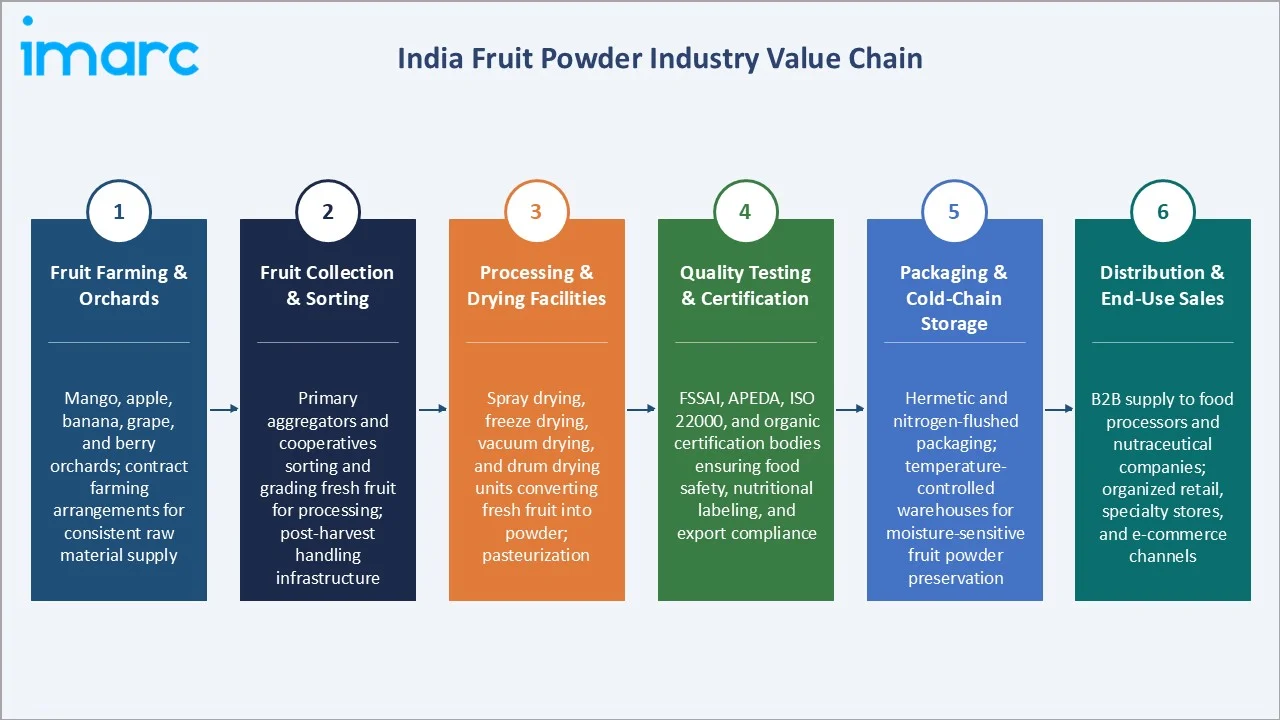
The ecosystem integrates fruit farms and orchards, primary collection and sorting centers, industrial drying and processing facilities, quality certification bodies, packaging and cold-chain providers, distribution networks, and end-use manufacturers. Macroeconomic factors include rising per capita income, health awareness, food processing PLI incentives, and export demand.
Market Dynamics
To evaluate market opportunities, Request Sample
Market Drivers
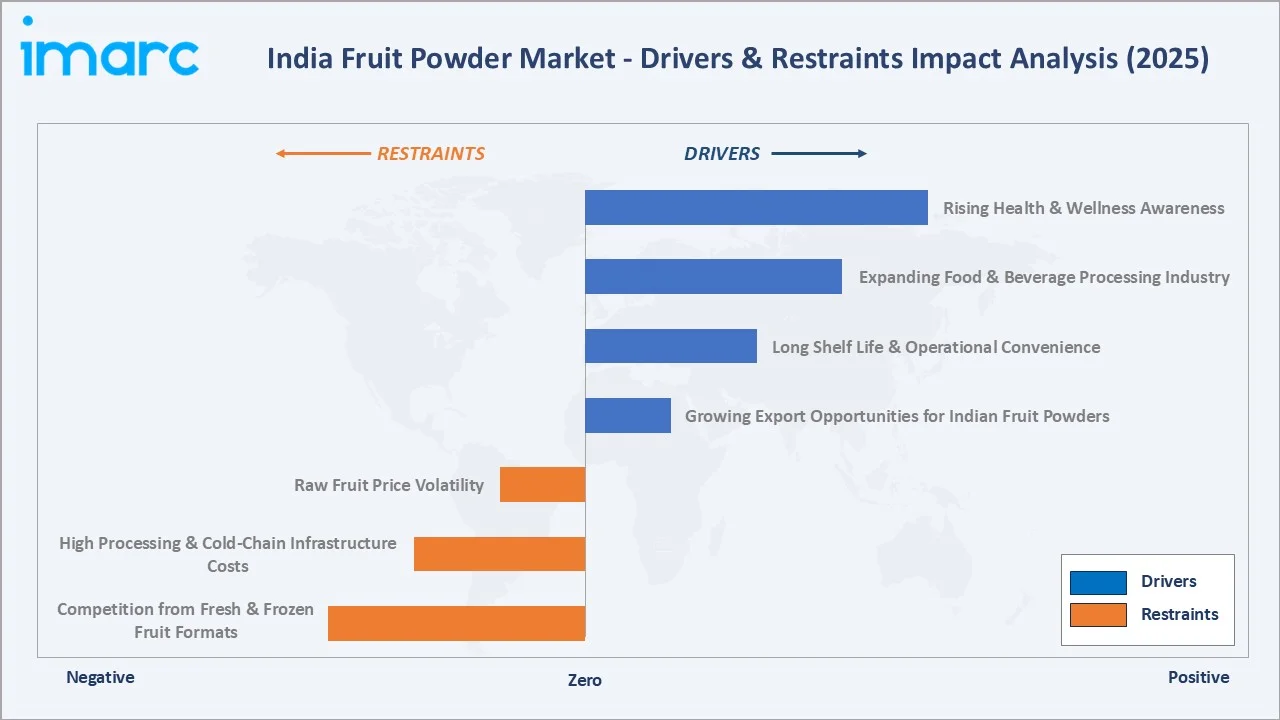
- Rising Health and Wellness Awareness: Growing health consciousness among Indian consumers is accelerating demand for natural, nutrient-dense food ingredients, driving fruit powder adoption across nutraceutical supplements, functional beverages, and clean-label food products. The Indian dietary supplement market is expanding rapidly, creating sustained demand for superfruit powders including berries, pomegranate, and amla. Urban millennial consumers increasingly seek convenient, shelf-stable alternatives to fresh fruit for home cooking, smoothies, and health food preparation. Rising awareness of antioxidant, vitamin, and mineral benefits reinforces fruit powder adoption as a dietary supplement ingredient.
- Expanding Food and Beverage Processing Industry: India's rapidly growing organized food and beverage processing sector is driving industrial-scale demand for consistent, high-quality fruit powder ingredients. The government's Production Linked Incentive (PLI) scheme for food processing is accelerating investment in large-scale processing facilities and ingredient sourcing. Expanding quick-service restaurant chains and packaged food manufacturers require year-round consistent fruit flavoring and coloring ingredients that fresh fruit cannot provide. Beverage companies, dairy processors, and bakery manufacturers are increasing fruit powder usage to reduce input variability and improve production efficiency.
- Long Shelf Life and Operational Convenience: Fruit powder's shelf life of one to three years in sealed packaging provides significant logistical and cost advantages over fresh fruit and frozen purees. Eliminating cold-chain dependency, reducing storage space requirements, and enabling year-round consistent supply regardless of seasonal availability make fruit powders indispensable for food manufacturers operating at industrial scale. The reconstitution flexibility of fruit powders allows food manufacturers to customize concentration levels and formulations to match specific product requirements. These operational benefits are particularly valued by pharmaceutical and nutraceutical producers who require precisely dosed, standardized fruit-based actives.
- Growing Export Opportunities for Indian Fruit Powders: India's competitive fruit production costs and improving food safety certification infrastructure position domestic fruit powder manufacturers as cost-competitive exporters to the Middle East, Southeast Asia, Europe, and North American markets. Rising global demand for natural, clean-label food ingredients is driving export-oriented capacity expansion among Indian processors.
Market Restraints
- Raw Fruit Price Volatility: Fruit powder production costs are highly sensitive to fresh fruit prices, which fluctuate with monsoon performance, seasonal availability, transportation disruptions, and disease outbreaks. Significant price swings in mango, banana, and grape raw material prices can compress processor margins and complicate forward pricing for food manufacturer customers. Year-on-year crop output variability in major fruit-producing states creates supply uncertainty that limits processor capacity utilization planning. For food manufacturers, input cost unpredictability creates procurement and formulation budgeting challenges that can delay fruit powder adoption decisions.
- High Processing and Cold-Chain Infrastructure Costs: Freeze-drying and vacuum-drying technologies require significant capital investment in equipment, energy, and quality systems that create barriers for smaller processors. The energy-intensive nature of drying operations increases variable production costs, particularly with rising electricity prices. Cold-chain infrastructure requirements for raw fruit transportation and finished powder storage add to logistics costs, limiting geographic reach. Inadequate cold-chain infrastructure in Tier 2 and Tier 3 producing regions increases raw material deterioration risks and reduces the quality consistency of fruit powders produced from sub-optimal inputs.
- Competition from Fresh and Frozen Fruit Formats: Fresh fruit and frozen fruit purees retain strong preference among food manufacturers who prioritize fresh flavor profiles and consumers who value the natural, unprocessed food experience. Premium food and beverage brands targeting health-conscious consumers may prefer fresh or minimally processed fruit ingredients over reconstituted powder formats. Frozen fruit availability has improved significantly with expanding cold-chain infrastructure, creating an alternative intermediate that captures market position between fresh and powdered formats. Changing consumer behavior toward fresh over processed is a structural headwind for fruit powder growth in certain premium food applications.
Market Opportunities
- Organic and Superfruit Powder Development: Rising consumer and food manufacturer demand for certified organic and superfruit-based ingredients creates premium pricing opportunities for processors who invest in organic sourcing, certification, and specialty processing. Superfruit powders including acai, blueberry, pomegranate, and amla command 3-5x the per-unit revenue of commodity fruit powders. This premium segment remains underdeveloped in India, presenting early-mover advantages for processors who establish certified supply chains and develop commercially viable organic fruit powder portfolios for domestic and export health food markets.
- Pharmaceutical and Nutraceutical Grade Applications: The rapidly expanding Indian nutraceutical market is driving demand for pharmaceutical-grade standardized fruit extracts and powders with verified bioactive content. Fruit powders with standardized polyphenol, vitamin, and mineral content command premium pricing from supplement formulators, clinical nutrition providers, and functional food manufacturers. Processors investing in analytical testing, standardization, and Good Manufacturing Practice (GMP) certification can access significantly higher-margin nutraceutical-grade fruit powder market segments beyond commodity food processing supply.
Market Challenges
- Fragmented and Unorganized Competitive Landscape: India's fruit powder market includes numerous small and unorganized processors operating without formal food safety certifications, competing primarily on price. These unorganized players compress margins for certified, organized manufacturers who invest in quality systems, testing, and compliance. Building sustainable differentiation through organic certification, consistent quality, and customer-specific formulation capabilities requires sustained investment that creates financial pressure on mid-sized processors. Price-driven procurement decisions by domestic food manufacturers limit the ability of quality-focused processors to recover certification investment costs through premium pricing.
- Limited Consumer Awareness Beyond Metro Markets: Outside major metropolitan cities, consumer and small food manufacturer awareness of fruit powder's nutritional benefits, formulation flexibility, and cost advantages over fresh fruit remains low. Regional bakeries, small-scale food processors, and institutional kitchens continue using fresh fruit despite fruit powder's logistical and consistency advantages. Expanding market penetration in Tier 2 and Tier 3 cities requires investment in distributor network development, product demonstration, and technical sales support that represents significant cost burdens for processors targeting geographically dispersed market segments.
Emerging Market Trends
To evaluate market opportunities, Request Sample
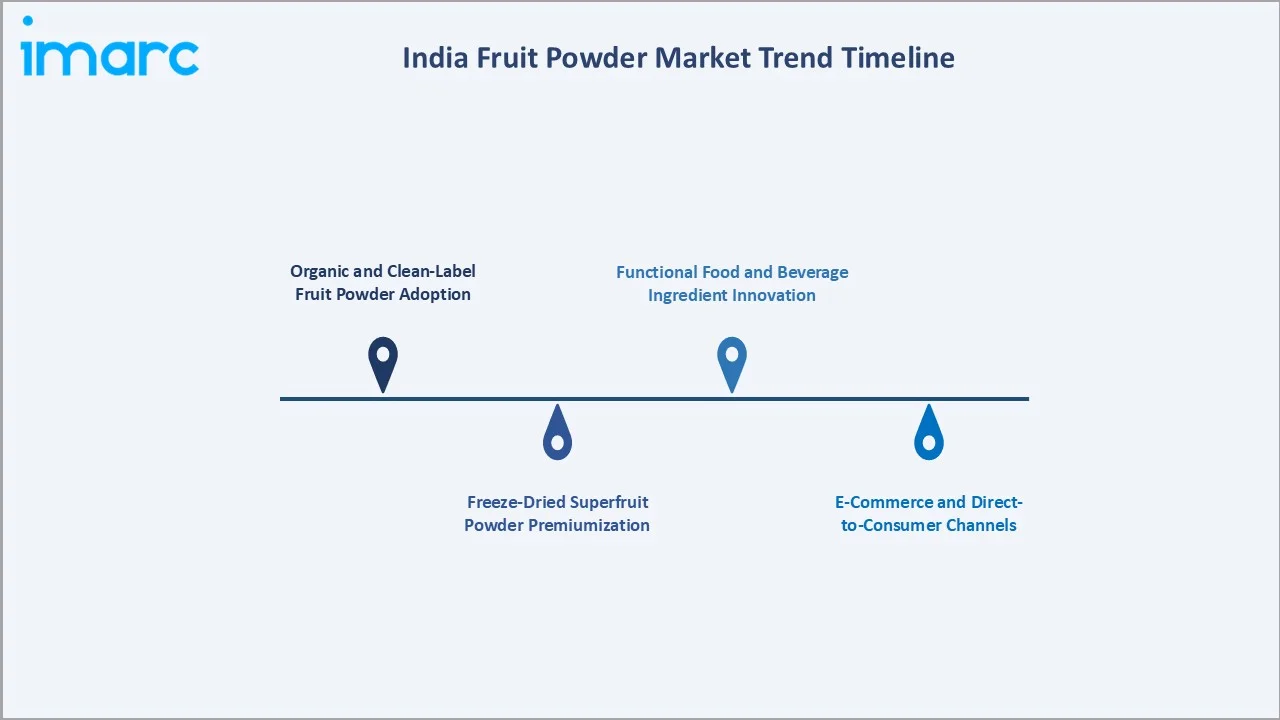
1. Organic and Clean-Label Fruit Powder Adoption
Food manufacturers are increasingly demanding organic-certified, additive-free fruit powders with transparent supply chain documentation for clean-label product positioning. Certified organic mango, banana, and berry powders are gaining adoption among premium food brands and health supplement formulators requiring non-GMO, residue-free ingredients.
2. Freeze-Dried Superfruit Powder Premiumization
Freeze-dried fruit powders are gaining market share through superior flavor retention, color preservation, and higher nutritional density compared to spray-dried alternatives. Premium health food brands are formulating products with freeze-dried blueberry, strawberry, and pomegranate powders, driving adoption in the nutraceutical, sports nutrition, and premium bakery segments.
3. E-Commerce and Direct-to-Consumer Channels
Growing health and wellness e-commerce platforms are creating new direct-to-consumer fruit powder channels targeting urban fitness enthusiasts, home bakers, and smoothie consumers. Online distribution reduces barriers to market for specialty organic and freeze-dried fruit powder brands, enabling smaller producers to reach health-conscious consumers directly without traditional retail network investment.
4. Functional Food and Beverage Ingredient Innovation
Rising demand for functional foods fortified with fruit-derived bioactives is driving formulation innovation using standardized fruit powder concentrates. Food technologists are incorporating pomegranate, acai, and amla powders for their antioxidant and immunomodulatory properties into functional beverages, energy bars, and clinical nutrition products targeting specific health outcomes.
Industry Value Chain Analysis
The India fruit powder value chain integrates orchard-level fruit farming and post-harvest handling, primary collection and sorting, industrial processing and drying, quality certification, packaging and cold-chain management, and distribution to end-use industries. The value chain consolidates toward integrated farm-to-powder models among leading processors.
|
Stage |
Key Participants |
|
Fruit Farming & Orchards |
Mango, apple, banana, grape, and berry orchards; contract farming arrangements for consistent raw material supply |
|
Fruit Collection & Sorting |
Primary aggregators and cooperatives sorting and grading fresh fruit for processing; post-harvest handling infrastructure |
|
Processing & Drying Facilities |
Spray drying, freeze drying, vacuum drying, and drum drying units converting fresh fruit into powder; pasteurization |
|
Quality Testing & Certification |
FSSAI, APEDA, ISO 22000, and organic certification bodies ensuring food safety, nutritional labeling, and export compliance |
|
Packaging & Cold-Chain Storage |
Hermetic and nitrogen-flushed packaging; temperature-controlled warehouses for moisture-sensitive fruit powder preservation |
|
Distribution & End-Use Sales |
B2B supply to food processors and nutraceutical companies; organized retail, specialty stores, and e-commerce channels |
The fruit farming stage is the most supply-sensitive tier, with monsoon variability, pest outbreaks, and regional crop failures creating the primary input risk for downstream processors. The spray-drying and freeze-drying stages require significant capital investment in industrial dryers, quality control equipment, and food safety systems, creating scale economies that favor integrated processors.
Technology Landscape in the India Fruit Powder Industry
Spray Drying Technology
Spray drying is the dominant fruit powder production technology, converting fruit juice, puree, or concentrate into fine powder through high-temperature atomization. Advanced two-stage and three-stage spray dryers improve energy efficiency, reduce thermal degradation of heat-sensitive nutrients, and produce consistent particle size distributions for better reconstitution performance.
Freeze Drying Technology
Freeze drying (lyophilization) preserves fruit powder flavor, color, aroma, and nutritional content superior to thermal drying methods by sublimating ice under vacuum at low temperatures. The process commands a significant price premium over spray-dried alternatives and targets the premium nutraceutical, gourmet food, and functional beverage markets requiring maximum nutritional integrity.
Vacuum and Drum Drying Technology
Vacuum drying processes fruit at lower temperatures under reduced pressure, preserving heat-sensitive nutrients and bioactive compounds while achieving moisture levels below spray drying. Drum drying applies heated drum surfaces to continuous fruit puree films, producing economical flaked or coarse powders for commodity food processing applications at lower capital cost than spray or freeze-drying systems.
Market Segmentation Analysis
The report covers the following segments:
|
Segment Category |
Leading Segment |
Market Share |
Year |
|
Fruit Type |
Mango |
27.8% |
2025 |
|
Technology |
Spray Dried |
38.5% |
2025 |
|
Distribution Channel |
🔒 |
🔒 |
2025 |
|
Application |
🔒 |
🔒 |
2025 |
|
Region |
West India |
34.5% |
2025 |

By Fruit Type
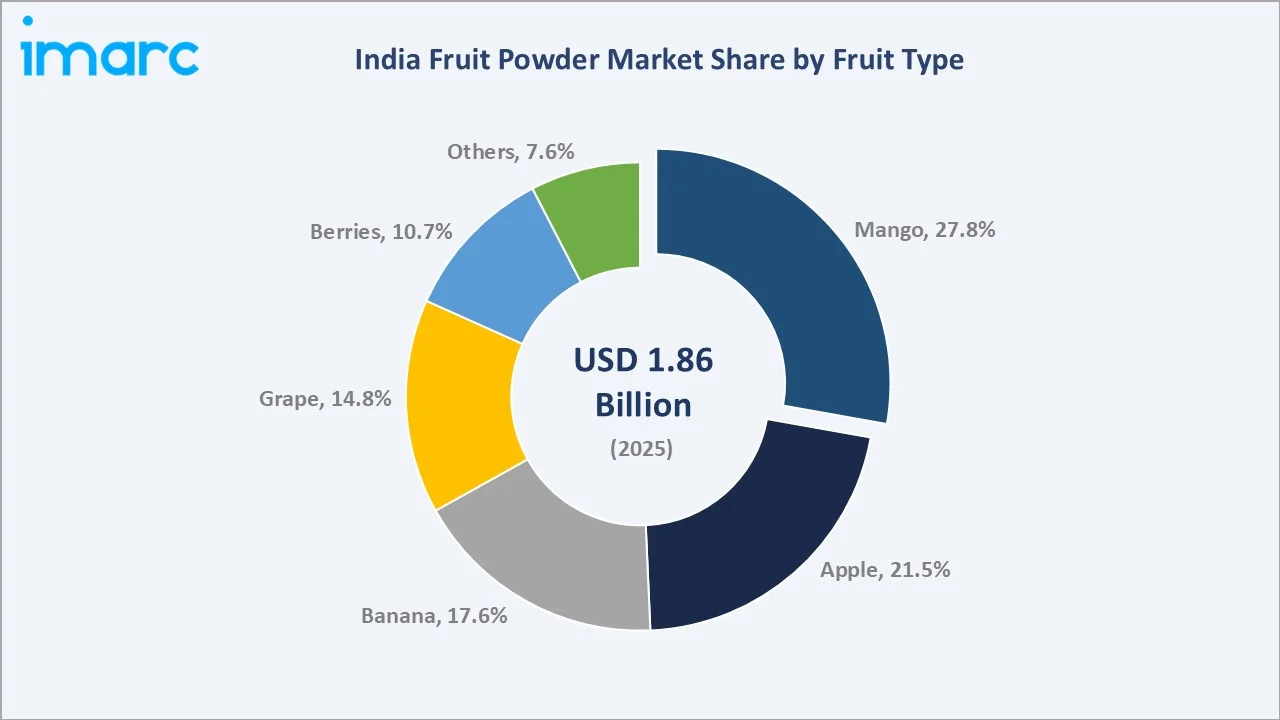
Mango leads at 27.8% in 2025, driven by India's position as the world's largest mango producer and the fruit's versatile application across beverages, dairy, confectionery, bakery, and nutraceutical products. Mango powder availability enables year-round industrial-scale production regardless of seasonal crop cycles.
To access detailed market analysis, Request Sample
Apple at 21.5% reflects strong demand from bakery, dairy, and health supplement applications, supported by Himachal Pradesh and Uttarakhand's apple production base. Banana at 17.6% captures confectionery, infant food, and nutraceutical demand. Grape at 14.8% serves wine-derived powder and functional food applications. Berries at 10.7% and Others at 7.6% encompass premium freeze-dried and specialty tropical varieties.
By Technology
Spray Dried dominates at 38.5% through its cost efficiency, high throughput, and versatility for producing commodity fruit powders at the scale required by large food and beverage manufacturers across India.
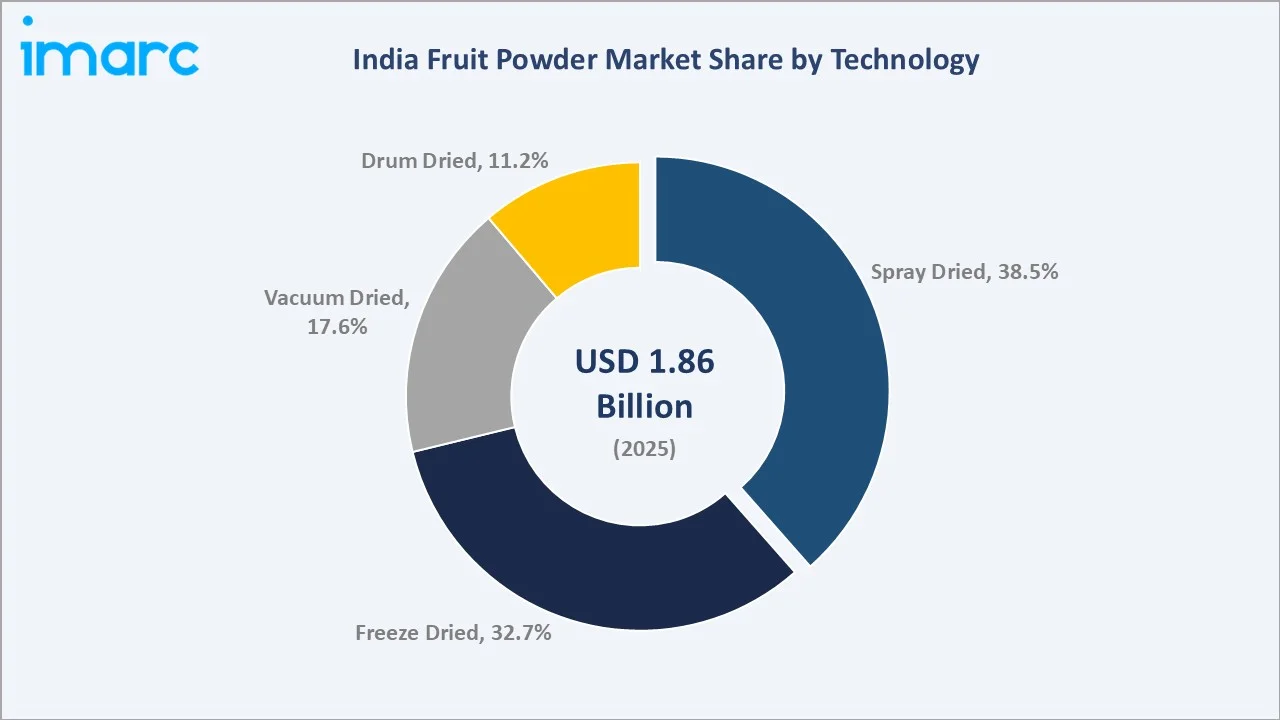
Freeze Dried at 32.7% captures the premium nutraceutical, gourmet food, and functional beverage segments where flavor, color, and nutritional integrity are critical and justify premium pricing. Vacuum Dried at 17.6% serves heat-sensitive specialty fruit powders. Drum Dried at 11.2% supplies commodity food processing segments requiring economical coarse powder at high throughput.
Regional Market Insights
|
Region |
Share (2025) |
Key Fruit Powder Market Drivers & Characteristics |
|
West India |
34.5% |
Largest market; Maharashtra and Gujarat host major food processing clusters, FMCG manufacturers, and mango/grape processing units driven by abundant raw material supply |
|
South India |
28.7% |
Strong raw material base in Karnataka, Andhra Pradesh, and Tamil Nadu; growing nutraceutical sector and freeze-dried product manufacturing for domestic and export markets |
|
North India |
22.6% |
Rising organized bakery and confectionery demand in Delhi NCR; apple powder from Himachal Pradesh and Uttarakhand reinforces the regional supply base and processing activity |
|
East India |
14.2% |
Emerging market with growing food processing investment; rising health awareness among urban consumers and banana/tropical fruit production support regional growth trajectory |
West India, at 34.5%, leads through Maharashtra's and Gujarat's large-scale food processing industries, mango and grape fruit processing clusters, and FMCG manufacturer concentration. Mumbai, Pune, and Ahmedabad are primary demand centers. South India at 28.7% benefits from the region's diverse fruit production base including banana, grape, and tropical fruits.
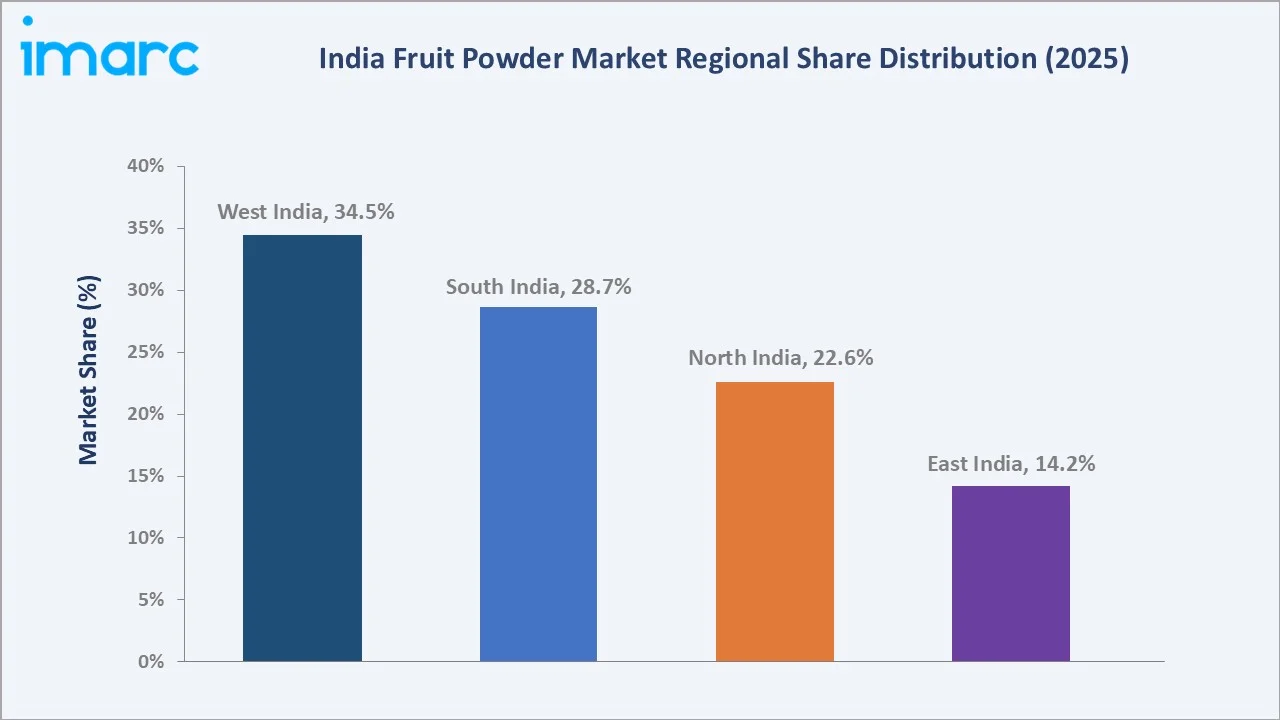
North India at 22.6% is driven by Delhi NCR's organized food processing demand, Himachal Pradesh's apple powder processing, and growing nutraceutical industry in the region. East India at 14.2% represents an emerging growth market driven by rising organized food processing investment, increasing health awareness, and tropical fruit availability in West Bengal and Odisha.
Competitive Landscape
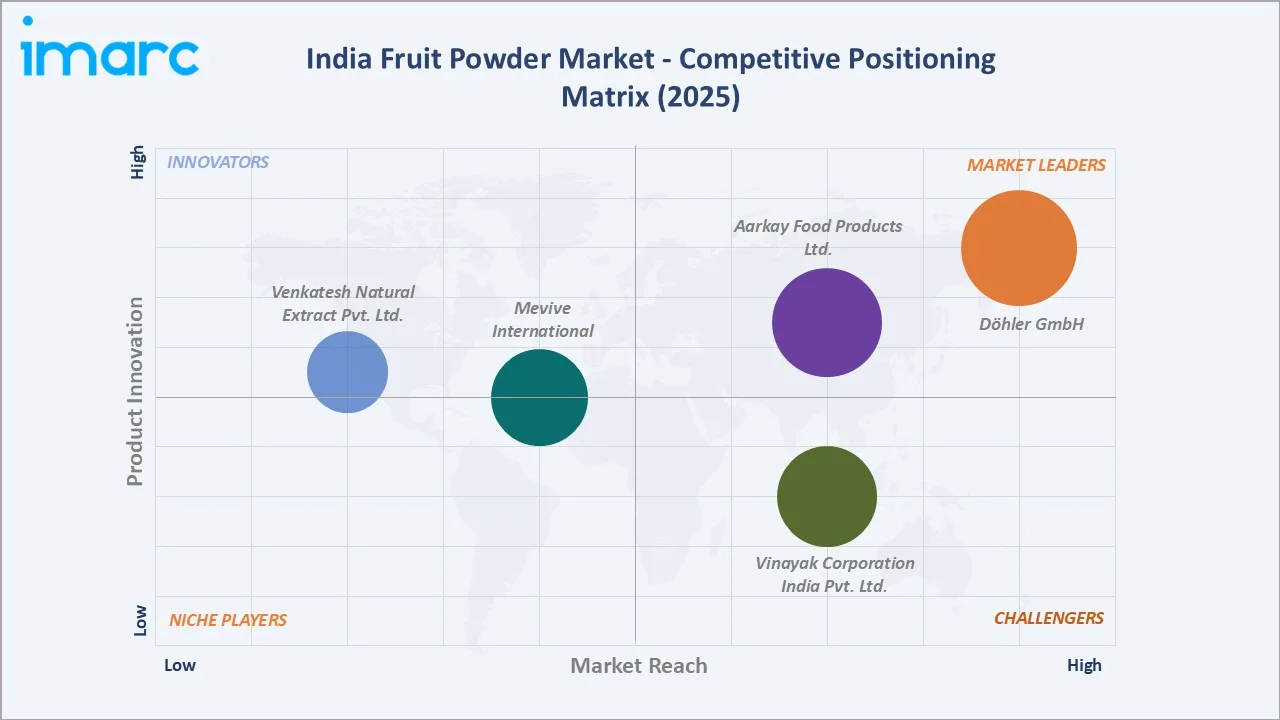
The India fruit powder market competitive landscape is moderately fragmented with three distinct tiers: global ingredient multinationals, established Indian spray-dried ingredient manufacturers, and smaller regional and specialty processors serving niche applications.
|
Company Name |
Key Products |
Market Position |
Core Strength |
|
Döhler GmbH |
Fruit powder blends, spray-dried fruit powders, freeze-dried fruit ingredients, natural flavors |
Market Leader |
Döhler is a global natural ingredients manufacturer supplying premium spray-dried and freeze-dried fruit powders to India's food, beverage, and nutraceutical sectors. |
|
Aarkay Food Products Ltd. |
Banana Powder, Orange Powder, Mango Powder, Pineapple Powder, Strawberry Powder, Lemon Powder |
Market Leader |
Aarkay Food Products is a leading Indian manufacturer of spray-dried mango, banana, and other fruit powders serving domestic food processors and international export markets. |
|
Vinayak Corporation India Pvt. Ltd. |
Blueberry Fruit Powder, Peach Powder, Raw Mango Powder, Apple Fruit Powder, ECOFLAV Raspberry Powder, Banana Fruit Powder, Strawberry Fruit Powder, Custard Apple Fruit Powder, Watermelon Fruit Powder, Lychee Fruit Powder |
Strong Challenger |
Vinayak Corporation is a specialty food ingredient manufacturer producing a wide range of spray-dried fruit powders for bakery, dairy, and beverage applications. |
|
Mevive International |
Mango Powder, Banana Powder, Pomegranate Powder, Strawberry Powder, Black Grape Powder, Guava Powder, Chikko Powder, Custard Apple Powder, Apple Powder, Watermelon Powder |
Emerging Player |
Mevive International is an Indian food ingredient manufacturer supplying freeze-dried and spray-dried fruit powders to food processing and nutraceutical customers. |
|
Venkatesh Natural Extract Pvt. Ltd. |
Spray-dried fruit powders, natural extracts, herbal powders, dehydrated vegetable ingredients |
Emerging Player |
Venkatesh Natural Extract Pvt. Ltd. is an Indian natural extract and spray-dried fruit powder manufacturer catering to food processing, pharmaceutical, and export customers. |
Key players include Döhler GmbH, Aarkay Food Products Ltd., Vinayak Corporation India Pvt. Ltd., Mevive International, Venkatesh Natural Extract Pvt. Ltd., and others.
Key Company Profiles
Aarkay Food Products Ltd.
Aarkay Food Products Ltd. is a Mumbai-based Indian manufacturer of spray-dried fruit and vegetable powders, natural food colorants, and dehydrated food ingredients, supplying domestic food processors and international export markets.
- Key Products: Banana Powder, Orange Powder, Mango Powder, Pineapple Powder, Strawberry Powder, Lemon Powder
- Strategic Focus: Expanding spray-dried fruit and vegetable powder production capacity for both domestic food manufacturing and export markets, with a focus on mango, tropical fruit, and vegetable powder varieties that leverage India's agricultural diversity. The company is developing new natural food colorant and clean-label ingredient lines that combine fruit powder functionality with natural coloring properties for food manufacturers seeking natural ingredient positioning. Aarkay's established export relationships and multi-country food safety certifications provide a competitive foundation for scaling into premium international natural ingredient markets.
Vinayak Corporation India Pvt. Ltd.
Vinayak Corporation India Pvt. Ltd. is a Mumbai-based Indian manufacturer of spray-dried fruit and vegetable powders, natural food colors, and functional food ingredients, supplying domestic food and beverage manufacturers and international export markets under its ECOFLAV brand for fruit powder ingredients.
- Key Products: Blueberry Fruit Powder, Peach Powder, Raw Mango Powder, Apple Fruit Powder, ECOFLAV Raspberry Powder, Banana Fruit Powder, Strawberry Fruit Powder, Custard Apple Fruit Powder, Watermelon Fruit Powder, Lychee Fruit Powder
- Strategic Focus: Expanding its ECOFLAV eco-sustainable spray-dried fruit and vegetable powder portfolio with a focus on replacing chemically derived food ingredients with natural-origin alternatives across bakery, dairy, beverage, and nutraceutical applications. The company is investing in modified starch production, encapsulated bioactives for nutraceutical applications, and expanded natural food color capabilities under the ECOCOL brand that complement its fruit powder range for integrated natural ingredient supply.
Market Concentration Analysis
The India fruit powder market is moderately fragmented, with multinational players and established Indian manufacturers collectively accounting for approximately 35-45% of organized market revenue. Market concentration is expected to gradually increase as organic certification requirements, export market quality standards, and food safety compliance demands favor larger, better-capitalized organized players. The domestic food processing sector's growing preference for certified, traceable ingredient suppliers further consolidates demand toward organized manufacturers.
Investment & Growth Opportunities
Highest Growth Segments
Freeze-dried superfruit powder (~5.5% CAGR), organic fruit powder (~6% CAGR from small base), pharma-grade standardized fruit extracts (~6.5% CAGR), berry and exotic fruit varieties (~5% CAGR), and e-commerce direct-to-consumer fruit powder (~9% CAGR) represent the highest-growth investment opportunities through 2034.
Emerging Investment Opportunities
Pharmaceutical-grade standardized fruit powder represents the highest per-unit-value emerging opportunity. Standardized polyphenol and antioxidant-content fruit powders command 4-6x the per-unit revenue of commodity spray-dried powders, with India's rapidly growing nutraceutical and clinical nutrition sectors creating a structurally growing demand pool through 2034.
Investment Themes
- Organic certification and premium freeze-dried capacity investment: Investments in organic-certified fruit sourcing networks, freeze-drying processing capacity, and international quality certification enable processors to access high-margin export markets and domestic premium nutraceutical customers seeking non-GMO, residue-free fruit powder ingredients.
- Export-oriented processing for Middle Eastern and European markets: India's competitive horticultural raw material costs and improving food safety certification frameworks create a strong investment case for export-oriented fruit powder manufacturing targeting European natural ingredient importers and Middle Eastern food processors.
Future Market Outlook (2026-2034)
The India fruit powder market is projected to grow from USD 1.86 Billion in 2025 to USD 1.95 Billion in 2026 and is forecast to reach USD 2.55 Billion by 2034, delivering a 3.42% CAGR. The fruit powder market size in India is anchored at USD 2.20 Billion in 2030, representing a critical premiumization and organic-transition inflection point.
Three structural forces define India fruit powder market growth through 2034. India's expanding organized food and beverage processing sector creates compounding demand for consistent, high-quality fruit powder ingredients at industrial scale. The health and wellness market's structural growth drives premium freeze-dried and organic fruit powder demand at above-market growth rates. Export market expansion driven by India's competitive horticultural costs and improving quality certification standards creates additional demand above domestic consumption growth.
Research Methodology
Primary Research
Primary research comprised structured interviews with 45+ industry stakeholders (2025), including fruit powder plant managers, food technology specialists, nutraceutical procurement leads, organic certification consultants, and export market development professionals across India's fruit processing industry.
Secondary Research
Secondary research encompassed company annual reports; APEDA fruit product export statistics; Ministry of Food Processing Industries PLI scheme data; FSSAI food safety standards; horticultural production reports from NHB; industry association publications; and over 55 secondary sources reviewed.
Forecasting Models
Market revenue forecasts developed using bottom-up model: (i) India organized food and beverage production volume projections; (ii) per-unit fruit powder content by food category; (iii) export volume growth by destination market; (iv) premium segment CAGR premium over base market; (v) unorganized-to-organized sector transition rates by region.
India Fruit Powder Market Report Coverage:
| Report Features | Details |
|---|---|
| Base Year of the Analysis | 2025 |
| Historical Period | 2020-2025 |
| Forecast Period | 2026-2034 |
| Units | Billion USD |
| Scope of the Report |
Exploration of Historical Trends and Market Outlook, Industry Catalysts and Challenges, Segment-Wise Historical and Future Market Assessment:
|
| Fruit Types Covered | Grape, Apple, Mango, Banana, Berries, Others |
| Technologies Covered | Freeze Dried, Spray Dried, Vacuum Dried, Drum Dried |
| Distribution Channels Covered |
|
| Applications Covered | Bakery, Confectionery, Snacks and RTE Products, Dairy, Beverages, Soups and Sauces, Others |
| Regions Covered | North India, South India, East India, West India |
| Companies Covered | Döhler GmbH, Aarkay Food Products Ltd., Vinayak Corporation India Pvt. Ltd., Mevive International, Venkatesh Natural Extract Pvt. Ltd., etc. |
| Customization Scope | 10% Free Customization |
| Post-Sale Analyst Support | 10-12 Weeks |
| Delivery Format | PDF and Excel through Email (We can also provide the editable version of the report in PPT/Word format on special request) |
Key Benefits for Stakeholders:
- IMARC’s industry report offers a comprehensive quantitative analysis of various market segments, historical and current market trends, market forecasts, and dynamics of the India fruit powder market from 2020-2034.
- The research report provides the latest information on the market drivers, challenges, and opportunities in the India fruit powder market.
- Porter's five forces analysis assist stakeholders in assessing the impact of new entrants, competitive rivalry, supplier power, buyer power, and the threat of substitution. It helps stakeholders to analyze the level of competition within the India fruit powder industry and its attractiveness.
- Competitive landscape allows stakeholders to understand their competitive environment and provides an insight into the current positions of key players in the market.
Frequently Asked Questions About the India Fruit Powder Market Report
The India fruit powder market reached size is estimated at USD 1.95 Billion in 2026, driven by Mango at 27.8%, Spray Dried technology at 38.5%, West India leading at 34.5%, and expanding organized food processing and health-focused consumer demand across domestic and export markets.
The India fruit powder market grows at 3.42% CAGR during 2026-2034, reaching USD 2.55 Billion by 2034. Growth reflects expanding food and beverage processing, rising health supplement demand, organic fruit powder adoption, and increasing export-oriented processing investment.
Mango leads at 27.8%, driven by India's dominant mango production base and the fruit's versatile industrial application across beverages, dairy, confectionery, bakery, and nutraceutical products. Year-round powder availability enables consistent industrial-scale production beyond the seasonal fresh fruit window.
Spray Dried leads at 38.5% through its cost efficiency, high-throughput scalability, and versatility for commodity fruit powder production at the scale required by India's organized food and beverage manufacturing sector across bakery, dairy, and beverage applications.
West India leads at 34.5% through Maharashtra's and Gujarat's large-scale food processing industries, mango and grape processing clusters, and FMCG manufacturer concentration. Mumbai, Pune, and Ahmedabad serve as the primary commercial demand centers for industrial fruit powder procurement.
Leading companies include Döhler GmbH, Aarkay Food Products Ltd., Vinayak Corporation India Pvt. Ltd., Mevive International, Venkatesh Natural Extract Pvt. Ltd., and others.
Need more help?
- Speak to our experienced analysts for insights on the current market scenarios.
- Include additional segments and countries to customize the report as per your requirement.
- Gain an unparalleled competitive advantage in your domain by understanding how to utilize the report and positively impacting your operations and revenue.
- For further assistance, please connect with our analysts.
 Request Customization
 Speak to an Analyst
 Request Brochure
 Inquire Before Buying
Benefits of Customization
- Personalize this research
- Triangulate with your data
- Get data as per your format and definition
- Gain a deeper dive into a specific application, geography, customer, or competitor
- Any level of personalization
Get in Touch With Us
UNITED STATES
Phone: +1-201-971-6302
INDIA
Phone: +91-120-433-0800
UNITED KINGDOM
Phone: +44-753-714-6104
Email: [email protected]
Client Testimonials




.webp)




.webp)













Related Reports

Choose your plan
*Please note that the prices mentioned below are starting prices for each bundle type. Kindly contact our team for further details.*
Single User License
- 1 User License, Access on 2 Devices
- PDF Report + Excel Dataset (Password Protected)
- Lifetime Access
- No Printing Rights
- 10% Free Report Customization
- 10–12 Weeks of Analyst Support
Five User License
- Access for 5 Users, 2 Devices per User
- PDF Report + Excel Dataset (Password Protected)
- Lifetime Access
- Dedicated Account Manager
- 12–14 Weeks of Analyst Support
- No Printing Rights
- 15% Free Report Customization
- 25% Discount on Your Next Purchase
Corporate User License
- Unlimited User Access (Within Your Organization)
- PDF Report + Excel Dataset
- Lifetime Access
- Dedicated Account Manager
- 14–20 Weeks of Analyst Support
- No Printing Rights
- 20% Free Report Customization
- 30% Discount on Your Next Purchase
Essential Insights
What's included:
3 reports
- Lifetime Access
- PDF Reports
- Excel Datasets
- 2 Weeks of Free Analyst Support
- 2 User Licenses
- Access on 2 Devices
- Printing Rights
- Complimentary PowerPoint (PPT) Version
- Complimentary License Upgrade
Professional Access
What's included:
5 reports
- Lifetime Access
- PDF Reports
- Excel Datasets
- 8 Weeks of Free Analyst Support
- 2 User Licenses
- Access on 2 Devices
- Printing Rights
- Complimentary PowerPoint (PPT) Version
- Complimentary License Upgrade
Business Advantage
What's included:
8 reports
- Lifetime Access
- PDF Reports
- Excel Datasets
- 14 Weeks of Free Analyst Support
- 2 User Licenses
- Access on 2 Devices
- Printing Rights
- Complimentary PowerPoint (PPT) Version
- Complimentary License Upgrade
Enterprise Intelligence
What's included:
10 reports
- Lifetime Access
- PDF Reports
- Excel Datasets
- 20 Weeks of Free Analyst Support
- 2 User Licenses
- Access on 2 Devices
- Printing Rights
- Complimentary PowerPoint (PPT) Version
- Complimentary License Upgrade