
India Gin Market Size, Share, Trends and Forecast by Type, Price Point, Distribution Channel, and Region, 2026-2034
India Gin Market Size, Share, Trends & Forecast (2026-2034)
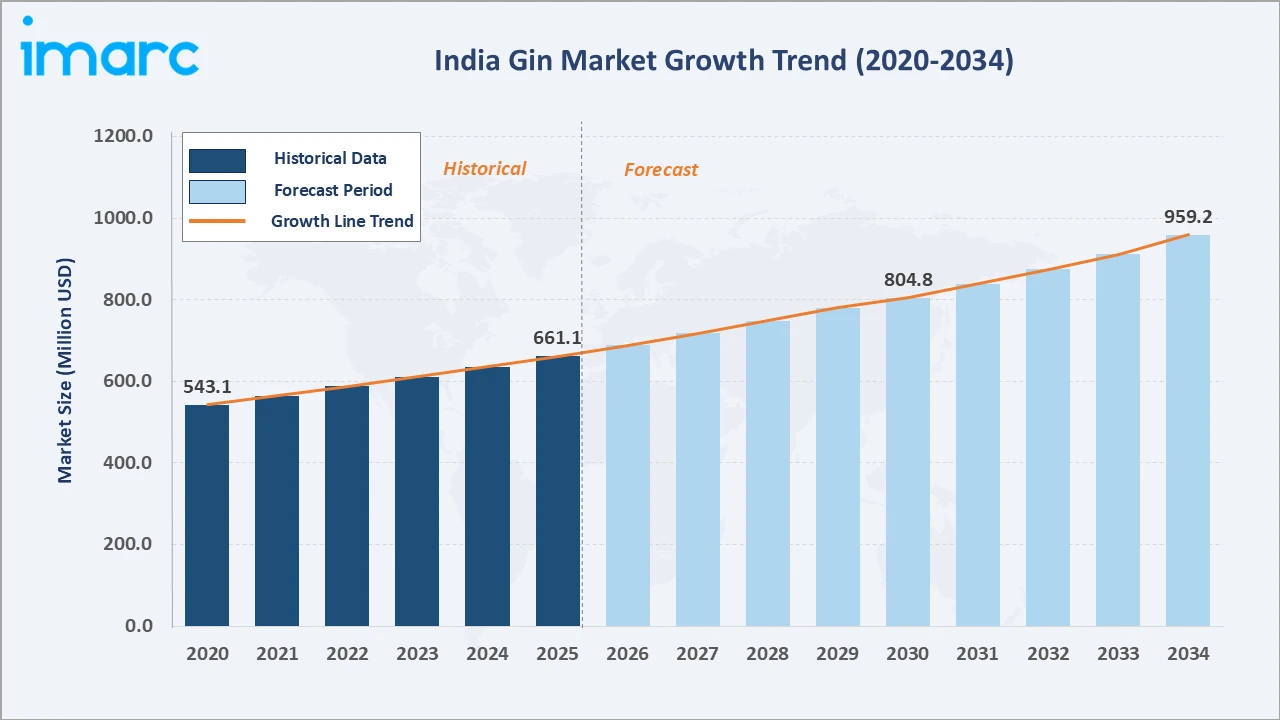
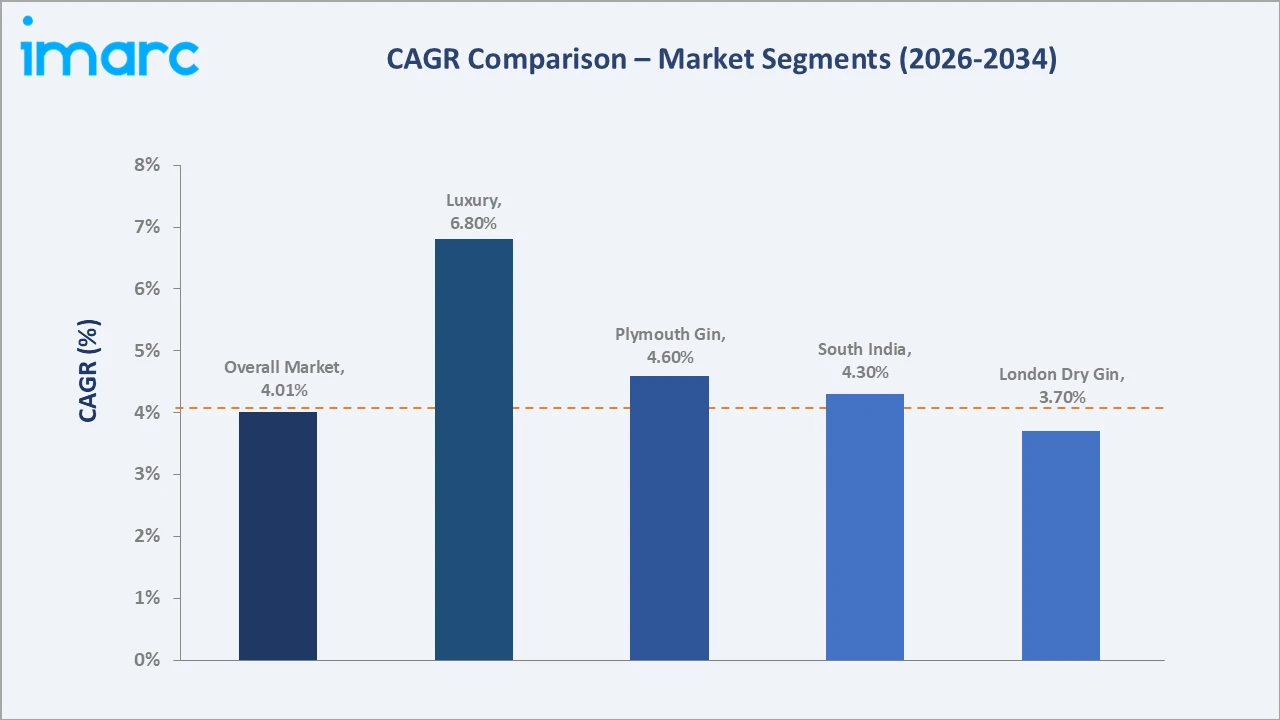
The India gin market size increased from USD 661.1 Million in 2025 to USD 687.6 Million in 2026 and is projected to reach USD 959.2 Million by 2034, growing at a CAGR of 4.01% during 2026-2034. Growth is anchored in premiumisation, the rise of homegrown craft distilleries, and a rapidly widening urban cocktail culture. Gin has moved from a narrow niche to a mainstream white spirit choice. Rising disposable incomes and botanical-led product innovation continue to broaden the consumer base. London Dry Gin dominates at 58.6%. Standard leads the price ladder at 54.7%. West India commands 36.4% of the national market share.
Regulatory change is now a genuine growth lever. The India-UK Comprehensive Economic and Trade Agreement entered into force in July 2026, cutting the import duty on UK gin from 150% to 75%, with a further step-down to 40% by 2036. This is reshaping the premium and luxury price tiers.
Market Snapshot
|
Metric |
Value |
|
Base Year Market Size (2025) |
USD 661.1 Million |
| Market Size (2026) | USD 687.6 Million |
|
Forecast Market Size (2034) |
USD 959.2 Million |
|
CAGR (2026-2034) |
4.01% |
|
Base Year |
2025 |
|
Historical Period |
2020-2025 |
|
Forecast Period |
2026-2034 |
|
Dominant Type |
London Dry Gin (58.6%, 2025) |
|
Dominant Price Point |
Standard (54.7%, 2025) |
|
Leading Region |
West India (36.4%, 2025) |
|
Fastest Growing Price Point |
Luxury (6.8% CAGR, 2026-2034) |
The market expanded from USD 543.1 Million in 2020 to USD 661.1 Million in 2025, reaching an estimated USD 687.6 Million in 2026. It is anchored at USD 804.8 Million in 2030 before reaching USD 959.2 Million by 2034. Growth accelerates modestly after 2030, as tariff reductions mature and luxury volumes scale.
To get more information on this market, Request Sample
Growth is uneven across the portfolio. Luxury advances fastest at roughly 6.8% CAGR, supported by high net worth consumption and duty rationalisation. Premium follows at 5.4%. Standard gin, still the volume base, grows at 2.6% as the value pool shifts upward rather than outward.
Executive Summary
The India gin market, which increased from USD 661.1 Million in 2025 to an estimated USD 687.6 Million in 2026, is one of Asia's most notable white spirits stories. India remains a brown spirits market by habit, so gin's expansion is a structural shift rather than a cyclical one. Craft distillers rebuilt the category around indigenous botanicals. Himalayan juniper, gondhoraj lime, tulsi and raw mango now define a recognisably Indian gin idiom.
The market is projected to reach USD 959.2 Million by 2034 at a 4.01% CAGR. London Dry Gin leads at 58.6% on cocktail versatility and brand equity. Standard pricing holds 54.7% of value, though premium and luxury together already account for 45.3%. West India leads regionally at 36.4%, driven by Mumbai, Pune and Goa.
Consolidation is now visible. Diageo (United Spirits) acquired Nao Spirits, maker of Greater Than and Hapusa, for approximately USD 15.2 Million. Allied Blenders acquired the Fullarton Distilleries portfolio, including Pumori gin, for around INR 39.5 Crore. Large players are buying craft credibility rather than building it.
Key Market Insights
|
Insight |
Data |
|
Dominant Type |
London Dry Gin - 58.6% share (2025) |
|
Dominant Price Point |
Standard - 54.7% share (2025) |
|
Leading Region |
West India - 36.4% share (2025) |
|
Fastest Growing Segment |
Luxury price point - 6.8% CAGR (2026-2034) |
|
Top Companies |
Diageo PLC, Radico Khaitan Limited, Allied Blenders and Distillers Limited, Third Eye Distillery Limited, and Bacardi Limited |
|
Market Opportunity |
Craft and flavoured gin expansion, tariff-enabled premium imports, ready-to-drink gin formats, and gin tourism around Goa and Rajasthan distilleries |
Key Analytical Observations Supporting The Above Data:
- London Dry Gin at 58.6%: This style anchors the category because it mixes reliably and is the format most Indian bartenders trained on. Its share should ease to roughly 56.8% by 2034 as contemporary and flavoured expressions expand faster at 4.9% CAGR.
- Standard at 54.7%: Standard pricing carries the volume base, mainly in off-trade retail. Growth is slow at 2.6% because incremental spending moves upward rather than expanding this tier.
- West India at 36.4%: Maharashtra and Goa form the manufacturing and consumption core of Indian gin. Goa hosts much of the craft distilling capacity, while Mumbai and Pune supply the deepest premium on-trade.
- Luxury at 12.5% and rising: Luxury is the fastest mover at 6.8% CAGR. Radico Khaitan's Jaisalmer Gold Edition, priced between INR 4,000 and INR 7,000 per 500 ml bottle, shows how far the ceiling has lifted. Its luxury portfolio turned over about INR 475 Crore in FY26.
- Imports are climbing sharply: The Ministry of Commerce and Industry figures show India imported 2.61 million litres of gin and genever in 2025, up 52% year on year and valued at USD 14.5 Million. UK shipments rose 68% by volume to 850,614 litres.
India Gin Market Overview
Gin in India is a botanical spirit distilled from a neutral base, usually grain or molasses extra neutral alcohol, redistilled with juniper. The industry combines large integrated IMFL distillers with boutique craft producers that emerged after 2017, when Greater Than launched as India's first craft gin and effectively created the modern category.
The ecosystem spans botanical sourcing, distillation, bottling, state excise clearance and a two-track on-trade and off-trade distribution system. Urbanisation, a young consuming class and rising discretionary income provide macroeconomic support. Regulation is the largest structural variable, since alcohol sits outside GST. Reserve Bank of India analysis notes state excise contributes 10% to 15% of own tax revenue for most states.
Market Dynamics
To evaluate market opportunities, Request Sample
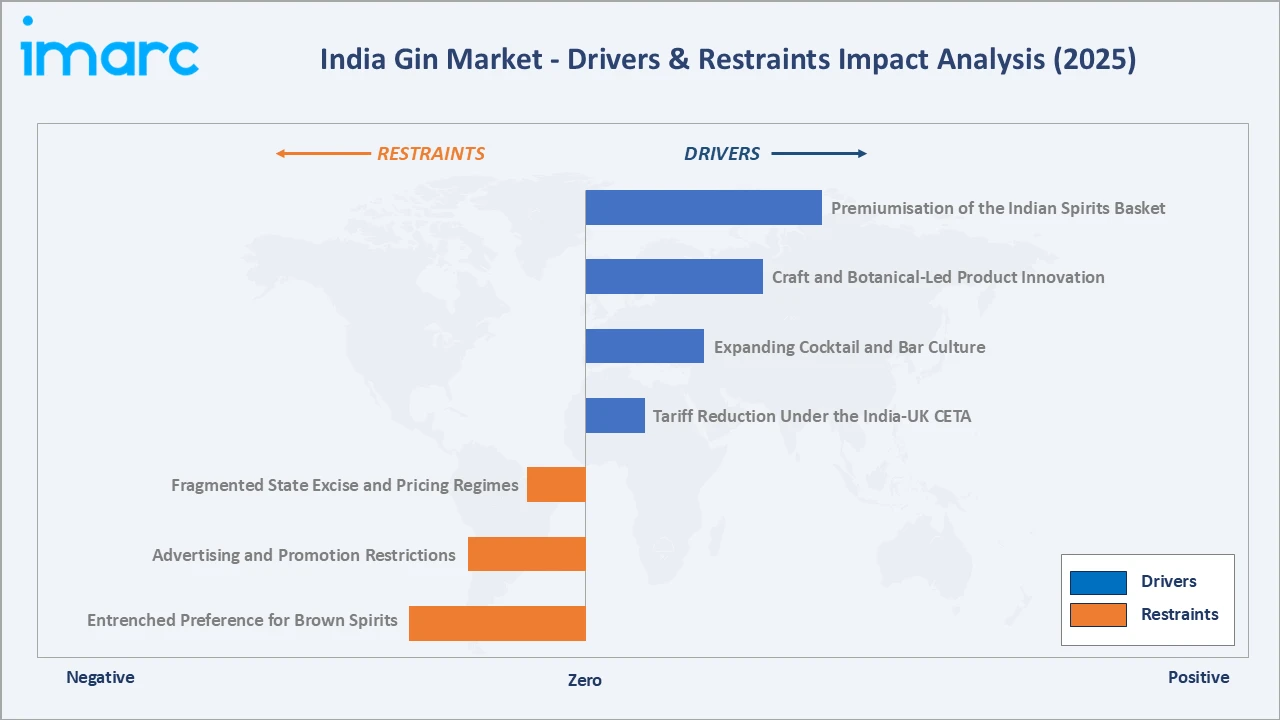
The market is shaped by a clear tension. Consumer momentum is strong and broad, while supply-side friction sits in regulation and route to market. The chart below summarises both sides of that balance for 2025.
Market Drivers
- Premiumisation of the Indian Spirits Basket: Indian consumers are trading up across categories and gin benefits directly. Premium and luxury together hold 45.3% of gin market value in 2025. Radico Khaitan reported FY26 net sales above INR 6,050 Crore, with premium and above contributing 70.3% of IMFL revenue.
- Craft and Botanical-Led Product Innovation: Indian distillers have built real differentiation using local botanicals. Hapusa uses foraged Himalayan juniper with turmeric, raw mango and gondhoraj lime. Globus Spirits launched TERAI India Craft Gin - Litchi & Mulberries in December 2024. This cadence supports repeat purchase at higher price points.
- Expanding Cocktail and Bar Culture: Urban millennials and Gen Z consumers are driving experiential drinking in bars, speakeasies and at home. Gin's botanical complexity makes it a natural base for mixology-led menus. Social platforms have widened the occasion base well beyond the classic gin and tonic.
- Tariff Reduction Under the India-UK CETA: The July 2026 cut in gin import duty from 150% to 75% improves availability and pricing of international labels. Government trade data already shows imports rising 52% in 2025 to 2.61 million litres. Wider premium availability tends to expand the whole category.
Market Restraints
- Fragmented State Excise and Pricing Regimes: Alcohol remains outside GST, so each state controls duty, label registration and retail pricing. A national launch can require separate approvals in more than twenty jurisdictions, raising working capital needs and slowing smaller craft distillers disproportionately.
- Advertising and Promotion Restrictions: State excise laws broadly prohibit direct alcohol advertising, pushing brands into surrogate marketing and bartender-led advocacy. Awareness building is therefore slower and costlier, and new craft entrants without on-trade relationships struggle to scale.
- Entrenched Preference for Brown Spirits: Whisky dominates Indian spirits consumption by a wide margin. Gin remains a small share of total spirits volume, limiting shelf allocation in off-trade outlets. Converting habitual whisky drinkers requires sustained category education.
Market Opportunities
- Ready-to-Drink and Low-ABV Gin Formats: Convenience formats suit younger consumers seeking moderation and portability. Canned gin serves address home and outdoor occasions that bottles miss. This remains underdeveloped in India, with headroom as canned alcohol rules relax in more states.
- Export Growth for Indian Craft Gin: Indian gins have won international recognition and now travel. Nao Spirits sells in over 15 countries, and Third Eye Distillery exported 100,000 bottles of Stranger & Sons. APEDA data shows the UAE led India's alcoholic beverage exports in FY2025 at over USD 115 Million.
- Tier-2 City On-Trade Expansion: Premium cocktail culture is concentrated in a few metros. Cities such as Jaipur, Chandigarh, Kochi and Indore are building modern bar infrastructure, offering first-mover advantage at lower competitive intensity.
Market Challenges
- Rising Competition from Imported Premium Gin: Lower tariffs improve the value proposition of international brands. Domestic craft producers, who priced against a 150% duty wall, now face sharper competition and realistic margin pressure in the premium tier.
- Botanical Sourcing and Supply Consistency: Wild-foraged and seasonal botanicals are hard to standardise at scale. Himalayan juniper and regional citrus vary by harvest, affecting consistency. Scaling without diluting the craft proposition is a persistent operational challenge.
Emerging Market Trends
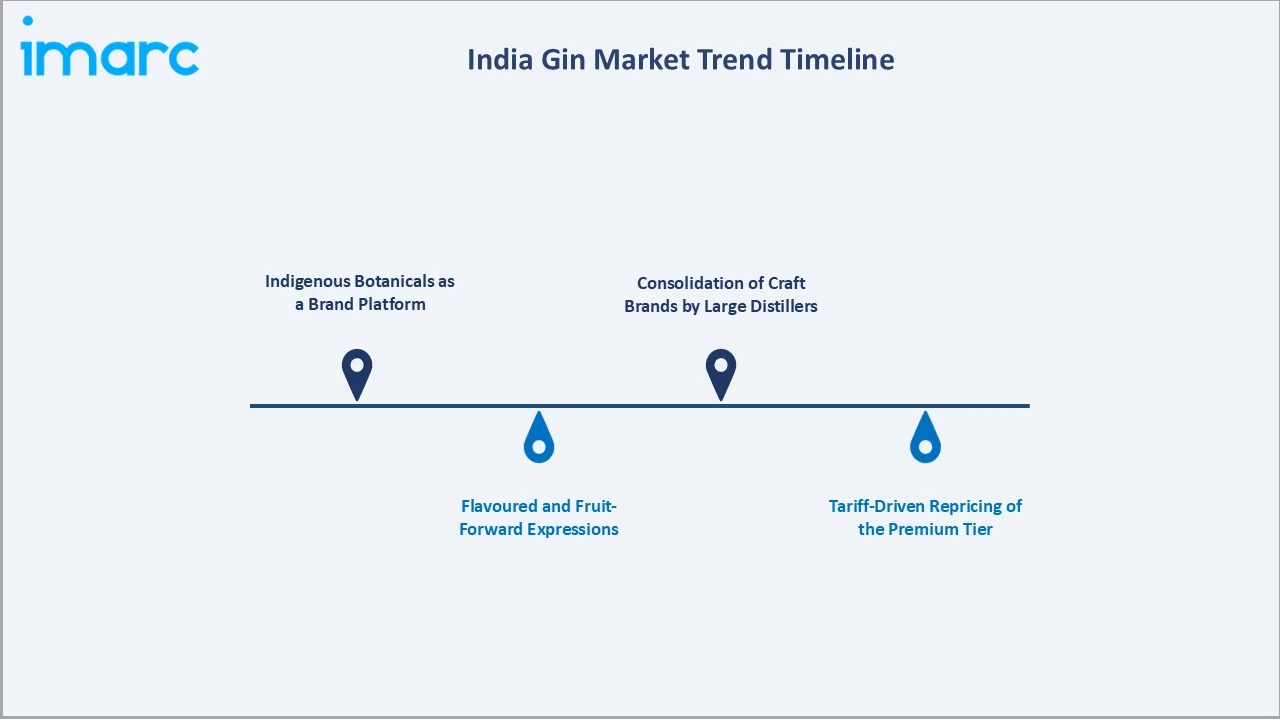
Four trends are reshaping how gin is made, priced and consumed in India, each on a distinct time horizon mapped below.
1. Indigenous Botanicals as a Brand Platform
Indian distillers have made local botanicals the core of brand identity, not a garnish. TERAI uses eleven botanicals including tulsi, lavender and rose. This creates a flavour signature imports cannot easily replicate, supporting premium pricing and helping the others type segment grow fastest at 4.9% CAGR.
2. Flavoured and Fruit-Forward Expressions
Flavoured gin is broadening the entry point for new consumers, particularly first-time spirits drinkers. Globus Spirits launched TERAI Litchi & Mulberries in December 2024, and Allied Blenders introduced ZOYA Special Batch Gin in January 2024. Both lower the intensity barrier of juniper-forward styles.
3. Consolidation of Craft Brands by Large Distillers
Established players are acquiring craft credibility rather than building it. Diageo (United Spirits) bought Nao Spirits for roughly USD 15.2 Million, and Allied Blenders acquired Fullarton Distilleries brands including Pumori for about INR 39.5 Crore. Craft brands gain distribution while acquirers gain premium depth.
4. Tariff-Driven Repricing of the Premium Tier
The July 2026 duty cut on UK gin from 150% to 75% changes competitive maths at the top of the market. Imported labels become more accessible and the gap to Indian premium gin narrows. Expect sharper positioning and greater emphasis on provenance from domestic producers.
Industry Value Chain Analysis
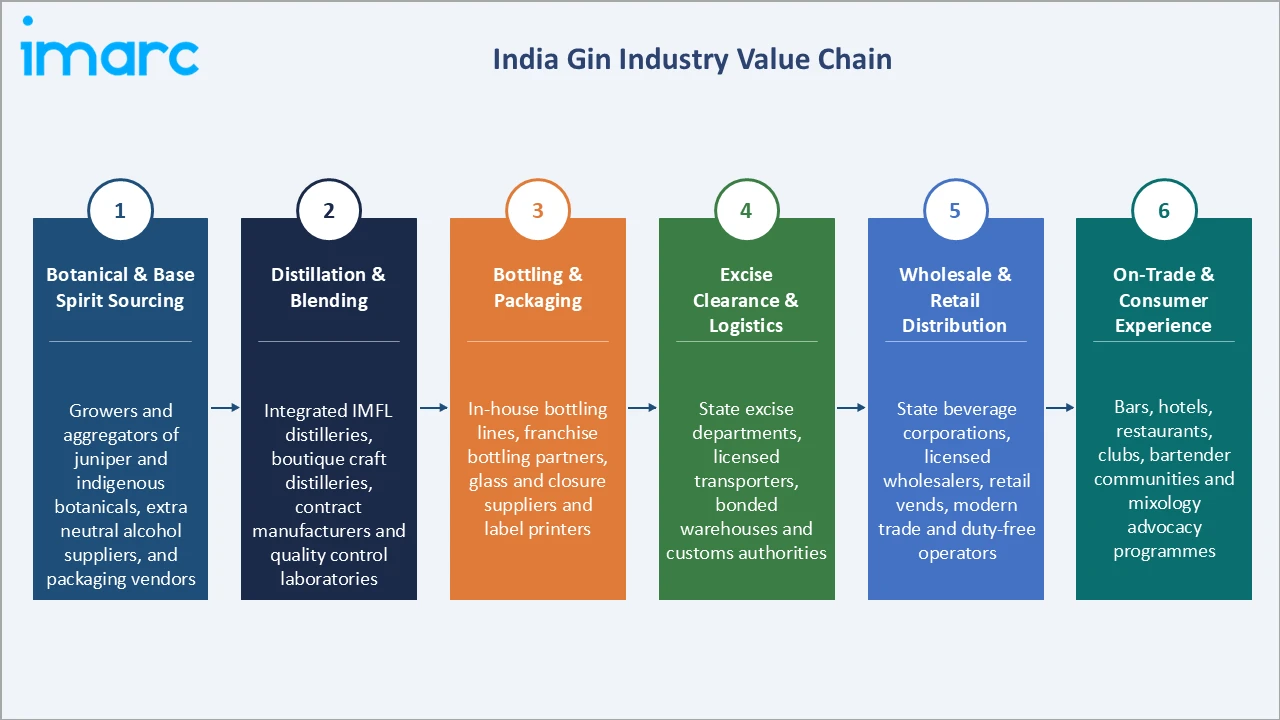
The India gin value chain is unusually regulated at the midpoint. A mandatory excise and logistics layer separates production from consumption and varies by state, shaping cost structure and speed to market more than manufacturing efficiency does.
|
Stage |
Key Participants |
|
Botanical & Base Spirit Sourcing |
Growers and aggregators of juniper and indigenous botanicals, extra neutral alcohol suppliers, and packaging vendors |
|
Distillation & Blending |
Integrated IMFL distilleries, boutique craft distilleries, contract manufacturers and quality control laboratories |
|
Bottling & Packaging |
In-house bottling lines, franchise bottling partners, glass and closure suppliers and label printers |
|
Excise Clearance & Logistics |
State excise departments, licensed transporters, bonded warehouses and customs authorities |
|
Wholesale & Retail Distribution |
State beverage corporations, licensed wholesalers, retail vends, modern trade and duty-free operators |
|
On-Trade & Consumer Experience |
Bars, hotels, restaurants, clubs, bartender communities and mixology advocacy programmes |
Value capture concentrates at the brand and on-trade ends. Base spirit and bottling are commoditised, while brand narrative, provenance and bartender advocacy create pricing power. Excise clearance traps working capital longest, giving scale players a structural advantage over craft entrants.
Technology Landscape in the India Gin Industry
Copper Pot and One-Shot Distillation
Craft producers have standardised on copper pot stills using the one-shot London Dry method, which distils the full botanical charge without later dilution. TERAI is made on a bespoke Carl GmbH copper pot still at Behror, Rajasthan. The choice is a quality signal supporting tiers growing above 5.4% CAGR.
Vapour Infusion and Botanical Extraction
Vapour infusion passes alcohol vapour through a botanical basket rather than macerating in liquid, producing lighter, more aromatic profiles. Indian distillers increasingly combine both techniques in one run, allowing delicate ingredients such as gondhoraj lime and rose to survive distillation intact.
Base Spirit Control and Grain-to-Glass Integration
Control over the neutral base is now a competitive lever. Globus Spirits produces TERAI's rice spirit base at a sister distillery, giving full grain-to-glass oversight and reducing batch variability. For integrated players such as Radico Khaitan, which sold 36.62 million cases in FY26, distillery scale underwrites gin quality economics.
Market Segmentation Analysis
The report covers the following segments:
|
Segment Category |
Leading Segment |
Market Share |
Year |
|
Type |
London Dry Gin |
58.6% |
2025 |
|
Price Point |
Standard |
54.7% |
2025 |
|
Distribution Channel |
🔒 |
🔒 |
2025 |
|
Region |
West India |
36.4% |
2025 |

By Type
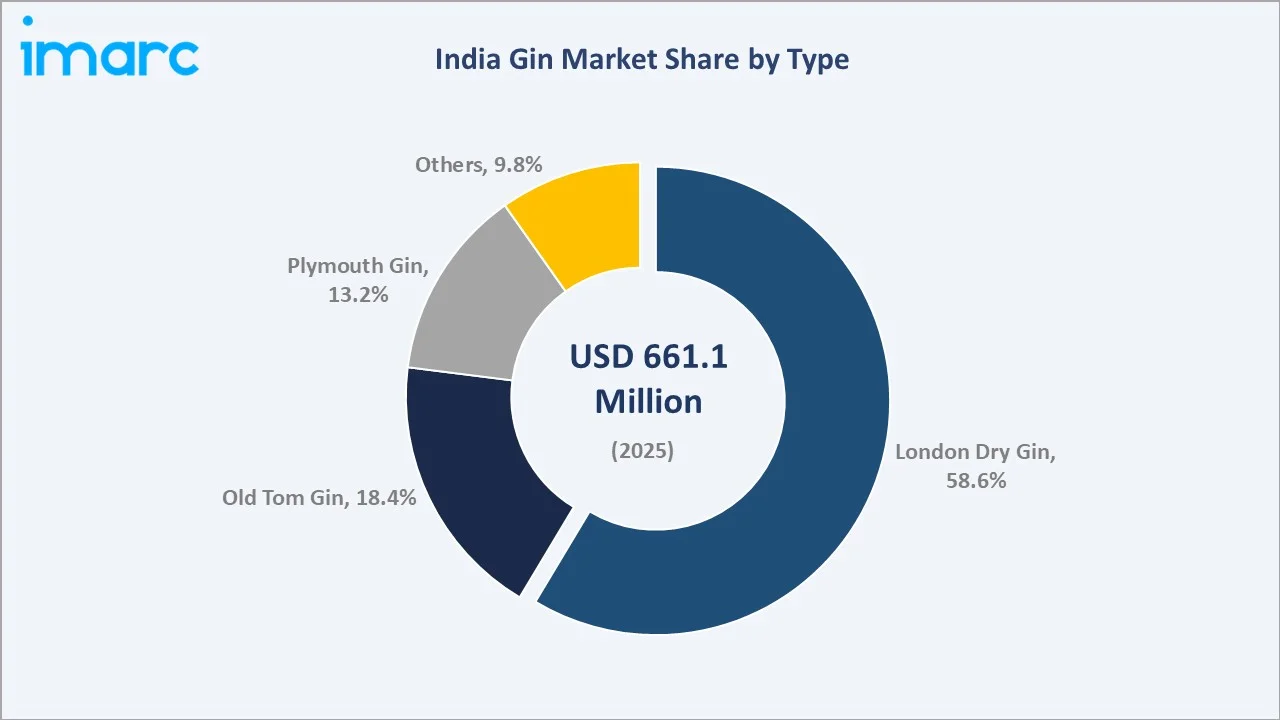
London Dry Gin leads at 58.6% in 2025. It dominates as the most versatile cocktail base with the deepest brand recognition among Indian consumers, and bartender familiarity reinforces its position across both channels.
To access detailed market analysis, Request Sample
Old Tom Gin holds 18.4% and grows at 4.3%, helped by classic cocktail revivalism and a sweeter profile suiting palates moving from brown spirits. Plymouth Gin accounts for 13.2% at 4.6% CAGR. The others category, covering contemporary and flavoured expressions, holds 9.8% but grows fastest at 4.9%.
By Price Point
Standard gin leads at 54.7% in 2025 and forms the volume foundation, distributed largely through off-trade retail. Its 2.6% CAGR is the slowest in the portfolio, reflecting spending that moves up the ladder rather than deepening at the base.
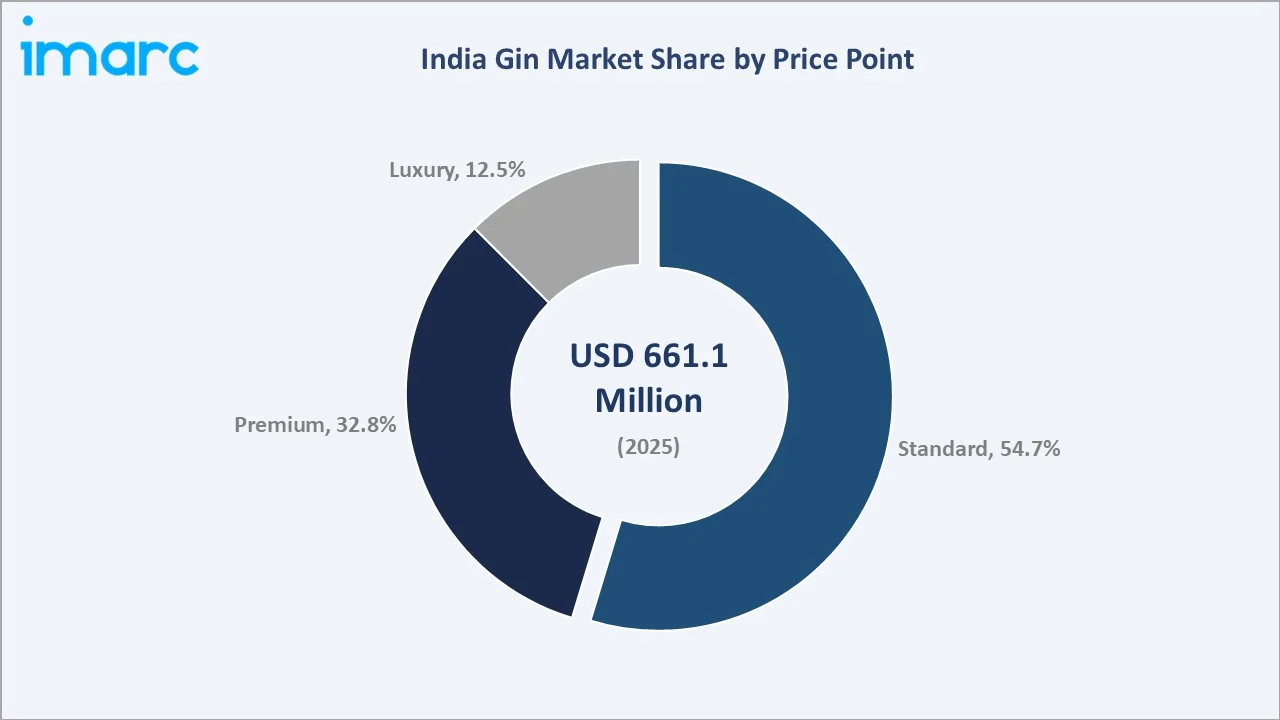
Premium holds 32.8% and grows at 5.4%, driven by craft distillers and international mid-tier labels. Luxury accounts for 12.5% and grows fastest at 6.8% CAGR.
Regional Market Insights
Regional performance reflects urban on-trade infrastructure, state excise policy and distilling capacity. The table below outlines the character of each region.
|
Region |
Share (2025) |
Key India Gin Market Drivers & Characteristics |
|
West India |
36.4% |
Deepest premium on-trade base and the largest concentration of craft distilling capacity. Cocktail culture in major commercial cities and tourism-linked hospitality support consistent demand. |
|
North India |
27.8% |
Large urban consumer base with growing appetite for premium white spirits. Corporate hospitality and an expanding modern retail footprint underpin adoption. |
|
South India |
23.6% |
Technology sector employment supports a young, well-travelled consumer receptive to craft propositions. State-controlled retail structures shape route to market and availability. |
|
East India |
12.2% |
Emerging on-trade infrastructure in principal urban centres with rising exposure to premium spirits. Penetration is at an earlier stage, leaving headroom for distribution-led growth. |
West India leads at 36.4% in 2025. Maharashtra and Goa anchor both production and consumption, with Goa hosting much of India's boutique gin distilling capacity. North India follows at 27.8%, supported by Delhi NCR's on-trade density and Punjab's above-average lifestyle spending.
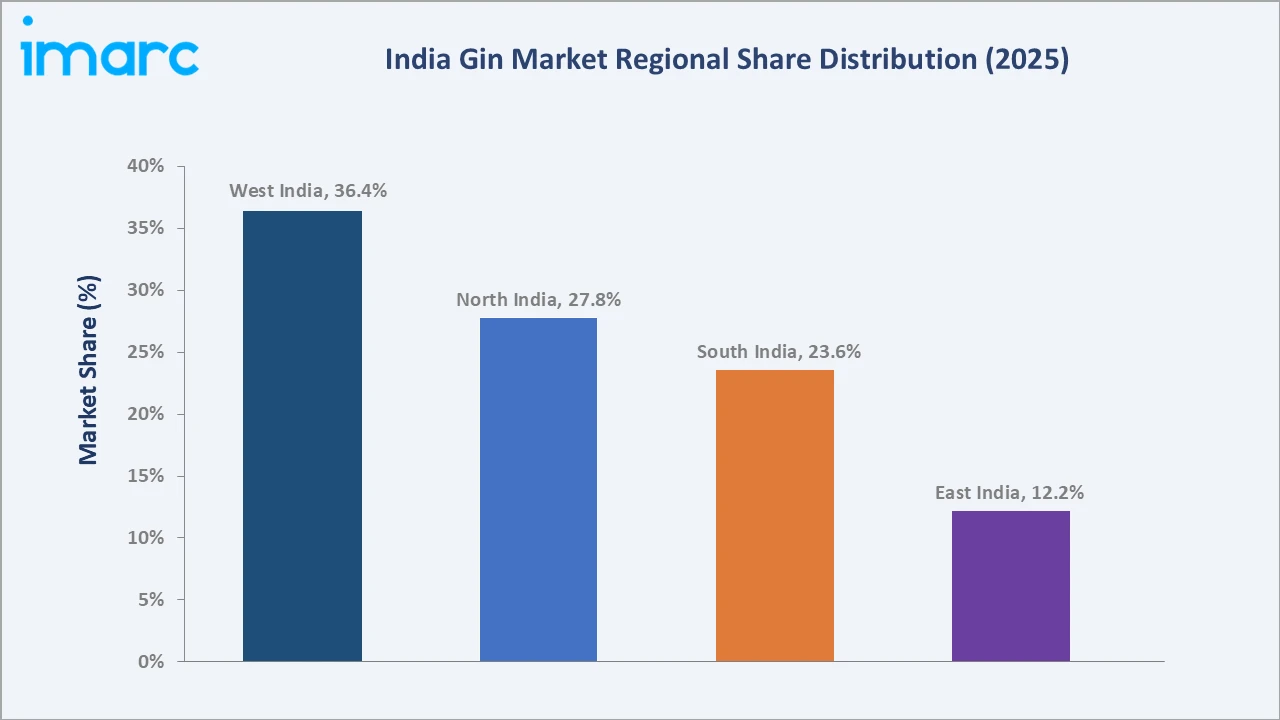
South India holds 23.6% and grows fastest at 4.3% CAGR, reflecting Bengaluru and Hyderabad's young professional base. East India accounts for 12.2% at 3.4% CAGR. It is the least developed gin region, though Kolkata's revived cocktail scene supports distribution-led expansion through 2034.
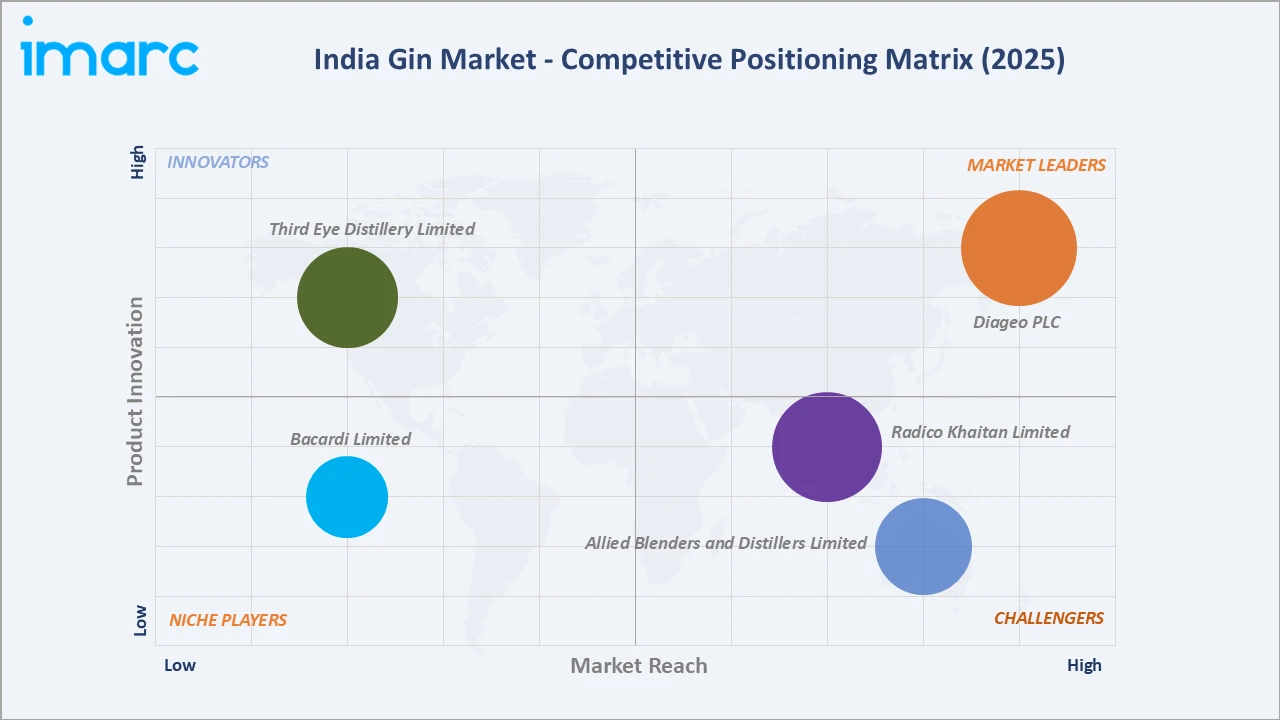
Competitive Landscape
The market is moderately consolidated at the top and fragmented below. Large integrated distillers control distribution scale, while craft producers hold outsized influence over category perception. Acquisition has become the bridge between the two.
|
Company |
Key Brands |
Market Position |
Core Strength |
|
Diageo PLC |
Greater Than, Hapusa |
Market Leader |
Operates United Spirits Limited (Diageo India), global gin brand equity combined with acquired Indian craft credentials from the USD 15.2 Million Nao Spirits transaction. |
|
Radico Khaitan Limited |
Jaisalmer Indian Craft Gin, Jaisalmer Gold Indian Craft Gin |
Strong Challenger |
Luxury-led positioning, with a luxury portfolio turnover of about INR 475 Crore in FY26 and exports to over 100 countries. |
|
Allied Blenders and Distillers Limited |
Zoya Special Batch Gin, Pumori Gin |
Strong Challenger |
Entered craft gin via the Fullarton Distilleries acquisition for roughly INR 39.5 Crore, adding small batch capability. |
|
Third Eye Distillery Limited |
Stranger & Sons, Short Story |
Innovator |
Export-led craft reputation, having shipped 100,000 bottles internationally, including 70,000 to the United Kingdom. |
|
Bacardi Limited |
Bombay Sapphire |
Niche Player |
Long-standing international London Dry equity with strong on-trade presence and sustained brand investment. |
The most consequential dynamic is the tariff reset. With UK gin duty at 75% from July 2026 and heading to 40% by 2036, imported premium labels gain pricing room they have never had. Domestic craft producers must defend on provenance rather than price.
Key Company Profiles
Diageo PLC
United Spirits Limited (Diageo India) is India's largest spirits company and the Indian arm of Diageo PLC, holding the strongest combined gin position through international and acquired craft brands. In June 2025, Diageo India acquired NAO Spirits, an emerging Indian craft spirits company with brands Greater Than and Hapusa.
- Key Brands: Greater Than, Hapusa.
- Strategic Focus: Building a full-ladder gin portfolio from standard international labels to luxury Indian craft expressions.
Radico Khaitan Limited
Radico Khaitan is a leading IMFL manufacturer operating two distillery campuses and exporting to over 100 countries. Jaisalmer Indian Craft Gin anchors its luxury white spirits presence.
- Key Brands: Jaisalmer Indian Craft Gin, Jaisalmer Gold Indian Craft Gin.
- Strategic Focus: Premiumisation across white spirits, with luxury gin as a margin-accretive export and domestic growth engine.
Allied Blenders and Distillers Limited
Allied Blenders and Distillers is a Mumbai-headquartered spirits manufacturer that entered craft gin through acquisition. Pumori Small Batch Gin has earned international competition recognition.
- Key Brands: Zoya Special Batch Gin, Pumori Gin.
- Strategic Focus: Scaling acquired craft brands through an established national distribution network.
Market Concentration Analysis
The market is moderately concentrated. The top participants account for an estimated 60% to 65% of organised market value in 2025, with Diageo PLC (United Spirits Limited) holding the largest single position. Concentration is highest in the standard tier, where distribution scale decides outcomes, and lowest in premium and luxury, where craft labels compete on provenance.
Two forces pull in opposite directions. Consolidation is rising as large distillers acquire craft brands, as the Nao Spirits and Fullarton deals show. Meanwhile, low minimum efficient scale in craft distilling keeps admitting new entrants. The likely outcome through 2034 is a barbell structure of a few scaled players and a long craft tail.
Investment & Growth Opportunities
Highest Growth Segments
Luxury leads at 6.8% CAGR through 2034, followed by premium at 5.4%. Within type, the others category grows fastest at 4.9%. South India is the quickest region at 4.3% CAGR. These four vectors offer the highest-return exposure over the forecast period.
Emerging Investment Opportunities
Ready-to-drink and low-ABV gin formats remain underpenetrated and reach occasions bottled gin misses. Export platforms are a second opportunity, with APEDA reporting the UAE as India's leading alcoholic beverage export destination in FY2025 at over USD 115 Million. Distillery tourism in Goa and Rajasthan is a third, capital-light route to brand building where advertising is restricted.
Investment Themes
- Craft brand acquisition at pre-scale valuations: Recent deals cleared at approachable multiples relative to the growth on offer, with Fullarton at around INR 39.5 Crore and Nao Spirits at roughly USD 15.2 Million. Craft assets with proven liquid and bartender credibility remain the most efficient premium entry.
- Tariff-enabled import and distribution platforms: With UK gin duty at 75% from July 2026 and stepping to 40% by 2036, import economics improve materially. Imports already rose 52% in 2025 to 2.61 million litres, favouring distribution platforms positioned for premium imported gin.
Future Market Outlook (2026-2034)
The India gin market is projected to grow from USD 661.1 Million in 2025 to USD 687.6 Million in 2026, reaching USD 959.2 Million by 2034, registering a CAGR of 4.01% during 2026–2034. The USD 804.8 Million anchor in 2030 marks where tariff effects, craft consolidation and premium distribution maturity converge. Growth runs slightly faster after 2030, near 4.5% annually.
Three structural forces define the period. The value pool keeps shifting upward, with premium and luxury rising from 45.3% of value in 2025 to an estimated 52.2% by 2034. Tariff reduction under the India-UK CETA restructures competition at the top. Category identity consolidates around Indian botanicals, giving domestic producers a durable position.
Risks remain real. State regulatory fragmentation will constrain launch speed, and whisky's dominance limits how fast gin expands its occasion base. Even so, the category enters the forecast period with stronger product credibility than at any prior point.
Research Methodology
Primary Research
Primary research comprised structured interviews with distillery operations heads, brand and category managers, state distribution partners, on-trade beverage directors and independent craft distillers. Consumer inputs were collected across North, South, East and West India, spanning standard, premium and luxury buyers.
Secondary Research
Secondary research drew on Ministry of Commerce and Industry trade statistics, Reserve Bank of India state finance analysis, APEDA export data, India-UK CETA tariff schedules, company annual reports, investor presentations and official craft distiller communications. Over 50 sources were reviewed and cross-checked.
Forecasting Models
Forecasts were built bottom-up. Urban drinking-age population by income band was multiplied by gin purchase incidence and average realisation per price tier, then aggregated nationally. Outputs were triangulated against a top-down spirits allocation and validated with import and excise data. Segment CAGRs reconcile to the headline 4.01% rate.
India Gin Market Report Coverage:
| Report Features | Details |
|---|---|
| Base Year of the Analysis | 2025 |
| Historical Period | 2020-2025 |
| Forecast Period | 2026-2034 |
| Units | Million USD |
| Scope of the Report | Exploration of Historical Trends and Market Outlook, Industry Catalysts and Challenges, Segment-Wise Historical and Future Market Assessment:
|
| Types Covered | London Dry Gin, Old Tom Gin, Plymouth Gin, Others |
| Price Points Covered | Standard, Premium, Luxury |
| Distribuion Channels Covered | On-Trade, Off-Trade |
| Regions Covered | North India, South India, East India, West India |
| Companies Covered | Diageo PLC, Radico Khaitan Limited, Allied Blenders and Distillers Limited, Third Eye Distillery Limited, Bacardi Limited, etc. |
| Customization Scope | 10% Free Customization |
| Post-Sale Analyst Support | 10-12 Weeks |
| Delivery Format | PDF and Excel through Email (We can also provide the editable version of the report in PPT/Word format on special request) |
Key Benefits for Stakeholders:
- IMARC’s industry report offers a comprehensive quantitative analysis of various market segments, historical and current market trends, market forecasts, and dynamics of the India gin market from 2020-2034.
- The research report provides the latest information on the market drivers, challenges, and opportunities in the India gin market.
- Porter's five forces analysis assist stakeholders in assessing the impact of new entrants, competitive rivalry, supplier power, buyer power, and the threat of substitution. It helps stakeholders to analyze the level of competition within the India gin industry and its attractiveness.
- Competitive landscape allows stakeholders to understand their competitive environment and provides an insight into the current positions of key players in the market.
Frequently Asked Questions About the India Gin Market Report
The India gin market size increased from USD 661.1 Million in 2025 to USD 687.6 Million in 2026, supported by premiumisation, craft distillery expansion, and a widening urban cocktail culture across major metropolitan and tier-2 consumption centres.
The India gin market is projected to grow at a 4.01% CAGR during 2026-2034, reaching USD 959.2 Million by 2034.
London Dry Gin leads with 58.6% share in 2025, driven by its cocktail versatility, established brand recognition, and widespread bartender familiarity across on-trade and off-trade channels.
Standard gin leads with 54.7% share in 2025, forming the volume base of the market through off-trade retail distribution across state corporation and licensed vend outlets.
West India leads with 36.4% share in 2025, anchored by Maharashtra and Goa, which together concentrate India's premium on-trade demand and craft gin distilling capacity.
The luxury price point grows fastest at approximately 6.8% CAGR during 2026-2034, supported by rising high net worth consumption and reduced import duties on premium international gin.
Leading companies include Diageo PLC, Radico Khaitan Limited, Allied Blenders and Distillers Limited, Third Eye Distillery Limited, and Bacardi Limited, among others.
The India gin market is projected to reach approximately USD 804.8 Million by 2030, with premium and luxury tiers accounting for a progressively larger share of total market value.
Import duty on UK gin fell from 150% to 75% in July 2026 under the CETA, with a further reduction to 40% scheduled by 2036, improving premium import competitiveness.
India imported 2.61 million litres of gin and genever in 2025, a 52% year-on-year increase valued at USD 14.5 Million, according to Ministry of Commerce and Industry data.
Need more help?
- Speak to our experienced analysts for insights on the current market scenarios.
- Include additional segments and countries to customize the report as per your requirement.
- Gain an unparalleled competitive advantage in your domain by understanding how to utilize the report and positively impacting your operations and revenue.
- For further assistance, please connect with our analysts.
 Request Customization
 Speak to an Analyst
 Request Brochure
 Inquire Before Buying
Benefits of Customization
- Personalize this research
- Triangulate with your data
- Get data as per your format and definition
- Gain a deeper dive into a specific application, geography, customer, or competitor
- Any level of personalization
Get in Touch With Us
UNITED STATES
Phone: +1-201-971-6302
INDIA
Phone: +91-120-433-0800
UNITED KINGDOM
Phone: +44-753-714-6104
Email: [email protected]
Client Testimonials




.webp)




.webp)













Related Reports

Choose your plan
*Please note that the prices mentioned below are starting prices for each bundle type. Kindly contact our team for further details.*
Single User License
- 1 User License, Access on 2 Devices
- PDF Report + Excel Dataset (Password Protected)
- Lifetime Access
- No Printing Rights
- 10% Free Report Customization
- 10–12 Weeks of Analyst Support
Five User License
- Access for 5 Users, 2 Devices per User
- PDF Report + Excel Dataset (Password Protected)
- Lifetime Access
- Dedicated Account Manager
- 12–14 Weeks of Analyst Support
- No Printing Rights
- 15% Free Report Customization
- 25% Discount on Your Next Purchase
Corporate User License
- Unlimited User Access (Within Your Organization)
- PDF Report + Excel Dataset
- Lifetime Access
- Dedicated Account Manager
- 14–20 Weeks of Analyst Support
- No Printing Rights
- 20% Free Report Customization
- 30% Discount on Your Next Purchase
Essential Insights
What's included:
3 reports
- Lifetime Access
- PDF Reports
- Excel Datasets
- 2 Weeks of Free Analyst Support
- 2 User Licenses
- Access on 2 Devices
- Printing Rights
- Complimentary PowerPoint (PPT) Version
- Complimentary License Upgrade
Professional Access
What's included:
5 reports
- Lifetime Access
- PDF Reports
- Excel Datasets
- 8 Weeks of Free Analyst Support
- 2 User Licenses
- Access on 2 Devices
- Printing Rights
- Complimentary PowerPoint (PPT) Version
- Complimentary License Upgrade
Business Advantage
What's included:
8 reports
- Lifetime Access
- PDF Reports
- Excel Datasets
- 14 Weeks of Free Analyst Support
- 2 User Licenses
- Access on 2 Devices
- Printing Rights
- Complimentary PowerPoint (PPT) Version
- Complimentary License Upgrade
Enterprise Intelligence
What's included:
10 reports
- Lifetime Access
- PDF Reports
- Excel Datasets
- 20 Weeks of Free Analyst Support
- 2 User Licenses
- Access on 2 Devices
- Printing Rights
- Complimentary PowerPoint (PPT) Version
- Complimentary License Upgrade