
India Ginger Processing Market Size, Share, Trends and Forecast by Form, Distribution Channel, End Use, and Region, 2026-2034
India Ginger Processing Market Size, Share, Trends & Forecast (2026-2034)
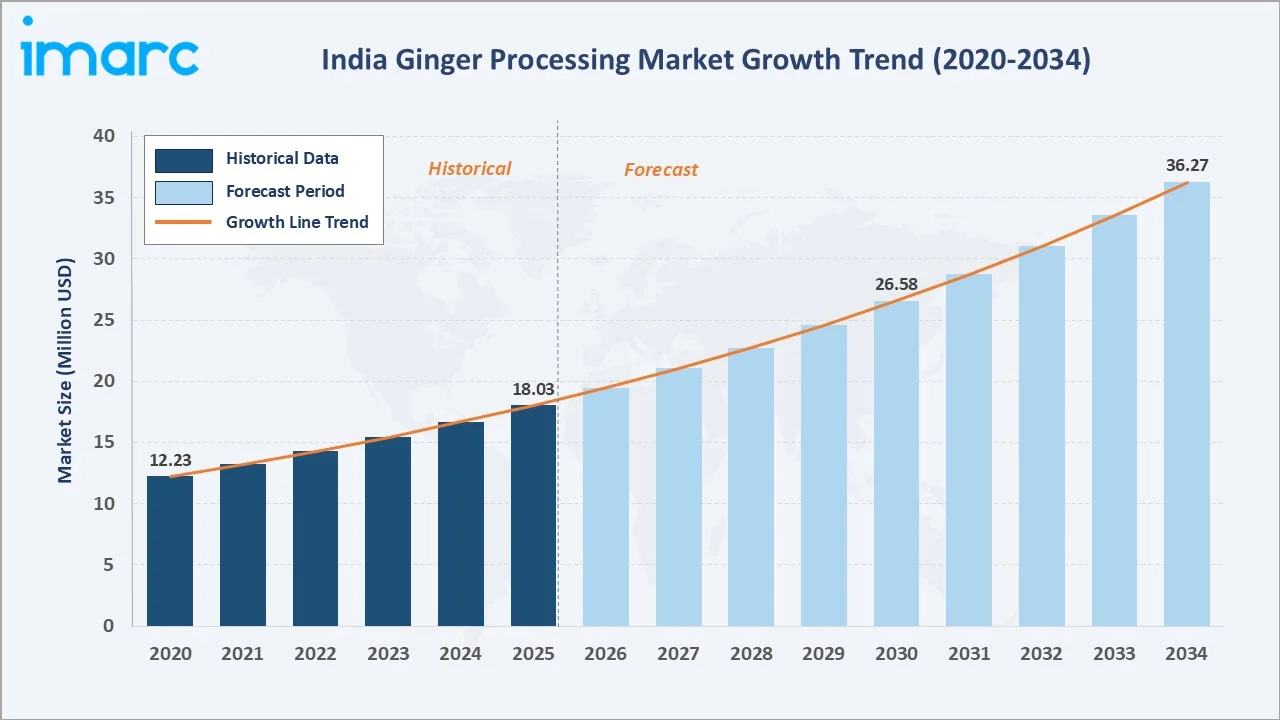
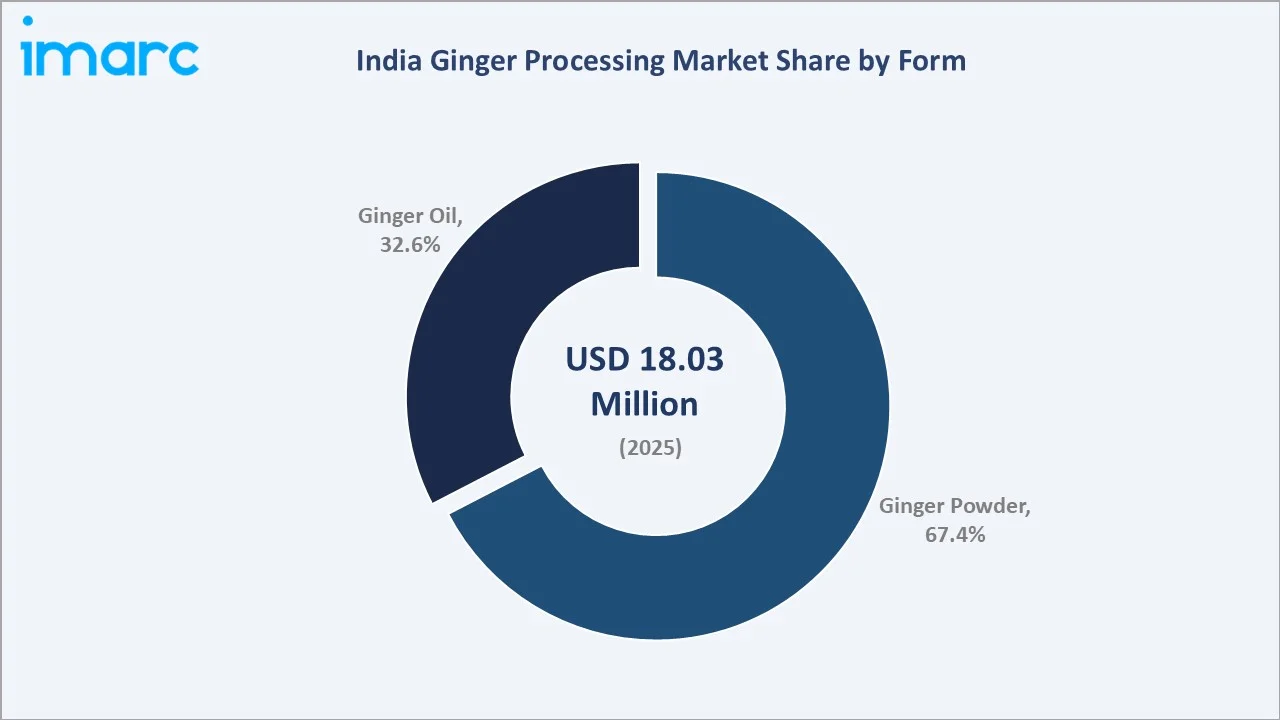
The India ginger processing market grew from USD 18.03 Million in 2025 to USD 19.49 Million in 2026 and is projected to reach USD 36.27 Million by 2034, exhibiting a robust CAGR of 8.08% during 2026-2034. India is the world’s largest producer of ginger, providing the domestic ginger processing industry a structurally advantaged raw material supply position that no other country replicates at equivalent scale and cost. India’s ginger production increased substantially from 1,786 thousand tons in 2018 to 2,654 thousand tons in 2024. This rising production supports India's ginger processing market by ensuring a larger supply base for processed products such as ginger powder, paste, oil, extracts, dehydrated ginger, and value-added food and beverage ingredients. Ginger powder dominates the form at 67.4%, the food industry leads end use at 57.6%, and South India accounts for the largest regional share at 34.8%.
Market Snapshot
|
Metric |
Value |
|
Base Year Market Size (2025) |
USD 18.03 Million |
| Market Size (2026) | USD 19.49 Million |
|
Forecast Market Size (2034) |
USD 36.27 Million |
|
CAGR (2026-2034) |
8.08% |
|
Base Year |
2025 |
|
Historical Period |
2020-2025 |
|
Forecast Period |
2026-2034 |
|
Dominant Form |
Ginger Powder – 67.4% (2025) |
|
Dominant End Use |
Food Industry – 57.6% (2025) |
|
Leading Region |
South India – 34.8% (2025) |
The India ginger processing market grew from USD 12.23 Million in 2020 to USD 18.03 Million in 2025 and an estimated USD 19.49 Million in 2026, anchored in post-COVID wellness demand for immunity-boosting ginger products, rising FMCG food company procurement of ginger powder for masala blends and packaged seasoning products, and growing exports of ginger oleoresin and essential oil to Europe, USA, and Japan. The market is projected to reach USD 26.58 Million by 2030 and USD 36.27 Million by 2034.
To get more information on this market, Request Sample
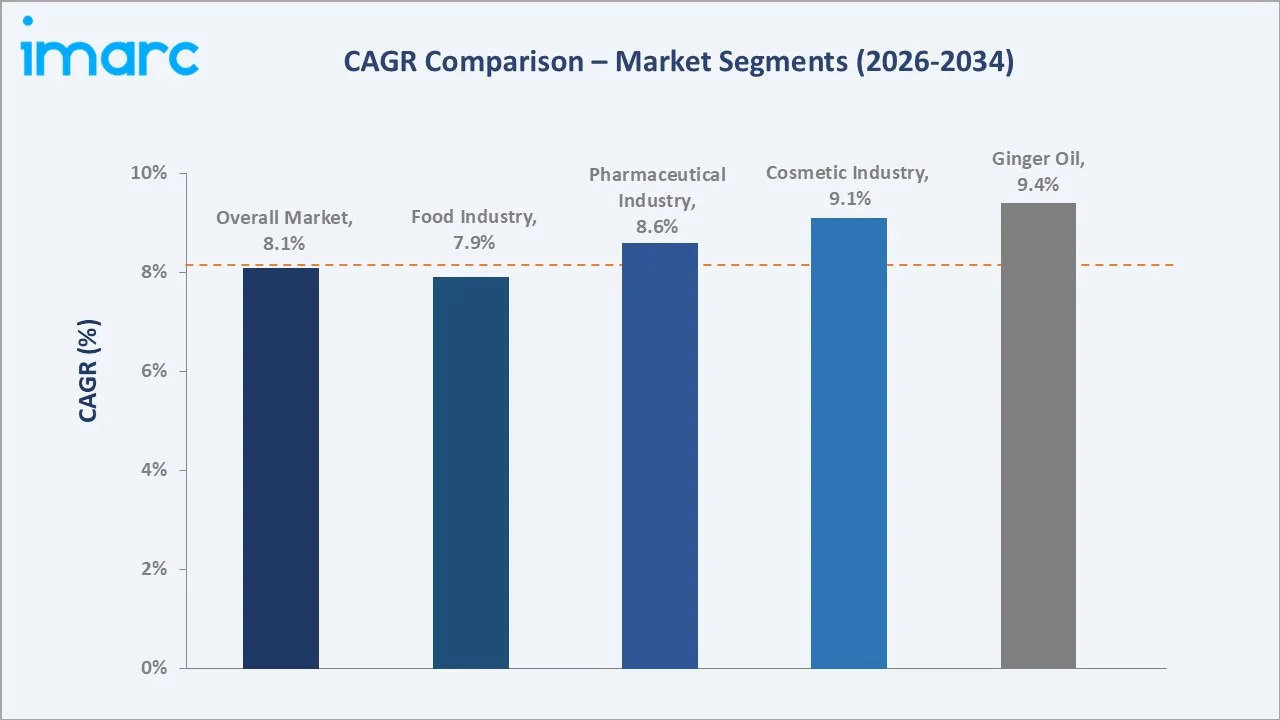
Ginger oil grows fastest at ~9.40% CAGR through cosmetic, aromatherapy, and premium food flavoring demand. Cosmetic industry end use grows at ~9.10% CAGR through premium haircare and personal care ginger oil adoption. The pharmaceutical industry grows at ~8.60% CAGR through gingerol API and nutraceutical supplement demand. Food industry grows at ~7.90% CAGR sustained by FMCG seasoning, beverage, and condiment sector procurement.
Executive Summary
India ginger processing market occupies a uniquely advantaged position in the global spice ingredient ecosystem, combining the world’s largest ginger production base, a cost-competitive processing infrastructure concentrated in Kerala’s Ernakulam-Thrissur spice processing belt, and growing multi-industry end-use demand that provides revenue diversification across food, pharmaceutical, cosmetic, and nutraceutical sectors.
Ginger powder commands 67.4% share through its versatility, shelf stability, and universal demand across India’s domestic masala blending industry and FMCG food processing companies. South India’s 34.8% regional leadership reflects Kerala’s dual advantage as India’s premier ginger processing hub and one of the leading ginger growing states for volatile oil content essential for essential oil extraction.
Key Market Insights
|
Insight |
Data |
|
Dominant Form |
Ginger Powder – 67.4% share (2025) |
|
Dominant End Use |
Food Industry – 57.6% share (2025) |
|
Leading Region |
South India – 34.8% share (2025) |
|
Market Opportunity |
Supercritical CO2 ginger extract for zero-solvent-residue pharmaceutical API applications; organic certified ginger powder for premium health food export; standardized 5-20% gingerol extract for clinical nutraceutical development; ginger-based cosmetic actives for premium global haircare brand supply |
Key Analytical Observations:
- Ginger Powder at 67.4% (2025): Ginger powder, produced through sequential washing, peeling, blanching/steaming, hot air drying to 8-10% moisture, milling on pin mills or hammer mills to 60-80 mesh, and sieving for uniform granulometry, is India’s most economically important ginger processed product by volume. India’s domestic masala and curry powder industry is the single largest buyer.
- Food Industry at 57.6% (2025): India’s food processing industry is the primary consumer of processed ginger products across masala blends, pickles and chutneys, bakery and confectionery, beverages, and instant noodle and soup seasonings.
- South India at 34.8% (2025): South India leads the market due to its established spice-processing ecosystem and access to ginger supplies, particularly across Karnataka and Kerala. Karnataka and Kerala have historically processed significant volumes into dry ginger, supporting value-added processing and trade.
India Ginger Processing Market Overview
The India ginger processing market encompasses the conversion of fresh ginger into value-added products for food, beverage, nutraceutical, pharmaceutical, and personal care applications. Major processed forms include ginger powder, paste, flakes, dried ginger, oil, oleoresin, extracts, and candied ginger. The market serves both domestic consumption and export demand, supported by India’s substantial ginger production base. Processing activities focus on extending shelf life, improving convenience, standardizing quality, and enhancing the commercial value of ginger. Macroeconomic factors include GDP growth, rising disposable incomes, food-processing sector expansion, inflation, agricultural production, and export demand.
Market Dynamics
To evaluate market opportunities, Request Sample
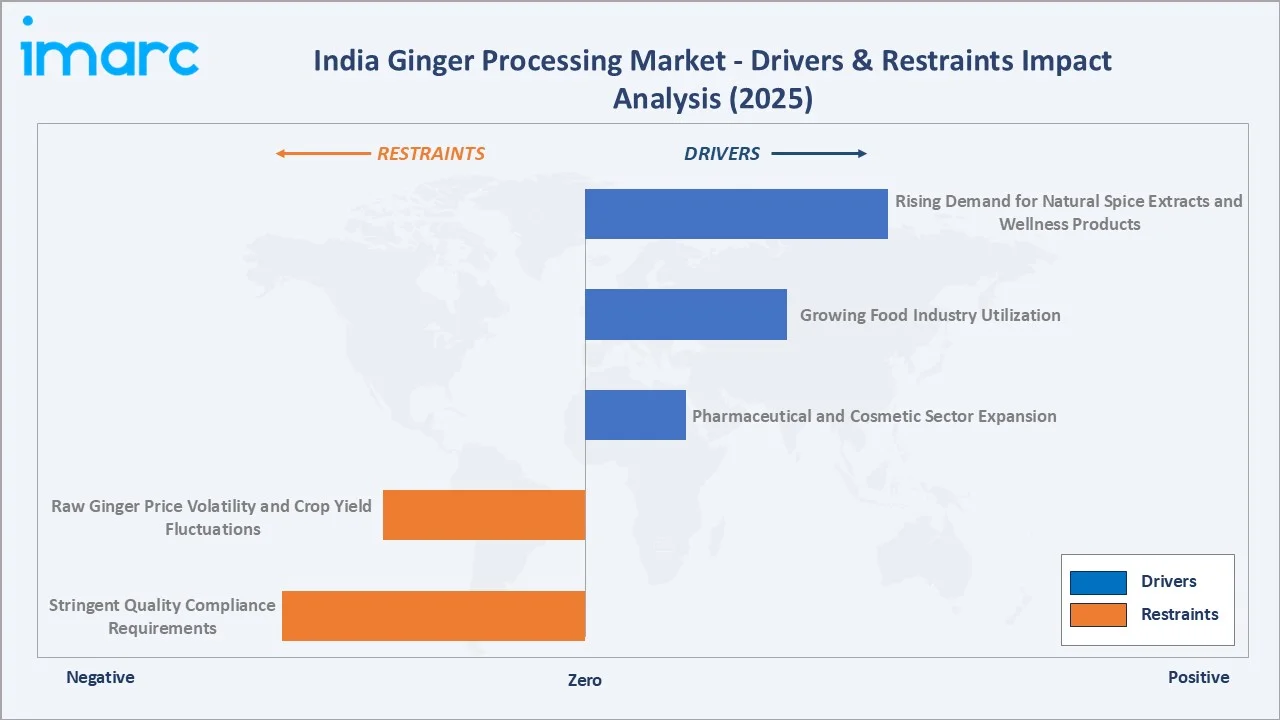
Market Drivers
- Rising Demand for Natural Spice Extracts and Wellness Products: The clean-label and natural ingredient movement, where food manufacturers are replacing synthetic flavor compounds with natural spice extracts, is creating sustained export demand growth for India ginger processed products. In 2024, India exported 82.26 million kg of ginger valued at approximately USD 98.90 million. Bangladesh was the largest destination, accounting for USD 32.52 million (61.43 million kg), followed by Morocco at USD 18.19 million, the United States at USD 10.54 million, the United Arab Emirates at USD 9.00 million, and Saudi Arabia at USD 4.27 million.
- Growing Food Industry Utilization: India’s food processing industry’s structural growth is creating growing institutional demand for ginger powder and oleoresin as standardized flavor ingredients. India’s masala and spice mix market consumes ginger powder as a core ingredient across virtually all curry powder, garam masala, biryani masala, and chai masala formulations. The beverages sector’s expansion into ginger-positioned health drinks is creating growing industrial ginger extract procurement above traditional food seasoning channels.
- Pharmaceutical and Cosmetic Sector Expansion: India’s pharmaceutical sector’s growing integration of evidence-based herbal ingredients is systematically expanding pharmaceutical end use of ginger processed products. India’s cosmetic market’s premiumization trend, where consumers trade up from mass-market FMCG personal care to premium natural and Ayurvedic beauty products, is increasing per-unit ginger oil demand from premium cosmetic brand manufacturers specifying higher-purity, authenticated ginger oil.
Market Restraints
- Raw Ginger Price Volatility and Crop Yield Fluctuations: Fluctuations in raw ginger prices and crop yields create uncertainty in raw material availability and procurement costs. Ginger production is highly sensitive to weather conditions, pest incidence, disease outbreaks, and variations in cultivated area, which can lead to inconsistent supplies. Sudden price increases raise processing costs and compress margins, particularly for small and mid-sized processors. Supply volatility can also disrupt production schedules and limit the ability of processors to maintain consistent pricing and product availability.
- Stringent Quality Compliance Requirements: Stringent quality and food safety compliance requirements are increasing testing, certification, traceability, and documentation costs for processors. Companies must maintain strict standards related to pesticide residues, microbial contamination, hygiene, moisture levels, and product labeling, particularly for export-oriented products. Smaller processors may struggle to invest in advanced testing facilities and standardized processing systems. Non-compliance can result in shipment rejections, product recalls, and restricted access to premium domestic and international markets.
Market Opportunities
- Farmer Aggregation and Organized Supply Chain Development: In May 2026, the Union Minister for Development of North Eastern Region, Jyotiraditya M. Scindia, along with Mizoram Chief Minister Lalduhoma, launched the Mizoram Ginger Mission, a ₹189.79 crore initiative aimed at strengthening ginger cultivation and value chain development across the state. The Mizoram Ginger Mission creates opportunities to establish organized procurement and farmer aggregation networks that connect ginger growers directly with processors and large buyers.
- Pharmaceutical-Grade Gingerol API and Standardized Extract Market: The development of pharmaceutical-grade gingerol and standardized ginger extracts presents an opportunity for Indian processors to move from conventional ginger products into higher-value pharmaceutical and nutraceutical ingredients. Gingerols are key bioactive compounds with documented pharmacological potential, creating scope for standardized, high-purity extracts with consistent active-compound concentrations.
Market Challenges
- Fragmented Ginger Supply Chain: India’s ginger supply chain remains fragmented, with production distributed among numerous small and marginal farmers. Limited aggregation and inconsistent procurement practices can make it difficult for processors to secure uniform-quality ginger in sufficient volumes. This fragmentation also increases transportation, handling, and sourcing costs.
- Maintaining Consistent Quality and Gingerol Content: Ginger quality can vary considerably based on variety, cultivation practices, maturity, climate, and post-harvest handling. Such variations can affect gingerol concentration, flavor, moisture, and extraction yields. Maintaining standardized specifications is therefore challenging for processors serving pharmaceutical, nutraceutical, and export customers.
Emerging Market Trends
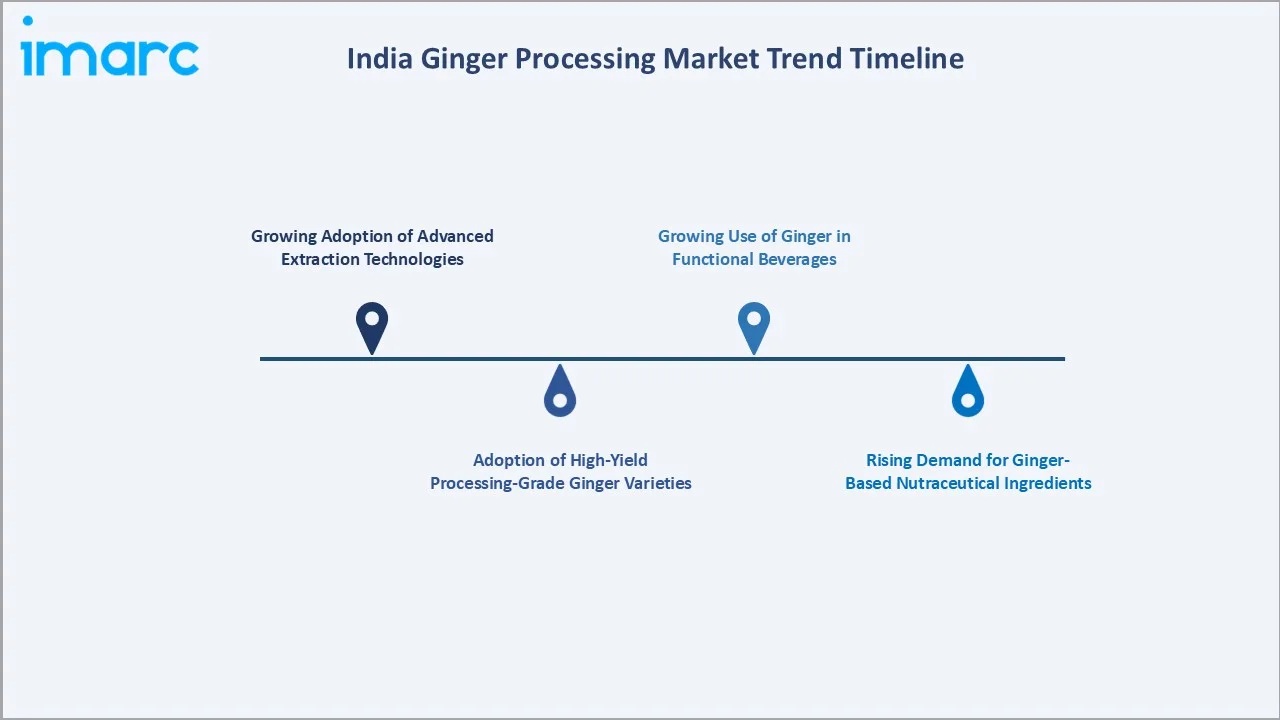
1. Growing Adoption of Advanced Extraction Technologies
Advanced processing technologies are gaining importance for improving extraction efficiency, product purity, and retention of ginger’s natural aroma. Fresh ginger processing technology can deliver higher ginger oil yield while reducing labor and energy requirements, highlighting the potential for technology-led processing modernization.
2. Adoption of High-Yield Processing-Grade Ginger Varieties
In November 2025, researchers at Nagaland University developed a new ginger variety offering consistently higher yields, improved dry matter recovery, and strong culinary characteristics. The variety has the potential to increase farmer returns while supporting demand from the fresh ginger market and spice processing industry. Such varieties can enhance processing efficiency, increase output of dried and value-added ginger products, and improve overall supply reliability for processors.
3. Rising Demand for Ginger-Based Nutraceutical Ingredients
Demand for gingerol-rich extracts, standardized ginger ingredients, and functional formulations is encouraging processors to target higher-value nutraceutical applications. This trend supports investment in extraction, purification, standardization, and quality-control capabilities beyond conventional food-grade processing.
4. Growing Use of Ginger in Functional Beverages
Ginger is increasingly being incorporated into functional drinks, wellness beverages, concentrates, and fermented beverages, reflecting consumer interest in natural and convenient ingredients. In July 2024, Naga entrepreneurs Moa and Tempi introduced ‘Ginger Nova,’ a probiotic beverage under the NOVA brand, produced by NOVA Traders and Manufacturers. The alcohol-free drink is made by fermenting ginger with other natural ingredients, offering an organic, wellness-oriented beverage option. This creates opportunities for processors to develop beverage-grade extracts, powders, juices, and concentrates with standardized flavor and functional characteristics.
Industry Value Chain Analysis
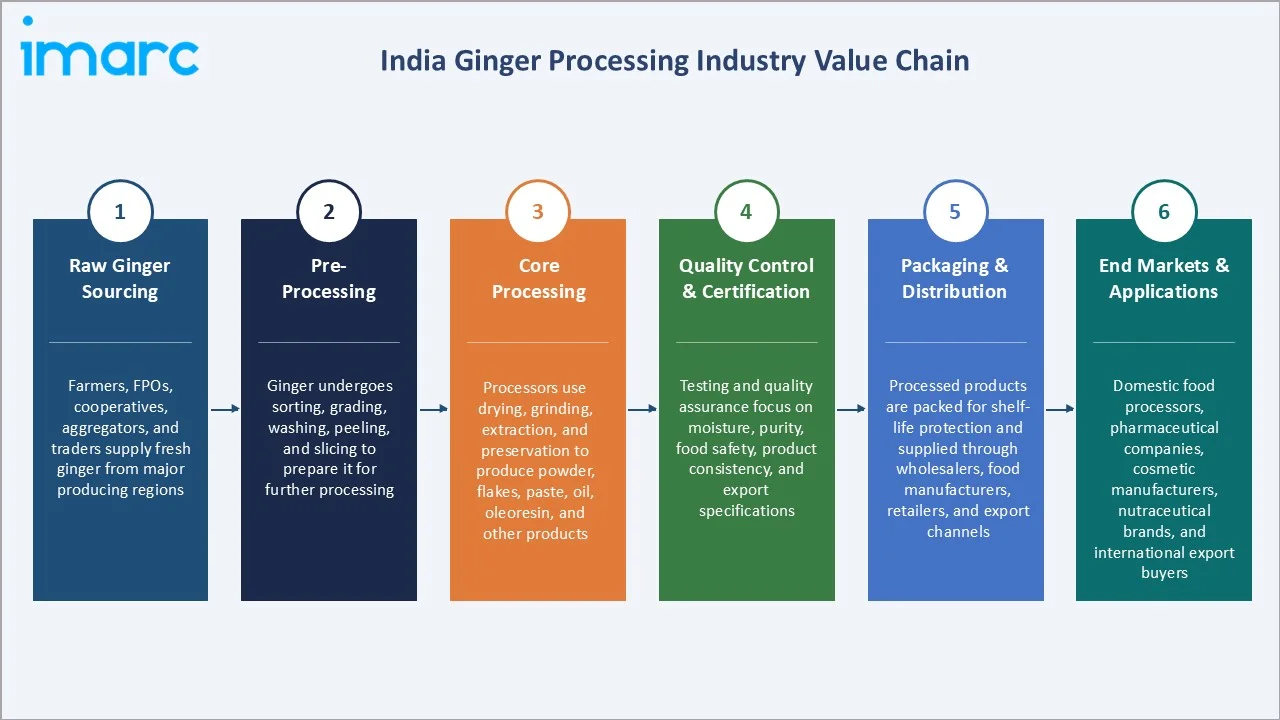
India’s ginger processing value chain integrates farm-level production, primary aggregation and pre-processing, core processing operations, quality testing, and multi-channel distribution across domestic food and export markets.
|
Stage |
Key Participants & Details |
|
Raw Ginger Sourcing |
Farmers, FPOs, cooperatives, aggregators, and traders supply fresh ginger from major producing regions. |
|
Pre-Processing |
Ginger undergoes sorting, grading, washing, peeling, and slicing to prepare it for further processing. |
|
Core Processing |
Processors use drying, grinding, extraction, and preservation to produce powder, flakes, paste, oil, oleoresin, and other products. |
|
Quality Control & Certification |
Testing and quality assurance focus on moisture, purity, food safety, product consistency, and export specifications. |
|
Packaging & Distribution |
Processed products are packed for shelf-life protection and supplied through wholesalers, food manufacturers, retailers, and export channels. |
|
End Markets & Applications |
Domestic food processors, pharmaceutical companies, cosmetic manufacturers, nutraceutical brands, and international export buyers. |
Core processing is the most value-added stage as it converts fresh ginger into higher-value products such as powder, oil, oleoresin, extracts, and other processed ingredients. These products offer longer shelf life, broader industrial applications, and greater commercial value than raw ginger, particularly in food, nutraceutical, and pharmaceutical markets.
Technology Landscape in the India Ginger Processing Industry
Controlled-Temperature and Mechanical Drying Technology
Cabinet and mechanical dryers provide controlled and uniform moisture removal, reducing dependence on traditional sun drying. These systems improve processing reliability during humid and rainy conditions while helping processors achieve consistent moisture levels and longer shelf life. They are particularly relevant for dried ginger, flakes, and powder production.
Steam Distillation Technology
Steam distillation is widely applicable for recovering ginger essential oil and volatile aromatic compounds from processed ginger. It enables processors to diversify from basic dried products into higher-value flavor, fragrance, food, and wellness ingredients. Fresh-ginger processing methods can also improve aroma retention and oil recovery.
Solvent Extraction and Oleoresin Technology
Solvent extraction is used to produce ginger oleoresin containing concentrated flavor and pungent compounds for food and ingredient applications. Processing typically involves ginger preparation, extraction using permitted solvents, solvent recovery, and standardization of the final extract. This technology enables greater value realization compared with conventional dried ginger products.
Market Segmentation Analysis
The report covers the following segments:
|
Segment Category |
Leading Segment |
Market Share |
Year |
|
Form |
Ginger Powder |
67.4% |
2025 |
|
Distribution Channel |
🔒 |
🔒 |
2025 |
|
End Use |
Food Industry |
57.6% |
2025 |
|
Region |
South India |
34.8% |
2025 |

By Form
Ginger powder leads at 67.4% (2025) through universal demand across domestic masala blending, food processing, beverage, and institutional food service channels.
To access detailed market analysis, Request Sample
Ginger oil at 32.6% is growing fastest at ~9.40% CAGR through premium cosmetic, pharmaceutical, and food flavoring export applications where oleoresin and essential oil command higher value per kilogram than ginger powder.
By End Use
Food industry leads at 57.6% (2025) through masala, seasoning, beverage, and packaged food sector procurement. Pharmaceutical industry at 24.8%, growing at ~8.60% CAGR, through Ayurvedic formulations and standardized gingerol nutraceutical demand.
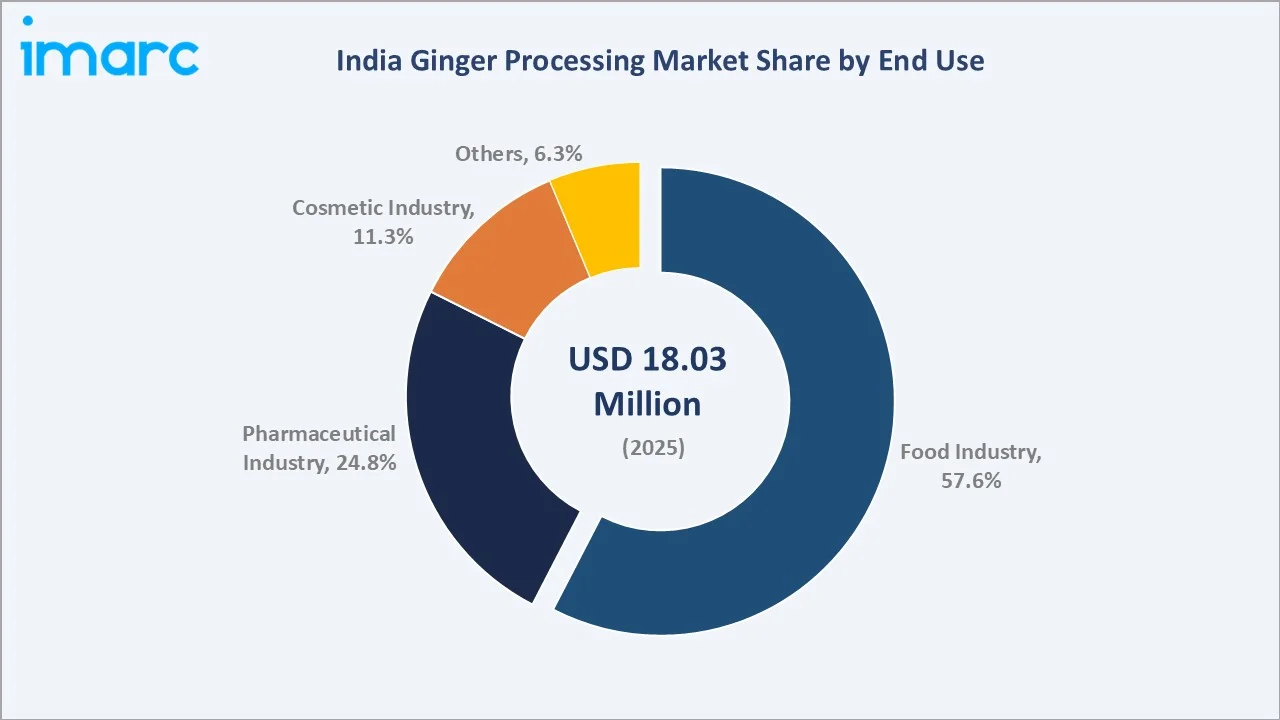
Cosmetic industry at 11.3% growing at ~9.10% CAGR through premium haircare and aromatherapy ginger oil applications. Others at 6.3% encompasses agricultural biostimulant and veterinary feed applications.
Regional Market Insights
|
Region |
Share (2025) |
Key Ginger Processing Market Drivers & Characteristics |
|
South India |
34.8% |
Strong spice-processing ecosystem, established food-processing infrastructure, and ginger availability in Karnataka and Kerala support market leadership. |
|
West India |
28.7% |
Benefits from Maharashtra’s developed food-processing sector, strong distribution networks, and access to major domestic consumption and export channels. |
|
North India |
23.1% |
Growing demand from food, beverage, nutraceutical, and traditional medicine applications supports processed ginger consumption. |
|
East India |
13.4% |
Ginger cultivation across Odisha and the Northeast, along with increasing investment in local processing and value addition, supports regional growth. |
South India leads with a 34.8% share in 2025, supported by Karnataka’s substantial ginger production and an established spice-processing ecosystem. Karnataka and Kerala also have a history of dry ginger processing. West India accounts for 28.7%, benefiting from developed food-processing infrastructure, strong urban demand, and established distribution and trade networks.
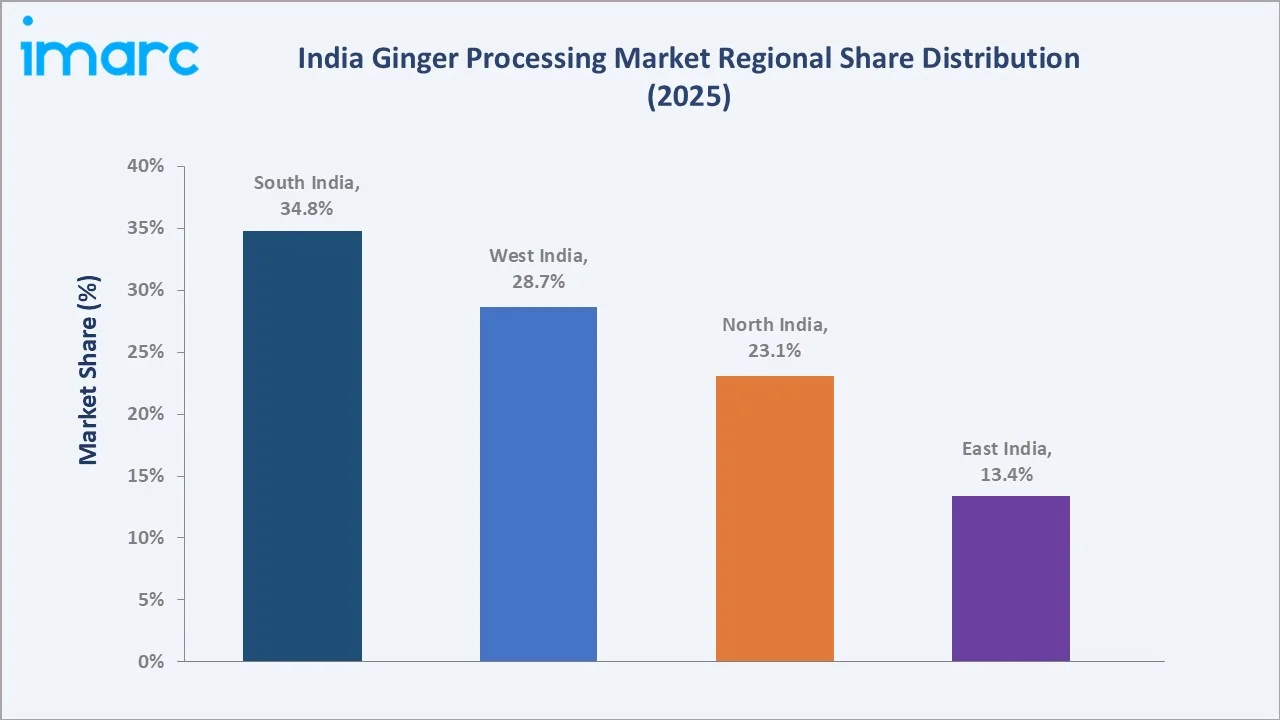
North India holds a 23.1% share, supported by large consumer markets and demand for ginger across food, beverage, traditional medicine, and wellness applications. East India represents 13.4%, with Odisha and the Northeast providing an important ginger production base.
Competitive Landscape
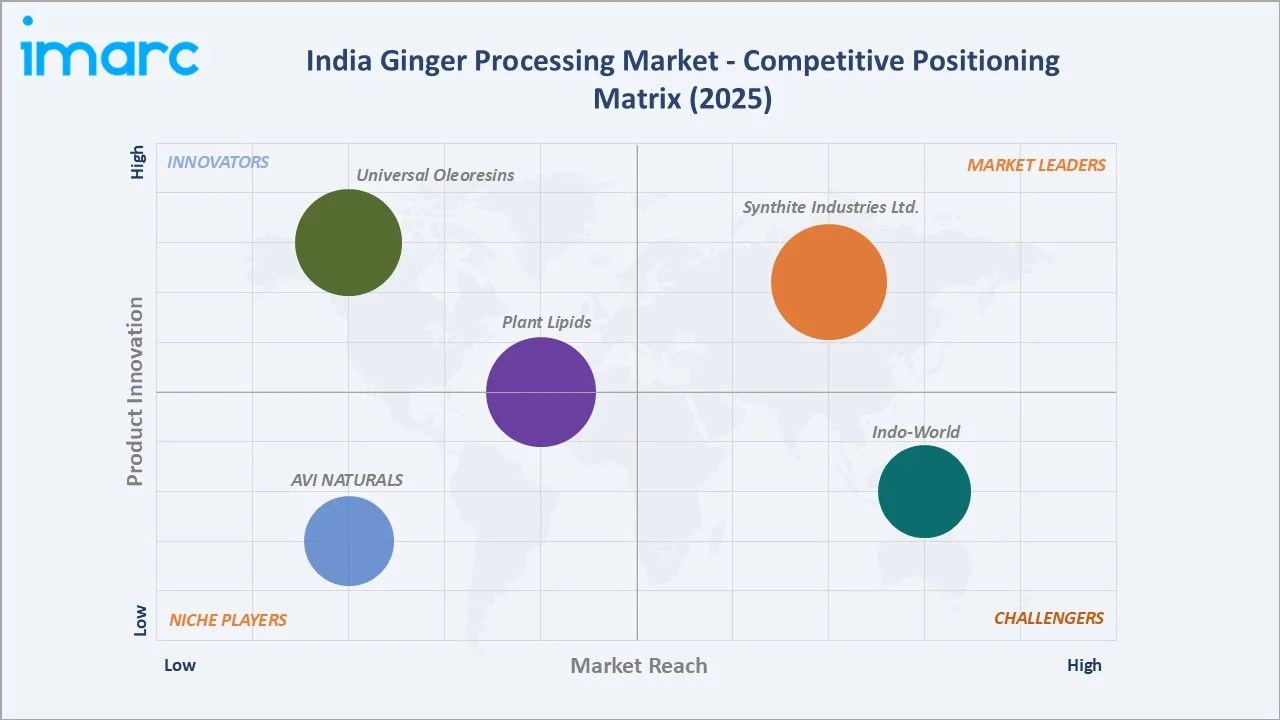
The India ginger processing market is fragmented, comprising specialized spice processors, extract and oleoresin manufacturers, regional processors, exporters, and smaller local enterprises. Competition is primarily based on raw material sourcing, product quality, processing technology, pricing, certifications, and distribution reach, while companies are increasingly differentiating through value-added products such as ginger extracts, essential oils, and oleoresins.
|
Company |
Key Products |
Market Position |
Core Strength |
|
Synthite Industries Ltd. |
Ginger essential oil, Oleoresin, Super critical CO₂ extract, Encapsulated ginger powder, Ginger granules |
Market Leader |
Synthite Industries Ltd. is a leader in botanical extracts and one of India’s largest producers of spice oleoresins and essential oils. |
|
Plant Lipids |
Ginger Oleoresins, Ginger Essential Oils |
Established Player |
Plant Lipids is a leading Indian manufacturer and exporter of ginger extracts, specializing in turning raw rhizomes into standardized, value-added products. |
|
Universal Oleoresins |
Ginger Grass Oil, Ginger Oil, Ginger Oleoresin |
Innovator |
Their role centers on transforming raw, dried ginger rhizomes into highly concentrated, standardized, and shelf-stable oleoresins and essential oils. |
|
Indo-World |
Ginger Powder, Gingergrass Oil, Ginger root Oil / Oleoresin |
Challenger |
Indo World specializes in processing raw Indian spices into value-added botanical extracts, natural essential oils, and spice oleoresins for global markets. |
|
AVI NATURALS |
Ginger Essential Oil, Ginger Oleoresin |
Niche Player |
Avi Naturals plays a specialized role in India's ginger processing sector by manufacturing concentrated ginger extracts and essential oils used in cosmetics, aromatherapy, and perfumery. |
India ginger processing competitive landscape rewards scale, technology, and market access. The market’s fragmented mid-tier creates consolidation opportunities for well-capitalized players seeking processing scales.
Key Company Profiles
Synthite Industries Ltd.
Synthite Industries Ltd. is a leading Indian manufacturer of value-added spices, spice oleoresins, botanical extracts, essential oils, and natural ingredient solutions. The company operates various manufacturing facilities and serves customers across many countries, with applications spanning food, beverages, wellness, and personal care. In the India ginger processing market, Synthite processes ginger into value-added ingredients including ginger oleoresins, ginger oil, and standardized gingerol-rich extracts. Its advanced extraction capabilities, extensive processing infrastructure, R&D expertise, and global distribution network strengthen its position in the premium ginger ingredients segment.
- Key Products: Ginger essential oil, Oleoresin, Super critical CO₂ extract, Encapsulated ginger powder, Ginger granules.
- Strategic Focus: Focuses on high-value ginger processing, advanced extraction technologies, product standardization, and natural ingredient innovation. Its R&D capabilities emphasize advanced extraction and purification, bioactive compounds, and analytical technologies that can support premium ginger oils, oleoresins, and standardized extracts.
Plant Lipids
Plant Lipids is an India-based natural ingredients company specializing in spice extracts, oleoresins, essential oils, ground spices, wellness ingredients, natural food colors, and flavor solutions. In the India ginger processing market, the company manufactures ginger oleoresin and related value-added ginger extracts for food, beverage, nutraceutical, and pharmaceutical applications. Its operations are supported by advanced extraction technologies, quality-control systems, and access to spice raw materials. The company’s broad natural-ingredient portfolio and global customer base strengthen its position in India’s processed ginger and spice extract industry.
- Key Products: Ginger Oleoresins, Ginger Essential Oils.
- Strategic Focus: Focuses on high-value ginger extracts, advanced extraction technologies, product purity, and customized natural ingredient solutions. The company uses supercritical CO₂ extraction to produce ginger extracts with consistent flavor, aroma, and purity, supporting clean-label and premium applications.
Market Concentration Analysis
The India ginger processing market is fragmented, with a mix of large spice extraction companies, specialized processors, exporters, and numerous regional manufacturers. Established players hold stronger positions in higher-value segments such as ginger oleoresins, essential oils, and standardized extracts, where advanced extraction technology, certifications, and export relationships create higher entry barriers. In contrast, ginger powder, dried ginger, paste, and basic processed products remain relatively fragmented due to the presence of smaller processors. Competition is driven by raw material sourcing, quality consistency, traceability, processing efficiency, and pricing. Growing demand for natural extracts and premium ingredients is encouraging investment in advanced processing capabilities.
Investment & Growth Opportunities
Highest Growth Segments
Ginger oil (~9.40% CAGR) and cosmetic industry end use (~9.10% CAGR) represent India’s ginger processing market’s highest-growth investment vectors through 2034, followed closely by Pharmaceutical Industry end use (~8.60% CAGR).
Investment Themes
- Supercritical CO2 Extraction Capacity: Investment in supercritical CO2 extraction facilities can enable processors to produce high-purity ginger extracts, essential oils, and gingerol-rich ingredients with minimal solvent residues. This supports premium applications in nutraceuticals, pharmaceuticals, functional foods, and export-oriented ingredient markets.
- Organic Certified Ginger Processing Cluster: Investment in organic-certified processing clusters can integrate farmer sourcing, cleaning, drying, extraction, testing, packaging, and traceability within a coordinated ecosystem. Such clusters can improve quality consistency, strengthen certification compliance, and help Indian processors target premium domestic and international demand for organic ginger products.
Future Market Outlook (2026-2034)
The India ginger processing market is projected to grow from USD 18.03 Million in 2025 to USD 19.49 Million in 2026 and is forecast to reach USD 36.27 Million by 2034, delivering an exceptional 8.08% CAGR that positions India’s ginger processing sector among the highest-growth food ingredient market segments, reflecting the alignment of India’s structural raw material advantage, technology capability advancement, and multi-industry end-use demand acceleration. The anchor value of USD 26.58 Million in 2030 matches precisely the 2020-2025 growth rate and confirms the structural consistency of India’s ginger processing market growth trajectory anchored in durable fundamental demand.
First, the global natural ingredient and clean-label movement is creating the most sustained multi-year demand expansion for India ginger processed products in the sector’s history. Second, India’s pharmaceutical and nutraceutical sectors’ growing adoption of evidence-based botanical ingredients is creating a structurally new, premium-priced demand layer for ginger processed products above the food industry baseline. Third, India’s domestic food, cosmetic, and personal care markets’ premiumization is creating above-market CAGR consumption growth for processed ginger products within India itself, adding a domestic demand growth engine to the export demand expansion.
Research Methodology
Primary Research
Primary research comprised in-depth interviews with ginger processing company leadership, food industry procurement officers, pharmaceutical and nutraceutical ingredient formulators, cosmetic brand ingredient sourcing specialists, export agents and freight forwarders, and Spices Board of India regional office officials.
Secondary Research
Secondary research encompassed a review of government publications, industry reports, company disclosures, trade databases, academic studies, and credible news sources to assess the India ginger processing market. It supported the analysis of production trends, processing technologies, trade dynamics, competitive developments, and growth opportunities.
Forecasting Models
Forecasting models developed using historical India ginger processing market data (2020-2025), India ginger production and pricing trend projection, global natural spice extract demand modeling, pharmaceutical and nutraceutical standardized extract demand projection, cosmetic industry ginger oil adoption curve modeling, export market share projection aligned with key destination market import growth rates, and domestic food industry processed ginger procurement growth linked to India organized food industry revenue CAGR.
India Ginger Processing Market Report Coverage:
| Report Features | Details |
|---|---|
| Base Year of the Analysis | 2025 |
| Historical Period | 2020-2025 |
| Forecast Period | 2026-2034 |
| Units | Million USD |
| Scope of the Report |
Exploration of Historical Trends and Market Outlook, Industry Catalysts and Challenges, Segment-Wise Historical and Future Market Assessment:
|
| Forms Covered | Ginger Powder, Ginger Oil |
| Distribution Channels Covered | Supermarkets and Hypermarkets, Convenience Stores, Specialty Food Stores, Online, Others |
| End Uses Covered | Food Industry, Pharmaceutical Industry, Cosmetic Industry, Others |
| Regions Covered | North India, South India, East India, West India |
| Companies Covered | Synthite Industries Ltd., Plant Lipids, Universal Oleoresins, Indo-World, AVI NATURALS, etc. |
| Customization Scope | 10% Free Customization |
| Post-Sale Analyst Support | 10-12 Weeks |
| Delivery Format | PDF and Excel through Email (We can also provide the editable version of the report in PPT/Word format on special request) |
Key Benefits for Stakeholders:
- IMARC’s industry report offers a comprehensive quantitative analysis of various market segments, historical and current market trends, market forecasts, and dynamics of the India ginger processing market from 2020-2034.
- The research report provides the latest information on the market drivers, challenges, and opportunities in the India ginger processing market.
- Porter's five forces analysis assist stakeholders in assessing the impact of new entrants, competitive rivalry, supplier power, buyer power, and the threat of substitution. It helps stakeholders to analyze the level of competition within the India ginger processing industry and its attractiveness.
- Competitive landscape allows stakeholders to understand their competitive environment and provides an insight into the current positions of key players in the market.
Frequently Asked Questions About the India Ginger Processing Market Report
The India ginger processing market size is estimated at USD 19.49 Million in 2026, driven by India’s ginger production, growing FMCG food industry procurement of standardized ginger powder and oleoresin for masala blends, post-COVID wellness-driven consumer demand for ginger-based health products, and pharmaceutical-grade gingerol standardized extract supply.
The market grows at 8.08% CAGR, reaching USD 36.27 Million by 2034. Growth is supported by rising demand for value-added ginger products, natural extracts, nutraceutical ingredients, and processed food applications.
Ginger powder leads at 67.4% (2025) through universal demand from India’s domestic masala blending industry, FMCG packaged food and seasoning product manufacturers, and exports to South Asian diaspora markets.
The food industry leads at 57.6% (2025) through ginger powder consumption in masala blends, ginger oleoresin in food flavoring standardization, and ginger extract in beverage formulations.
South India leads at 34.8% through Kerala’s world-class spice processing infrastructure concentration representing most of India’s organized ginger processing capacity, quality certification and export promotion infrastructure, and Kerala ginger offering India’s highest volatile oil content preferred for essential oil production.
Leading companies include Synthite Industries Ltd., Plant Lipids, Universal Oleoresins, Indo-World, and AVI NATURALS, among others.
The market is projected to reach USD 26.58 Million by 2030, driven by CO2 supercritical extraction capacity doubling, proprietary ginger microencapsulation for heat-stable bakery and confectionery applications, global nutraceutical industry growth generating proportional standardized plant extract demand growth, and India’s domestic premium food and cosmetic market scale enabling viable branded ginger product launches at premium price points.
Top investment opportunities include CO2 supercritical ginger extract capacity, organic certified ginger processing unit, pharmaceutical-grade standardized ginger extract, spray-dried instant ginger powder for beverage premix, cosmetic-grade fresh ginger oil from Wayanad green ginger, ginger oleoresin microencapsulation for functional food.
Need more help?
- Speak to our experienced analysts for insights on the current market scenarios.
- Include additional segments and countries to customize the report as per your requirement.
- Gain an unparalleled competitive advantage in your domain by understanding how to utilize the report and positively impacting your operations and revenue.
- For further assistance, please connect with our analysts.
 Request Customization
 Speak to an Analyst
 Request Brochure
 Inquire Before Buying
Benefits of Customization
- Personalize this research
- Triangulate with your data
- Get data as per your format and definition
- Gain a deeper dive into a specific application, geography, customer, or competitor
- Any level of personalization
Get in Touch With Us
UNITED STATES
Phone: +1-201-971-6302
INDIA
Phone: +91-120-433-0800
UNITED KINGDOM
Phone: +44-753-714-6104
Email: [email protected]
Client Testimonials




.webp)




.webp)













Related Reports

Choose your plan
*Please note that the prices mentioned below are starting prices for each bundle type. Kindly contact our team for further details.*
Single User License
- 1 User License, Access on 2 Devices
- PDF Report + Excel Dataset (Password Protected)
- Lifetime Access
- No Printing Rights
- 10% Free Report Customization
- 10–12 Weeks of Analyst Support
Five User License
- Access for 5 Users, 2 Devices per User
- PDF Report + Excel Dataset (Password Protected)
- Lifetime Access
- Dedicated Account Manager
- 12–14 Weeks of Analyst Support
- No Printing Rights
- 15% Free Report Customization
- 25% Discount on Your Next Purchase
Corporate User License
- Unlimited User Access (Within Your Organization)
- PDF Report + Excel Dataset
- Lifetime Access
- Dedicated Account Manager
- 14–20 Weeks of Analyst Support
- No Printing Rights
- 20% Free Report Customization
- 30% Discount on Your Next Purchase
Essential Insights
What's included:
3 reports
- Lifetime Access
- PDF Reports
- Excel Datasets
- 2 Weeks of Free Analyst Support
- 2 User Licenses
- Access on 2 Devices
- Printing Rights
- Complimentary PowerPoint (PPT) Version
- Complimentary License Upgrade
Professional Access
What's included:
5 reports
- Lifetime Access
- PDF Reports
- Excel Datasets
- 8 Weeks of Free Analyst Support
- 2 User Licenses
- Access on 2 Devices
- Printing Rights
- Complimentary PowerPoint (PPT) Version
- Complimentary License Upgrade
Business Advantage
What's included:
8 reports
- Lifetime Access
- PDF Reports
- Excel Datasets
- 14 Weeks of Free Analyst Support
- 2 User Licenses
- Access on 2 Devices
- Printing Rights
- Complimentary PowerPoint (PPT) Version
- Complimentary License Upgrade
Enterprise Intelligence
What's included:
10 reports
- Lifetime Access
- PDF Reports
- Excel Datasets
- 20 Weeks of Free Analyst Support
- 2 User Licenses
- Access on 2 Devices
- Printing Rights
- Complimentary PowerPoint (PPT) Version
- Complimentary License Upgrade