
India Home Cleaning Equipment Market Size, Share, Trends and Forecast by Type, Application, and Region, 2026-2034
India Home Cleaning Equipment Market Summary:
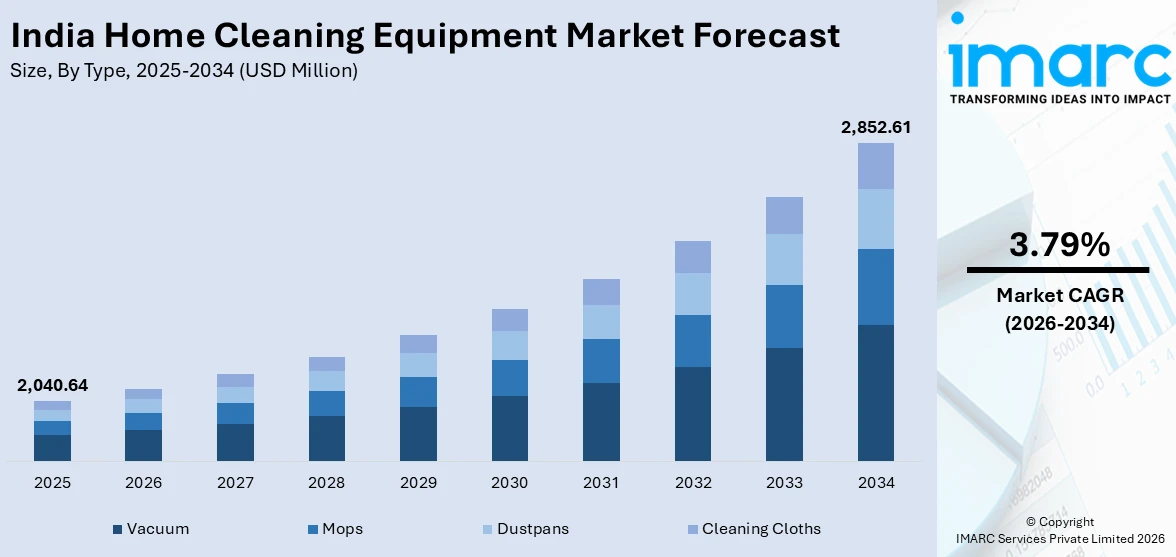
The India home cleaning equipment market size was valued at USD 2,040.64 Million in 2025 and is projected to reach USD 2,852.61 Million by 2034, growing at a compound annual growth rate of 3.79% from 2026-2034.
Rising urbanization and expanding middle-class households drive sustained demand for modern cleaning equipment across residential and commercial segments. Increasing health consciousness following the pandemic elevates preferences for professional-grade vacuum cleaners, mops, and specialized cleaning tools that ensure thorough sanitization. Growing adoption of automated cleaning solutions reflects consumer appetite for time-saving technologies while expanding e-commerce platforms improve product accessibility across tier-one and emerging cities, supporting consistent India home cleaning equipment market share expansion.
Key Takeaways and Insights:
- By Type: Vacuum dominates the market with a share of 36% in 2025, owing to its versatility in cleaning multiple surfaces, rising preference for automated cleaning solutions, and growing consumer awareness about dust allergen removal. Increasing availability of cordless and robotic variants enhances market penetration.
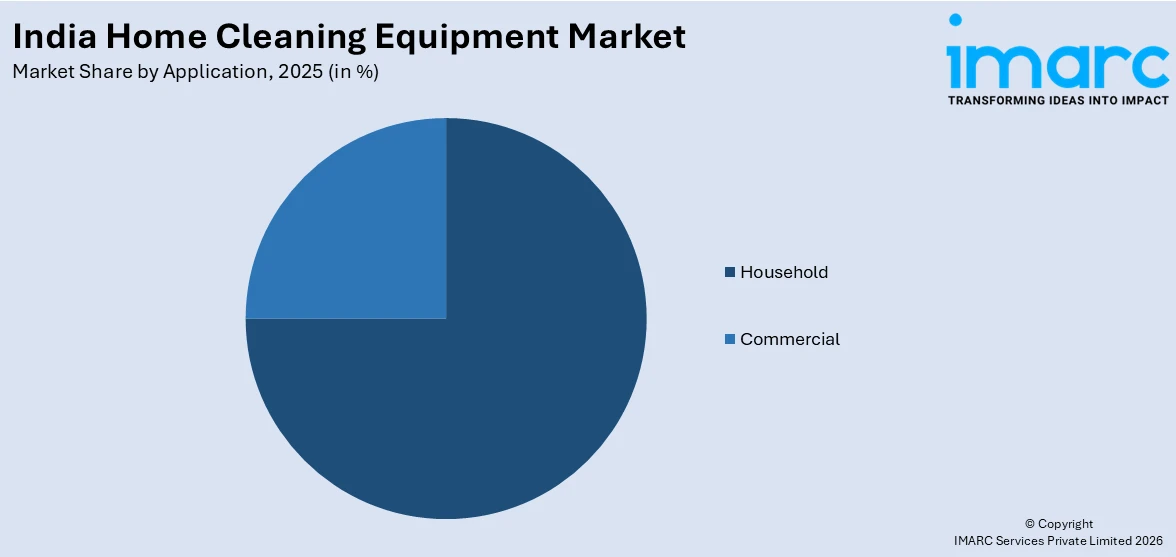
- By Application: Household leads the market with a share of 75% in 2025, reflecting strong consumer preference for residential cleaning equipment, rising disposable incomes enabling purchase of branded products, and increasing nuclear family structures driving demand for individual household cleaning solutions.
- Key Players: Key players drive the India home cleaning equipment market by launching innovative products with advanced features, establishing robust distribution networks across urban and rural markets, and investing in consumer awareness campaigns. Their focus on affordability, product quality, and after-sales service strengthens brand loyalty while partnerships with e-commerce platforms expand market reach across diverse consumer segments.
To get more information on this market Request Sample
Technological advancements shape product evolution as manufacturers integrate smart features including app-based controls, automated navigation systems, and energy-efficient motors into vacuum cleaners and robotic cleaning devices. Consumer preferences shift toward multi-functional equipment capable of handling both wet and dry cleaning tasks across various floor types while compact designs suit urban apartment living constraints. Growing awareness about indoor air quality drives demand for HEPA-filtered vacuum cleaners that capture fine dust particles and allergens. In August 2024, Dreame Technology expanded its India portfolio by launching robotic vacuum cleaners including the D10 Plus Gen 2, D9 Max Gen 2, and L10 Prime with prices starting at INR 7,999, featuring high suction power and advanced navigation technology. Rising middle-class purchasing power enables investment in premium cleaning equipment while expanding organized retail presence and aggressive e-commerce promotion strategies improve product visibility. Government urbanization initiatives accelerate migration toward cities where modern cleaning equipment adoption rates remain substantially higher compared to rural regions, supporting sustained market expansion.
India Home Cleaning Equipment Market Trends:
Growing Adoption of Smart and Robotic Vacuum Cleaners
Technological advancements drive increasing consumer preference for automated cleaning solutions equipped with artificial intelligence and Internet of Things capabilities that enable remote operation and intelligent navigation. Smart vacuum cleaners featuring app-based controls allow users to schedule cleaning sessions, monitor progress remotely, and customize cleaning patterns according to specific room requirements. Manufacturers continuously expand product portfolios with robotic vacuum cleaners featuring advanced navigation systems and efficient mopping capabilities. These innovations appeal to busy urban professionals seeking hands-free cleaning solutions while growing affordability through competitive pricing strategies makes automated equipment accessible to middle-income households. Consumer electronics retailers and online marketplaces facilitate widespread product availability supporting market penetration.
E-commerce Expansion and Direct-to-Consumer Brand Growth
Online retail platforms transform purchasing patterns by offering extensive product variety, competitive pricing, and convenient delivery across urban and rural markets while enabling consumers to access detailed product specifications and user reviews before purchase decisions. Digital payment infrastructure improvements and increasing smartphone penetration support seamless online transactions while aggressive promotional campaigns by e-commerce platforms drive trial and adoption. Direct-to-consumer business models demonstrate substantial growth potential for cleaning equipment brands leveraging digital sales channels. Online marketplaces provide manufacturers with cost-effective customer acquisition opportunities while eliminating traditional retail intermediaries. Subscription services and loyalty programs enhance customer retention while data analytics enable personalized marketing strategies improving conversion rates.
Rising Demand for Eco-Friendly and Plant-Based Cleaning Solutions
Growing health consciousness fuels consumer shift toward non-toxic, biodegradable cleaning products without harsh chemicals that pose risks to family members and pets while environmental awareness drives preference for sustainable packaging and manufacturing practices. Consumers increasingly scrutinize product ingredient lists and certifications seeking assurance about safety standards while premium positioning of eco-friendly products appeals to environmentally conscious urban demographics. In February 2024, Koparo, a sustainable and plant-based home care brand, secured INR 70 Lakh investment to expand its presence in India's cleaning products market, demonstrating investor confidence in eco-friendly segment growth potential.
Market Outlook 2026-2034:
Sustained urbanization coupled with rising disposable incomes positions the India home cleaning equipment market for robust expansion as consumers prioritize convenience, hygiene, and efficiency in household maintenance routines. Technological innovation drives product enhancement with manufacturers introducing advanced features including improved suction power, extended battery life, and smart connectivity options that appeal to tech-savvy urban consumers seeking automated cleaning solutions. The market generated a revenue of USD 2,040.64 Million in 2025 and is projected to reach a revenue of USD 2,852.61 Million by 2034, growing at a compound annual growth rate of 3.79% from 2026-2034. Expanding e-commerce infrastructure broadens market reach while competitive pricing strategies make quality cleaning equipment accessible to price-sensitive segments. Growing awareness about indoor air quality and allergen management supports demand for HEPA-filtered vacuum cleaners and specialized cleaning tools. Commercial sector expansion including offices, healthcare facilities, and hospitality establishments generates institutional demand for professional-grade cleaning equipment supporting diversified revenue streams for market participants.
India Home Cleaning Equipment Market Report Segmentation:
| Segment Category | Leading Segment | Market Share |
|---|---|---|
| Type | Vacuum | 36% |
| Application | Household | 75% |
Type Insights:
- Mops
- Dustpans
- Vacuum
- Cleaning Cloths
Vacuum dominates with a market share of 36% of the total India home cleaning equipment market in 2025.
Vacuum cleaners command substantial market presence owing to their versatility in cleaning multiple surface types including carpets, hard floors, upholstery, and curtains while offering superior dust removal compared to traditional cleaning methods. Growing awareness about indoor air quality and allergen management drives consumer preference for HEPA-filtered models that capture microscopic particles including dust mites, pollen, and pet dander. Technological advancements introduce cordless variants featuring improved battery life and lightweight designs that enhance maneuverability while robotic vacuum cleaners with intelligent navigation systems appeal to busy urban professionals seeking automated cleaning solutions. Leading manufacturers continuously launch innovative models featuring advanced suction technology and self-righting capabilities. Rising pet ownership across Indian households increases demand for specialized attachments designed to handle pet hair and dander.
Expanding product portfolios cater to diverse consumer requirements with canister, upright, handheld, and stick vacuum variants available across different price points enabling market penetration across income segments. Premium segment growth reflects consumer willingness to invest in durable, feature-rich models offering extended warranties and superior after-sales service while budget-friendly options remain popular among price-conscious buyers. Wet and dry vacuum cleaners capable of handling liquid spills alongside dry debris provide enhanced utility particularly for households with children and pets. Smart connectivity features enabling app-based controls and scheduling functions align with broader smart home adoption trends while attracting tech-savvy consumers. Aggressive marketing campaigns by international and domestic brands highlighting product benefits and demonstration of cleaning efficiency through retail displays strengthen consumer awareness and purchase consideration across metropolitan and tier-two cities supporting sustained segment expansion.
Application Insights:
Access the comprehensive market breakdown Request Sample
- Household
- Commercial
Household leads with a share of 75% of the total India home cleaning equipment market in 2025.
Household segment maintains dominant position reflecting strong residential demand driven by rising disposable incomes enabling purchase of branded cleaning equipment across middle-class families. Nuclear family structures prevalent in urban areas necessitate individual household cleaning tool ownership rather than reliance on shared resources while dual-income households value time-saving automated cleaning solutions that reduce manual effort. Growing health consciousness following the pandemic elevates focus on thorough home sanitization with families investing in professional-grade equipment ensuring comprehensive cleaning of living spaces. In March 2025, Urban Company introduced Insta Maids service in Mumbai at INR 49 per hour, demonstrating growing consumer willingness to pay for professional household cleaning services. Expanding e-commerce platforms improve product accessibility enabling consumers across tier-two and tier-three cities to purchase quality cleaning equipment through convenient digital channels supported by competitive pricing and attractive promotional offers.
Increasing apartment living in metropolitan areas drives demand for compact, space-efficient cleaning equipment suited to smaller living spaces while cordless and lightweight designs enhance storage convenience. Rising pet ownership across Indian households generates specialized cleaning requirements including pet hair removal and odor management supporting adoption of vacuum cleaners with dedicated attachments. Growing awareness about dust allergen impact on respiratory health particularly among children and elderly family members motivates investment in HEPA-filtered vacuum cleaners and air purifier combinations. Government initiatives promoting affordable housing under Pradhan Mantri Awas Yojana expand homeownership particularly among middle-income segments creating sustained demand for household cleaning equipment. Smart home adoption trends encourage purchase of connected cleaning devices offering app-based controls and scheduling functions while product durability and warranty coverage influence purchase decisions with consumers preferring established brands offering reliable after-sales support.
Regional Insights:
- North India
- South India
- East India
- West India
North India demonstrates robust market presence driven by high urbanization rates in Delhi-NCR, substantial middle-class population, and strong purchasing power across Haryana, Punjab, and Uttar Pradesh. Growing awareness about hygiene standards and increasing nuclear family structures support demand for modern cleaning equipment while expanding retail infrastructure and aggressive e-commerce penetration improve product accessibility. Rising disposable incomes enable investment in premium vacuum cleaners and automated cleaning solutions while seasonal dust accumulation during summer months necessitates regular deep cleaning driving consistent equipment usage.
South India exhibits strong technology adoption patterns particularly across Bangalore, Hyderabad, Chennai, and Pune where IT professionals demonstrate higher propensity for smart and robotic cleaning equipment. Cultural emphasis on cleanliness and household maintenance supports regular purchase of cleaning tools while tropical climate conditions necessitate frequent floor cleaning driving sustained demand for wet and dry vacuum cleaners. Growing awareness about indoor air quality management and allergen control particularly in coastal areas with high humidity levels encourages adoption of HEPA-filtered vacuum cleaners while expanding organized retail presence supports market penetration.
East India presents emerging market opportunities with Kolkata serving as primary urban center while Bhubaneswar and Guwahati demonstrate increasing adoption rates. Rising middle-class population coupled with improving infrastructure development drives gradual shift toward modern cleaning equipment while growing awareness about hygiene benefits supports market expansion. E-commerce platforms facilitate product accessibility across semi-urban areas while competitive pricing strategies by domestic and international brands enable market penetration. Monsoon season creates specific cleaning challenges necessitating wet cleaning capabilities driving demand for versatile equipment handling both wet and dry debris.
West India exhibits substantial market activity concentrated in Mumbai, Pune, and Ahmedabad where high population density and premium residential developments drive demand for quality cleaning equipment. Strong commercial sector presence including corporate offices and hospitality establishments generates institutional demand while affluent consumer base demonstrates willingness to invest in premium and imported cleaning solutions. Growing real estate development across Maharashtra and Gujarat creates sustained demand for household cleaning equipment while expanding retail networks supported by established distribution infrastructure ensure product availability across price segments enhancing market accessibility.

Market Dynamics:
Growth Drivers:
Why is the India Home Cleaning Equipment Market Growing?
Rapid Urbanization and Rising Disposable Incomes
Urban population expansion coupled with increased purchasing power drives demand for modern cleaning equipment and professional services as city dwellers prioritize convenience and efficiency in household maintenance routines. Migration toward metropolitan areas creates concentrated consumer markets with higher propensity for branded product adoption while apartment living necessitates compact, efficient cleaning solutions suited to smaller living spaces. Gross disposable income of Indian households demonstrates consistent growth enabling consumers to invest in branded and specialized cleaning products. Government urbanization initiatives accelerate housing development creating sustained demand for household cleaning equipment among new homeowners. Urban household numbers continue expanding reflecting substantial market growth potential. Rising dual-income families demonstrate higher willingness to invest in time-saving automated cleaning solutions that reduce manual effort while maintaining cleanliness standards. Expanding middle-class demographic with aspirational consumption patterns supports premium product segment growth as consumers seek feature-rich equipment offering superior performance and durability. Infrastructure development including metro rail networks and improved road connectivity enhances distribution efficiency enabling manufacturers to serve emerging urban centers cost-effectively.
Heightened Health and Hygiene Awareness
Post-pandemic consciousness about cleanliness and sanitation elevates priority for professional-grade cleaning equipment and disinfection solutions as households recognize importance of thorough cleaning in disease prevention. Growing awareness about respiratory health impacts from dust and allergens drives demand for HEPA-filtered vacuum cleaners capable of capturing microscopic particles including pollen, dust mites, and pet dander. Government surveys indicate majority of Indian households now consider regular disinfection a priority, creating sustained demand for effective cleaning products across urban and semi-urban areas. Rising incidence of respiratory ailments particularly in high-pollution urban centers motivates investment in air quality management solutions including vacuum cleaners with advanced filtration systems. Educational campaigns by health organizations and cleaning equipment manufacturers highlight connection between household hygiene and family wellbeing supporting informed purchase decisions. Growing pet ownership across Indian households increases awareness about pet allergen management and regular cleaning requirements while concern about bacterial contamination in high-touch surfaces drives adoption of specialized cleaning tools and disinfectants. Digital media proliferation enables widespread dissemination of hygiene information through social media platforms and online health portals reinforcing consumer consciousness about cleaning equipment benefits supporting consistent market demand.
Technology Integration and Automation
Advanced features including app control, smart navigation, and automated functions enhance cleaning efficiency while saving time for busy urban households as technological innovation transforms traditional cleaning equipment into intelligent home maintenance solutions. Smart vacuum cleaners equipped with artificial intelligence enable autonomous operation with minimal human intervention while laser-based navigation systems ensure comprehensive coverage of living spaces without manual guidance. Leading manufacturers continuously introduce innovative vacuum cleaners featuring advanced suction technology and self-righting capabilities alongside wet floor cleaners with specialized cleaning mechanisms. Integration with smart home ecosystems through WiFi connectivity allows remote operation and scheduling via smartphone applications appealing to tech-savvy consumers seeking convenience. Sensor technology enables automatic adjustment of suction power based on floor type and debris density optimizing cleaning performance while conserving battery life. Voice assistant compatibility facilitates hands-free operation aligning with broader home automation trends. Machine learning algorithms enable devices to memorize room layouts and optimize cleaning patterns improving efficiency with each usage cycle. Cordless designs with lithium-ion batteries eliminate cord management challenges while providing extended runtime supporting whole-home cleaning sessions without interruption.
Market Restraints:
What Challenges the India Home Cleaning Equipment Market is Facing?
High Price Sensitivity Among Consumer Segments
Strong cost consciousness particularly in rural and semi-urban areas limits adoption of premium cleaning equipment and advanced technologies as budget constraints influence purchase decisions favoring economical alternatives. Over 50% of rural households spend cautiously on non-essential goods according to Ministry of Rural Development data, creating affordability barriers for modern cleaning equipment. Competitive pressure from low-cost local brands restricts premium pricing opportunities for branded products while price-sensitive consumers often opt for traditional cleaning methods despite lower efficiency. Economic uncertainties and inflation pressures constrain discretionary spending on household equipment purchases while consumers prioritize essential expenditures over non-urgent investments in cleaning technology.
Limited Awareness and Understanding in Rural Markets
Insufficient knowledge about advanced cleaning equipment benefits and proper usage hinders market penetration beyond urban centers as rural consumers remain unfamiliar with modern cleaning technologies and their advantages over traditional methods. Lack of awareness about vacuum cleaners, robotic cleaning devices, and specialized equipment remains prevalent in rural areas creating barriers to adoption despite increasing availability through expanding retail networks. Limited exposure to product demonstrations and educational marketing initiatives restricts understanding of cleaning equipment capabilities while language barriers complicate product information dissemination. Traditional cleaning practices deeply ingrained in rural households resist adoption of modern alternatives without compelling evidence of superior performance.
High Upfront Investment Costs for Advanced Equipment
Premium pricing of smart and robotic cleaning devices presents affordability challenges for middle-income households as cost of high-end vacuum cleaners and automated cleaning systems may be prohibitive for budget-conscious consumers particularly when traditional cleaning methods remain prevalent and economical alternatives exist in the market. Initial purchase price concerns outweigh long-term efficiency gains in consumer decision-making while absence of financing options or installment payment schemes limits accessibility. Maintenance costs including battery replacement, filter changes, and repairs add to total ownership expenses while lack of service network presence in smaller cities creates concerns about after-sales support availability discouraging premium product adoption.
Competitive Landscape:
Market participants compete through product innovation, pricing strategies, distribution network expansion, and brand positioning as international brands leverage technological superiority while domestic manufacturers capitalize on cost advantages and local market understanding. Premium segment players emphasize advanced features including smart connectivity, powerful suction, and superior build quality targeting affluent consumers willing to invest in high-performance equipment. Budget-focused manufacturers offer value propositions through competitive pricing and adequate functionality appealing to price-sensitive segments across tier-two and tier-three cities. Aggressive marketing campaigns highlighting product benefits and consumer testimonials strengthen brand recall while celebrity endorsements and sponsorships enhance market visibility. Strategic partnerships with e-commerce platforms enable direct-to-consumer sales reducing distribution costs while improving profit margins supporting competitive pricing without compromising quality standards.
India Home Cleaning Equipment Market Report Coverage:
| Report Features | Details |
|---|---|
| Base Year of the Analysis | 2025 |
| Historical Period | 2020-2025 |
| Forecast Period | 2026-2034 |
| Units | Million USD |
| Scope of the Report |
Exploration of Historical Trends and Market Outlook, Industry Catalysts and Challenges, Segment-Wise Historical and Future Market Assessment:
|
| Types Covered | Mops, Dustpans, Vacuum Cleaners, Cleaning Cloths |
| Applications Covered | Household, Commercial |
| Regions Covered | North India, South India, East India, West India |
| Customization Scope | 10% Free Customization |
| Post-Sale Analyst Support | 10-12 Weeks |
| Delivery Format | PDF and Excel through Email (We can also provide the editable version of the report in PPT/Word format on special request) |
Frequently Asked Questions About the India Home Cleaning Equipment Market Report
The India home cleaning equipment market size was valued at USD 2,040.64 Million in 2025.
The India home cleaning equipment market is expected to grow at a compound annual growth rate of 3.79% from 2026-2034 to reach USD 2,852.61 Million by 2034.
Vacuum dominated the market with a share of 36%, owing to its versatility in cleaning multiple surface types, rising preference for automated solutions, and growing consumer awareness about dust allergen removal and indoor air quality management.
Key factors driving the India home cleaning equipment market include rapid urbanization with expanding middle-class demographics, heightened health and hygiene awareness following the pandemic, rising disposable incomes enabling branded product purchases, and technology integration offering smart and automated cleaning solutions.
Major challenges include high price sensitivity among consumer segments particularly in rural and semi-urban areas, limited awareness and understanding about advanced cleaning equipment benefits beyond urban centers, and high upfront investment costs for smart and robotic cleaning devices presenting affordability barriers for middle-income households.
Need more help?
- Speak to our experienced analysts for insights on the current market scenarios.
- Include additional segments and countries to customize the report as per your requirement.
- Gain an unparalleled competitive advantage in your domain by understanding how to utilize the report and positively impacting your operations and revenue.
- For further assistance, please connect with our analysts.
 Request Customization
 Speak to an Analyst
 Request Brochure
 Inquire Before Buying
Benefits of Customization
- Personalize this research
- Triangulate with your data
- Get data as per your format and definition
- Gain a deeper dive into a specific application, geography, customer, or competitor
- Any level of personalization
Get in Touch With Us
UNITED STATES
Phone: +1-201-971-6302
INDIA
Phone: +91-120-433-0800
UNITED KINGDOM
Phone: +44-753-714-6104
Email: [email protected]
Client Testimonials




.webp)




.webp)













Related Reports

Choose your plan
*Please note that the prices mentioned below are starting prices for each bundle type. Kindly contact our team for further details.*
Single User License
- 1 User License, Access on 2 Devices
- PDF Report + Excel Dataset (Password Protected)
- Lifetime Access
- No Printing Rights
- 10% Free Report Customization
- 10–12 Weeks of Analyst Support
Five User License
- Access for 5 Users, 2 Devices per User
- PDF Report + Excel Dataset (Password Protected)
- Lifetime Access
- Dedicated Account Manager
- 12–14 Weeks of Analyst Support
- No Printing Rights
- 15% Free Report Customization
- 25% Discount on Your Next Purchase
Corporate User License
- Unlimited User Access (Within Your Organization)
- PDF Report + Excel Dataset
- Lifetime Access
- Dedicated Account Manager
- 14–20 Weeks of Analyst Support
- No Printing Rights
- 20% Free Report Customization
- 30% Discount on Your Next Purchase
Essential Insights
What's included:
3 reports
- Lifetime Access
- PDF Reports
- Excel Datasets
- 2 Weeks of Free Analyst Support
- 2 User Licenses
- Access on 2 Devices
- Printing Rights
- Complimentary PowerPoint (PPT) Version
- Complimentary License Upgrade
Professional Access
What's included:
5 reports
- Lifetime Access
- PDF Reports
- Excel Datasets
- 8 Weeks of Free Analyst Support
- 2 User Licenses
- Access on 2 Devices
- Printing Rights
- Complimentary PowerPoint (PPT) Version
- Complimentary License Upgrade
Business Advantage
What's included:
8 reports
- Lifetime Access
- PDF Reports
- Excel Datasets
- 14 Weeks of Free Analyst Support
- 2 User Licenses
- Access on 2 Devices
- Printing Rights
- Complimentary PowerPoint (PPT) Version
- Complimentary License Upgrade
Enterprise Intelligence
What's included:
10 reports
- Lifetime Access
- PDF Reports
- Excel Datasets
- 20 Weeks of Free Analyst Support
- 2 User Licenses
- Access on 2 Devices
- Printing Rights
- Complimentary PowerPoint (PPT) Version
- Complimentary License Upgrade