
India Hospital Electronic Health Records Market Size, Share, Trends and Forecast by Component, Deployment, Type, Application, and Region, 2026-2034
India Hospital Electronic Health Records Market Summary:
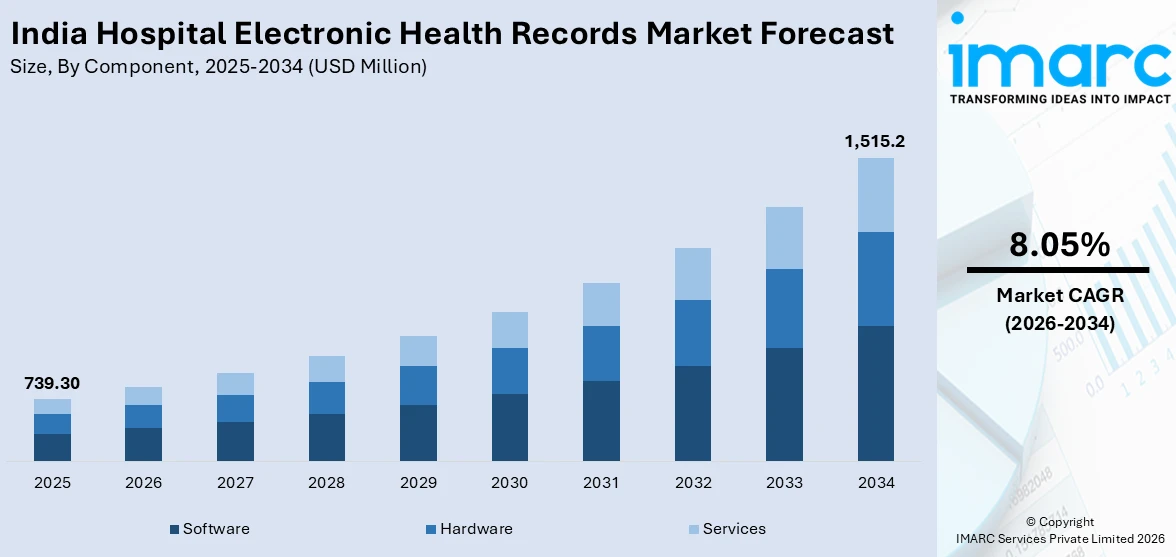
The India hospital electronic health records market size was valued at USD 739.30 Million in 2025 and is projected to reach USD 1,515.2 Million by 2034, growing at a compound annual growth rate of 8.05% from 2026-2034.
The India hospital electronic health records market is moving forward at a rapid pace as hospitals in the country are adopting digital transformation to enhance patient outcomes and operational efficiency. Digitization initiatives led by the government, growing hospital infrastructure, and the increasing need for an interoperable health data management system are driving the adoption of EHRs in the country. Growing investments in health IT, the rising importance of telemedicine and remote care delivery, and the need for standardized patient records are all contributing to the transformation of healthcare delivery models and improving the India hospital electronic health records market share.
Key Takeaways and Insights:
- By Component: Software dominates the market with a share of 52.7% in 2025, driven by rising demand for integrated clinical workflow solutions, AI-powered analytics, and interoperable platforms across Indian hospitals.
- By Deployment: Cloud-based lead the market with a share of 58.9% in 2025, fueled by scalability, cost-efficiency, and remote accessibility advantages attracting healthcare providers nationwide.
- By Type: Interoperable EMRs hold the largest share at 46.3% in 2025, reflecting the growing emphasis on standardized health data exchange and national digital health interoperability frameworks.
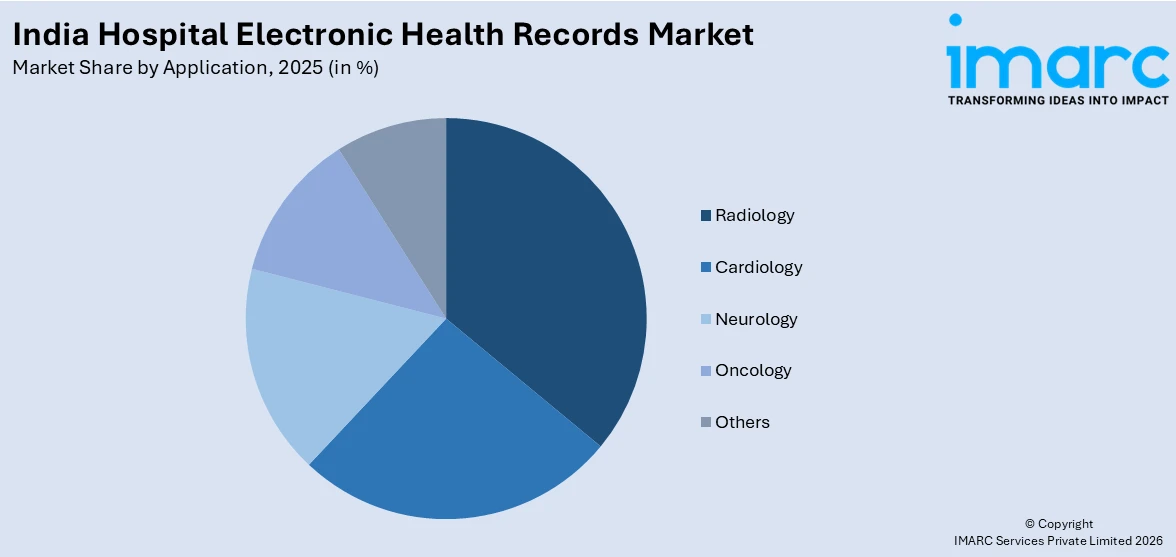
- By Application: Radiology leads the market with a share of 24.8% in 2025, supported by increasing diagnostic imaging volumes and demand for digital image management and reporting systems.
- By Region: South India dominates the market with a share of 33.6% in 2025, underpinned by advanced healthcare infrastructure, higher hospital density, and stronger digital health adoption rates.
- Key Players: The India hospital electronic health records market features a dynamic competitive landscape with established multinational vendors, domestic health-tech startups, and regional software developers competing across price segments and clinical specialties.
To get more information on this market Request Sample
The India hospital EHR market is undergoing a transformation as the healthcare industry shifts from paper records to a digital health platform. Hospitals and healthcare institutions are adopting EHR systems to manage patient information in a centralized manner and ensure regulatory requirements. According to reports, the National Health Authority integrated the Ayushman Bharat Digital Mission with the Aarogya Setu application, enabling users to create digital health IDs and link hospital records, prescriptions, and diagnostic reports, allowing healthcare providers to securely access and share patient health information across facilities. The government's focus on developing a digital health platform through targeted digitization efforts has accelerated the adoption of EHR systems in the country. Cloud-based solutions, AI-based clinical solutions, and data exchange solutions are expected to be key enablers in the adoption of EHR systems, while the growing prevalence of chronic diseases and the expansion of hospital capacity are expected to drive the adoption of advanced health record management solutions.
India Hospital Electronic Health Records Market Trends:
Accelerating Government-Led Digital Health Infrastructure
The Indian government, both at the national and state levels, is making efforts to develop a complete digital health ecosystem that will facilitate smooth adoption of EHRs in hospitals. The national policies developed to ensure interoperability of health records and data sharing are contributing to a favorable environment for the digital transformation of hospitals. For instance, under the Ayushman Bharat Digital Mission (ABDM), the government reported that over 79.71 crore Ayushman Bharat Health Accounts (ABHA) had been created and approximately 65.09 crore health records linked as of July 2025, enabling interoperable digital access and exchange of patient medical histories across healthcare providers. These efforts are developing the necessary architecture for scaling the EHR system in hospitals and fueling the growth of the India hospital electronic health records market.
Rising Integration of Artificial Intelligence in Clinical Workflows
Hospitals across India are increasingly incorporating AI-driven functionalities into their electronic health record systems to enhance clinical documentation, streamline diagnostic processes, and support evidence-based treatment decisions. For instance, in March 2025, Apollo Hospitals announced expanded deployment of AI tools capable of analyzing electronic medical records, transcribing doctor observations, and automatically generating discharge summaries to reduce clinician workload and improve operational efficiency. Intelligent automation of routine administrative tasks, natural language processing for clinical note generation, and predictive analytics for patient risk assessment are becoming integral components of modern EHR platforms, enabling healthcare providers to improve both care quality and operational productivity.
Expanding Adoption of Cloud-Based EHR Platforms
The shift toward cloud-hosted electronic health record solutions is gaining significant momentum among Indian hospitals seeking scalable, cost-effective, and remotely accessible health information systems. Cloud-based EHR platforms enable healthcare organizations to reduce upfront infrastructure investments while facilitating real-time data access, multi-location interoperability, and enhanced disaster recovery capabilities. For instance, in November 2025, Apollo Hospitals migrated its hospital information system and electronic medical record platform to Microsoft Azure cloud infrastructure to improve scalability, security, and system performance, achieving 99.95% uptime and significantly enhancing operational resilience across its hospital network. This transition enabled the hospital network to modernize its digital infrastructure and support future innovation through flexible and scalable cloud architecture.
Market Outlook 2026-2034:
The India hospital electronic health records market is positioned for sustained expansion, driven by continued government investment in digital health infrastructure, growing hospital IT spending, and rising demand for patient-centric care delivery models. Technological advancements in AI-powered clinical tools, enhanced interoperability standards, and expanding telemedicine ecosystems are expected to further accelerate market development. Increasing integration of health records with insurance platforms and growing emphasis on data-driven healthcare management are anticipated to create new revenue streams and foster a more connected, efficient, and digitally mature hospital ecosystem across the country. The market generated a revenue of USD 739.30 Million in 2025 and is projected to reach a revenue of USD 1,515.2 Million by 2034, growing at a compound annual growth rate of 8.05% from 2026-2034.
India Hospital Electronic Health Records Market Report Segmentation:
|
Segment Category |
Leading Segment |
Market Share |
|
Component |
Software |
52.7% |
|
Deployment |
Cloud-based |
58.9% |
|
Type |
Interoperable EMRs |
46.3% |
|
Application |
Radiology |
24.8% |
|
Region |
South India |
33.6% |
Component Insights:
- Hardware
- Software
- Services
The software dominates with a market share of 52.7% of the total India hospital electronic health records market in 2025.
The software segment’s leadership is underpinned by the growing demand for comprehensive digital platforms that integrate clinical documentation, order management, and patient engagement functionalities. Hospitals across India are investing in EHR software solutions that offer specialty-specific templates, multilingual prescription capabilities, and AI-powered clinical decision support tools. The increasing availability of modular software architectures allows facilities to customize implementations according to their departmental needs, clinical workflows, and patient volume requirements.
Furthermore, the expansion of subscription-based and software-as-a-service pricing models is democratizing access to sophisticated EHR platforms, particularly for mid-sized hospitals and standalone clinics. The integration of analytics dashboards, population health management tools, and regulatory compliance modules within EHR software is strengthening clinical governance and enabling data-driven hospital management decisions, reinforcing the segment’s dominant market position.
Deployment Mode Insights:
- Cloud-based
- On-premises
The cloud-based leads with a market share of 58.9% of the total India hospital electronic health records market in 2025.
Cloud-based EHR deployment has become the preferred choice for Indian hospitals seeking scalable, cost-efficient, and remotely accessible health information management solutions. The flexibility offered by cloud platforms allows healthcare providers to scale operations without significant capital expenditure on physical IT infrastructure. Multi-location hospital networks benefit particularly from centralized cloud-based systems that enable consistent data access, real-time synchronization, and streamlined inter-facility communication. Government programs promoting digital health adoption have further accelerated the transition to cloud-hosted platforms.
The benefits of cloud-based deployment go beyond the cost-effectiveness and include benefits such as improved data security, software updates, and disaster recovery. The Indian healthcare industry is slowly realizing the benefits of cloud-based environments for hospitals, such as reduced IT maintenance and shorter implementation times. With the continued improvement of internet connectivity in the country, the adoption of cloud-based EHR systems is also expected to penetrate semi-urban and rural healthcare setups.
Type Insights:
- Interoperable EMRs
- Speech enabled EMRs
- Traditional EMRs
- Others
The interoperable EMRs leads with a share of 46.3% of the total India hospital electronic health records market in 2025.
The dominance of interoperable electronic medical record systems reflects the healthcare sector’s growing emphasis on standardized data exchange and connected care delivery. National digital health frameworks mandating health data interoperability are compelling hospitals to adopt EMR systems capable of seamless communication with external registries, laboratories, pharmacies, and insurance platforms. Interoperable systems enable clinicians to access comprehensive patient histories across healthcare touchpoints, improving diagnostic accuracy and treatment coordination.
The push toward interoperability is further reinforced by accreditation bodies establishing digital health standards that require hospitals to demonstrate health information exchange capabilities. As hospital networks expand through mergers and multi-location chains, the need for unified patient records accessible across affiliated facilities is intensifying demand for interoperable EMR solutions, solidifying this segment’s market leadership.
Application Insights:
Access the comprehensive market breakdown Request Sample
- Cardiology
- Neurology
- Oncology
- Radiology
- Others
The radiology dominates with a market share of 24.8% of the total India hospital electronic health records market in 2025.
The radiology segment’s market leadership is driven by the high volume of diagnostic imaging procedures performed across Indian hospitals and the critical need for digital image storage, retrieval, and reporting capabilities. Electronic health record systems with integrated picture archiving and communication system functionalities enable radiologists to manage large volumes of imaging data efficiently while facilitating seamless image sharing with referring physicians across departments and facilities.
The increasing adoption of advanced imaging modalities, growing prevalence of chronic diseases requiring frequent diagnostic monitoring, and expanding tele-radiology services are further boosting demand for EHR solutions tailored to radiology workflows. Integration of artificial intelligence tools for automated image analysis and preliminary reporting within radiology EHR modules is enhancing diagnostic throughput and accuracy, strengthening the segment’s position.
Regional Insights:
- North India
- South India
- East India
- West India
South India exhibits a clear dominance with a 33.6% share of the total India hospital electronic health records market in 2025.
The hospital EHR market in South India leads the way in terms of market share due to the well-established private healthcare infrastructure, advanced IT infrastructure, and high presence of multispecialty hospitals in the states of Karnataka, Tamil Nadu, Telangana, and Kerala. The region has access to the top healthcare technology hubs that act as innovation hubs for health IT and EHR software development. The support of the government for digital health initiatives has also fueled the adoption of EHRs.
The combination of high healthcare expenditure, tech-savvy healthcare providers, and progressive adoption of digital health initiatives positions South India as the frontrunner in hospital EHR implementation. The region's hospitals are among the earliest adopters of cloud-based EHR systems, AI-integrated clinical tools, and interoperable health data exchange platforms. Growing patient awareness about digital health records and the expansion of telemedicine services continue to reinforce South India's leadership in the national hospital electronic health records market.

Market Dynamics:
Growth Drivers:
Why is the India Hospital Electronic Health Records Market Growing?
Government-Led Digital Health Transformation Initiatives
The Indian government's continued focus on developing a national digital health infrastructure is thus proving to be the key driving force behind the adoption of EHR systems in hospitals. The national digitization initiatives are thus laying the basic framework for the development of interoperable electronic health records in the country by establishing essential registries that facilitate the creation of essential digital identities for seamless sharing of data between healthcare facilities. For instance, as of December 2024, more than 68.97 crore Ayushman Bharat Health Accounts (ABHA) had been created, over 3.49 lakh health facilities registered, and 45.37 crore health records linked under the Ayushman Bharat Digital Mission, enabling interoperable digital health records across India’s healthcare ecosystem. Incentivization plans for hospitals, labs, and clinics to adopt digital health solutions are also accelerating the process.
Rising Healthcare Expenditure and Hospital Infrastructure Expansion
India's healthcare sector is experiencing significant growth driven by increasing public and private investment in hospital infrastructure, medical technology, and health service delivery. The expansion of multispecialty hospital chains, corporate healthcare groups, and specialty care facilities across metropolitan and tier-2 cities is creating substantial demand for integrated EHR systems that support complex, multi-departmental clinical operations. Rising healthcare expenditure, combined with the growing prevalence of chronic diseases requiring long-term patient data management, is compelling healthcare organizations to invest in sophisticated digital record-keeping systems that improve care continuity and clinical outcomes.
Technological Advancements in AI, Cloud Computing, and Interoperability
The pace of technological change in the areas of artificial intelligence, cloud technology, and health data interoperability standards is adding immense value to the capabilities of contemporary EHR systems. AI-based systems are making hospital workflows more efficient and less administrative in nature through the use of generative AI, ambient documentation, and intelligent clinical decision support. For instance, in February 2025, the World Economic Forum launched the India Digital Health Activator in collaboration with the Government of India and industry stakeholders to establish regional hubs that pilot and scale digital health solutions, including AI-driven diagnostics, interoperable health data exchange, and integrated digital health ecosystems. Public-private collaborations are driving the adoption of digital health by developing regional centers to pilot and scale healthcare technologies such as interoperable EHR systems. The increasing intersection of AI, cloud technology, and health data interoperability standards is propelling the EHR ecosystem in Indian hospitals.
Market Restraints:
What Challenges the India Hospital Electronic Health Records Market is Facing?
Data Security and Privacy Vulnerabilities
The protection of sensitive patient information remains a significant concern for healthcare organizations implementing EHR systems in India. Cybersecurity threats targeting digital health infrastructure, combined with evolving regulatory requirements around data privacy, create complexities for hospitals seeking to fully digitize their record-keeping processes. The absence of a mature, universally enforced data protection framework specific to healthcare adds to institutional hesitancy, particularly among smaller facilities with limited IT security capabilities.
Interoperability and System Integration Challenges
Achieving seamless data exchange between disparate EHR systems remains a persistent challenge in India’s fragmented healthcare landscape. The lack of universally adopted interoperability standards, coupled with the prevalence of legacy health information systems across many hospitals, hinders the efficient transfer of patient data between providers. These integration barriers limit the full realization of coordinated care delivery and restrict the development of comprehensive longitudinal patient health records.
High Implementation Costs and Digital Literacy Gaps
The initial capital investment required for the implementation of EHR systems, such as the purchase of hardware and software, training of personnel, and redesigning of workflows, is a major hindrance for many hospitals in India. Smaller healthcare facilities and those in resource-poor settings do not have the financial resources to invest in EHR systems. Furthermore, the digital literacy of healthcare professionals, especially in rural and semi-urban regions, may act as a barrier to the efficient use of EHR systems.
Competitive Landscape:
The India hospital EHR market is being driven by increasing competition among international technology companies, existing health IT companies, and new Indian health tech startups. Companies are differentiating themselves through AI-enabled capabilities, cloud-native platform development, better interoperability solutions, and customized clinical workflow solutions. Partnerships with hospital groups, R&D investments, and expansion into tier-2 and tier-3 cities are emerging as important competitive moves in the market. Increasing focus on adherence to the country’s digital health standards and compatibility with government health registries is also influencing the competitive landscape, as companies that can show seamless alignment with the country’s evolving health standards are gaining a substantial competitive edge in securing large-scale deployment contracts.
Recent Developments:
-
In August 2025, Narayana Health launched “Aira,” an AI-powered documentation tool integrated with its Athma electronic medical records platform. The solution automates clinical documentation, reduces physician administrative workload, and improves workflow efficiency. It enables faster diagnosis, enhances patient care quality, and allows doctors to manage more patients efficiently, strengthening hospital adoption of advanced EMR technologies in India.
India Hospital Electronic Health Records Market Report Coverage:
|
Report Features |
Details |
|
Base Year of the Analysis |
2025 |
|
Historical Period |
2020-2025 |
|
Forecast Period |
2026-2034 |
|
Units |
Million USD |
|
Scope of the Report |
Exploration of Historical Trends and Market Outlook, Industry Catalysts and Challenges, Segment-Wise Historical and Future Market Assessment:
|
|
Components Covered |
Hardware, Software, Services |
|
Deployments Covered |
Cloud-based, On-premises |
|
Types Covered |
Interoperable EMRs, Speech enabled EMRs, Traditional EMRs, Others |
|
Applications Covered |
Cardiology, Neurology, Oncology, Radiology, Others |
|
Regions Covered |
North India, South India, East India, West India |
|
Customization Scope |
10% Free Customization |
|
Post-Sale Analyst Support |
10-12 Weeks |
|
Delivery Format |
PDF and Excel through Email (We can also provide the editable version of the report in PPT/Word format on special request) |
Frequently Asked Questions About the India Hospital Electronic Health Records Market Report
The India hospital electronic health records market size was valued at USD 739.30 Million in 2025.
The India hospital electronic health records market is expected to grow at a compound annual growth rate of 8.05% from 2026-2034 to reach USD 1,515.2 Million by 2034.
Software holds the largest share at 52.7%, driven by the growing demand for integrated clinical workflow platforms, AI-powered analytics, and interoperable digital health solutions across Indian hospitals.
Key factors driving the India hospital electronic health records market include government digital health transformation initiatives, rising healthcare expenditure, expanding hospital infrastructure, increasing AI and cloud technology adoption, and growing demand for interoperable patient data management systems.
Major challenges include data security and privacy vulnerabilities, interoperability and system integration barriers across fragmented healthcare networks, high implementation costs for smaller facilities, digital literacy gaps among healthcare professionals, and limited standardized regulatory frameworks for health data protection.
Need more help?
- Speak to our experienced analysts for insights on the current market scenarios.
- Include additional segments and countries to customize the report as per your requirement.
- Gain an unparalleled competitive advantage in your domain by understanding how to utilize the report and positively impacting your operations and revenue.
- For further assistance, please connect with our analysts.
 Request Customization
 Speak to an Analyst
 Request Brochure
 Inquire Before Buying
Benefits of Customization
- Personalize this research
- Triangulate with your data
- Get data as per your format and definition
- Gain a deeper dive into a specific application, geography, customer, or competitor
- Any level of personalization
Get in Touch With Us
UNITED STATES
Phone: +1-201-971-6302
INDIA
Phone: +91-120-433-0800
UNITED KINGDOM
Phone: +44-753-714-6104
Email: [email protected]
Client Testimonials




.webp)




.webp)













Related Reports

Choose your plan
*Please note that the prices mentioned below are starting prices for each bundle type. Kindly contact our team for further details.*
Single User License
- 1 User License, Access on 2 Devices
- PDF Report + Excel Dataset (Password Protected)
- Lifetime Access
- No Printing Rights
- 10% Free Report Customization
- 10–12 Weeks of Analyst Support
Five User License
- Access for 5 Users, 2 Devices per User
- PDF Report + Excel Dataset (Password Protected)
- Lifetime Access
- Dedicated Account Manager
- 12–14 Weeks of Analyst Support
- No Printing Rights
- 15% Free Report Customization
- 25% Discount on Your Next Purchase
Corporate User License
- Unlimited User Access (Within Your Organization)
- PDF Report + Excel Dataset
- Lifetime Access
- Dedicated Account Manager
- 14–20 Weeks of Analyst Support
- No Printing Rights
- 20% Free Report Customization
- 30% Discount on Your Next Purchase
Essential Insights
What's included:
3 reports
- Lifetime Access
- PDF Reports
- Excel Datasets
- 2 Weeks of Free Analyst Support
- 2 User Licenses
- Access on 2 Devices
- Printing Rights
- Complimentary PowerPoint (PPT) Version
- Complimentary License Upgrade
Professional Access
What's included:
5 reports
- Lifetime Access
- PDF Reports
- Excel Datasets
- 8 Weeks of Free Analyst Support
- 2 User Licenses
- Access on 2 Devices
- Printing Rights
- Complimentary PowerPoint (PPT) Version
- Complimentary License Upgrade
Business Advantage
What's included:
8 reports
- Lifetime Access
- PDF Reports
- Excel Datasets
- 14 Weeks of Free Analyst Support
- 2 User Licenses
- Access on 2 Devices
- Printing Rights
- Complimentary PowerPoint (PPT) Version
- Complimentary License Upgrade
Enterprise Intelligence
What's included:
10 reports
- Lifetime Access
- PDF Reports
- Excel Datasets
- 20 Weeks of Free Analyst Support
- 2 User Licenses
- Access on 2 Devices
- Printing Rights
- Complimentary PowerPoint (PPT) Version
- Complimentary License Upgrade