
India Hydraulic Cylinders Market Size, Share, Trends and Forecast by Function, Type, Bore Size, Application, End-Use Industry, and Region, 2026-2034
India Hydraulic Cylinders Market Size, Share, Trends & Forecast (2026-2034)
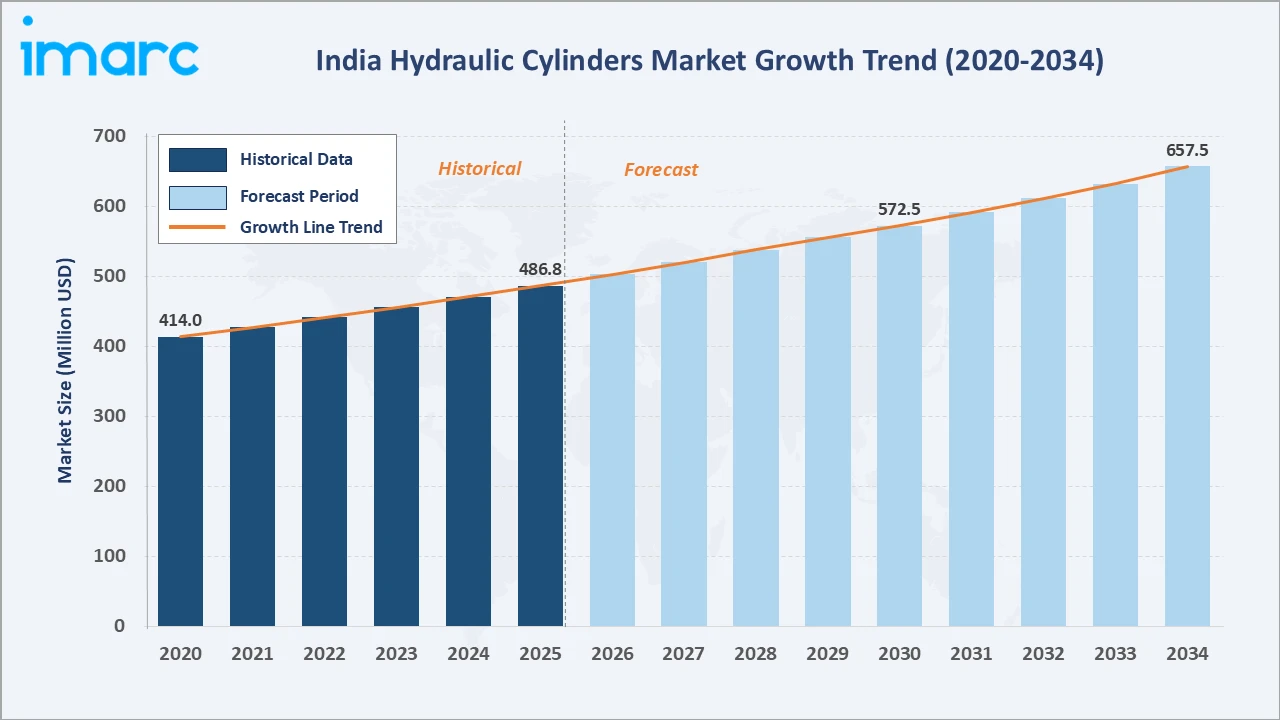
The India hydraulic cylinders market grew from USD 486.8 Million in 2025 to USD 507.4 Million in 2026 and is projected to reach USD 657.5 Million by 2034, exhibiting a CAGR of 3.29% during 2026-2034. India's hydraulic cylinders sector is underpinned by the National Infrastructure Pipeline (NIP) committing INR 111 lakh crore to roads, urban infrastructure, and railways that requires excavators, cranes, dump trucks, and concrete equipment deploying hydraulic cylinders as primary actuation components; the agricultural mechanization wave support translating into new tractor sales each equipped with front loader, backhoe, and implement cylinders, and India's manufacturing sector expansion under Make in India creating industrial press, injection molding machine, and material handling cylinder demand. The 50-150 MM bore size leads at 48.6%, mobile application dominates at 67.9%, and West India accounts for the largest regional share at 33.7%.
Market Snapshot
|
Metric |
Value |
|
Base Year Market Size (2025) |
USD 486.8 Million |
| Market Size (2026) | USD 507.4 Million |
|
Forecast Market Size (2034) |
USD 657.5 Million |
|
CAGR (2026-2034) |
3.29% |
|
Base Year |
2025 |
|
Historical Period |
2020-2025 |
|
Forecast Period |
2026-2034 |
|
Dominant Bore Size |
50-150 MM – 48.6% (2025) |
|
Dominant Application |
Mobile – 67.9% (2025) |
|
Leading Region |
West India – 33.7% (2025) |
The India hydraulic cylinders market expanded from USD 414.0 Million in 2020 to USD 486.8 Million in 2025 and an estimated USD 507.4 Million in 2026, driven by post-COVID construction equipment demand rebound, record tractor sales, mining sector capex, and the Indian government's capex push on highways. The market is projected to reach USD 572.5 Million by 2030 and USD 657.5 Million by 2034.
To get more information on this market, Request Sample
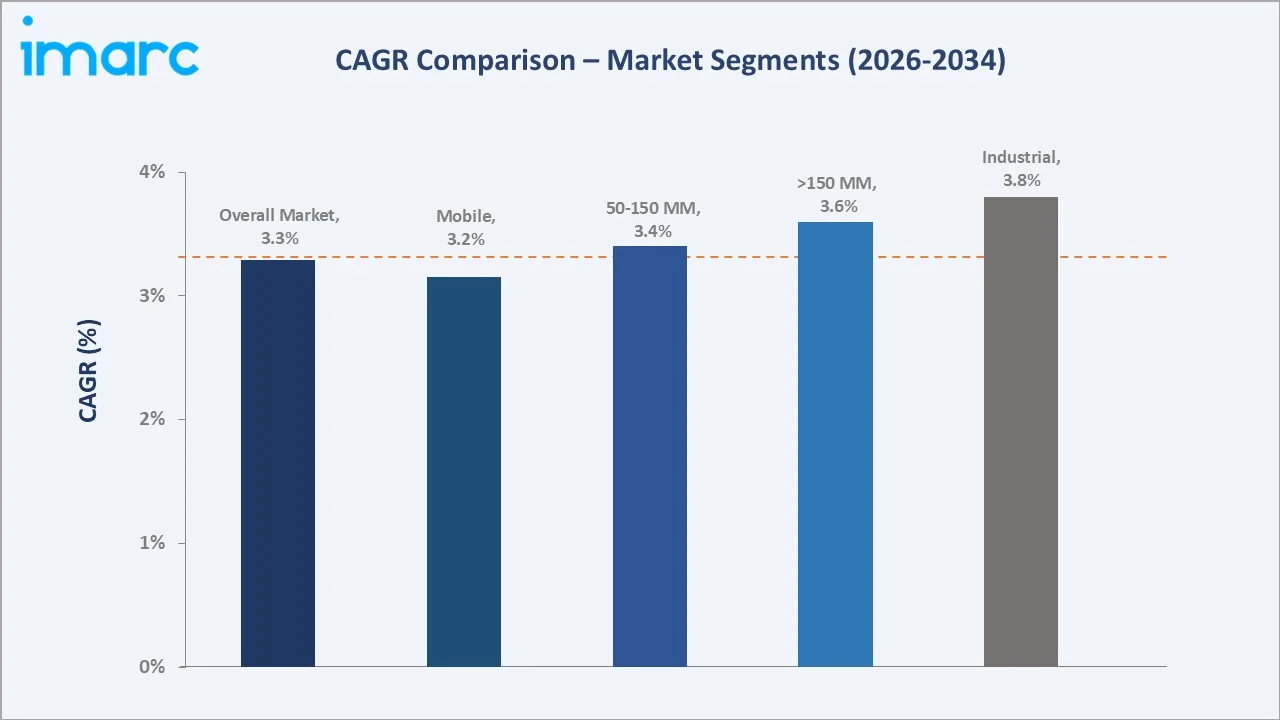
Industrial applications grow fastest at ~3.80% CAGR through press machines, material handling, and manufacturing automation. Large bore >150 MM cylinders grow at ~3.60% CAGR through heavy mining, dam construction, and steel plant hydraulic presses. Mid bore 50-150 MM grows at ~3.40% CAGR as the dominant segment. Mobile applications grow at ~3.15% CAGR, sustained by construction equipment and tractor cylinder volume.
Executive Summary
India hydraulic cylinder market is a foundational segment of the country's industrial machinery ecosystem, supplying the linear actuation force that enables excavators to dig, tractors to lift, cranes to position loads, presses to form metal, and injection molding machines to clamp molds across India's expanding manufacturing economy. Unlike many industrial equipment categories where electrification and digitalization are rapidly displacing incumbent technologies, hydraulic cylinders retain enduring commercial advantage in high-force, high-duty-cycle applications where electric linear actuators cannot economically match the power density, robustness, and cost-per-Newton of hydraulic actuation, ensuring sustained demand through 2034 across India's infrastructure-intensive and agriculture-heavy economy.
The 50-150 MM bore size segment at 48.6% (2025) serves the broadest range of India's hydraulic cylinder applications, encompassing tractor front loader cylinders, excavator boom and arm cylinders, and industrial hydraulic press cylinders. Mobile applications' 67.9% majority reflects the extraordinary scale and growth of India's construction equipment market and the structural permanence of tractor hydraulics.
Key Market Insights
|
Insight |
Data |
|
Dominant Bore Size |
50-150 MM – 48.6% share (2025) |
|
Dominant Application |
Mobile – 67.9% share (2025) |
|
Leading Region |
West India – 33.7% share (2025) |
|
Market Opportunity |
Electro-hydraulic smart cylinder retrofit for older mobile equipment fleets; agricultural precision hydraulics for GPS-guided tractors and farm automation; large-bore mining cylinder import substitution with domestic manufacturing; hydraulic cylinder MRO/remanufacturing services for India's aging construction equipment fleet |
Key Analytical Observations Supporting the Above Data:
- 50-150 MM Bore at 48.6% (2025): The 50-150 mm bore range is India's most commercially significant hydraulic cylinder category because it spans the actuation force range required by the largest volume applications in India's mobile equipment and mid-capacity industrial machinery.
- Mobile Application at 67.9% (2025): Mobile hydraulic cylinders, defined as cylinders installed on self-propelled or towed equipment operating across varied terrain and weather conditions, command the market majority through the combined demand from India's construction equipment fleet, agricultural tractor and implement fleet, commercial vehicle tipping and crane applications, and specialized mobile equipment in mining and forestry.
- West India at 33.7% (2025): West India leads the market, supported by strong automotive, engineering, construction equipment, chemicals, and industrial machinery activity across Maharashtra and Gujarat.
India Hydraulic Cylinders Market Overview
The India hydraulic cylinders market encompasses hydraulic actuation systems used across construction equipment, agricultural machinery, material handling, automotive, mining, industrial machinery, and infrastructure applications. It includes single-acting, double-acting, telescopic, and welded hydraulic cylinders designed for linear force and motion control. The market covers both OEM installations and replacement demand across mobile and industrial equipment. Macroeconomic factors include India’s expanding infrastructure investment, manufacturing growth, rising construction and mining activity, and increasing mechanization across agriculture and material handling.
Market Dynamics
To evaluate market opportunities, Request Sample
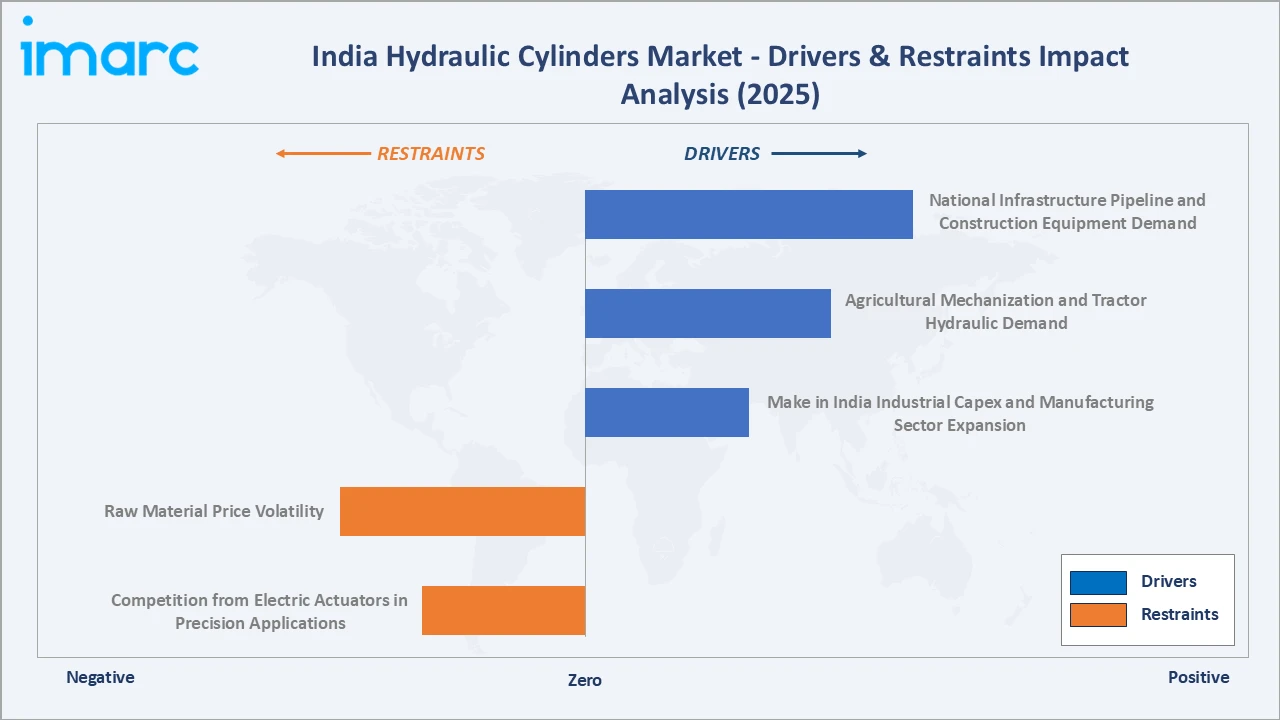
Market Drivers
- National Infrastructure Pipeline and Construction Equipment Demand: The National Infrastructure Pipeline (NIP) with a projected investment of INR 111 lakh crore (USD 1.5 trillion) for the 2020–2025 period for energy, roads, urban infrastructure, and railways, creates the most sustained multi-year construction equipment demand pipeline in India's history. Each kilometer of highway construction consumes 8-12 excavators operating for 100-150 work days, each excavator incorporating 8-12 hydraulic cylinders requiring replacement at 3,000-5,000 hour intervals, creating recurring replacement cylinder demand that adds to the new equipment cylinder content from expanding fleet size.
- Agricultural Mechanization and Tractor Hydraulic Demand: India's agricultural sector is in structural transition toward mechanized operations driven by rural labor shortages, PM-KISAN direct income support of INR 6,000/year to farmers, and crop insurance incentivizing investment in quality inputs. India's tractor market is not only the world's largest by volume but also the primary single application driving India's hydraulic cylinder demand. Each tractor incorporates 4-8 hydraulic cylinders: the three-point linkage draft control cylinder, hydraulic power steering cylinder, front axle swing cylinder, front loader arm and tilt cylinders, and backhoe attachment cylinders.
- Make in India Industrial Capex and Manufacturing Sector Expansion: India's manufacturing sector expansion under PLI (Production Linked Incentive) schemes across 14 sectors is creating industrial press, injection molding machine, and material handling equipment capacity addition that drives industrial hydraulic cylinder demand. PLI scheme-linked electronics manufacturing is constructing factory buildings using tower cranes and concrete pumps; PLI pharmaceutical manufacturing is installing packaging press lines; PLI food processing is deploying fruit/vegetable processing presses; and PLI automotive components is expanding auto part forging and stamping capacity, all requiring hydraulic cylinder-equipped machinery.
Market Restraints
- Raw Material Price Volatility: Fluctuations in the prices of steel, aluminum, seals, and other key inputs increase production costs for hydraulic cylinder manufacturers. Unpredictable material costs can compress profit margins and make product pricing difficult, particularly for fixed-price contracts. This volatility also affects smaller manufacturers with limited purchasing power and inventory flexibility.
- Competition from Electric Actuators in Precision Applications: Electric actuators are increasingly preferred in applications requiring precise positioning, clean operation, and easy integration with automated control systems. Their lower maintenance requirements and energy efficiency can reduce the attractiveness of hydraulic cylinders in certain factory automation and robotics applications. This trend may limit hydraulic cylinder demand in high-precision, light- to medium-load use cases.
Market Opportunities
- Large-Bore Import Substitution for Mining and Steel: Growing demand for heavy-duty, large-bore hydraulic cylinders in India’s mining and steel industries creates opportunities for domestic manufacturing to replace imported systems. Local production can reduce lead times, import dependence, and lifecycle costs while improving access to customized engineering and after-sales support. Expansion of mining equipment and steel capacity further strengthens this investment opportunity.
- Electro-Hydraulic Smart Cylinder Retrofit Market: The modernization of existing industrial equipment creates opportunities to retrofit conventional hydraulic cylinders with sensors, electronic controls, and condition-monitoring capabilities. Smart retrofits can enable real-time position monitoring, predictive maintenance, and improved operational efficiency without requiring complete equipment replacement. Growing Industry 4.0 adoption across manufacturing, steel, mining, and material handling is expected to support this opportunity.
Market Challenges
- Fragmented Domestic Supply Base and Quality Inconsistency: The presence of numerous small and regional hydraulic cylinder manufacturers creates variations in product quality, material standards, and manufacturing precision. Inconsistent sealing, machining, and testing practices can reduce reliability and increase equipment downtime. This fragmentation makes it challenging for end users to identify standardized, high-quality suppliers, particularly for critical heavy-duty applications.
- Leakage, Seal Failure, and Maintenance Issues: Hydraulic cylinders operate under high pressure and demanding environmental conditions, making seal wear and fluid leakage recurring concerns. Poor maintenance can reduce efficiency, contaminate surrounding equipment, and cause unplanned downtime. End users increasingly require durable sealing technologies and preventive maintenance programs.
Emerging Market Trends
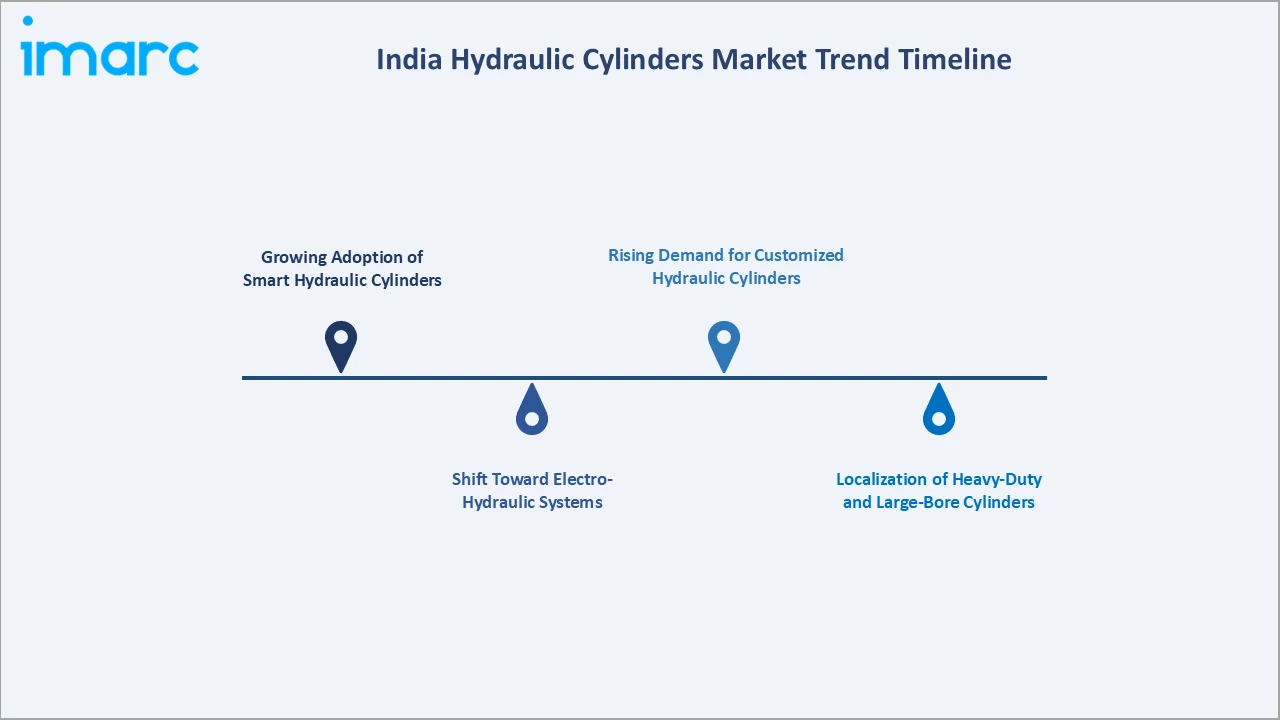
1. Growing Adoption of Smart Hydraulic Cylinders
Hydraulic cylinders are increasingly being integrated with position sensors, pressure sensors, and electronic control systems. These technologies enable real-time performance monitoring, accurate positioning, and predictive maintenance. Smart cylinders are gaining relevance across automated manufacturing and heavy machinery. Industry 4.0 adoption is expected to further accelerate this trend.
2. Shift Toward Electro-Hydraulic Systems
Electro-hydraulic technology is gaining traction by combining the high-force capability of hydraulics with electronic precision and control. These systems can improve responsiveness, energy management, and automation compatibility. Adoption is increasing in material handling, industrial machinery, and mobile equipment. The trend is encouraging manufacturers to develop electronically controlled cylinder solutions.
3. Localization of Heavy-Duty and Large-Bore Cylinders
Indian manufacturers are increasingly focusing on domestic production of large-bore and heavy-duty hydraulic cylinders previously dependent on imports. In August 2024, Wipro Hydraulics inaugurated a state-of-the-art hydraulic cylinder and component manufacturing facility in Mahindra World City, Jaipur. The plant marks the company’s first hydraulics manufacturing unit in Northern India and is designed to supply hydraulic cylinders to customers in both domestic and international markets. Localization can shorten delivery times and improve customization and aftermarket support. Make in India initiatives are further encouraging domestic manufacturing capabilities.
4. Rising Demand for Customized Hydraulic Cylinders
OEMs increasingly require hydraulic cylinders tailored to specific pressure, stroke, mounting, load, and environmental requirements. Customized solutions are gaining importance across construction machinery, agricultural equipment, material handling, and industrial automation. Manufacturers are strengthening engineering and design capabilities to address application-specific requirements. This trend supports greater differentiation among domestic suppliers.
Industry Value Chain Analysis
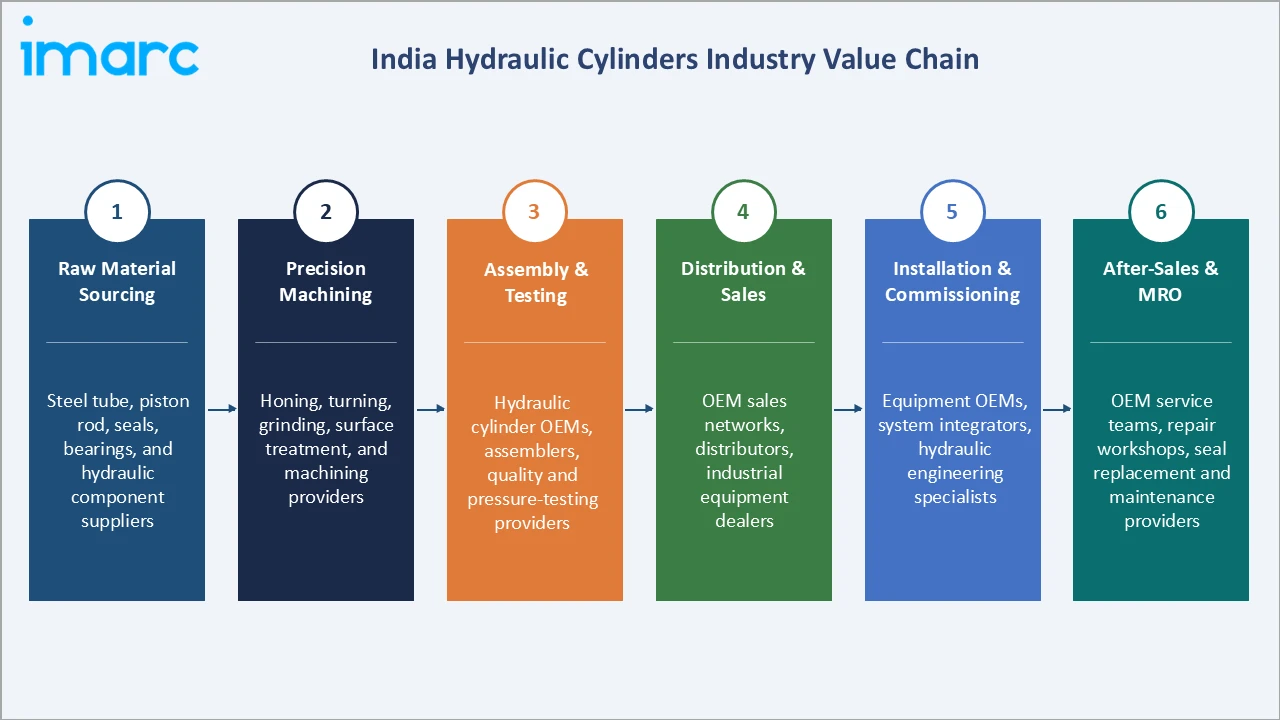
The India hydraulic cylinders value chain encompasses raw material procurement, precision machining, sealing and finishing, testing and quality assurance, OEM and aftermarket distribution, and maintenance and remanufacturing services.
|
Stage |
Key Participants |
|
Raw Material Sourcing |
Steel tube, piston rod, seals, bearings, and hydraulic component suppliers. |
|
Precision Machining |
Honing, turning, grinding, surface treatment, and machining providers. |
|
Assembly & Testing |
Hydraulic cylinder OEMs, assemblers, quality and pressure-testing providers. |
|
Distribution & Sales |
OEM sales networks, distributors, industrial equipment dealers. |
|
Installation & Commissioning |
Equipment OEMs, system integrators, hydraulic engineering specialists. |
|
After-Sales & MRO |
OEM service teams, repair workshops, seal replacement and maintenance providers. |
Precision machining is the most value-added stage in the India hydraulic cylinders value chain, as it directly determines cylinder accuracy, durability, sealing performance, and operational reliability. Advanced honing, grinding, surface treatment, and tight-tolerance machining are critical for high-pressure applications. Strong machining capabilities also enable customization for mining, construction, steel, and industrial machinery applications.
Technology Landscape in the India Hydraulic Cylinders Industry
Electro-Hydraulic Control Technology
Electro-hydraulic systems combine hydraulic power with electronic controls to improve cylinder movement, positioning, and responsiveness. Proportional and servo valves enable more precise control of pressure and flow. The technology is increasingly relevant for automated machinery and material handling equipment. It also supports integration with modern industrial control systems.
Advanced Sealing Technology
High-performance sealing systems are used to minimize hydraulic fluid leakage and maintain pressure under demanding operating conditions. Modern seal materials provide improved resistance to heat, abrasion, chemicals, and high pressures. These technologies extend cylinder service life and reduce maintenance requirements. They are particularly important in mining, steel, construction, and heavy machinery.
Precision Honing and Machining Technology
Advanced CNC machining, honing, grinding, and finishing technologies enable manufacturers to achieve tight dimensional tolerances. High precision improves sealing performance, reduces internal leakage, and supports smooth cylinder movement. Automated machining also improves manufacturing consistency and productivity. The technology is essential for high-pressure and customized hydraulic cylinders.
Market Segmentation Analysis
The report covers the following segments:
|
Segment Category |
Leading Segment |
Market Share |
Year |
|
Function |
🔒 |
🔒 |
2025 |
|
Type |
🔒 |
🔒 |
2025 |
|
Bore Size |
50–150 MM |
48.6% |
2025 |
|
Application |
Mobile |
67.9% |
2025 |
|
End-Use Industry |
🔒 |
🔒 |
2025 |
|
Region |
West India |
33.7% |
2025 |

By Bore Size
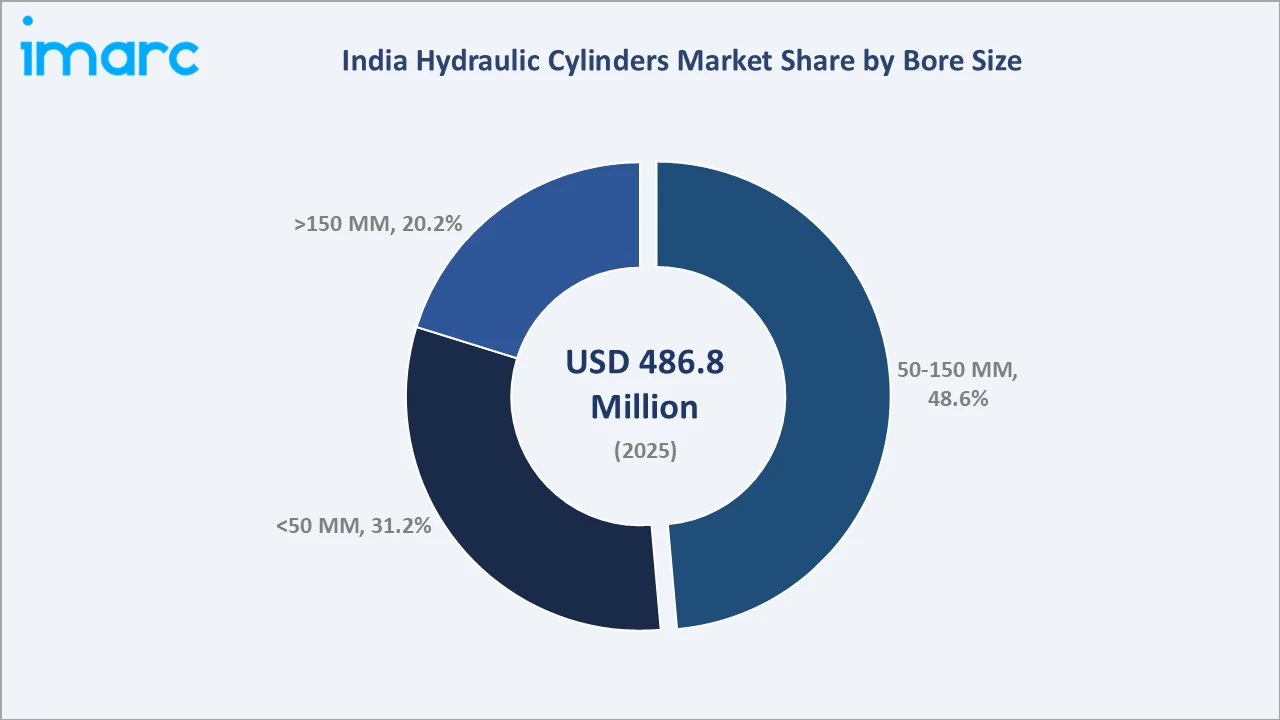
50-150 MM bore leads at 48.6% (2025) as the dominant versatile mid-range category serving tractors, compact excavators, and mid-capacity industrial presses.
To access detailed market analysis, Request Sample
<50 MM bore at 31.2% serves light-duty agricultural implements, compact material handling, and industrial clamping fixtures. >150 MM bore at 20.2% is growing at ~3.60% CAGR through mining, steel, and heavy infrastructure hydraulic systems.
By Application
Mobile leads at 67.9% (2025) through construction equipment, tractor/agricultural machinery, commercial vehicle tipping, and mobile crane cylinder demand.
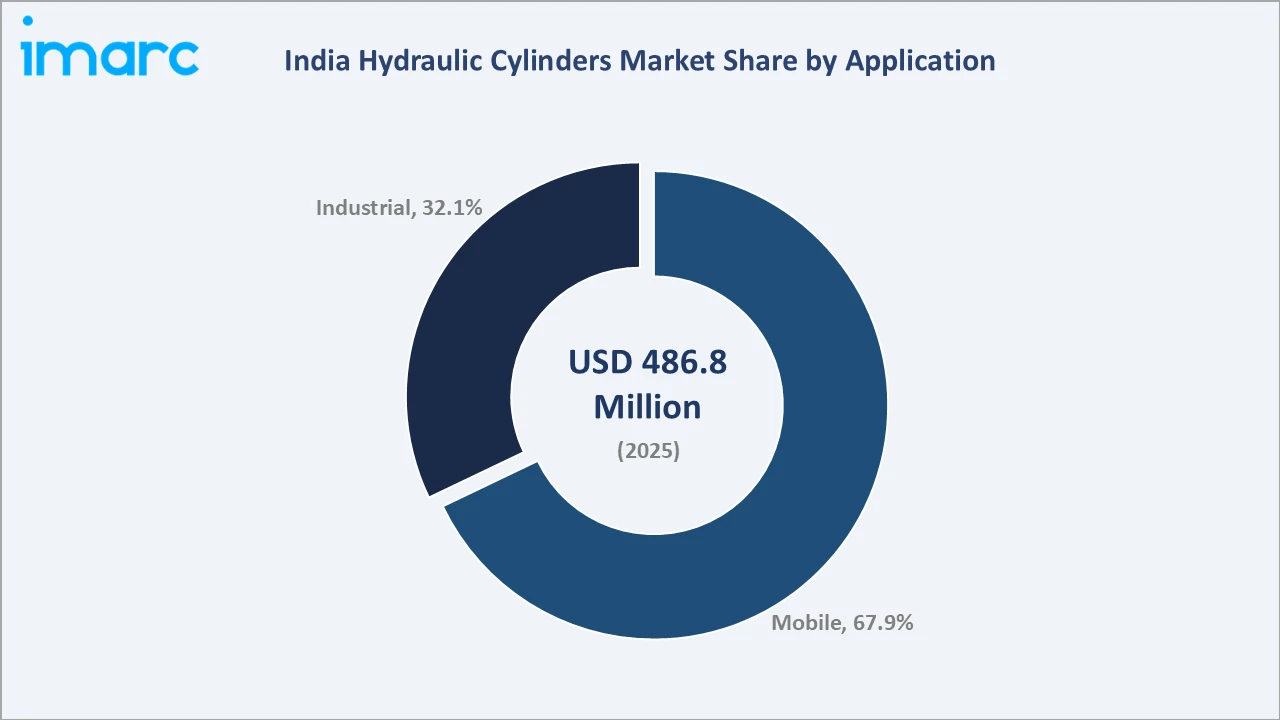
Industrial at 32.1%, growing at ~3.80% CAGR through manufacturing expansion, material handling automation, and processing industry cylinder investment.
Regional Market Insights
|
Region |
Share (2025) |
Key India Hydraulic Cylinder Market Drivers & Characteristics |
|
West India |
33.7% |
Strong automotive, engineering, construction equipment, and industrial machinery manufacturing base. |
|
South India |
28.6% |
Expanding automotive, agricultural machinery, aerospace, material handling, and heavy engineering industries. |
|
North India |
24.2% |
Growing construction equipment, automotive, agricultural machinery, and general manufacturing activities. |
|
East India |
13.5% |
Strong presence of mining, steel, metals, power, and heavy industrial operations. |
West India leads the market with a 33.7% share in 2025, supported by strong automotive, engineering, construction equipment, and industrial machinery manufacturing across Maharashtra and Gujarat. South India accounts for 28.6%, driven by automotive, agricultural machinery, aerospace, material handling, and heavy engineering clusters.
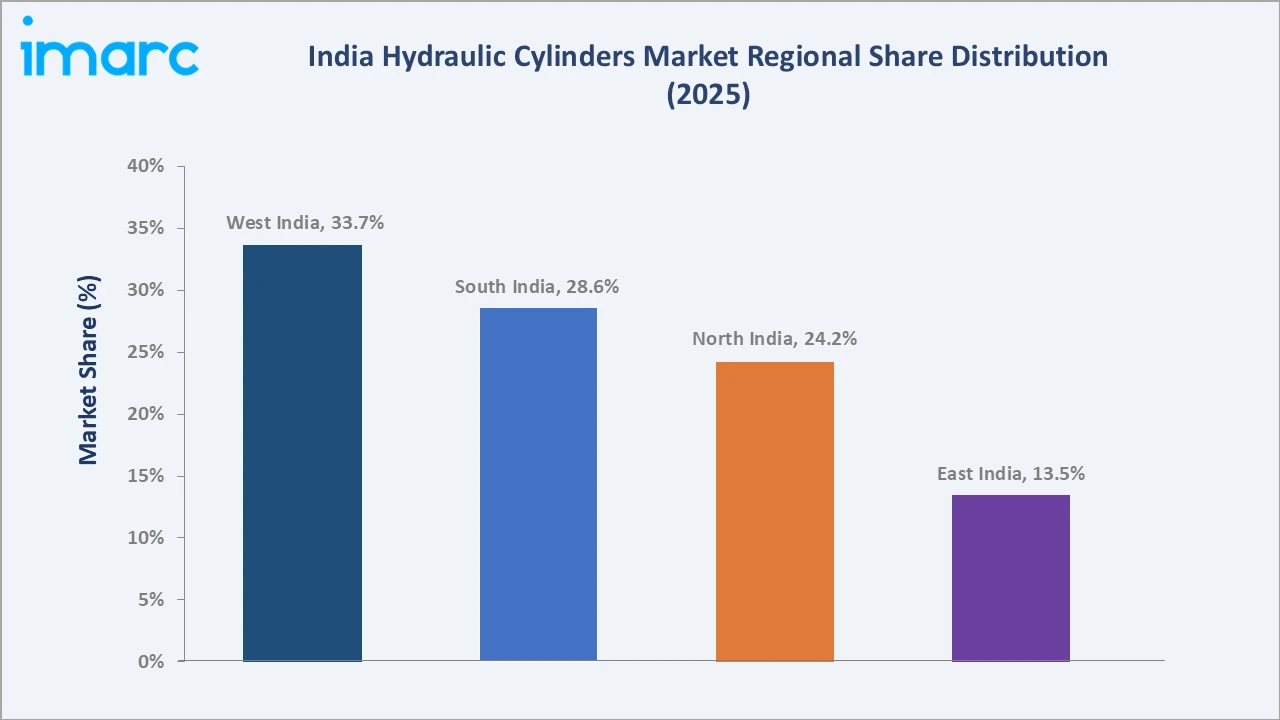
North India holds 24.2%, supported by expanding construction equipment, automotive, agricultural machinery, and general manufacturing activities. East India represents 13.5%, with demand concentrated in mining, steel, metals, power, and heavy industries. Infrastructure development and rising mechanization continue to strengthen hydraulic cylinder demand across regions.
Competitive Landscape
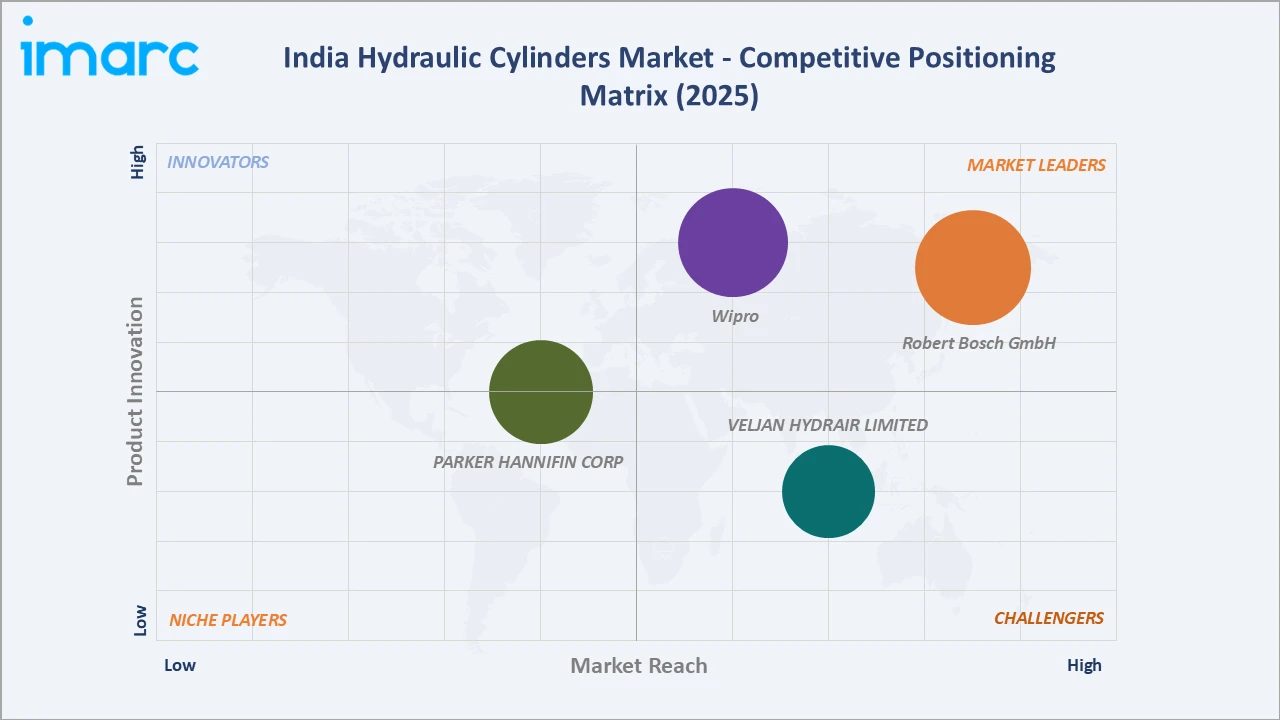
The India hydraulic cylinders market is moderately fragmented, with domestic and multinational manufacturers competing on product quality, customization, durability, pricing, and after-sales support. Companies are increasingly investing in smart cylinders, electro-hydraulic systems, advanced sealing technologies, and localized manufacturing to strengthen their market positions.
|
Company |
Key Products |
Market Position |
Core Strength |
|
Robert Bosch GmbH |
CD – differential cylinder (mill type), CG – double-acting cylinder (mill type), CD – differential cylinder (tie rod design), CG – double-acting cylinder (tie rod design) |
Market Leader |
Robert Bosch GmbH operates in the Indian hydraulic cylinders market primarily through its industrial technology subsidiary, Bosch Rexroth. |
|
PARKER HANNIFIN CORP |
Gen II Series 2H, 3H Family, Parker Series 2HX/3HX Family, Series HMI, Series HMIF, Series HMIX, Series MA3, Series MMB |
Established Player |
Dominant player in India's industrial and mobile hydraulics sector, supplying critical Hydraulic Cylinders to major Original Equipment Manufacturers (OEMs) in construction, agriculture, and manufacturing. |
|
Wipro |
Diamond Front End Telescopic Cylinder, Cover Type (DFC) Cylinder, Eye Type (DFE) Cylinder |
Market Leader |
Wipro via Wipro Hydraulics is one of the largest independent hydraulic cylinder manufacturers in India. |
|
VELJAN HYDRAIR LIMITED |
HT Series, HR Series, HH Series, HG Series |
Challenger |
Supplies hydraulic cylinders for heavy-duty industrial, mobile, energy, and shipbuilding sectors. |
India's competitive landscape reflects a market in productive tension between technology leaders commanding premium industrial specification and price points, a domestic champion competing at OEM quality level in automotive-quality certified tractor and construction OEM supply, and an extensive domestic MSME ecosystem serving the large mid-market and aftermarket segments.
Key Company Profiles
Robert Bosch GmbH
Robert Bosch GmbH has an established presence in India through Bosch Rexroth, providing industrial and mobile hydraulic technologies. Its portfolio spans hydraulic actuators, pumps, valves, electro-hydraulic controls, power units, and connected hydraulic solutions for sectors such as automotive, construction, metallurgy, materials and resources, and industrial automation. The company emphasizes digitally connected and energy-efficient hydraulics, supported by retrofit, repair, spare parts, and field-service capabilities in India.
- Key Products: CD – differential cylinder (mill type), CG – double-acting cylinder (mill type), CD – differential cylinder (tie rod design), CG – double-acting cylinder (tie rod design).
- Strategic Focus: Strengthening its position through advanced electro-hydraulic, digitally connected, and energy-efficient motion-control solutions. Its strategy emphasizes smart hydraulics, sensor integration, predictive maintenance, and application-specific engineering for industrial and mobile machinery.
PARKER HANNIFIN CORP
PARKER HANNIFIN CORP is a motion and control technology company with operations in India and a broad presence in hydraulic and industrial motion systems. Its portfolio includes hydraulic cylinders, actuators, pumps, valves, motors, filtration systems, and related motion-control components for mobile and industrial applications. In the India hydraulic cylinders market, the company serves sectors such as construction equipment, material handling, manufacturing, mining, agriculture, and other heavy machinery applications. Parker combines engineering expertise, application-specific solutions, and aftermarket capabilities to address demanding hydraulic motion and control requirements.
- Key Products: Gen II Series 2H, 3H Family, Parker Series 2HX/3HX Family, Series HMI, Series HMIF, Series HMIX, Series MA3, Series MMB.
- Strategic Focus: Strengthening its position through high-performance, application-specific hydraulic and motion-control solutions. Its strategy emphasizes energy-efficient hydraulics, electro-hydraulic integration, advanced sealing and filtration, and connected control technologies for mobile and industrial machinery.
Market Concentration Analysis
The India hydraulic cylinders market is moderately fragmented, with a mix of multinational companies, established domestic manufacturers, and numerous regional suppliers. Large players maintain competitive advantages through advanced engineering, customized products, OEM relationships, and extensive service networks. Smaller manufacturers compete primarily through pricing, local availability, and application-specific customization. Increasing demand for smart hydraulics, large-bore cylinders, and higher quality standards is expected to favor technologically capable and organized manufacturers.
Investment & Growth Opportunities
Highest Growth Segments
Industrial application (~3.80% CAGR) and >150 MM bore (~3.60% CAGR) represent India's hydraulic cylinder market's highest-growth investment vectors through 2034.
Investment Themes
- Large-Bore Import Substitution Manufacturing: Investment in domestic manufacturing of large-bore hydraulic cylinders offers opportunities to reduce dependence on imported systems used in mining, steel, construction, and heavy machinery. Localized production can shorten lead times, improve customization, and strengthen aftermarket support for critical industrial applications.
- Electro-Hydraulic Smart Cylinder Retrofit Market: Investment in smart retrofit solutions enables existing hydraulic equipment to incorporate sensors, electronic controls, and condition-monitoring technologies without complete system replacement. Growing factory automation and Industry 4.0 adoption create opportunities for retrofit providers offering predictive maintenance, improved positioning, and operational efficiency.
Future Market Outlook (2026-2034)
The India hydraulic cylinders market is expected to increase from USD 486.8 Million in 2025 to USD 507.4 Million in 2026 and further to USD 657.5 Million by 2034, delivering a 3.29% CAGR supported by three compounding structural growth mechanisms that provide demand stability across economic cycles through their diversification across infrastructure, agriculture, and manufacturing application sectors. The anchor value of USD 572.5 Million in 2030 mirrors the 2020-2025 growth rate and confirms that India's hydraulic cylinder market grows at a dependable low-single-digit rate anchored in industrial capital investment cycles rather than exhibiting the volatility of consumer or technology markets.
First, India's National Infrastructure Pipeline (NIP) is creating the most sustained multi-year construction equipment demand wave in India's history. Second, India's agricultural modernization trajectory is creating durable above-historical-average tractor sales volumes that directly translate into hydraulic cylinder demand. Third, India's manufacturing sector deepening under PLI scheme incentives is creating industrial hydraulic cylinder demand that is new in nature rather than replacement of existing capacity, where PLI-linked new factory construction in electronics, pharmaceuticals, food processing, and advanced manufacturing requires hydraulic presses, injection molding machines, and material handling systems each deploying industrial cylinders at specifications previously imported from European or Japanese machinery.
Research Methodology
Primary Research
Primary research comprised in-depth interviews with hydraulic cylinder manufacturers, OEM procurement engineers, hydraulic system integrators in Pune, Ahmedabad, and Hyderabad industrial clusters, government procurement officers, and independent hydraulic service center operators. Discussions validated market size estimates, segment share dynamics, OEM procurement specifications, regional demand patterns, competitive positioning, and quality standard requirements.
Secondary Research
Secondary research encompassed a review of government publications, company annual reports, industry associations, trade journals, regulatory databases, and other credible industry sources. The analysis focused on hydraulic cylinder demand, end-use industries, technology developments, regional trends, competitive activity, and domestic manufacturing initiatives in India.
Forecasting Models
Forecasting models developed using historical India hydraulic cylinder market data, NIP project execution timeline and construction equipment deployment scheduling, tractor sales forecast aligned with agricultural mechanization policy targets, PLI-linked manufacturing capacity creation timeline and hydraulic equipment content modeling, mining sector capex projections, steel sector capacity expansion hydraulic cylinder requirement modeling, industrial application segment growth linked to India manufacturing PMI and industrial production index, regional share stability analysis, and competitive market evolution under domestic manufacturer quality improvement trajectories. Both top-down and bottom-up approaches were validated through primary research.
India Hydraulic Cylinders Market Report Coverage:
| Report Features | Details |
|---|---|
| Base Year of the Analysis | 2025 |
| Historical Period | 2020-2025 |
| Forecast Period | 2026-2034 |
| Units | Million USD |
| Scope of the Report |
Exploration of Historical Trends and Market Outlook, Industry Catalysts and Challenges, Segment-Wise Historical and Future Market Assessment:
|
| Functions Covered | Single-Acting Hydraulic Cylinders, Double-Acting Hydraulic Cylinders |
| Types Covered | Tie-Rod Cylinders, Welded Cylinders, Telescopic Cylinders, Mill-Type Cylinders |
| Bore Sizes Covered | <50 MM, 50–150 MM, >150 MM |
| Applications Covered | Mobile, Industrial |
| End-Use Industries Covered | Construction, Aerospace and Defense, Material Handling, Agriculture, Automotive, Mining, Oil and Gas, Marine, Others |
| Regions Covered | North India, South India, East India, West India |
| Companies Covered | Robert Bosch GmbH, PARKER HANNIFIN CORP, Wipro, VELJAN HYDRAIR LIMITED, etc. |
| Customization Scope | 10% Free Customization |
| Post-Sale Analyst Support | 10-12 Weeks |
| Delivery Format | PDF and Excel through Email (We can also provide the editable version of the report in PPT/Word format on special request) |
Key Benefits for Stakeholders:
- IMARC’s industry report offers a comprehensive quantitative analysis of various market segments, historical and current market trends, market forecasts, and dynamics of the India hydraulic cylinders market from 2020-2034.
- The research report provides the latest information on the market drivers, challenges, and opportunities in the India hydraulic cylinders market.
- Porter's five forces analysis assist stakeholders in assessing the impact of new entrants, competitive rivalry, supplier power, buyer power, and the threat of substitution. It helps stakeholders to analyze the level of competition within the India hydraulic cylinders industry and its attractiveness.
- Competitive landscape allows stakeholders to understand their competitive environment and provides an insight into the current positions of key players in the market.
Frequently Asked Questions About the India Hydraulic Cylinders Market Report
The India hydraulic cylinders market size is estimated at USD 507.4 Million in 2026, driven by record highway construction deploying construction machines requiring mobile hydraulic cylinders, PLI scheme manufacturing capacity expansion creating industrial press and material handling cylinder demand, steel sector expansion requiring rolling mill and heavy press large-bore cylinders, and import substitution of mid-bore cylinders by domestic manufacturers.
The market grows at 3.29% CAGR, reaching USD 657.5 Million by 2034. Growth is supported by infrastructure development, industrial automation, construction equipment demand, and increasing mechanization across key end-use sectors.
50-150 MM bore leads at 48.6% (2025) through its alignment with India's highest-volume applications, tractor three-point linkage cylinders, compact and medium excavator boom/arm cylinders, and mid-capacity industrial press cylinders.
Mobile application leads at 67.9% (2025) through the combined demand from India's construction equipment market, commercial vehicle tipper, and mobile crane markets.
West India leads at 33.7% through Maharashtra and Gujarat's dual industrial advantage: Maharashtra's automotive manufacturing and Nashik's tractor manufacturing, Gujarat's Rajkot-Ahmedabad hydraulic component manufacturing cluster.
Leading companies include Robert Bosch GmbH, PARKER HANNIFIN CORP, Wipro, and VELJAN HYDRAIR LIMITED.
The market is projected to reach USD 572.5 Million by 2030, driven by the NIP construction project pipeline converting INR 111 lakh crore committed investment into active construction site equipment deployment, tractor market growth as agricultural mechanization penetrates Uttar Pradesh, Bihar, and Madhya Pradesh, and domestic large-bore cylinder manufacturing reducing import dependency.
Top opportunities include large-bore manufacturing capability investment, electro-hydraulic smart cylinder retrofit kit, hydraulic cylinder remanufacturing service center, defense hydraulic cylinder manufacturing, and bio-hydraulic fluid compatible seal and cylinder development.
Need more help?
- Speak to our experienced analysts for insights on the current market scenarios.
- Include additional segments and countries to customize the report as per your requirement.
- Gain an unparalleled competitive advantage in your domain by understanding how to utilize the report and positively impacting your operations and revenue.
- For further assistance, please connect with our analysts.
 Request Customization
 Speak to an Analyst
 Request Brochure
 Inquire Before Buying
Benefits of Customization
- Personalize this research
- Triangulate with your data
- Get data as per your format and definition
- Gain a deeper dive into a specific application, geography, customer, or competitor
- Any level of personalization
Get in Touch With Us
UNITED STATES
Phone: +1-201-971-6302
INDIA
Phone: +91-120-433-0800
UNITED KINGDOM
Phone: +44-753-714-6104
Email: [email protected]
Client Testimonials




.webp)




.webp)













Related Reports

Choose your plan
*Please note that the prices mentioned below are starting prices for each bundle type. Kindly contact our team for further details.*
Single User License
- 1 User License, Access on 2 Devices
- PDF Report + Excel Dataset (Password Protected)
- Lifetime Access
- No Printing Rights
- 10% Free Report Customization
- 10–12 Weeks of Analyst Support
Five User License
- Access for 5 Users, 2 Devices per User
- PDF Report + Excel Dataset (Password Protected)
- Lifetime Access
- Dedicated Account Manager
- 12–14 Weeks of Analyst Support
- No Printing Rights
- 15% Free Report Customization
- 25% Discount on Your Next Purchase
Corporate User License
- Unlimited User Access (Within Your Organization)
- PDF Report + Excel Dataset
- Lifetime Access
- Dedicated Account Manager
- 14–20 Weeks of Analyst Support
- No Printing Rights
- 20% Free Report Customization
- 30% Discount on Your Next Purchase
Essential Insights
What's included:
3 reports
- Lifetime Access
- PDF Reports
- Excel Datasets
- 2 Weeks of Free Analyst Support
- 2 User Licenses
- Access on 2 Devices
- Printing Rights
- Complimentary PowerPoint (PPT) Version
- Complimentary License Upgrade
Professional Access
What's included:
5 reports
- Lifetime Access
- PDF Reports
- Excel Datasets
- 8 Weeks of Free Analyst Support
- 2 User Licenses
- Access on 2 Devices
- Printing Rights
- Complimentary PowerPoint (PPT) Version
- Complimentary License Upgrade
Business Advantage
What's included:
8 reports
- Lifetime Access
- PDF Reports
- Excel Datasets
- 14 Weeks of Free Analyst Support
- 2 User Licenses
- Access on 2 Devices
- Printing Rights
- Complimentary PowerPoint (PPT) Version
- Complimentary License Upgrade
Enterprise Intelligence
What's included:
10 reports
- Lifetime Access
- PDF Reports
- Excel Datasets
- 20 Weeks of Free Analyst Support
- 2 User Licenses
- Access on 2 Devices
- Printing Rights
- Complimentary PowerPoint (PPT) Version
- Complimentary License Upgrade