
India Hydroponics Market Size, Share, Trends and Forecast by Type, Crop Type, Equipment, and Region, 2026-2034
India Hydroponics Market Summary:
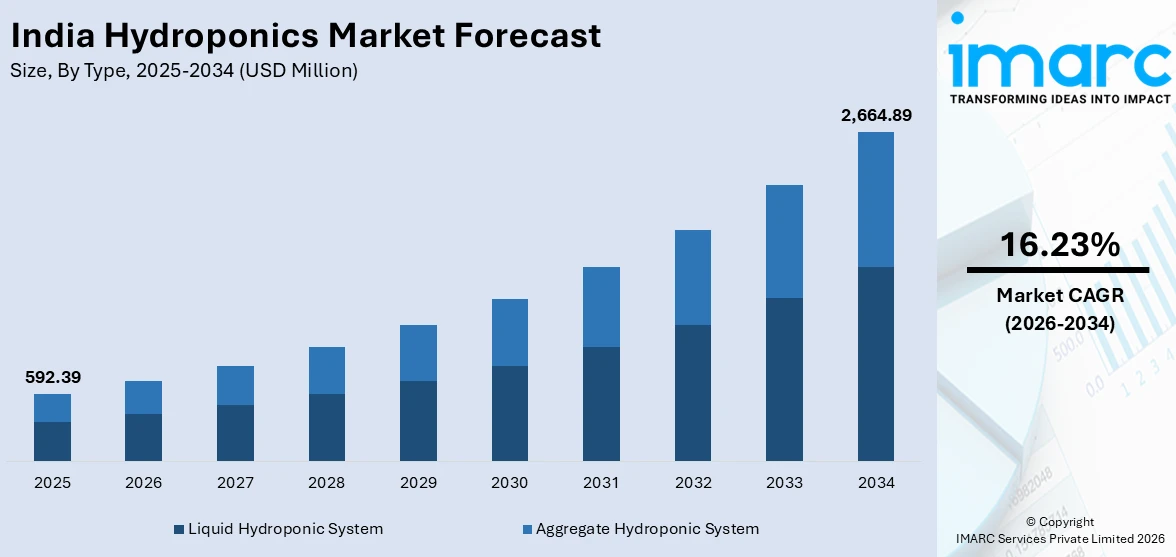
The India hydroponics market size was valued at USD 592.39 Million in 2025 and is projected to reach USD 2,664.89 Million by 2034, growing at a compound annual growth rate of 16.23% from 2026-2034.
The India hydroponics market is experiencing robust expansion, driven by rising consumer demand for pesticide-free and fresh products, rapid urbanization, and growing awareness of sustainable agricultural practices. Technological advancements in soilless cultivation techniques, increasing government support and policy initiatives, and the growing proliferation of vertical and urban farming are collectively reshaping the country's agricultural landscape and fueling the market share.
Key Takeaways and Insights:
- By Type: Liquid hydroponic system dominates the market with a share of 65.0% in 2025, driven by efficient nutrient delivery precision, high adaptability to diverse crops, and increasing commercial farm adoption supporting sustained market growth.
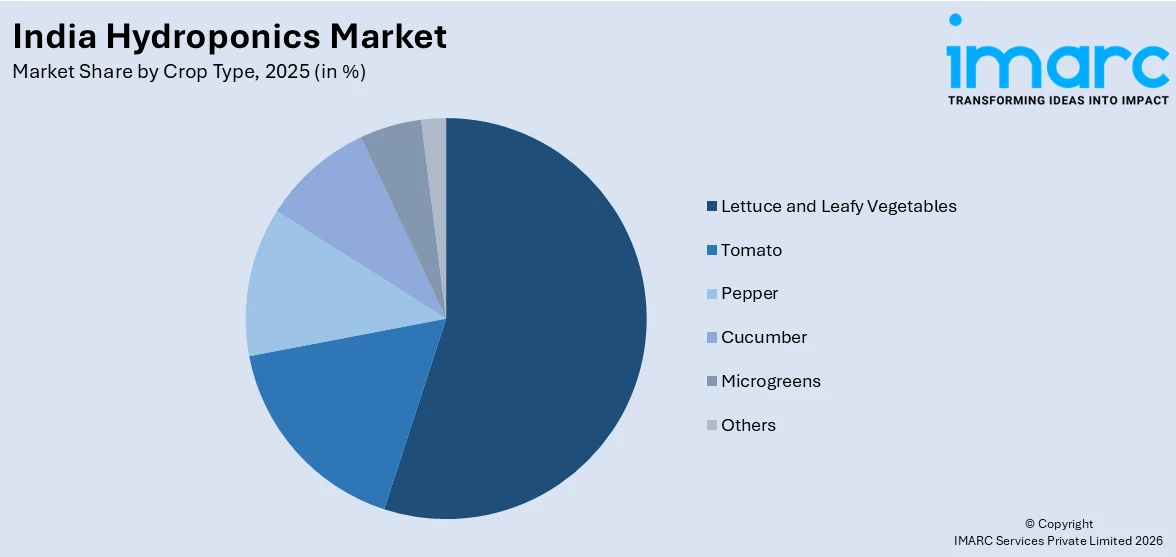
- By Crop Type: Lettuce and leafy vegetables lead the market with a share of 55.0% in 2025, owing to fast growth cycles, high pesticide-free consumer demand, and compatibility with hydroponic systems enabling year-round urban production.
- By Equipment: Irrigation systems prevail the market with a share of 35.0% in 2025, owing to their critical role in enabling precise water and nutrient delivery, ensuring consistent crop yields across varied commercial hydroponic installations.
- By Region: South India comprises the largest region with 30.0% share in 2025, driven by a high concentration of agritech startups, favorable climatic conditions, and strong commercial demand for pesticide-free fresh produce across major metropolitan areas.
- Key Players: Key players are driving the India hydroponics market by expanding technological capabilities, enhancing soilless farming infrastructure, and forging strategic partnerships. Their investments in precision irrigation, nutrient management, and climate-controlled cultivation accelerate market adoption, improve farmer accessibility, and support sustainable agricultural growth.
To get more information on this market Request Sample
The India hydroponics market is progressing through a pivotal phase of growth, underpinned by mounting pressure on conventional agricultural systems, rapid urbanization, and an increasingly health-conscious consumer base demanding fresh, chemical-free produce. The country's limited arable land and widespread water scarcity are accelerating transition towards soilless cultivation technologies. Both commercial and residential growers are adopting hydroponic systems at an expanding pace, recognizing advantages of precise nutrient delivery, faster crop cycles, and significantly reduced water consumption compared to traditional methods. Government-backed policies have reinforced this momentum. Under the Mission for Integrated Development of Horticulture (MIDH), the Union Government announced in October 2024 the formal inclusion of hydroponics within its agricultural strategy. This milestone has encouraged institutional investment and accelerated commercial hydroponic infrastructure development.
India Hydroponics Market Trends:
Integration of Internet of Things (IoT) in Controlled Environment Agriculture
The integration of artificial intelligence (AI) and IoT technologies is revolutionizing hydroponic farming in India by enabling real-time monitoring of critical parameters, such as pH, electrical conductivity, temperature, and humidity. These intelligent systems allow growers to automate nutrient delivery, predict crop diseases, and optimize growing conditions with minimal manual intervention. In August 2024, Calvin Aranha and Farish Anfal, two engineers from Udupi, Karnataka, developed an advanced AI-enabled hydroponic setup to cultivate exotic plants, exemplifying the grassroots-level adoption of smart technology across India's soilless farming sector.
Expansion of Urban and Vertical Farming
India's rapidly urbanizing population is driving the emergence of vertical and rooftop hydroponic farms as viable alternatives to conventional agriculture. Cities, such as Bengaluru, Pune, and Hyderabad, are witnessing accelerated adoption in both commercial and residential settings, as space constraints push urban consumers and entrepreneurs toward compact soilless growing systems. Additionally, the increasing availability of modular hydroponic kits and urban farming training programs is encouraging households, startups, and restaurants to adopt controlled-environment food production systems.
Rising Demand for Organic and Pesticide-Free Produce
Growing health and wellness consciousness among Indian consumers, particularly in urban areas, is generating consistent demand for pesticide-free vegetables and herbs. As per IMARC Group, the India health and wellness market size was valued at USD 164.35 Billion in 2025. Hydroponic systems, which inherently minimize the need for chemical pesticides through controlled cultivation environments, are increasingly positioned as the preferred method for producing clean-label fresh items. This trend is particularly prominent in premium retail and e-commerce food sectors, where consumers are willing to pay a premium for traceable, chemically uncontaminated produce grown through advanced soilless systems operating in clean, water-efficient cultivation environments.
Market Outlook 2026-2034:
The India hydroponics market is poised for sustained and transformative growth over the forecast period, driven by the convergence of technological innovation, urbanization, and mounting food security imperatives. Increasing land degradation, erratic monsoon patterns, and growing dependence on imported fresh produce in metropolitan regions are compelling farmers, entrepreneurs, and institutional investors to pivot toward resource-efficient controlled environment agriculture. The market generated a revenue of USD 592.39 Million in 2025 and is projected to reach a revenue of USD 2,664.89 Million by 2034, growing at a compound annual growth rate of 16.23% from 2026-2034. Investment activity is expected to intensify further, particularly in South India, as the ecosystem matures and the costs of hydroponic technology continue to moderate through economies of scale and localized manufacturing.
India Hydroponics Market Report Segmentation:
| Segment Category | Leading Segment | Market Share |
|---|---|---|
|
Type |
Liquid Hydroponic System |
65.0% |
|
Crop Type |
Lettuce and Leafy Vegetables |
55.0% |
|
Equipment |
Irrigation Systems |
35.0% |
|
Region |
South India |
30.0% |
Type Insights:
- Aggregate Hydroponic System
- Closed System
- Open System
- Liquid Hydroponic System
Liquid hydroponic system dominates the market with a market share of 65.0% of the total India hydroponics market in 2025.
Liquid hydroponic system has emerged as the most widely adopted soilless cultivation method in India, because of its exceptional accuracy in delivering nutrients and oxygen to plant roots. Liquid systems reduce per-unit expenses during repeated cultivation cycles since they do not require solid growing media, in contrast to aggregate systems. Growers can maintain low operating costs over long production seasons while achieving consistent, high-quality yields, due to their interoperability with automation and AI-assisted fertilizer management.
Liquid hydroponic systems' scalability and adaptability to a variety of crop types further enhance their attractiveness across the country. Because of the continuous or sporadic flow of oxygenated nutritional solution to exposed root systems, leafy greens, herbs, microgreens, and several fruiting vegetables flourish in liquid-based arrangements. Liquid systems are used in research institutions, big commercial farms, and residential vertical setups in India's quickly growing controlled environment agriculture sector.
Crop Type Insights:
Access the comprehensive market breakdown Request Sample
- Tomato
- Lettuce and Leafy Vegetables
- Pepper
- Cucumber
- Microgreens
- Others
Lettuce and leafy vegetables lead the market with a share of 55.0% of the total India hydroponics market in 2025.
Lettuce and leafy vegetables account for the largest share within the crop type segmentation, owing to their biological compatibility with hydroponic environments. These crops exhibit exceptionally fast growth cycles, enabling commercial operators to achieve multiple production turnovers per year. Their shallow root systems and relatively low nutrient requirements make them highly suitable for controlled soilless cultivation systems. Additionally, uniform plant size and consistent quality make leafy greens ideal for commercial hydroponic production and urban farm operations.
Growing consumer desire for freshly collected, pesticide-free greens in urban markets is another factor driving the preference for hydroponically cultivated lettuce and leafy vegetables. Due to wilting and contamination during the journey from farm to shelf, traditional supply chains for green vegetables frequently result in large post-harvest losses. By providing farm-to-fork proximity through rooftop gardens, urban vertical farms, and regulated indoor setups situated inside or close to consumption areas, hydroponic farming tackles this problem.
Equipment Insights:
- HVAC
- LED Grow Light
- Irrigation Systems
- Material Handling
- Control Systems
- Others
Irrigation systems exhibit a clear dominance with a 35.0% share of the total India hydroponics market in 2025.
Irrigation systems form the backbone of hydroponic farming operations, as the precise delivery of water and dissolved nutrients to plant root zones is the defining principle of soilless cultivation. These systems encompass drip irrigation setups, nutrient film technique channels, deep water culture reservoirs, and automated flood-and-drain configurations. As hydroponic farm sizes expand and investor interest intensifies, demand for advanced irrigation systems is expected to grow considerably.
The growing sophistication of irrigation systems deployed in the India hydroponic sector reflects broader trends toward agricultural automation and resource optimization. Modern systems are increasingly integrated with sensors, timers, and AI-based controllers that monitor real-time parameters such as pH levels, electrical conductivity, dissolved oxygen, and flow rates. These intelligent irrigation solutions minimize wastage, prevent nutrient imbalances, and reduce the need for manual oversight, making them particularly valuable for large-scale commercial operations where consistency and efficiency are paramount.
Regional Insights:
- North India
- West and Central India
- South India
- East and Northeast India
South India comprises the largest region with 30.0% of the total India hydroponics market in 2025.
South India holds a commanding position in the India hydroponics market, driven by a dynamic ecosystem of agritech startups concentrated in Bengaluru, Hyderabad, and Chennai. The region benefits from strong institutional support, high consumer purchasing power, and favorable year-round climatic conditions that reduce artificial heating and cooling costs in hydroponic facilities. In October 2024, Vivek Raj Poojary, a Mangalore-based entrepreneur, was featured in Forbes India for pioneering hydroponic saffron farming, representing the region's deep culture of agricultural innovation and individual-led technology adoption.
The commercial hydroponics sector in South India has attracted sustained entrepreneurial activity, with numerous small and medium enterprises (SMEs) introducing innovative farm management models, consumer-direct retail channels, and technology-forward cultivation frameworks. Karnataka, Tamil Nadu, Telangana, and Andhra Pradesh collectively provide a fertile environment for hydroponic enterprise, supported by strong agricultural research institutions, growing retail demand for organic and fresh products, and an educated workforce capable of managing technically complex soilless farming systems and precision-controlled growing environments.
Market Dynamics:
Growth Drivers:
Why is the India Hydroponics Market Growing?
Escalating Demand for Pesticide-Free and Fresh Products
India's urban population is increasingly prioritizing nutritional quality and food safety, generating robust demand for pesticide-free vegetables and herbs. According to the Economic Survey 2023-24, it is projected that by 2030, over 40% of India's population will reside in urban regions. Traditional farming methods, which rely heavily on chemical inputs, soil-based production, and extended supply chains, are increasingly incapable of consistently meeting the standards demanded by health-conscious consumers. Hydroponic cultivation addresses this demand by producing crops in strictly controlled, closed environments where synthetic pesticides and herbicides are largely unnecessary. The absence of soil in hydroponic systems eliminates soil-borne pathogens and pests, further reducing the need for chemical intervention. In India's growing premium grocery and direct-to-consumer (D2C) food retail sector, hydroponically grown produce commands significant price premiums, creating strong commercial incentives for farmers and entrepreneurs to adopt soilless cultivation methods.
Supportive Government Policies and Financial Incentives
Government policies at both the central and state levels have played a decisive role in stimulating growth across the India hydroponics market by reducing the financial barriers associated with high initial capital investment. Various protected cultivation and modern farming schemes provide subsidies for greenhouse structures, climate control systems, irrigation infrastructure, and other advanced agricultural technologies that are commonly integrated with hydroponic setups. Financial assistance, soft loans, and credit-linked subsidy programs offered through agricultural development initiatives are encouraging farmers, startups, and agripreneurs to adopt controlled-environment agriculture. In addition, training programs, demonstration farms, and technology transfer initiatives conducted by agricultural universities and extension agencies are helping build awareness and technical expertise among growers. Several state governments are also promoting urban farming, rooftop cultivation, and high-value crop production as part of broader strategies to enhance food security and optimize land use in densely populated regions.
Water Scarcity and Limited Arable Land
India's agricultural sector faces acute structural challenges related to water scarcity and diminishing arable land, both of which are compelling farmers and policymakers to explore more resource-efficient cultivation technologies. The country is classified among the most water-stressed nations globally, with groundwater depletion a persistent concern in major crop-producing states. Traditional soil-based farming, which requires substantially greater water volumes per unit of output, is increasingly unsustainable in this context. Hydroponic farming, which consumes significantly less water than conventional methods by recirculating nutrient-enriched water through closed or semi-closed systems, offers a compelling and scalable alternative. Hydroponics, by enabling cultivation in vertically stacked structures, rooftops, warehouses, and other non-traditional spaces, effectively decouples food production from land availability. As India's population continues to expand and demographic pressure on both water and land resources intensifies, the inherent resource efficiency of hydroponic systems is expected to drive sustained adoption across commercial, institutional, and community-scale farming contexts. As per worldometer, the mid-year population of India in 2026 is projected to be 1,476,625,576 individuals.
Market Restraints:
What Challenges the India Hydroponics Market is Facing?
High Initial Capital Investment
The establishment of hydroponic farms requires substantial upfront expenditure on specialized infrastructure, including pumping systems, nutrient dosing equipment, environmental controls, and structural elements, such as greenhouse or polytunnel constructions. These capital requirements present a significant barrier to entry, particularly for smallholder farmers with limited access to credit or institutional financing. While government subsidies partially offset these costs, the net investment required remains prohibitive for a large proportion of India's agricultural community, slowing broader market adoption among the most resource-constrained growers.
Technical Skill Gap and Knowledge Deficit
Successful hydroponic cultivation demands a high degree of technical proficiency in nutrient management, pH regulation, pest identification, and equipment maintenance. In India, where the majority of the agricultural workforce has limited exposure to controlled environment agriculture, this skill gap poses a material constraint to rapid market expansion. The shortage of certified trainers, accessible vocational programs, and local technical support infrastructure creates operational risks for newly adopting farmers and undermines confidence in hydroponic systems outside established urban agritech centers and research institutions.
Inconsistent Power Supply and Infrastructure Limitations
Hydroponic systems depend on continuous and reliable access to electricity for powering irrigation pumps, climate control units, and automated monitoring systems. In many rural and semi-urban regions of India, erratic power supply and frequent outages represent significant operational risks, potentially disrupting nutrient delivery cycles and causing crop losses. The cost of backup power solutions, such as generators or solar installations, adds additional financial burden, further constraining adoption among smaller operators in geographically underserved areas with limited infrastructure support.
Competitive Landscape:
The India hydroponics market features a dynamic and evolving competitive landscape, encompassing established agritech enterprises, emerging startups, and technology-driven controlled environment agriculture providers. Key players are leveraging advanced automation, IoT integration, and precision nutrient management systems to differentiate their offerings and expand market presence. The competitive environment is characterized by frequent product innovation, strategic partnerships with academic institutions, and increasing investments in large-scale commercial hydroponic infrastructure. Companies are also diversifying their revenue streams through training academies, turnkey project delivery, and investment platforms targeting retail and institutional investors. The entry of technology-forward enterprises and established corporate groups into the sector is intensifying competition, accelerating knowledge transfer, and driving down per-unit system costs. This competitive dynamism is expected to sustain innovation and broaden market accessibility throughout the forecast period.
Recent Developments:
- In October 2025, Brio Hydroponics, Gujarat's largest hydroponics farming company, announced the launch of 'Unnati', a 100-acre hi-tech hydroponics park in Talod, Sabarkantha district. Developed using Controlled Environment Agriculture (CEA) technology, incorporating inputs from France, Israel, and New Zealand, the project was designed to empower farmers and agripreneurs through sustainable, high-yield soilless cultivation while attracting institutional and corporate investors seeking returns in India's growing hydroponics sector.
India Hydroponics Market Report Coverage:
| Report Features | Details |
|---|---|
| Base Year of the Analysis | 2025 |
| Historical Period | 2020-2025 |
| Forecast Period | 2026-2034 |
| Units | Million USD |
| Scope of the Report | Exploration of Historical Trends and Market Outlook, Industry Catalysts and Challenges, Segment-Wise Historical and Future Market Assessment:
|
| Types Covered |
|
| Crop Types Covered | Tomato, Lettuce and Leafy Vegetables, Pepper, Cucumber, Microgreens, Others |
| Equipments Covered | HVAC, LED Grow Light, Irrigation Systems, Material Handling, Control Systems, Others |
| Regions Covered | North India, West and Central India, South India, East and Northeast India |
| Customization Scope | 10% Free Customization |
| Post-Sale Analyst Support | 10-12 Weeks |
| Delivery Format | PDF and Excel through Email (We can also provide the editable version of the report in PPT/Word format on special request) |
Frequently Asked Questions About the India Hydroponics Market Report
The India hydroponics market size was valued at USD 592.39 Million in 2025.
The India hydroponics market is expected to grow at a compound annual growth rate of 16.23% from 2026-2034 to reach USD 2,664.89 Million by 2034.
Liquid hydroponic system dominated the market with a share of 65.0%, owing to its efficient nutrient delivery precision, broad crop adaptability, and high adoption rates across large-scale commercial farming operations.
Key factors driving the India hydroponics market include escalating demand for pesticide-free produce, supportive government policies, water scarcity, limited arable land, and rapid adoption of IoT-enabled controlled environment agriculture.
Major challenges include high initial capital investment for system setup, a significant technical skill gap among the farming workforce, inconsistent electricity supply in rural regions, limited awareness in non-urban areas, and the absence of standardized quality regulations for hydroponically grown produce.
Need more help?
- Speak to our experienced analysts for insights on the current market scenarios.
- Include additional segments and countries to customize the report as per your requirement.
- Gain an unparalleled competitive advantage in your domain by understanding how to utilize the report and positively impacting your operations and revenue.
- For further assistance, please connect with our analysts.
 Request Customization
 Speak to an Analyst
 Request Brochure
 Inquire Before Buying
Benefits of Customization
- Personalize this research
- Triangulate with your data
- Get data as per your format and definition
- Gain a deeper dive into a specific application, geography, customer, or competitor
- Any level of personalization
Get in Touch With Us
UNITED STATES
Phone: +1-201-971-6302
INDIA
Phone: +91-120-433-0800
UNITED KINGDOM
Phone: +44-753-714-6104
Email: [email protected]
Client Testimonials




.webp)




.webp)













Related Reports

Choose your plan
*Please note that the prices mentioned below are starting prices for each bundle type. Kindly contact our team for further details.*
Single User License
- 1 User License, Access on 2 Devices
- PDF Report + Excel Dataset (Password Protected)
- Lifetime Access
- No Printing Rights
- 10% Free Report Customization
- 10–12 Weeks of Analyst Support
Five User License
- Access for 5 Users, 2 Devices per User
- PDF Report + Excel Dataset (Password Protected)
- Lifetime Access
- Dedicated Account Manager
- 12–14 Weeks of Analyst Support
- No Printing Rights
- 15% Free Report Customization
- 25% Discount on Your Next Purchase
Corporate User License
- Unlimited User Access (Within Your Organization)
- PDF Report + Excel Dataset
- Lifetime Access
- Dedicated Account Manager
- 14–20 Weeks of Analyst Support
- No Printing Rights
- 20% Free Report Customization
- 30% Discount on Your Next Purchase
Essential Insights
What's included:
3 reports
- Lifetime Access
- PDF Reports
- Excel Datasets
- 2 Weeks of Free Analyst Support
- 2 User Licenses
- Access on 2 Devices
- Printing Rights
- Complimentary PowerPoint (PPT) Version
- Complimentary License Upgrade
Professional Access
What's included:
5 reports
- Lifetime Access
- PDF Reports
- Excel Datasets
- 8 Weeks of Free Analyst Support
- 2 User Licenses
- Access on 2 Devices
- Printing Rights
- Complimentary PowerPoint (PPT) Version
- Complimentary License Upgrade
Business Advantage
What's included:
8 reports
- Lifetime Access
- PDF Reports
- Excel Datasets
- 14 Weeks of Free Analyst Support
- 2 User Licenses
- Access on 2 Devices
- Printing Rights
- Complimentary PowerPoint (PPT) Version
- Complimentary License Upgrade
Enterprise Intelligence
What's included:
10 reports
- Lifetime Access
- PDF Reports
- Excel Datasets
- 20 Weeks of Free Analyst Support
- 2 User Licenses
- Access on 2 Devices
- Printing Rights
- Complimentary PowerPoint (PPT) Version
- Complimentary License Upgrade