
India Insurtech Market Size, Share, Trends and Forecast by Type, Service, Technology, and Region, 2026-2034
India Insurtech Market Size, Share, Trends & Forecast (2026-2034)
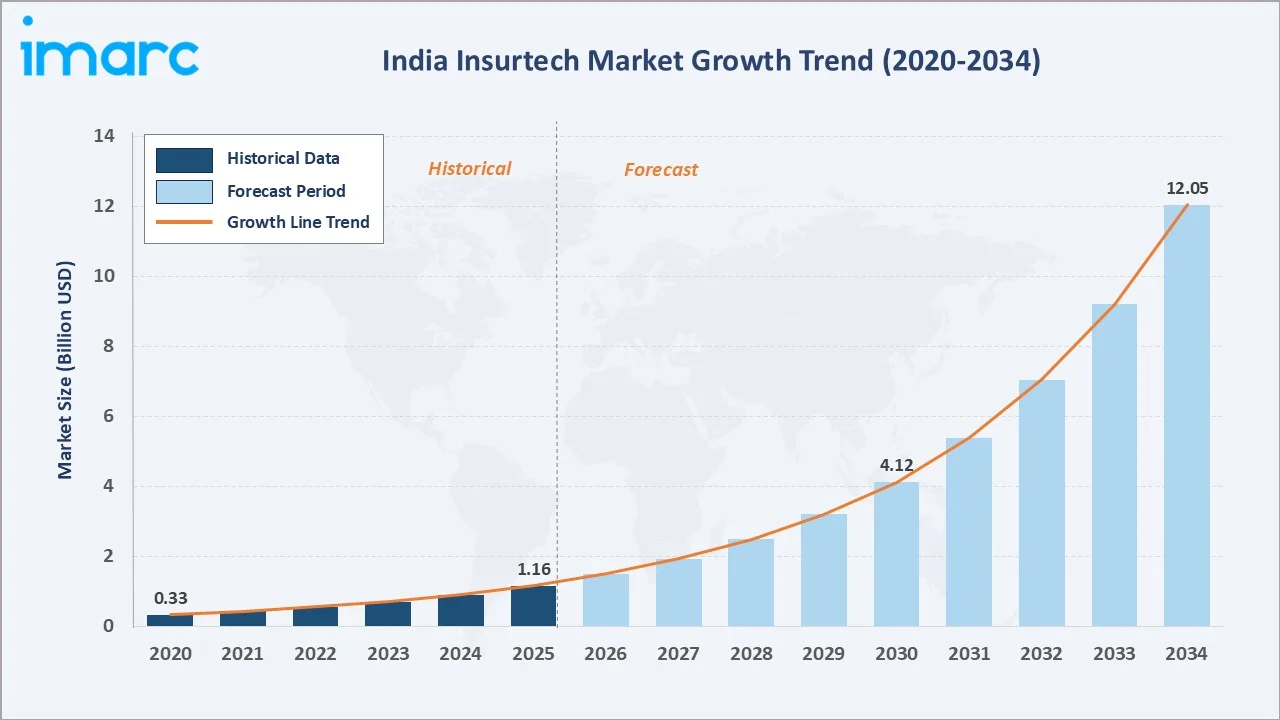
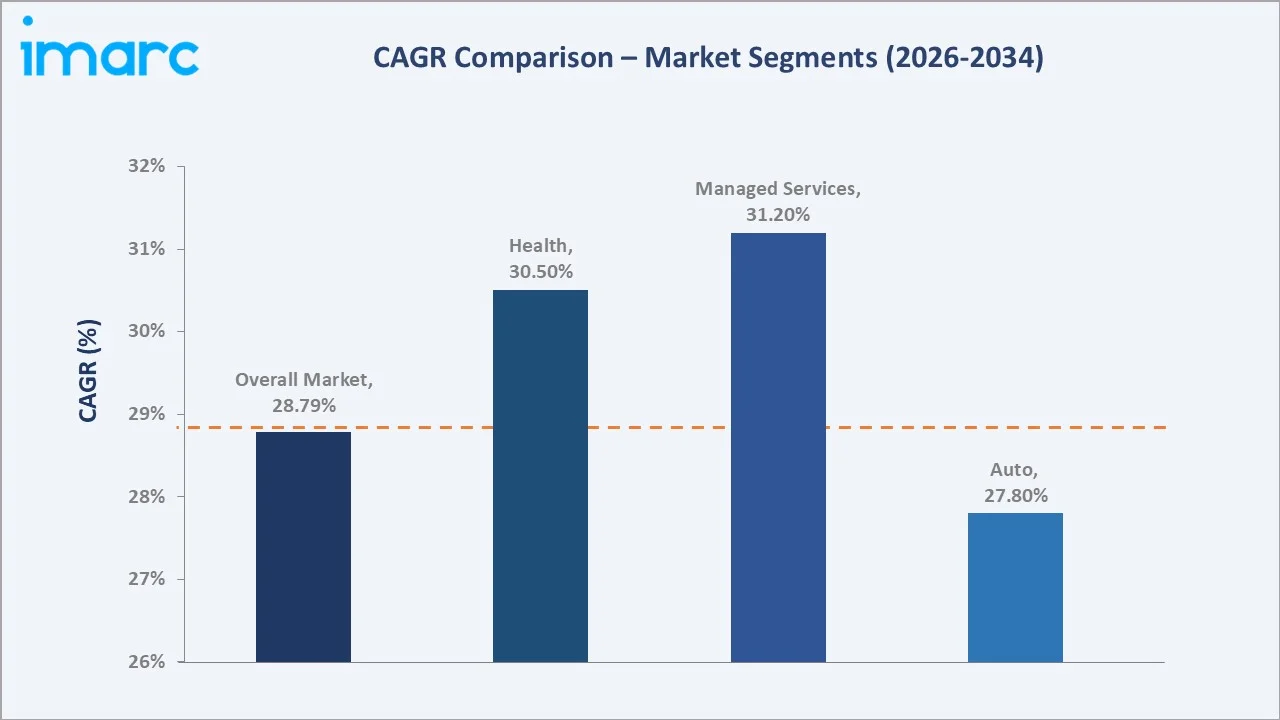
The India insurtech market grew from USD 1.16 Billion in 2025 to USD 1.50 Billion in 2026. The market is further expected to grow to USD 4.12 Billion by 2030 and USD 12.05 Billion by 2034, registering a CAGR of 28.79% during 2026-2034.
The market is driven by rising smartphone penetration, government-backed insurance inclusion schemes, AI-enabled underwriting, and a young digitally-savvy population. Health leads at 37.6%, Managed Services at 44.8%, and North India commands 32.6% of the national market.
Market Snapshot
|
Metric |
Value |
|
Base Year Market Size (2025) |
USD 1.16 Billion |
|
Market Size (2026) |
USD 1.50 Billion |
|
Forecast Market Size (2034) |
USD 12.05 Billion |
|
CAGR (2026-2034) |
28.79% |
|
Base Year |
2025 |
|
Historical Period |
2020-2025 |
|
Forecast Period |
2026-2034 |
|
Dominant Type |
Health (37.6%, 2025) |
|
Dominant Service |
Managed Services (44.8%, 2025) |
|
Leading Region |
North India (32.6%, 2025) |
The India insurtech market size increased from USD 0.33 Billion in 2020 to USD 1.16 Billion in 2025 and is estimated to reach USD 1.50 Billion in 2026. The market is further expected to grow to USD 4.12 Billion by 2030 and USD 12.05 Billion by 2034. India insurtech market is commercially distinctive, combining one of the world's most underpenetrated insurance markets with explosive digital infrastructure growth. The market's structure is shaped by low legacy constraints, IRDAI's sandbox framework, and a tech-first consumer base demanding paperless, instant-issuance insurance products.
To get more information on this market, Request Sample
Health leads at 37.6% through COVID-driven awareness and PMJAY penetration. Managed Services at 44.8% reflects insurtech's dependency on outsourced cloud and analytics platforms. North India's 32.6% leadership reflects Delhi-NCR's startup density and highest mobile insurance adoption in India.
Executive Summary
The India insurtech market expanded from USD 1.16 Billion in 2025 to an estimated USD 1.50 Billion in 2026, positioning it as one of Asia's fastest-growing digital insurance markets. The market is projected to reach USD 12.05 Billion by 2034.
India insurtech market is distinguished from other major Asian digital insurance markets by its extraordinary combination of massive underinsurance, enabling regulatory reforms, and a startup ecosystem receiving record venture capital inflows. Health at 37.6%, Managed Services at 44.8%, and North India at 32.6% lead respectively.
Key Market Insights
|
Insight |
Data |
|
Dominant Type |
Health – 37.6% share (2025) |
|
Dominant Service |
Managed Services – 44.8% market share (2025) |
|
Leading Region |
North India – 32.6% share (2025) |
|
Market Opportunity |
Embedded insurance in e-commerce; micro-insurance for rural India; parametric crop insurance; BNPL-linked coverage; SME digital insurance bundles |
Key Analytical Observations Supporting the Above Data:
- Health at 37.6%: Dominates due to post-COVID health awareness surge, PMJAY enrollment driving digital health policy issuance, and rising out-of-pocket healthcare costs compelling urban and semi-urban consumers to adopt tech-enabled health insurance with instant-claim digital processing and telemedicine integration.
- Managed Services at 44.8%: Leads because insurtech platforms require specialized cloud infrastructure, AI/ML analytics, and cybersecurity management that exceed in-house capabilities. Outsourced managed services provide the scalability and compliance infrastructure required to service millions of policyholders at minimal marginal cost.
- North India at 32.6%: Leads through Delhi-NCR's concentration of insurtech startups, India's highest mobile wallet penetration, and a young professional demographic with above-national insurance adoption rates driven by employer-facilitated digital group health policy enrollment.
India Insurtech Market Overview
India insurtech market is positioned at a unique commercial intersection: the world's most populous uninsured or underinsured market meeting one of the fastest-growing digital infrastructure ecosystems. India's insurance penetration at ~4% of GDP—below the global average of ~7%—creates an extraordinary addressable opportunity for technology-driven distribution and product innovation.
The market ecosystem integrates insurtech startups, established insurers adopting digital channels, IRDAI's regulatory sandbox enabling product experimentation, AI/ML platform providers, embedded insurance aggregators, and emerging micro-insurance models targeting India's 600 million rural consumers through mobile-first platforms.
Market Dynamics
To evaluate market opportunities, Request Sample
Market Drivers
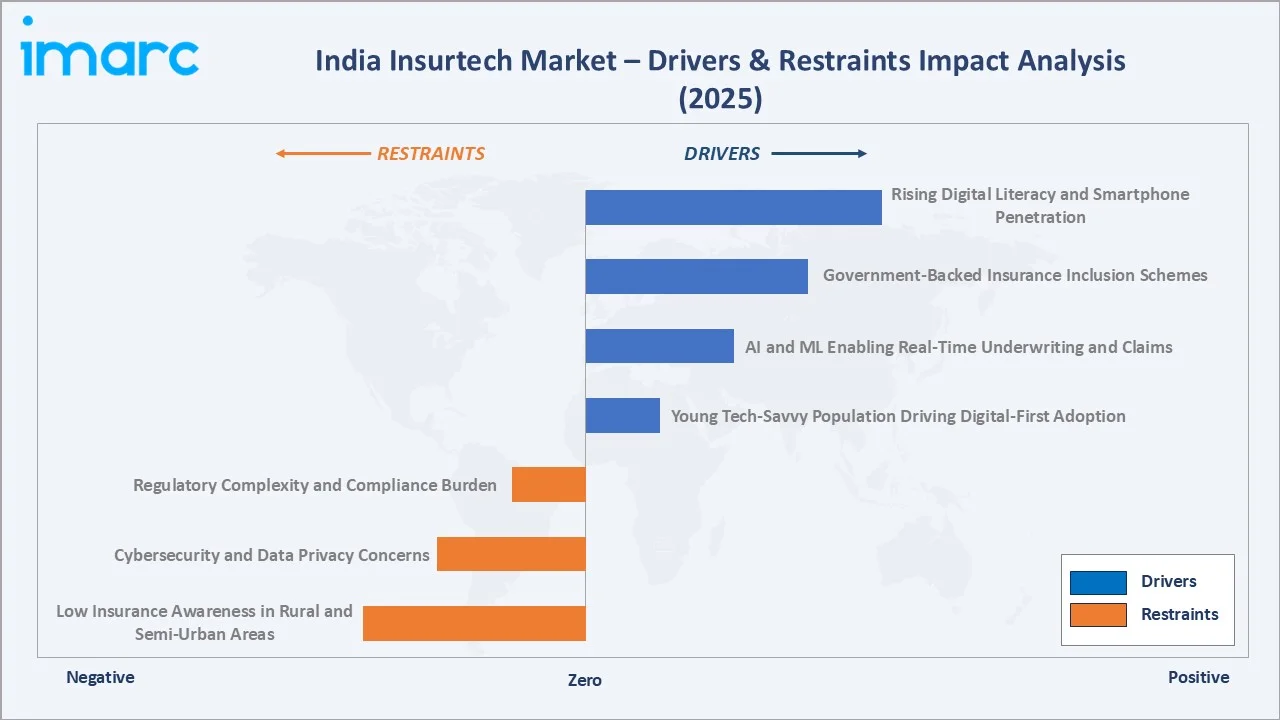
- Rising Digital Literacy and Smartphone Penetration: India's 560 million smartphone users and 800 million internet users create the largest addressable digital insurance consumer base globally, enabling mobile-first policy distribution and instant digital claims. UPI integration with insurance payments has removed the friction barrier for first-time buyers. Digital literacy programs under Digital India mission continue to expand the insurable digital-native population cohort beyond metro cities into Tier-2 and Tier-3 markets where traditional agent-based models have historically underserved.
- Government-Backed Insurance Inclusion Schemes: PMJAY (Ayushman Bharat), PM Jeevan Jyoti Bima Yojana, and PM Fasal Bima Yojana collectively enroll hundreds of millions of first-time insurance buyers through government-subsidized digital platforms, creating a pipeline of newly insured citizens who transition to commercial insurtech products. Government schemes provide market entry economics that commercial insurtech platforms leverage by offering supplemental or upgrade products to enrolled beneficiaries. IRDAI's progressive sandbox framework allows startups to experiment with novel parametric, on-demand, and micro-insurance products at regulatory-approved scale before full commercial launch.
- AI and ML Enabling Real-Time Underwriting and Claims: Artificial intelligence and machine learning are fundamentally transforming the India insurtech value chain, enabling real-time risk assessment, instant underwriting decisions, and automated claims processing that reduce turnaround from days to minutes. AI-powered fraud detection significantly reduces India's high insurance fraud rate, improving profitability and enabling competitive premium pricing. Computer vision for motor claims assessment, NLP-based customer service bots, and predictive health risk models are creating commercially differentiated product experiences that traditional insurance companies cannot replicate without substantial technology investment. These capabilities create structural barriers to entry and pricing advantages for technology-first insurtech players.
- Young Tech-Savvy Population Driving Digital-First Adoption: India's median age of 28 years and the largest Gen Z population globally create a consumer base that strongly prefers digital-first, on-demand, and embedded insurance experiences over traditional agent-intermediated products. This demographic cohort's comfort with app-based financial services directly translates into willingness to purchase, manage, and claim insurance digitally without physical interaction. Their preference for transparent, flexible coverage options and micro-duration policies is driving product innovation toward pay-per-use, bite-sized, and subscription-based insurance models.
Market Restraints
- Low Insurance Awareness in Rural and Semi-Urban Areas: Despite government schemes, insurance literacy and voluntary adoption remain critically low in rural India, where a majority of the population has never purchased a standalone commercial insurance product and lacks awareness of digital claim processes or policy terms. The complexity of insurance product language creates friction that prevents first-time buyers from completing enrolment, resulting in high digital onboarding drop-off rates that undermine customer acquisition economics for insurtech platforms targeting India's rural market. Trust deficits in digital financial services, amplified by cases of misselling and claim rejection experiences, further depress rural digital insurance adoption. Overcoming this barrier requires sustained vernacular content investment, local community champion models, and simplified product structures.
- Cybersecurity and Data Privacy Concerns: India's insurtech platforms handle extraordinarily sensitive health, financial, and personal data for millions of policyholders, creating a high-value target environment for cyberattacks that generate reputational damage, regulatory penalties, and consumer trust erosion disproportionate to the breach scale. The Digital Personal Data Protection Act (DPDP Act 2023) imposes compliance obligations on insurtech companies regarding data processing, localization, and consent management that require significant technology and legal investment, increasing operational costs for startups already operating at thin margins. Consumer reluctance to share health data, vehicle telematics information, or financial details with digital insurance platforms remains a commercially significant barrier to insurtech platforms' data monetization and underwriting optimization strategies.
- Regulatory Complexity and Compliance Burden: India's insurance regulatory framework, while progressively reform-oriented under IRDAI, imposes licensing, solvency, reinsurance, and product filing requirements that increase time-to-market and capital requirements for insurtech startups above those in comparable digital financial services segments. The requirement for insurtech platforms to partner with licensed insurance entities creates dependency relationships with traditional insurers whose legacy systems and risk appetites may constrain digital innovation speed.
Market Opportunities
- Embedded Insurance and API-First Distribution: The integration of insurance into e-commerce, travel booking, lending, and ride-sharing platforms through API-first distribution creates a USD billion+ embedded insurance opportunity in India, where millions of daily digital transactions create natural insurance attachment points. Embedded insurance products achieve conversion rates 5-10x higher than standalone digital distribution because they are contextually relevant and purchase-friction-free.
- Micro-Insurance for Rural and Agricultural Markets: India's 600 million rural population and 140 million farming households represent the world's largest untapped micro-insurance market, addressable through mobile-based, low-premium parametric products that use satellite data, weather indices, and IoT sensors to trigger automatic claims without manual assessment.
Market Challenges
- Unit Economics at Scale in Low-Premium Segments: Profitably serving India's mass-market insurance segments requires achieving extraordinary operational efficiency through automation, AI-driven claims, and minimal distribution costs, a challenge that requires significant upfront technology investment before reaching sustainable scale.
- Talent Scarcity in Insurtech Technology and Actuarial Sciences: India's insurtech growth is constrained by acute talent shortages at the intersection of insurance domain expertise and technology capability, with qualified actuaries, data scientists specializing in insurance risk, and experienced insurtech product managers commanding premium compensation that early-stage platforms struggle to sustain.
Emerging Market Trends
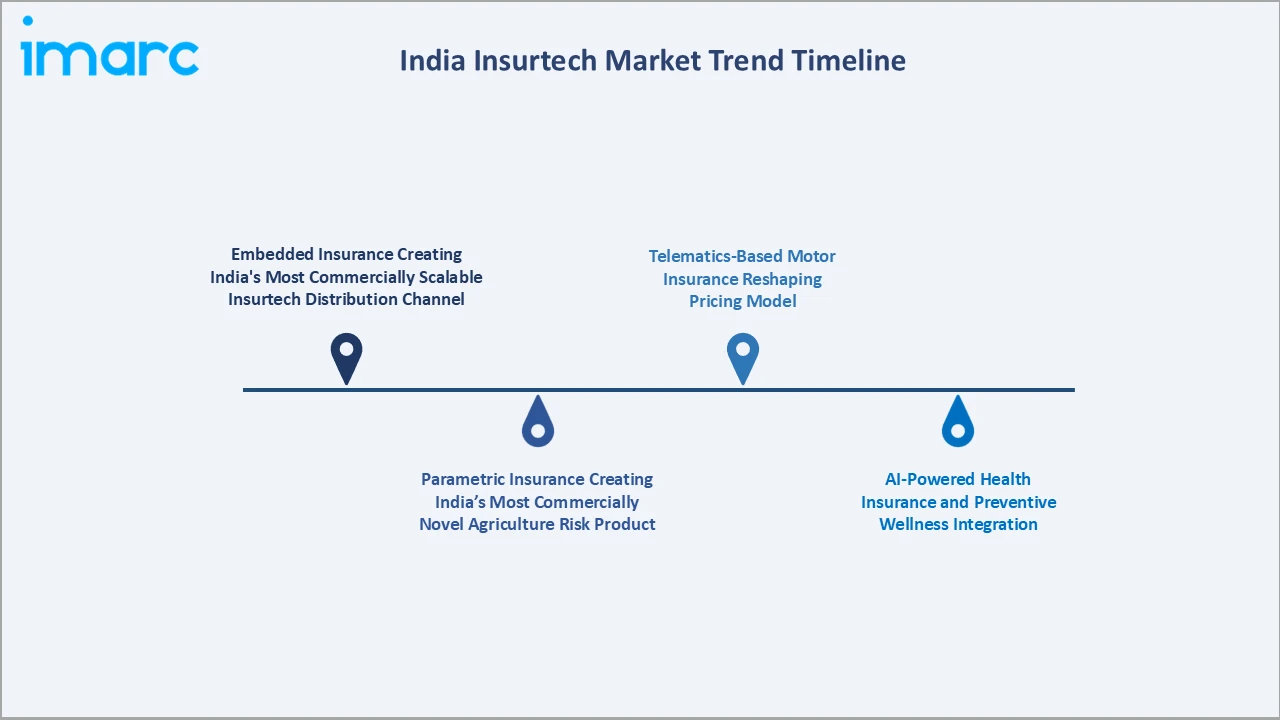
1. Embedded Insurance Creating India's Most Commercially Scalable Insurtech Distribution Channel
Embedded insurance integration into India's digital commerce platforms is creating a distribution channel that reaches 400 million+ active digital consumers without sales force investment. Multiple platforms launched one-click purchase protection, embedded travel cover, and instant mobile device insurance products generating above-30% attachment rates.
2. Parametric Insurance Creating India's Most Commercially Novel Agriculture Risk Product
Parametric crop insurance using satellite imagery, weather APIs, and IoT soil sensors triggers automatic payouts without field assessment, transforming India's PMFBY scheme from a manually-assessed, dispute-prone product into an instant-settlement digital product. Multiple insurtech players are commercializing parametric products for flood, drought, and cyclone coverage, with pilots in Maharashtra, Karnataka, and Odisha generating 85%+ farmer satisfaction scores versus 45% for traditional assessed products.
3. Telematics-Based Motor Insurance Reshaping Pricing Model
Usage-based motor insurance using telematics, dashcams, and smartphone sensor data enables pay-per-km and behavior-based pricing that rewards safe drivers with 20-40% premium discounts, attracting India's low-mileage urban drivers and two-wheeler segment.
4. AI-Powered Health Insurance and Preventive Wellness Integration
Health insurtech platforms are integrating wearable data, telemedicine records, and preventive wellness program participation into dynamic health insurance pricing, creating the world's most commercially innovative personal health insurance ecosystem. Platforms rewarding healthier behaviors with premium discounts generate above-market renewal rates, creating policyholder lifetime value structures that justify higher customer acquisition investment.
Industry Value Chain Analysis
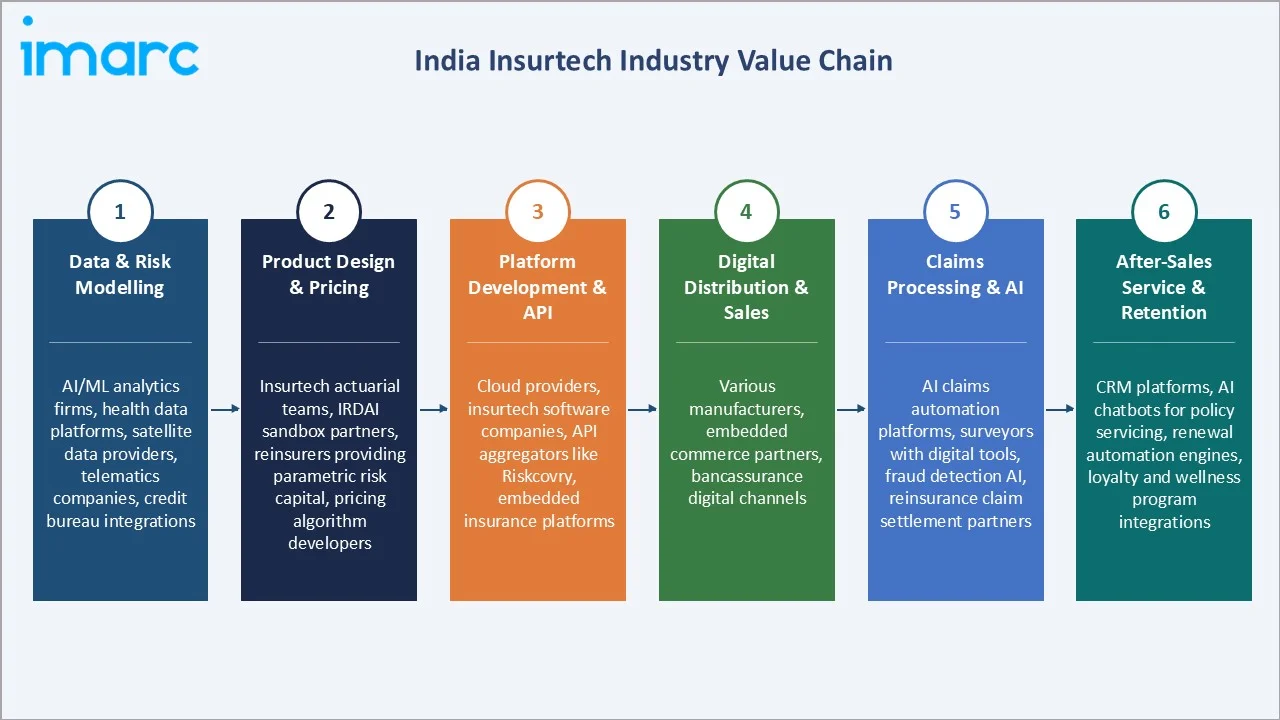
India insurtech value chain is characterized by a digital-first architecture where data and risk modelling at the upstream stage feeds algorithmic underwriting, API-integrated distribution, and automated claims—replacing the traditional paper-based, agent-mediated chain with a technology-continuous flow from risk origination to policy lifecycle management.
|
Stage |
Key Participants |
|
Data & Risk Modelling |
AI/ML analytics firms, health data platforms, satellite data providers, telematics companies, credit bureau integrations |
|
Product Design & Pricing |
Insurtech actuarial teams, IRDAI sandbox partners, reinsurers providing parametric risk capital, pricing algorithm developers |
|
Platform Development & API |
Cloud providers, insurtech software companies, API aggregators like Riskcovry, embedded insurance platforms |
|
Digital Distribution & Sales |
Various manufacturers, embedded commerce partners, bancassurance digital channels |
|
Claims Processing & AI |
AI claims automation platforms, surveyors with digital tools, fraud detection AI, reinsurance claim settlement partners |
|
After-Sales Service & Retention |
CRM platforms, AI chatbots for policy servicing, renewal automation engines, loyalty and wellness program integrations |
The digital distribution stage is India insurtech's most commercially valuable, where PolicyBazaar have numerous registered users and InsuranceDekho's rural reach create distribution moats that generate premium income at near-zero marginal customer acquisition cost once platform scale is achieved.
Technology Landscape in the India Insurtech Industry
Artificial Intelligence and Machine Learning
AI/ML applications in India insurtech span underwriting automation, real-time fraud detection, claims triage, customer segmentation, and churn prediction—creating commercially measurable improvements in loss ratios, claim cycle times, and renewal rates. Large language models are enabling vernacular customer service at scale across Hindi, Tamil, Telugu, and Marathi-speaking markets.
Cloud Computing and API Infrastructure
Cloud infrastructure enables India's insurtech platforms to serve millions of simultaneous policy issuances at festival and payroll cycle demand peaks without proportional infrastructure investment. API-first architecture allows insurtech platforms to integrate with banks, hospitals, vehicle dealerships, and e-commerce platforms in days rather than months.
Block Chain and Smart Contracts
Block chain-based policy issuance and smart contract-triggered parametric claims are reducing fraudulent duplicate claims, enabling real-time reinsurance settlement, and creating tamper-proof policy records. India's Insurance Information Bureau is exploring block chain for industry-wide data sharing, which would significantly reduce underwriting fraud and improve risk pricing accuracy across the market.
Market Segmentation Analysis
The report covers the following segments:
|
Segment Category |
Leading Segment |
Market Share |
Year |
|
Type |
Health |
37.6% |
2025 |
|
Service |
Managed Services |
44.8% |
2025 |
|
Technology |
Block Chain |
34.2% |
2025 |
|
Region |
North India |
32.6% |
2025 |

By Type
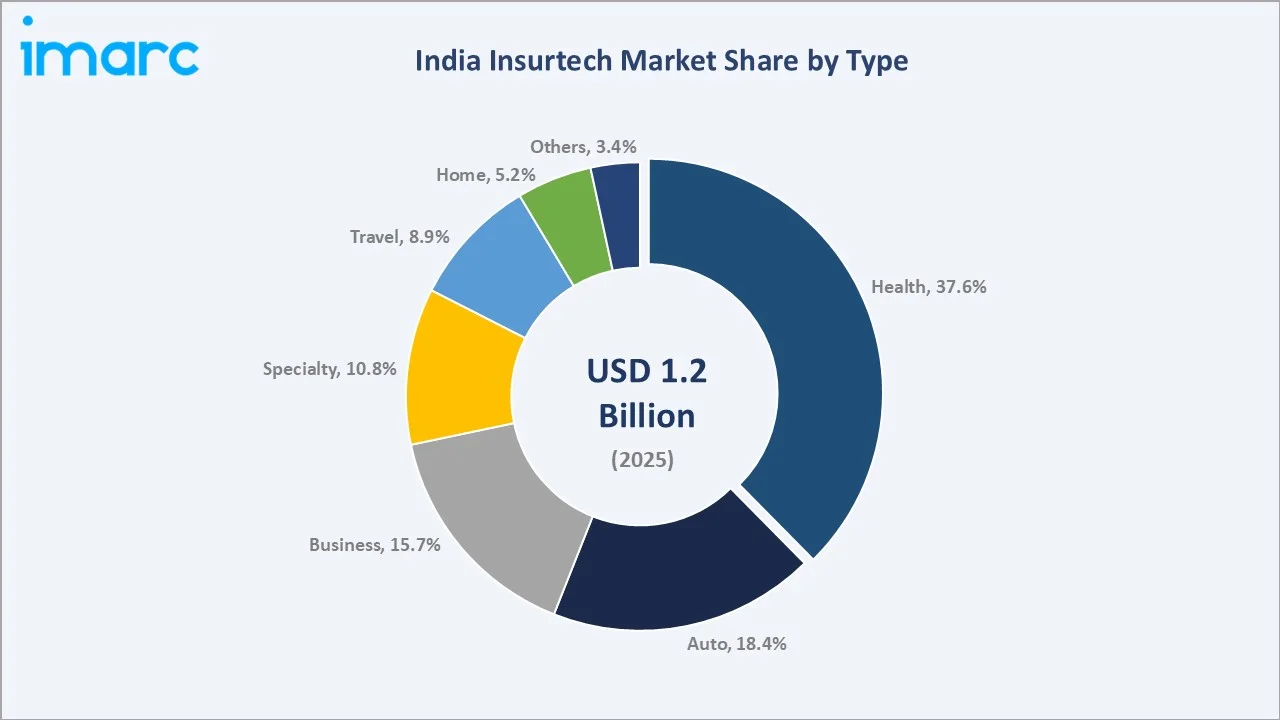
Health leads at 37.6% (2025). The health insurtech segment encompasses digital-first health policies, OPD coverage, telemedicine-integrated plans, and corporate group health digitization. COVID-19 catalyzed permanent behavioral change toward health insurance adoption, with digital platforms replacing agent-sold products for urban and semi-urban consumers under age 45.
To access detailed market analysis, Request Sample
Auto at 18.4% grows through mandatory motor third-party digitization and telematics adoption. Business at 15.7% reflects SME digital insurance bundles. Specialty at 10.8%, Travel at 8.9%, Home at 5.2%, and Others at 3.4% represent emerging high-growth micro-segments with accelerating digital penetration.
By Service
Managed Services leads at 44.8% (2025). Insurtech platforms' dependency on outsourced cloud management, AI/ML operations, cybersecurity, and regulatory compliance infrastructure makes managed services the most commercially dominant service segment. Cost efficiency, scalability, and specialist capability drive outsourcing above in-house alternatives.
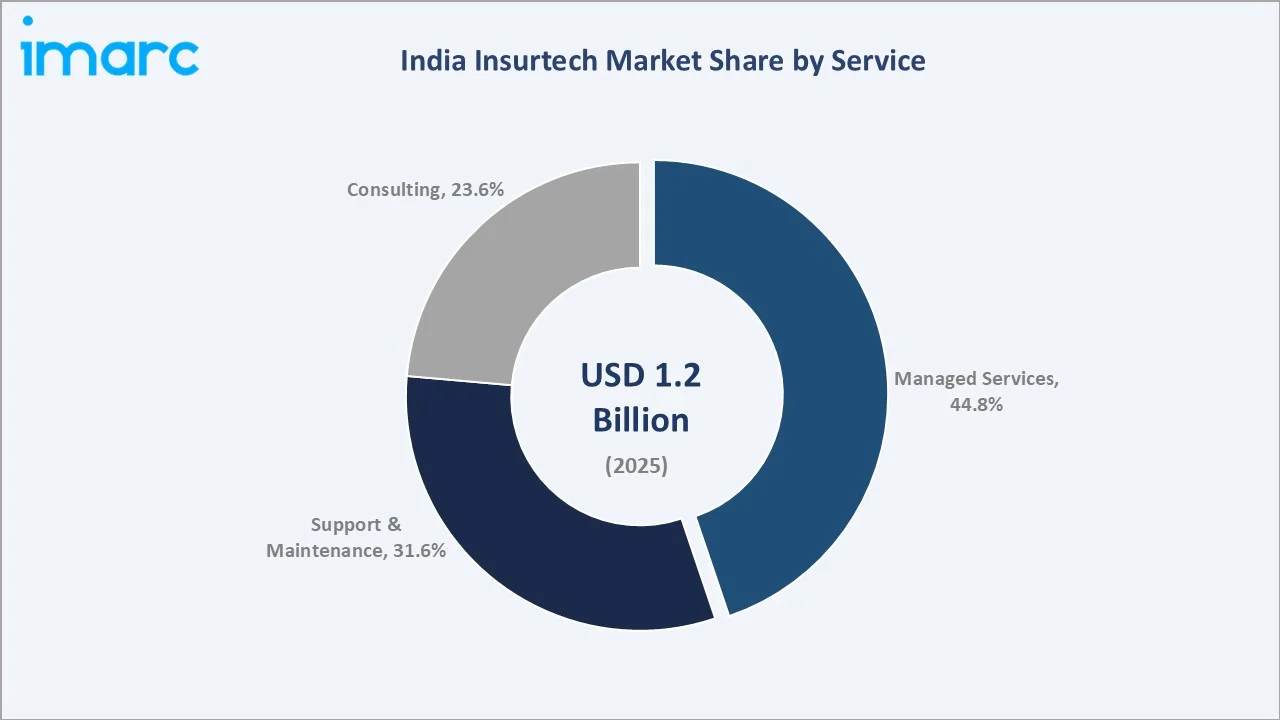
Support and Maintenance at 31.6% reflects ongoing platform upkeep demands. Consulting at 23.6% supports insurtech strategy, regulatory compliance advisory, and technology architecture design for both startups and traditional insurers undergoing digital transformation.
Regional Market Insights
|
Region |
Share (2025) |
Key India Insurtech Market Drivers & Characteristics |
|
North India |
32.6% |
Driven by Delhi-NCR's startup ecosystem density, highest mobile insurance adoption, and young professional demographic with employer-facilitated digital health policy enrollment. |
|
West India |
28.4% |
Mumbai's BFSI infrastructure and fintech ecosystem, Maharashtra's agricultural insurance opportunity, and Gujarat's SME digital insurance adoption drive strong market activity. |
|
South India |
23.7% |
Bengaluru's tech talent concentration enabling insurtech development, Tamil Nadu's strong health insurance culture, and Andhra Pradesh PMJAY integration support regional growth. |
|
East India |
15.3% |
Kolkata's growing fintech adoption, Odisha's parametric agriculture insurance pilots, and Northeast India's mobile-first connectivity expansion drive emerging insurtech demand. |
North India's 32.6% market leadership reflects Delhi-NCR's concentration of insurtech headquarters, India's highest density of employer-facilitated group health policy digital enrollment, and the region's technology-savvy young professional population with above-national digital insurance purchase frequency.
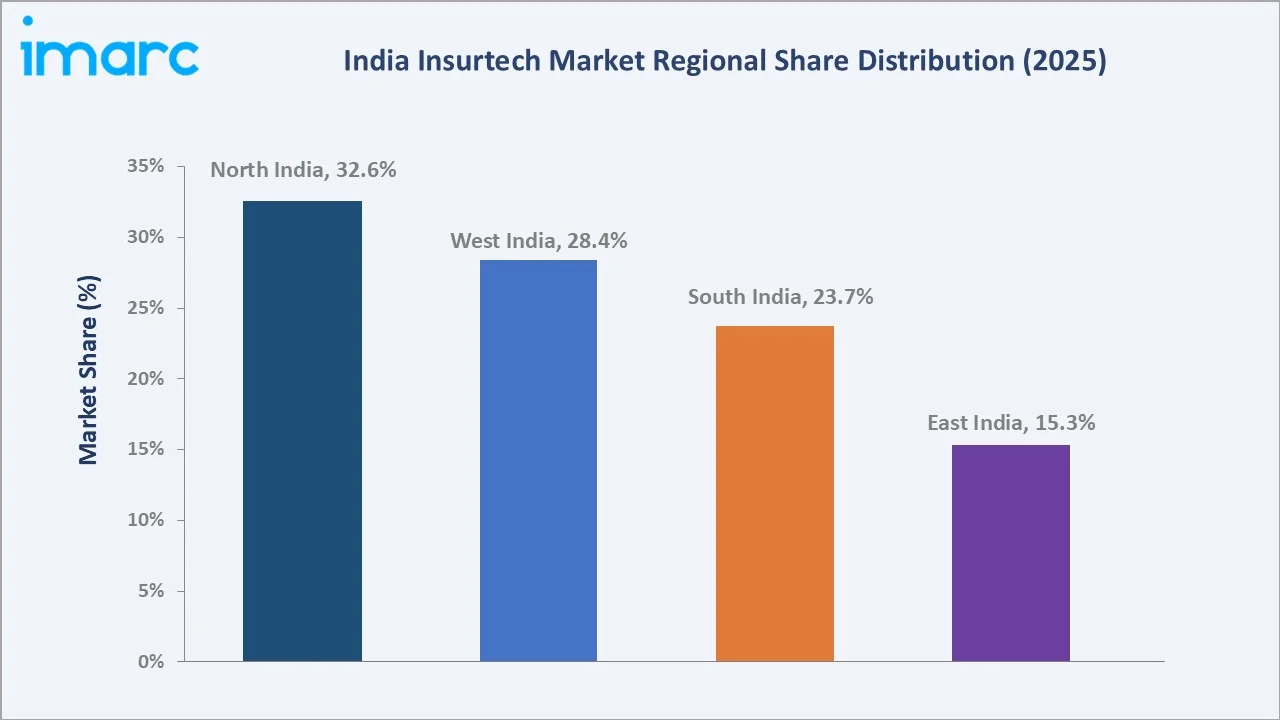
West India's 28.4% reflects Mumbai's BFSI ecosystem advantages and Maharashtra's large agricultural insurance market. South India at 23.7% benefits from Bengaluru's technology talent ecosystem. East India at 15.3% is growing fastest as mobile connectivity expansion reaches Tier-3 markets in West Bengal, Bihar, and Odisha.
Competitive Landscape
India insurtech competitive landscape is defined by digital-native platforms, traditional insurer digital arms, and API aggregators competing across distribution, underwriting, and claims technology. Competition is intensifying through embedded insurance partnerships, telematics-based motor product innovation, and AI-powered health platform investments.
|
Company |
Key Products/Services |
Market Position |
Core Strength |
|
PB Fintech Limited |
PolicyBazaar, Paisabazaar |
Market Leader |
India's largest digital insurance aggregator, unmatched brand recall, and category leadership in online term, health, and investment-linked policy distribution. |
|
Acko Technology and Services Private Limited |
Acko (Motor, Health, Micro) |
Innovator |
Direct-to-consumer digital insurer with embedded insurance partnerships across Amazon India and OLA, achieving claims settlement in under 30 minutes for standard motor claims through AI automation. |
|
Turtlemint Fintech Solutions Ltd. |
Digital insurance advisory platform |
Strong Challenger |
Agent-empowerment platform enabling 120,000+ trained insurance advisors with digital tools, creating a hybrid human-digital distribution model that reaches semi-urban and rural markets effectively. |
|
Coverfox |
Digital insurance brokerage |
Market Challenger |
Pioneer digital insurance broker with deep motor and health insurance expertise, strong API integrations with insurer backends enabling real-time comparison and instant issuance capabilities. |
Key players include PB Fintech Limited, Acko Technology and Services Private Limited, Turtlemint Fintech Solutions Ltd., Coverfox, and others.
Key Company Profiles
PB Fintech Limited
PB Fintech Ltd is India's largest online insurance aggregator and a publicly listed insurtech company, operating PolicyBazaar for insurance and Paisabazaar for credit products. It commands the dominant market share in digital insurance distribution with numerous registered users and comprehensive product coverage across term, health, motor, and investment-linked insurance.
- Key Products/Services: PolicyBazaar, Paisabazaar, PBPartners, among others.
- Recent Developments: In March 2026, PB Fintech Limited launched a mobile application designed to simplify insurance sales and enhance the efficiency of insurance advisors. The app introduces a phygital (physical + digital) insurance distribution model, enabling advisors to compare, select, and sell insurance products from over 26 leading insurers through a single platform.
- Strategic Focus: PB Fintech is investing in health ecosystem integrations, partnering with hospital networks, diagnostic chains, and telemedicine providers to create embedded health insurance products that generate above-market renewal rates through wellness program integration and policyholder health outcome tracking.
Acko Technology and Services Private Limited
Acko Technology and Services Private Limited is a direct-to-consumer digital insurer known for its embedded insurance partnerships and claims automation innovation. Acko's model—combining proprietary underwriting with embedded distribution through Amazon India, OLA, and food delivery platforms—creates a high-volume, low-acquisition-cost insurance business that is commercially differentiated from both traditional insurers and aggregator-dependent platforms.
- Key Products/Services: Acko Motor Insurance, Acko Health Insurance, Acko Micro-Insurance products, embedded device protection.
- Strategic Focus: Deepening embedded insurance penetration by expanding API partnerships with India's top 50 digital consumer platforms, targeting fintech apps, neobanks, e-commerce marketplaces, and travel booking platforms, to create contextually triggered insurance attachment now of highest purchase relevance.
Market Concentration Analysis
India insurtech market is moderately concentrated at the distribution layer, with PB Fintech Limited commanding an estimated 40-50% of India's online insurance aggregation market by premium value. The underwriting layer is more fragmented, with the other key players among the leading digital-first underwriters alongside traditional insurers' growing digital volumes.
Market concentration is evolving through two converging forces: the vertical integration of digital-first underwriters combining product design, technology, and direct distribution into unified platforms, while distribution aggregators simultaneously enter underwriting through insurance broker license upgrades and white-label product partnerships that reduce their dependency on traditional insurer margins.
Investment & Growth Opportunities
Highest Growth Segments
Health insurance (~30.5% CAGR through digital health ecosystem integration), managed services (~31.2% CAGR through AI/ML platform expansion), and North India (~29.4% CAGR through startup ecosystem maturity) represent India's highest-growth insurtech investment vectors through 2034.
Emerging Investment Opportunities
India's parametric agriculture insurance market, addressable for 140 million farming households, represents a transformative investment opportunity combining satellite imagery, weather data APIs, and mobile money settlement infrastructure. The government's PMFBY scheme provides a subsidy infrastructure that reduces distribution cost to near-zero for qualified insurtech platform partners.
Investment Themes
- Embedded insurance infrastructure investment for India's fastest-growing insurtech distribution channel, requiring API-first policy issuance platforms, real-time premium collection integrations, and embedded claims initiation capabilities that convert every digital transaction point into an insurance distribution touchpoint.
- AI underwriting technology investment enabling instant, paperless policy issuance for India's mass market at premium levels that create commercially viable unit economics while serving India's 900 million uninsured adults through digital platforms with zero marginal distribution cost.
Future Market Outlook (2026-2034)
The India insurtech market is projected to grow from USD 1.16 Billion in 2025 to USD 1.50 Billion in 2026, reaching USD 12.05 Billion by 2034, registering a CAGR of 28.79% during 2026-2034. The market's anchor value of USD 4.12 Billion in 2030 represents India insurtech at a structural inflection, where embedded insurance achieves mainstream commercial scale, AI underwriting enables profitable micro-insurance at rural scale, and health insurtech becomes the primary channel for India's 300 million middle-class health insurance consumers.
Three structural forces define India insurtech growth through 2034: India's 900 million+ uninsured adults representing the world's largest green-field insurance market addressable through digital platforms; IRDAI's continued regulatory modernization enabling product innovation velocity that exceeds global peers; and embedded insurance's geometric distribution expansion converting every digital transaction into an insurance touchpoint.
Research Methodology
Primary Research
Primary research comprised structured interviews with India insurtech industry stakeholders, including CEO and Co-Founders of insurtech startups, Chief Digital Officers of traditional insurers, IRDAI regulatory advisors, venture capital investors specializing in insurtech, and consumer survey data from digital insurance buyers across North, West, South, and East India.
Secondary Research
Secondary research encompassed IRDAI annual reports and regulatory circulars, company annual reports and investor presentations, insurance company financial disclosures, venture capital deal databases, DPIIT startup recognition data, and India digital economy reports. Over 50 secondary sources reviewed and cross-referenced.
Forecasting Models
Market revenue forecasts were developed using a digital insurance penetration model: India's internet-active population by income segment multiplied by digital insurance adoption rate and average premium per segment, aggregated across type and service categories. Government scheme enrollment pipeline applied as market seeding multiplier.
India Insurtech Market Report Coverage:
| Report Features | Details |
|---|---|
| Base Year of the Analysis | 2025 |
| Historical Period | 2020-2025 |
| Forecast Period | 2026-2034 |
| Units | Billion USD |
| Scope of the Report |
Exploration of Historical Trends and Market Outlook, Industry Catalysts and Challenges, Segment-Wise Historical and Future Market Assessment:
|
| Types Covered | Auto, Business, Health, Home, Specialty, Travel, Others |
| Services Covered | Consulting, Support and Maintenance, Managed Services |
| Technologies Covered | Block Chain, Cloud Computing, IoT, Machine Learning, Robo Advisory, Others |
| Regions Covered | North India, South India, East India, West India |
| Companies Covered | PB Fintech Limited, Acko Technology and Services Private Limited, Turtlemint Fintech Solutions Ltd., Coverfox, etc. |
| Customization Scope | 10% Free Customization |
| Post-Sale Analyst Support | 10-12 Weeks |
| Delivery Format | PDF and Excel through Email (We can also provide the editable version of the report in PPT/Word format on special request) |
Key Benefits for Stakeholders:
- IMARC’s industry report offers a comprehensive quantitative analysis of various market segments, historical and current market trends, market forecasts, and dynamics of the India Insurtech market from 2020-2034.
- The research report provides the latest information on the market drivers, challenges, and opportunities in the India Insurtech market.
- Porter's five forces analysis assist stakeholders in assessing the impact of new entrants, competitive rivalry, supplier power, buyer power, and the threat of substitution. It helps stakeholders to analyze the level of competition within the India Insurtech industry and its attractiveness.
- Competitive landscape allows stakeholders to understand their competitive environment and provides an insight into the current positions of key players in the market.
Frequently Asked Questions About the India Insurtech Market Report
India insurtech market size is estimated at USD 1.50 Billion in 2026, driven by rising smartphone penetration, government digital insurance inclusion schemes, and AI-enabled underwriting platforms. India's 900 million+ uninsured adults and low insurance penetration of ~4% of GDP create an extraordinary addressable market for technology-driven insurance distribution and product innovation.
India insurtech market grows at 28.79% CAGR during 2026-2034, reaching USD 12.05 Billion by 2034. Growth is sustained by embedded insurance scaling across digital commerce, AI underwriting enabling micro-insurance economics, IRDAI regulatory reforms, and India's young, tech-savvy population transitioning from uninsured to digitally-insured cohorts.
Health leads at 37.6% through post-COVID health awareness surge, PMJAY enrollment driving digital health policy issuance, and rising out-of-pocket healthcare costs. Digital health platforms offering telemedicine integration, OPD coverage, and instant-claim processing are converting India's previously uninsured middle class into active health insurance buyers.
Managed Services leads at 44.8% because insurtech platforms require outsourced cloud infrastructure, AI/ML analytics, cybersecurity management, and regulatory compliance services that exceed in-house startup capabilities. Managed service providers enable insurtech platforms to serve millions of policyholders at minimal marginal cost without proportional headcount expansion.
North India leads at 32.6% through Delhi-NCR's insurtech startup concentration, India's highest mobile insurance adoption rates, and a young professional demographic with above-national digital insurance purchase frequency driven by employer-facilitated group health policy digital enrollment and fintech platform insurance integrations.
Leading companies include PB Fintech Limited, Acko Technology and Services Private Limited, Turtlemint Fintech Solutions Ltd., Coverfox, and others.
India insurtech market is projected to reach approximately USD 4.12 Billion by 2030, with embedded insurance achieving mainstream scale across digital commerce platforms, AI underwriting enabling profitable rural micro-insurance at scale, and health insurtech emerging as the primary distribution channel for India's rapidly growing middle-class health insurance cohort.
Need more help?
- Speak to our experienced analysts for insights on the current market scenarios.
- Include additional segments and countries to customize the report as per your requirement.
- Gain an unparalleled competitive advantage in your domain by understanding how to utilize the report and positively impacting your operations and revenue.
- For further assistance, please connect with our analysts.
 Request Customization
 Speak to an Analyst
 Request Brochure
 Inquire Before Buying
Benefits of Customization
- Personalize this research
- Triangulate with your data
- Get data as per your format and definition
- Gain a deeper dive into a specific application, geography, customer, or competitor
- Any level of personalization
Get in Touch With Us
UNITED STATES
Phone: +1-201-971-6302
INDIA
Phone: +91-120-433-0800
UNITED KINGDOM
Phone: +44-753-714-6104
Email: [email protected]
Client Testimonials




.webp)




.webp)













Related Reports

Choose your plan
*Please note that the prices mentioned below are starting prices for each bundle type. Kindly contact our team for further details.*
Single User License
- 1 User License, Access on 2 Devices
- PDF Report + Excel Dataset (Password Protected)
- Lifetime Access
- No Printing Rights
- 10% Free Report Customization
- 10–12 Weeks of Analyst Support
Five User License
- Access for 5 Users, 2 Devices per User
- PDF Report + Excel Dataset (Password Protected)
- Lifetime Access
- Dedicated Account Manager
- 12–14 Weeks of Analyst Support
- No Printing Rights
- 15% Free Report Customization
- 25% Discount on Your Next Purchase
Corporate User License
- Unlimited User Access (Within Your Organization)
- PDF Report + Excel Dataset
- Lifetime Access
- Dedicated Account Manager
- 14–20 Weeks of Analyst Support
- No Printing Rights
- 20% Free Report Customization
- 30% Discount on Your Next Purchase
Essential Insights
What's included:
3 reports
- Lifetime Access
- PDF Reports
- Excel Datasets
- 2 Weeks of Free Analyst Support
- 2 User Licenses
- Access on 2 Devices
- Printing Rights
- Complimentary PowerPoint (PPT) Version
- Complimentary License Upgrade
Professional Access
What's included:
5 reports
- Lifetime Access
- PDF Reports
- Excel Datasets
- 8 Weeks of Free Analyst Support
- 2 User Licenses
- Access on 2 Devices
- Printing Rights
- Complimentary PowerPoint (PPT) Version
- Complimentary License Upgrade
Business Advantage
What's included:
8 reports
- Lifetime Access
- PDF Reports
- Excel Datasets
- 14 Weeks of Free Analyst Support
- 2 User Licenses
- Access on 2 Devices
- Printing Rights
- Complimentary PowerPoint (PPT) Version
- Complimentary License Upgrade
Enterprise Intelligence
What's included:
10 reports
- Lifetime Access
- PDF Reports
- Excel Datasets
- 20 Weeks of Free Analyst Support
- 2 User Licenses
- Access on 2 Devices
- Printing Rights
- Complimentary PowerPoint (PPT) Version
- Complimentary License Upgrade