
India IoT Security Market Size, Share, Trends and Forecast by Component, Security Type, Vertical, and Region, 2026-2034
India IoT Security Market Summary:
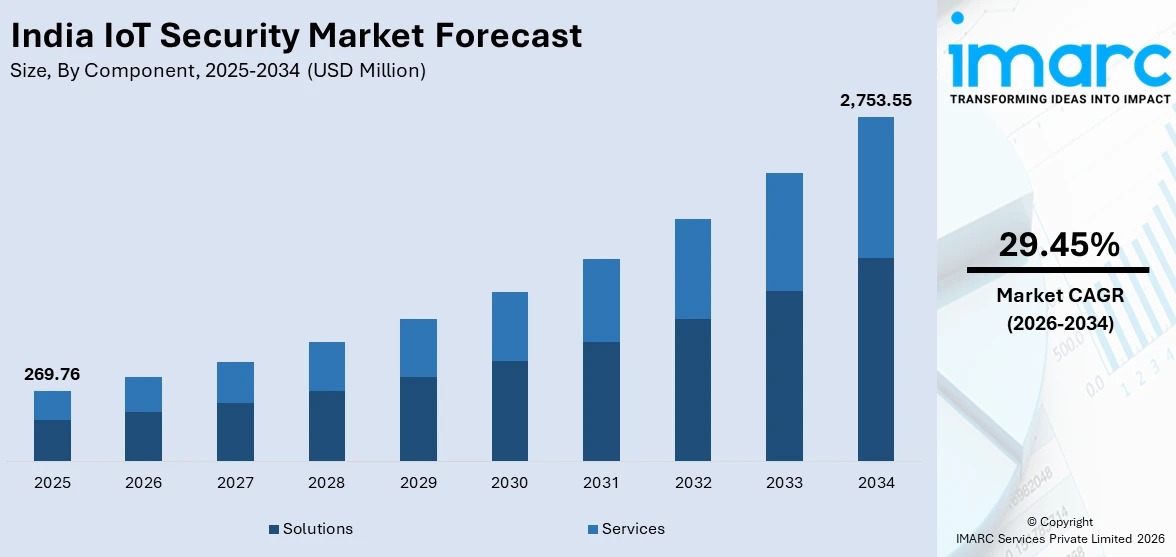
The India IoT security market size was valued at USD 269.76 Million in 2025 and is projected to reach USD 2,753.55 Million by 2034, growing at a compound annual growth rate of 29.45% from 2026-2034.
The market is driven by the rapid proliferation of connected devices across industrial and consumer ecosystems, coupled with increasing government initiatives promoting digital infrastructure and smart city deployments. Rising cybersecurity threats targeting IoT networks are compelling enterprises to adopt comprehensive security frameworks. Stringent data protection regulations and growing awareness of endpoint vulnerabilities are further accelerating demand for integrated IoT security solutions, contributing to the expanding India IoT security market share.
Key Takeaways and Insights:
- By Component: Solutions dominate the market with a share of 67% in 2025, driven by growing enterprise demand for integrated security platforms encompassing identity management, encryption, and comprehensive threat intelligence capabilities across connected ecosystems.
- By Security Type: Network security leads the market with a share of 35% in 2025, owing to the critical need for safeguarding data transmission channels across expanding IoT architectures through firewall deployment and intrusion detection systems.
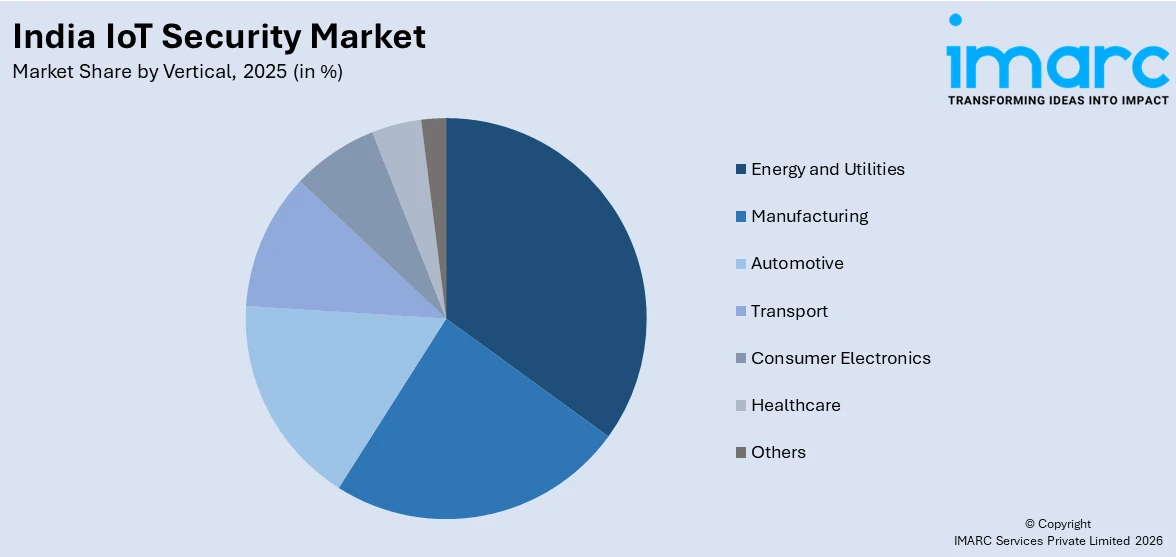
- By Vertical: Energy and utilities represent the largest segment with a market share of 20% in 2025, driven by by extensive deployment of smart grid technologies and connected metering infrastructure requiring robust cybersecurity measures for critical infrastructure protection.
- By Region: North India leads the market with a share of 30% in 2025, owing to the concentration of technology enterprises, government institutions, and digital infrastructure hubs in the National Capital Region (NCR) alongside smart city investments.
- Key Players: The India IoT security market exhibits a moderately fragmented competitive landscape, with global cybersecurity corporations competing alongside domestic technology firms, focusing on strategic partnerships and AI-driven threat detection capabilities.
To get more information on this market Request Sample
The India IoT security market is experiencing significant momentum, underpinned by the country's accelerating digital transformation across manufacturing, healthcare, energy, and urban infrastructure sectors. The exponential growth in connected devices, ranging from industrial sensors to consumer wearables, has created an expansive attack surface that demands sophisticated security solutions. According to sources, the Indian government, through the National Security Council Secretariat (NSCS), announced a mandatory cybersecurity framework for connected devices in critical sectors, including healthcare, energy, and transportation, requiring source verification and rigorous security testing before deployment. Moreover, government-led initiatives such as digital India, smart cities mission, and the national cyber security policy are catalyzing investments in Internet of Things (IoT) security infrastructure. The increasing adoption of cloud computing, edge analytics, and AI across enterprises is driving demand for adaptive security frameworks capable of protecting heterogeneous IoT environments against evolving cyber threats.
India IoT Security Market Trends:
Incorporating Artificial Intelligence and Machine Learning for Enhanced Threat Detection
The India IoT security landscape is witnessing a transformative shift toward artificial intelligence (AI) and machine learning (ML) powered security solutions that enable real-time threat identification and automated response mechanisms. In 2025, identity security company Saviynt announced the launch of its new innovation hub in Bengaluru focused on AI‑driven identity and access security research, underscoring industry efforts to localize advanced cybersecurity capabilities. Enterprises are increasingly deploying intelligent security platforms capable of analyzing vast volumes of network traffic data to detect anomalous behavior patterns indicative of cyber intrusions.
Expansion of Zero Trust Security Architecture Across IoT Ecosystems
The adoption of zero trust security frameworks is gaining considerable traction within India’s IoT ecosystem as organizations recognize the limitations of traditional perimeter-based defense models. As per sources, in 2025, enterprises in India, including Sandvik and Maverick Transportation, began using Zscaler Cellular to secure IoT and OT devices through zero-trust, cellular-connected networks demonstrating practical industry adoption of advanced security solutions. This approach mandates continuous verification of every device, user, and application attempting to access network resources, regardless of their location within the infrastructure.
Rising Demand for Edge-Native Security Solutions
The proliferation of edge computing deployments across Indian industries is creating substantial demand for security solutions designed to operate at the network periphery. In November 2025, Blue Cloud Softech Solutions signed a Letter of Intent with UK‑based BlackDice Cyber to integrate advanced AI‑driven security directly into 5G edge and IoT infrastructure, strengthening localized threat mitigation at network edges. Edge-native security platforms offering lightweight encryption, device attestation, and local threat mitigation capabilities are emerging as essential components of comprehensive IoT security strategies, particularly in manufacturing, transportation, and smart city applications.
Market Outlook 2026-2034:
The India IoT security market revenue is poised for robust expansion over the forecast period, driven by escalating cybersecurity investments across public and private sectors. Enterprise spending on comprehensive IoT security frameworks is anticipated to accelerate as connected device deployments multiply across industrial automation, smart infrastructure, and healthcare applications. The market revenue trajectory is expected to benefit from supportive regulatory developments, increasing compliance requirements, and growing recognition of cybersecurity as a strategic business imperative rather than a discretionary technology expenditure, positioning India as a leading IoT security market in the Asia-Pacific region. The market generated a revenue of USD 269.76 Million in 2025 and is projected to reach a revenue of USD 2,753.55 Million by 2034, growing at a compound annual growth rate of 29.45% from 2026-2034.
India IoT Security Market Report Segmentation:
|
Segment Category |
Leading Segment |
Market Share |
|
Component |
Solutions |
67% |
|
Security Type |
Network Security |
35% |
|
Vertical |
Energy and Utilities |
20% |
|
Region |
North India |
30% |
Component Insights:
- Solutions
- Services
Solutions dominate with a market share of 67% of the total India IoT security market in 2025.
The solutions hold the largest share of the India IoT security market, encompassing a comprehensive range of software platforms and integrated tools designed to protect connected devices, networks, and data assets. According to reports, Tata Consultancy Services deployed its Cyber Defense Suite globally, enabling over 10,000 organizations to gain end-to-end IoT and enterprise threat visibility with automated incident response. This segment includes identity and access management systems, encryption technologies, unified threat management platforms, and security analytics solutions.
Growing adoption of cloud-based security solutions is further strengthening this segment as organizations seek scalable and cost-effective platforms capable of managing security across geographically distributed IoT deployments. The increasing sophistication of cyber threats targeting IoT infrastructure is compelling enterprises to invest in advanced solutions incorporating behavioral analytics, automated patch management, and real-time monitoring functionalities. These capabilities collectively enhance organizational resilience against emerging attack methodologies while supporting seamless integration with existing enterprise security architectures.
Security Type Insights:
- Network Security
- Endpoint Security
- Application Security
- Cloud Security
- Others
Network security leads with a share of 35% of the total India IoT security market in 2025.
Network security represents the leading segment within the India IoT security market, reflecting the fundamental importance of protecting data transmission pathways across interconnected device ecosystems. According to reports, India saw IoT attacks surge by 59% from 1057320 to 1,680,787, while cryptojacking incidents jumped 409%, highlighting urgent demand for robust network and IoT security solutions. This segment encompasses firewall solutions, intrusion detection and prevention systems, virtual private networks, and network access control platforms specifically designed for IoT environments.
The increasing complexity of IoT network architectures, incorporating multi-cloud environments, edge computing nodes, and heterogeneous communication protocols, necessitates advanced network security measures. Organizations are prioritizing investments in next-generation firewalls and deep packet inspection technologies capable of monitoring encrypted IoT traffic without compromising performance. The growing adoption of software-defined networking approaches is further elevating demand for dynamic, policy-driven network security solutions adaptable to evolving IoT infrastructure requirements across diverse industry verticals.
Vertical Insights:
Access the comprehensive market breakdown Request Sample
- Energy and Utilities
- Manufacturing
- Automotive
- Transport
- Consumer Electronics
- Healthcare
- Others
Energy and utilities exhibit a clear dominance with a 20% share of the total India IoT security market in 2025.
The energy and utilities command the largest share of the India IoT security market, driven by the extensive digitalization of power generation, distribution, and consumption monitoring infrastructure. In December 2025, the Ministry of Power established a dedicated Computer Security Incident Response Team Power (CSIRT‑Power) and expanded sector‑wide cybersecurity regulations to help utilities detect, respond to, and manage cyber incidents across grid operations. Smart grid deployments, advanced metering infrastructure, and connected supervisory control systems require robust cybersecurity frameworks to protect critical national assets from sophisticated threat actors.
India’s plans to deploy more renewable energy and smart grid networks are putting forth considerable demand for specific types of IoT security solutions that are designed specifically to meet the needs of operational technology platforms. The integration of information technologies and operational technologies poses considerable and specific types of risks that need to be addressed through specified types of platform solutions. The demand for new industrial-grade security solutions, which implement anomaly-based security features and remote access solutions, is increasing among energy companies.
Regional Insights:
- North India
- West and Central India
- South India
- East and Northeast India
North India dominates with a market share of 30% of the total India IoT security market in 2025.
North India leads the regional landscape of the India IoT security market, primarily due to the concentration of government institutions, defense establishments, and technology enterprises in the National Capital Region (NCR) and surrounding areas. The region benefits from substantial public sector investments in digital infrastructure, cybersecurity centers of excellence, and smart city implementations across major urban centers. The presence of a robust information technology ecosystem and skilled workforce further supports the widespread adoption of advanced IoT security solutions.
The region's leadership position is reinforced by significant private sector spending on IoT security across banking, financial services, and telecommunications verticals concentrated in Delhi, Gurugram, and Noida. Government procurement programs focused on securing critical infrastructure and defense communication networks contribute meaningfully to regional demand. Additionally, the establishment of cybersecurity research institutions and industry collaboration frameworks in North India is fostering innovation and accelerating the development of indigenous IoT security capabilities tailored to domestic market requirements.
Market Dynamics:
Growth Drivers:
Why is the India IoT Security Market Growing?
Accelerating Digital Transformation and Smart Infrastructure Deployment
India's comprehensive digital transformation agenda is fundamentally reshaping the demand landscape for IoT security solutions across public and private sectors. The government's Smart Cities Mission, coupled with large-scale industrial automation initiatives under the Make in India framework, is driving unprecedented deployment of connected sensors, actuators, and monitoring systems across urban infrastructure, manufacturing facilities, and agricultural operations. As per sources, in March 2025, CERT-In and Kaspersky released comprehensive Smart City cybersecurity guidelines, targeting over 100 connected cities in India to strengthen IoT, AI, and network security across urban digital infrastructure.
Escalating Cyber Threat Landscape Targeting Connected Devices
The increasing sophistication and frequency of cyberattacks specifically targeting IoT infrastructure in India is serving as a powerful catalyst for market growth. Threat actors are increasingly exploiting vulnerabilities in connected devices to launch distributed denial-of-service attacks, conduct industrial espionage, and compromise critical infrastructure systems. In 2025, Indian organizations faced an average of over 2,000 cyberattacks weekly per organization, reflecting escalating threats that often leverage IoT and connected endpoints. The evolving nature of these threats, encompassing advanced persistent threats, ransomware campaigns targeting operational technology environments, and supply chain compromise attempts, compels organizations across sectors to strengthen their IoT security investments with specialized platforms offering device-level protection and behavioral analytics capabilities.
Strengthening Regulatory Framework and Data Protection Mandates
India's evolving regulatory environment is creating substantial compliance-driven demand for IoT security solutions across regulated industries. The implementation of the Digital Personal Data Protection Act and sector-specific cybersecurity guidelines issued by regulatory bodies are establishing mandatory security standards for organizations operating connected device infrastructure. As per sources, in November 2025, India officially notified the Digital Personal Data Protection Rules under the DPDP Act, mandating strong security safeguards, breach reporting, and consent controls for data fiduciaries across digital ecosystems. These regulatory developments require enterprises to implement comprehensive data encryption, access control, audit logging, and incident response mechanisms across their IoT deployments.

Market Restraints:
What Challenges the India IoT Security Market is Facing?
Fragmented IoT Device Ecosystem and Interoperability Challenges
The highly fragmented nature of the IoT device landscape in India presents significant obstacles for comprehensive security deployment. The absence of universally adopted security standards across device manufacturers creates inconsistent vulnerability profiles and complicates unified security management. Organizations struggle to maintain consistent security policies across heterogeneous device populations operating on diverse communication protocols and firmware versions.
Shortage of Specialized IoT Security Talent
India faces an acute shortage of cybersecurity professionals with specialized expertise in IoT security architectures and operational technology environments. The intersection of embedded systems knowledge, network security expertise, and industrial control system understanding represents a rare skill combination. This talent gap constrains organizational ability to design, deploy, and maintain comprehensive IoT security frameworks effectively.
High Implementation Costs for Small and Medium Enterprises
The substantial financial investment required for deploying enterprise-grade IoT security solutions presents a significant barrier for India's extensive small and medium enterprise sector. Comprehensive implementations encompassing device management platforms, network monitoring tools, and security analytics capabilities demand considerable capital expenditure alongside ongoing operational costs, leaving smaller organizations with inadequate connected device protection.
Competitive Landscape:
The India IoT security market features a dynamic competitive environment characterized by the coexistence of established global cybersecurity corporations and emerging domestic technology providers. Market participants are actively pursuing product differentiation through investments in AI-enhanced threat detection, cloud-native security architectures, and industry-specific solution portfolios tailored to verticals such as energy, manufacturing, and healthcare. Strategic partnerships between security vendors and IoT platform providers are intensifying as organizations seek integrated solutions that address the complete device lifecycle security requirements. The competitive landscape is further shaped by increasing merger and acquisition activity as larger players seek to consolidate capabilities across network security, endpoint protection, and cloud security domains.
Recent Developments:
- In March 2025, Chennai-based Mindgrove Technologies announced plans to launch India’s first indigenously designed Secure IoT microcontroller within six to seven months. Targeting wearables, smart home devices, smart city meters, access control, and EV battery management, production is scheduled for September–October 2025.
India IoT Security Market Report Coverage:
| Report Features | Details |
|---|---|
| Base Year of the Analysis | 2025 |
| Historical Period | 2020-2025 |
| Forecast Period | 2026-2034 |
| Units | Million USD |
| Scope of the Report | Exploration of Historical Trends and Market Outlook, Industry Catalysts and Challenges, Segment-Wise Historical and Future Market Assessment:
|
| Components Covered | Solutions, Services |
| Security Types Covered | Network Security, Endpoint Security, Application Security, Cloud Security, Others |
| Verticals Covered | Energy and Utilities, Manufacturing, Automotive, Transport, Consumer Electronics, Healthcare, Others |
| Regions Covered | North India, West and Central India, South India, East and Northeast India |
| Customization Scope | 10% Free Customization |
| Post-Sale Analyst Support | 10-12 Weeks |
| Delivery Format | PDF and Excel through Email (We can also provide the editable version of the report in PPT/Word format on special request) |
Frequently Asked Questions About the India IoT Security Market Report
The India IoT security market size was valued at USD 269.76 Million in 2025.
The India IoT security market is expected to grow at a compound annual growth rate of 29.45% from 2026-2034 to reach USD 2,753.55 Million by 2034.
Solutions held the largest India IoT security market share, driven by the increasing enterprise demand for comprehensive, integrated security platforms encompassing threat detection, identity management, and encryption capabilities across diverse IoT ecosystems.
Key factors driving the India IoT security market include the rapid proliferation of connected devices across industries, government-led smart city and digital infrastructure initiatives, escalating cybersecurity threats targeting IoT networks, and strengthening data protection regulations mandating comprehensive security compliance.
Major challenges include the highly fragmented IoT device ecosystem creating interoperability issues, acute shortage of specialized IoT security professionals, high implementation costs for small and medium enterprises, inconsistent security standards across device manufacturers, and complexity of managing security across heterogeneous connected environments.
Need more help?
- Speak to our experienced analysts for insights on the current market scenarios.
- Include additional segments and countries to customize the report as per your requirement.
- Gain an unparalleled competitive advantage in your domain by understanding how to utilize the report and positively impacting your operations and revenue.
- For further assistance, please connect with our analysts.
 Request Customization
 Speak to an Analyst
 Request Brochure
 Inquire Before Buying
Benefits of Customization
- Personalize this research
- Triangulate with your data
- Get data as per your format and definition
- Gain a deeper dive into a specific application, geography, customer, or competitor
- Any level of personalization
Get in Touch With Us
UNITED STATES
Phone: +1-201-971-6302
INDIA
Phone: +91-120-433-0800
UNITED KINGDOM
Phone: +44-753-714-6104
Email: [email protected]
Client Testimonials




.webp)




.webp)













Related Reports

Choose your plan
*Please note that the prices mentioned below are starting prices for each bundle type. Kindly contact our team for further details.*
Single User License
- 1 User License, Access on 2 Devices
- PDF Report + Excel Dataset (Password Protected)
- Lifetime Access
- No Printing Rights
- 10% Free Report Customization
- 10–12 Weeks of Analyst Support
Five User License
- Access for 5 Users, 2 Devices per User
- PDF Report + Excel Dataset (Password Protected)
- Lifetime Access
- Dedicated Account Manager
- 12–14 Weeks of Analyst Support
- No Printing Rights
- 15% Free Report Customization
- 25% Discount on Your Next Purchase
Corporate User License
- Unlimited User Access (Within Your Organization)
- PDF Report + Excel Dataset
- Lifetime Access
- Dedicated Account Manager
- 14–20 Weeks of Analyst Support
- No Printing Rights
- 20% Free Report Customization
- 30% Discount on Your Next Purchase
Essential Insights
What's included:
3 reports
- Lifetime Access
- PDF Reports
- Excel Datasets
- 2 Weeks of Free Analyst Support
- 2 User Licenses
- Access on 2 Devices
- Printing Rights
- Complimentary PowerPoint (PPT) Version
- Complimentary License Upgrade
Professional Access
What's included:
5 reports
- Lifetime Access
- PDF Reports
- Excel Datasets
- 8 Weeks of Free Analyst Support
- 2 User Licenses
- Access on 2 Devices
- Printing Rights
- Complimentary PowerPoint (PPT) Version
- Complimentary License Upgrade
Business Advantage
What's included:
8 reports
- Lifetime Access
- PDF Reports
- Excel Datasets
- 14 Weeks of Free Analyst Support
- 2 User Licenses
- Access on 2 Devices
- Printing Rights
- Complimentary PowerPoint (PPT) Version
- Complimentary License Upgrade
Enterprise Intelligence
What's included:
10 reports
- Lifetime Access
- PDF Reports
- Excel Datasets
- 20 Weeks of Free Analyst Support
- 2 User Licenses
- Access on 2 Devices
- Printing Rights
- Complimentary PowerPoint (PPT) Version
- Complimentary License Upgrade