
India Laundry Detergent Market Size, Share, Trends and Forecast by Product Type, Distribution Channel, Application, and Region, 2026-2034
India Laundry Detergent Market Summary:
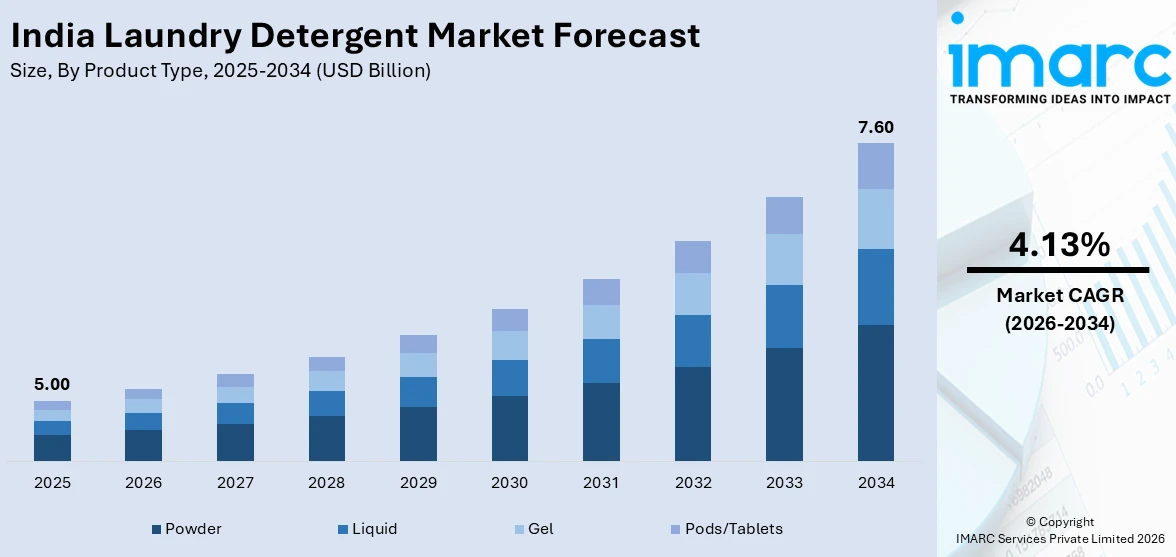
The India laundry detergent market grew from USD 5.00 Billion in 2025 to USD 5.50 Billion in 2026 and is projected to reach USD 7.60 Billion by 2034, growing at a compound annual growth rate of 4.13% from 2026-2034.
The market is driven by rising urbanization and increasing household hygiene awareness, which are fueling demand for effective fabric cleaning solutions. Growing washing machine penetration, evolving consumer preferences toward premium and eco-friendly formulations, and expanding modern retail infrastructure are strengthening consumption patterns. Additionally, rising disposable incomes, shifting lifestyles in semi-urban and rural regions, and continuous product innovation are collectively supporting the expansion of India laundry detergent market share.
Key Takeaways and Insights:
- By Product Type: Powder dominates the market with a share of 48.5% in 2025, driven by widespread affordability, suitability for both hand and machine washing, and strong penetration across urban, semi-urban, and rural households nationwide.
- By Distribution Channel: Supermarkets and hypermarkets lead the market with a share of 34.5% in 2025, owing to extensive product assortment, competitive pricing strategies, and enhanced consumer access across organized retail formats.
- By Application: Household represents the largest segment with a market share of 72.5% in 2025, driven by India's large residential consumer base, rising hygiene consciousness, and growing preference for effective daily laundry care solutions.
- By Region: North India leads the market with a share of 32.8% in 2025, owing to its high population density, increasing disposable incomes, expanding modern trade penetration, and growing demand for branded detergent products.
- Key Players: The India laundry detergent market is highly competitive, with multinational corporations and domestic manufacturers competing across premium, mid-range, and economy segments through product innovation, distribution expansion, strategic partnerships, and aggressive pricing to strengthen their presence.
To get more information on this market Request Sample
The India laundry detergent market is experiencing strong growth fueled by evolving socioeconomic conditions and shifting lifestyle patterns that are transforming household cleaning practices nationwide. Rapid urbanization, coupled with the steady expansion of the middle-class population, is broadening the consumer base while driving higher purchasing power and greater awareness of hygiene and fabric care. As per sources, Godrej Consumer Products launched a new affordable liquid detergent “Godrej Fab,” priced at INR 99 for one litre and supported by a TV campaign in Southern India, aimed at increasing accessibility and adoption of modern detergent formats. The increasing adoption of washing machines, particularly across semi-urban and rural regions supported by ongoing rural electrification initiatives, is encouraging a transition from traditional washing methods to modern detergent formats. Additionally, the growing presence of organized retail outlets and the rapid expansion of e-commerce platforms are significantly improving product accessibility, allowing consumers to discover and purchase a diverse range of premium and specialized detergent formulations tailored to specific fabric care needs and cleaning preferences.
India Laundry Detergent Market Trends:
Rising Demand for Eco-Friendly and Plant-Based Detergent Formulations
Consumer awareness regarding environmental sustainability and health safety is driving a significant shift toward eco-friendly and plant-based laundry detergent formulations across India. Consumers are increasingly prioritizing biodegradable, phosphate-free, and hypoallergenic products that minimize water pollution and reduce skin irritation risks. In January 2026, Forever Living India expanded its home‑care portfolio by launching “Forever Detergent LiquiPak,” a plant‑derived machine‑wash laundry pod designed to offer a gentler and eco‑conscious alternative to conventional detergents. This trend is supported by regulatory initiatives promoting green chemistry and sustainable packaging practices. Manufacturers are responding by investing in eco-certifications, recyclable packaging materials, and natural surfactants derived from coconut extracts and soap nuts.
Accelerating Shift Toward Liquid and Concentrated Detergent Formats
India is experiencing a notable transition from traditional powder and bar detergents toward liquid and concentrated formats, driven by increasing washing machine adoption and evolving urban lifestyles. Liquid detergents are gaining popularity due to their ease of use, superior stain removal capabilities, and compatibility with high efficiency washing machines. In July 2025, Godrej Consumer Products Ltd announced plans to scale its liquid detergent brand Godrej Fab over two‑fold to reach ₹500 crore in annual revenue by fiscal year 2026, reinforcing the growing preference for liquid formats among Indian consumers. Concentrated formulations appeal to environmentally conscious consumers seeking reduced packaging waste and lower water consumption.
Expansion of E-Commerce and Direct-to-Consumer Distribution Models
The rapid growth of e-commerce platforms and quick-commerce services is transforming laundry detergent purchasing patterns across India. Digital channels are expanding product accessibility beyond metropolitan centers to tier-two, tier-three cities, and rural areas, enabling consumers to explore diverse product offerings and compare options conveniently. In June 2025, e‑commerce, quick commerce, and modern trade accounted for 31% of ITC’s FMCG portfolio, up from 17% in FY 2019‑20, highlighting growth via tailored channel-specific strategies. Brands are leveraging social media marketing, influencer collaborations, and AI-driven personalization to strengthen their online presence and engage directly with consumers. Auto-replenishment subscription models and exclusive online product variants are further enhancing customer retention and creating new revenue streams. This digital transformation is reshaping competitive dynamics in the detergent market.
Market Outlook 2026-2034:
The India laundry detergent market is poised for sustained expansion as urbanization accelerates, disposable incomes rise, and hygiene awareness continues to deepen across consumer segments. The growing adoption of washing machines in semi-urban and rural households is expected to further drive demand for modern detergent formats. Additionally, increasing investments by key players in product innovation, eco-friendly formulations, and digital distribution channels are anticipated to unlock new growth opportunities, reinforcing the market's positive trajectory over the coming years. The market generated a revenue of USD 5.00 Billion in 2025 ,which is expected to reach USD 5.50 Billion in 2026 and further grow to USD 7.60 Billion by 2034, at a compound annual growth rate (CAGR) of 4.13% during 2026-2034.
India Laundry Detergent Market Report Segmentation:
| Segment Category | Leading Segment | Market Share |
|---|---|---|
|
Product Type |
Powder |
48.5% |
|
Distribution Channel |
Supermarkets and Hypermarkets |
34.5% |
|
Application |
Household |
72.5% |
|
Region |
North India |
32.8% |
Product Type Insights:
- Powder
- Liquid
- Gel
- Pods/Tablets
Powder dominates with a market share of 48.5% of the total India laundry detergent market in 2025.
Powder holds the leading position in the India laundry detergent market, driven by its widespread affordability, versatility, and deep-rooted consumer familiarity across both urban and rural households. The format's suitability for hand washing, which remains prevalent across a significant portion of the population, reinforces its dominant status. Powder detergents are available in a broad range of pack sizes, making them accessible to diverse income groups. Additionally, strong brand recognition built through decades of advertising and distribution efforts continues to sustain consumer loyalty toward this traditional format.
The stronghold of powder detergent is further established by its performance under different water conditions, such as hard water, which is common in India. The manufacturers are also introducing better products with improved properties under the same category. The availability of many powder detergent brands is another factor supporting its market penetration through local stores and online shopping. Finally, the pricing strategies adopted by the manufacturers also support the market position of the powder detergent product, which is the favorite among the price-conscious consumers of India.
Distribution Channel Insights:
Access the comprehensive market breakdown Request Sample
- Supermarkets and Hypermarkets
- Online Stores
- Convenience Stores
- Others
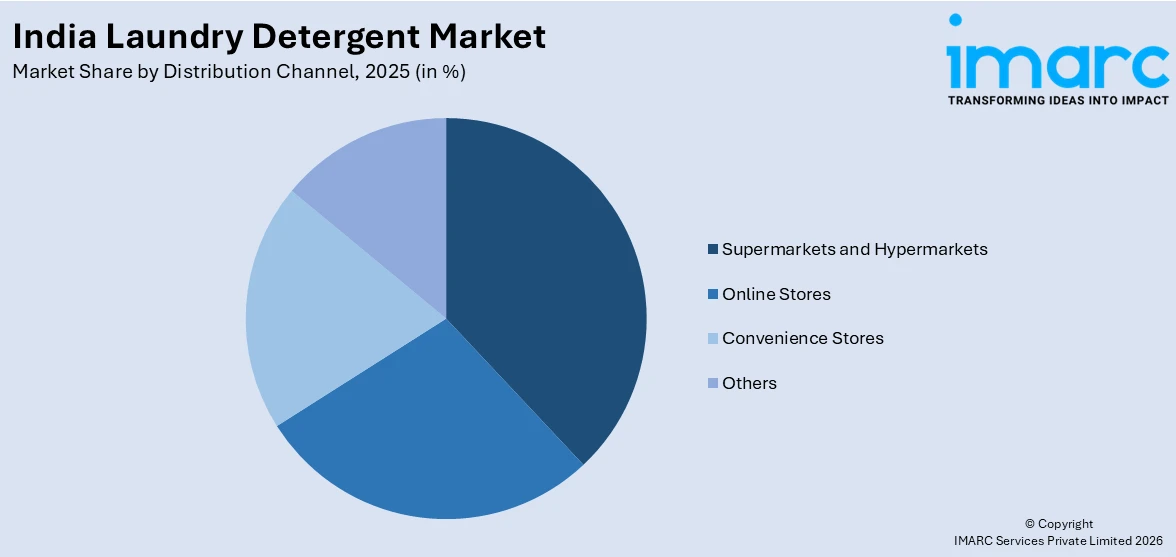
Supermarkets and hypermarkets lead with a share of 34.5% of the total India laundry detergent market in 2025.
Supermarkets and hypermarkets represent the leading distribution channel in the India laundry detergent market, driven by the rapid expansion of organized retail infrastructure across major urban and semi-urban centers. These outlets offer consumers a convenient one-stop shopping experience with access to a wide variety of detergent brands, formats, and pack sizes under a single roof. The ability to physically compare products, assess pricing, and take advantage of in-store promotions and bulk purchase discounts significantly influences consumer purchasing decisions in favor of these modern retail formats.
Moreover, the dominance of supermarkets and hypermarkets is further sustained with strategic partnerships between detergent makers and retailers, thereby providing shelf space and conducting exclusive promotional campaigns. The focus of the organized retail industry on maintaining inventory levels and providing loyalty programs helps in retaining customers. Furthermore, the rising presence of retail chains in tier-two and tier-three cities for both domestic and international retailers help in expanding the sales of branded detergents, thereby sustaining the role of supermarkets and hypermarkets as the major sales channel for the product.
Application Insights:
- Industrial
- Household
Household exhibits a clear dominance with a 72.5% share of the total India laundry detergent market in 2025.
The household commands the leading position in the India laundry detergent market, underpinned by the essential and recurring nature of laundry cleaning in daily domestic routines. In January 2026, RSPL Group’s Ghadi detergent launched a campaign highlighting daily Indian laundry routines, showing that surveyed households relate to real-life stains and everyday cleaning experiences. With a vast and growing population base, the sheer volume of household laundry requirements drives consistent and sustained demand for detergent products. Rising health awareness and lifestyle changes in Indian households boost the demand for effective laundry solutions, keeping the household segment as the primary driver.
This dominance of the household is further supplemented by the changing consumer preferences towards premium and differentiated variants of detergents such as fabric softening, color protection, and antibacterial properties. Moreover, the rise of dual-income households and the increasing pressure of a hectic lifestyle are creating a requirement for effective cleaning solutions that can provide the best results with the least amount of effort. Furthermore, the rising penetration of washing machines among households in India is creating a requirement for machine-specified variants of detergents, thereby increasing the consumption of the household segment.
Regional Insights:
- North India
- South India
- East India
- West India
North India dominates with a market share of 32.8% of the total India laundry detergent market in 2025.
North India holds the leading regional position in the India laundry detergent market, supported by its large and densely populated demographic base spanning key states with significant urban and semi-urban consumer clusters. The region's well-established retail infrastructure, coupled with strong distribution networks maintained by major detergent brands, ensures widespread product availability across diverse consumer segments. Higher levels of urbanization in states across North India contribute to elevated hygiene awareness and a greater propensity to adopt branded and modern detergent formulations over traditional cleaning alternatives.
The regional leadership position of North India is further supported by the growth in disposable incomes and the rising number of people belonging to the middle-income bracket, thereby boosting the consumption of household cleaning products. Strong brand presence and effective marketing strategies undertaken by leading players to target the consumer base of North India are boosting brand loyalty. In addition, the growth in rural electrification and the increasing number of washing machine owners in the semi-urban and rural parts of North India are boosting the overall consumer base, thereby maintaining the leadership position of North India.

Market Dynamics:
Growth Drivers:
Why is the India Laundry Detergent Market Growing?
Rapid Urbanization and Expanding Middle-Class Consumer Base
India's accelerating urbanization and the steady expansion of its middle-class population are significantly driving laundry detergent demand. As more consumers migrate to urban centers, their exposure to modern lifestyles and heightened hygiene standards increases the adoption of branded cleaning products. As per sources, industry insights showed that washing liquids (including liquid detergents) have grown 2.7X in volume and added nearly 24 million households since FY ’23, reflecting stronger uptake of modern laundry formats among urban and aspirational buyers. Rising disposable incomes enable households to transition from unbranded or locally manufactured products toward established detergent brands offering superior cleaning performance.
Increasing Washing Machine Penetration Across Semi-Urban and Rural Regions
The growing adoption of washing machines, particularly in semi-urban and rural India, is reshaping laundry detergent consumption patterns and fueling market expansion. Government-led rural electrification programs and affordable financing options are enabling wider appliance ownership beyond metropolitan areas. As per sources, a GfK/NIQ report noted that the retail network for washing machines had expanded to roughly 15 outlets per 100 villages, signalling deeper penetration of appliances into smaller towns and rural markets. This transition from hand washing to machine washing drives demand for machine-compatible detergent formats, including liquids and concentrated variants.
Rising Hygiene Awareness and Health-Conscious Consumer Behavior
Growing health consciousness among Indian consumers, amplified by increased awareness around cleanliness and disease prevention, is driving sustained demand for effective laundry detergent products. Households are increasingly prioritizing regular fabric cleaning using branded detergents that offer antibacterial and sanitizing properties. In October 2024, Reckitt’s Dettol brand and NDTV launched the 11th season of the “Banega Swasth India” campaign to promote hygiene and health awareness across the country, reinforcing public focus on cleanliness practices at home and in communities. This behavioral shift extends across urban and rural demographics, supported by government public health campaigns promoting domestic hygiene practices.
Market Restraints:
What Challenges the India Laundry Detergent Market is Facing?
Prevalence of Counterfeit and Low-Quality Products
The India laundry detergent market faces significant challenges from the proliferation of counterfeit and low-quality products, particularly in rural and semi-urban markets. These products, often sold at substantially lower prices through unorganized retail channels, erode market share for established brands and undermine consumer trust in product quality. The difficulty in enforcing quality standards across fragmented distribution networks allows substandard products to persist, impacting overall market integrity and discouraging investment in premium formulations.
Volatility in Raw Material Costs
Fluctuations in the prices of key raw materials, including surfactants, enzymes, and petrochemical-derived ingredients, pose ongoing challenges for detergent manufacturers in India. Rising input costs compress profit margins and force manufacturers to either absorb higher production expenses or pass costs to price-sensitive consumers. Supply chain disruptions and global commodity price fluctuations further exacerbate this challenge, making it difficult for companies to maintain consistent pricing strategies.
Environmental and Regulatory Compliance Pressures
Increasing regulatory scrutiny around chemical composition, wastewater discharge standards, and packaging sustainability is raising compliance costs for laundry detergent manufacturers operating in India. Stringent environmental norms require significant investment in reformulating products with biodegradable ingredients and adopting sustainable packaging solutions. Smaller manufacturers with limited resources face particular difficulty in meeting these evolving standards, creating competitive imbalances and potentially constraining overall market participation.
Competitive Landscape:
The India laundry detergent market is characterized by a dynamic competitive landscape where multinational corporations and domestic manufacturers compete intensely across premium, mid-range, and economy product segments. Market players are differentiating themselves through continuous investment in research and development, focusing on advanced formulation technologies, eco-friendly product lines, and innovative packaging solutions. Strategic partnerships between detergent brands and appliance manufacturers are creating synergistic marketing opportunities that enhance consumer engagement. Companies are also expanding their distribution networks by leveraging both traditional retail channels and rapidly growing digital commerce platforms to maximize market reach. The competitive environment is further shaped by aggressive promotional activities, regional brand loyalty patterns, and the emergence of direct-to-consumer business models that are redefining market access and consumer relationships.
Recent Developments:
- In August 2025, Hindustan Unilever Limited launched Surf Excel Matic Express, India’s first detergent designed for 15-minute quick wash cycles. The product incorporates advanced malodour and fragrance technologies, addressing sweat and dust stains in synthetic fabrics. Indian pace bowler Jasprit Bumrah features in the campaign to highlight speed and performance.
India Laundry Detergent Market Report Coverage:
| Report Features | Details |
|---|---|
| Base Year of the Analysis | 2025 |
| Historical Period | 2020-2025 |
| Forecast Period | 2026-2034 |
| Units | Billion USD |
| Scope of the Report |
Exploration of Historical Trends and Market Outlook, Industry Catalysts and Challenges, Segment-Wise Historical and Future Market Assessment:
|
| Product Types Covered | Powder, Liquid, Gel, Pods/Tablets |
| Distribution Channels Covered | Supermarkets and Hypermarkets, Online Stores, Convenience Stores, Others |
| Applications Covered | Industrial, Household |
| Regions Covered | North India, South India, East India, West India |
| Customization Scope | 10% Free Customization |
| Post-Sale Analyst Support | 10-12 Weeks |
| Delivery Format | PDF and Excel through Email (We can also provide the editable version of the report in PPT/Word format on special request) |
Frequently Asked Questions About the India Laundry Detergent Market Report
The India laundry detergent market size increased from USD 5.00 Billion in 2025 to USD 5.50 Billion in 2026.
The India laundry detergent market is expected to grow at a compound annual growth rate of 4.13% from 2026-2034 to reach USD 7.60 Billion by 2034.
Powder held the largest India laundry detergent market share as it remains the most widely used format in India due to its affordability, versatility for hand and machine washing, and strong penetration across urban, semi-urban, and rural households.
Key factors driving the India laundry detergent market include rising urbanization and expanding middle-class population, increasing washing machine penetration, growing hygiene awareness, premiumization of detergent formulations, expansion of organized retail and e-commerce channels.
Major challenges include prevalence of counterfeit products in unorganized retail channels, volatility in raw material costs affecting profit margins, increasing environmental and regulatory compliance pressures, intense price competition, and supply chain constraints.
Need more help?
- Speak to our experienced analysts for insights on the current market scenarios.
- Include additional segments and countries to customize the report as per your requirement.
- Gain an unparalleled competitive advantage in your domain by understanding how to utilize the report and positively impacting your operations and revenue.
- For further assistance, please connect with our analysts.
 Request Customization
 Speak to an Analyst
 Request Brochure
 Inquire Before Buying
Benefits of Customization
- Personalize this research
- Triangulate with your data
- Get data as per your format and definition
- Gain a deeper dive into a specific application, geography, customer, or competitor
- Any level of personalization
Get in Touch With Us
UNITED STATES
Phone: +1-201-971-6302
INDIA
Phone: +91-120-433-0800
UNITED KINGDOM
Phone: +44-753-714-6104
Email: [email protected]
Client Testimonials




.webp)




.webp)













Related Reports

Choose your plan
*Please note that the prices mentioned below are starting prices for each bundle type. Kindly contact our team for further details.*
Single User License
- 1 User License, Access on 2 Devices
- PDF Report + Excel Dataset (Password Protected)
- Lifetime Access
- No Printing Rights
- 10% Free Report Customization
- 10–12 Weeks of Analyst Support
Five User License
- Access for 5 Users, 2 Devices per User
- PDF Report + Excel Dataset (Password Protected)
- Lifetime Access
- Dedicated Account Manager
- 12–14 Weeks of Analyst Support
- No Printing Rights
- 15% Free Report Customization
- 25% Discount on Your Next Purchase
Corporate User License
- Unlimited User Access (Within Your Organization)
- PDF Report + Excel Dataset
- Lifetime Access
- Dedicated Account Manager
- 14–20 Weeks of Analyst Support
- No Printing Rights
- 20% Free Report Customization
- 30% Discount on Your Next Purchase
Essential Insights
What's included:
3 reports
- Lifetime Access
- PDF Reports
- Excel Datasets
- 2 Weeks of Free Analyst Support
- 2 User Licenses
- Access on 2 Devices
- Printing Rights
- Complimentary PowerPoint (PPT) Version
- Complimentary License Upgrade
Professional Access
What's included:
5 reports
- Lifetime Access
- PDF Reports
- Excel Datasets
- 8 Weeks of Free Analyst Support
- 2 User Licenses
- Access on 2 Devices
- Printing Rights
- Complimentary PowerPoint (PPT) Version
- Complimentary License Upgrade
Business Advantage
What's included:
8 reports
- Lifetime Access
- PDF Reports
- Excel Datasets
- 14 Weeks of Free Analyst Support
- 2 User Licenses
- Access on 2 Devices
- Printing Rights
- Complimentary PowerPoint (PPT) Version
- Complimentary License Upgrade
Enterprise Intelligence
What's included:
10 reports
- Lifetime Access
- PDF Reports
- Excel Datasets
- 20 Weeks of Free Analyst Support
- 2 User Licenses
- Access on 2 Devices
- Printing Rights
- Complimentary PowerPoint (PPT) Version
- Complimentary License Upgrade