
India Machine Automation Controller Market Size, Share, Trends and Forecast by Type, Industry, and Region, 2026-2034
India Machine Automation Controller Market Summary:
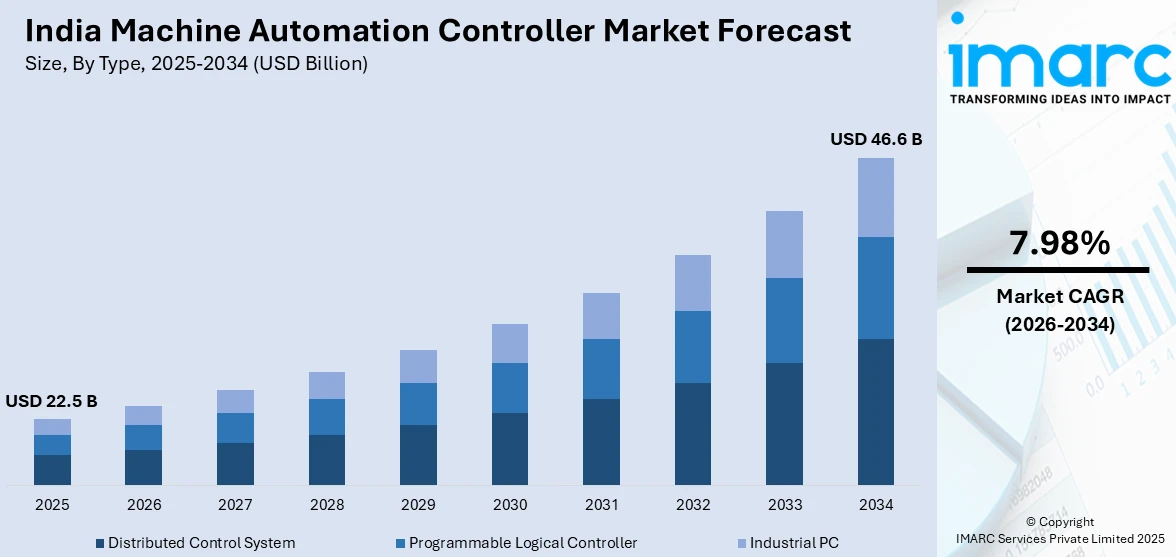
The India machine automation controller market size was valued at USD 22.5 Billion in 2025 and is projected to reach USD 46.6 Billion by 2034, growing at a compound annual growth rate of 7.98% from 2026-2034.
The India machine automation controller market is registering a strong growth, owing to the rapid industrialization and digitalization efforts in the country. The increasing adoption of smart factories, Industry 4.0 solutions, and the government's initiative for a self-reliant manufacturing system are propelling the demand for advanced automation solutions. The increasing investments in the modernization of traditional production systems, along with the focus on efficiency and minimizing downtime, are boosting the India machine automation controller market share.
Key Takeaways and Insights:
- By Type: Distributed control system dominates the market with a share of 48.9% in 2025, driven by the extensive deployment in process industries requiring real-time monitoring, centralized operations management, and seamless coordination across complex industrial environments.
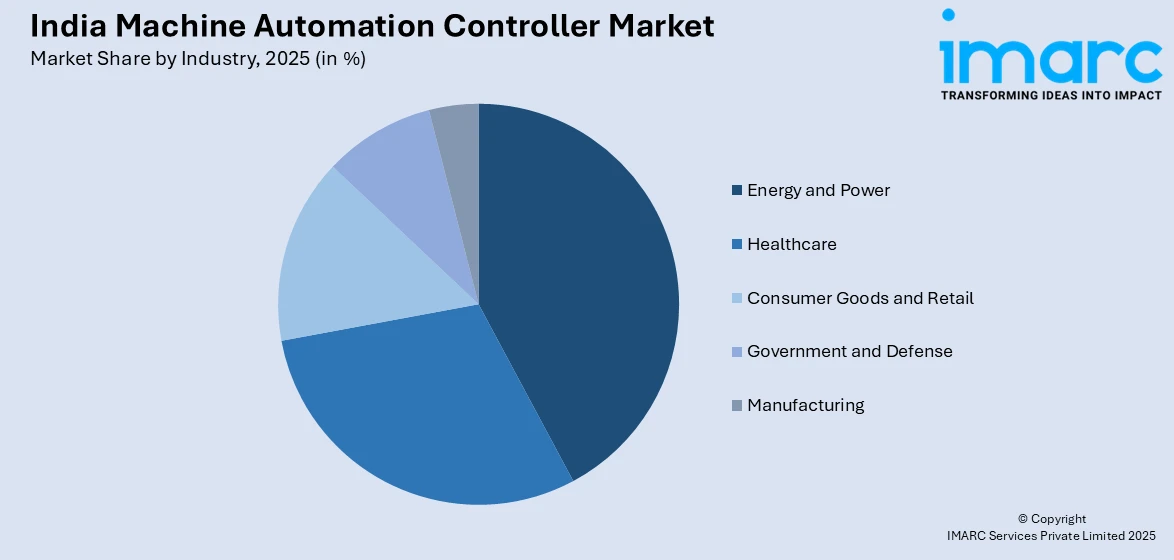
- By Industry: Energy and power leads the market with a share of 42.3% in 2025, driven by substantial investments in power generation, renewable energy adoption, and grid modernization initiatives that demand advanced automation and control solutions.
- By Region: West India holds the largest market share at 36.8% in 2025, attributed to the concentration of manufacturing hubs, petrochemical complexes, and major industrial corridors in Maharashtra and Gujarat states.
- Key Players: The India machine automation controller market features a competitive landscape with established global automation leaders and domestic players competing through technology innovation, localized solutions, and strategic partnerships.
To get more information on this market Request Sample
The India machine automation controller market is advancing as industries prioritize operational efficiency, precision manufacturing, and seamless process integration. Rising demand for distributed control systems, programmable logic controllers, and industrial PCs reflects the growing complexity of modern production environments. Government initiatives promoting digital manufacturing and smart infrastructure are creating favorable conditions for automation adoption. In 2024, Siemens India announced an expansion of its Goa automation manufacturing facility to strengthen domestic production of industrial automation and digitalization solutions, reinforcing the country’s push toward latest industry adoption. The energy and power sector remains the dominant consumer, driven by large-scale power plant modernization and renewable energy integration projects. West India continues to lead regional adoption, supported by its established industrial base and ongoing investments in manufacturing excellence. Increasing focus on predictive maintenance, reduced operational costs, and enhanced production flexibility is encouraging enterprises to invest in advanced automation technologies.
India Machine Automation Controller Market Trends:
Rising Integration of Industrial Internet of Things
The proliferation of Industrial Internet of Things is transforming machine automation in India, enabling real-time data exchange between controllers, sensors, and enterprise systems. Manufacturers are increasingly deploying connected automation solutions to achieve enhanced visibility, predictive analytics, and remote monitoring capabilities. In 2023, Rockwell Automation expanded its smart manufacturing and IIoT solution portfolio in India to support connected factory deployments and digital production optimization. This interconnected approach supports smarter decision-making and facilitates continuous process optimization across production facilities.
Growing Emphasis on Edge Computing Solutions
Edge computing is gaining traction within India machine automation controller market growth as industries seek to process data closer to the source for faster response times. By enabling local data processing, edge-enabled controllers reduce latency, minimize bandwidth requirements, and enhance system reliability. In May 2024, Rockwell Automation announced plans to expand its manufacturing footprint and technology workforce in India, strengthening its industrial automation and edge-enabled production capabilities. This trend is particularly significant for applications requiring instantaneous decision-making, such as quality inspection and safety-critical operations.
Increasing Adoption of Modular Automation Architectures
Indian manufacturers are shifting toward modular automation architectures that offer flexibility, scalability, and simplified integration. These systems allow enterprises to expand or reconfigure production lines efficiently without extensive downtime or complete system overhauls. In April 2024, Rockwell Automation announced plans to open a new 98,000-square-foot manufacturing facility in Chennai to strengthen localized production of industrial automation and modular control solutions, supporting faster and more adaptable factory deployments in India. Modular designs support diverse manufacturing requirements and enable faster deployment of automation solutions across varied industrial applications.
Market Outlook 2026-2034:
The Indian machine automation controller market is poised for growth as various industries are accelerating their digital transformation and smart manufacturing plans. Increasing investments in infrastructure development, renewable energy projects, and industrialization will fuel the demand for advanced automation solutions. The integration of artificial intelligence, machine learning, and analytics with conventional control systems will open up new possibilities in predictive maintenance and autonomous systems. The market generated a revenue of USD 22.5 Billion in 2025 and is projected to reach a revenue of USD 46.6 Billion by 2034, growing at a compound annual growth rate of 7.98% from 2026-2034.
India Machine Automation Controller Market Report Segmentation:
|
Segment Category |
Leading Segment |
Market Share |
|
Type |
Distributed Control System |
48.9% |
|
Industry |
Energy and Power |
42.3% |
|
Region |
West India |
36.8% |
Type Insights:
- Distributed Control System
- Programmable Logical Controller
- Industrial PC
The distributed control system dominates with a market share of 48.9% of the total India machine automation controller market in 2025.
Distributed control systems are extensively deployed across India's process industries, particularly in oil and gas refineries, chemical plants, and power generation facilities. These systems provide centralized supervisory control while distributing control functions to multiple subsystems, ensuring reliable operations and seamless coordination. Their ability to handle complex processes with high accuracy makes them essential for industries requiring continuous monitoring and precise parameter management.
The growing complexity of industrial operations and increasing demand for integrated automation solutions are driving widespread adoption of distributed control systems. Indian enterprises are investing in modern distributed control architectures to achieve improved process efficiency, reduced energy consumption, and enhanced safety compliance. The systems' scalability and compatibility with emerging technologies support long-term operational excellence across diverse industrial sectors.
Industry Insights:
Access the comprehensive market breakdown Request Sample
- Energy and Power
- Healthcare
- Consumer Goods and Retail
- Government and Defense
- Manufacturing
The energy and power leads with a share of 42.3% of the total India machine automation controller market in 2025.
The energy and power sector represents the largest consumer of machine automation controllers in India, driven by the country's massive power infrastructure expansion and modernization efforts. Thermal power plants, renewable energy installations, and transmission networks rely heavily on advanced automation systems for efficient generation, distribution, and grid management. The sector's emphasis on operational reliability, safety compliance, and optimal resource utilization necessitates sophisticated control solutions. In October 2025, Power Grid Corporation secured ₹3,375 crore in transmission projects to strengthen grid stability and renewable integration, further accelerating demand for advanced automation technologies.
The Indian government's focus on integrating renewable energy sources and building smart grids is fueling the demand for sophisticated automation controllers in the power industry. Solar and wind energy power plants demand accurate control systems for managing variable power output, whereas traditional power plants are looking to upgrade automation systems to enhance efficiency and lower pollution. The energy sector in India is undergoing a radical shift, which is fueling massive investments in automation solutions.
Regional Insights:
- North India
- South India
- East India
- West India
West India exhibits a clear dominance with a 36.8% share of the total India machine automation controller market in 2025.
West India holds the largest market share in the machine automation controller market, thanks to the presence of prominent industrial hubs in the states of Maharashtra and Gujarat. The region has prominent petrochemical refineries, pharmaceutical manufacturing units, and automobile manufacturing facilities that rely heavily on automation technology. The presence of prominent industrial hubs and proximity to prominent ports makes it easier to adopt advanced control systems.
The development of industrial corridors and special economic zones in West India is attracting heavy investments in automated manufacturing units. The region has a favorable business environment, availability of qualified manpower, and well-developed infrastructure, making it easier to adopt advanced automation solutions. The focus on industrial development and export manufacturing is likely to continue, thereby boosting the adoption of machine automation controllers in the region.

Market Dynamics:
Growth Drivers:
Why is the India Machine Automation Controller Market Growing?
Government Initiatives Promoting Manufacturing Excellence
The Indian government's comprehensive manufacturing promotion programs are significantly driving demand for machine automation controllers. National policies aimed at transforming India into a global manufacturing hub emphasize technology adoption, digitalization, and production efficiency improvements. In 2023, the Government of India expanded the Production-Linked Incentive (PLI) schemes across key sectors such as electronics, automotive, and specialty steel, encouraging manufacturers to invest in advanced automation, robotics, and digital production systems. These initiatives provide incentives for enterprises to modernize their production infrastructure with advanced automation solutions. The focus on developing smart factories and integrating digital technologies across manufacturing value chains creates substantial opportunities for automation vendors. Production-linked incentive schemes across various industrial sectors encourage investments in sophisticated control systems that enhance productivity and competitiveness.
Expanding Power Generation and Grid Modernization
India's ambitious power sector expansion and grid modernization programs are generating strong demand for automation controllers across generation, transmission, and distribution segments. The country's growing electricity requirements necessitate continued investments in power infrastructure, including both conventional and renewable energy facilities. In December 2025, the Ministry of Power reported that 4.76 crore smart meters had been installed nationwide under RDSS to enhance power monitoring, efficiency, and clean energy integration. Power plants increasingly rely on advanced distributed control systems for efficient operations, safety management, and environmental compliance. Grid modernization efforts aimed at improving transmission efficiency and reducing losses require sophisticated automation solutions. The integration of renewable energy sources into the national grid demands precise control capabilities that modern automation systems provide.
Rising Focus on Operational Efficiency and Cost Optimization
Indian industries are increasingly prioritizing operational efficiency and cost optimization, driving substantial investments in machine automation controllers. Competitive market pressures compel manufacturers to reduce production costs while maintaining quality standards, making automation essential for sustainable operations. Advanced control systems enable precise process management, reduced material wastage, and optimized energy consumption. According to the International Federation of Robotics, India recorded a new high of 9,120 industrial robot installations in 2024, reflecting accelerating automation adoption across manufacturing sectors. The capability to minimize human errors and ensure consistent production quality justifies automation investments across industrial sectors. Growing labor costs and workforce availability challenges further encourage enterprises to adopt automated solutions that enhance productivity and operational reliability.
Market Restraints:
What Challenges the India Machine Automation Controller Market is Facing?
High Initial Investment Requirements
The major initial investment required for the implementation of machine automation controllers is a major hindrance for most Indian companies, especially the small and medium-scale ones. The latest automation solutions not only require investment in equipment but also in installation, integration, and training of personnel. Most organizations find it difficult to justify the initial investment despite the long-term benefits.
Shortage of Skilled Technical Workforce
The limited availability of skilled professionals capable of operating, programming, and maintaining sophisticated automation systems constrains market growth. Effective utilization of modern controllers requires specialized technical expertise that remains scarce in many industrial regions. This skills gap increases operational risks and dependence on external support, discouraging some enterprises from adopting advanced automation technologies.
Integration Complexities with Legacy Systems
Integrating modern automation controllers with existing legacy equipment presents technical challenges that can delay adoption. Many Indian manufacturing facilities operate older machinery that may not readily interface with contemporary control systems. These compatibility issues require customized solutions, extended implementation timelines, and additional investments, creating hesitation among potential adopters seeking seamless automation upgrades.
Competitive Landscape:
The India machine automation controller market is observed to have a competitive market structure, with established global players in automation technology competing with new entrants in the Indian market. The market is highly competitive, with players competing in terms of innovative product development, comprehensive service delivery, and indigenous solution development to meet Indian industry needs. Partnerships with system integrators and end-user industries help companies establish a strong market presence and reach a wider customer base. Companies are now focusing on providing end-to-end solutions that encompass hardware, software, and services to cater to the growing demands of automation. The market is also witnessing significant investments in research and development activities to improve the capabilities of the controller, improve cybersecurity, and ensure compatibility with new Industry 4.0 technologies.
Recent Developments:
-
In July 2025, Kinetic Communications inaugurated a fully automated motor controller manufacturing line in Pune to scale EV electronics production in India. The new facility integrates PLC- and HMI-driven automation with advanced SMT and assembly systems to improve precision, throughput, and quality while reducing manual intervention. The move supports India’s growing electric vehicle and industrial automation ecosystem.
India Machine Automation Controller Market Report Coverage:
|
Report Features |
Details |
|
Base Year of the Analysis |
2025 |
|
Historical Period |
2020-2025 |
|
Forecast Period |
2026-2034 |
|
Units |
USD Billion |
|
Scope of the Report |
Exploration of Historical Trends and Market Outlook, Industry Catalysts and Challenges, Segment-Wise Historical and Future Market Assessment:
|
|
Types Covered |
Distributed Control System, Programmable Logical Controller, Industrial PC |
|
Industries Covered |
Energy And Power, Healthcare, Consumer Goods and Retail, Government and Defense, Manufacturing |
|
Regions Covered |
North India, South India, East India, West India |
|
Customization Scope |
10% Free Customization |
|
Post-Sale Analyst Support |
10-12 Weeks |
|
Delivery Format |
PDF and Excel through Email (We can also provide the editable version of the report in PPT/Word format on special request) |
Frequently Asked Questions About the India Machine Automation Controller Market Report
The India machine automation controller market size was valued at USD 22.5 Billion in 2025.
The India machine automation controller market is expected to grow at a compound annual growth rate of 7.98% from 2026-2034 to reach USD 46.6 Billion by 2034.
Distributed control system held the largest share at 48.9%, driven by its extensive deployment in process industries requiring centralized supervisory control, real-time monitoring, and seamless coordination across complex industrial operations.
Key factors driving the India machine automation controller market include government manufacturing initiatives, power sector expansion, rising focus on operational efficiency, Industry 4.0 adoption, and growing investments in smart factory development.
Major challenges include high initial investment requirements, shortage of skilled technical workforce, integration complexities with legacy systems, cybersecurity concerns, and limited awareness about advanced automation benefits among smaller enterprises.
Need more help?
- Speak to our experienced analysts for insights on the current market scenarios.
- Include additional segments and countries to customize the report as per your requirement.
- Gain an unparalleled competitive advantage in your domain by understanding how to utilize the report and positively impacting your operations and revenue.
- For further assistance, please connect with our analysts.
 Request Customization
 Speak to an Analyst
 Request Brochure
 Inquire Before Buying
Benefits of Customization
- Personalize this research
- Triangulate with your data
- Get data as per your format and definition
- Gain a deeper dive into a specific application, geography, customer, or competitor
- Any level of personalization
Get in Touch With Us
UNITED STATES
Phone: +1-201-971-6302
INDIA
Phone: +91-120-433-0800
UNITED KINGDOM
Phone: +44-753-714-6104
Email: [email protected]
Client Testimonials




.webp)




.webp)













Related Reports

Choose your plan
*Please note that the prices mentioned below are starting prices for each bundle type. Kindly contact our team for further details.*
Single User License
- 1 User License, Access on 2 Devices
- PDF Report + Excel Dataset (Password Protected)
- Lifetime Access
- No Printing Rights
- 10% Free Report Customization
- 10–12 Weeks of Analyst Support
Five User License
- Access for 5 Users, 2 Devices per User
- PDF Report + Excel Dataset (Password Protected)
- Lifetime Access
- Dedicated Account Manager
- 12–14 Weeks of Analyst Support
- No Printing Rights
- 15% Free Report Customization
- 25% Discount on Your Next Purchase
Corporate User License
- Unlimited User Access (Within Your Organization)
- PDF Report + Excel Dataset
- Lifetime Access
- Dedicated Account Manager
- 14–20 Weeks of Analyst Support
- No Printing Rights
- 20% Free Report Customization
- 30% Discount on Your Next Purchase
Essential Insights
What's included:
3 reports
- Lifetime Access
- PDF Reports
- Excel Datasets
- 2 Weeks of Free Analyst Support
- 2 User Licenses
- Access on 2 Devices
- Printing Rights
- Complimentary PowerPoint (PPT) Version
- Complimentary License Upgrade
Professional Access
What's included:
5 reports
- Lifetime Access
- PDF Reports
- Excel Datasets
- 8 Weeks of Free Analyst Support
- 2 User Licenses
- Access on 2 Devices
- Printing Rights
- Complimentary PowerPoint (PPT) Version
- Complimentary License Upgrade
Business Advantage
What's included:
8 reports
- Lifetime Access
- PDF Reports
- Excel Datasets
- 14 Weeks of Free Analyst Support
- 2 User Licenses
- Access on 2 Devices
- Printing Rights
- Complimentary PowerPoint (PPT) Version
- Complimentary License Upgrade
Enterprise Intelligence
What's included:
10 reports
- Lifetime Access
- PDF Reports
- Excel Datasets
- 20 Weeks of Free Analyst Support
- 2 User Licenses
- Access on 2 Devices
- Printing Rights
- Complimentary PowerPoint (PPT) Version
- Complimentary License Upgrade