
India Managed Print Services Market Size, Share, Trends and Forecast by Type, Deployment Mode, Organization Size, Industry Vertical, and Region, 2026-2034
India Managed Print Services Market Summary:
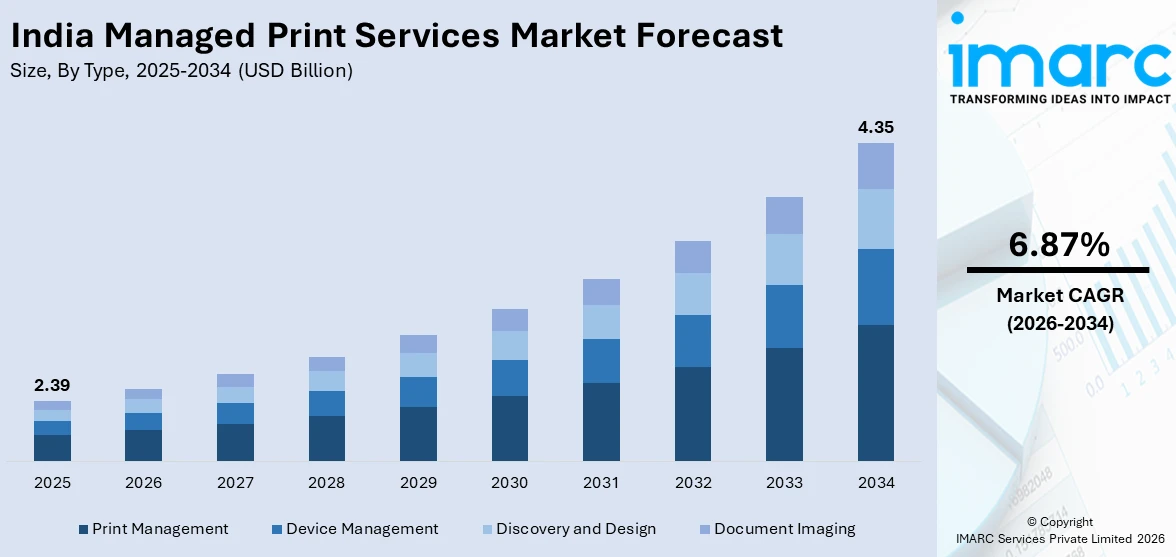
The India managed print services market grew from USD 2.39 Billion in 2025 to USD 2.56 Billion in 2026 and is projected to reach USD 4.35 Billion by 2034, growing at a compound annual growth rate of 6.87% from 2026-2034.
This market is driven by trends like digital transformation initiatives, cost optimization pressures, and increasing demand for secure document management solutions for businesses. Organizations are increasingly selecting these services to reduce their printing infrastructure, improve efficiency, and facilitate hybrid work. Additionally, increased sustainability directives and regulatory needs are also driving this market. Focus on reducing business complexities and document security has been a major growth driver for this segment, particularly for the Indian market due to the managed print services market share.
Key Takeaways and Insights:
- By Type: Print management dominates the market with a share of 33% in 2025, driven by comprehensive oversight capabilities enabling organizations to optimize device performance, monitor usage patterns, and implement highly cost-effective printing policies across all distributed enterprise networks.
- By Deployment Mode: On-premises lead the market with a share of 58% in 2025, owing to data security concerns, regulatory compliance requirements, and established IT infrastructure preferences among traditional enterprises seeking direct comprehensive control over print environments.
- By Organization Size: Large enterprises represents the largest segment with a market share of 50% in 2025, driven by their substantial print volumes, complex multi-location requirements, diverse device portfolios, and significant budget allocations for comprehensive managed service solutions.
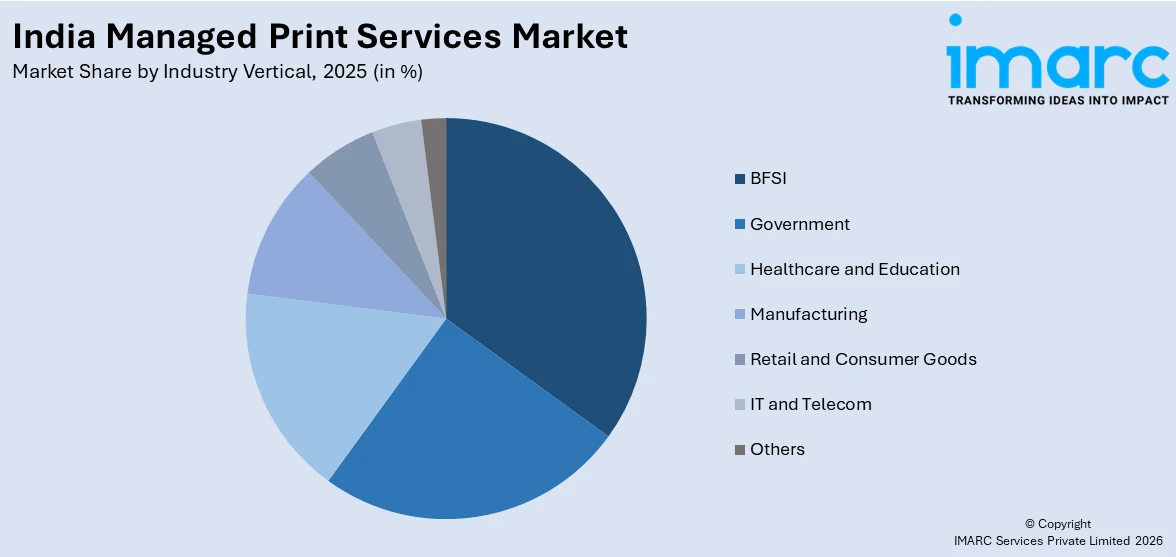
- By Industry Vertical: BFSI dominates the market with a share of 21% in 2025, owing to extensive documentation needs, stringent security protocols, regulatory compliance mandates, and high-volume transaction processing requiring highly reliable comprehensive print infrastructure management.
- By Region: North India leads the market with a share of 31% in 2025, driven by concentration of corporate headquarters, financial institutions, government agencies, and established business hubs requiring highly sophisticated print management capabilities.
- Key Players: The competitive market features a truly diverse landscape with established global technology providers actively competing alongside specialized regional service integrators, consistently offering highly customized solutions across different enterprise segments and various industry vertical market sectors.
To get more information on this market Request Sample
The India managed print services market can be viewed as a strategic shift from conventional "device-centric" printing to "service-centric" solutions to tackle complex issues faced in managing modern-day business organizations. The majority of organizations from various industry segments are beginning to understand and experience the compelling proposition of allowing experts to manage, operate, and maintain printing and other infrastructure-related activities to achieve enhanced effectiveness, predictability, and strategic alignment. For example, in January 2026, Iris Waves completed a Xerox Managed Print Services implementation for Control & Switchgears Electric (C&S), deploying a unified print infrastructure across four manufacturing plants and a headquarters in Noida to enhance print security, enable auditability, and support sustainability reporting under a three-year OPEX model. The market is bolstered by gaining traction from digitalization initiatives and strategies, which are resulting in an increased need to procure efficient and highly effective integrated solutions that are compatible with cloud computing, mobile software, and other collaborative tools that are required to support modern-day business requirements.
India Managed Print Services Market Trends:
Cloud Integration and Mobility Enhancement
Besides, there is an increasing need in the contemporary market for print solutions that work well with cloud-based technologies, thereby ensuring that there is some integration with the needs of the mobile workforce at the same time. There is thus the need for printing solutions that are accessible anywhere at any time, meaning that people are comfortable printing documents regardless of their location while at the same time ensuring that the necessary security standards are adhered to within the enterprise ecosystem. Reflecting this trend, in October 2025, Levi, Ray & Shoup, Inc. announced the launch of a cloud-based print, scan, and auditing suite built on its LRS Mission Control platform. The solution offers managed print services, pull-print functionality, and centralized print management without the need for on-premise servers, enabling organizations to support remote and hybrid workforce printing needs more securely and efficiently. This has resulted in the adoption of cloud-enabled print management systems to meet this need.
Security-First Printing Solutions
Growing cybersecurity threats and the demand for compliance with regulatory requirements are driving the demand for advanced security features in print management solutions. In addition, organizations secure print release mechanisms, user authentication protocols, and encrypted data transmission capabilities that provide security for sensitive information throughout the document lifecycle. For instance, in March 2025, Lexmark expanded its Lexmark Security Services globally to help enterprises secure their print fleets against evolving cyberthreats by addressing overlooked vulnerabilities, such as insecure settings, outdated firmware, and weak permissions. The expansion includes tailored security assessments, configuration management, and ongoing protection services.
Sustainability and Environmental Responsibility
Environmental consciousness drives organizations to adopt print solutions that reduce paper consumption, optimize energy usage, and support corporate sustainability objectives. This trend manifests through intelligent print policies that encourage duplex printing, digital-first workflows, and automated supply optimization reducing waste generation. Organizations seek providers offering carbon footprint measurement, recycling programs, and energy-efficient device deployment strategies. Reflecting this industry shift, in October 2025, a group of major print and signage providers, Sir Speedy, PIP, and Signal Graphics, announced a partnership with PrintReleaf. The collaboration ties everyday printing to certified global reforestation projects, with the companies planning to plant nearly 150,000 trees annually based on their clients’ print volumes as part of their sustainable business solutions. The sustainability focus aligns with regulatory requirements and stakeholder expectations while delivering operational cost benefits through resource optimization and waste reduction initiatives.
Market Outlook 2026-2034:
The India managed print services market demonstrates robust growth prospects driven by accelerating digital transformation initiatives and evolving workplace dynamics. Organizations increasingly recognize strategic value in outsourcing print infrastructure management to focus resources on core business activities while achieving operational efficiency gains. Revenue expansion reflects growing adoption across small and medium enterprises seeking cost-effective solutions, alongside large corporations optimizing complex multi-location print environments. Market maturation brings sophisticated service offerings incorporating artificial intelligence, predictive analytics, and advanced security features addressing contemporary enterprise requirements for flexible, secure, and sustainable print solutions. The market generated a revenue of USD 2.39 Billion in 2025, which is expected to reach USD 2.56 Billion in 2026 and further grow to USD 4.35 Billion by 2034, at a compound annual growth rate of 6.87% from 2026-2034.
India Managed Print Services Market Report Segmentation:
|
Segment Category |
Leading Segment |
Market Share |
|
Type |
Print Management |
33% |
|
Deployment Mode |
On-premises |
58% |
|
Organization Size |
Large Enterprises |
50% |
|
Industry Vertical |
BFSI |
21% |
|
Region |
North India |
31% |
Type Insights:
- Print Management
- Device Management
- Discovery and Design
- Document Imaging
The print management dominates with a market share of 33% of the total India managed print services market in 2025.
Organizations that provide print management services tend to dominate by virtue of their comprehensive oversight abilities, which allow enterprises to track their device performance, patterns, and develop strategic policies regarding their organizational networks. These services offer central control over enterprise networks, including enhanced visibility through various operational statistics and a cost allocation system. The providers offer automated reporting services, user management systems, and policy enforcement, thus facilitating strategic decision-making initiatives while maintaining a high level of flexibility and security.
Sophisticated print management solutions provide smooth integration with the existing IT infrastructure of the organization, thereby ensuring diversified and varied support for different ecosystems and complex organizational structures. These solutions include software for standardization of drivers, queues, and supply tracking. Organizations reap a variety of benefits from a simplified and streamlined operational environment, while still enjoying control and governing powers through sophisticated monitoring and management features.
Deployment Mode Insights:
- On-premises
- Cloud-based
The on-premises leads with a share of 58% of the total India managed print services market in 2025.
On-premises dominates market adoption, driven by the needs of enterprises to have direct control over infrastructure, data sovereignty, and integrations with existing technological environments. This deployment model has been prioritized by many organizations to handle critical information security needs, maintain regulatory compliance, and address complex business operations with unique configurations. This model allows for maximum flexibility to address security needs with custom configurations for direct network connectivity and integrations with legacy environments.
This mode of deployment is more likely to be adopted by organizations whose needs include high levels of customization, specialized compliance levels, and integration with other enterprise systems considered critical to the mission of the organization. The model can accommodate many locations, complex needs, and still provide the necessary central governance and security policies, such as guaranteed performance, minimal latency, and increased security capabilities, while at the same time meeting the varied needs of multiple users, as well as the specialized requirements of the infrastructure and support personnel at each site.
Organization Size Insights:
- Large Enterprises
- Medium Enterprises
- Small Enterprises
The large enterprises exhibit a clear dominance with a 50% share of the total India managed print services market in 2025.
Large enterprises hold greater market penetration due to their substantial print volumes, needs for multi-location operations, and budgetary commitments to comprehensive managed service solutions. Large enterprises have highly sophisticated and diverse printing environments with various geographical locations that require a very high level of coordination and sophisticated platform management. They benefit from economies of scale, which allow users to utilize high-end features, associated support systems, and bespoke solution developments that cater to specific needs and strategic directions.
Enterprise-level implementations require solid service level agreements, specific security arrangements, and supportive integrative platforms to address organizational structures and user populations. Large enterprises utilize managed print services to ensure operational standardization, cost predictability, and significantly improved security levels with reduced administrative headaches. This segment comprises innovative approaches to delivering services, using analytical and supportive frameworks to ensure strategic focus on core business activities.
Industry Vertical Insights:
Access the comprehensive market breakdown Request Sample
- BFSI
- Government
- Healthcare and Education
- Manufacturing
- Retail and Consumer Goods
- IT and Telecom
- Others
The BFSI leads with a market share of 21% of the total India managed print services market in 2025.
The BFSI drives the adoption pattern due to high documentation needs, stringent regulatory compliance demands, and high demands for reliable transaction processing infrastructure. Organizations in this space focus on secure document management, audit trails, and integrating document management solutions with core banking systems that support customer service operations. The BFSI adoption pattern meets organizational needs for high operational dependability, security enhancement, and cost optimization in branch facilities and admin offices.
BFSI industry organizations require unique and specialized security solutions, which include secure print release, user authentication, and monitoring solutions, ensuring the security of sensitive data from their customers. This industry benefits from customized compliance solutions, regulatory reporting, and integration with risk management systems. Providers of services offer solutions for the BFSI industry, considering the uniqueness of the operational needs of this industry, ensuring service excellence for the customers while maintaining regulatory and operational efficiency.
Regional Insights:
- North India
- West and Central India
- South India
- East and Northeast India
North India dominates with a market share of 31% of the total India managed print services market in 2025.
North India dominates regional market distribution through concentration of corporate headquarters, financial institutions, and government agencies requiring sophisticated print management solutions. The region benefits from established business ecosystems, advanced technology infrastructure, and significant enterprise investment in digital transformation initiatives. Metropolitan areas including Delhi NCR serve as primary adoption centers, driving demand for comprehensive managed print services supporting large-scale organizational operations and complex multi-location requirements across diverse industry sectors.
The region's leadership reflects strong technology adoption patterns, mature enterprise markets, and significant government sector presence requiring specialized print management capabilities. North India's corporate landscape encompasses multinational corporations, domestic conglomerates, and technology companies driving innovation in service delivery models and solution sophistication. The concentration of decision-making centers, procurement authorities, and technology leadership positions enables rapid adoption of advanced managed print services supporting regional economic development and organizational efficiency enhancement initiatives.

Market Dynamics:
Growth Drivers:
Why is the India Managed Print Services Market Growing?
Hybrid Work Environment Expansion
The widespread adoption of hybrid and remote work models across Indian organizations creates substantial demand for flexible print solutions supporting distributed workforce requirements. Enterprises need printing capabilities accessible from multiple locations while maintaining security protocols and operational control standards. This work environment shift necessitates cloud-enabled print management platforms offering seamless connectivity across home offices, corporate facilities, and co-working spaces. For example, in October 2024, Tungsten Automation introduced a Hybrid Cloud Print Solution that unifies cloud and on‑premises print and capture management. The solution enables remote and home printing on any device and supports hybrid work environments with improved security and centralized control, responding to the rising need for flexible print solutions in distributed organizations. Organizations seek solutions enabling employees to print securely from any location while administrators maintain centralized oversight, driving adoption of comprehensive managed print services addressing modern workplace flexibility demands.
Regulatory Compliance Mandates
Stringent regulatory frameworks across industries create compelling drivers for managed print services adoption as organizations seek compliance assurance and risk mitigation strategies. Financial institutions, healthcare providers, and government entities face increasing documentation requirements, audit trail mandates, and data protection regulations demanding sophisticated print management capabilities. Service providers offer specialized compliance frameworks addressing sector-specific requirements while reducing organizational burden through automated reporting, secure document handling, and comprehensive audit capabilities. For example, in, the Ricoh Company, Ltd.‑supported Quocirca Managed Print Services Vendor Landscape 2025 report highlighted that leading managed print solutions are embedding professional services‑led security audits and compliance controls aligned with frameworks such as ISO 27001, HIPAA, and GDPR to help customers meet strict regulatory requirements across sectors. This reinforces how regulatory complexity is shaping service offerings.
IT Resource Optimization Initiatives
Organizations increasingly prioritize strategic IT resource allocation by outsourcing non-core functions to specialized service providers enabling internal teams to focus on innovation and business-critical initiatives. Print infrastructure management traditionally consumes significant IT resources through device maintenance, supply management, troubleshooting, and user support activities. Managed print services enable IT departments to redirect expertise toward digital transformation projects, cybersecurity initiatives, and strategic technology implementations while ensuring optimal print environment performance. For example, industry analysts note that managed print services not only streamline printing operations but also free up internal IT resources by offloading routine printer fleet management, such as device monitoring, maintenance, and support, to external specialists. This allows IT teams to focus on strategic projects like infrastructure upgrades, digital workflows, and innovation initiatives instead of day‑to‑day operational tasks. This resource optimization approach supports organizational agility and competitive positioning through enhanced focus on value-creating technology initiatives rather than operational maintenance activities.
Market Restraints:
What Challenges the India Managed Print Services Market is Facing?
Budget Allocation Constraints
Organizations face significant budget limitations restricting adoption of comprehensive managed print services, particularly small and medium enterprises operating under tight financial constraints. Economic uncertainties and competing technology investment priorities limit organizational willingness to commit long-term service contracts. Cost-sensitive enterprises often prefer maintaining existing print infrastructure despite inefficiencies, viewing managed services as additional expenses rather than strategic investments requiring justification.
Organizational Change Resistance
Employee and management resistance to workflow modifications creates substantial adoption barriers as established printing habits and operational procedures resist external service provider intervention. Organizations struggle with user acceptance of new authentication protocols, printing policies, and modified document handling processes. Change management complexity increases implementation timelines and costs, particularly in organizations with diverse user communities requiring extensive training and support initiatives.
Service Dependency Concerns
Enterprise hesitation regarding external service provider dependency creates adoption challenges as organizations worry about service continuity, provider reliability, and potential business disruption risks. Concerns about vendor lock-in situations, service level agreement enforcement, and provider financial stability limit organizational commitment to long-term managed service relationships. Organizations prefer maintaining internal control over critical infrastructure rather than relying on external providers for essential business functions.
Competitive Landscape:
The India managed print services market exhibits moderate competitive intensity with global technology providers competing alongside regional service integrators and specialized solution developers across diverse market segments. Market participants differentiate through comprehensive service portfolios encompassing device management, security solutions, and digital transformation capabilities addressing varied enterprise requirements. Competition intensifies around innovation capabilities, with providers investing in artificial intelligence, predictive analytics, and cloud platform integration enhancing service value propositions and customer experience quality. Strategic partnerships between technology vendors and regional service providers create comprehensive market coverage enabling localized service delivery while leveraging global technology resources and expertise.
Recent Developments:
- In December 2025, Xerox announced plans to raise $500 million in debt financing backed by its intellectual property assets, amid earnings pressure. The move is aimed at strengthening liquidity and supporting its managed print services (MPS) business, potentially funding future service expansions and technology launches.
India Managed Print Services Market Report Coverage:
| Report Features | Details |
|---|---|
| Base Year of the Analysis | 2025 |
| Historical Period | 2020-2025 |
| Forecast Period | 2026-2034 |
| Units | Billion USD |
| Scope of the Report | Exploration of Historical Trends and Market Outlook, Industry Catalysts and Challenges, Segment-Wise Historical and Future Market Assessment:
|
| Types Covered | Print Management, Device Management, Discovery and Design, Document Imaging |
| Deployment Modes Covered | On-premises, Cloud-based |
| Organization Sizes Covered | Large Enterprises, Medium Enterprises, Small Enterprises |
| Industry Verticals Covered | BFSI, Government, Healthcare and Education, Manufacturing, Retail and Consumer Goods, IT and Telecom, Others |
| Regions Covered | North India, West and Central India, South India, East and Northeast India |
| Customization Scope | 10% Free Customization |
| Post-Sale Analyst Support | 10-12 Weeks |
| Delivery Format | PDF and Excel through Email (We can also provide the editable version of the report in PPT/Word format on special request) |
Frequently Asked Questions About the India Managed Print Services Market Report
The India managed print services market size increased from USD 2.39 Billion in 2025 to USD 2.56 Billion in 2026.
The India managed print services market is expected to grow at a compound annual growth rate of 6.87% from 2026-2034 to reach USD 4.35 Billion by 2034.
Print management held the largest market share, driven by comprehensive oversight capabilities enabling organizations to optimize device performance, monitor usage patterns, implement cost-effective printing policies, and achieve centralized control over distributed print environments while maintaining operational efficiency.
Key factors driving the India managed print services market include digital transformation acceleration, cost optimization initiatives, security enhancement requirements, and growing organizational demand for operational efficiency across diverse industry sectors.
Major challenges include technology integration complexity with existing enterprise systems, data security concerns regarding external service provider access, service standardization limitations, and organizational resistance to workflow changes requiring comprehensive change management initiatives.
Need more help?
- Speak to our experienced analysts for insights on the current market scenarios.
- Include additional segments and countries to customize the report as per your requirement.
- Gain an unparalleled competitive advantage in your domain by understanding how to utilize the report and positively impacting your operations and revenue.
- For further assistance, please connect with our analysts.
 Request Customization
 Speak to an Analyst
 Request Brochure
 Inquire Before Buying
Benefits of Customization
- Personalize this research
- Triangulate with your data
- Get data as per your format and definition
- Gain a deeper dive into a specific application, geography, customer, or competitor
- Any level of personalization
Get in Touch With Us
UNITED STATES
Phone: +1-201-971-6302
INDIA
Phone: +91-120-433-0800
UNITED KINGDOM
Phone: +44-753-714-6104
Email: [email protected]
Client Testimonials




.webp)




.webp)













Related Reports

Choose your plan
*Please note that the prices mentioned below are starting prices for each bundle type. Kindly contact our team for further details.*
Single User License
- 1 User License, Access on 2 Devices
- PDF Report + Excel Dataset (Password Protected)
- Lifetime Access
- No Printing Rights
- 10% Free Report Customization
- 10–12 Weeks of Analyst Support
Five User License
- Access for 5 Users, 2 Devices per User
- PDF Report + Excel Dataset (Password Protected)
- Lifetime Access
- Dedicated Account Manager
- 12–14 Weeks of Analyst Support
- No Printing Rights
- 15% Free Report Customization
- 25% Discount on Your Next Purchase
Corporate User License
- Unlimited User Access (Within Your Organization)
- PDF Report + Excel Dataset
- Lifetime Access
- Dedicated Account Manager
- 14–20 Weeks of Analyst Support
- No Printing Rights
- 20% Free Report Customization
- 30% Discount on Your Next Purchase
Essential Insights
What's included:
3 reports
- Lifetime Access
- PDF Reports
- Excel Datasets
- 2 Weeks of Free Analyst Support
- 2 User Licenses
- Access on 2 Devices
- Printing Rights
- Complimentary PowerPoint (PPT) Version
- Complimentary License Upgrade
Professional Access
What's included:
5 reports
- Lifetime Access
- PDF Reports
- Excel Datasets
- 8 Weeks of Free Analyst Support
- 2 User Licenses
- Access on 2 Devices
- Printing Rights
- Complimentary PowerPoint (PPT) Version
- Complimentary License Upgrade
Business Advantage
What's included:
8 reports
- Lifetime Access
- PDF Reports
- Excel Datasets
- 14 Weeks of Free Analyst Support
- 2 User Licenses
- Access on 2 Devices
- Printing Rights
- Complimentary PowerPoint (PPT) Version
- Complimentary License Upgrade
Enterprise Intelligence
What's included:
10 reports
- Lifetime Access
- PDF Reports
- Excel Datasets
- 20 Weeks of Free Analyst Support
- 2 User Licenses
- Access on 2 Devices
- Printing Rights
- Complimentary PowerPoint (PPT) Version
- Complimentary License Upgrade