
India Mattress Market Size, Share, and Trends and forecast by Product, Distribution Channel, Size, Application, and Region, 2026-2034
India Mattress Market Summary:
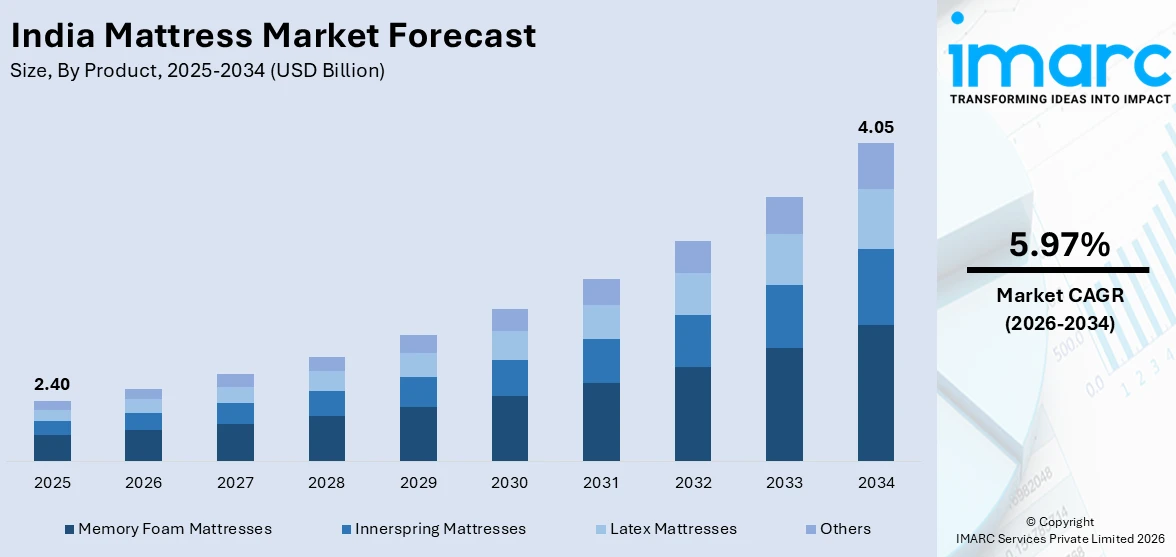
The India mattress market grew from USD 2.40 Billion in 2025 to USD 2.55 Billion in 2026 and is projected to reach USD 4.05 Billion by 2034, growing at a compound annual growth rate of 5.97% from 2026-2034.
Heightened urban developments, rising disposable incomes, and increasing consumer awareness about sleep health are fundamentally transforming mattresses from basic household items into wellness investments. Rapid expansion of organized retail networks, coupled with digital-first direct-to-consumer models, is democratizing access to premium sleep solutions across metropolitan and emerging tier cities. The convergence of health-conscious purchasing behaviors, real estate sector growth, and technological innovations in mattress design is driving the demand across residential and commercial segments, expanding the India mattress market share.
Key Takeaways and Insights:
-
By Product: Memory foam mattresses dominate the market with a share of 48% in 2025, driven by orthopedic benefits and affordability innovations helping people overcome various pain related complications.
-
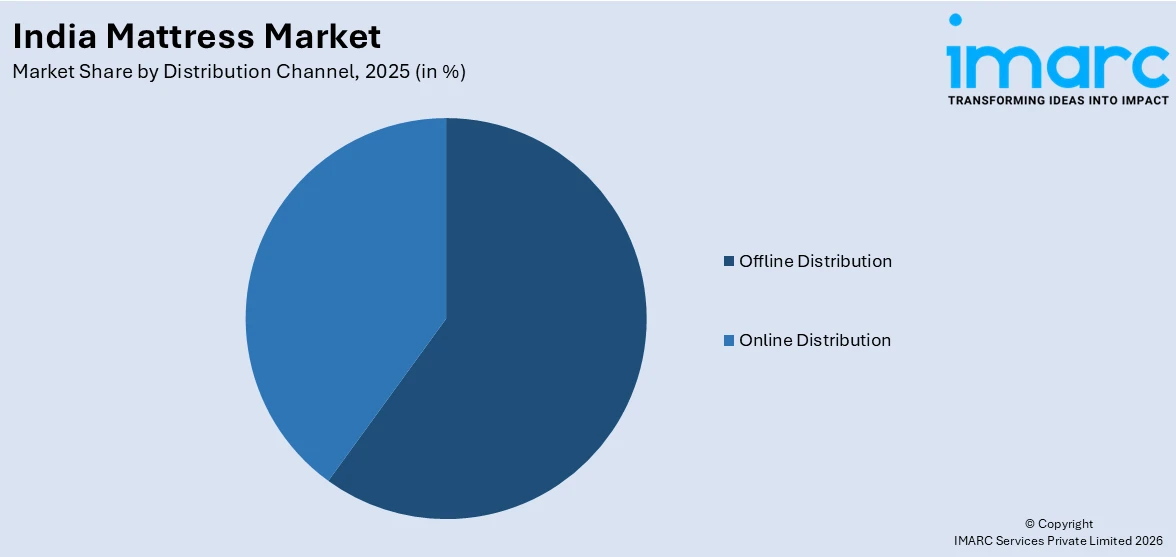
By Distribution Channel: Offline distribution leads the market with a share of 56% in 2025, supported by extensive dealer networks, exclusive brand showrooms, and experience centers enabling tactile product evaluation.
-
By Size: Queen size represents the largest segment with a market share of 40% in 2025, balancing optimal space efficiency with sleeping comfort for modern nuclear families in urban apartments.
-
By Application: Domestic leads the market with a share of 74% in 2025, fueled by expanding urban housing stock, rising replacement demand, and focus on sleep wellness as health investment.
-
By Region: North India represents the largest segment with a market share of 29% in 2025, benefiting from high population density, intense urban developments and surrounding metropolitan areas, and strong household purchasing power supporting premium product adoption.
-
Key Players: Key market players dominate the organized sector through complementary strategies spanning brand heritage, manufacturing expertise, vertical integration, omnichannel distribution, and technological innovation. These companies compete intensely across price segments, product categories, and geographic markets while collectively elevating industry standards. A detailed profiles of all major companies is given, including Duroflex, Wakefit, Sheela Foam, Springfit, Wink & Nod, Coirfit Mattress, Springwel, Peps, and Coirfoam.
To get more information on this market Request Sample
India's mattress industry is experiencing transformative growth as user preferences shift toward health-oriented sleep solutions and premium product categories. The organized sector, accounting for approximately one-third of the overall market, is witnessing intense competition as legacy manufacturers compete with agile direct-to-consumer startups such. Digital penetration and e-commerce expansion have lowered entry barriers, enabling innovative brands to capture millennial and Gen Z demographics through value pricing and technology integration. Numerous brands are also expanding their retail footprint and launching new stores. For example, in 2025, Sealy India introduced its new Posture Advance mattress collection, produced at its newly inaugurated Hyderabad facility. This shift enhances their premium range and coincides with intentions to grow its retail footprint from 20 stores to 100 locations in Indian cities within the next three years. Furthermore, the sector's evolution reflects broader trends prioritizing spinal health, sleep quality, and sustainable materials, with manufacturers responding through memory foam innovations, hybrid constructions, and smart mattress technologies that integrate sleep tracking and personalized comfort adjustments.
India Mattress Market Trends:
Digital-First Direct-to-Consumer Model Acceleration
The India mattress market is witnessing rapid adoption of direct-to-consumer business models that eliminate traditional retail intermediaries, offering competitive pricing and enhanced customer engagement. D2C brands have leveraged digital platforms to educate consumers, provide virtual consultations, and implement risk-free trial policies that build purchase confidence. This transformation gained significant momentum as Wakefit filed IPO papers in December 2025 to raise INR 1,288.89 crores, operating 125 company-owned stores across 62 cities. The model's success stems from vertical integration enabling brands to control design, manufacturing, and distribution while maintaining quality standards and cost advantages. E-commerce platforms facilitate nationwide reach beyond metropolitan markets, with data analytics informing product development and personalized marketing strategies that resonate with digitally-savvy individuals seeking value and transparency.
Smart and Technology-Integrated Sleep Solutions
Technological innovation is reshaping consumer expectations as smart mattresses equipped with sensors, sleep tracking capabilities, and adjustable firmness settings gain market traction. These advanced products appeal to tech-oriented urban professionals prioritizing data-driven health insights and personalized comfort optimization. AI-driven products featuring advanced sensors that monitor sleep patterns and provide personalized recommendations are also gaining traction. In 2024, The Sleep Company (TSC) introduced a revolutionary innovation with the debut of the SensAI Sleep Analyzer Pillow, the first AI-driven SmartGRID pillow in the world. This action corresponds with TSC’s strategic goal to adopt artificial intelligence (AI) and establish new benchmarks in comfort technology as it commemorates its sixth year of operation. By integrating AI into its product range, TSC plans to allocate resources to research and development (R&D) of technology-enhanced products in the next few years. The introduction of the SensAI Sleep Analyzer Pillow showcases the company’s dedication to innovation and its goal to transform sleep health with advanced technologies.
Health-Conscious Premiumization and Orthopedic Focus
Growing awareness about sleep's impact on overall health is driving substantial demand for orthopedic and ergonomically designed mattresses that support spinal alignment and pressure point relief. Health campaigns and medical endorsements have educated people about the connection between mattress quality and musculoskeletal wellness, particularly relevant given India's high incidence of back pain. Research linking mattress choice to spinal alignment has doubled online searches for orthopedic options, signaling strong consumer intent. The India orthopedic mattress market reached USD 98.06 Million in 2024 and is projected to grow at a rate (CAGR) of 25.80% during 2025-2033, according to the predictions of IMARC Group. Memory foam and latex materials are gaining popularity, offering superior body contouring and support compared to traditional spring constructions. Manufacturers are partnering with healthcare professionals and physiotherapists to develop medically endorsed products, while corporate wellness programs increasingly specify premium mattresses for employee housing projects, creating B2B opportunities that complement retail expansion.
Market Outlook 2026-2034:
The India mattress market is positioned for sustained expansion, propelled by favorable demographic trends, economic development, and evolving consumer priorities. The market generated a revenue of USD 2.40 Billion in 2025, which is expected to reach USD 2.55 Billion in 2026 and further grow to USD 4.05 Billion by 2034, at a compound annual growth rate of 5.97% during 2026-2034. Sustainability considerations will influence material selection, favoring eco-friendly foams and natural latex formulations. Distribution strategies will blend online convenience with offline experiential touchpoints, as omnichannel approaches prove most effective in converting prospects.
India Mattress Market Report Segmentation:
|
Segment Category |
Leading Segment |
Market Share |
|
Product |
Memory Foam Mattresses |
48% |
|
Distribution Channel |
Offline Distribution |
56% |
|
Size |
Queen Size |
40% |
|
Application |
Domestic |
74% |
|
Region |
North India |
29% |
Product Insights:
- Innerspring Mattresses
- Memory Foam Mattresses
- Latex Mattresses
- Others
Memory foam mattresses dominate with a market share of 48% of the total India mattress market in 2025.
Memory foam mattresses have emerged as the fastest-growing and most popular product category in India's organized mattress sector, commanding significant market share through a combination of health benefits, competitive pricing, and effective marketing by D2C disruptors. The viscoelastic foam technology conforms to body contours, distributing weight evenly and alleviating pressure on joints and spine, addressing widespread concerns about back pain and sleep quality. D2C brands revolutionized market access by offering competitively priced memory foam mattresses supported by aggressive digital marketing campaigns and risk-free trial policies that overcome traditional purchase hesitations.
Innovations such as gel-infused foam for enhanced temperature regulation and multi-density constructions for targeted support have broadened appeal across diverse consumer preferences and budgets, positioning memory foam as the preferred choice for urban millennials and working professionals prioritizing orthopedic wellness. In 2025, Peps Industries, a top sleep solutions brand in India, launched its newest collection of premium mattresses, specifically crafted to provide exceptional sleep experiences for customers in the Goa market. Created with a dedication to affordability and innovation, Peps' latest collection introduces four new series, including Peps Comfort, Peps Supreme, and Peps Restonic Memory Foam, aiming to transform the experience of comfort, support, and longevity. As more people focus on sleep health and enhancing their well-being, the mattresses are designed to meet customer needs, providing maximum comfort and restorative sleep.
Distribution Channel Insights:
Access the comprehensive market breakdown Request Sample
- Online Distribution
- Offline Distribution
Offline distribution leads with a share of 56% of the total India mattress market in 2025.
Offline distribution maintains dominant market position despite digital channel growth, as consumers continue valuing physical interaction with mattresses before purchase decisions. Traditional retail infrastructure comprising specialty stores, multi-brand outlets, and exclusive brand showrooms enables hands-on testing of firmness levels, material quality, and construction details that influence satisfaction. B2C retail controlled a major portion of the market share in 2024, advancing through strategic omnichannel initiatives. They also focused on product innovation to fulfil customer needs.
In 2025, VFI Group, a prominent maker of high-quality mattresses in India, has opened its main store, Beyond Sleep, which is India’s first unique showroom, showcasing several of the world’s most famous mattress brands together. The shop contains top mattress brands like Simmons Beautyrest, Serta, Springfit, Organa, and the Springfit Luxury Furniture Collection, providing customers with an unmatched sleep experience. Moreover, store associates provide personalized guidance on orthopedic requirements and size selection, enhancing conversion rates and reducing post-purchase returns.
Size Insights:
- Twin or Single Size
- Twin XL Size
- Full or Double Size
- Queen Size
- King Size Mattress
- Others
Queen size exhibits a clear dominance with a 40% share of the total India mattress market in 2025.
Queen size mattresses have established market leadership by addressing the predominant sleeping requirements of India's growing nuclear family structure, particularly within urban apartments where space optimization is paramount. Queen-size units captured a major revenue share in 2024, providing adequate sleeping surface for couples while fitting comfortably within standard bedroom dimensions that characterize contemporary housing developments. The format's popularity reflects changing household compositions, as joint family structures give way to smaller family units seeking furniture proportioned for efficient space utilization without compromising comfort standards.
Moreover, the rise in construction of luxury apartments and hotels with massive rooms is driving the need for high-quality queen-sized mattresses. Real estate developers increasingly specify queen-size bedrooms in new residential projects, creating embedded demand that manufacturers leverage through partnerships with furnishing packages. The category benefits from established manufacturing economies of scale that enable competitive pricing across foam, spring, and hybrid constructions, making premium sleep experiences accessible to middle-income households upgrading from smaller mattress sizes.
Application Insights:
- Domestic
- Commercial
Domestic leads with a share of 74% of the total India mattress market in 2025.
The domestic application segment commands dominant market position as residential buyers prioritize sleep quality investments amid rising health awareness and disposable income growth. Residential applications accounted for a major share of India mattress market size in 2024, reflecting fundamental demand drivers including housing expansion, replacement cycles, and lifestyle upgrades. Urban households are increasingly viewing mattresses as essential wellness products rather than commodity furniture items, driving premiumization trends that favor memory foam and orthopedic constructions over traditional coir and basic spring alternatives.
The segment benefits from demographic shifts as young professionals establish independent households, nuclear families upgrade from joint family hand-me-downs, and retirees invest in comfort-enhancing products for health management. E-commerce penetration has democratized access to premium brands and informed purchase decisions through reviews and comparison tools, accelerating category growth within residential applications. Moreover, the increase in migration of people towards urban areas is rising the need for high-quality mattresses for homes.
Regional Insights:
- South India
- North India
- West & Central India
- East India
North India exhibits a clear dominance with a 29% share of the total India mattress market in 2025.
North India commands the largest regional market share, driven by the concentration of high-income urban centers including Delhi NCR, Gurgaon, Noida, and Chandigarh that exhibit strong demand for premium and technologically advanced mattresses. North India led with 29% revenue share, attributed to dense population, rapid urban development rates, and household purchasing power that supports premiumization trends across organized retail and e-commerce channels. The region's real estate development pipeline encompasses both residential projects and commercial infrastructure, creating sustained replacement and first-time purchase opportunities.
People’s preferences skew toward memory foam and hybrid constructions that offer orthopedic support and temperature regulation suitable for the region's climate extremes. Distribution infrastructure is highly developed, with legacy brands maintaining extensive dealer networks while D2C players concentrate flagship stores and experience centers in key metropolitan markets to maximize visibility and trial conversion rates. In 2024, SleepyCat, the top direct-to-consumer mattress and sleep solutions brand in India, has revealed the launch of its inaugural retail store in Ghitorni, Delhi. This milestone represents an important advancement in the company's quest to transform the sleep sector by offering unmatched comfort and cutting-edge sleep products to a broader audience.

Market Dynamics:
Growth Drivers:
Why is the India Mattress Market Growing?
Rapid Real Estate Expansion
India's accelerating urban migration is fundamentally reshaping housing demand patterns and driving sustained mattress market growth through multiple interconnected mechanisms. According to the Press Information Bureau, by 2030 over 40% of India's total population will reside in urban cities, representing massive demographic transition that necessitates extensive residential infrastructure development. Real estate value is projected to climb to USD 1.5 trillion by 2034, catalyzing mattress purchases through both new construction deliveries and existing housing stock upgrades. Urban population growth requires new housing units, creating substantial first-time buyer opportunities as young professionals and migrant workers establish independent households.
Rising Disposable Incomes and Consumer Purchasing Power
Economic prosperity and wage growth across Indian households are enabling discretionary spending on quality-of-life enhancements including premium mattresses, fundamentally altering market composition toward organized brands and value-added features. An individual making Rs. 10 Lakh annually has now Rs. 50,000 additional as available funds in 2025. However, the savings have also been secured beyond the income range of Rs. 12 Lakhs. Urban households allocate approximately significant portion of income to home furnishings, demonstrating category prioritization that mattress manufacturers can capture through strategic positioning and value communication. The expanding middle class exhibits increasing willingness to invest in health-oriented products, viewing mattresses as wellness investments rather than commodity purchases. This psychological shift enables manufacturers to command premium pricing for orthopedic features, sustainable materials, and technological integrations that deliver tangible benefits beyond basic functionality.
Expanding Hospitality and Commercial Infrastructure
Commercial sector growth, particularly within hospitality and institutional segments, is generating substantial B2B mattress demand that complements residential market expansion and provides volume opportunities for manufacturers. India's hospitality sector is targeting USD 31.01 billion revenue by 2029, driven by the government's G20 tourism push and infrastructure investments that position the country as a premier travel destination. Hotel construction and renovation activity creates consistent bulk purchase requirements, with specifications favoring durable spring and hybrid constructions that balance guest comfort with operational longevity.
Market Restraints:
What Challenges the India Mattress Market is Facing?
Higher Pricing of Premium and Smart Mattresses
Premium and technologically advanced mattresses command significantly higher price points that limit market penetration among price-sensitive consumer segments, particularly in Tier 2 and Tier 3 cities where affordability constraints restrict adoption of innovative products. Smart mattresses equipped with sleep tracking sensors, adjustable firmness mechanisms, and IoT connectivity can retail at multiples of conventional mattress prices, creating affordability barriers even among urban middle-class households. While affluent consumers readily invest in health-oriented premium products, the majority of India's mattress market remains dominated by unorganized sector offerings priced substantially lower than organized brands, making premium segment expansion challenging without addressing cost structures through manufacturing efficiencies or material innovations.
Limited Organized Retail Penetration in Tier 2-3 Cities
Despite urban growth momentum, organized mattress retail infrastructure remains concentrated in metropolitan areas, creating distribution and supply chain gaps that impede market expansion into emerging cities where consumer purchasing power is rising. Traditional dealer networks face logistical challenges in servicing smaller markets economically, while brand awareness and education remain limited outside major urban centers. E-commerce provides partial solutions but cannot replicate the tactile evaluation experience that consumers prioritize for mattress purchases. The absence of adequate stores and reliable supply chains in Tier 2 and Tier 3 cities forces consumers toward local unorganized sector alternatives despite growing brand preference, representing lost market share opportunities for organized players.
Raw Material Cost Volatility
Fluctuating prices of petrochemical-derived foams, natural latex, steel springs, and fabric components create margin pressures and pricing instability that complicate long-term planning and market positioning strategies. Input cost variations particularly impact the foam segment, as crude oil price swings directly affect polyurethane raw materials. Manufacturers struggle to pass through cost increases to price-sensitive consumers while maintaining competitive positioning against unorganized sector alternatives that operate with lower overhead structures. Currency fluctuations affecting imported materials like specialized foams and fabrics add additional complexity, forcing continuous pricing reviews that risk customer confusion and competitive disadvantage if implemented too frequently.
Competitive Landscape:
Leading players in India’s mattress market are strengthening their position through sharper execution rather than headline moves. Many are expanding physical retail to complement online sales, improving reach beyond metro cities. Cost efficiency is a priority, with consolidation of manufacturing, sourcing, and logistics to protect margins. Brands are also investing more in consumer education around sleep health to justify premium pricing. Product lines are being refreshed with advanced foam, hybrid designs, and comfort-focused features to match changing preferences. At the same time, tighter inventory control and data-led demand planning are helping firms move closer to sustainable profitability.
Recent Developments:
-
In December 2025, Peps Industries, the top spring mattress and sleep solutions brand in India, has broadened its retail presence in Chennai by opening a new Peps Great Sleep Store in Kundrathur. This new location enhances Peps’ current footprint in the city and demonstrates the brand’s ongoing commitment to providing premium, technology-enabled sleep solutions conveniently available to customers throughout Chennai’s swiftly expanding areas.
-
In February 2025, VFI Group, a worldwide leader in high-end sleep solutions with more than forty years of excellence, has introduced India's first and largest mattress and furniture store, Beyond Sleep. Situated in the prime area of DLF City Center, MG Road, Gurgaon, covering 5000 sq. ft., it combines the most renowned global brands, the largest range of products, and the best facilities all in one spot, beneath a single roof.
India Mattress Market Report Coverage:
|
Report Features |
Details |
|
Base Year of the Analysis |
2025 |
|
Historical Period |
2020-2025 |
|
Forecast Period |
2026-2034 |
|
Units |
Billion USD |
|
Scope of the Report |
Exploration of Historical Trends and Market Outlook, Industry Catalysts and Challenges, Segment-Wise Historical and Future Market Assessment:
|
|
Products Covered |
Innerspring Mattresses, Memory Foam Mattresses, Latex Mattresses, Others |
|
Distribution Channels Covered |
Online Distribution, Offline Distribution |
|
Sizes Covered |
Twin or Single Size, Twin XL Size, Full or Double Size, Queen Size, King Size Mattress, Others |
|
Applications Covered |
Domestic, Commercial |
|
Regions Covered |
South India, North India, West & Central India, East India |
|
Companies Covered |
Duroflex, Wakefit, Sheela Foam, Springfit, Wink & Nod, Coirfit Mattress, Springwel, Peps, Coirfoam, etc. |
|
Customization Scope |
10% Free Customization |
|
Post-Sale Analyst Support |
10-12 Weeks |
|
Delivery Format |
PDF and Excel through Email (We can also provide the editable version of the report in PPT/Word format on special request) |
Frequently Asked Questions About the India Mattress Market Report
The India mattress market size increased from USD 2.40 Billion in 2025 to USD 2.55 Billion in 2026.
The India mattress market is expected to grow at a compound annual growth rate of 5.97% from 2026-2034 to reach USD 4.05 Billion by 2034.
Memory foam mattresses dominate the India mattress market with 48% share in 2025, driven by orthopedic benefits, competitive pricing from D2C disruptors, and consumer preference for pressure-relieving sleep solutions that address back pain and spinal health concerns.
Key growth drivers include rapid urban developments with a major section of India's population expected to reside in urban cities by 2030, rising disposable incomes, expanding real estate and hospitality sectors contributing to GDP growth, increasing health awareness prioritizing sleep quality, and technological innovations in mattress design including memory foam and smart features.
The India mattress market faces pressure from intense price competition and low entry barriers that encourage unorganized players. Volatile raw material costs affect margins, while high logistics expenses complicate nationwide distribution. The price sensitivity outside urban areas and limited awareness of premium sleep products also slow value of products.
Need more help?
- Speak to our experienced analysts for insights on the current market scenarios.
- Include additional segments and countries to customize the report as per your requirement.
- Gain an unparalleled competitive advantage in your domain by understanding how to utilize the report and positively impacting your operations and revenue.
- For further assistance, please connect with our analysts.
 Request Customization
 Speak to an Analyst
 Request Brochure
 Inquire Before Buying
Benefits of Customization
- Personalize this research
- Triangulate with your data
- Get data as per your format and definition
- Gain a deeper dive into a specific application, geography, customer, or competitor
- Any level of personalization
Get in Touch With Us
UNITED STATES
Phone: +1-201-971-6302
INDIA
Phone: +91-120-433-0800
UNITED KINGDOM
Phone: +44-753-714-6104
Email: [email protected]
Client Testimonials




.webp)




.webp)













Related Reports

Choose your plan
*Please note that the prices mentioned below are starting prices for each bundle type. Kindly contact our team for further details.*
Single User License
- 1 User License, Access on 2 Devices
- PDF Report + Excel Dataset (Password Protected)
- Lifetime Access
- No Printing Rights
- 10% Free Report Customization
- 10–12 Weeks of Analyst Support
Five User License
- Access for 5 Users, 2 Devices per User
- PDF Report + Excel Dataset (Password Protected)
- Lifetime Access
- Dedicated Account Manager
- 12–14 Weeks of Analyst Support
- No Printing Rights
- 15% Free Report Customization
- 25% Discount on Your Next Purchase
Corporate User License
- Unlimited User Access (Within Your Organization)
- PDF Report + Excel Dataset
- Lifetime Access
- Dedicated Account Manager
- 14–20 Weeks of Analyst Support
- No Printing Rights
- 20% Free Report Customization
- 30% Discount on Your Next Purchase
Essential Insights
What's included:
3 reports
- Lifetime Access
- PDF Reports
- Excel Datasets
- 2 Weeks of Free Analyst Support
- 2 User Licenses
- Access on 2 Devices
- Printing Rights
- Complimentary PowerPoint (PPT) Version
- Complimentary License Upgrade
Professional Access
What's included:
5 reports
- Lifetime Access
- PDF Reports
- Excel Datasets
- 8 Weeks of Free Analyst Support
- 2 User Licenses
- Access on 2 Devices
- Printing Rights
- Complimentary PowerPoint (PPT) Version
- Complimentary License Upgrade
Business Advantage
What's included:
8 reports
- Lifetime Access
- PDF Reports
- Excel Datasets
- 14 Weeks of Free Analyst Support
- 2 User Licenses
- Access on 2 Devices
- Printing Rights
- Complimentary PowerPoint (PPT) Version
- Complimentary License Upgrade
Enterprise Intelligence
What's included:
10 reports
- Lifetime Access
- PDF Reports
- Excel Datasets
- 20 Weeks of Free Analyst Support
- 2 User Licenses
- Access on 2 Devices
- Printing Rights
- Complimentary PowerPoint (PPT) Version
- Complimentary License Upgrade