
India Mayonnaise Market Size, Share, Trends and Forecast by Type, End Use, Distribution Channel, and Region, 2026-2034
India Mayonnaise Market Summary:
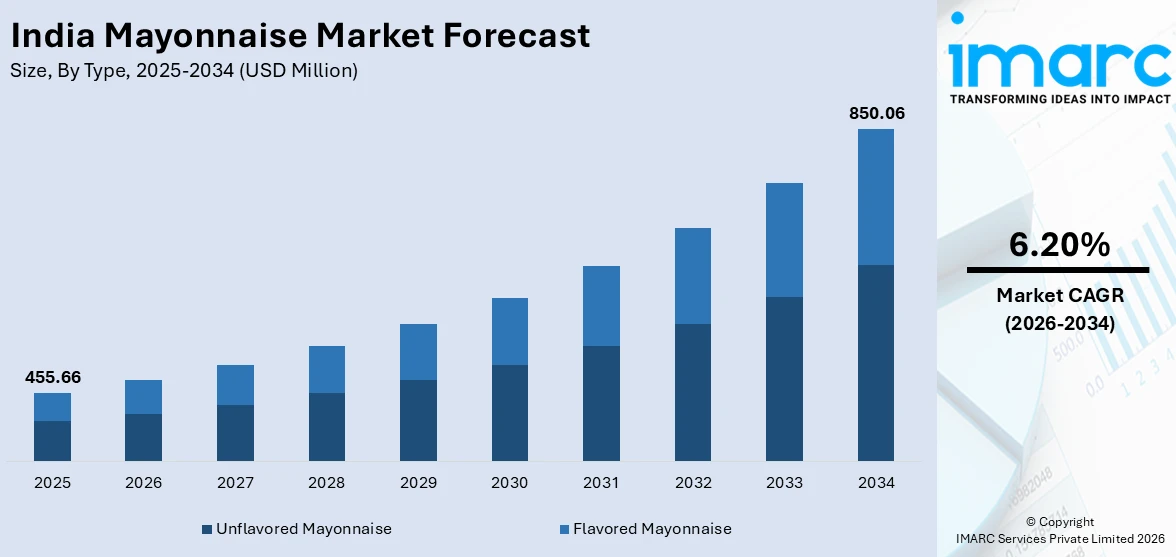
The India mayonnaise market grew from USD 455.66 Million in 2025 to USD 525.29 Million in 2026 and is projected to reach USD 850.06 Million by 2034, growing at a compound annual growth rate of 6.20% from 2026-2034.
The India mayonnaise market is experiencing robust expansion driven by the rapid proliferation of quick-service restaurants, cloud kitchens, and food delivery platforms across metropolitan and tier-2 cities. Shifting dietary preferences among the country's young, urban population are accelerating the adoption of Western-style condiments in both home kitchens and institutional foodservice operations. The growing demand for eggless and flavored variants tailored to regional palates is broadening the consumer base considerably, particularly among the vegetarian demographic that constitutes a significant share of the national population. The expanding organized food retail infrastructure is strengthening the distribution reach of branded condiments including mayonnaise through supermarkets and hypermarkets across urban and semi-urban centers. Government-backed initiatives supporting micro food processing enterprises are enabling small and mid-sized manufacturers to scale production capabilities. Product premiumization, clean-label formulations, and innovative packaging solutions are further contributing to rising per-unit value and expanding the India mayonnaise market share.
Key Takeaways and Insights:
- By Type: Unflavored mayonnaise dominates the market with a share of 58.5% in 2025, owing to its widespread versatility as a base ingredient across sandwiches, burgers, dressings, and institutional food preparation. Its neutral flavor profile and adaptability to customized regional recipes sustain its leading position.
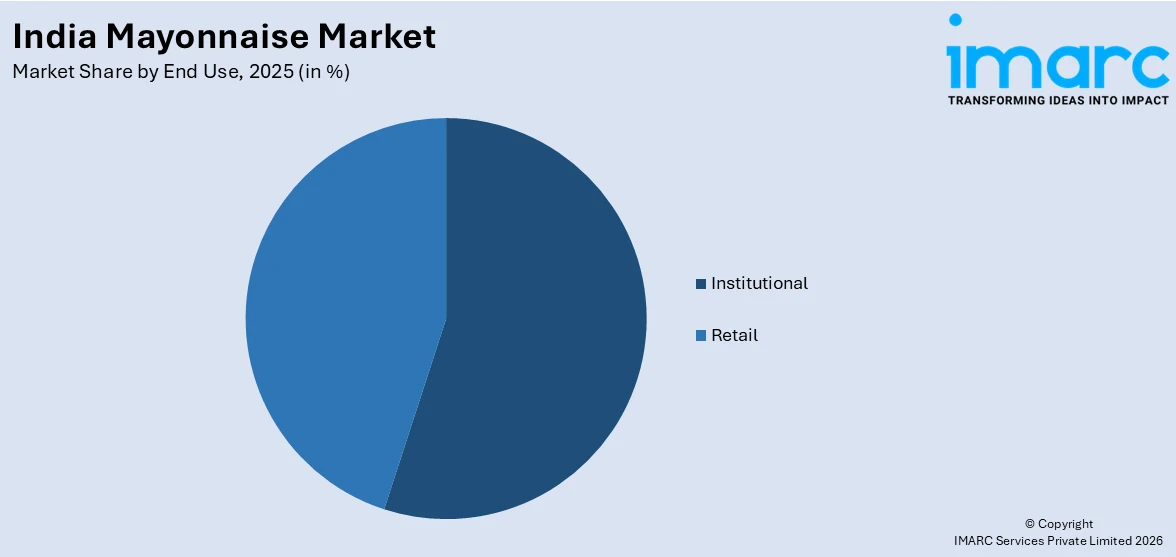
- By End Use: Institutional leads the market with a share of 54.2% in 2025. This dominance is driven by high-volume consumption in quick-service restaurants, hotels, catering companies, and cloud kitchens that rely on mayonnaise as an essential condiment for diverse menu applications.
- By Distribution Channel: Supermarkets and hypermarkets represent the biggest segment with a market share of 44.5% in 2025, reflecting consumer preference for organized retail environments that offer wide product assortments, promotional pricing, and the ability to compare branded mayonnaise options under one roof.
- By Region: West and Central India is the largest region with 29.5% share in 2025, driven by the concentration of organized retail infrastructure, thriving quick-service restaurant chains, and the presence of major manufacturing hubs in Maharashtra and Gujarat that facilitate efficient product distribution.
- Key Players: Key players drive the India mayonnaise market by expanding product portfolios, introducing regionally inspired flavors, improving eggless and clean-label formulations, and strengthening nationwide distribution. Their investments in institutional partnerships, digital marketing, and retail shelf visibility accelerate adoption and ensure consistent product availability across diverse consumer segments.
To get more information on this market Request Sample
The India mayonnaise market is advancing as manufacturers, foodservice operators, and retailers embrace innovation-led strategies to capture an increasingly diverse consumer base. Rising urbanization, growing dual-income households, and the expanding culture of eating out are creating sustained demand for convenient condiments across both institutional and retail channels. Eggless and plant-based formulations are gaining substantial traction, aligning with the dietary preferences of a vegetarian population that reaches around 30-40% nationally. In order to appeal to local taste profiles, brands are aggressively localizing their product portfolios by adding fusion flavors like tandoori, schezwan, and peri-peri. For instance, Veeba Foods, one of India's leading condiment companies, surpassed INR 1,000 crore in annual revenue in FY24, underscoring the robust commercial potential of the domestic mayonnaise and sauces segment. Premiumization trends, enhanced cold-chain logistics, and the proliferation of e-commerce grocery platforms are further strengthening the market's growth trajectory across metropolitan and emerging urban centers.
India Mayonnaise Market Trends:
Rising Demand for Eggless and Plant-Based Formulations
India is witnessing a pronounced shift toward eggless and plant-based mayonnaise formulations driven by the country's large vegetarian population and increasing health consciousness among urban consumers. Manufacturers are leveraging ingredients such as soy protein, chickpea emulsions, and aquafaba to develop cholesterol-free alternatives that offer comparable taste and texture. The growing preference for animal-free diets among millennials and Gen Z demographics is further accelerating product development in this category. Urban restaurants and retail chains are increasingly stocking eggless variants not only for ethical considerations but also due to their longer shelf life and lower temperature sensitivity, broadening their appeal across institutional and household segments.
Localization of Flavor Profiles for Regional Palates
The Indianization of mayonnaise is a defining trend reshaping the condiment landscape, with brands aggressively launching fusion flavors tailored to regional taste preferences. Variants such as tandoori, mint-coriander, schezwan, and garlic mayo are expanding market penetration into tier-2 and tier-3 cities where heritage flavors are strongly preferred. For instance, in August 2024, Unilever reinvented its Hellmann's brand globally by introducing new flavored options including chipotle and garlic aioli, targeting millennial and Gen Z consumers who seek distinctive and versatile products, supporting the India mayonnaise market growth.
Clean-Label and Health-Oriented Product Innovation
Consumer demand for transparency in ingredient sourcing and nutritional content is pushing manufacturers toward clean-label mayonnaise formulations that eliminate artificial preservatives, synthetic colors, and excessive additives. Low-fat, sugar-free, and zero-cholesterol variants are emerging as preferred choices among health-conscious urban consumers and institutional buyers in schools, hospitals, and wellness chains. Evolving regulatory frameworks around labelling transparency are prompting condiment manufacturers across India to enhance their ingredient declarations, accelerating the shift toward functional and health-oriented mayonnaise products. Niche brands targeting premium retail and nutrition-focused channels are introducing functional formulations enriched with ingredients such as flaxseed oil and olive oil to meet rising consumer expectations for healthier condiment options.

Market Outlook 2026-2034:
India's mayonnaise market is poised for sustained expansion, supported by the accelerating growth of quick-service restaurants, deepening penetration of organized retail, and continuous product innovation across eggless, flavored, and health-oriented categories. Increasing disposable incomes and evolving dietary habits among the young urban population are expected to sustain consumption growth across both institutional and retail end-use segments. The market generated a revenue of USD 455.66 Million in 2025, which is expected to reach USD 525.29 Million in 2026 and further grow to USD 850.06 Million by 2034, at a compound annual growth rate (CAGR) of 6.20% during 2026-2034. Expanding cold-chain infrastructure, the proliferation of cloud kitchens and food aggregator platforms, and rising consumer awareness of clean-label products are expected to strengthen demand trajectories and broaden the addressable market across metropolitan and emerging urban centers in India.
India Mayonnaise Market Report Segmentation:
| Segment Category | Leading Segment | Market Share |
|---|---|---|
|
Type |
Unflavored Mayonnaise |
58.5% |
|
End Use |
Institutional |
54.2% |
|
Distribution Channel |
Supermarkets and Hypermarkets |
44.5% |
|
Region |
West and Central India |
29.5% |
Type Insights:
- Unflavored Mayonnaise
- Flavored Mayonnaise
Unflavored mayonnaise dominates with a market share of 58.5% of the total India mayonnaise market in 2025.
Unflavored mayonnaise maintains its commanding position in India's condiment landscape due to its exceptional versatility as a base ingredient across both household and commercial food preparation applications. Its neutral taste profile allows seamless integration into sandwiches, burgers, salads, wraps, and dressings, making it indispensable for quick-service restaurants and institutional catering operations. The segment benefits from consistent demand across all demographic groups, as consumers and chefs utilize plain mayonnaise as a foundational component for customizing flavors according to regional preferences and specific recipe requirements.
The institutional foodservice sector is a particularly strong driver of unflavored mayonnaise consumption, as hotels, catering companies, and cloud kitchens procure large volumes for menu preparation at scale. For instance, India's quick-service restaurant market reached approximately USD 8.70 Billion in 2024, with condiments including mayonnaise forming a critical component of menu offerings across thousands of outlets. The widespread availability of unflavored variants in bulk packaging formats tailored for commercial use continues to reinforce the segment's dominance within the broader India mayonnaise market.
End Use Insights:
Access the comprehensive market breakdown Request Sample
- Institutional
- Retail
Institutional leads with a share of 54.2% of the total India mayonnaise market in 2025.
The institutional segment commands a leading position in the India mayonnaise market, driven by high-volume procurement from quick-service restaurant chains, hotels, catering companies, cloud kitchens, and food aggregator platforms. Mayonnaise serves as an essential condiment across virtually every menu category within the foodservice industry, from burgers and wraps to dipping sauces and salad preparations. The explosive growth of food delivery platforms and cloud kitchen operations across tier-1 and tier-2 cities has amplified bulk ordering patterns for standardized and custom-formulated mayonnaise variants.
Brands have strategically adapted to institutional demand by launching bulk stock-keeping units, specialized dispensing systems, and customized flavor profiles tailored for commercial kitchen requirements. Leading condiment manufacturers are forging long-term supply partnerships with major quick-service restaurant chains, hotel groups, and catering companies to ensure consistent product availability at scale. This business-to-business focus enables manufacturers to develop region-specific formulations that align with the diverse menu requirements of institutional buyers. The expanding commercial condiment supply chain reflects the significant role of institutional partnerships in sustaining the overall growth of the India mayonnaise market.
Distribution Channel Insights:
- Supermarkets and Hypermarkets
- Convenience Stores
- Online Retailers
- Specialty Stores
- Others
Supermarkets and hypermarkets hold the largest share at 44.5% of the total India mayonnaise market in 2025.
In India, supermarkets and hypermarkets are the main retail outlets for branded mayonnaise because of their extensive product selection, aggressive pricing tactics, and customers' inclination for one-stop shopping. For both domestic and foreign mayonnaise brands, these structured retail formats provide increased shelf visibility, promoting product discovery and impulsive sales among a variety of consumer demographics. The increasing trend of weekly bulk shopping among urban households looking for convenience and diversity in their condiment selections further bolsters the channel's strength.
Mayonnaise distribution through supermarkets and hypermarkets is being directly strengthened by the growth of organized retail infrastructure throughout India. In order to increase the physical availability of branded condiments, such as mayonnaise, in previously underserved locations, major retail chains are aggressively expanding their store networks throughout metropolitan, tier-2, and smaller cities. Manufacturers may reach new customer segments and strengthen brand exposure through strategic product placement, in-store promotions, and dedicated shelf space thanks to this continuous retail expansion. The distribution channel's leading position in the mayonnaise market in India is supported by the expanding use of hypermarket and supermarket formats in various geographical areas.
Regional Insights:
- North India
- West and Central India
- South India
- East and Northeast India
West and Central India represents the leading region with a 29.5% share of the total India mayonnaise market in 2025.
Because of its well-established organized retail infrastructure, flourishing quick-service restaurant environment, and concentration of significant food manufacturing and distribution hubs throughout Maharashtra and Gujarat, West and Central India dominates the mayonnaise industry. Both institutional and retail mayonnaise consumption are encouraged by the region's high pace of urbanization, sizable middle-class customer base, and strong preference for convenience food items. Leading supermarket chains and hypermarket networks guarantee that branded condiment goods are widely available on shelves in both established and developing urban areas.
A dense network of eateries, cloud kitchens, and catering businesses centered in the area's major cities supports the region's thriving foodservice sector. Leading retail chains' headquarters and several stores are located in West and Central India, which together improve condiment distribution networks and guarantee broad product accessibility. Effective supply chain operations for perishable condiments are made possible by the well-developed transportation corridors that link important commercial hubs. Mayonnaise's leading position in the national scene is further reinforced by ongoing investments in cold-chain logistics and warehousing capacity, which enable seamless distribution across the region's growing consumer markets.
Market Dynamics:
Growth Drivers:
Why is the India Mayonnaise Market Growing?
Expansion of Quick-Service Restaurants and Cloud Kitchen Operations
In India, the fast growth of cloud kitchens, quick-service restaurants, and food delivery services is creating a steady institutional demand for mayonnaise as a necessary condiment for menu creation. The geographic reach of commercial mayonnaise consumption is expanding due to the aggressive expansion of both domestic and international food chains into tier-2 and tier-3 cities. The foodservice industry's reliance on mayonnaise as a flexible foundation for burger spreads, wrap fillings, dressings, and dipping sauces guarantees steady high-volume buying from institutional buyers. Because condiments are a crucial component of cost management and branding in cloud kitchens, which run delivery-only models with minimal administrative costs, they are especially important users of bulk mayonnaise varieties. A strong and growing consumer base for mayonnaise producers is being created by the expansion of organized foodservice infrastructure, which is sustaining demand for both standard and customized formulations made to meet the needs of commercial kitchens across the nation.
Growing Vegetarian Population and Demand for Eggless Variants
Eggless mayonnaise formulations that satisfy dietary choices based on cultural and religious customs are in high demand due to India's sizable vegetarian population. The demand for cholesterol-free and low-fat substitutes is being further increased by urban millennials and Gen Z consumers' growing awareness of plant-based diets and health-conscious eating practices. Eggless product development has become a key growth strategy for both domestic and foreign industries as a result of this demographic trend. Businesses are utilizing cutting-edge plant-based emulsions with ingredients derived from chickpeas, aquafaba, and soy protein to produce eggless mayonnaise that retains the creamy flavor and texture that customers demand. The long-term growth of the India mayonnaise market is supported by the country's status as one of the world's biggest consumer marketplaces for egg-free condiment substitutes, which guarantees consistent demand for eggless versions through institutional and retail channels.
Rising Urbanization and Changing Dietary Preferences
Mayonnaise and other Western-style condiments are becoming more popular among India's expanding urban middle class due to the country's rapid urbanization and the ensuing change in eating habits. Mayonnaise is becoming a standard side dish for sandwiches, wraps, burgers, and salads that are eaten at home and through meal delivery services due to the rise in dual-income households, busy lifestyles, and the growing convenience dining culture. The acceptance of various cuisines is quickly increasing among Indian consumers, and young customers are especially open to experimenting with global culinary influences. Mayonnaise can now be used as an addition to a wider variety of foods because to this diversity of culinary preferences. The market's growth trajectory is being reinforced by rising disposable incomes, increased exposure to international cuisine trends through digital media, and the availability of a variety of branded options in organized retail.
Market Restraints:
What Challenges the India Mayonnaise Market is Facing?
Health Perceptions and Calorie Concerns
In a market that is becoming more and more concerned with health and wellbeing, consumers' view of mayonnaise as a high-calorie, high-fat product presents a serious obstacle. Health-conscious consumers are turning to lower-calorie substitutes like hummus and yogurt-based dressings because traditional mayonnaise contains significant amounts of vegetable oil. Adoption among diet-conscious populations is restricted by this notion, which also restricts development potential in markets where consumers prioritize nutritional clarity.
Cold-Chain Infrastructure Limitations
Mayonnaise is perishable, thus ensuring product quality and safety throughout the supply chain requires strong cold-chain logistics. Inadequate refrigeration facilities limit the reach of distribution outside of major cities and provide logistical issues for smaller businesses, especially in semi-urban and rural areas. The market's capacity to successfully reach underserved geographic areas is hampered by temperature changes during transit and storage, which can cause spoiling, quality degradation, and food safety issues.
Intense Competition from Unorganized Sector and Substitutes
The enormous unorganized sector that produces inexpensive, locally produced spreads and dips that compete on price rather than quality or brand recognition puts pressure on the mayonnaise market in India. In home kitchens, traditional Indian condiments like raita, pickles, and chutneys are also well-known substitutes for mayonnaise. The expansion of premium branded mayonnaise products is further constrained by the price sensitivity of a sizable segment of the customer base, especially in cost-conscious rural and semi-urban regions.
Competitive Landscape:
With both well-known international companies and up-and-coming local businesses fighting for market dominance, the mayonnaise industry in India has a somewhat consolidated competitive structure. In order to improve their market standing, businesses are competing through product innovation, taste diversification, strategic pricing, and distribution growth. Long-term supply agreements between manufacturers and quick-service restaurant chains define the institutional market, whereas shelf space optimization across organized retail channels, promotional tactics, and brand visibility drive the retail segment. Investments in clean-label goods, eggless formulations, and regional flavor modifications are becoming important differentiators in the market. The rivalry is getting more intense as firms try to expand their addressable market throughout India and take advantage of changing customer preferences through strategic partnerships with celebrity chefs, food delivery services, and e-commerce aggregators.
India Mayonnaise Market Report Coverage:
| Report Features | Details |
|---|---|
| Base Year of the Analysis | 2025 |
| Historical Period | 2020-2025 |
| Forecast Period | 2026-2034 |
| Units | Million USD |
| Scope of the Report | Exploration of Historical Trends and Market Outlook, Industry Catalysts and Challenges, Segment-Wise Historical and Future Market Assessment:
|
| Types Covered | Unflavored Mayonnaise, Flavored Mayonnaise |
| End Uses Covered | Institutional, Retail |
| Distribution Channels Covered | Supermarkets and Hypermarkets, Convenience Stores, Online Retailers, Specialty Stores, Others |
| Regions Covered | North India, West and Central India, South India, East and Northeast India |
| Customization Scope | 10% Free Customization |
| Post-Sale Analyst Support | 10-12 Weeks |
| Delivery Format | PDF and Excel through Email (We can also provide the editable version of the report in PPT/Word format on special request) |
Frequently Asked Questions About the India Mayonnaise Market Report
The India mayonnaise market size increased from USD 455.66 Million in 2025 to USD 525.29 Million in 2026.
The India mayonnaise market is expected to grow at a compound annual growth rate of 6.20% from 2026-2034 to reach USD 850.06 Million by 2034.
Unflavored mayonnaise dominated the market with a share of 58.5%, driven by its exceptional versatility as a base ingredient across both household cooking and commercial food preparation applications, enabling customized flavor adaptations for diverse regional preferences.
Key factors driving the India mayonnaise market include expanding quick-service restaurant infrastructure, growing demand for eggless and flavored variants, rising urbanization and disposable incomes, increasing convenience food consumption, and strengthening organized retail distribution networks.
Major challenges include health perceptions of mayonnaise as a high-calorie product, cold-chain infrastructure limitations in semi-urban and rural areas, intense competition from unorganized local manufacturers and traditional condiment substitutes, and rising raw material input costs.
Need more help?
- Speak to our experienced analysts for insights on the current market scenarios.
- Include additional segments and countries to customize the report as per your requirement.
- Gain an unparalleled competitive advantage in your domain by understanding how to utilize the report and positively impacting your operations and revenue.
- For further assistance, please connect with our analysts.
 Request Customization
 Speak to an Analyst
 Request Brochure
 Inquire Before Buying
Benefits of Customization
- Personalize this research
- Triangulate with your data
- Get data as per your format and definition
- Gain a deeper dive into a specific application, geography, customer, or competitor
- Any level of personalization
Get in Touch With Us
UNITED STATES
Phone: +1-201-971-6302
INDIA
Phone: +91-120-433-0800
UNITED KINGDOM
Phone: +44-753-714-6104
Email: [email protected]
Client Testimonials




.webp)




.webp)













Related Reports

Choose your plan
*Please note that the prices mentioned below are starting prices for each bundle type. Kindly contact our team for further details.*
Single User License
- 1 User License, Access on 2 Devices
- PDF Report + Excel Dataset (Password Protected)
- Lifetime Access
- No Printing Rights
- 10% Free Report Customization
- 10–12 Weeks of Analyst Support
Five User License
- Access for 5 Users, 2 Devices per User
- PDF Report + Excel Dataset (Password Protected)
- Lifetime Access
- Dedicated Account Manager
- 12–14 Weeks of Analyst Support
- No Printing Rights
- 15% Free Report Customization
- 25% Discount on Your Next Purchase
Corporate User License
- Unlimited User Access (Within Your Organization)
- PDF Report + Excel Dataset
- Lifetime Access
- Dedicated Account Manager
- 14–20 Weeks of Analyst Support
- No Printing Rights
- 20% Free Report Customization
- 30% Discount on Your Next Purchase
Essential Insights
What's included:
3 reports
- Lifetime Access
- PDF Reports
- Excel Datasets
- 2 Weeks of Free Analyst Support
- 2 User Licenses
- Access on 2 Devices
- Printing Rights
- Complimentary PowerPoint (PPT) Version
- Complimentary License Upgrade
Professional Access
What's included:
5 reports
- Lifetime Access
- PDF Reports
- Excel Datasets
- 8 Weeks of Free Analyst Support
- 2 User Licenses
- Access on 2 Devices
- Printing Rights
- Complimentary PowerPoint (PPT) Version
- Complimentary License Upgrade
Business Advantage
What's included:
8 reports
- Lifetime Access
- PDF Reports
- Excel Datasets
- 14 Weeks of Free Analyst Support
- 2 User Licenses
- Access on 2 Devices
- Printing Rights
- Complimentary PowerPoint (PPT) Version
- Complimentary License Upgrade
Enterprise Intelligence
What's included:
10 reports
- Lifetime Access
- PDF Reports
- Excel Datasets
- 20 Weeks of Free Analyst Support
- 2 User Licenses
- Access on 2 Devices
- Printing Rights
- Complimentary PowerPoint (PPT) Version
- Complimentary License Upgrade