
India Medical Imaging Market Size, Share, Trends and Forecast by Product, Application, End User, and Region, 2026-2034
India Medical Imaging Market Summary:
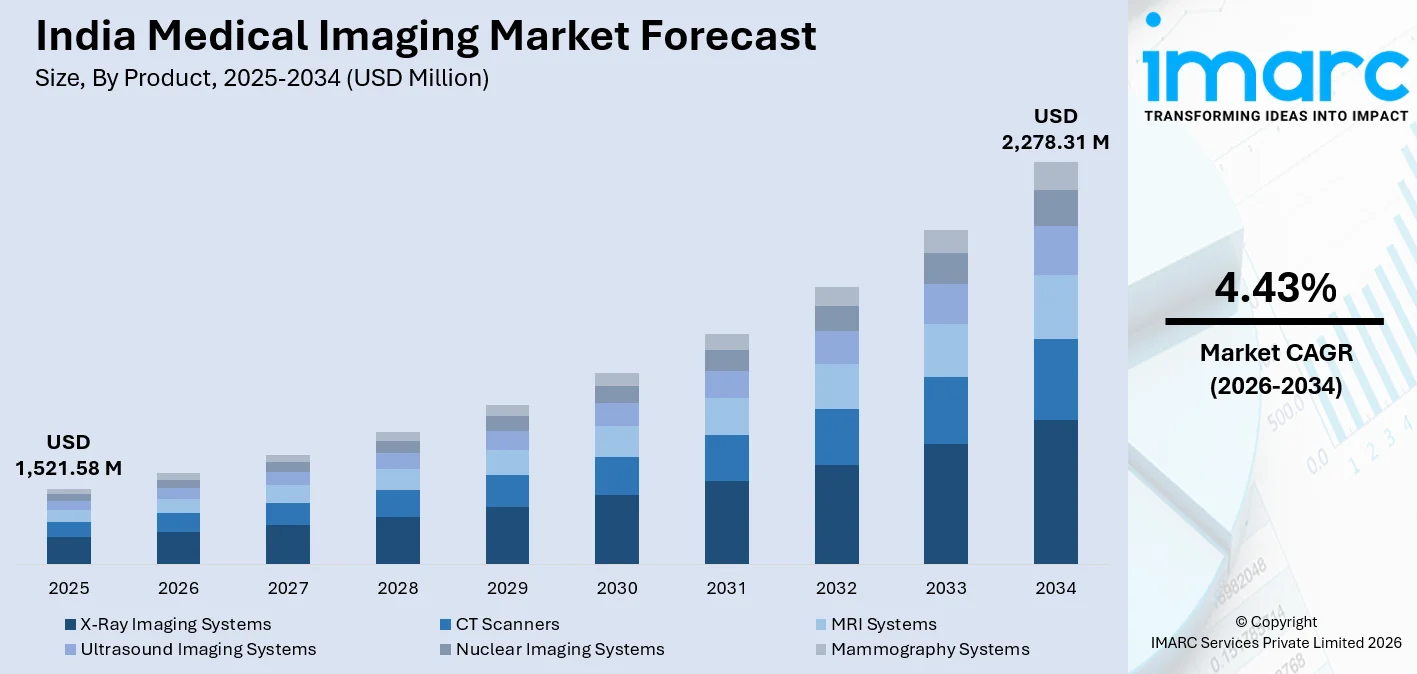
The India medical imaging market size was valued at USD 1,521.58 Million in 2025 and is projected to reach USD 2,278.31 Million by 2034, growing at a compound annual growth rate of 4.43% from 2026-2034.
The medical imaging market in India is expanding steadily. This is due to the increasing prevalence of chronic diseases, age-related diseases, investment in healthcare infrastructure, and the importance of early disease diagnosis. Expansion of health insurance coverage, the increasing number of diagnostic centers in tier 2 and tier 3 cities, and the increasing incorporation of advanced medical imaging modalities are contributing to the medical imaging market share in India.
Key Takeaways and Insights:
- By Product: X-ray imaging systems dominates the market with a share of 28.7% in 2025, attributable to their broad clinical utility spanning emergency care, primary diagnostics, and orthopedic assessments across India's extensive healthcare network.
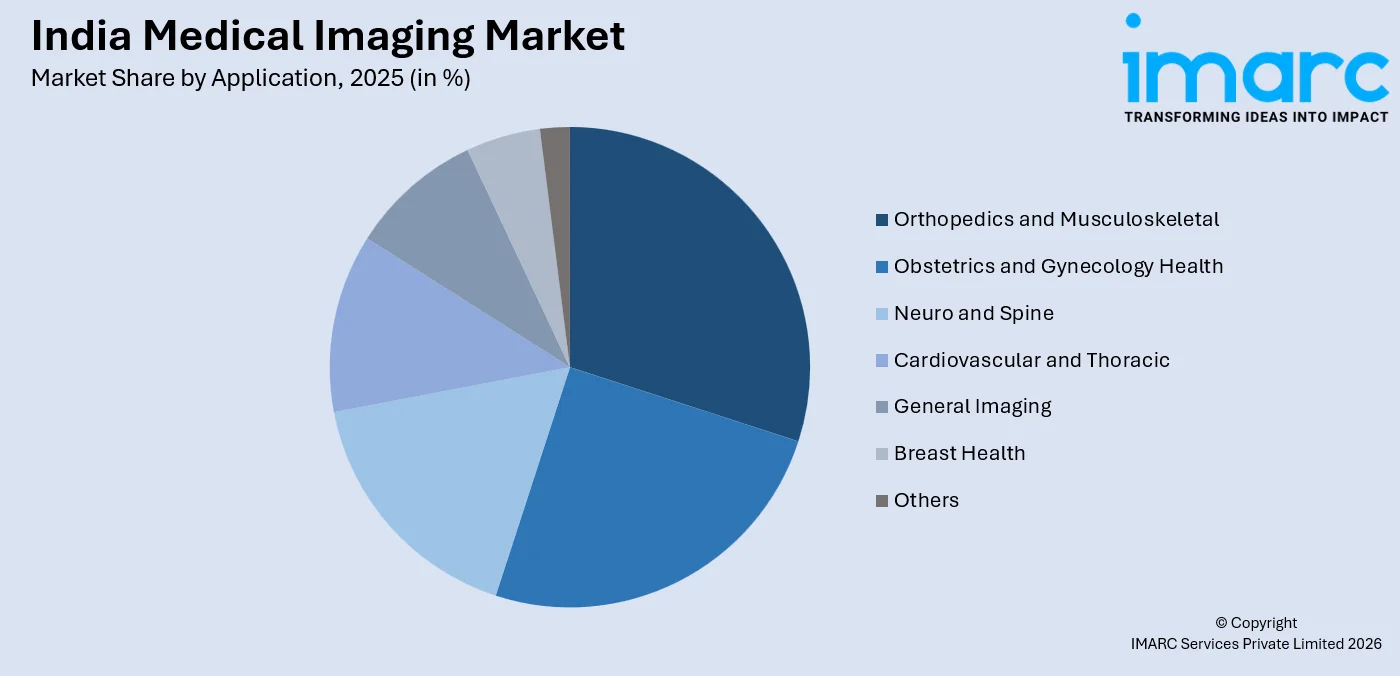
- By Application: Orthopedics and Musculoskeletal leads the market with a share of 24.6% in 2025, reflecting the rising prevalence of bone disorders, sports-related injuries, and aging-related skeletal conditions across India.
- By End User: Hospitals represents the largest segment with a market share of 65.4% in 2025, underscoring their comprehensive imaging infrastructure, high patient volumes, and capability to manage diverse and complex diagnostic requirements across India.
- By Region: South India dominates the market with a share of 29.1% in 2025, supported by a dense concentration of specialty hospitals, high healthcare expenditure, and well-developed medical infrastructure in metropolitan centers.
- Key Players: The India medical imaging market features intense competition among multinational and domestic players investing in AI-enabled imaging platforms, localized manufacturing, and strategic partnerships to expand diagnostic capabilities and improve healthcare access across urban and rural settings.
To get more information on this market Request Sample
The India medical imaging market is advancing rapidly as healthcare providers modernize diagnostic infrastructure and integrate cutting-edge technologies to improve patient outcomes. The market encompasses a diverse range of imaging modalities, from conventional X-ray systems to sophisticated computed tomography, magnetic resonance imaging, nuclear imaging, and ultrasound platforms. In March 2025, India developed its first indigenous 1.5 Tesla MRI scanner, which is set to be installed at the All India Institute of Medical Sciences, New Delhi for clinical trials under a collaboration with the Society for Applied Microwave Electronics Engineering and Research, aiming to reduce dependence on imported imaging equipment and expand affordable diagnostic access. Growing public awareness about preventive healthcare, the proliferation of diagnostic centers in tier-2 and tier-3 cities, and escalating demand for precise diagnostic tools are collectively reshaping the market landscape. Government-led health insurance schemes and infrastructure programs are expanding imaging access to underserved populations, while advancements in artificial intelligence are augmenting diagnostic accuracy and clinical workflows. These converging factors are reinforcing the market's long-term trajectory across India's dynamic healthcare ecosystem.
India Medical Imaging Market Trends:
Rising Adoption of AI-Integrated Imaging Technologies
The integration of artificial intelligence into diagnostic imaging is transforming clinical workflows across India. AI-powered tools are improving detection accuracy for conditions such as cancer, neurological, and pulmonary disorders by identifying subtle anomalies in medical scans. In July 2025, Apollo Hospitals partnered with Siemens Healthineers to develop AI-enabled imaging solutions and quantitative ultrasound technologies aimed at improving early detection and monitoring of liver diseases such as metabolic dysfunction-associated steatotic liver disease (MASLD) in India. This is enhancing radiologist productivity, enabling faster diagnostic turnaround times, and supporting more informed clinical decision-making across hospitals, diagnostic centers, and specialty care settings throughout the country.
Expansion of Portable and Point-of-Care Imaging Solutions
Portable and handheld imaging devices are gaining rapid adoption across India, particularly in rural and semi-urban regions with limited healthcare infrastructure. Mobile X-ray and point-of-care ultrasound systems are extending diagnostic services to underserved populations, improving healthcare accessibility, and supporting diagnostic continuity in emergency, primary care, and community health settings. In July 2025, the Government of India announced plans to procure around 1,500 handheld X-ray machines under the TB‑Mukt Bharat Abhiyaan to strengthen tuberculosis screening and early detection through portable imaging technologies deployed across the country. The broadening clinical utility of portable imaging is gradually reshaping how diagnostic services are delivered beyond traditional facility-based environments.
Growth of Teleradiology and Digital Health Platforms
Teleradiology is transforming India's diagnostic landscape by enabling real-time transmission of medical images to specialist radiologists from geographically remote locations. Cloud-based archiving and communication platforms are facilitating seamless image sharing across healthcare networks, reducing diagnostic delays, improving access to subspecialty expertise, and optimizing imaging workflows. In January 2026, a teleradiology centre was established at Sadar Hospital in Ranchi to digitally process and report radiological investigations from multiple government hospitals across Jharkhand, enabling centralized image interpretation and improving diagnostic access in districts such as Palamu, Khunti, Gumla, and Simdega. This digital transformation is reshaping radiology service delivery models and expanding quality diagnostic coverage across urban, semi-urban, and rural healthcare settings throughout India.
Market Outlook 2026-2034:
The medical imaging market in India is expected to exhibit a strong revenue growth trajectory over the forecast period. This can be attributed to the increasing healthcare infrastructure, the prevalence of lifestyle diseases, and the government’s increased focus on providing quality healthcare to the public. Additionally, the increasing adoption of AI-based medical imaging technology and portable diagnostic tools will significantly change the face of medical services. Medical tourism, health insurance coverage, and the aging population will significantly contribute to the growth of the medical imaging market. South India and North India are expected to contribute significantly to the overall revenue. The market generated a revenue of USD 1,521.58 Million in 2025 and is projected to reach a revenue of USD 2,278.31 Million by 2034, growing at a compound annual growth rate of 4.43% from 2026-2034.
India Medical Imaging Market Report Segmentation:
| Segment Category | Leading Segment | Market Share |
|---|---|---|
|
Product |
X-Ray Imaging Systems |
28.7% |
|
Application |
Orthopedics and Musculoskeletal |
24.6% |
|
End User |
Hospitals |
65.4% |
|
Region |
South India |
29.1% |
Product Insights:
- CT Scanners
- X-Ray Imaging Systems
- MRI Systems
- Ultrasound Imaging Systems
- Nuclear Imaging Systems
- Mammography Systems
The X-ray imaging systems dominates with a market share of 28.7% of the total India medical imaging market in 2025.
The leading position in the market for medical imaging systems in India is held by X-ray imaging systems due to their widespread usage in emergency care facilities, outpatient facilities, and primary care facilities. The broad applicability of these systems in diagnosing respiratory infections, bone fractures, and tuberculosis ensures that these systems maintain high usage levels throughout India's varied healthcare facilities. The shift from traditional analog systems to digital radiography systems is increasing the resolution and accuracy of these systems.
The increasing compatibility of X-ray systems with artificial intelligence-assisted diagnostic systems is helping sustain their relevance in modern clinical environments. The integration of artificial intelligence is helping ensure automated anomaly detection, faster interpretation of data, and increased consistency in diagnostic outcomes. The cost-effectiveness of digital X-ray systems vis-à-vis other advanced imaging modalities makes them an attractive option for implementation in resource-constrained environments, including district hospitals and community health centers, where they are used as a primary diagnostic tool for various clinical assessments.
Application Insights:
Access the comprehensive market breakdown Request Sample
- Obstetrics and Gynecology Health
- Orthopedics and Musculoskeletal
- Neuro and Spine
- Cardiovascular and Thoracic
- General Imaging
- Breast Health
- Others
The orthopedics and musculoskeletal leads with a share of 24.6% of the total India medical imaging market in 2025.
Orthopedics and musculoskeletal imaging leads the application segment of the India medical imaging market, reflecting the country's significant burden of arthritis, osteoporosis, sports-related injuries, and age-related skeletal conditions across all demographic groups. Advanced imaging modalities including MRI, computed tomography, and digital X-ray are extensively utilized for accurate injury assessment, pre-surgical planning, and post-operative monitoring. According to the World Health Organization, musculoskeletal conditions are the leading contributor to disability worldwide, affecting around 1.71 billion people, highlighting the growing need for imaging-based diagnosis and monitoring of bone and joint disorders, including in rapidly aging populations such as India. Growing awareness of musculoskeletal health and the expansion of orthopedic specialty centers are collectively sustaining high procedure volumes across the country's evolving diagnostic landscape.
The rising prevalence of physically demanding occupations, increasing sports participation, and an aging population are intensifying demand for precise musculoskeletal imaging in India. Adoption of AI-powered diagnostic tools for fracture detection, cartilage assessment, and joint evaluation is enhancing clinical precision and reducing diagnostic turnaround times. The expansion of orthopedic departments within multispecialty hospitals and the growth of dedicated bone and joint clinics in tier-2 cities are further broadening access to specialized musculoskeletal imaging services across India's rapidly developing healthcare infrastructure.
End User Insights:
- Hospitals
- Diagnostic Centers
- Academic Institutes and Research Organizations
The hospitals dominates with a market share of 65.4% of the total India medical imaging market in 2025.
Hospitals are found to be the key end-user segment for the medical imaging market in India, driven by the presence of extensive imaging capabilities within the hospital infrastructure, coupled with the ability to serve a large patient base with diverse diagnostic needs. Tertiary care or multispecialty hospitals have access to all imaging modalities, thereby providing diagnostic support for cancer treatment, cardiology services, neurological disorders, orthopedic conditions, etc. Ongoing expansions of hospital infrastructure both in public and private sectors are fueling the demand for medical imaging equipment.
Government-backed health insurance programs extending imaging coverage within hospital settings are further reinforcing utilization across inpatient and outpatient departments. The availability of specialized radiology teams, dedicated imaging suites, and integrated digital infrastructure within hospital environments enables higher diagnostic accuracy and more efficient clinical workflows. As new hospital campuses continue to emerge across tier-2 and tier-3 cities, the demand for imaging equipment installations is expected to remain strong, consolidating hospitals as the primary channel for medical imaging service delivery across India.
Regional Insights:
- South India
- North India
- West and Central India
- East India
South India exhibits a clear dominance with a 29.1% share of the total India medical imaging market in 2025.
South India commands the largest regional share in the India medical imaging market, supported by a dense concentration of multispecialty hospitals, well-established private healthcare networks, and robust medical tourism activity. States including Tamil Nadu, Karnataka, Telangana, and Kerala have made substantial investments in advanced diagnostic infrastructure, enabling high imaging procedure volumes across urban centers. Strong health insurance penetration and a skilled healthcare workforce are further sustaining demand for sophisticated imaging technologies across the region's rapidly evolving healthcare ecosystem.
Progressive adoption of AI-integrated imaging platforms, teleradiology services, and cloud-based diagnostic networks is reinforcing South India's position as a leading hub for medical imaging innovation within the country. The region's well-developed referral systems connect tertiary hospitals with smaller facilities, enabling efficient patient routing for specialized imaging assessments. Continued expansion of multispecialty hospital chains into semi-urban areas, combined with growing corporate wellness and preventive screening programs, is broadening the demand base and driving sustained growth in imaging service utilization across the region.

Market Dynamics:
Growth Drivers:
Why is the India Medical Imaging Market Growing?
Rising Burden of Chronic and Age-Related Diseases
India is experiencing a significant rise in chronic diseases, including cardiovascular conditions, cancer, diabetes-related complications, and respiratory disorders, creating sustained demand for diagnostic imaging across clinical settings. The rapidly aging population is particularly susceptible to musculoskeletal disorders, neurological conditions, and cancer, driving procedure volumes across hospitals and diagnostic centers. According to the World Health Organization, noncommunicable diseases account for majority of all deaths in India, underscoring the growing need for diagnostic technologies such as CT, MRI, and ultrasound for early detection and disease monitoring. As India undergoes demographic transition with a growing elderly population, the need for regular imaging-based health monitoring is intensifying. Medical imaging plays an indispensable role in early disease detection and treatment planning, making it a critical component of disease management protocols. The burden of multi-morbidities among older adults further amplifies the frequency of imaging evaluations across diverse clinical specialties.
Government Healthcare Initiatives and Infrastructure Expansion
Government-led healthcare initiatives are playing a pivotal role in driving medical imaging demand across India. National health insurance programs have significantly expanded coverage for diagnostic procedures, enabling a broader segment of the population to access advanced imaging services within hospital settings. In November 2025, the Delhi Government announced plans to install over 230 new radiology machines, including 44 CT scanners, 30 MRI systems, and 78 ultrasound machines, across major government hospitals to reduce diagnostic waiting times and strengthen imaging capacity in public healthcare facilities. Targeted investments in public healthcare infrastructure, including the establishment of new medical institutions and district hospital upgrades, are expanding the availability of imaging facilities in underserved regions. Production-linked incentive programs are also stimulating domestic medical device manufacturing, improving affordability and local supply of imaging systems. Additionally, policy support for digital health platforms and telemedicine networks is extending diagnostic reach into rural areas where access to imaging specialists has historically been limited.
Technological Advancements and Digital Transformation
The rapid advancement of medical imaging technologies is fundamentally transforming diagnostic capabilities across India’s healthcare sector. Innovations in artificial intelligence and machine learning are enabling automated image analysis, reducing diagnostic error rates, and enhancing clinical decision-making speed. In January 2025, Royal Philips unveiled the CT 5300 AI-enabled imaging system at the Asian Oceanian Congress of Radiology 2025, designed to integrate AI-driven diagnostic capabilities and workflow automation to improve diagnostic confidence and efficiency in radiology departments. The integration of deep learning algorithms into imaging platforms is facilitating the detection of subtle pathologies that may be difficult to identify through conventional review methods. Cloud-based picture archiving and communication systems are enabling seamless storage, retrieval, and sharing of imaging data across provider networks. The adoption of high-resolution imaging platforms and advanced reconstruction techniques is improving diagnostic accuracy for complex conditions, stimulating procurement of next-generation equipment across hospitals and specialty centers throughout India.
Market Restraints:
What Challenges the India Medical Imaging Market is Facing?
High Acquisition and Maintenance Costs of Advanced Imaging Equipment
The elevated capital investment required to procure advanced imaging systems presents a significant barrier for mid-sized and rural healthcare facilities across India. Ongoing costs associated with maintenance, equipment upgrades, software licensing, and specialized component replacement impose substantial financial burdens on providers operating with constrained budgets. These cumulative cost pressures limit the adoption of the latest imaging technologies in cost-sensitive settings and slow overall market penetration in underserved regions, restricting equitable access to modern diagnostic capabilities.
Shortage of Trained Radiology Professionals
India faces a persistent shortage of trained radiologists and imaging technologists relative to its rapidly expanding equipment base. Growing imaging demand is outpacing the availability of skilled professionals capable of interpreting complex diagnostic studies across specialized clinical domains. This workforce gap is especially pronounced in rural and semi-urban regions, where limited specialist access constrains imaging throughput and equipment utilization. Teleradiology services partially address this gap but remain dependent on reliable broadband and digital infrastructure for effective deployment.
Limited Healthcare Infrastructure in Rural and Underserved Areas
A significant proportion of India’s rural population has limited access to medical imaging due to inadequate healthcare infrastructure. Many primary health facilities lack the equipment, space, and technical capacity required for modern imaging systems. Geographic remoteness and underdeveloped transport networks further restrict patient access to imaging centers in nearby urban areas. While government programs are gradually addressing infrastructure gaps, the pace of deployment remains insufficient to meet the growing diagnostic needs of underserved communities across the country.
Competitive Landscape:
The India medical imaging market is characterized by a competitive landscape featuring multinational technology providers and emerging domestic manufacturers. Competition is primarily driven by continuous product innovation, integration of artificial intelligence into imaging platforms, and the development of portable and cost-effective solutions tailored for emerging market needs. Players are investing in localized manufacturing capabilities, strategic distribution partnerships, and service network expansion to improve market penetration across tier-1, tier-2, and tier-3 cities. The growing emphasis on after-sales support, application training, and digital platform integration is differentiating market leaders from emerging entrants. Increasing collaboration between imaging equipment providers and healthcare institutions is facilitating technology upgrades, pilot programs, and co-development of India-specific diagnostic solutions. As government policies promote domestic medical device manufacturing, new entrants are entering the market with competitively priced alternatives, intensifying competitive dynamics while broadening the availability of advanced imaging technologies across India’s diverse healthcare ecosystem.
Recent Developments:
- In March 2026, Wipro GE Healthcare launched the SIGNA Prime Elite MRI system at the IRIA 2026 conference in Hyderabad. The AI-powered MRI uses deep-learning–based image reconstruction to enhance image clarity and reduce noise while lowering scan table time by up to 37%. The system is manufactured in India at the company’s PLI-supported facility, supporting domestic production of advanced diagnostic equipment.
India Medical Imaging Market Report Coverage:
| Report Features | Details |
|---|---|
| Base Year of the Analysis | 2025 |
| Historical Period | 2020-2025 |
| Forecast Period | 2026-2034 |
| Units | Million USD |
| Scope of the Report | Exploration of Historical Trends and Market Outlook, Industry Catalysts and Challenges, Segment-Wise Historical and Future Market Assessment:
|
| Products Covered | CT Scanners, X-Ray Imaging Systems, MRI Systems, Ultrasound Imaging Systems, Nuclear Imaging Systems, Mammography Systems |
| Applications Covered | Obstetrics and Gynecology Health, Orthopedics and Musculoskeletal, Neuro and Spine, Cardiovascular and Thoracic, General Imaging, Breast Health, Others |
| End Users Covered | Hospitals, Diagnostic Centers, Academic Institutes and Research Organizations |
| Regions Covered | North India, West and Central India, South India, East and Northeast India |
| Customization Scope | 10% Free Customization |
| Post-Sale Analyst Support | 10-12 Weeks |
| Delivery Format | PDF and Excel through Email (We can also provide the editable version of the report in PPT/Word format on special request) |
Frequently Asked Questions About the India Medical Imaging Market Report
The India medical imaging market size was valued at USD 1,521.58 Million in 2025.
The India medical imaging market is expected to grow at a compound annual growth rate of 4.43% from 2026-2034 to reach USD 2,278.31 Million by 2034.
X-Ray Imaging Systems, holding the largest revenue share of 28.7%, remains pivotal for India's medical imaging market, supporting emergency care, primary diagnostics, and orthopedic assessments across diverse healthcare settings throughout the country.
Key factors driving the India medical imaging market include rising chronic disease prevalence, an aging population, government healthcare initiatives, expansion of health insurance coverage, technological advancements in AI-integrated imaging, and growing healthcare infrastructure investment across urban and rural regions.
Major challenges include high acquisition costs of advanced imaging equipment, a shortage of trained radiology professionals, limited imaging infrastructure in rural areas, and the need for stronger digital connectivity to support teleradiology expansion across underserved regions.
Need more help?
- Speak to our experienced analysts for insights on the current market scenarios.
- Include additional segments and countries to customize the report as per your requirement.
- Gain an unparalleled competitive advantage in your domain by understanding how to utilize the report and positively impacting your operations and revenue.
- For further assistance, please connect with our analysts.
 Request Customization
 Speak to an Analyst
 Request Brochure
 Inquire Before Buying
Benefits of Customization
- Personalize this research
- Triangulate with your data
- Get data as per your format and definition
- Gain a deeper dive into a specific application, geography, customer, or competitor
- Any level of personalization
Get in Touch With Us
UNITED STATES
Phone: +1-201-971-6302
INDIA
Phone: +91-120-433-0800
UNITED KINGDOM
Phone: +44-753-714-6104
Email: [email protected]
Client Testimonials




.webp)




.webp)













Related Reports

Choose your plan
*Please note that the prices mentioned below are starting prices for each bundle type. Kindly contact our team for further details.*
Single User License
- 1 User License, Access on 2 Devices
- PDF Report + Excel Dataset (Password Protected)
- Lifetime Access
- No Printing Rights
- 10% Free Report Customization
- 10–12 Weeks of Analyst Support
Five User License
- Access for 5 Users, 2 Devices per User
- PDF Report + Excel Dataset (Password Protected)
- Lifetime Access
- Dedicated Account Manager
- 12–14 Weeks of Analyst Support
- No Printing Rights
- 15% Free Report Customization
- 25% Discount on Your Next Purchase
Corporate User License
- Unlimited User Access (Within Your Organization)
- PDF Report + Excel Dataset
- Lifetime Access
- Dedicated Account Manager
- 14–20 Weeks of Analyst Support
- No Printing Rights
- 20% Free Report Customization
- 30% Discount on Your Next Purchase
Essential Insights
What's included:
3 reports
- Lifetime Access
- PDF Reports
- Excel Datasets
- 2 Weeks of Free Analyst Support
- 2 User Licenses
- Access on 2 Devices
- Printing Rights
- Complimentary PowerPoint (PPT) Version
- Complimentary License Upgrade
Professional Access
What's included:
5 reports
- Lifetime Access
- PDF Reports
- Excel Datasets
- 8 Weeks of Free Analyst Support
- 2 User Licenses
- Access on 2 Devices
- Printing Rights
- Complimentary PowerPoint (PPT) Version
- Complimentary License Upgrade
Business Advantage
What's included:
8 reports
- Lifetime Access
- PDF Reports
- Excel Datasets
- 14 Weeks of Free Analyst Support
- 2 User Licenses
- Access on 2 Devices
- Printing Rights
- Complimentary PowerPoint (PPT) Version
- Complimentary License Upgrade
Enterprise Intelligence
What's included:
10 reports
- Lifetime Access
- PDF Reports
- Excel Datasets
- 20 Weeks of Free Analyst Support
- 2 User Licenses
- Access on 2 Devices
- Printing Rights
- Complimentary PowerPoint (PPT) Version
- Complimentary License Upgrade