
India Medical Loupes Market Size, Share, Trends and Forecast by Type, Lens Type, Application, End-User, and Region, 2026-2034
India Medical Loupes Market Summary:
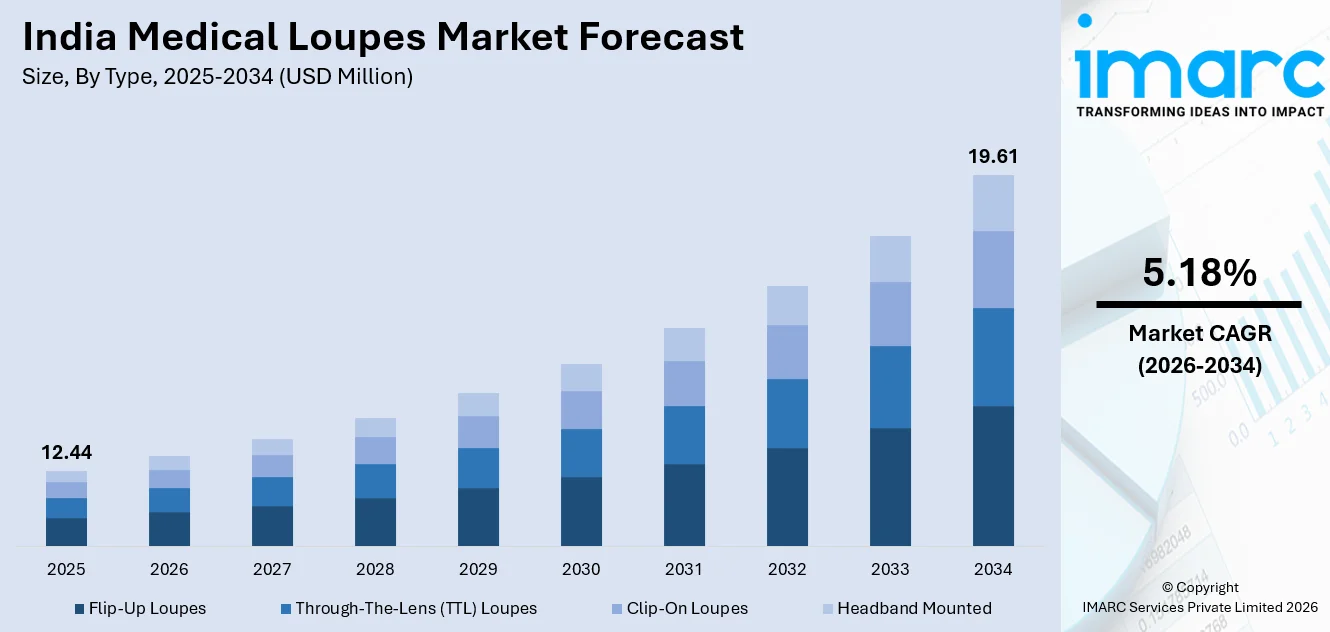
The India medical loupes market size was valued at USD 12.44 Million in 2025 and is projected to reach USD 19.61 Million by 2034, growing at a compound annual growth rate of 5.18% from 2026-2034.
The India medical loupes market is experiencing steady momentum as more healthcare professionals begin to adopt the use of magnification devices for improved accuracy and comfort. The increasing demand in the dental and surgical fields, as well as the rising focus on accuracy and healthcare, is driving the adoption of medical loupes. The growing healthcare infrastructure, awareness of procedures using medical loupes, and increasing use of optical devices in healthcare education are collectively boosting the India medical loupes market share.
Key Takeaways and Insights:
-
By Type: Flip-up loupes dominate the market with a share of 32% in 2025, driven by their versatility, ease of use, adjustable magnification angles, and widespread preference among dental and surgical practitioners across India.
- By Lens Type: Galilean led the market with a share of 57% in 2025, owing to their lightweight construction, wide field of view, and cost-effectiveness that make them preferred among general dental and surgical professionals.
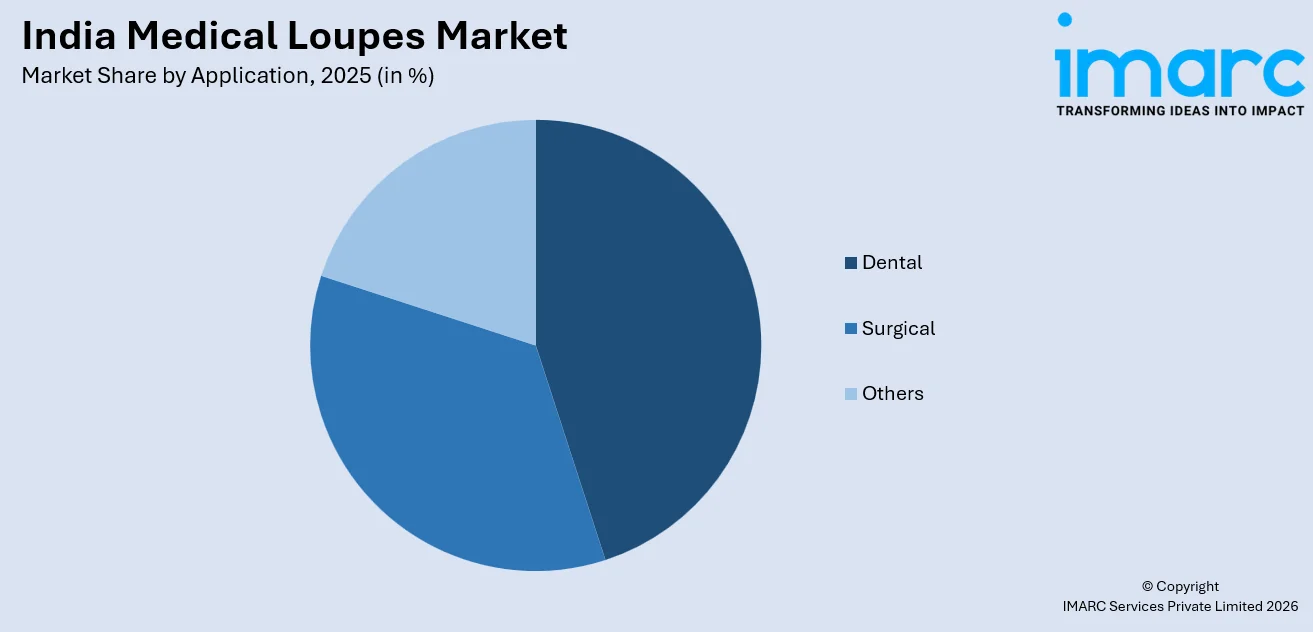
- By Application: Dental hold the largest market share of 45% in 2025, fueled by rising oral health awareness, increasing dental procedures, and growing adoption of magnification-enhanced precision tools across dental practices nationwide.
- By End-User: Hospitals and dental clinics dominate the market with a share of 56% in 2025, supported by expanding institutional infrastructure, rising patient volumes, and increasing procurement of advanced visualization equipment for clinical use.
- Key Players: The India medical loupes market features a competitive landscape with both international manufacturers and domestic suppliers competing across product quality, pricing, and ergonomic innovation to capture market share among dental and surgical professionals.
To get more information on this market Request Sample
The India medical loupes market is advancing as healthcare professionals across dental, surgical, and specialty medical fields increasingly recognize the clinical value of enhanced magnification during procedures. Demand is being driven by a broader shift toward precision-oriented care, growing awareness of occupational musculoskeletal health, and the expanding role of loupes in clinical education. Institutions are integrating loupe training early in medical and dental curricula, fostering long-term familiarity among practitioners. In May 2024, Optident (a Henry Schein company) expanded its magnification portfolio with the launch of PeriOptix through-the-lens (TTL) loupes, offering enhanced edge-to-edge optical clarity and multiple magnification options to support more accurate diagnoses and improved clinical outcomes. Additionally, the expanding network of dental clinics, hospitals, and ambulatory care centers across metropolitan and emerging urban centers is broadening the addressable market. The growing accessibility of ergonomic, lightweight loupe designs and the rising preference for customizable optical solutions are further contributing to market expansion across diverse healthcare settings in India.
India Medical Loupes Market Trends:
Rising Emphasis on Ergonomic and Lightweight Loupe Designs
Healthcare professionals are increasingly seeking ergonomic medical loupes designed to minimize neck and shoulder strain during prolonged clinical procedures. In response, manufacturers are developing ultra-light frames, adjustable declination angles, and customizable fitting options that promote proper posture and sustained occupational health. In 2025, a Scientific Reports (Nature Portfolio) study found that dental loupes significantly improved clinician posture, with notable reductions in head, neck, and shoulder strain, supporting their role in reducing ergonomic risk during clinical procedures. This growing emphasis on user comfort and physical well-being is encouraging wider adoption among dental and surgical practitioners, reinforcing the demand for ergonomically advanced loupe solutions.
Integration of LED Illumination with Magnification Systems
The integration of built-in LED headlights with medical loupes is gaining considerable traction across Indian healthcare settings. These combined illumination and magnification systems significantly enhance visualization of treatment areas, delivering shadow-free clarity during intricate dental and surgical procedures. In October 2024, Orascoptic announced a new generation of loupe-mounted LED headlight technology featuring higher brightness, improved color rendering accuracy, and more uniform light output to enhance clinical visibility during dental and surgical procedures. By improving precision and supporting better clinical outcomes, integrated lighting solutions are becoming a standard expectation among practitioners, driving increased investment in advanced loupe technologies equipped with high-performance LED systems.
Growing Adoption of Loupes in Medical and Dental Education
Medical and dental institutions across India are progressively incorporating loupe usage into clinical training programs at earlier stages of professional education. This early exposure helps students build familiarity with magnification tools, refine procedural techniques, and develop enhanced clinical precision. As per sources, a British Dental Journal systematic review reported that integrating loupes into undergraduate dental education improved students’ visual acuity, ergonomic posture, procedural accuracy, and clinical confidence, supporting their formal inclusion in dental curricula. As these trained graduates transition into professional practice, they are creating a sustained pipeline of demand, contributing to the continued expansion of the India medical loupes market.

Market Outlook 2026-2034:
The India medical loupes market is poised to experience favorable growth, thanks to the increasing focus on healthcare expenditure, the rising number of procedures in the fields of dentistry and surgery, and the growing need for precision-driven healthcare practices. The growing number of hospitals, specialty care centers, and dental facilities is further fueling the demand for high-quality magnification solutions. Moreover, the increasing awareness among medical professionals about the advantages of improved visualization capabilities is further driving the adoption rates, thus providing a positive market outlook for the coming years. The market generated a revenue of USD 12.44 Million in 2025 and is projected to reach a revenue of USD 19.61 Million by 2034, growing at a compound annual growth rate of 5.18% from 2026-2034.
India Medical Loupes Market Report Segmentation:
| Segment Category | Leading Segment | Market Share |
|---|---|---|
| Type | Flip-Up Loupes | 32% |
| Lens Type | Galilean | 57% |
| Application | Dental | 45% |
| End-User | Hospitals and Dental Clinics | 56% |
Type Insights:
- Flip-Up Loupes
- Through-The-Lens (TTL) Loupes
- Clip-On Loupes
- Headband Mounted
The flip-up loupes dominate with a market share of 32% of the total India medical loupes market in 2025.
Flip-up loupes remain the favorite among healthcare professionals in India, thanks to their adjustable functionality and ease of use. The fact that these loupes can be flipped away from the line of sight when not in use provides healthcare professionals with greater flexibility when transitioning between magnified and unmagnified views. This functionality makes the flip-up loupes highly popular among general dental practitioners and surgeons, who often find themselves switching between tasks that require different levels of visual detail.
The flexibility of flip-up loupes also lies in their ability to be used with different frame types and prescription lenses. This makes the loupes more accessible to a wider range of healthcare professionals. The fact that they are also relatively less expensive than through-the-lens loupes further adds to their popularity in the cost-conscious environment of the healthcare sector. This has helped the flip-up loupes maintain their leading market position in India.
Lens Type Insights:
- Galilean
- Prismatic
The galilean leads with a share of 57% of the total India medical loupes market in 2025.
Galilean currently enjoy a leading position in the Indian market because of their lightweight optical design and affordability. These loupes employ a simple lens system that provides sufficient magnification power for general dental inspections, simple surgical procedures, and general clinical evaluations. The compact design and light weight of these loupes ensure a high level of comfort during prolonged usage, thereby effectively eliminating practitioner fatigue during extended clinical procedures.
The popularity of galilean is also fueled by their ready availability from a variety of Indian and foreign suppliers currently operating in the Indian market. The ease of customization of these loupes for specific working distances and interpupillary separations ensures that they remain a viable entry-level magnification tool for dental students, general practitioners, and healthcare professionals. This factor, combined with their reliable optical performance that does not come with the higher price tag of prismatic loupes, continues to fuel sustained demand in the Indian market.
Application Insights:
Access the comprehensive market breakdown Request Sample
- Surgical
- Dental
- Others
The dental dominates with a market share of 45% of the total India medical loupes market in 2025.
The dental holds the largest application share in India, driven by the growing volume of dental procedures and increasing emphasis on precision in treatments such as root canals, periodontal surgeries, and restorative work. Magnification loupes enable dental professionals to visualize fine anatomical details within the oral cavity, significantly improving diagnostic accuracy and treatment outcomes while minimizing procedural errors. According to reports, a BMC Oral Health randomized crossover study found that magnification loupes improved precision in dental cavity preparations, particularly among operators with higher visual acuity, supporting their role in enhancing restorative accuracy.
Rising oral health awareness among the Indian population, combined with the expanding network of dental clinics and corporate dental chains, is broadening the addressable market for dental loupes. Furthermore, dental education institutions are increasingly mandating loupe usage during clinical training programs, fostering early adoption habits among future practitioners. This integration of magnification tools into both professional practice and academic curricula is supporting sustained demand growth within this leading application segment.
End-User Insights:
- Hospitals and Dental Clinics
- Ambulatory Care Centers
- Others
The hospitals and dental clinics lead with a share of 56% of the total India medical loupes market in 2025.
Hospitals and dental clinics are the main end-users of medical loupes in India, given the importance of these facilities as the main operational centers for surgical and dental work. These facilities invest in advanced visualization technology to improve the quality of their work, ensure better patient outcomes, and stay ahead in the competitive field of clinical practice. The rise of private hospitals and dental chains in the country is also increasing institutional demand for high-quality magnification loupes and illumination systems.
Institutional procurement initiatives in hospitals and dental chains are increasingly standardizing the use of medical loupes in their facilities, which is fueling institutional buying and standardization in the market. In addition, the rise of corporate dental chains in the country that are opening facilities in urban and semi-urban areas is also providing ergonomic loupes to their clinical staff as part of standard operating procedures.
Regional Insights:
- North India
- South India
- East India
- West India
North India is a significant contributor to the medical loupes market, supported by a high concentration of hospitals, dental colleges, and specialty clinics across major urban centers. Growing healthcare investment and expanding institutional infrastructure are driving steady adoption of magnification devices among dental and surgical practitioners, reinforcing the region's importance in the overall market landscape.
South India plays a leading role in the medical loupes market, benefiting from a well-established healthcare ecosystem, a large number of dental and medical institutions, and a strong emphasis on clinical precision. Rising awareness of occupational ergonomics among practitioners, combined with the region's advanced medical training infrastructure, is further accelerating demand for high-quality magnification solutions.
East India is gradually emerging as a growing market for medical loupes, supported by expanding healthcare access, increasing dental clinic openings, and government initiatives to strengthen medical infrastructure. Rising procedural volumes across hospitals and clinics, along with growing awareness of precision-oriented clinical practices, are fostering greater adoption of magnification tools throughout the region.
West India represents a key market for medical loupes, driven by a robust network of private hospitals, dental chains, and medical education institutions concentrated across major metropolitan areas. The region's strong healthcare spending and growing preference for advanced clinical visualization tools continue to support consistent demand for magnification devices among healthcare professionals.
Market Dynamics:
Growth Drivers:
Why is the India Medical Loupes Market Growing?
Expanding Dental and Surgical Healthcare Infrastructure
India is witnessing a significant expansion in its dental and surgical healthcare infrastructure, which is directly fueling the demand for medical loupes. The proliferation of private dental clinics, corporate dental chains, and multispecialty hospitals across metropolitan and semi-urban areas is creating a larger institutional base for loupe procurement. According to India’s Ministry of Health & Family Welfare, the National Oral Health Programme (NOHP) has supported the establishment of over 9587 dental care units at district hospitals, community health centers, and primary health centers nationwide to expand public dental infrastructure and improve access to oral healthcare.Government initiatives aimed at improving healthcare accessibility, including the establishment of dental units in underserved regions and the strengthening of primary healthcare facilities, are further broadening the market. As more clinical settings adopt standardized equipment protocols that include magnification tools, the volume of loupes being procured and deployed continues to rise, supporting sustained market expansion.
Growing Awareness of Occupational Health and Ergonomic Practices
Increasing recognition of musculoskeletal disorders among dental and surgical professionals is driving adoption of ergonomic medical loupes across India. Prolonged clinical procedures often lead to neck, back, and shoulder strain, which can compromise long-term career sustainability for healthcare practitioners. Medical loupes with proper declination angles and lightweight frames help professionals maintain neutral posture during extended treatments, reducing physical strain and fatigue. According to reports, International Journal of Environmental Research and Public Health reported that the use of magnification loupes significantly improved working posture and reduced musculoskeletal discomfort among dental professionals, supporting their role in occupational health protection. Professional associations and continuing education programs are increasingly highlighting the importance of ergonomic tools in clinical practice. This growing awareness is motivating healthcare professionals to invest in high-quality loupes that support both procedural precision and long-term occupational wellness.
Rising Emphasis on Precision-Oriented Clinical Care
The Indian healthcare sector is experiencing a notable shift toward precision-oriented clinical practices, particularly in dental and surgical specialties. Patients increasingly expect high-quality treatment outcomes, driving practitioners to adopt magnification tools that enhance visualization of minute anatomical structures during procedures. Medical loupes enable superior diagnostic accuracy, reduce treatment errors, and improve the quality of intricate procedures such as endodontic treatments, microsurgeries, and cosmetic dentistry. In 2024, an in vitro study published in the Journal of Pharmacy and Bioallied Sciences demonstrated that the use of magnification and enhanced visualization, including dental loupes, significantly improved precision in endodontic access, canal shaping, and obturation compared with procedures performed without magnification. The growing trend toward minimally invasive techniques, which demand exceptional visual clarity, is further reinforcing the role of loupes as essential clinical instruments. This emphasis on procedural excellence is creating sustained demand for advanced magnification solutions across Indian healthcare facilities.
Market Restraints:
What Challenges the India Medical Loupes Market is Facing?
High Cost of Premium Medical Loupes
The significant upfront cost of high-quality medical loupes, particularly prismatic and ergonomic models with advanced optical features, remains a barrier for many healthcare professionals and institutions in India. Price sensitivity is especially pronounced among individual practitioners in smaller clinics and in Tier 2 and Tier 3 cities, where budget constraints limit the adoption of premium magnification devices.
Limited Awareness in Non-Metropolitan Healthcare Settings
Despite growing acceptance in urban centers, awareness of the clinical benefits of medical loupes remains limited in semi-urban and rural healthcare settings across India. Many practitioners in these regions continue to rely on unaided vision during procedures, and the absence of targeted awareness campaigns and training programs in non-metropolitan areas constrains broader market penetration and adoption.
Competition from Alternative Visualization Technologies
The increasing availability and advancement of surgical microscopes, digital magnification systems, and augmented reality visualization tools present competitive alternatives to traditional medical loupes. In certain high-precision surgical specialties, practitioners may opt for microscope-based solutions that offer higher magnification and integrated imaging capabilities, potentially limiting loupe adoption in advanced clinical environments.
Competitive Landscape:
The India medical loupes market is characterized by a moderately competitive landscape featuring a mix of established international manufacturers and emerging domestic suppliers. Market participants are focusing on product differentiation through advancements in optical quality, ergonomic design, and integrated illumination systems to capture a broader share of the professional healthcare audience. Competition is driven by the ability to offer customizable, lightweight, and cost-effective magnification solutions that cater to the diverse needs of dental and surgical practitioners. Distribution strategies are also evolving, with players expanding their presence through online platforms, dealer networks, and partnerships with dental supply companies. Additionally, competitive positioning is influenced by after-sales support, warranty provisions, and the ability to offer prescription-compatible options. As the market continues to grow, manufacturers are intensifying their efforts in product innovation, clinical engagement, and brand visibility to strengthen their market positioning across India.
Recent Developments:
- In March 2025, ZEISS introduced its EyeMag Medical Loupes at IDS 2025, featuring lightweight ergonomic frames, advanced optical clarity, and multiple magnification options (2.0x–5x) for dental and microsurgical precision. The launch reinforces ZEISS’ presence in India’s expanding clinical optics and dental equipment market, supporting demand for high-accuracy visual enhancement tools in modern healthcare.
India Medical Loupes Market Report Coverage:
| Report Features | Details |
|---|---|
| Base Year of the Analysis | 2025 |
| Historical Period | 2020-2025 |
| Forecast Period | 2026-2034 |
| Units | Million USD |
| Scope of the Report |
Exploration of Historical Trends and Market Outlook, Industry Catalysts and Challenges, Segment-Wise Historical and Future Market Assessment:
|
| Types Covered | Flip-Up Loupes, Through-The-Lens (TTL) Loupes, Clip-On Loupes, Headband Mounted |
| Lens Types Covered | Galilean, Prismatic |
| Applications Covered | Surgical, Dental, Others |
| End-Users Covered | Hospitals and Dental Clinics, Ambulatory Care Centers, Others |
| Regions Covered | North India, South India, East India, West India |
| Customization Scope | 10% Free Customization |
| Post-Sale Analyst Support | 10-12 Weeks |
| Delivery Format | PDF and Excel through Email (We can also provide the editable version of the report in PPT/Word format on special request) |
Frequently Asked Questions About the India Medical Loupes Market Report
The India medical loupes market size was valued at USD 12.44 Million in 2025.
The India medical loupes market is expected to grow at a compound annual growth rate of 5.18% from 2026-2034 to reach USD 19.61 Million by 2034.
Flip-up loupes held the largest market share, driven by their adjustable design, user-friendly functionality, compatibility with prescription lenses, and relatively lower cost compared to through-the-lens alternatives, making them widely preferred across hospitals, clinics, and training institutions.
Key factors driving the India medical loupes market include expanding dental and surgical healthcare infrastructure, growing awareness of occupational ergonomics, rising emphasis on precision-oriented clinical care, increasing loupe adoption in medical education, and advancing optical technologies.
Major challenges include high upfront costs of premium loupes, limited awareness in non-metropolitan healthcare settings, competition from alternative visualization technologies, inconsistent training on loupe usage, and price sensitivity among individual practitioners.
Need more help?
- Speak to our experienced analysts for insights on the current market scenarios.
- Include additional segments and countries to customize the report as per your requirement.
- Gain an unparalleled competitive advantage in your domain by understanding how to utilize the report and positively impacting your operations and revenue.
- For further assistance, please connect with our analysts.
 Request Customization
 Speak to an Analyst
 Request Brochure
 Inquire Before Buying
Benefits of Customization
- Personalize this research
- Triangulate with your data
- Get data as per your format and definition
- Gain a deeper dive into a specific application, geography, customer, or competitor
- Any level of personalization
Get in Touch With Us
UNITED STATES
Phone: +1-201-971-6302
INDIA
Phone: +91-120-433-0800
UNITED KINGDOM
Phone: +44-753-714-6104
Email: [email protected]
Client Testimonials




.webp)




.webp)













Related Reports

Choose your plan
*Please note that the prices mentioned below are starting prices for each bundle type. Kindly contact our team for further details.*
Single User License
- 1 User License, Access on 2 Devices
- PDF Report + Excel Dataset (Password Protected)
- Lifetime Access
- No Printing Rights
- 10% Free Report Customization
- 10–12 Weeks of Analyst Support
Five User License
- Access for 5 Users, 2 Devices per User
- PDF Report + Excel Dataset (Password Protected)
- Lifetime Access
- Dedicated Account Manager
- 12–14 Weeks of Analyst Support
- No Printing Rights
- 15% Free Report Customization
- 25% Discount on Your Next Purchase
Corporate User License
- Unlimited User Access (Within Your Organization)
- PDF Report + Excel Dataset
- Lifetime Access
- Dedicated Account Manager
- 14–20 Weeks of Analyst Support
- No Printing Rights
- 20% Free Report Customization
- 30% Discount on Your Next Purchase
Essential Insights
What's included:
3 reports
- Lifetime Access
- PDF Reports
- Excel Datasets
- 2 Weeks of Free Analyst Support
- 2 User Licenses
- Access on 2 Devices
- Printing Rights
- Complimentary PowerPoint (PPT) Version
- Complimentary License Upgrade
Professional Access
What's included:
5 reports
- Lifetime Access
- PDF Reports
- Excel Datasets
- 8 Weeks of Free Analyst Support
- 2 User Licenses
- Access on 2 Devices
- Printing Rights
- Complimentary PowerPoint (PPT) Version
- Complimentary License Upgrade
Business Advantage
What's included:
8 reports
- Lifetime Access
- PDF Reports
- Excel Datasets
- 14 Weeks of Free Analyst Support
- 2 User Licenses
- Access on 2 Devices
- Printing Rights
- Complimentary PowerPoint (PPT) Version
- Complimentary License Upgrade
Enterprise Intelligence
What's included:
10 reports
- Lifetime Access
- PDF Reports
- Excel Datasets
- 20 Weeks of Free Analyst Support
- 2 User Licenses
- Access on 2 Devices
- Printing Rights
- Complimentary PowerPoint (PPT) Version
- Complimentary License Upgrade