
India Mining Equipment Market Size, Share, Trends and Forecast by Type, Equipment, Application, and Region, 2026-2034
India Mining Equipment Market Summary:
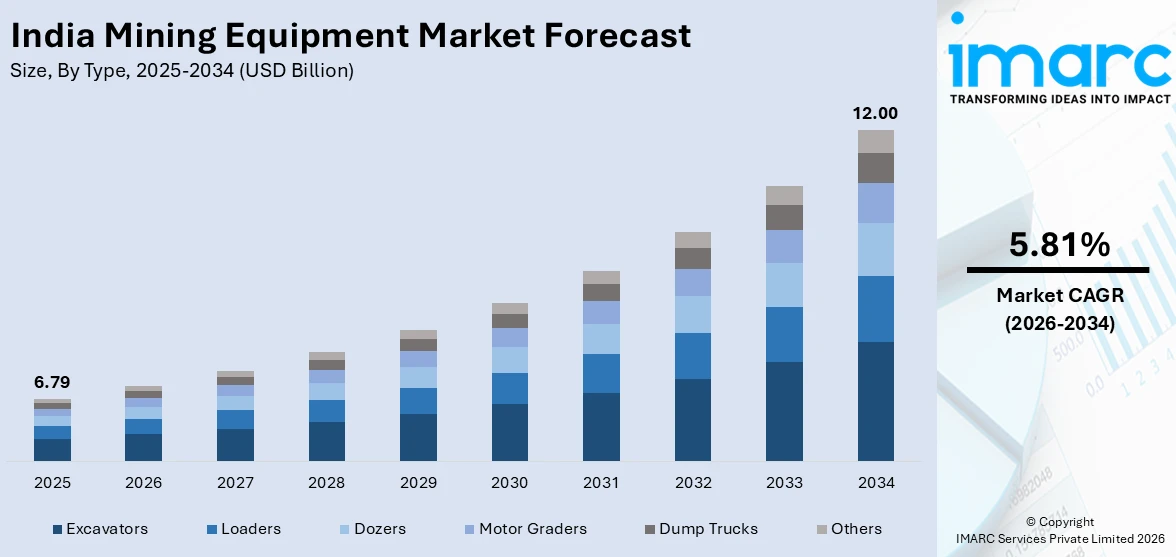
The India mining equipment market size was valued at USD 6.79 Billion in 2025 and is projected to reach USD 12.00 Billion by 2034, growing at a compound annual growth rate of 5.81% from 2026-2034.
The India mining equipment market is driven by accelerating mineral extraction activities, large-scale infrastructure development, and sustained government investment in coal and critical mineral programs. Growing mechanization across surface and underground mining operations, combined with the rising adoption of automated and digitally connected machinery, is transforming operational efficiency. Equipment manufacturers are expanding local production capabilities to meet rising demand, further strengthening the market share.
Key Takeaways and Insights:
- By Type: Excavators dominate the market with a share of 28.5% in 2025, owing to their versatility across open-pit coal extraction, iron ore mining, and construction-linked earthmoving operations, supported by India's large-scale infrastructure investments that consistently drive fleet expansion and equipment replacement demand.
- By Equipment: Surface mining leads the market with a share of 49.5% in 2025. This dominance is driven by the prevalence of open-pit coal and iron ore extraction operations, which require large-scale draglines, shovels, and high-capacity surface miners operating across eastern and central mining zones.
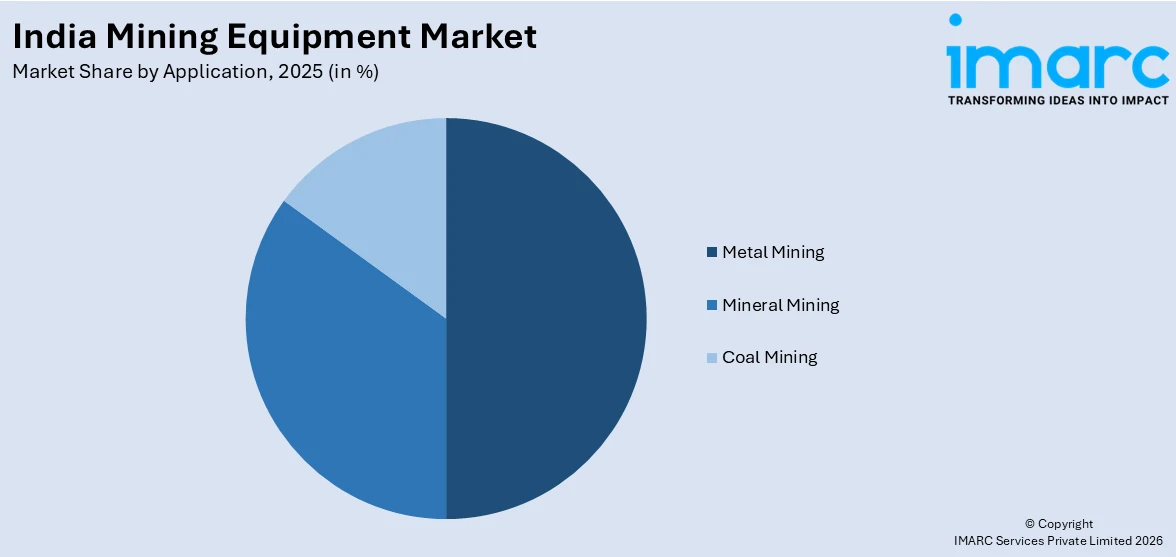
- By Application: Metal mining represents the largest segment with a market share of 47.1% in 2025, reflecting India's expanding steel, aluminum, and zinc production base that necessitates significant volumes of excavation and haulage equipment across multi-commodity extraction sites.
- By Region: East India comprises the largest region with 45.7% share in 2025, driven by the concentration of coal reserves, iron ore deposits, and steel production clusters across Jharkhand, Odisha, and Chhattisgarh, generating consistent demand for high-capacity surface and underground mining equipment.
- Key Players: Key players drive the India mining equipment market by expanding domestic manufacturing capabilities, adopting automation and digitalization, and building service networks. Their investments in localization, product innovation, and partnerships with mining companies strengthen equipment availability and accelerate adoption across coal, metal, and mineral extraction operations.
To get more information on this market Request Sample
The India mining equipment market is witnessing robust growth, underpinned by expanding mineral extraction activities, significant government investment, and accelerating mechanization across surface and underground operations. The market benefits from a favorable policy environment, with the government actively promoting domestic manufacturing through the Make in India initiative and progressive regulatory reforms that streamline mining license processes. Rising coal production, which remains central to India's energy security, continues to drive fleet procurement by state-owned enterprises. As per government data, the total coal production in India for 2024-25 reached 1047.523 MT, reflecting an increase of 4.98%. Growing demand for metal ores, such as iron, aluminum, and zinc, further supports sustained equipment sales across privately operated mining sites. Technological advancements, fleet modernization programs, and expanding localization efforts collectively reinforce the sector's growth trajectory.
India Mining Equipment Market Trends:
Rising Adoption of Automation and Digital Technologies
The integration of automation, telematics, and Internet of Things (IoT)-enabled systems is rapidly transforming mining operations across India. Real-time equipment monitoring, predictive maintenance platforms, and sensor-based performance tracking are enabling operators to reduce unplanned downtime and optimize machine utilization. Digital control systems are increasingly being deployed on excavators, dump trucks, and drilling rigs to enhance operational precision and worker safety. These technologies also provide centralized data analytics capabilities, allowing mining companies to make faster and more informed operational decisions.
Surge in Critical Mineral Exploration and Equipment Demand
India's focus on securing domestic supplies of critical minerals is creating substantial new demand for specialized exploration and extraction equipment. The government's strategic push to explore lithium, cobalt, nickel, and rare earth deposits is driving procurement of advanced drilling rigs, core samplers, and mineral processing machinery. The National Critical Mineral Mission (NCMM) was initiated by the Government of India in 2025 to create a strong foundation for self-sufficiency in the critical mineral industry. In line with this mission, the Geological Survey of India (GSI) is assigned to carry out 1,200 exploration initiatives between 2024-25 and 2030-31. Expanded auction programs for mineral blocks and the development of dedicated mineral processing parks are encouraging private sector participation, broadening the addressable market for exploration equipment beyond traditional coal and iron ore domains.
Localization and Make in India Initiatives Reshaping Supply Chains
Growing emphasis on domestic manufacturing of mining equipment is reshaping India's industrial supply landscape. State-owned enterprises and global original equipment manufacturers (OEMs) are investing in local production facilities, component sourcing networks, and technology licensing agreements to manufacture heavy mining machinery within the country. This shift reduces dependency on imports, shortens delivery timelines, and provides localized after-market service capabilities. Government programs incentivizing indigenous manufacturing, combined with competitive labor costs and growing engineering expertise, are positioning India as an emerging hub for mining equipment production serving both domestic requirements and export markets.
Market Outlook 2026-2034:
The India mining equipment market is poised for sustained expansion over the forecast period, driven by escalating mineral extraction requirements, continued government infrastructure investment, and accelerating fleet modernization across state-owned and private mining enterprises. The government's push to significantly ramp up coal production, combined with active exploration programs for critical and metallic minerals, is compelling large-scale procurement of excavators, surface miners, underground equipment, and drills. The market generated a revenue of USD 6.79 Billion in 2025 and is projected to reach a revenue of USD 12.00 Billion by 2034, growing at a compound annual growth rate of 5.81% from 2026-2034. The expansion of India's steel, aluminum, and zinc industries is reinforcing demand for metal mining equipment, while national missions targeting critical mineral self-sufficiency are opening new growth corridors.
India Mining Equipment Market Report Segmentation:
| Segment Category | Leading Segment | Market Share |
|---|---|---|
|
Type |
Excavators |
28.5% |
|
Equipment |
Surface Mining |
49.5% |
|
Application |
Metal Mining |
47.1% |
|
Region |
East India |
45.7% |
Type Insights:
- Excavators
- Loaders
- Dozers
- Motor Graders
- Dump Trucks
- Others
Excavators dominate with a market share of 28.5% of the total India mining equipment market in 2025.
Excavators hold the leading position within the India mining equipment market, because of their essential role in large-scale earthmoving operations, iron ore mining, and open-pit coal extraction. Hydraulic excavators are the ideal option for operators in a variety of commodity types and terrain conditions due to their versatility, which includes the ability to execute digging, loading, and site preparation. The procurement of heavy earth moving machinery (HEMM) constituted Coal India’s third-largest expense at INR 3,078 Crore in FY24, reaching a target fulfillment of 156.5%, reflecting the scale of state-driven investment in excavation equipment to support national coal production targets.
Significant expansion initiatives aimed at both surface and subterranean extraction activities support the demand for excavators. To increase efficiency at high-volume extraction sites, mining operators are increasingly purchasing large-horsepower crawler excavators with sophisticated hydraulic systems and digital monitoring capabilities. The need for customized excavator designs that can function in a variety of terrain settings is being driven by the increasing complexity of ore body geometries and the shift from shallow to deeper mineral deposits.
Equipment Insights:
- Underground Mining
- Surface Mining
- Crushing, Pulverizing and Screening
- Drills and Breakers
- Others
Surface mining leads with a share of 49.5% of the total India mining equipment market in 2025.
Surface mining maintains the dominant position within the India mining equipment market, driven primarily by the scale of open-pit coal and iron ore operations concentrated in the Eastern and Central India. The prevalence of large-seam coal deposits accessible through open-cast methods has sustained demand for draglines, rope shovels, high-capacity surface miners, and high-horsepower bulldozers. Domestic coal output is projected to hit approximately 1.5 Billion Tons by 2029-30, directly compelling fleet upgrades and expansion across hundreds of active surface mining blocks. This production imperative drives multi-unit equipment orders and compresses fleet replacement cycles for surface machinery nationwide.
India's well-established logistical infrastructure, which includes material handling facilities, rail connections, and road corridors that enable the large-scale deployment of heavy machinery, is advantageous to surface mining operations. Large excavators, conveyor systems, and surface miners are examples of high-throughput equipment that can be used in open-pit mining to achieve cost savings through bulk extraction. Equipment accessibility and operating efficiency are being improved by infrastructure improvements in major coal-producing states, such as new rail lines and road enhancements within mining zones.
Application Insights:
Access the comprehensive market breakdown Request Sample
- Metal Mining
- Mineral Mining
- Coal Mining
Metal mining represents the leading segment with a 47.1% share of the total India mining equipment market in 2025.
Metal mining holds the largest application share within the India mining equipment market, reflecting the country's substantial and expanding production base for iron ore, aluminum, zinc, and copper. India's steel manufacturing sector, which relies on iron ore extraction at scale, drives significant procurement of excavators, loaders, and haul trucks. The production of primary aluminum in India reached 7.07 Lakh Tons during April-May of FY 2025-26, up from 6.98 Lakh Tons in the corresponding period of FY 2024-25, underscoring sustained growth in non-ferrous metal extraction. The rising output from integrated metal producers continues to support procurement of advanced mining machinery across ore extraction and beneficiation stages.
Significant private sector investment in integrated steel, aluminum, and zinc production facilities, which call for reliable and high-performing equipment fleets, benefits the metal mining sector. Large multi-mine operations are seeing long-term demand visibility for specialist excavation and ore handling technology due to India's growing importance as a worldwide producer of zinc and aluminum. Drilling rigs, loaders, and processing equipment are in constant demand due to the commissioning of new greenfield and brownfield metal mining projects in Andhra Pradesh, Rajasthan, and Odisha.
Regional Insights:
- North India
- South India
- East India
- West India
East India exhibits a clear dominance with a 45.7% share of the total India mining equipment market in 2025.
East India leads the India mining equipment market, anchored by concentrated coal, iron ore, and steel operations across Jharkhand, Odisha, and Chhattisgarh. The region houses India's largest coal reserve base and extensive open-pit iron ore mines that drive sustained equipment procurement. Several large public and private mining enterprises operate major extraction projects in these states, sustaining consistent demand for heavy earthmoving and material handling machinery. Continuous production from these mineral-rich belts further supports regular equipment replacement and fleet expansion across the region.
Large steel and aluminum expansion projects in East India continue to attract significant equipment investment from domestic producers and international manufacturers. The region's well-developed mining infrastructure, including dedicated rail corridors and established service networks, supports fleet deployment at scale. Growing adoption of automation and digital monitoring by major mine operators across eastern states is creating additional demand for advanced, technology-integrated mining equipment that enhances operational efficiency and reduces worker safety risks across active mining sites.

Market Dynamics:
Growth Drivers:
Why is the India Mining Equipment Market Growing?
Government Infrastructure Investments and Coal Production Expansion
India's government has maintained an aggressive investment posture in infrastructure development and energy security that directly stimulates mining equipment demand across the country. The National Infrastructure Pipeline, encompassing road corridors, railways, ports, power plants, and urban infrastructure, requires enormous volumes of coal, iron ore, limestone, and industrial minerals, compelling mine operators to continuously expand production capacity and upgrade equipment fleets to meet escalating mineral throughput targets. The Ministry of Coal has established ambitious multi-year production goals, spanning numerous active commercial blocks in Jharkhand, Odisha, Chhattisgarh, and Madhya Pradesh, requiring consistent procurement of high-capacity excavation and haulage machinery. State-owned coal enterprises are executing comprehensive fleet renewal programs, encompassing heavy excavators, surface miners, high-tonnage haul trucks, and conveyor systems designed to boost extraction efficiency while transitioning towards mechanized operations. Rail connectivity improvements in coal-bearing regions are expanding market access and enabling deployment of larger, more productive equipment configurations previously restricted by logistical constraints.
Rising Demand for Critical and Non-Ferrous Minerals
India's growing focus on securing critical minerals essential for clean energy and advanced technologies is creating significant new demand for specialized exploration and extraction equipment. The transition towards electric vehicles (EVs), solar power, and wind energy is intensifying procurement of critical minerals, such as lithium, cobalt, nickel, and rare earth elements, motivating mine operators to invest in advanced equipment configurations suited for deep and complex ore bodies. As per IMARC Group, the India EV market size was valued at USD 3,712.15 Million in 2025. India's non-ferrous metal sector, encompassing zinc, copper, and aluminum, is expanding as industrial and infrastructure demand grows. Major integrated metal producers are commissioning new greenfield and brownfield extraction projects requiring sustained procurement across excavation, haulage, crushing, and beneficiation stages. India's bilateral partnerships with mineral-rich nations and strategic overseas asset acquisitions by public sector entities are further diversifying the extraction base, expanding the range of equipment types required and broadening the market's long-term growth potential.
Mechanization and Technological Modernization of Mining Operations
India's mining industry is undergoing a structural shift towards mechanization, driven by the urgent need to improve operational safety, boost productivity, and comply with evolving environmental standards. Manual and semi-mechanized mining operations are progressively being replaced by automated, sensor-equipped machinery that delivers superior throughput, reduces labor costs, and minimizes accident risks. Advanced technologies, including telematics, IoT-based monitoring platforms, and predictive maintenance systems, are being integrated into surface and underground mining equipment, enabling real-time performance tracking and condition-based maintenance scheduling. This digital transformation is driving operators to procure new, connected equipment models, stimulating fleet renewal cycles. Growing demand for underground mining equipment is accelerating adoption of continuous miners, roof bolters, and automated load-haul-dump machines capable of operating in subterranean environments.
Market Restraints:
What Challenges the India Mining Equipment Market is Facing?
High Capital Investment Requirements
The procurement of modern, high-capacity mining equipment involves substantial capital outlays that pose significant financial barriers, particularly for smaller private mine operators and newly awarded commercial block holders. Advanced excavators, surface miners, and underground drilling rigs command premium prices, while associated costs for installation, commissioning, operator training, and ongoing maintenance further amplify total investment requirements. Financing constraints and extended payback periods limit the pace at which smaller operators can upgrade fleets, tempering overall equipment procurement rates.
Regulatory and Environmental Compliance Challenges
India's mining sector is subject to a complex web of regulatory requirements, encompassing environmental clearances, land acquisition processes, and safety compliance mandates that extend project timelines and delay equipment deployment. Obtaining environmental approvals through multiple central and state-level bodies remains a time-intensive process, even with the introduction of single-window clearance portals. Prolonged permitting delays reduce effective equipment utilization and create uncertainty in procurement planning cycles, restraining market momentum.
Skilled Labor Shortages for Advanced Equipment Operation
The transition towards automated, digitally integrated, and electrically powered mining equipment requires operators with specialized technical competencies that are currently in short supply across India's mining workforce. Operating advanced continuous miners, autonomous haul systems, and sensor-equipped excavators demands trained technicians and engineers familiar with digital platforms, which are not yet widely available in many mining districts. Skill gaps slow the effective deployment of cutting-edge equipment, reduce operational efficiency, and limit the realized productivity benefits of modernization investments, tempering the pace of advanced equipment adoption across the market.
Competitive Landscape:
The India mining equipment market is characterized by a competitive landscape, comprising global equipment manufacturers with established local operations and domestic producers expanding their manufacturing and service capabilities. Leading players compete on product innovation, after-sales support network depth, localization of components, and technology partnerships that enhance operational performance. The growing emphasis on the Make in India initiative has encouraged international manufacturers to establish or expand production facilities within India, enabling faster delivery and reducing import dependencies. Competitive differentiation increasingly centers on automation capabilities, electrification readiness, and digital integration of fleet management systems. After-market services, including spare parts availability, equipment rebuilding programs, and remote diagnostics, are emerging as critical competitive differentiators as mine operators prioritize fleet uptime and total cost of ownership.
Recent Developments:
- In January 2025, Gainwell Engineering Private Limited delivered India's first indigenously manufactured Room and Pillar Mining Equipment Package to Eastern Coalfields Limited, comprising a Continuous Miner (Model GCM345) and Feeder Breaker (Model GFB110). Both machines were developed at Gainwell's Panagarh facility in West Bengal, marking a significant milestone in domestic mining equipment manufacturing and advancing India's self-reliance in high-end capital goods for the coal mining sector.
India Mining Equipment Market Report Coverage:
| Report Features | Details |
|---|---|
| Base Year of the Analysis | 2025 |
| Historical Period | 2020-2025 |
| Forecast Period | 2026-2034 |
| Units | Billion USD |
| Scope of the Report |
Exploration of Historical Trends and Market Outlook, Industry Catalysts and Challenges, Segment-Wise Historical and Future Market Assessment:
|
| Types Covered | Excavators, Loaders, Dozers, Motor Graders, Dump Trucks, Others |
| Equipments Covered | Underground Mining, Surface Mining, Crushing, Pulverizing and Screening, Drills and Breakers, Others |
| Applications Covered | Metal Mining, Mineral Mining, Coal Mining |
| Regions Covered | North India, South India, East India, West India |
| Customization Scope | 10% Free Customization |
| Post-Sale Analyst Support | 10-12 Weeks |
| Delivery Format | PDF and Excel through Email (We can also provide the editable version of the report in PPT/Word format on special request) |
Frequently Asked Questions About the India Mining Equipment Market Report
The India mining equipment market size was valued at USD 6.79 Billion in 2025.
The India mining equipment market is expected to grow at a compound annual growth rate of 5.81% from 2026-2034 to reach USD 12.00 Billion by 2034.
Excavators dominated the market with a share of 28.5%, owing to their versatility across open-pit coal extraction, iron ore mining, and construction-linked earthmoving operations that represent a significant share of India's overall mining activities.
Key factors driving the India mining equipment market include increasing government investment in coal production expansion, rising demand for critical and non-ferrous minerals, growing mechanization of surface and underground operations, and active regulatory reforms facilitating private sector mining participation.
Major challenges include high capital investment requirements for modern equipment, regulatory and environmental clearance delays, skilled labor shortages for operating advanced machinery, and infrastructure gaps in emerging mining districts that limit efficient equipment deployment.
Need more help?
- Speak to our experienced analysts for insights on the current market scenarios.
- Include additional segments and countries to customize the report as per your requirement.
- Gain an unparalleled competitive advantage in your domain by understanding how to utilize the report and positively impacting your operations and revenue.
- For further assistance, please connect with our analysts.
 Request Customization
 Speak to an Analyst
 Request Brochure
 Inquire Before Buying
Benefits of Customization
- Personalize this research
- Triangulate with your data
- Get data as per your format and definition
- Gain a deeper dive into a specific application, geography, customer, or competitor
- Any level of personalization
Get in Touch With Us
UNITED STATES
Phone: +1-201-971-6302
INDIA
Phone: +91-120-433-0800
UNITED KINGDOM
Phone: +44-753-714-6104
Email: [email protected]
Client Testimonials




.webp)




.webp)













Related Reports

Choose your plan
*Please note that the prices mentioned below are starting prices for each bundle type. Kindly contact our team for further details.*
Single User License
- 1 User License, Access on 2 Devices
- PDF Report + Excel Dataset (Password Protected)
- Lifetime Access
- No Printing Rights
- 10% Free Report Customization
- 10–12 Weeks of Analyst Support
Five User License
- Access for 5 Users, 2 Devices per User
- PDF Report + Excel Dataset (Password Protected)
- Lifetime Access
- Dedicated Account Manager
- 12–14 Weeks of Analyst Support
- No Printing Rights
- 15% Free Report Customization
- 25% Discount on Your Next Purchase
Corporate User License
- Unlimited User Access (Within Your Organization)
- PDF Report + Excel Dataset
- Lifetime Access
- Dedicated Account Manager
- 14–20 Weeks of Analyst Support
- No Printing Rights
- 20% Free Report Customization
- 30% Discount on Your Next Purchase
Essential Insights
What's included:
3 reports
- Lifetime Access
- PDF Reports
- Excel Datasets
- 2 Weeks of Free Analyst Support
- 2 User Licenses
- Access on 2 Devices
- Printing Rights
- Complimentary PowerPoint (PPT) Version
- Complimentary License Upgrade
Professional Access
What's included:
5 reports
- Lifetime Access
- PDF Reports
- Excel Datasets
- 8 Weeks of Free Analyst Support
- 2 User Licenses
- Access on 2 Devices
- Printing Rights
- Complimentary PowerPoint (PPT) Version
- Complimentary License Upgrade
Business Advantage
What's included:
8 reports
- Lifetime Access
- PDF Reports
- Excel Datasets
- 14 Weeks of Free Analyst Support
- 2 User Licenses
- Access on 2 Devices
- Printing Rights
- Complimentary PowerPoint (PPT) Version
- Complimentary License Upgrade
Enterprise Intelligence
What's included:
10 reports
- Lifetime Access
- PDF Reports
- Excel Datasets
- 20 Weeks of Free Analyst Support
- 2 User Licenses
- Access on 2 Devices
- Printing Rights
- Complimentary PowerPoint (PPT) Version
- Complimentary License Upgrade