
India Nano Silica Market Size, Share, Trends and Forecast by Type, Application, and Region, 2026-2034
India Nano Silica Market Summary:
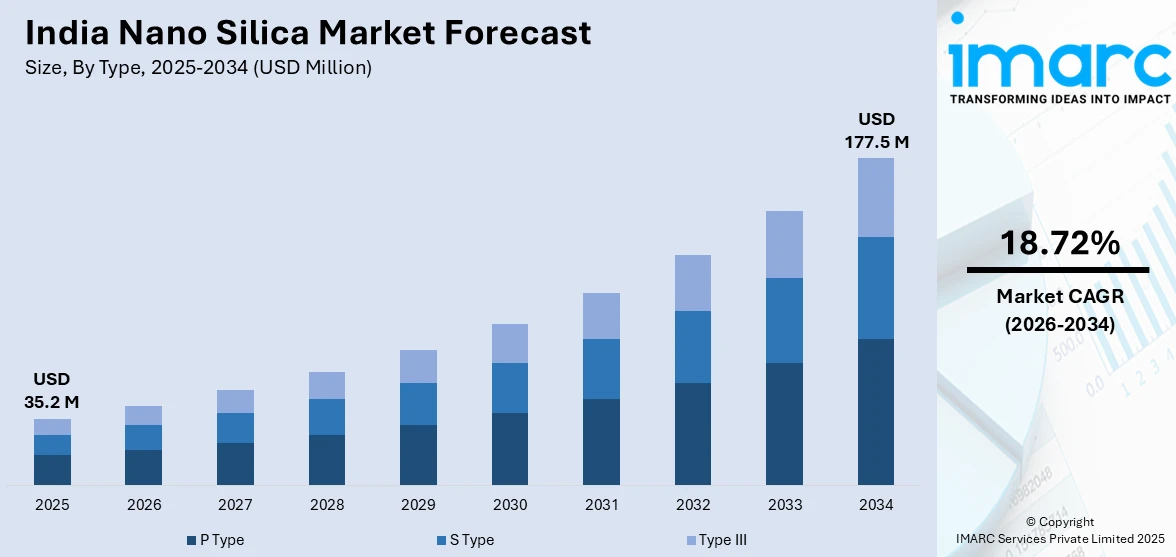
The India nano silica market size was valued at USD 35.2 Million in 2025 and is projected to reach USD 177.5 Million by 2034, growing at a compound annual growth rate of 18.72% from 2026-2034.
The India nano silica market is experiencing robust expansion driven by the country's accelerating infrastructure development initiatives, rising demand for high-performance construction materials, and growing applications across diverse industrial sectors. The adoption of nano silica as a cement additive in infrastructure projects enhances concrete durability and strength, supporting demand from the construction sector. Additionally, the automotive industry's focus on fuel-efficient tires and the pharmaceutical sector's incorporation of nano silica in innovative drug formulations are propelling the India nano silica market share.
Key Takeaways and Insights:
- By Type: P Type dominates the market with a share of 48.1% in 2025, driven by its higher pore rate and larger specific surface area that enhance UV reflectivity and make it ideal for reinforced fillers in concrete and rubber applications.
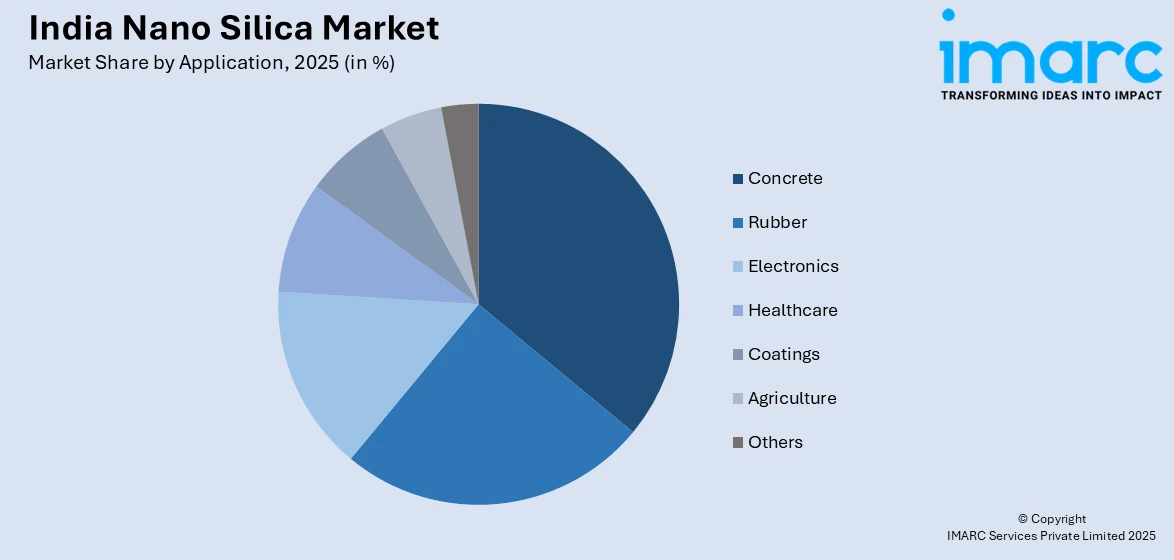
- By Application: Concrete leads the market with a share of 36.4% in 2025, owing to its critical role in improving mechanical properties, reducing permeability, and enhancing durability of construction materials across infrastructure projects.
- By Region: West India represents the largest segment with a market share of 34.2% in 2025, attributed to the concentration of industrial manufacturing hubs, major port infrastructure, and ongoing mega construction projects in Maharashtra and Gujarat.
- Key Players: The India nano silica market exhibits a moderately fragmented competitive landscape, with both multinational chemical corporations and domestic manufacturers competing across product categories. Market participants are focusing on capacity expansion, technological innovation, and strategic partnerships to strengthen their market positioning.
To get more information on this market Request Sample
The India nano silica market is witnessing transformative growth underpinned by the government's substantial infrastructure investments and the construction sector's shift toward advanced materials. The National Infrastructure Pipeline and programs like Bharatmala Pariyojana are creating sustained demand for high-performance concrete admixtures. Nano-concrete is being actively tested in major metro expansions across Delhi, Nagpur, and Bengaluru, demonstrating up to a thirty percent increase in compressive strength compared to conventional concrete. The country's rapidly expanding semiconductor ecosystem, supported by the India Semiconductor Mission with a budget allocation of INR 76,000 crore, is creating new application opportunities in electronics manufacturing. Additionally, India's pharmaceutical industry, which exported drugs worth USD 11.9 billion between April and August 2024, is increasingly incorporating nano silica in innovative drug formulations, representing a significant growth avenue for market participants.
India Nano Silica Market Trends:
Integration in High-Performance Concrete for Infrastructure Projects
The integration of nano silica in high-performance concrete formulations is emerging as a defining trend across India's infrastructure sector. Construction companies are increasingly adopting nano silica-enhanced concrete to meet stringent durability requirements for metro systems, expressways, and bridge structures. Research indicates that nano silica accelerates cement hydration, densifies the concrete matrix, and significantly improves impermeability. Under the Bharatmala Pariyojana, which delivered 18,926 kilometers of roads by November 2024, contractors are specifying performance-based mixes that incorporate nano silica to achieve superior compressive strength and crack resistance in challenging environmental conditions.
Rising Adoption in Tire Manufacturing for Enhanced Fuel Efficiency
The automotive tire industry is increasingly leveraging nano silica to develop fuel-efficient and environmentally sustainable products. The India tyre market size reached USD 13.4 Billion in 2024. The market is expected to reach USD 27.6 Billion by 2033, exhibiting a growth rate (CAGR) of 7.6% during 2025-2033. Nano silica serves as a reinforcing filler that reduces rolling resistance while maintaining excellent wet grip and abrasion resistance. India's growing electric vehicle market, supported by the FAME India scheme, is accelerating demand for advanced tire formulations. India’s precipitated silica market is witnessing robust growth, largely fueled by demand from the rubber industry. Tire manufacturers are increasingly adopting silica-based technologies to improve performance, enhance fuel efficiency, and comply with stricter emission standards. The shift toward advanced silica-reinforced tires is driving innovation and investment, supporting the broader expansion of precipitated silica applications across both passenger and commercial vehicle segments.
Expansion into Semiconductor and Electronics Applications
India's emerging semiconductor ecosystem is creating new demand pathways for high-purity nano silica in electronics manufacturing. The India Semiconductor Mission, with substantial government backing, is driving investments in chip fabrication facilities that require ultra-pure colloidal silica for chemical mechanical polishing processes. Nano silica's excellent electrical insulation properties and compatibility with silicon substrates make it essential for semiconductor device fabrication. The India semiconductor market size is estimated at USD 59.8 Billion in 2025, and is expected to reach USD 177.0 Billion by 2034, at a CAGR of 12.18% during the forecast period 2026-2034. India’s push to become a semiconductor manufacturing hub highlights nano silica as a key enabler, supporting the growth of electronics production by enhancing material performance, enabling advanced manufacturing processes, and meeting the demands of high-tech components.
Market Outlook 2026-2034:
The India nano silica market is positioned for substantial expansion over the forecast period, supported by sustained infrastructure investments, technological advancements, and diversifying application landscapes. The Union Budget 2025-26 allocated INR 11.21 lakh crore for government infrastructure spending, creating a robust demand foundation for construction-grade nano silica. The market is benefiting from the convergence of multiple growth drivers, including the Smart Cities Mission's infrastructure development, highway construction under Bharatmala, and metro rail expansions across major urban centers. The market generated a revenue of USD 35.2 Million in 2025 and is projected to reach a revenue of USD 177.5 Million by 2034, growing at a compound annual growth rate of 18.72% from 2026-2034.
India Nano Silica Market Report Segmentation:
|
Segment Category |
Leading Segment |
Market Share |
|
Type |
P Type |
48.1% |
|
Application |
Concrete |
36.4% |
|
Region |
West India |
34.2% |
Type Insights:
- P Type
- S Type
- Type III
P Type dominates with a market share of 48.1% of the total India nano silica market in 2025.
P Type nano silica maintains market leadership owing to its distinctive porous structure characterized by numerous nano-pores that deliver superior performance in demanding applications. The higher pore rate of approximately 0.61 ml/g results in a larger specific surface area and enhanced UV reflectivity compared to alternative formulations. These characteristics make P Type nano silica particularly suitable for reinforcing fillers in concrete applications where strength enhancement is critical, as well as rubber and plastics manufacturing, where performance optimization is paramount.
The segment's dominance is further reinforced by its effectiveness in construction and coating applications where UV protection and material durability are essential requirements. P-type nano silica provides superior protection against UV degradation, extending the service life of construction materials and coatings. Research institutions and manufacturing facilities across India are increasingly specifying P Type formulations for high-performance applications, driving sustained demand growth across the forecast period.
Application Insights:
Access the comprehensive market breakdown Request Sample
- Concrete
- Rubber
- Electronics
- Healthcare
- Coatings
- Agriculture
- Others
Concrete leads the market with a share of 36.4% of the total India nano silica market in 2025.
The concrete application segment's leadership position reflects India's massive infrastructure development programs driving demand for high-performance construction materials. Nano silica enhances concrete by refining pore structure, acting as a pozzolanic material to produce additional calcium silicate hydrate gel, and serving as nucleation sites for accelerated hydration. These mechanisms deliver significant improvements in compressive strength, flexural strength, and bond strength while reducing permeability and water absorption.
The segment is gaining momentum due to extensive government investment in infrastructure, with major projects such as expressways, freight corridors, and metro rail expansions increasingly incorporating nano silica-enhanced concrete. Trials of these advanced concrete formulations in various urban projects have demonstrated significant improvements in compressive strength and durability compared to conventional mixes. These results highlight the effectiveness of nano silica in large-scale construction, supporting its adoption across critical infrastructure developments. As a result, nano silica is becoming an essential material for enhancing the performance, longevity, and sustainability of modern infrastructure projects.
Regional Insights:
- North India
- South India
- East India
- West India
West India represents the highest revenue with a 34.2% share of the total India nano silica market in 2025.
West India's market leadership stems from the region's concentration of industrial manufacturing facilities, major port infrastructure, and ongoing mega construction projects in Maharashtra and Gujarat. The region houses significant chemical manufacturing capabilities and benefits from established supply chain networks that facilitate nano silica production and distribution. Mumbai's position as India's financial capital drives substantial commercial real estate development requiring high-performance construction materials.
The region is witnessing accelerated infrastructure development including the Navi Mumbai International Airport, Mumbai Trans Harbour Link, and multiple highway projects under Bharatmala Pariyojana. Gujarat's industrial corridors and port expansion activities under Sagarmala initiative create sustained demand for construction-grade nano silica. Additionally, the automotive manufacturing cluster in western India supports rubber application growth, with tire manufacturers incorporating nano silica to develop fuel-efficient products meeting emission regulations.

Market Dynamics:
Growth Drivers:
Why is the India Nano Silica Market Growing?
Massive Infrastructure Development Under Government Programs
India’s ongoing infrastructure expansion is generating strong demand for advanced construction materials, including nano silica. Government initiatives across transportation, urban development, and industrial projects are encouraging the use of high-performance concrete formulations nationwide. These large-scale programs are fostering widespread adoption of innovative construction materials, establishing a solid foundation for long-term growth and technological advancement in the sector, while promoting durability, efficiency, and sustainability in modern infrastructure development. The Smart Cities Mission, despite concluding in March 2025, completed over 7,555 projects totaling INR 1.51 lakh crore, establishing precedents for technology-driven urban infrastructure. Metro rail expansions across Delhi, Mumbai, Bengaluru, Chennai, and other cities are adopting nano-concrete technology to achieve superior structural performance and extended service life for underground and elevated structures.
Growing Automotive and Tire Industry Demand
India's expanding automotive industry is driving significant demand for nano silica in tire manufacturing applications, where it serves as a critical reinforcing filler. The industry's focus on developing fuel-efficient vehicles aligned with stringent emission norms is accelerating the adoption of silica-based tire technology that reduces rolling resistance while maintaining performance characteristics. Nano silica reinforcement enables tire manufacturers to achieve an optimal balance between fuel efficiency, wet grip, and tread wear resistance. The FAME India scheme promoting electric and hybrid vehicles is creating additional demand for specialized tire formulations optimized for EV weight characteristics and regenerative braking systems. The India electric vehicle market size was valued at USD 3,712.15 Million in 2025 and is projected to reach USD 191,037.22 Million by 2034, growing at a compound annual growth rate of 54.94% from 2026-2034. Major tire manufacturers are establishing dedicated research facilities and expanding production capacities to meet rising demand for eco-friendly, high-performance tires incorporating advanced silica technology.
Expansion of Pharmaceutical and Healthcare Applications
India's pharmaceutical industry is increasingly incorporating nano silica in innovative drug formulations, leveraging its properties as an excipient for controlled drug release, tablet stability, and formulation optimization. The country's position as a leading generic pharmaceutical manufacturer creates substantial opportunities for nano silica applications in tablet manufacturing, where it serves as an anti-caking and flow-enhancing agent, ensuring dosage uniformity and shelf stability. The India pharmaceutical market size was valued at USD 68.38 Billion in 2025 and is projected to reach USD 174.67 Billion by 2034, growing at a compound annual growth rate of 10.98% from 2026-2034, representing growth in global market penetration and manufacturing capabilities. The healthcare sector's adoption of nano silica extends beyond pharmaceuticals to include drug delivery systems, biomedical imaging applications, and dental materials where biocompatibility and controlled release properties are essential. Research institutions are exploring advanced applications including tissue engineering and diagnostic platforms, expanding the potential application landscape for healthcare-grade nano silica.
Market Restraints:
What Challenges the India Nano Silica Market is Facing?
High Production Costs and Complex Manufacturing Processes
Nano silica production involves sophisticated manufacturing processes requiring specialized equipment and stringent quality controls that contribute to elevated production costs. The complex synthesis techniques including sol-gel processes, flame pyrolysis, and precipitation methods demand significant capital investments and technical expertise. These cost factors can limit adoption, particularly among price-sensitive construction applications and smaller manufacturers seeking to incorporate nano silica into their product formulations.
Stringent Regulatory Frameworks for Nanomaterials
The evolving regulatory landscape surrounding nanomaterials presents compliance challenges for market participants. Regulations governing production, handling, storage, and disposal of nano-scale materials require continuous monitoring and adaptation. Manufacturers must navigate Bureau of Indian Standards specifications, environmental safety requirements, and industry-specific quality certifications, adding complexity to market operations and potentially delaying product introductions.
Limited Awareness and Technical Expertise
Awareness regarding nano silica benefits and application techniques remains limited among certain end-user segments, particularly in smaller construction companies and regional manufacturers. Effective dispersion of nano silica within concrete matrices requires specialized knowledge and equipment to prevent agglomeration that can reduce performance benefits. The shortage of trained personnel familiar with nanotechnology applications creates barriers to broader adoption across potential end-use industries.
Competitive Landscape:
The India nano silica market demonstrates a moderately fragmented competitive structure with multinational chemical corporations competing alongside domestic manufacturers across product categories and regional markets. Leading global players maintain strong positions through established technology platforms, extensive distribution networks, and diversified application expertise spanning construction, automotive, electronics, and healthcare sectors. These companies are investing in capacity expansions, research partnerships with Indian institutions, and localized product development to strengthen market positioning. Domestic manufacturers are increasingly challenging established players through competitive pricing, regional market knowledge, and customized product solutions addressing local application requirements. The competitive landscape is characterized by ongoing innovation in synthesis processes, surface modification techniques, and application-specific formulations that differentiate market offerings and create value for end users across diverse industries.
India Nano Silica Market Report Coverage:
|
Report Features |
Details |
|
Base Year of the Analysis |
2025 |
|
Historical Period |
2020-2025 |
|
Forecast Period |
2026-2034 |
|
Units |
USD Million |
|
Scope of the Report |
Exploration of Historical Trends and Market Outlook, Industry Catalysts and Challenges, Segment-Wise Historical and Future Market Assessment:
|
|
Types Covered |
P Type, S Type, Type III |
|
Applications Covered |
Concrete, Rubber, Electronics, Healthcare, Coatings, Agriculture, Others |
|
Regions Covered |
North India, South India, East India, West India |
|
Customization Scope |
10% Free Customization |
|
Post-Sale Analyst Support |
10-12 Weeks |
|
Delivery Format |
PDF and Excel through Email (We can also provide the editable version of the report in PPT/Word format on special request) |
Frequently Asked Questions About the India Nano Silica Market Report
The India nano silica market size was valued at USD 35.2 Million in 2025.
The India nano silica market is expected to grow at a compound annual growth rate of 18.72% from 2026-2034 to reach USD 177.5 Million by 2034.
P Type dominated the market with a 48.1% share in 2025, driven by its superior pore structure, higher specific surface area, and enhanced UV reflectivity making it ideal for concrete reinforcement and rubber applications.
Key factors driving the India nano silica market include massive infrastructure development under government programs like Bharatmala and Smart Cities Mission, growing automotive and tire industry demand for fuel-efficient products, and expanding pharmaceutical and healthcare applications.
Major challenges include high production costs from complex manufacturing processes, stringent regulatory frameworks for nanomaterials, limited awareness and technical expertise among certain end-user segments, and dispersion challenges requiring specialized knowledge and equipment.
Need more help?
- Speak to our experienced analysts for insights on the current market scenarios.
- Include additional segments and countries to customize the report as per your requirement.
- Gain an unparalleled competitive advantage in your domain by understanding how to utilize the report and positively impacting your operations and revenue.
- For further assistance, please connect with our analysts.
 Request Customization
 Speak to an Analyst
 Request Brochure
 Inquire Before Buying
Benefits of Customization
- Personalize this research
- Triangulate with your data
- Get data as per your format and definition
- Gain a deeper dive into a specific application, geography, customer, or competitor
- Any level of personalization
Get in Touch With Us
UNITED STATES
Phone: +1-201-971-6302
INDIA
Phone: +91-120-433-0800
UNITED KINGDOM
Phone: +44-753-714-6104
Email: [email protected]
Client Testimonials




.webp)




.webp)













Related Reports

Choose your plan
*Please note that the prices mentioned below are starting prices for each bundle type. Kindly contact our team for further details.*
Single User License
- 1 User License, Access on 2 Devices
- PDF Report + Excel Dataset (Password Protected)
- Lifetime Access
- No Printing Rights
- 10% Free Report Customization
- 10–12 Weeks of Analyst Support
Five User License
- Access for 5 Users, 2 Devices per User
- PDF Report + Excel Dataset (Password Protected)
- Lifetime Access
- Dedicated Account Manager
- 12–14 Weeks of Analyst Support
- No Printing Rights
- 15% Free Report Customization
- 25% Discount on Your Next Purchase
Corporate User License
- Unlimited User Access (Within Your Organization)
- PDF Report + Excel Dataset
- Lifetime Access
- Dedicated Account Manager
- 14–20 Weeks of Analyst Support
- No Printing Rights
- 20% Free Report Customization
- 30% Discount on Your Next Purchase
Essential Insights
What's included:
3 reports
- Lifetime Access
- PDF Reports
- Excel Datasets
- 2 Weeks of Free Analyst Support
- 2 User Licenses
- Access on 2 Devices
- Printing Rights
- Complimentary PowerPoint (PPT) Version
- Complimentary License Upgrade
Professional Access
What's included:
5 reports
- Lifetime Access
- PDF Reports
- Excel Datasets
- 8 Weeks of Free Analyst Support
- 2 User Licenses
- Access on 2 Devices
- Printing Rights
- Complimentary PowerPoint (PPT) Version
- Complimentary License Upgrade
Business Advantage
What's included:
8 reports
- Lifetime Access
- PDF Reports
- Excel Datasets
- 14 Weeks of Free Analyst Support
- 2 User Licenses
- Access on 2 Devices
- Printing Rights
- Complimentary PowerPoint (PPT) Version
- Complimentary License Upgrade
Enterprise Intelligence
What's included:
10 reports
- Lifetime Access
- PDF Reports
- Excel Datasets
- 20 Weeks of Free Analyst Support
- 2 User Licenses
- Access on 2 Devices
- Printing Rights
- Complimentary PowerPoint (PPT) Version
- Complimentary License Upgrade