
India Network as a Service Market Size, Share, Trends and Forecast by Type, Application, End Use Industry, and Region, 2026-2034
India Network as a Service Market Summary:
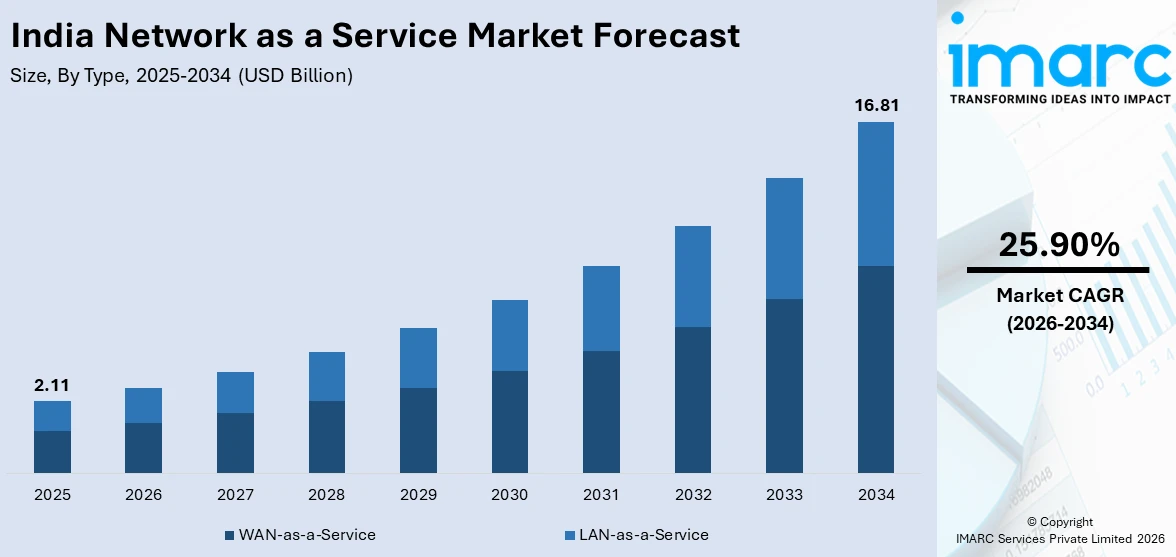
The India network as a service market size was valued at USD 2.11 Billion in 2025 and is projected to reach USD 16.81 Billion by 2034, growing at a compound annual growth rate of 25.90% from 2026-2034.
The India network as a service market is expanding rapidly, as enterprises across industries shift from capital-intensive legacy networking infrastructure towards subscription-based, cloud-managed connectivity solutions. The growing emphasis on digital transformation, accelerated by the proliferation of hybrid work models and multi-cloud deployments, is driving demand for scalable, on-demand networking capabilities. Increasing 5G adoption, government-led broadband connectivity initiatives, and the rising integration of artificial intelligence (AI) in network operations are strengthening the foundation for network as a service (NaaS) adoption.
Key Takeaways and Insights:
- By Type: WAN-as-a-service dominates the market with a share of 70% in 2025, owing to the increasing demand for cloud-based wide area connectivity, the shift from hardware-dependent multiprotocol label switching (MPLS) networks, and the growing adoption of SD-WAN solutions by medium-to-large enterprises seeking cost-efficient scalability.
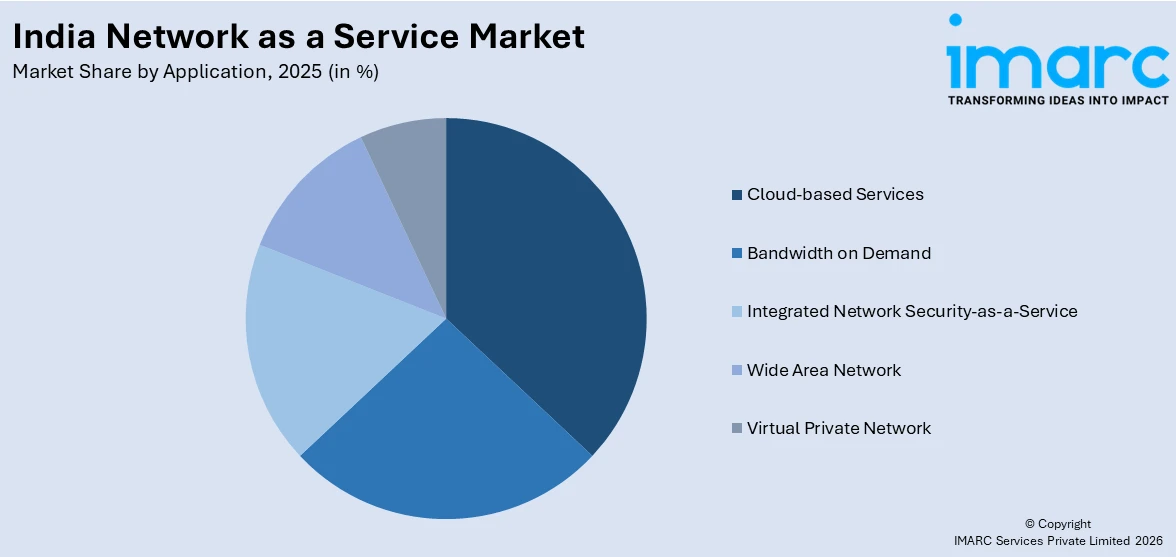
- By Application: Cloud-based services lead the market with a share of 28% in 2025. This dominance is driven by the rapid migration of enterprise workloads to public and hybrid cloud environments, fueling the need for flexible, on-demand networking that integrates seamlessly with cloud platforms.
- By End Use Industry: IT and telecom comprise the largest segment with a market share of 24% in 2025, reflecting the sector's inherent requirement for robust, high-performance networking infrastructure to support distributed operations, digital service delivery, and large-scale data processing.
- By Region: North India represents the largest region with 30% share in 2025, driven by the concentration of information technology (IT) parks, government establishments, and enterprise headquarters in NCR and surrounding technology corridors that drive robust demand for cloud-managed networking solutions.
- Key Players: Key players drive the India network as a service market by expanding cloud-managed networking portfolios, enhancing SD-WAN and secure access service edge (SASE) capabilities, forming strategic partnerships with hyperscalers, and investing in AI-driven network automation to strengthen market share and accelerate enterprise adoption.
To get more information on this market Request Sample
The India network as a service market is advancing, as enterprises, government agencies, and telecom operators embrace flexible, cloud-native networking to meet evolving connectivity demands. A major driver shaping this progress is the country's accelerating digital transformation, supported by rapid cloud adoption and the nationwide expansion of 5G infrastructure. As of February 28, 2025, telecom service providers (TSPs) installed 4.69 Lakhs 5G base transceiver stations (BTSs) nationwide, creating a robust connectivity backbone that strengthens NaaS deployment. Policy encouragement through initiatives, such as the Digital India programme, combined with rising investments in data center infrastructure, is contributing to a more favorable environment for NaaS adoption. Enterprises across banking, healthcare, retail, and manufacturing are increasingly leveraging subscription-based networking models to reduce capital expenditure, improve network agility, and support hybrid workforce requirements.
India Network as a Service Market Trends:
Convergence of SD-WAN and SASE Frameworks
Indian enterprises are increasingly converging SD-WAN with SASE architectures to unify networking and security under a single cloud-delivered framework. This convergence simplifies branch connectivity, reduces latency for cloud applications, and strengthens zero-trust enforcement across distributed environments. For instance, in June 2024, Cisco introduced the Meraki India Region, a dedicated cloud service for the country, under its global Meraki platform focused on data privacy and localization. The adoption of integrated SD-WAN and SASE solutions is accelerating the India network as a service market growth, as organizations prioritize simplified, secure connectivity across hybrid work environments.
Rising Adoption of AI-Driven Network Operations
AI is reshaping network management in India, as enterprises adopt AI-powered tools for predictive maintenance, anomaly detection, and automated traffic optimization. AI-driven networking reduces operational costs and improves uptime by enabling self-healing networks that proactively address issues before they impact performance. For example, in March 2025, Jio Platforms, together with AMD, Cisco, and Nokia, announced plans to build an Open Telecom AI Platform at Mobile World Congress 2025, aimed at driving AI-powered autonomous network operations and intelligent automation for telecom operators globally. This reflects the growing emphasis on embedding intelligence into network infrastructure.
Expansion of Edge Computing and Private 5G Networks
Edge computing is gaining prominence in India, as industries deploy localized processing capabilities to support latency-sensitive applications, such as telemedicine, real-time analytics, and Industrial Internet of Things (IIoT). The expansion of private 5G networks in manufacturing and logistics further amplifies the need for edge-optimized NaaS solutions. According to ICRA, India's edge data center capacity is projected to triple from 60-70 MW in 2024 to 200-210 MW by 2027, driven by the proliferation of emerging technologies. Hospitals and smart factories are leveraging edge appliances to ensure real-time data synchronization with cloud systems.
Market Outlook 2026-2034:
The India network as a service market is poised for sustained advancement, supported by accelerating cloud adoption, expanding 5G infrastructure, and rising enterprise demand for agile, software-defined connectivity. The market generated a revenue of USD 2.11 Billion in 2025 and is projected to reach a revenue of USD 16.81 Billion by 2034, growing at a compound annual growth rate of 25.90% from 2026-2034. Government-led digital infrastructure initiatives are strengthening the connectivity backbone essential for NaaS deployment. Increasing domestic manufacturing investments by hyperscalers, coupled with the proliferation of hybrid work models and multi-cloud strategies, are expected to drive higher revenue streams across enterprise, BFSI, and public sector verticals.
India Network as a Service Market Report Segmentation:
|
Segment Category |
Leading Segment |
Market Share |
|
Type |
WAN-as-a-Service |
70% |
|
Application |
Cloud-based Services |
28% |
|
End Use Industry |
IT and Telecom |
24% |
|
Region |
North India |
30% |
Type Insights:
- LAN-as-a-Service
- WAN-as-a-Service
WAN-as-a-service dominates with a market share of 70% of the total India network as a service market in 2025.
WAN-as-a-service is the dominant type segment in India's NaaS landscape, underpinned by the rapid enterprise migration from traditional MPLS-based wide area networks to cloud-managed, software-defined connectivity solutions. To provide application-aware routing, centralized policy management, and seamless multi-cloud access while drastically lowering operating costs, businesses in the banking, manufacturing, and IT sectors are implementing WAN-as-a-service. Additionally, mid-sized businesses looking for scalable networking solutions are finding WAN-as-a-service more affordable because of its rapid deployment capabilities and subscription-based pricing models.
The growth of the hybrid work environment, which necessitates safe, high-performance connectivity across geographically separated offices and remote locations, further solidifies the segment's leadership. Businesses are using WAN-as-a-service to improve bandwidth allocation, incorporate zero-trust security frameworks into their wide area connectivity fabric, and consolidate branch networking. The need for robust, low-latency WAN-as-a-service infrastructures is further heightened by the increasing dependence on SaaS apps and real-time collaboration tools.
Application Insights:
Access the comprehensive market breakdown Request Sample
- Cloud-based Services
- Bandwidth on Demand
- Integrated Network Security-as-a-Service
- Wide Area Network
- Virtual Private Network
Cloud-based services lead with a share of 28% of the total India network as a service market in 2025.
Cloud-based services represent the leading application segment, driven by the mass migration of enterprise workloads to public and hybrid cloud environments across India. Organizations are increasingly demanding networking solutions that seamlessly integrate with cloud platforms, enabling dynamic scaling, optimized application delivery, and centralized management. The India public cloud market size was valued at USD 27.38 Billion in 2024, reflecting the accelerating pace of cloud adoption that directly fuels demand for cloud-integrated NaaS offerings.
The increased reliance on cloud-hosted collaboration tools, enterprise resource planning (ERP) platforms, and AI-driven analytics apps is advantageous to the segment’s growth. Cloud-based NaaS is being prioritized by businesses in the BFSI, healthcare, and retail sectors to guarantee low-latency access to mission-critical applications while upholding uniform security standards across dispersed cloud environments. Additionally, businesses are replacing outdated networking architectures with cloud-native, consumption-based NaaS solutions due to the requirement for predictable performance and easier network orchestration.
End Use Industry Insights:
- Healthcare
- BFSI
- Retail and E-Commerce
- IT and Telecom
- Manufacturing
- Transportation and Logistics
- Public Sector
IT and telecom exhibit a clear dominance with a 24% share of the total India network as a service market in 2025.
IT and telecom lead the end-use industry segment, reflecting the sector's fundamental requirement for robust, scalable, and automated networking infrastructure to support digital service delivery, data processing, and distributed enterprise operations. The sector's distributed operational model, spanning global delivery centers, cloud data environments, and remote workforce locations, makes subscription-based NaaS an essential component of modern IT infrastructure. Additionally, rising demand for low-latency connectivity and secure access to cloud-native applications is accelerating NaaS adoption across IT service providers and telecom enterprises.
Telecom operators are simultaneously leveraging NaaS to monetize 5G infrastructure through network slicing and enterprise-grade connectivity offerings. The industry's dominance is being reinforced by the convergence of AI-driven network automation, SASE, and SD-WAN in IT and telecom operations. Telecom companies can provide adaptable, on-demand network services that are suited to business security and performance needs because of NaaS. This shift supports faster service provisioning and more efficient utilization of network resources.
Regional Insights:
- North India
- West and Central India
- South India
- East and Northeast India
North India represents the largest region with a 30% share of the total India network as a service market in 2025.
North India leads the regional landscape, anchored by the concentration of government establishments, IT parks, and corporate headquarters in NCR, Noida, Gurgaon, and surrounding technology corridors. The region benefits from robust digital infrastructure, high enterprise density, and significant public sector demand for cloud-managed networking solutions. The presence of major data center hubs and proximity to key decision-making centers for national digital initiatives strengthen NaaS adoption across both private and government verticals. In March 2025, Neon Cloud has started operations in India with a data center located in Gurgaon. Services included block storage, object storage, secure backups, virtual private cloud, cloud firewall, and load balancing.
Expanding fiber connectivity, the rollout of 5G in major cities, and the concentration of banking and financial services organizations that need high-performance, secure networking infrastructure contribute to the region's dominance. Subscription-based network management systems are in high demand, as a result of smart city projects and e-governance initiatives in states like Delhi, Uttar Pradesh, and Rajasthan. A developing startup ecosystem in North India is increasing demand for cost-effective, scalable NaaS models that provide multi-cloud connectivity and quick business expansion.

Market Dynamics:
Growth Drivers:
Why is the India Network as a Service Market Growing?
Accelerating Digital Transformation and Cloud Adoption Across Enterprises
Organizations across industries are emphasizing cloud migration, AI integration, and data-driven operations as key strategic imperatives, with India's enterprise landscape undergoing a significant digital change. Strong demand is being created by the quick shift towards adaptable, subscription-based networking models that do away with the expense and hassle of maintaining conventional hardware infrastructure. Cloud-managed NaaS platforms that provide application-aware routing, centralized policy enforcement, and on-demand scalability are gradually replacing legacy MPLS and VPN configurations in enterprises. According to IBEF, India's IT spending is projected to reach USD 161.5 Billion in 2025, reflecting an 11.1% year-on-year increase, driven by investments in cloud computing, cybersecurity, and AI. Agile networking solutions that seamlessly connect public and private cloud platforms with on-premises environments are becoming increasingly important, as hybrid and multi-cloud strategies gain traction.
Government-Led Connectivity Initiatives and 5G Infrastructure Expansion
The broadening of 5G infrastructure and government-led connectivity efforts are significantly propelling the India network as a service market by establishing a strong, future-ready network foundation. Enterprise demand for adaptable, cloud-managed networking models is rising, as a result of initiatives like Digital India and BharatNet, which are extending high-speed internet connectivity throughout urban and rural areas. Businesses need flexible network designs to enable edge computing, Internet of Things (IoT) deployments, ultra-low latency applications, and real-time data processing, as the implementation of 5G picks up speed. With NaaS, businesses can subscribe to these cutting-edge features without having to make significant upfront investments in network hardware. Through enterprise-focused services like network slicing and on-demand bandwidth, which naturally complement NaaS offerings, 5G opens up monetization prospects for telecom operators.
Rising Enterprise Demand for Cost-Efficient and Scalable Network Infrastructure
The shift from capital expenditure-heavy networking models towards operational expenditure-based, pay-as-you-go connectivity is a fundamental driver of NaaS adoption in India. Enterprises are embracing subscription-based network services to reduce upfront infrastructure investments, simplify network management, and achieve predictable cost structures. The elimination of hardware procurement, maintenance, and upgrade cycles enables organizations to redirect resources towards core business innovation and growth. The increasing complexity of enterprise networks, driven by the proliferation of multi-cloud environments and distributed workforce models, makes traditional networking approaches unsustainable. In November 2025, India's broadband subscriber base exceeded 1 Billion (100 Crore), reflecting the surge in data consumption that demands flexible, scalable connectivity solutions. NaaS platforms address this complexity by offering automated provisioning, intelligent traffic management, and unified security policies, enabling enterprises to scale their network capabilities dynamically without investing in additional physical infrastructure.
Market Restraints:
What Challenges the India Network as a Service Market is Facing?
Data Security and Privacy Concerns in Multi-Cloud Environments
As enterprises migrate networking operations to cloud-managed platforms, concerns about data security, privacy compliance, and regulatory adherence remain significant barriers to NaaS adoption. Organizations handling sensitive data in sectors, such as banking, healthcare, and government, are cautious about outsourcing network control to third-party cloud providers, particularly amid evolving data protection regulations and increasing cyber threats. The challenge of maintaining consistent security policies across distributed multi-cloud environments and ensuring compliance with India's data localization mandates creates hesitation among risk-averse enterprises considering NaaS migration.
Shortage of Skilled Networking Professionals
The rapid adoption of advanced networking technologies, including SD-WAN, SASE, AI-driven network management, and cloud-native architectures, is outpacing the availability of skilled professionals capable of managing these solutions. Indian enterprises face a persistent digital skills gap that limits their ability to fully leverage NaaS capabilities and optimize network performance. This shortage increases reliance on managed service providers and delays internal capacity building, creating challenges for organizations seeking to maintain operational control while transitioning to subscription-based networking models.
Legacy Infrastructure Integration Challenges
Many Indian enterprises continue to operate on legacy networking infrastructure built around traditional routers, switches, and MPLS circuits that are not easily integrated with modern cloud-managed NaaS platforms. The complexity and cost associated with migrating from established network architectures to software-defined models create adoption barriers, particularly for organizations with extensive branch networks and deeply embedded hardware configurations. Interoperability challenges between legacy systems and new NaaS solutions, coupled with the risk of service disruptions during migration, slow the pace of enterprise adoption across certain verticals.
Competitive Landscape:
The India network as a service market is becoming increasingly competitive, as global technology vendors, domestic telecom operators, and cloud service providers expand their NaaS portfolios to capture growing enterprise demand. Companies are focusing on integrating SD-WAN, SASE, and AI-driven automation into unified subscription platforms that offer end-to-end networking and security capabilities. Competition is driven by investments in locally hosted cloud infrastructure, strategic partnerships with hyperscalers, and the development of managed service offerings tailored to India's diverse enterprise landscape. Domestic players leverage their established customer relationships and network footprints, while global vendors bring advanced technology stacks and multi-cloud orchestration capabilities.
India Network as a Service Market Report Coverage:
| Report Features | Details |
|---|---|
| Base Year of the Analysis | 2025 |
| Historical Period | 2020-2025 |
| Forecast Period | 2026-2034 |
| Units | Billion USD |
| Scope of the Report | Exploration of Historical Trends and Market Outlook, Industry Catalysts and Challenges, Segment-Wise Historical and Future Market Assessment:
|
| Types Covered | LAN-as-a-Service, WAN-as-a-Service |
| Applications Covered | Cloud-based Services, Bandwidth on Demand, Integrated Network Security-as-a-Service, Wide Area Network, Virtual Private Network |
| End Use Industries Covered | Healthcare, BFSI, Retail and E-Commerce, IT and Telecom, Manufacturing, Transportation and Logistics, Public Sector |
| Regions Covered | North India, West and Central India, South India, East and Northeast India |
| Customization Scope | 10% Free Customization |
| Post-Sale Analyst Support | 10-12 Weeks |
| Delivery Format | PDF and Excel through Email (We can also provide the editable version of the report in PPT/Word format on special request) |
Frequently Asked Questions About the India Network as a Service Market Report
The India network as a service market size was valued at USD 2.11 Billion in 2025.
The India network as a service market is expected to grow at a compound annual growth rate of 25.90% from 2026-2034 to reach USD 16.81 Billion by 2034.
WAN-as-a-service dominated the market with a share of 70%, driven by the enterprise shift from legacy MPLS networks to cloud-managed SD-WAN solutions that offer scalable, application-aware wide area connectivity.
Key factors driving the India network as a service market include accelerating digital transformation, rapid cloud adoption, government-led 5G and broadband expansion initiatives, rising enterprise demand for cost-efficient subscription networking, and integration of AI-driven automation.
Major challenges include data security and privacy concerns in multi-cloud environments, shortage of skilled networking professionals, legacy infrastructure integration complexities, high initial migration costs, and evolving regulatory compliance requirements.
Need more help?
- Speak to our experienced analysts for insights on the current market scenarios.
- Include additional segments and countries to customize the report as per your requirement.
- Gain an unparalleled competitive advantage in your domain by understanding how to utilize the report and positively impacting your operations and revenue.
- For further assistance, please connect with our analysts.
 Request Customization
 Speak to an Analyst
 Request Brochure
 Inquire Before Buying
Benefits of Customization
- Personalize this research
- Triangulate with your data
- Get data as per your format and definition
- Gain a deeper dive into a specific application, geography, customer, or competitor
- Any level of personalization
Get in Touch With Us
UNITED STATES
Phone: +1-201-971-6302
INDIA
Phone: +91-120-433-0800
UNITED KINGDOM
Phone: +44-753-714-6104
Email: [email protected]
Client Testimonials




.webp)




.webp)













Related Reports

Choose your plan
*Please note that the prices mentioned below are starting prices for each bundle type. Kindly contact our team for further details.*
Single User License
- 1 User License, Access on 2 Devices
- PDF Report + Excel Dataset (Password Protected)
- Lifetime Access
- No Printing Rights
- 10% Free Report Customization
- 10–12 Weeks of Analyst Support
Five User License
- Access for 5 Users, 2 Devices per User
- PDF Report + Excel Dataset (Password Protected)
- Lifetime Access
- Dedicated Account Manager
- 12–14 Weeks of Analyst Support
- No Printing Rights
- 15% Free Report Customization
- 25% Discount on Your Next Purchase
Corporate User License
- Unlimited User Access (Within Your Organization)
- PDF Report + Excel Dataset
- Lifetime Access
- Dedicated Account Manager
- 14–20 Weeks of Analyst Support
- No Printing Rights
- 20% Free Report Customization
- 30% Discount on Your Next Purchase
Essential Insights
What's included:
3 reports
- Lifetime Access
- PDF Reports
- Excel Datasets
- 2 Weeks of Free Analyst Support
- 2 User Licenses
- Access on 2 Devices
- Printing Rights
- Complimentary PowerPoint (PPT) Version
- Complimentary License Upgrade
Professional Access
What's included:
5 reports
- Lifetime Access
- PDF Reports
- Excel Datasets
- 8 Weeks of Free Analyst Support
- 2 User Licenses
- Access on 2 Devices
- Printing Rights
- Complimentary PowerPoint (PPT) Version
- Complimentary License Upgrade
Business Advantage
What's included:
8 reports
- Lifetime Access
- PDF Reports
- Excel Datasets
- 14 Weeks of Free Analyst Support
- 2 User Licenses
- Access on 2 Devices
- Printing Rights
- Complimentary PowerPoint (PPT) Version
- Complimentary License Upgrade
Enterprise Intelligence
What's included:
10 reports
- Lifetime Access
- PDF Reports
- Excel Datasets
- 20 Weeks of Free Analyst Support
- 2 User Licenses
- Access on 2 Devices
- Printing Rights
- Complimentary PowerPoint (PPT) Version
- Complimentary License Upgrade