
India Nitrile Gloves Market Size, Share, Trends and Forecast by Type, Product, End User, and Region, 2026-2034
India Nitrile Gloves Market Summary:
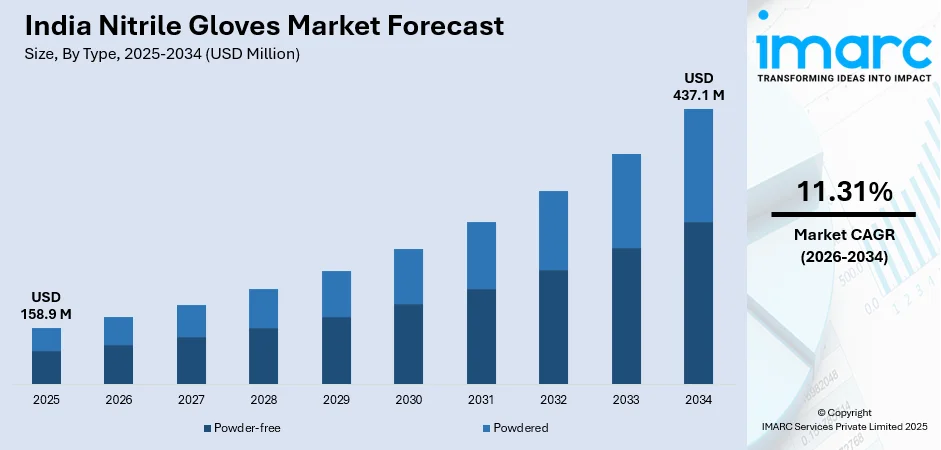
The India nitrile gloves market size was valued at USD 158.9 Million in 2025 and is projected to reach USD 437.1 Million by 2034, growing at a compound annual growth rate of 11.31% from 2026-2034.
The Indian nitrile gloves market is witnessing strong growth, fueled by the expansion of healthcare infrastructure, strict workplace safety regulations across industries, and heightened awareness of infection control measures. Nitrile gloves are increasingly preferred over latex due to their superior chemical resistance and hypoallergenic properties. Additionally, government initiatives promoting domestic manufacturing, such as the Make in India campaign, are supporting local production and capacity expansion. These factors collectively are driving market demand and enhancing India’s share in the global nitrile gloves industry.
Key Takeaways and Insights:
- By Type: Powder-free dominates the market with a share of 72.4% in 2025, driven by reduced allergy risks and contamination concerns in healthcare and cleanroom environments, making it the preferred choice for medical and industrial applications.
- By Product: Disposable leads the market with a share of 88.6% in 2025, owing to strict hygiene protocols in healthcare, food processing, and pharmaceutical sectors that require single-use gloves to prevent cross-contamination.
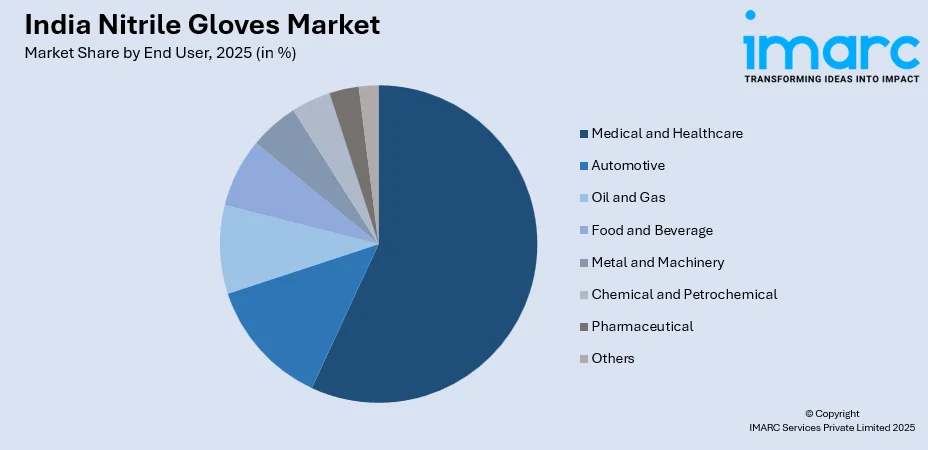
- By End User: Medical and healthcare represent the largest segment with a market share of 56.8% in 2025, supported by expanding hospital infrastructure, rising surgical procedures, and heightened infection control awareness.
- By Region: West India leads the market with a share of 33.9% in 2025, attributed to the concentration of pharmaceutical manufacturing hubs in Maharashtra and Gujarat, along with advanced healthcare infrastructure.
- Key Players: The India nitrile gloves market exhibits a moderately fragmented competitive structure with a mix of established multinational corporations and emerging domestic manufacturers. The market is characterized by strategic partnerships, capacity expansions, and technological innovations as companies compete to capture growing demand across healthcare, industrial, and food processing sectors.
To get more information on this market Request Sample
The India nitrile gloves market is set for strong growth, supported by increasing healthcare spending and rising demand from hospitals, clinics, and medical research facilities. The pharmaceutical and biotechnology sectors are driving consumption as laboratories and research institutions rely on nitrile gloves for safety and contamination control. Government initiatives promoting domestic manufacturing, such as the Make in India program, have encouraged investments in production facilities across key states. These efforts are strengthening local supply chains, reducing dependence on imports, and enabling manufacturers to meet the growing demand for high-quality, durable, and safe nitrile gloves across healthcare and industrial applications. For instance, Wadi Surgicals launched India's first accelerator-free nitrile gloves under the Enliva brand in 2025, developed through extensive research and development to address skin sensitivity concerns while maintaining international quality standards.
India Nitrile Gloves Market Trends:
Rising Adoption of Accelerator-Free and Hypoallergenic Gloves
The Indian nitrile gloves market is increasingly moving toward accelerator-free products as healthcare and industrial workers prioritize safety and comfort. These advanced gloves remove common allergenic accelerators while retaining high tensile strength and chemical resistance, reducing the risk of skin irritation and allergic reactions. A notable milestone in this trend was achieved with the introduction of domestically manufactured accelerator-free nitrile gloves, representing a major step forward in protecting workers from occupational dermatitis and meeting the growing demand for safer, high-performance gloves across medical and industrial applications.
Growing Emphasis on Sustainable and Biodegradable Solutions
Environmental sustainability is becoming a key consideration in the nitrile gloves market as manufacturers respond to increasing ecological awareness. Companies are investing in research to develop biodegradable nitrile formulations that can decompose more rapidly while maintaining protective qualities. For instance, in November 2024, Sybron launched biodegradable nitrile gloves that degrade approximately 81% within 491 days, targeting healthcare, hospitality, and food service industries seeking environmentally responsible options without compromising safety standards.
Expansion of Domestic Manufacturing Under Make in India Initiative
The Indian government's Make in India campaign is driving significant investments in domestic nitrile gloves production capacity to reduce import dependence and create self-sustaining supply chains. Local manufacturers are establishing state-of-the-art facilities with automated production lines and international quality certifications. For instance, LATRILE operates its manufacturing facility at the SIPCOT Industrial Complex in Dindigul, Tamil Nadu, with a daily production capacity of 700,000 powder-free gloves, representing the growing domestic manufacturing ecosystem.
Market Outlook 2026-2034:
The India nitrile gloves market is set for significant growth, supported by the rapid development of healthcare infrastructure in tier-2 and tier-3 cities, driven by government programs and private sector investments. Demand is further fueled by the expanding pharmaceutical industry, strict workplace safety regulations, and the growing food processing sector. These factors collectively create sustained market momentum, encouraging manufacturers to scale up production and introduce advanced, high-quality gloves to meet the increasing requirements of medical, industrial, and food-handling applications across the country. The market generated a revenue of USD 158.9 Million in 2025 and is projected to reach a revenue of USD 437.1 Million by 2034, growing at a compound annual growth rate of 11.31% from 2026-2034.
India Nitrile Gloves Market Report Segmentation:
|
Segment Category |
Leading Segment |
Market Share |
|
Type |
Powder-free |
72.4% |
|
Product |
Disposable |
88.6% |
|
End User |
Medical and Healthcare |
56.8% |
|
Region |
West India |
33.9% |
Type Insights:
- Powder-free
- Powdered
Powder-free dominates with a market share of 72.4% of the total India nitrile gloves market in 2025.
Powder-free nitrile gloves have emerged as the preferred choice across healthcare, laboratory, and food processing applications due to their elimination of powder-related contamination risks and reduced allergenic potential. These gloves undergo chlorination processes to remove residual powder, making them essential for cleanroom environments and surgical procedures where particulate contamination must be minimized. The growing emphasis on infection control protocols and international quality standards has accelerated adoption among Indian healthcare facilities.
The growth of the nitrile gloves segment is being reinforced by evolving regulatory standards, including requirements set by the Ministry of Chemicals and Fertilisers to ensure compliance with national quality norms for medical gloves. These regulations are raising overall product standards and encouraging the adoption of powder-free formulations that meet international benchmarks for medical-grade protective equipment. By addressing occupational health concerns such as powder-related respiratory issues and skin sensitization, the regulatory framework is promoting safer, higher-quality gloves, supporting increased demand across healthcare and industrial applications.
Product Insights:
- Disposable
- Durable
Disposable leads with a share of 88.6% of the total India nitrile gloves market in 2025.
Disposable nitrile gloves represent the dominant product category due to stringent hygiene requirements in healthcare, pharmaceutical manufacturing, and food processing industries where single-use protocols are mandatory to prevent cross-contamination. The convenience of frequent glove changes without compromising safety has made disposable variants indispensable in clinical settings, diagnostic laboratories, and surgical environments. Healthcare professionals prefer disposable gloves as they provide reliable barrier protection during patient examinations and medical procedures.
The growing volume of surgical procedures and diagnostic tests across India’s expanding hospitals and clinics is driving strong demand for disposable gloves. Rapid development of healthcare infrastructure, supported by increased investment from private and institutional players, is fueling the need for high-quality protective equipment. As new medical facilities are established, strict infection control protocols aligned with global healthcare standards are being implemented, further boosting consumption of disposable gloves. This trend ensures sustained market growth across hospitals, diagnostic centers, and other healthcare settings throughout the country.
End User Insights:
Access the comprehensive market breakdown Request Sample
- Medical and Healthcare
- Automotive
- Oil and Gas
- Food and Beverage
- Metal and Machinery
- Chemical and Petrochemical
- Pharmaceutical
- Others
Medical and healthcare represent the highest revenue with a 56.8% share of the total India nitrile gloves market in 2025.
Medical and healthcare applications represent the primary demand driver for nitrile gloves in India, with hospitals, clinics, diagnostic centers, and nursing homes requiring substantial quantities for patient care and surgical procedures. The segment benefits from heightened infection control awareness, mandatory glove usage protocols, and expanding healthcare infrastructure driven by government initiatives such as Ayushman Bharat. Nitrile gloves offer superior puncture resistance and barrier protection against bloodborne pathogens, making them essential for examination and surgical applications.
The Government of India has announced plans to launch a credit incentive scheme valued at Rs. 50,000 crore (approximately USD 6.8 billion) to enhance healthcare infrastructure nationwide. This substantial investment is creating new healthcare facilities in semi-urban and rural areas, generating sustained demand for medical-grade nitrile gloves. Additionally, the growing telemedicine and home healthcare segments are expanding glove usage beyond traditional clinical settings, diversifying demand channels across the healthcare ecosystem.
Regional Insights:
- North India
- South India
- East India
- West India
West India leads with a share of 33.9% of the total India nitrile gloves market in 2025.
The India nitrile gloves market in West India is being driven by rapid growth in healthcare infrastructure, including hospitals, diagnostic centers, and specialty clinics in major urban hubs. Increasing awareness of infection control and occupational safety protocols among healthcare professionals is fueling demand for high-quality disposable gloves. Additionally, rising private sector investments in medical facilities and expansion of medical education and research institutions are creating steady consumption of nitrile gloves, reinforcing the region’s role as a key contributor to the overall national market.
Industrial and food processing sectors in West India are also driving nitrile glove demand, as strict workplace safety and hygiene regulations require protective equipment for workers. Growing awareness of chemical resistance and allergy-free properties is encouraging the shift from latex to nitrile gloves across manufacturing, laboratories, and food handling operations. Government initiatives promoting domestic production and Make in India policies are further supporting local manufacturing, ensuring supply meets the rising regional demand while enhancing market competitiveness.

Market Dynamics:
Growth Drivers:
Why is the India Nitrile Gloves Market Growing?
Expanding Healthcare Infrastructure and Rising Medical Expenditure
India's healthcare sector is experiencing unprecedented expansion through government initiatives and private investments, creating substantial demand for medical-grade nitrile gloves. The Government of India has outlined plans to raise healthcare spending to more than 2.5% of GDP by 2025, marking a significant increase from levels observed in recent years. This government funding is driving increased procurement of medical supplies, including protective gloves, across hospitals and clinics nationwide. Initiatives to expand healthcare access in semi-urban and rural areas are supporting the establishment of new medical facilities, broadening the market for nitrile gloves beyond major metropolitan centers and creating opportunities for manufacturers to meet growing demand across a wider geographic footprint.
Stringent Workplace Safety Regulations Across Industrial Sectors
The increased concern about occupational health and safety needs is encouraging the use of nitrile gloves in manufacturing, chemical processing, automobile, and oil and gas sectors in India. The need to use personal protection gear in unsafe working conditions is increasing demand on long lasting and chemical-resistant hand protection as mandated by the regulatory authorities alongside corporate safety programs. The regulatory push towards higher standards of quality is reflected in the Quality Control Order of medical gloves suggested by the government, which is likely to incorporate surgical and examination gloves under the requirements of BIS certification. Through this framework, the quality of imports is being minimized, and local deployment of nitrile glove production in line with international standards is taking place.
Growing Preference for Latex-Free Alternatives Due to Allergy Concerns
The rising numbers of latex allergies in healthcare and industrial employees are prompting the use of nitrile gloves as the handwear of choice. Nitrile, being a synthetic rubber, gets rid of the hypersensitivity reaction that is associated with natural latex, hence it is safe for individuals who are allergic. Its excellent chemical resistance, puncture resistance, and extended shelf life make it more desirable in comparison to latex and vinyl. Indian manufacturers have reacted to this by creating accelerator-free nitrile gloves, which have ensured the chemical sensitivity issues without losing their protective performance abilities and have been able to meet the changing needs of safety and comfort of the users in medical and industrial environments.
Market Restraints:
What Challenges the India Nitrile Gloves Market is Facing?
Fluctuating Raw Material Prices and Supply Chain Vulnerabilities
The production of nitrile gloves depends on acrylonitrile and butadiene monomers derived from petroleum feedstocks, making manufacturing costs susceptible to oil price volatility and global supply disruptions. Fluctuating raw material prices create uncertainty in production planning and pricing strategies, potentially impacting manufacturer profit margins and product affordability for price-sensitive market segments.
Heavy Dependence on Imports and Limited Domestic Production Capacity
India remains significantly dependent on imports from established manufacturing countries such as Malaysia, Thailand, and China to meet domestic nitrile gloves demand. Limited local production capacity constrains supply chain resilience and exposes the market to international price fluctuations, currency exchange risks, and import regulatory changes that can affect product availability and pricing stability.
Influx of Substandard Imported Products Affecting Market Quality
Insufficient regulation of imported gloves has allowed substandard products rejected by other markets to enter India, undermining quality standards and creating unfair competition for domestic manufacturers investing in compliant production. The Indian Rubber Gloves Manufacturers Association has raised concerns about this issue, prompting government consideration of stricter quality control measures.
Competitive Landscape:
The India nitrile gloves market exhibits a moderately fragmented competitive structure characterized by the presence of established multinational corporations alongside emerging domestic manufacturers. International players leverage their advanced production technologies, extensive distribution networks, and brand recognition to maintain market presence, while Indian companies are gaining ground through localized manufacturing, competitive pricing, and government support under the Make in India initiative. Market participants are focusing on product innovation, including accelerator-free formulations, antimicrobial coatings, and biodegradable materials, to differentiate their offerings. Strategic partnerships between foreign manufacturers and Indian distributors are strengthening supply chain capabilities and market penetration across diverse geographic regions.
Recent Developments:
- February 2025: The Ministry of Chemicals and Fertilisers published a draft Quality Control Order for medical gloves under the single-use medical examination gloves regime, mandating compliance with Indian Standard IS 15354 (Part 1): 2023 and BIS certification for imported and domestic products.
- October 2024: KluraLabs and Unigloves partnered to launch the CrossGuard antimicrobial nitrile glove, designed to eradicate nearly all targeted bacteria within a minute. This innovative glove achieves rapid microbial protection using a specialized surface chemistry formulation, without relying on active chemical agents, setting a new benchmark in hygiene and safety for medical and industrial applications.
India Nitrile Gloves Market Report Coverage:
|
Report Features |
Details |
|
Base Year of the Analysis |
2025 |
|
Historical Period |
2020-2025 |
|
Forecast Period |
2026-2034 |
|
Units |
USD Million |
|
Scope of the Report |
Exploration of Historical Trends and Market Outlook, Industry Catalysts and Challenges, Segment-Wise Historical and Future Market Assessment:
|
|
Types Covered |
Powder-free, Powdered |
|
Products Covered |
Disposable, Durable |
|
End Users Covered |
Medical and Healthcare, Automotive, Oil and Gas, Food and Beverage, Metal and Machinery, Chemical and Petrochemical, Pharmaceutical, Others |
|
Regions Covered |
North India, South India, East India, West India |
|
Customization Scope |
10% Free Customization |
|
Post-Sale Analyst Support |
10-12 Weeks |
|
Delivery Format |
PDF and Excel through Email (We can also provide the editable version of the report in PPT/Word format on special request) |
Frequently Asked Questions About the India Nitrile Gloves Market Report
The India nitrile gloves market size was valued at USD 158.9 Million in 2025.
The India nitrile gloves market is expected to grow at a compound annual growth rate of 11.31% from 2026-2034 to reach USD 437.1 Million by 2034.
Powder-free nitrile gloves dominated the market with a 72.4% share in 2025, driven by reduced contamination risks, lower allergy potential, and regulatory compliance requirements in healthcare and cleanroom environments.
Key factors driving the India nitrile gloves market include expanding healthcare infrastructure, rising medical expenditure, stringent workplace safety regulations across industrial sectors, growing preference for latex-free alternatives, and government support for domestic manufacturing under the Make in India initiative.
Major challenges include fluctuating raw material prices due to petroleum feedstock volatility, heavy dependence on imports from established manufacturing countries, limited domestic production capacity, and the influx of substandard imported products affecting quality standards and fair competition.
Need more help?
- Speak to our experienced analysts for insights on the current market scenarios.
- Include additional segments and countries to customize the report as per your requirement.
- Gain an unparalleled competitive advantage in your domain by understanding how to utilize the report and positively impacting your operations and revenue.
- For further assistance, please connect with our analysts.
 Request Customization
 Speak to an Analyst
 Request Brochure
 Inquire Before Buying
Benefits of Customization
- Personalize this research
- Triangulate with your data
- Get data as per your format and definition
- Gain a deeper dive into a specific application, geography, customer, or competitor
- Any level of personalization
Get in Touch With Us
UNITED STATES
Phone: +1-201-971-6302
INDIA
Phone: +91-120-433-0800
UNITED KINGDOM
Phone: +44-753-714-6104
Email: [email protected]
Client Testimonials




.webp)




.webp)













Related Reports

Choose your plan
*Please note that the prices mentioned below are starting prices for each bundle type. Kindly contact our team for further details.*
Single User License
- 1 User License, Access on 2 Devices
- PDF Report + Excel Dataset (Password Protected)
- Lifetime Access
- No Printing Rights
- 10% Free Report Customization
- 10–12 Weeks of Analyst Support
Five User License
- Access for 5 Users, 2 Devices per User
- PDF Report + Excel Dataset (Password Protected)
- Lifetime Access
- Dedicated Account Manager
- 12–14 Weeks of Analyst Support
- No Printing Rights
- 15% Free Report Customization
- 25% Discount on Your Next Purchase
Corporate User License
- Unlimited User Access (Within Your Organization)
- PDF Report + Excel Dataset
- Lifetime Access
- Dedicated Account Manager
- 14–20 Weeks of Analyst Support
- No Printing Rights
- 20% Free Report Customization
- 30% Discount on Your Next Purchase
Essential Insights
What's included:
3 reports
- Lifetime Access
- PDF Reports
- Excel Datasets
- 2 Weeks of Free Analyst Support
- 2 User Licenses
- Access on 2 Devices
- Printing Rights
- Complimentary PowerPoint (PPT) Version
- Complimentary License Upgrade
Professional Access
What's included:
5 reports
- Lifetime Access
- PDF Reports
- Excel Datasets
- 8 Weeks of Free Analyst Support
- 2 User Licenses
- Access on 2 Devices
- Printing Rights
- Complimentary PowerPoint (PPT) Version
- Complimentary License Upgrade
Business Advantage
What's included:
8 reports
- Lifetime Access
- PDF Reports
- Excel Datasets
- 14 Weeks of Free Analyst Support
- 2 User Licenses
- Access on 2 Devices
- Printing Rights
- Complimentary PowerPoint (PPT) Version
- Complimentary License Upgrade
Enterprise Intelligence
What's included:
10 reports
- Lifetime Access
- PDF Reports
- Excel Datasets
- 20 Weeks of Free Analyst Support
- 2 User Licenses
- Access on 2 Devices
- Printing Rights
- Complimentary PowerPoint (PPT) Version
- Complimentary License Upgrade