
India Pallet Market Size, Share, Trends and Forecast by Type, Application, Structural Design, and Region, 2026-2034
India Pallet Market Summary:
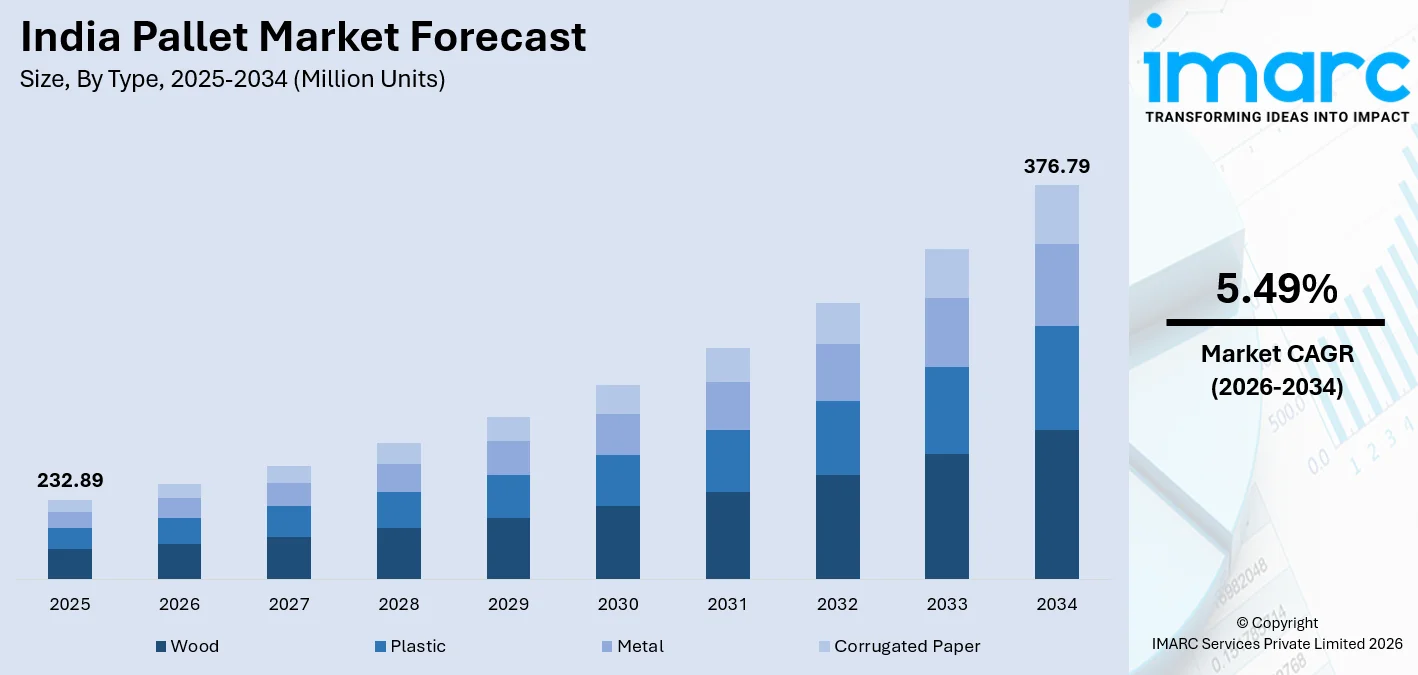
The India pallet market size reached 232.89 Million Units in 2025 and is projected to reach 376.79 Million Units by 2034, growing at a compound annual growth rate of 5.49% from 2026-2034.
The pallet industry in India is moving forward with increasing momentum, driven by the fast pace of industrialization, the growing e-commerce sector, and the rising need for efficient and reliable logistics infrastructure. Increasing investments in warehousing, cold chain, and organized retail are further adding to the demand for pallets. Manufacturing schemes launched by the government, such as production-linked incentive schemes and development of industrial corridors, are also adding to the procurement demands in the end-use sectors. Improvements in sustainable materials and automation in the supply chain are continuously changing the preferences and boosting the pallet market share in India.
Key Takeaways and Insights:
- By Type: Wood dominates the market with a share of 50% in 2025, driven by their cost-effectiveness, wide availability, and versatility across diverse industrial, agricultural, and logistics applications throughout India.
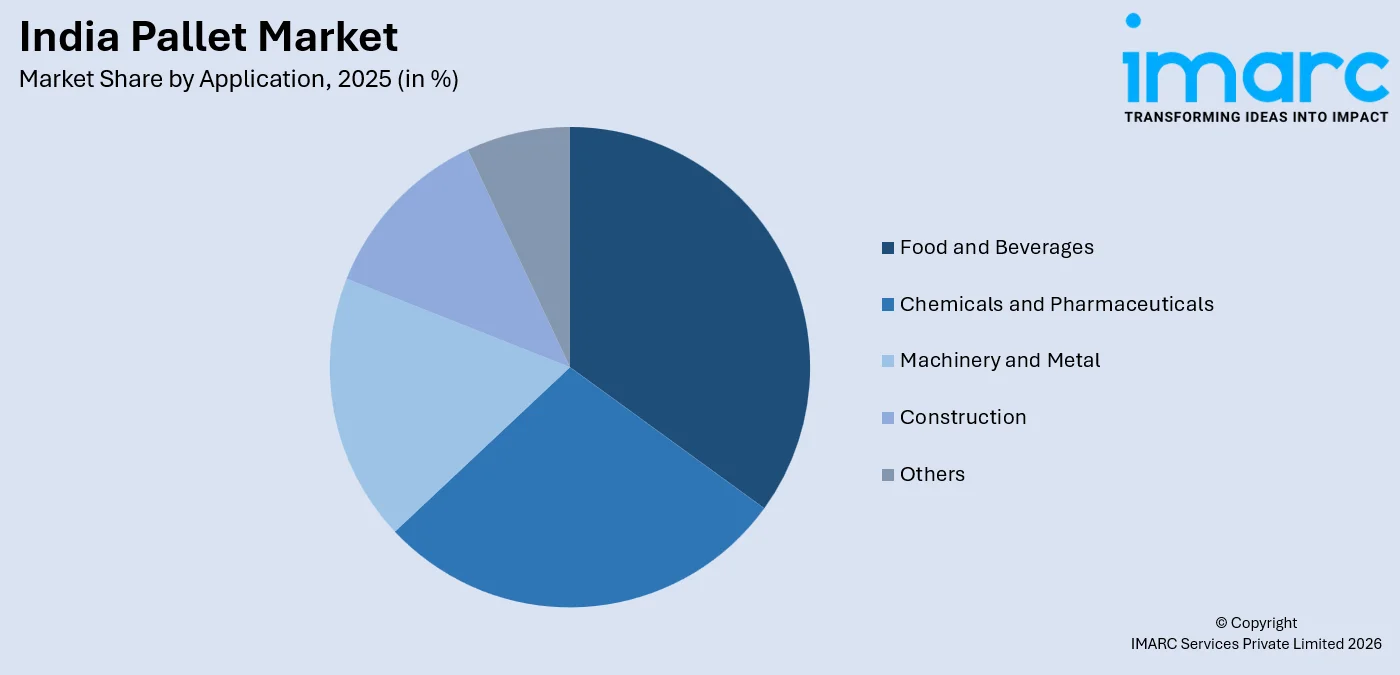
- By Application: Food and beverages leads the market with a share of 32% in 2025, owing to growing demand for safe, standardized material handling solutions across India's expanding cold chain, organized retail, and food distribution networks.
- By Structural Design: Block holds the largest market share of 45% in 2025, favored for its superior load-bearing capacity, four-way forklift accessibility, and seamless compatibility with automated material handling systems.
- Key Players: The India pallet market features a competitive mix of domestic manufacturers and organized service providers. Players compete on product durability, material innovation, competitive pricing, and expanding service reach, with growing differentiation through sustainable product offerings and technology-enabled pallet pooling solutions across key industrial and logistics verticals.
To get more information on this market Request Sample
India's pallet market is experiencing robust growth, underpinned by evolving supply chain priorities and broad macroeconomic expansion. The country's rapidly expanding manufacturing base, growth in organized retail, and the surge in e-commerce have collectively elevated demand for standardized and durable pallet solutions. In a key development, LEAP India filed a DRHP with SEBI in 2025 for a ₹2,400 crore IPO, aiming to expand its pallet pooling and reusable asset network across India’s logistics ecosystem. Industries spanning food and beverages, pharmaceuticals, construction, and automotive rely on pallets for safe storage, transportation, and inventory management. The increasing adoption of warehouse automation and cold chain logistics further amplifies the need for high-performance pallets. Policy initiatives supporting infrastructure development and industrial corridors are enabling deeper penetration of pallet usage across urban and rural supply chains, positioning India as a significant long-term growth market for diversified pallet solutions.
India Pallet Market Trends:
Rising Adoption of Sustainable and Recyclable Pallet Materials
Growing environmental awareness is accelerating a shift toward recyclable and reusable pallet materials across Indian industries. Manufacturers and logistics operators are transitioning from conventional wood toward molded wood, composite, and plastic alternatives that offer extended service life, lower maintenance requirements, and alignment with global sustainability standards. In February 2025, Netherlands‑based CocoPallet, partnering with Superpacks, plans a Tiptur, Karnataka factory producing 1.5 lakh wood‑free, bio‑based export pallets from coconut husk waste, promoting eco-friendly pallet solutions while reducing single‑use wood reliance and deforestation impact. Export-oriented supply chains are increasingly prioritizing compliance with international phytosanitary regulations, further reinforcing demand for heat-treated or non-wood pallet variants that bypass fumigation requirements and reduce phytosanitary certification complexity.
Expansion of Cold Chain and Temperature-Controlled Warehousing
India's rapidly growing cold chain infrastructure is driving heightened demand for pallets capable of performing reliably within refrigerated and frozen storage environments. The expansion of organized food retail, pharmaceutical distribution, and perishable goods logistics is creating a sustained need for pallets with enhanced structural integrity, hygiene compatibility, and consistent load-bearing performance. Reflecting this momentum, in February 2026, Cold Chain Technologies opened a major 42,000‑sq‑ft facility in Taloja, Navi Mumbai, a strategic hub for pharmaceuticals and perishables that reinforces investment in temperature‑controlled logistics infrastructure. As investments in multi-temperature warehousing facilities accelerate across urban and semi-urban geographies, the India pallet market growth is being reinforced by increasing reliance on specialized pallet configurations suited to cold chain operational requirements.
Integration of Smart Technologies and Automation in Pallet Logistics
Growing adoption of automated storage and retrieval systems and IoT-enabled supply chain tools is reshaping pallet specifications across India. Operators are selecting standardized, sensor-compatible pallets that integrate with robotic handling equipment, improving inventory visibility, reducing handling time, and supporting digital transformation of warehousing and distribution. Reflecting this shift toward technology‑driven logistics, quick‑commerce platform Zepto announced the completion of pan‑India automation of its backend supply chain in December, scaling automated operations nationwide to boost efficiency and reliability across its distribution network. Fulfillment centers serving e-commerce and pharmaceutical clients are increasingly specifying pallets with embedded tracking capabilities, reflecting a broader industry shift toward real-time asset visibility and proactive supply chain management.
Market Outlook 2026-2034:
The India pallet market is expected to grow at a steady pace during the forecast period, owing to the increasing focus on industrialization, infrastructure development, and the growing penetration of e-commerce in the country. Increasing spending on cold chain logistics, pharmaceutical, and food retail sectors will continue to drive the demand for various pallet sizes. There is a growing need for optimizing the supply chain, warehouse automation, and sustainability, which will continue to drive innovation in pallet materials and designs. The market size was estimated at 232.89 Million Units in 2025 and is expected to reach 376.79 Million Units by 2034, reflecting a compound annual growth rate of 5.49% over the forecast period 2026-2034.
India Pallet Market Report Segmentation:
| Segment Category | Leading Segment | Market Share |
|---|---|---|
|
Type |
Wood |
50% |
|
Application |
Food and Beverages |
32% |
|
Structural Design |
Block |
45% |
Type Insights:
- Wood
- Plastic
- Metal
- Corrugated Paper
The wood dominates with a market share of 50% of the total India pallet market in 2025.
Wood remains the preferred pallet material across India owing to its inherent cost advantage, widespread raw material availability, and ease of fabrication and on-site repair. The material's natural strength and load-bearing capacity make it suitable for a wide range of applications spanning logistics, manufacturing, construction, and agriculture. As India's industrial and export sectors continue to expand, wood pallets serve as a reliable and accessible solution meeting diverse operational requirements without necessitating significant capital investment or specialized infrastructure for procurement and maintenance.
The dominance of wood pallets is further strengthened by their compatibility with the existing material handling equipment, such as forklifts and pallet jacks, which makes it easy to integrate them into the existing logistics chain. The repair and reuse options provide a cost-effective solution to enterprises operating on a large scale, and heat-treated wood pallets are also available to meet international phytosanitary requirements for export shipments. The increasing focus on responsible forestry practices is slowly influencing the procurement trends, and a more organized and quality-focused approach is being adopted in the wood pallet market in India.
Application Insights:
Access the comprehensive market breakdown Request Sample
- Food and Beverages
- Chemicals and Pharmaceuticals
- Machinery and Metal
- Construction
- Others
The food and beverages leads with a share of 32% of the total India pallet market in 2025.
The food and beverages sector represents the largest end-use application for pallets in India, driven by the country's vast and expanding consumption base and the growing need for hygienic, efficient material handling throughout the supply chain. A key recent development reinforcing this trend is India’s plan to double food processing capacity over the next 6-7 years, expected to boost demand for modern logistics assets, including pallets, to support standardized handling and efficient storage of processed and perishable foods. Rising supermarket penetration, organized food retail growth, and expanding processed food production are key contributors to this segment's sustained and broadening demand across the country.
The enhancement of cold chain infrastructure, the imposition of food safety regulations, and the growing adoption of quick commerce and e-grocery services are further fueling the dependence on high-performance pallets in the food and beverages industry in India. Hygiene requirements are increasingly pushing the industry towards plastic and treated wood types of pallets that have less potential for contamination and are more amenable to easy washdown processes. At the same time, the growing production of dairy products, packaged drinks, and frozen foods is expanding the use of pallets.
Structural Design Insights:
- Block
- Stringer
- Others
The block dominates with a market share of 45% of the total India pallet market in 2025.
Block pallets are the most popular structural type in the Indian pallet industry, appreciated for their superior carrying capacity and all-around forklift accessibility. Unlike stringer pallets, block pallets allow access from all four directions, which is a major boost to efficiency in high-volume warehousing and manufacturing operations. The sturdy design of block pallets, featuring cylindrical or rectangular blocks supporting the top surface, makes them ideal for stacking and transporting goods in a stable manner across various industry verticals such as food, pharmaceuticals, chemicals, and industrial manufacturing.
The widespread adoption of block pallets in India is also driven by their strong compatibility with modern automated material handling systems, including conveyor lines and automated guided vehicles deployed across large distribution and fulfillment centers. Their standardized dimensions facilitate seamless integration into racking systems and optimize available warehouse floor space. As India's logistics sector continues to modernize, propelled by e-commerce growth and expanding manufacturing output, demand for block pallets is expected to remain consistently robust across both organized and semi-organized supply chain operations throughout the country.
Regional Insights:
- North India
- West and Central India
- South India
- East India
North India represents a significant pallet consumption hub, anchored by major industrial and commercial centers across Delhi NCR, Haryana, Punjab, and Uttar Pradesh. The region's robust manufacturing activity, large-scale agricultural logistics, and rapidly expanding organized retail and e-commerce distribution networks generate consistent and diversified demand for standardized pallet solutions across key supply chain touchpoints.
West and Central India leads pallet consumption nationally, supported by the region's dominant manufacturing and industrial base across Maharashtra, Gujarat, and Madhya Pradesh. The presence of major logistics corridors, export-oriented industries, automotive clusters, and well-established warehousing infrastructure collectively drives sustained demand for diverse pallet types serving both domestic distribution and international supply chain requirements.
South India demonstrates robust and growing pallet demand, underpinned by the region's strong concentration of technology, automobile, pharmaceutical, and food processing industries across Tamil Nadu, Karnataka, Andhra Pradesh, and Telangana. Port-linked export logistics networks, expanding modern warehousing facilities, and increasing cold chain investments are further reinforcing the region's role as a significant and evolving pallet consumption market.
East India presents steadily expanding pallet demand, driven by increasing industrial activity across West Bengal, Odisha, and Jharkhand, alongside growing agri-commodity logistics and pharmaceutical distribution requirements. Progressive infrastructure-led investment is improving supply chain connectivity across the region, gradually integrating previously underserved areas into organized logistics networks and expanding the addressable base for standardized pallet solutions.

Market Dynamics:
Growth Drivers:
Why is the India Pallet Market Growing?
Rapid Expansion of India's Manufacturing and Industrial Sector
India's manufacturing sector is undergoing a structural transformation, supported by policy-driven initiatives designed to attract investments, boost production capacity, and integrate domestic industries into global supply chains. As factories, industrial parks, and production facilities scale up operations across automotive, electronics, textiles, and consumer goods sectors, the requirement for reliable material handling solutions continues to grow substantially. Reflecting this trend, Colliers India reported in February 2026 that India’s industrial and warehousing sector is entering a phase of accelerated transformation, with expanding industrial and freight corridors, multimodal logistics parks, and manufacturing‑led growth expected to significantly bolster logistics infrastructure across established and emerging regions. Standardized pallet solutions reduce material damage, improve inventory tracking, and streamline warehouse operations.
Growth of E-Commerce and Demand for Efficient Supply Chain Solutions
The rapid proliferation of e-commerce platforms across India has fundamentally transformed logistics and fulfillment requirements, creating substantial demand for standardized pallet solutions throughout the supply chain. Fulfillment centers, sorting hubs, and last-mile distribution facilities require consistent and durable pallets that facilitate fast and efficient movement of diverse products at scale. For instance, in August 2025, Flipkart expanded its supply chain infrastructure by adding new fulfillment centers and last-mile hubs across multiple states, increasing its logistics footprint to over 100 fulfillment centers and covering more than 21,000 pin codes nationwide. The shift toward omnichannel retail, where products flow through multiple touchpoints before reaching consumers, further amplifies the need for pallet-centric material handling systems. E-commerce-driven demand has also accelerated investment in warehousing infrastructure, particularly in tier-2 and tier-3 cities, extending the geographic reach of pallet consumption beyond traditional industrial hubs and creating new opportunities for pallet manufacturers and pooling service providers.
Government Infrastructure Initiatives and Cold Chain Development
Sustained government investment in logistics and infrastructure development is creating a structurally supportive environment for pallet market growth across India. Large-scale programs focused on improving road connectivity, developing multi-modal logistics parks, and expanding cold chain capacity are driving increased volumes of goods through organized supply chain networks that depend on palletized handling. For instance, in December 2024, the Uttar Pradesh government earmarked 17,000 acres for multimodal logistics parks, offering subsidies and incentives to attract private investment and develop integrated warehousing, cold storage, and cargo terminals to strengthen supply chain efficiency. The growing emphasis on reducing food wastage through improved cold chain coverage is expanding the base of temperature-sensitive logistics operations requiring specialized pallet solutions. Furthermore, policy support for the pharmaceutical and FMCG sectors through production incentive schemes and export facilitation is generating sustained demand for pallets meeting both domestic operational standards and international export compliance requirements.
Market Restraints:
What Challenges the India Pallet Market is Facing?
Dominance of the Unorganized Sector and Lack of Standardization
India's pallet market is characterized by a fragmented supply base, with a significant portion of production concentrated among small, unorganized manufacturers operating outside established quality and dimensional standards. This lack of standardization creates compatibility issues across supply chains, limits interoperability with modern material handling equipment, and introduces variability in product quality, ultimately impeding efficient logistics operations and reducing confidence in pallet pooling and rental models.
Volatility in Raw Material Prices
Fluctuations in the cost of wood and plastic, the primary raw materials for pallet manufacturing, introduce significant pricing uncertainty across the supply chain. Rising timber costs influenced by forest regulation and global supply dynamics, alongside periodic volatility in petrochemical-derived plastic resins, compress manufacturer margins and create procurement challenges for buyers seeking consistent, cost-effective pallet solutions across large-scale logistics operations throughout India.
Infrastructure Gaps in Semi-Urban and Rural Logistics
Despite notable logistics improvements, considerable infrastructure gaps persist in semi-urban and rural India, where inadequate road networks, limited warehousing capacity, and low mechanization levels restrict broader adoption of palletized handling. Many enterprises in these regions continue relying on manual methods due to cost constraints and limited access to forklifts or pallet jacks, curtailing organized pallet penetration beyond established industrial and commercial centers.
Competitive Landscape:
India's pallet market exhibits a dual competitive structure, combining a large fragmented base of regional manufacturers with a growing tier of organized players offering standardized, high-quality products. Competition is principally driven by product durability, pricing, range of material options, and the ability to fulfill large-volume orders consistently. The market is progressively shifting toward differentiated offerings, with suppliers focusing on product quality improvements, material diversification, and enhanced after-sales service as key differentiators. Pallet pooling and rental models are gaining traction as cost-efficient alternatives to outright purchase, encouraging service-oriented business models. The growing emphasis on sustainability is prompting suppliers to develop eco-friendly product lines. Technological integration, including RFID-enabled tracking and sensor-embedded pallet solutions, is emerging as a value-added differentiator, enabling end users to achieve greater supply chain visibility and optimize pallet utilization across their logistics networks.
Recent Developments:
- In January 2026, Indian logistics tech firm Unicommerce announced the launch of Shipway Cargo, a cloud‑based B2B logistics SaaS platform designed for frequent business shipments and enterprise‑grade delivery optimization, marking a strategic expansion beyond parcel logistics into broader freight solutions.
India Pallet Market Report Coverage:
| Report Features | Details |
|---|---|
| Base Year of the Analysis | 2025 |
| Historical Period | 2020-2025 |
| Forecast Period | 2026-2034 |
| Units | Million Units |
| Scope of the Report |
Exploration of Historical Trends and Market Outlook, Industry Catalysts and Challenges, Segment-Wise Historical and Future Market Assessment:
|
| Types Covered | Wood, Plastic, Metal, Corrugated Paper |
| Applications Covered | Food and Beverages, Chemicals and Pharmaceuticals, Machinery and Metal, Construction, Others |
| Structural Designs Covered | Block, Stringer, Others |
| Regions Covered | North India, West and Central India, South India, East India |
| Customization Scope | 10% Free Customization |
| Post-Sale Analyst Support | 10-12 Weeks |
| Delivery Format | PDF and Excel through Email (We can also provide the editable version of the report in PPT/Word format on special request) |
Frequently Asked Questions About the India Pallet Market Report
The India pallet market reached a volume of 232.89 Million Units in 2025.
The India pallet market is expected to grow at a compound annual growth rate of 5.49% from 2026-2034 to reach 376.79 Million Units by 2034.
Wood account for the largest share at 50%, owing to their cost-effectiveness, wide availability of raw materials, ease of repair, and versatility across diverse industrial, logistics, and agricultural applications throughout India.
Key factors driving the India pallet market include rapid industrialization, growing e-commerce adoption, expansion of cold chain infrastructure, government manufacturing and logistics initiatives, increasing organized retail penetration, and rising demand for efficient and standardized supply chain solutions.
Major challenges include a fragmented and unorganized supply structure, lack of dimensional standardization, volatility in raw material costs, infrastructure gaps in rural and semi-urban logistics, and limited mechanized handling adoption among smaller enterprises.
Need more help?
- Speak to our experienced analysts for insights on the current market scenarios.
- Include additional segments and countries to customize the report as per your requirement.
- Gain an unparalleled competitive advantage in your domain by understanding how to utilize the report and positively impacting your operations and revenue.
- For further assistance, please connect with our analysts.
 Request Customization
 Speak to an Analyst
 Request Brochure
 Inquire Before Buying
Benefits of Customization
- Personalize this research
- Triangulate with your data
- Get data as per your format and definition
- Gain a deeper dive into a specific application, geography, customer, or competitor
- Any level of personalization
Get in Touch With Us
UNITED STATES
Phone: +1-201-971-6302
INDIA
Phone: +91-120-433-0800
UNITED KINGDOM
Phone: +44-753-714-6104
Email: [email protected]
Client Testimonials




.webp)




.webp)













Related Reports

Choose your plan
*Please note that the prices mentioned below are starting prices for each bundle type. Kindly contact our team for further details.*
Single User License
- 1 User License, Access on 2 Devices
- PDF Report + Excel Dataset (Password Protected)
- Lifetime Access
- No Printing Rights
- 10% Free Report Customization
- 10–12 Weeks of Analyst Support
Five User License
- Access for 5 Users, 2 Devices per User
- PDF Report + Excel Dataset (Password Protected)
- Lifetime Access
- Dedicated Account Manager
- 12–14 Weeks of Analyst Support
- No Printing Rights
- 15% Free Report Customization
- 25% Discount on Your Next Purchase
Corporate User License
- Unlimited User Access (Within Your Organization)
- PDF Report + Excel Dataset
- Lifetime Access
- Dedicated Account Manager
- 14–20 Weeks of Analyst Support
- No Printing Rights
- 20% Free Report Customization
- 30% Discount on Your Next Purchase
Essential Insights
What's included:
3 reports
- Lifetime Access
- PDF Reports
- Excel Datasets
- 2 Weeks of Free Analyst Support
- 2 User Licenses
- Access on 2 Devices
- Printing Rights
- Complimentary PowerPoint (PPT) Version
- Complimentary License Upgrade
Professional Access
What's included:
5 reports
- Lifetime Access
- PDF Reports
- Excel Datasets
- 8 Weeks of Free Analyst Support
- 2 User Licenses
- Access on 2 Devices
- Printing Rights
- Complimentary PowerPoint (PPT) Version
- Complimentary License Upgrade
Business Advantage
What's included:
8 reports
- Lifetime Access
- PDF Reports
- Excel Datasets
- 14 Weeks of Free Analyst Support
- 2 User Licenses
- Access on 2 Devices
- Printing Rights
- Complimentary PowerPoint (PPT) Version
- Complimentary License Upgrade
Enterprise Intelligence
What's included:
10 reports
- Lifetime Access
- PDF Reports
- Excel Datasets
- 20 Weeks of Free Analyst Support
- 2 User Licenses
- Access on 2 Devices
- Printing Rights
- Complimentary PowerPoint (PPT) Version
- Complimentary License Upgrade