
India Personal Care Ingredients Market Size, Share, Trends and Forecast by Type, Application, and Region, 2026-2034
India Personal Care Ingredients Market Summary:
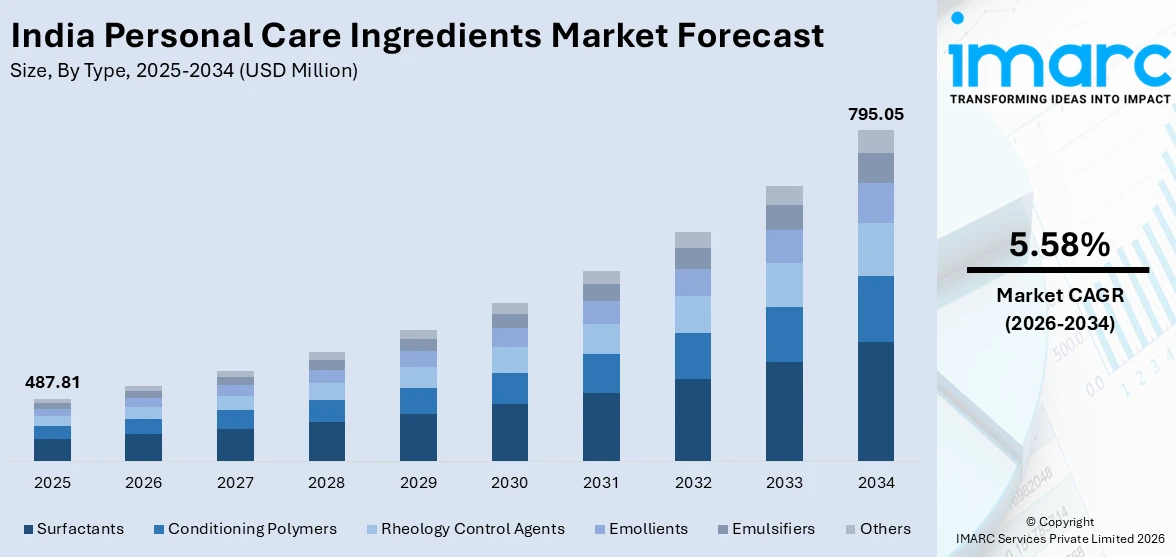
The India personal care ingredients market grew from USD 487.81 Million in 2025 to USD 514.92 Million in 2026 and is projected to reach USD 795.05 Million by 2034, growing at a compound annual growth rate of 5.58% from 2026-2034.
The market is fueled by the growing demand for natural and organic ingredients, increasing disposable incomes, and rising awareness levels about skin care and personal hygiene. The growing beauty and wellness industry, along with technological advancements in ingredients and government support for the local cosmetics industry, is also propelling the market. Furthermore, the trend of clean beauty and sustainable sourcing is also boosting the India personal care ingredients market share.
Key Takeaways and Insights:
- By Type: Surfactants dominate the market with a share of 32% in 2025, driven by their widespread use across cleansing, foaming, and emulsifying applications in shampoos and body washes.
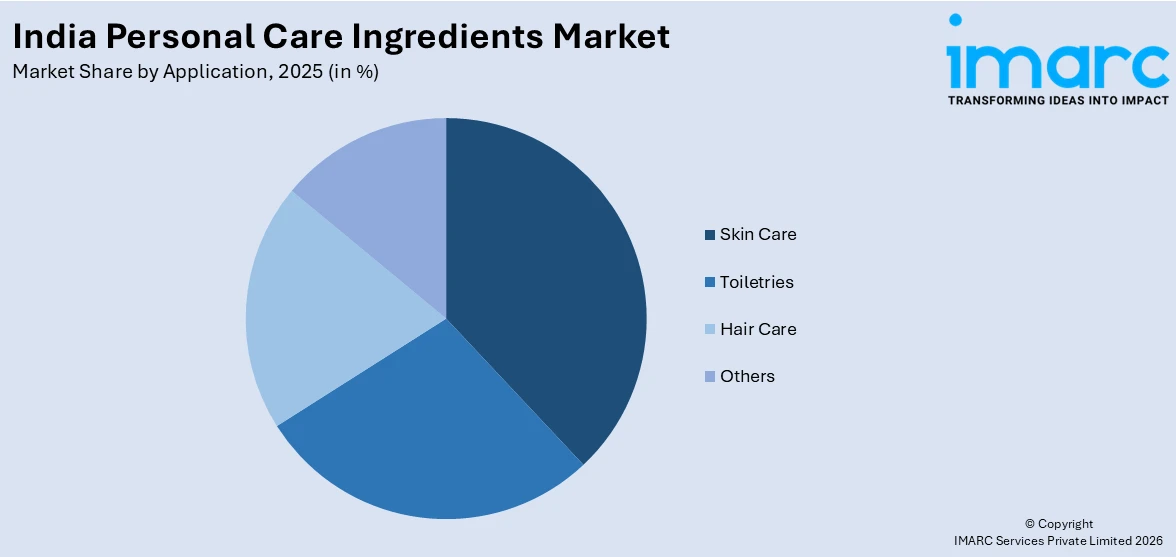
- By Application: Skin care leads the market with a share of 35% in 2025, owing to rising consumer consciousness about skin health and growing demand for anti-aging and moisturizing formulations.
- Key Players: The India personal care ingredients market exhibits moderate to highly competitive dynamics, with established multinational ingredient suppliers competing alongside emerging domestic manufacturers across specialty and commodity ingredient categories, driving continuous innovation in formulation technologies.
To get more information on this market Request Sample
The India personal care ingredients market is experiencing robust expansion fueled by a confluence of socioeconomic and consumer-driven factors. Rapid urbanization and rising middle-class incomes are enabling broader access to premium personal care products, thereby increasing demand for high-performance and specialty ingredients. The growing influence of social media and digital platforms is shaping consumer awareness about ingredient transparency and product efficacy, prompting manufacturers to invest in innovative formulations. According to reports, the Government of India announced plans to introduce a Production Linked Incentive (PLI) scheme for the chemicals and petrochemicals sector to strengthen domestic manufacturing of specialty chemicals widely used in cosmetics and personal care formulations. Additionally, the cultural emphasis on traditional beauty practices rooted in Ayurveda is blending with modern cosmetic science, creating unique demand for botanically derived and multifunctional ingredients.
India Personal Care Ingredients Market Trends:
Rising Demand for Plant-Based and Naturally Derived Ingredients
Indian consumers are increasingly gravitating toward personal care products formulated with plant-based and naturally derived ingredients, reflecting a broader shift toward clean beauty and holistic wellness. This trend is particularly pronounced among younger demographics who prioritize ingredient transparency and environmental sustainability in their purchasing decisions. In July 2024, Herbalife India launched its Vritilife Outer Nutrition skincare range in India, combining Ayurvedic botanicals with clinically tested natural oils, highlighting rising industry adoption of plant-based formulation approaches. Manufacturers are responding by sourcing botanical extracts, plant-derived surfactants, and bio-based emollients that deliver comparable performance to synthetic counterparts. The integration of traditional Indian botanicals such as turmeric, neem, and amla into modern formulations is further amplifying this trend across both premium and mass-market segments.
Advancement in Multifunctional Ingredient Technologies
The personal care industry in India is witnessing a significant shift toward multifunctional ingredients that serve multiple purposes within a single formulation, thereby reducing product complexity and manufacturing costs. Ingredient suppliers are innovating to develop actives that simultaneously offer moisturizing, anti-aging, sun protection, and skin-brightening benefits. As per sources, India-based ingredient manufacturer Flychem introduced KOSAVA™, an encapsulated salicylic acid technology designed to deliver sustained release, enhanced stability, and multiple skin benefits within a single cosmetic formulation. This trend is driven by consumer preference for simplified skincare routines and cost-effective products that deliver multiple benefits without extensive layering. The growing sophistication of Indian consumers, combined with increased exposure to global beauty innovations through digital channels, is accelerating adoption of these advanced ingredient systems.
Expansion of Male Grooming and Gender-Neutral Personal Care
The male grooming segment is emerging as a significant growth driver for personal care ingredients in India, with evolving social norms and increasing workplace grooming expectations fueling demand for specialized formulations. This expansion extends beyond traditional shaving products to encompass skincare, hair care, and body care solutions tailored for male consumers. In April 2024, Piramal Pharma Limited entered India’s men’s grooming segment with the launch of its Bohem range, featuring scientifically formulated beard care, hair removal, and underarm products designed specifically for male consumers. Moreover, the rise of gender-neutral personal care products is creating new ingredient demand patterns that emphasize universal efficacy and inclusive formulations. Ingredient suppliers are developing specialized active delivery systems that address distinct physiological requirements while maintaining broad consumer appeal.
Market Outlook 2026-2034:
The Indian personal care ingredients market is expected to witness positive growth during the forecast period, thanks to the right demographics, increasing consumer sophistication, and the penetration of the beauty and wellness industry in tier two and tier three cities. The increasing investments in manufacturing capabilities and the rising exports of specialty ingredients are expected to improve the supply chain and drive innovation. The combination of Ayurvedic practices and modern knowledge of cosmetics will continue to unlock new growth opportunities for the ingredient industry. The market generated a revenue of USD 487.81 Million in 2025, which is expected to reach USD 514.92 Million in 2026 and further grow to USD 795.05 Million by 2034, at a compound annual growth rate of 5.58% during 2026-2034.
India Personal Care Ingredients Market Report Segmentation:
| Segment Category | Leading Segment | Market Share |
|---|---|---|
|
Type |
Surfactants |
32% |
|
Application |
Skin Care |
35% |
Type Insights:
- Surfactants
- Conditioning Polymers
- Rheology Control Agents
- Emollients
- Emulsifiers
- Others
Surfactants dominate with a market share of 32% of the total India personal care ingredients market in 2025.
Surfactants represent the leading product type segment in the India personal care ingredients market, commanding a dominant share owing to their essential role in the vast majority of personal care formulations. These ingredients enable effective cleansing in shampoos, body washes, facial cleansers, and liquid soaps by removing dirt, oil, and impurities efficiently. In February 2025, Galaxy Surfactants received the HPCI India Innovation Award for its multifunctional ingredient Galseer® Flexcon, developed to enhance conditioning performance while reducing surfactant load in modern hair care formulations.
The dominant position of surfactants is further supported by innovation in mild and natural surfactant technologies that address the rising consumer demand for gentle and sulfate-free surfactants. Companies are increasingly working on the development of bio-based surfactants from coconut, palm, and sugar raw materials, which have enhanced foaming and cleaning abilities and retain a favorable environmental and skin compatibility profile. The rising awareness about personal hygiene practices among rural and semi-urban populations is further fueling the base demand for surfactant-based products.
Application Insights:
Access the comprehensive market breakdown Request Sample
- Toiletries
- Skin Care
- Hair Care
- Others
Skin care leads with a share of 35% of the total India personal care ingredients market in 2025.
The skin care holds the largest share in the India personal care ingredients market, reflecting the growing consumer emphasis on skin health, appearance, and anti-aging solutions. This segment includes moisturizers, serums, sunscreens, and cleansers requiring diverse ingredients such as emollients, humectants, and active compounds for varied skin needs. In April 2025, Emami Limited officially launched Emami Pure Glow, a skincare formulation powered by niacinamide and Japanese sakura flower extracts, combining botanical and science-based actives to address hydration and skin-brightening needs.
The dominance of skin care applications is driven by the increasing urbanization and exposure to environmental pollution, which has led to a rise in consumer demand for protective and restorative skincare solutions. The impact of social media beauty trends and dermatological awareness has led to an increase in consumer expectations in terms of product efficacy and ingredient quality. Furthermore, the rise of specialized skincare regimens based on global beauty trends has led to an increase in ingredient requirements beyond basic moisturization to include actives for hyperpigmentation, acne, and barrier repair.
Regional Insights:
- North India
- South India
- East India
- West India
North India is a major regional market for personal care ingredients, due to the high population density, rapid urbanization, and growing consumer expenditure on high-end personal grooming and skincare products. The region has a well-developed manufacturing base and easy access to the distribution channels. The growing awareness about beauty and grooming among the urban population in the major cities is driving the demand for innovative and specialized personal care ingredient formulations.
South India is a major market for personal care ingredients, due to the strong tradition of natural beauty and a strong preference for herbal and Ayurvedic formulations. The region has a well-developed cosmetics manufacturing base and easy access to the raw materials. The growing literacy and awareness about digital technology among the consumers are driving the demand for ingredient-transparent and scientifically validated personal care products.
East India is witnessing the development of a promising regional market for personal care ingredients, supported by improving economic conditions, the development of the retail infrastructure, and growing consumer awareness about the importance of personal hygiene and grooming practices. The region presents vast untapped market potential, with improving disposable incomes slowly shifting consumer preferences from traditional hygiene products to high-end and specialized personal care ingredients. Government development programs are further improving market accessibility for previously underserved consumer segments.
West India leads the personal care ingredients market, supported by the presence of prominent cosmetic manufacturing facilities and successful business centers. The region enjoys a strong industrial base, well-established supply chain networks, and a cosmopolitan consumer base with high purchasing power and brand recognition. The demand for high-end skincare, hair care, and grooming products continues to drive the significant consumption of personal care ingredients.

Market Dynamics:
Growth Drivers:
Why is the India Personal Care Ingredients Market Growing?
Expanding Middle-Class Consumer Base and Rising Disposable Incomes
India's rapidly expanding middle-class population represents a fundamental growth driver for the personal care ingredients market, as increasing disposable incomes enable consumers to transition from basic hygiene products to premium and specialized personal care formulations. This demographic shift is particularly evident in tier-two and tier-three cities where rising affluence is creating new demand centers for quality personal care products. In August 2025, Meesho partnered with Marico Limited to expand distribution of personal care brands such as Parachute Advansed and Livon across India’s Tier-II and smaller cities, improving access to premium grooming and wellness products. As consumers move up the economic ladder, their purchasing behavior evolves from price-driven commodity purchases to quality-conscious selections that prioritize ingredient sophistication and superior product performance.
Government Support for Domestic Manufacturing and Make in India Initiatives
Government policies aimed at strengthening domestic manufacturing capabilities are significantly bolstering the personal care ingredients market in India. Favorable regulatory frameworks, production-linked incentive schemes, and initiatives promoting self-reliance in cosmetics manufacturing are encouraging ingredient suppliers to establish and expand local production facilities. In March 2025, the Government of India increased budget allocations under the Production Linked Incentive (PLI) Scheme to accelerate domestic manufacturing and promote innovation across chemicals, pharmaceuticals, and allied value chains supporting personal care production. These policy measures reduce dependency on imported raw materials while fostering indigenous innovation in ingredient development. The supportive business environment is attracting both domestic entrepreneurs and international ingredient manufacturers to invest in advanced production technologies and research capabilities within the country.
Increasing Penetration of E-Commerce and Direct-to-Consumer Beauty Brands
The rapid proliferation of e-commerce platforms and direct-to-consumer beauty brands across India is creating substantial upstream demand for diverse personal care ingredients. Online retail channels enable niche and indie brands to reach consumers nationwide without traditional distribution infrastructure, encouraging product experimentation and ingredient-intensive formulations. As per sources, WOW Skin Science partnered with Indian e-commerce platform Dukaan to strengthen its direct-to-consumer distribution model, enabling faster nationwide online access to its personal care and wellness product portfolio. This democratization of market access is driving demand for specialty actives, novel botanical extracts, and performance-driven ingredients that differentiate emerging brands from established competitors. The digital ecosystem empowers consumers to make informed ingredient-conscious purchasing decisions across categories.
Market Restraints:
What Challenges the India Personal Care Ingredients Market is Facing?
High Cost of Specialty and Natural Ingredients
The relative cost difference between specialty and naturally derived ingredients and conventional synthetic ingredients is a significant restraint to market growth. High-end botanical extracts, bio-fermented actives, and raw materials are more expensive due to the specialized procurement, processing, and quality assurance requirements involved in their production. Cost constraints are not adopted by mass-market manufacturers serving price-conscious consumer segments.
Fragmented Regulatory Landscape and Compliance Complexity
The dynamic and, at times, disjointed regulatory environment surrounding personal care ingredients in India adds to the challenges of compliance for both local and foreign ingredient manufacturers. The nuances in standards pertaining to ingredient safety testing, labeling regulations, and acceptable ingredient use add to the challenges. This could result in time-consuming product development and ingredient approval, especially in the case of new actives.
Limited Domestic Manufacturing of Advanced Specialty Ingredients
The fact that India is a large importer of a substantial number of advanced specialty ingredients such as high-performance actives, specialty polymers, and advanced delivery systems limits the development of the market. The lack of capabilities in the country to manufacture these ingredients limits the market growth due to exposure to currency fluctuations and lead times.
Competitive Landscape:
The India personal care ingredients market has a highly competitive landscape with the presence of established global ingredient companies, in addition to an emerging local player base. The market is witnessing an increasing level of competition across various parameters such as innovation, pricing, technical services, and sustainability. The key players are focusing on differentiation through investments in application labs, technical services, and local ingredient development according to Indian consumer preferences and climate. There is a rise in the number of collaborations between personal care ingredient suppliers and brands, which is helping in new product development and time-to-market for innovative personal care products. The market is also experiencing a trend of consolidation, where large players are acquiring local companies to enhance their ingredient offerings and distribution networks in the country.
India Personal Care Ingredients Market Report Coverage:
| Report Features | Details |
|---|---|
| Base Year of the Analysis | 2025 |
| Historical Period | 2020-2025 |
| Forecast Period | 2026-2034 |
| Units | Million USD |
| Scope of the Report |
Exploration of Historical Trends and Market Outlook, Industry Catalysts and Challenges, Segment-Wise Historical and Future Market Assessment:
|
| Types Covered | Surfactants, Conditioning Polymers, Rheology Control Agents, Emollients, Emulsifiers, Others |
| Applications Covered | Toiletries, Skin Care, Hair Care, Others |
| Regions Covered | North India, South India, East India, West India |
| Customization Scope | 10% Free Customization |
| Post-Sale Analyst Support | 10-12 Weeks |
| Delivery Format | PDF and Excel through Email (We can also provide the editable version of the report in PPT/Word format on special request) |
Frequently Asked Questions About the India Personal Care Ingredients Market Report
The India personal care ingredients market size increased from USD 487.81 Million in 2025 to USD 514.92 Million in 2026.
The India personal care ingredients market is expected to grow at a compound annual growth rate of 5.58% from 2026-2034 to reach USD 795.05 Million by 2034.
Surfactants held the largest market share owing to their indispensable role across cleansing, foaming, and emulsifying applications in personal care formulations, including shampoos, body washes, and facial cleansers, reflecting their widespread adoption across product categories.
Key factors driving the India personal care ingredients market include rising disposable incomes and expanding middle-class demographics, growing consumer awareness of ingredient transparency, increasing demand for natural and clean beauty formulations, and expanding e-commerce penetration.
Major challenges include high costs of specialty and natural ingredients limiting mass-market adoption, fragmented regulatory landscape creating compliance complexities, limited domestic manufacturing of advanced specialty ingredients, supply chain dependencies on imports, and intense price competition across commodity ingredient segments.
Need more help?
- Speak to our experienced analysts for insights on the current market scenarios.
- Include additional segments and countries to customize the report as per your requirement.
- Gain an unparalleled competitive advantage in your domain by understanding how to utilize the report and positively impacting your operations and revenue.
- For further assistance, please connect with our analysts.
 Request Customization
 Speak to an Analyst
 Request Brochure
 Inquire Before Buying
Benefits of Customization
- Personalize this research
- Triangulate with your data
- Get data as per your format and definition
- Gain a deeper dive into a specific application, geography, customer, or competitor
- Any level of personalization
Get in Touch With Us
UNITED STATES
Phone: +1-201-971-6302
INDIA
Phone: +91-120-433-0800
UNITED KINGDOM
Phone: +44-753-714-6104
Email: sales@imarcgroup.com
Client Testimonials




.webp)




.webp)













Related Reports

Choose your plan
*Please note that the prices mentioned below are starting prices for each bundle type. Kindly contact our team for further details.*
Single User License
- 1 User License, Access on 2 Devices
- PDF Report + Excel Dataset (Password Protected)
- Lifetime Access
- No Printing Rights
- 10% Free Report Customization
- 10–12 Weeks of Analyst Support
Five User License
- Access for 5 Users, 2 Devices per User
- PDF Report + Excel Dataset (Password Protected)
- Lifetime Access
- Dedicated Account Manager
- 12–14 Weeks of Analyst Support
- No Printing Rights
- 15% Free Report Customization
- 25% Discount on Your Next Purchase
Corporate User License
- Unlimited User Access (Within Your Organization)
- PDF Report + Excel Dataset
- Lifetime Access
- Dedicated Account Manager
- 14–20 Weeks of Analyst Support
- No Printing Rights
- 20% Free Report Customization
- 30% Discount on Your Next Purchase
Essential Insights
What's included:
3 reports
- Lifetime Access
- PDF Reports
- Excel Datasets
- 2 Weeks of Free Analyst Support
- 2 User Licenses
- Access on 2 Devices
- Printing Rights
- Complimentary PowerPoint (PPT) Version
- Complimentary License Upgrade
Professional Access
What's included:
5 reports
- Lifetime Access
- PDF Reports
- Excel Datasets
- 8 Weeks of Free Analyst Support
- 2 User Licenses
- Access on 2 Devices
- Printing Rights
- Complimentary PowerPoint (PPT) Version
- Complimentary License Upgrade
Business Advantage
What's included:
8 reports
- Lifetime Access
- PDF Reports
- Excel Datasets
- 14 Weeks of Free Analyst Support
- 2 User Licenses
- Access on 2 Devices
- Printing Rights
- Complimentary PowerPoint (PPT) Version
- Complimentary License Upgrade
Enterprise Intelligence
What's included:
10 reports
- Lifetime Access
- PDF Reports
- Excel Datasets
- 20 Weeks of Free Analyst Support
- 2 User Licenses
- Access on 2 Devices
- Printing Rights
- Complimentary PowerPoint (PPT) Version
- Complimentary License Upgrade