
India Petrochemicals Market Size, Share, Trends and Forecast by Type, Application, End Use Industry, and Region, 2026-2034
India Petrochemicals Market Size, Share, Trends & Forecast (2026-2034)
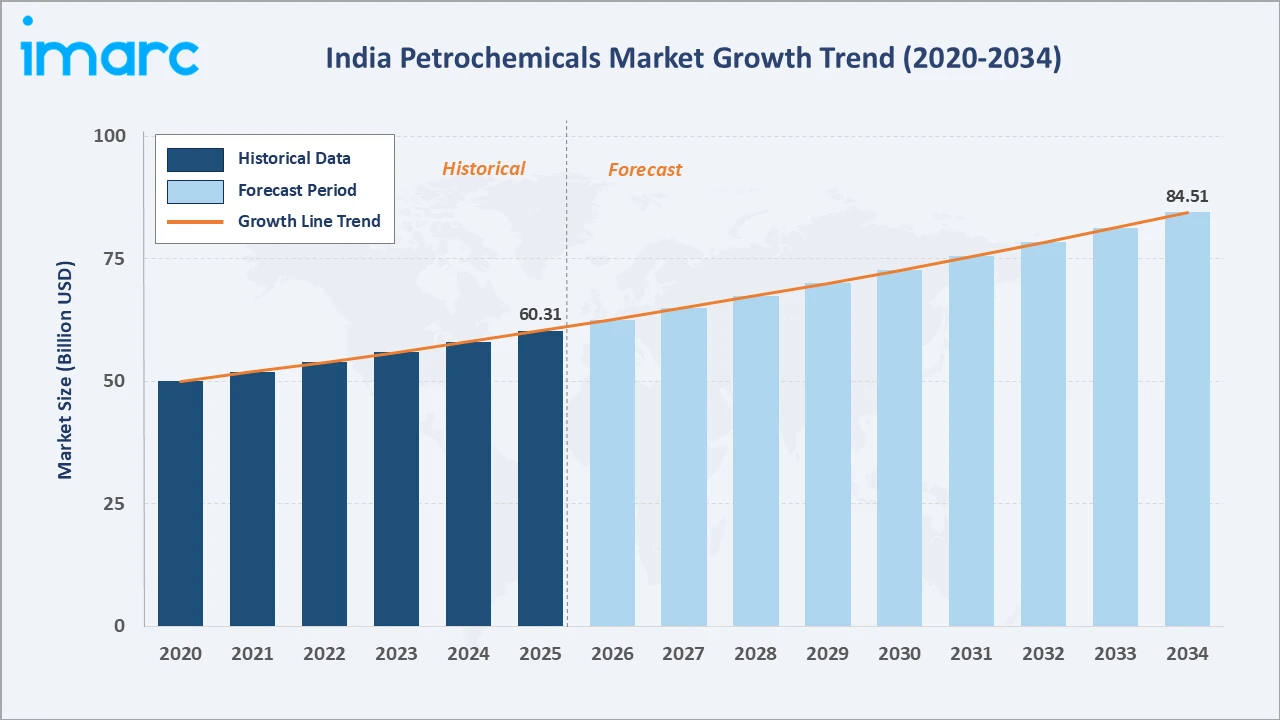
The India petrochemicals market grew from USD 60.31 Billion in 2025 to USD 62.61 Billion in 2026 and is projected to reach USD 84.51 Billion by 2034, growing at a CAGR of 3.82% during 2026-2034. Demand is widening as packaging, construction, automotive, textiles and consumer goods industries raise their consumption of polymers and chemical intermediates. Refinery integration, new cracker and aromatics capacity and expanding downstream conversion lift domestic output.
Modernization through advanced catalysts, process automation and energy-efficient plant design improves yields, while supportive policy on chemical clusters, trade protection and investment incentives keeps capital moving. Structural shifts toward import substitution and higher-grade specialty products broaden the buyer base of the petrochemicals market. Supporting growth factors include rising per-capita plastics use, infrastructure spending and steady private capacity investment. Ethylene dominates at 22.0%. Polymers lead at 55.0%. West India commands 45.0% of the regional market share.
Market Snapshot
| Metric | Value |
|---|---|
| Base Year Market Size (2025) | USD 60.31 Billion |
| Market Size (2026) | USD 62.61 Billion |
| Forecast Market Size (2034) | USD 84.51 Billion |
| CAGR (2026-2034) | 3.82% |
| Base Year | 2025 |
| Historical Period | 2020-2025 |
| Forecast Period | 2026-2034 |
| Dominant Type | Ethylene (22.0%, 2025) |
| Dominant Application | Polymers (55.0%, 2025) |
| Leading Region | West India (45.0%, 2025) |
The India petrochemicals market size increased from USD 50.00 Billion in 2020 to USD 60.31 Billion in 2025 and is estimated to reach USD 62.61 Billion in 2026. The market is further expected to grow to USD 72.74 Billion by 2030 and USD 84.51 Billion by 2034. Its commercial distinctiveness rests on large integrated refining and petrochemical complexes and a vast domestic consumption base that still imports a meaningful share of key polymers.
To get more information on this market, Request Sample
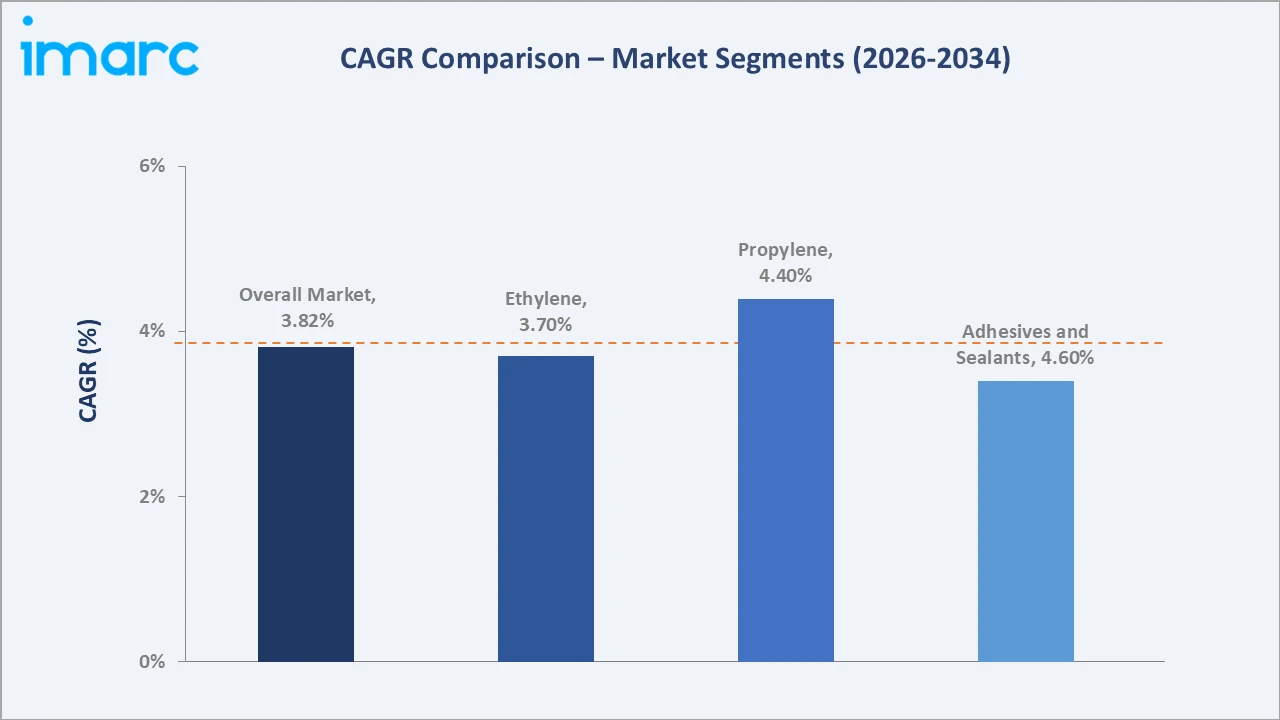
Propylene at ~4.4% CAGR and adhesives and sealants at ~4.6% CAGR are the fastest-growing sub-segments in their dimensions, the first driven by polypropylene demand in packaging and automotive parts, the second by construction and consumer assembly, reflecting a petrochemicals market moving toward higher-value downstream uses.
Executive Summary
The India petrochemicals market expanded from USD 60.31 Billion in 2025 to an estimated USD 62.61 Billion in 2026, with demand anchored in packaging, construction materials, automotive components, textiles, agriculture and consumer durables. The fastest-developing areas are propylene-based polymers, methanol derivatives and adhesives and sealants, each outpacing the wider market because they combine strong downstream conversion demand with import substitution.
Integrated refinery-petrochemical complexes, expanding cracker and aromatics capacity and a growing base of plastic processors keep the supply chain responsive, while digital process control and catalyst advances improve yields and reduce energy intensity. The market is projected to reach USD 84.51 Billion by 2034. Ethylene at 22.0% leads through its role as the core feedstock for polyethylene and glycols. Polymers at 55.0% anchors application demand, reflecting the breadth of plastic use across industries. West India leads regionally at 45.0%.
Key Market Insights
| Insight | Data |
|---|---|
| Dominant Type | Ethylene - 22.0% share (2025) |
| Dominant Application | Polymers - 55.0% market share (2025) |
| Leading Region | West India - 45.0% share (2025) |
| Market Opportunity | Import substitution, specialty polymers, methanol-based fuels, circular plastics. |
Key Analytical Observations Supporting the Above Data:
- Ethylene at 22.0%: Ethylene leads because it feeds polyethylene, ethylene glycol and PVC chains consumed across packaging, textiles and construction, and because large integrated crackers concentrate output close to refining feedstock supply, giving ethylene producers a structural cost advantage over importers.
- Polymers at 55.0%: Polymers dominate application demand because plastics replace metal, glass and paper across packaging, pipes, automotive parts and appliances, and rising household consumption keeps converter order books filling year after year.
- West India at 45.0%: West India leads because Gujarat and Maharashtra host the largest coastal refining and cracker complexes, deepwater ports for feedstock imports and the densest cluster of downstream processors, which together lower logistics costs and speed delivery to converters.
India Petrochemicals Market Overview
The India petrochemicals market is organized around large integrated refining and petrochemical complexes, standalone crackers, aromatics units, methanol and fertilizer-linked plants and a dense downstream layer of polymer converters, resin compounders and specialty chemical formulators. Feedstock comes from naphtha, natural gas, refinery off-gases and imported ethane and propane, with port-based import terminals shaping plant location.
Demand flows from packaging, construction, automotive, textiles, agriculture, healthcare and consumer goods industries, with commodity grades traded on price and specialty grades sold on technical performance. Because the country remains a net importer of several polymers and intermediates, domestic capacity additions and trade policy strongly influence pricing and competitive position. Scale, feedstock security and downstream integration decide margins, and the petrochemicals market rewards operators that combine cost-advantaged feedstock access with reliable logistics and application development support for converters.
Market Dynamics
To evaluate market opportunities, Request Sample
Market Drivers
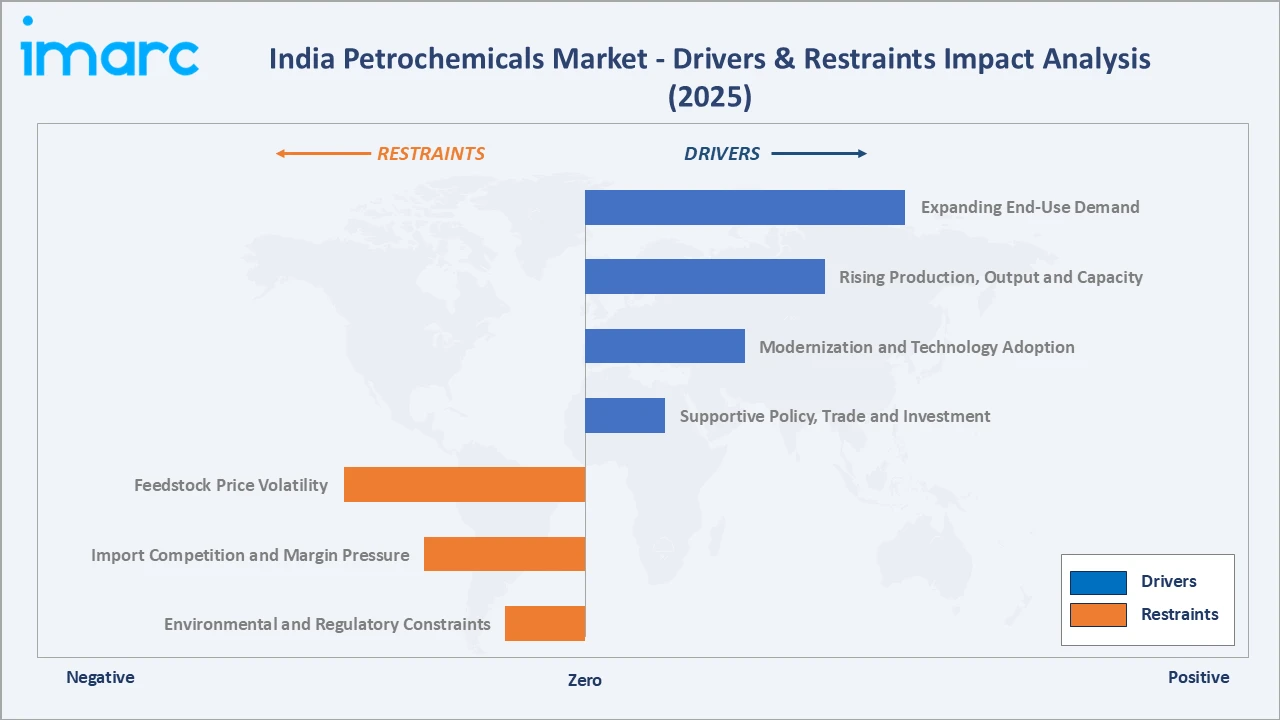
- Expanding End-Use Demand: Packaging, construction, automotive, textiles and consumer goods industries keep raising consumption of polymers, solvents and intermediates. Rising household incomes, urban housing and organized retail lift plastic use per person, while infrastructure programs consume pipes, cables and coatings. Because petrochemical products enter almost every manufactured good, this broad base provides recurring demand that grows with industrial output and consumption across the entire economy.
- Rising Production, Output and Capacity: Producers are adding cracker, polymer, aromatics and methanol capacity to reduce import dependence and serve a growing converter base. Integration with refineries lowers feedstock cost and logistics burden, while larger single-train units improve scale economics. Higher domestic output shortens delivery times for converters, stabilizes supply during global disruptions and lets producers compete more effectively against imported material in commodity grades.
- Modernization and Technology Adoption: Advanced catalysts, distributed control systems, predictive maintenance and energy integration are raising yields and cutting energy use per tonne of product. Plant operators use data analytics to optimize furnace and reactor performance, reduce unplanned shutdowns and tune product grades to converter needs. These upgrades lower unit costs, improve environmental performance and allow producers to shift output toward higher-value grades without large new capital outlays.
- Supportive Policy, Trade and Investment: Chemical and petrochemical investment regions, production-linked incentives, import duty protection and infrastructure for ports and pipelines lower the cost and risk of new capacity. Policy emphasis on self-reliance in key chemicals encourages domestic projects, while stable demand growth attracts private and public capital. These measures shorten project timelines, support downstream clusters and strengthen the long-term case for integrated investment across the value chain.
Market Restraints
- Feedstock Price Volatility: Naphtha, natural gas and imported ethane and propane prices track global energy markets, while product prices respond to regional supply and demand. When feedstock costs rise faster than polymer prices, margins compress, especially for non-integrated producers. Volatility complicates contract pricing and capital planning, and it exposes converters to input cost swings they cannot always pass on to their customers.
- Import Competition and Margin Pressure: Large new capacity in the Middle East and China sends low-cost polymers and intermediates into India, particularly during global oversupply. Domestic producers face pressure on realizations even with duty protection, and converters often favor the lowest landed price. Cyclical oversupply therefore limits pricing power and reduces returns on commodity grade capacity.
- Environmental and Regulatory Constraints: Rules on single-use plastics, emissions, effluent treatment and waste management raise compliance cost and restrict some product categories. Producers must invest in cleaner technology and reporting, and uncertainty about future restrictions complicates long-cycle investment. Extended producer responsibility obligations add cost along the chain and can slow demand growth in specific packaging applications.
Market Opportunities
- Import Substitution in Polymers and Intermediates: Domestic consumption of several polymers, glycols and aromatics still relies on imports, creating room for new capacity that replaces shipped material. Producers with feedstock access and port connectivity can capture this volume at attractive returns, supported by converter preference for shorter lead times and reliable supply. Backward integration into missing intermediates strengthens the entire downstream chain.
- Specialty and Engineering Grades: Automotive lightweighting, electrical equipment, medical devices and high-performance coatings need engineering plastics, specialty elastomers and tailored resins that India imports in large quantities. Investing in compounding, application laboratories and specialty polymer capacity lets producers move beyond commodity pricing, build customer stickiness and earn higher margins on technically differentiated products.
- Circular Plastics and Bio-Based Chemicals: Recycled-content resins, chemical recycling and bio-based intermediates are gaining demand as brand owners set sustainability targets and regulation encourages recycled content. Producers that develop certified recycled grades and secure collection partnerships can serve premium packaging buyers, diversify feedstock and reduce exposure to fossil price swings while meeting tightening environmental expectations.
Market Challenges
- High Capital Intensity and Long Project Cycles: Crackers and integrated complexes need very large capital outlays and several years from approval to commissioning. Cost overruns, land acquisition delays and financing conditions can erode returns, while demand conditions may change before capacity starts. Only well-capitalized groups can sustain such investment, which limits the pace of new entry into the industry.
- Logistics and Infrastructure Bottlenecks: Moving feedstock and products between ports, plants and converters depends on pipelines, rail, road and storage terminals that are not always sufficient. Congestion at ports and limited liquid cargo handling raise costs and delivery uncertainty, particularly for imported ethane, propane and bulk polymers serving inland demand centers.
- Skilled Workforce and Technology Dependence: Operating complex crackers and specialty units requires experienced process engineers and licensors' technology support, and many advanced catalysts and process designs are imported. Competition for talent and reliance on foreign licensors raise costs and slow indigenous innovation, limiting how quickly domestic producers can shift toward advanced products and new applications.
Emerging Market Trends
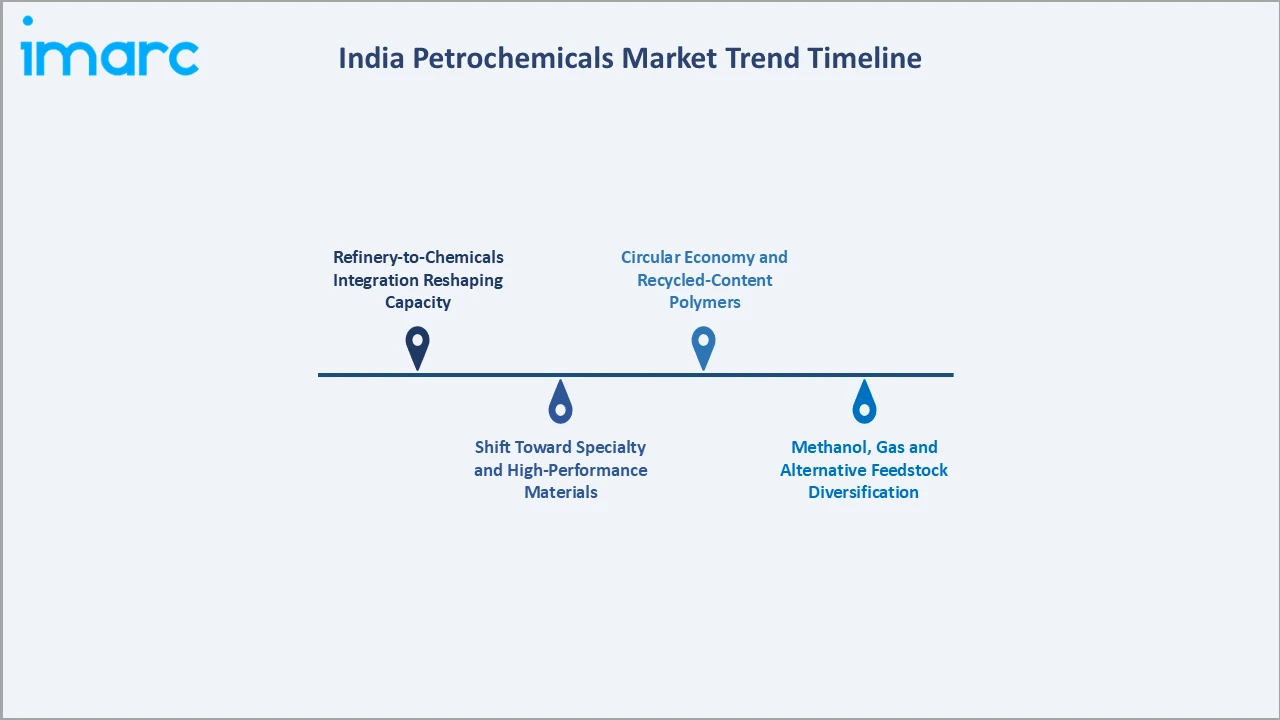
1. Refinery-to-Chemicals Integration Reshaping Capacity
Producers are linking refineries more closely to petrochemical units, converting a larger share of crude and naphtha into olefins and aromatics rather than fuels. This integration improves margins by capturing value across the chain, reduces exposure to transport fuel cycles and shortens the path from feedstock to polymer. Integrated sites also share utilities, storage and logistics, lowering operating cost per tonne. Investment decisions increasingly favor expansions at existing complexes over standalone greenfield projects, and the approach is steadily raising the domestic share of polymer and intermediate supply across the country.
2. Shift Toward Specialty and High-Performance Materials
Demand is moving beyond commodity resins toward engineering plastics, specialty elastomers, high-grade adhesives and performance coatings used in electric vehicles, electronics, medical products and infrastructure. Domestic producers are building compounding lines and application laboratories to serve these customers, replacing imported grades with locally tailored products. The shift raises average realization per tonne and builds longer customer relationships based on technical service, qualification cycles and joint development, which makes specialty volumes less exposed to the pricing swings that characterize commodity trade.
3. Circular Economy and Recycled-Content Polymers
Brand owners and regulators are pushing recycled content into packaging and consumer goods, prompting producers to develop mechanically and chemically recycled resins and to partner with collection and sorting networks. Food-grade recycled polymers require rigorous quality control and certification, which favors larger players with technical capability. The trend adds a new revenue stream, reduces reliance on virgin fossil feedstock for selected grades and positions producers to meet tightening packaging rules while serving customers with measurable sustainability commitments. Early movers that build certified supply chains gain a lead that is difficult for late entrants to close quickly.
4. Methanol, Gas and Alternative Feedstock Diversification
Producers are diversifying beyond naphtha toward natural gas, imported ethane and propane, and methanol-based routes to improve cost and supply security. Gas-based and coal-linked methanol projects, together with methanol-to-olefins interest and expanding methanol blending in fuels, are widening the feedstock slate. Diversification reduces dependence on a single energy price benchmark, supports regional production hubs near ports and pipelines, and gives the market additional flexibility to respond when relative feedstock economics shift between oil and gas. Access to alternative feedstocks also lowers exposure to crude oil price cycles that affect naphtha-based producers and their customers.
Industry Value Chain Analysis
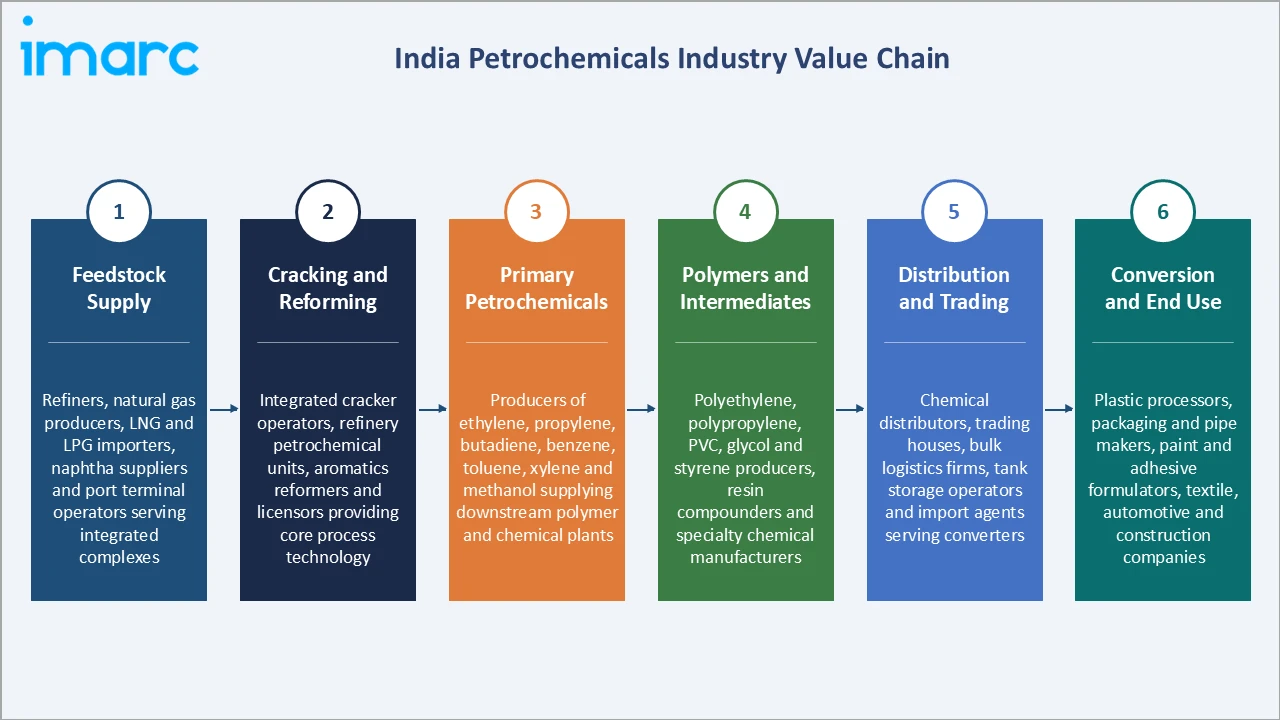
The industry value chain spans feedstock supply, cracking and reforming, primary petrochemical production, polymer and intermediate manufacturing, distribution and trading, and downstream conversion and end use. Each stage adds value by transforming hydrocarbon feedstocks into graded materials delivered to converters in specification and on schedule, with margins at each stage shaped by scale, integration and logistics proximity.
| Stage | Key Participants |
|---|---|
| Feedstock Supply | Refiners, natural gas producers, LNG and LPG importers, naphtha suppliers and port terminal operators serving integrated complexes. |
| Cracking and Reforming | Integrated cracker operators, refinery petrochemical units, aromatics reformers and licensors providing core process technology. |
| Primary Petrochemicals | Producers of ethylene, propylene, butadiene, benzene, toluene, xylene and methanol supplying downstream polymer and chemical plants. |
| Polymers and Intermediates | Polyethylene, polypropylene, PVC, glycol and styrene producers, resin compounders and specialty chemical manufacturers. |
| Distribution and Trading | Chemical distributors, trading houses, bulk logistics firms, tank storage operators and import agents serving converters. |
| Conversion and End Use | Plastic processors, packaging and pipe makers, paint and adhesive formulators, textile, automotive and construction companies. |
Primary petrochemical production is the most commercially critical stage, because feedstock access, scale and integration at the cracker decide cost position for every downstream product and determine which producers can compete when import prices fall. Producers that control multiple adjacent stages capture a larger share of total chain value and are better positioned to weather commodity cycles, price swings and shifts in converter demand across the market.
Technology Landscape in the India Petrochemicals Industry
Steam Cracking and Advanced Furnace Technology
Steam crackers convert naphtha, ethane and propane into ethylene and propylene, and modern furnace designs with improved coil geometry and heat recovery raise olefin yield while cutting fuel use. Feed-flexible crackers can switch between liquid and gas feeds as relative prices change, protecting margins. Advanced control systems stabilize run length and reduce coking, lowering unplanned shutdowns. Producers increasingly retrofit older units with these upgrades to extend asset life and improve emissions performance.
Catalytic Reforming and Aromatics Processing
Catalytic reformers and aromatics complexes produce benzene, toluene and xylene from naphtha and refinery streams, using continuous catalyst regeneration and selective separation to raise purity and yield. Transalkylation and isomerization units shift product mix toward the most valuable aromatics, notably paraxylene for polyester. Integration with refineries lets operators balance gasoline blending against chemical output, and improved catalysts reduce hydrogen and energy consumption per tonne processed.
Polymerization and Process Catalysis
Gas-phase, slurry and loop reactors with advanced Ziegler-Natta and metallocene catalysts allow producers to tailor polyethylene and polypropylene grades for film, injection molding, pipes and fibers. Catalyst innovation widens the property range from a single plant, enabling quick grade transitions in response to converter demand. Higher activity catalysts reduce residues and improve product consistency, which matters for food packaging, medical applications and demanding automotive specifications.
Digitalization, Automation and Emissions Control
Distributed control systems, digital twins and predictive analytics monitor reactors, compressors and furnaces to anticipate failures and optimize throughput. Emissions control technology, including flare gas recovery, effluent treatment and carbon capture pilots, helps plants meet environmental norms and reduce energy intensity. Plant data platforms link production, inventory and logistics, enabling faster response to demand shifts and supporting reporting for customers who require verified environmental performance.
Market Segmentation Analysis
The report covers the following segments:
| Segment Category | Leading Segment | Market Share | Year |
|---|---|---|---|
| Type | Ethylene | 22.0% | 2025 |
| Application | Polymers | 55.0% | 2025 |
| End Use Industry | 🔒 | 🔒 | 2025 |
| Region | West India | 45.0% | 2025 |

By Type
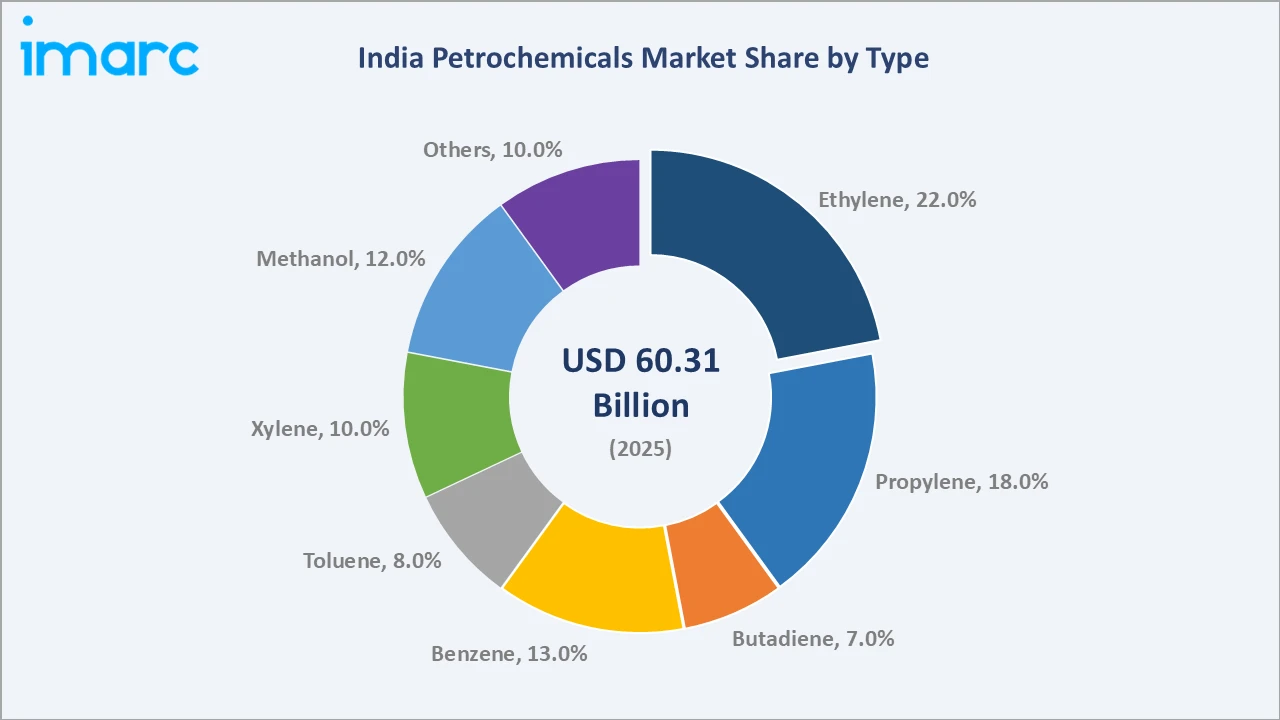
Ethylene leads at 22.0% (2025). Ethylene holds the largest share because it is the core building block for polyethylene, ethylene glycol and PVC chains used in packaging, textiles and construction. Integrated cracker scale and refinery feedstock access keep supply cost-competitive and demand broad.
To Request customized data tailored to your needs – Request Customization
Propylene is the fastest-growing type at ~4.4% CAGR. Polypropylene demand in flexible packaging, automotive parts and household goods keeps expanding, and new propane dehydrogenation and refinery propylene capacity raises availability to serve converters.
By Application
Polymers leads at 55.0% (2025). Polymers account for the largest share because plastics substitute for metal, glass and paper across packaging, pipes, automotive components and appliances, and because rising consumption and infrastructure spending keep converter demand strong across economic cycles.
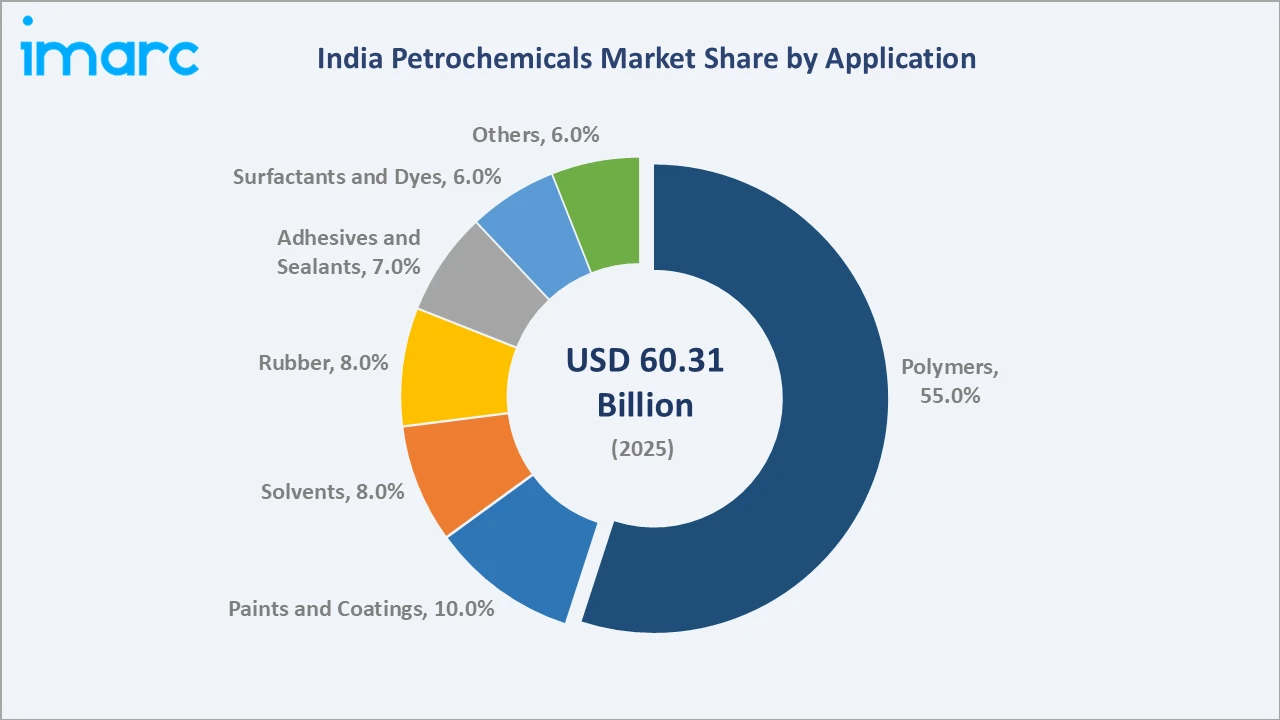
Adhesives and sealants is the fastest-growing application at ~4.6% CAGR. Construction activity, flexible packaging lamination, furniture and automotive assembly raise consumption, and formulators increasingly adopt performance resins in place of mechanical fastening.
Regional Market Insights
| Region | Share (2025) | Key Drivers & Characteristics |
|---|---|---|
| West India | 45.0% | Jamnagar, Dahej and Mumbai complexes, deepwater ports and dense downstream converter clusters. |
| South India | 22.0% | Chennai and Mangalore refining links, automotive and textile demand and growing port-based chemical terminals. |
| North India | 20.0% | Panipat petrochemical complex, large packaging and consumer goods base and strong construction demand. |
| East India | 13.0% | Haldia complex, Paradip refinery integration and expanding downstream processing near eastern ports. |
West India accounts for 45.0% of the India petrochemicals market, anchored by the large coastal refining and cracker complexes in Gujarat and Maharashtra, deepwater import terminals and the densest cluster of polymer converters in the country. The region's combination of feedstock access, port infrastructure and downstream industry depth makes it the structural center of the market. South India holds 22.0%, where refinery-linked petrochemical units, automotive manufacturing and textile demand sustain consumption of polymers and aromatics, and ongoing port-based terminal investment is widening capacity and improving import handling.
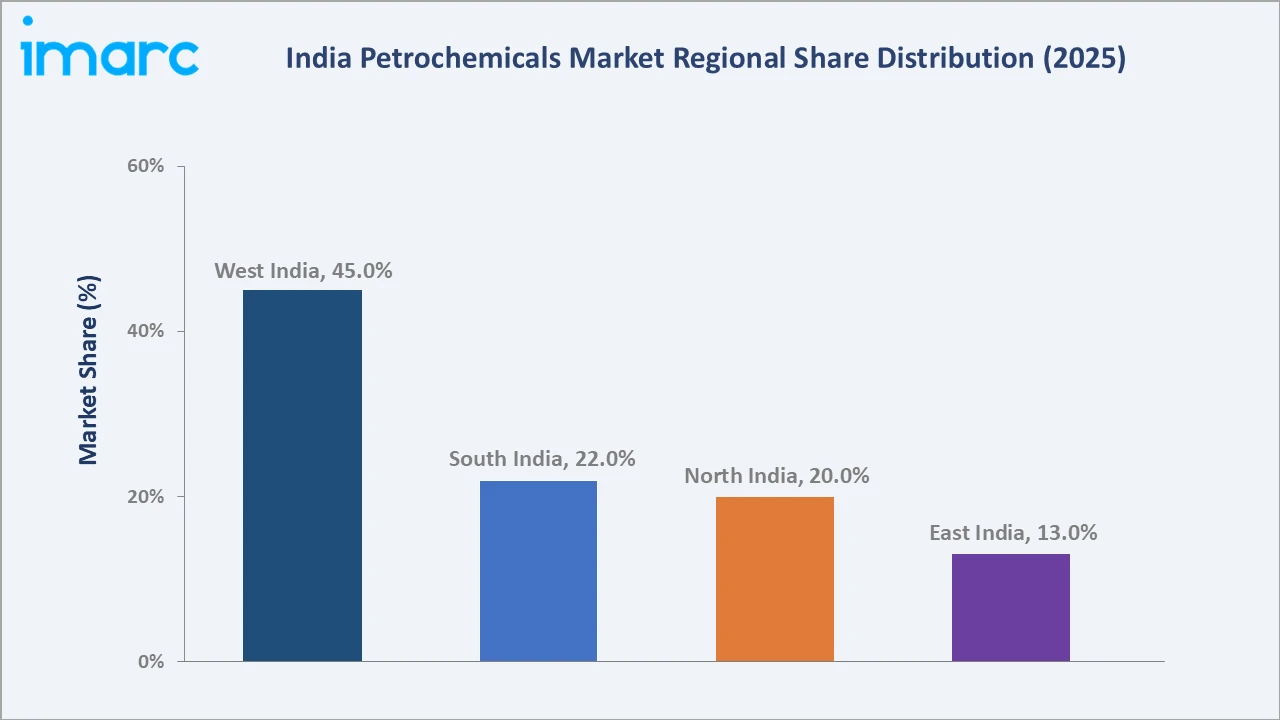
North India contributes 20.0%, supported by the Panipat complex and a large packaging and consumer goods base that generates consistent polymer demand, while strong construction activity adds steady pipe, cable and coating consumption. East India accounts for 13.0%, centered on the Haldia and Paradip complexes, where eastern port access and improving downstream investment are broadening a still smaller but steadily growing regional base, with further expansion expected as connectivity improves.
Competitive Landscape
The competitive landscape is moderately concentrated in primary petrochemicals and polymers, where a few integrated groups with owned crackers and refinery feedstock dominate, and fragmented in specialty chemicals, compounding and distribution. Competition turns on feedstock cost, integration depth, grade breadth, supply reliability and technical service to converters.
| Company | Key Offerings | Market Position | Core Strength |
|---|---|---|---|
| Reliance Industries Limited | Polymers, Polyesters | Market Leader | Largest integrated refining and petrochemical complex with unmatched scale and feedstock flexibility. |
| GAIL (India) Limited | High Density Polyethylene (HDPE) and Linear Low Density Polyethylene (LLDPE) | Established Player | integrated natural gas and petrochemical operations, supported by a strong gas transmission network and established expertise in manufacturing HDPE and LLDPE polymers. |
| Indian Oil Corporation Ltd | Polypropylene | Established Player | Integrated refining and petrochemical capabilities, supported by a diversified portfolio of polymers, synthetic fibers, and petrochemical intermediates. |
| Bharat Petroleum Corporation Limited | ISO Butanol, 2-ETHY HEXANOL | Innovator | Integrated refining and petrochemical operations, with growing capabilities in polymer production and value-added petrochemical derivatives. |
State-owned groups use refinery integration and national marketing networks to add polymer capacity, while the private leader defends share through grade breadth, export reach and downstream presence in fibers and intermediates. Imported material from the Middle East and China caps domestic pricing, so differentiation increasingly relies on supply reliability, shorter lead times and technical support rather than price alone. Converters benefit from more local sourcing options, and new capacity is gradually shifting the market from import dependence toward domestic self-sufficiency in key polymers.
Key Company Profiles
Reliance Industries Limited
Reliance Industries Limited operates India's largest integrated refining and petrochemical complex, producing olefins, aromatics, polymers, polyester and intermediates at Jamnagar and Dahej. Its scale, feedstock flexibility and downstream presence anchor domestic supply of polyethylene, polypropylene, PVC and polyester chains.
- Key Offerings: Polymers, Polyesters.
- Strategic Focus: Pursuing deeper integration, feedstock flexibility, specialty polymer growth and lower-carbon initiatives to defend its cost position across commodity and differentiated products.
GAIL (India) Limited
GAIL (India) Limited is a leading Indian natural gas and petrochemical company with an established presence in polymer manufacturing and marketing. It operates a major gas-based petrochemical complex at Pata, Uttar Pradesh, producing HDPE, LLDPE, and polypropylene. The company also markets polymer products through its subsidiary, Brahmaputra Cracker and Polymer Limited (BCPL), and is expanding its petrochemical portfolio through investments in polypropylene and PTA production. Its extensive distribution network serves packaging, agriculture, infrastructure, automotive, and other downstream industries.
- Key Offerings: High Density Polyethylene (HDPE) and Linear Low Density Polyethylene (LLDPE).
- Recent Developments: In November 2026, GAIL India Limited, through its wholly owned subsidiary GAIL Mangalore Petrochemicals Limited (GMPL), commissioned a purified terephthalic acid (PTA) manufacturing facility with an annual capacity of 1.25 million tons at the Mangalore Special Economic Zone (MSEZ) in Karnataka. The development strengthens the company's downstream petrochemical operations while contributing to India's domestic manufacturing capabilities.
- Strategic Focus: Expanding its petrochemical production capacity, diversifying its polymer portfolio, and strengthening its position in India's growing downstream plastics industry. The company is also prioritizing capacity optimization, operational efficiency, and investments in value-added petrochemical products to reduce import dependence and address rising domestic demand.
Market Concentration Analysis
The India petrochemicals market is moderately concentrated in primary petrochemicals and polymers and fragmented across specialty chemicals and distribution. Reliance Industries Limited holds the largest single position, with an estimated 30% to 38% share of domestic value, supported by integrated capacity, feedstock flexibility and broad product coverage. A group of state-owned refiners and gas companies follows, while many converters, compounders and specialty formulators divide the remainder, which keeps concentration moderate despite the dominance of the leading tier.
Two opposing forces are reshaping concentration. Incumbents are consolidating through refinery integration, capacity additions and downstream expansion that raise capital barriers for newcomers, reinforcing the advantage of large established operators. At the same time, imports, specialty-focused entrants, recycled-polymer producers and methanol-based projects are widening supply options and keeping pricing contestable, preventing tighter concentration from taking hold across the full market and preserving room for new competitors.
Investment & Growth Opportunities
Highest Growth Segments
Adhesives and sealants at ~4.6% CAGR, propylene at ~4.4% CAGR, methanol at ~4.3% CAGR and surfactants and dyes at ~4.3% CAGR lead the investment hierarchy through 2034, followed by xylene at ~4.0% CAGR. Investment concentrates there because downstream conversion demand, import substitution and higher-value specialty grades support above-market growth and better margins than commodity ethylene derivatives offer over the same period, according to the segment outlook.
Emerging Investment Opportunities
The most dynamic emerging opportunity is specialty and engineering polymer capacity that replaces imported grades used in automotive, electrical and packaging applications. It scales fastest through compounding lines and application laboratories co-located with integrated complexes, where feedstock access and customer proximity reduce unit cost, shorten qualification cycles and support the technical service relationships that lock in repeat volumes.
Investment Themes
- Import-substituting polymer capacity: New polypropylene, polyethylene and glycol units near ports capture volume currently imported, supported by converter preference for reliable domestic supply, shorter lead times and trade protection that improves project economics and investor returns.
- Specialty and engineering grades: Compounding, elastomers and performance resins serve automotive, electrical and medical customers, lifting realization per tonne and building long qualification-based relationships that provide more stable demand than commodity markets offer over time.
- Circular and recycled-content materials: Certified recycled resins and chemical recycling capacity address brand-owner targets and tightening packaging rules, creating a new premium demand stream alongside virgin production and reducing feedstock exposure to fossil price cycles.
Future Market Outlook (2026-2034)
The India petrochemicals market is projected to grow from USD 60.31 Billion in 2025 to USD 62.61 Billion in 2026, reaching USD 84.51 Billion by 2034, registering a CAGR of 3.82% during 2026-2034. The market's anchor value of USD 72.74 Billion in 2030 reflects steady compounding from packaging, construction and automotive demand rather than a single capacity wave, as import substitution and downstream conversion expand consistently across the forecast period. West India and South India sustain leadership as port access, refining integration and converter density remain strongest there, reinforcing their structural advantage over inland regions.
Three structural forces define market growth through 2034 the integration of refining with petrochemicals that lowers cost and raises domestic supply; the shift toward specialty, engineering and circular materials that lifts value per tonne; and the diversification of feedstock toward gas and methanol routes that improves supply security and reduces dependence on crude-linked naphtha pricing, helping producers manage volatility.
Research Methodology
Primary Research
Primary research covered discussions with petrochemical producers, refinery and cracker operators, polymer converters, chemical distributors and downstream formulators across India, focused on feedstock sourcing, capacity plans, pricing practice, grade requirements and logistics constraints in active supply chains. These conversations validated quantitative findings and provided ground-level perspective on investment priorities.
Secondary Research
Secondary research drew on company disclosures, government and ministry publications on chemicals and petroleum, trade association commentary, port and trade statistics and industry reporting, triangulated to establish type, application and regional splits for the India petrochemicals market. Data points were cross-checked across multiple independent sources to ensure consistency.
Forecasting Models
Forecasting combined capacity pipeline analysis with end-use consumption modeling across packaging, construction, automotive and textiles, adjusted for import dependence and feedstock economics, producing year-wise values from 2026 to 2034 reconciled to the overall market CAGR of 3.82%. Model assumptions were stress-tested against alternative demand and feedstock price scenarios.
India Petrochemicals Market Report Coverage:
| Report Features | Details |
|---|---|
| Base Year of the Analysis | 2025 |
| Historical Period | 2020-2025 |
| Forecast Period | 2026-2034 |
| Units | Billion USD |
| Scope of the Report |
Exploration of Historical Trends and Market Outlook, Industry Catalysts and Challenges, Segment-Wise Historical and Future Market Assessment:
|
| Types Covered | Ethylene, Propylene, Butadiene, Benzene, Toluene, Xylene, Methanol, Others |
| Applications Covered | Polymers, Paints and Coatings, Solvents, Rubber, Adhesives and Sealants, Surfactants and Dyes, Others |
| End Use Industries Covered | Packaging, Automotive and Transportation, Construction, Electrical and Electronics, Healthcare, Others |
| Regions Covered | North India, South India, East India, West India |
| Companies Covered | Reliance Industries Limited, GAIL (India) Limited, Indian Oil Corporation Ltd, Bharat Petroleum Corporation Limited, etc. |
| Customization Scope | 10% Free Customization |
| Post-Sale Analyst Support | 10-12 Weeks |
| Delivery Format | PDF and Excel through Email (We can also provide the editable version of the report in PPT/Word format on special request) |
Key Benefits for Stakeholders:
- IMARC’s industry report offers a comprehensive quantitative analysis of various market segments, historical and current market trends, market forecasts, and dynamics of the India petrochemicals market from 2020-2034.
- The research report provides the latest information on the market drivers, challenges, and opportunities in the India petrochemicals market.
- Porter's five forces analysis assist stakeholders in assessing the impact of new entrants, competitive rivalry, supplier power, buyer power, and the threat of substitution. It helps stakeholders to analyze the level of competition within the India petrochemicals industry and its attractiveness.
- Competitive landscape allows stakeholders to understand their competitive environment and provides an insight into the current positions of key players in the market.
Frequently Asked Questions About the India Petrochemicals Market Report
The India petrochemicals market reached USD 62.61 Billion in 2026, supported by rising demand for polymers, plastics, synthetic fibers, and specialty chemicals across key end-use industries. Expanding infrastructure and construction activities, growing automotive and packaging sectors, and investments in domestic petrochemical manufacturing capacity are further strengthening market demand.
The market is expected to register a CAGR of 3.82% during 2026-2034, driven by rising demand for polymers, synthetic fibers, plastics, and specialty petrochemicals across packaging, automotive, construction, and consumer goods industries. Additionally, expanding domestic manufacturing capacity, infrastructure development, and investments in integrated petrochemical complexes are expected to support market growth.
Ethylene leads the type segment with a 22.0% share in 2025, reflecting its role as the core feedstock for polyethylene, ethylene glycol and PVC chains, supported by large integrated crackers concentrated near refinery feedstock supply and deepwater import terminals in western India.
Polymers lead the application segment with a 55.0% share in 2025, because plastics replace metal, glass and paper across packaging, pipes, automotive parts and appliances, and steady growth in household consumption and organized retail keeps converter demand consistently strong year after year.
West India leads with a 45.0% regional share in 2025, anchored by large coastal refining and cracker complexes in Gujarat and Maharashtra, deepwater import terminals for feedstock and the densest cluster of downstream polymer converters found anywhere in the country.
Leading companies include Reliance Industries Limited, GAIL (India) Limited, Indian Oil Corporation Ltd, and Bharat Petroleum Corporation Limited, among others.
Key investment opportunities in the India petrochemicals market lie in expanding domestic production of polymers, specialty chemicals, and high-value petrochemical intermediates to reduce import dependence. Investments in integrated petrochemical complexes, advanced processing technologies, sustainable materials, and downstream manufacturing capabilities can further capitalize on rising demand from packaging, automotive, construction, and consumer goods industries.
Need more help?
- Speak to our experienced analysts for insights on the current market scenarios.
- Include additional segments and countries to customize the report as per your requirement.
- Gain an unparalleled competitive advantage in your domain by understanding how to utilize the report and positively impacting your operations and revenue.
- For further assistance, please connect with our analysts.
 Request Customization
 Speak to an Analyst
 Request Brochure
 Inquire Before Buying
Benefits of Customization
- Personalize this research
- Triangulate with your data
- Get data as per your format and definition
- Gain a deeper dive into a specific application, geography, customer, or competitor
- Any level of personalization
Get in Touch With Us
UNITED STATES
Phone: +1-201-971-6302
INDIA
Phone: +91-120-433-0800
UNITED KINGDOM
Phone: +44-753-714-6104
Email: [email protected]
Client Testimonials























Related Reports

Choose your plan
*Please note that the prices mentioned below are starting prices for each bundle type. Kindly contact our team for further details.*
Single User License
- 1 User License, Access on 2 Devices
- PDF Report + Excel Dataset (Password Protected)
- Lifetime Access
- No Printing Rights
- 10% Free Report Customization
- 10–12 Weeks of Analyst Support
Five User License
- Access for 5 Users, 2 Devices per User
- PDF Report + Excel Dataset (Password Protected)
- Lifetime Access
- Dedicated Account Manager
- 12–14 Weeks of Analyst Support
- No Printing Rights
- 15% Free Report Customization
- 25% Discount on Your Next Purchase
Corporate User License
- Unlimited User Access (Within Your Organization)
- PDF Report + Excel Dataset
- Lifetime Access
- Dedicated Account Manager
- 14–20 Weeks of Analyst Support
- No Printing Rights
- 20% Free Report Customization
- 30% Discount on Your Next Purchase
Essential Insights
What's included:
3 reports
- Lifetime Access
- PDF Reports
- Excel Datasets
- 2 Weeks of Free Analyst Support
- 2 User Licenses
- Access on 2 Devices
- Printing Rights
- Complimentary PowerPoint (PPT) Version
- Complimentary License Upgrade
Professional Access
What's included:
5 reports
- Lifetime Access
- PDF Reports
- Excel Datasets
- 8 Weeks of Free Analyst Support
- 2 User Licenses
- Access on 2 Devices
- Printing Rights
- Complimentary PowerPoint (PPT) Version
- Complimentary License Upgrade
Business Advantage
What's included:
8 reports
- Lifetime Access
- PDF Reports
- Excel Datasets
- 14 Weeks of Free Analyst Support
- 2 User Licenses
- Access on 2 Devices
- Printing Rights
- Complimentary PowerPoint (PPT) Version
- Complimentary License Upgrade
Enterprise Intelligence
What's included:
10 reports
- Lifetime Access
- PDF Reports
- Excel Datasets
- 20 Weeks of Free Analyst Support
- 2 User Licenses
- Access on 2 Devices
- Printing Rights
- Complimentary PowerPoint (PPT) Version
- Complimentary License Upgrade