
India Pilates & Yoga Studios Market Size, Share, Trends and Forecast by Activity Type, Application, and Region, 2026-2034
India Pilates & Yoga Studios Market Summary:
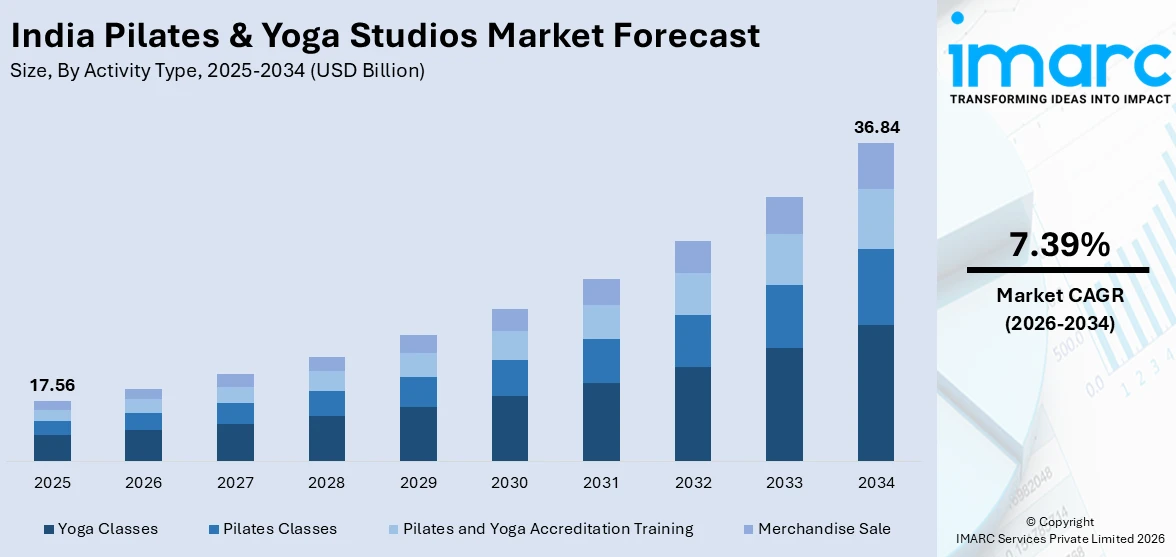
The India Pilates & yoga studios market size was valued at USD 17.56 Billion in 2025 and is projected to reach USD 36.84 Billion by 2034, growing at a compound annual growth rate of 7.39% from 2026-2034.
Pilates and yoga studios market in India is gaining momentum, underpinned by deep cultural roots in yogic traditions, a surging health-conscious population, and growing awareness of both physical and mental well-being. Government-led initiatives promoting yoga as a national wellness practice, rising disposable incomes, and the rapid expansion of boutique fitness chains are collectively reshaping the competitive landscape. The integration of digital platforms, artificial intelligence (AI)-powered training tools, and corporate wellness programs is further driving adoption, positioning India as a high-growth frontier for Pilates and yoga studios.
Key Takeaways and Insights:
- By Activity Type: Yoga classes dominate the market with a share of 53.0% in 2025, driven by India's deep cultural connection with yoga, diverse class formats catering to all skill levels, and strong government promotion through annual International Yoga Day campaigns.
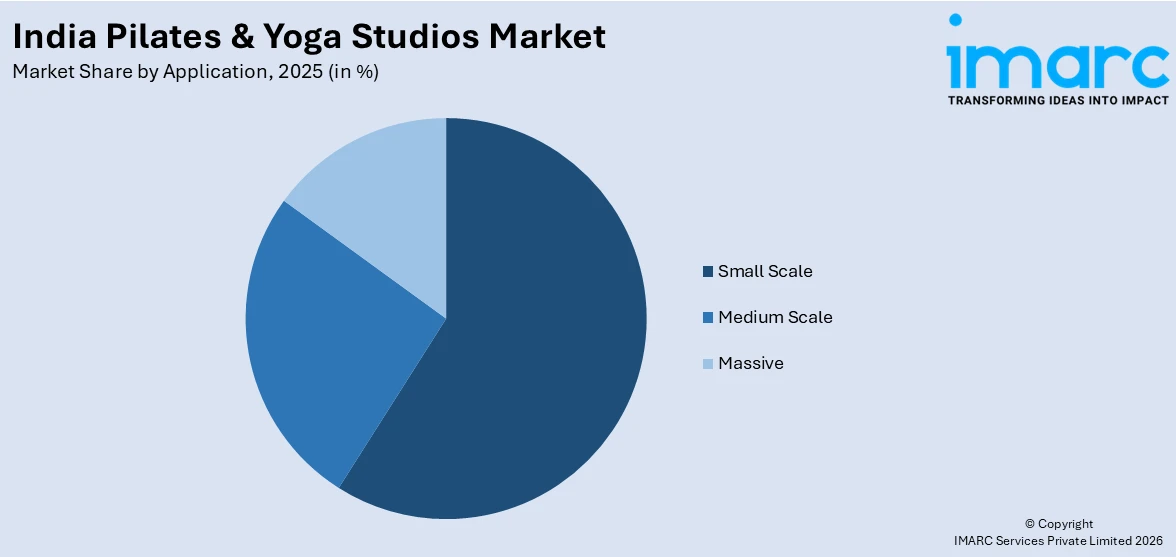
- By Application: Small scale leads the market with a share of 58.5% in 2025, reflecting the proliferation of neighborhood and boutique studios offering personalized instruction, community-driven engagement, and flexible scheduling that appeals to India's growing urban wellness consumer base.
- By Region: West India represents the largest segment with a market share of 35.0% in 2025, anchored by metro markets, such as Mumbai and Pune, where premium fitness culture, high disposable incomes, and dense concentrations of corporate wellness programs fuel consistent studio demand.
- Key Players: The India Pilates and yoga studios market features a competitive blend of domestic boutique studios, rapidly scaling franchise networks, and internationally partnered wellness brands, all competing to capture the expanding urban consumer segment through differentiated offerings and digital innovation.
To get more information on this market Request Sample
The growing individual interest in preventive healthcare and structured fitness programs is driving the demand for Pilates and yoga studios across India. Urban dwellers are increasingly prioritizing physical wellbeing, posture improvement, stress management, and long-term health maintenance through guided fitness practices rather than unstructured exercise routines. Pilates and yoga studios provide professional instruction, specialized equipment, and curated wellness environments that appeal to individuals seeking personalized fitness experiences. Rising awareness about holistic wellness, combined with higher disposable incomes in metropolitan cities, is encouraging the establishment of boutique fitness studios that combine movement training with broader lifestyle and nutrition guidance. This shift toward structured wellness services is also attracting entrepreneurs, wellness professionals, and public figures to invest in specialized fitness facilities. For instance, in 2025, Sara Tendulkar launched a new Pilates studio in Mumbai that promotes health, movement, and nutrition, drawing on her academic background in clinical and public health nutrition. Such developments reflect the increasing commercialization and professionalization of wellness-focused fitness services across India’s urban markets.
India Pilates & Yoga Studios Market Trends:
Expansion of Luxury Wellness Destinations Integrating Yoga and Pilates
The development of luxury wellness destinations that combine hospitality, spa services, and structured fitness programs is emerging as a key factor impelling the India Pilates and yoga studios market growth. Premium hotels and lifestyle properties are increasingly incorporating dedicated yoga and Pilates spaces to provide guests with comprehensive wellbeing experiences that extend beyond traditional spa offerings. These integrated wellness environments attract both domestic and international visitors seeking relaxation, preventive health support, and guided fitness routines within a single location. Reflecting this trend, in 2025, Leela Palace Hyderabad launched Nila, a four-storey wellness and spa sanctuary featuring dedicated yoga and Pilates studios, a physiotherapy suite, wellness café, and gender-specific spa floors designed to enhance holistic wellness experiences. Such developments are strengthening the presence of structured yoga and Pilates offerings within premium hospitality settings.
Rising Integration of Traditional Healthcare Systems with Yoga-Based Wellness Services
The growing integration of traditional healthcare systems with yoga and wellness practices is leading to higher demand for holistic health centers across India. People are increasingly seeking preventive and lifestyle-oriented healthcare approaches that combine physical activity with natural therapies and traditional medical practices. As a result, wellness providers are establishing centers that incorporate yoga programs alongside Ayurveda, naturopathy, and therapeutic treatments to deliver comprehensive health solutions. This approach is particularly gaining traction in regions where access to integrated healthcare services is expanding. Reflecting this trend, in 2024, Patanjali Wellness Centre opened a new facility in Guwahati offering a combination of Ayurveda, yoga, naturopathy, and wellness therapies aimed at supporting preventive healthcare and promoting holistic lifestyle management.
Growing Adoption of Digital Pilates Platforms and Home-Based Training Programs
The expansion of digital fitness platforms offering structured Pilates training is increasing accessibility to guided workouts across India. Individuals are increasingly adopting home-based fitness solutions that provide flexibility, convenience, and personalized workout plans without the need for regular studio visits. Online platforms are responding by offering extensive libraries of on-demand sessions, guided programs, and fitness challenges designed for users at different skill levels while requiring minimal equipment. This digital shift is helping broaden the reach of Pilates training beyond metropolitan studio networks. In 2025, Australian wellness platform Fluidform at Home launched its digital Pilates program in India, providing more than 400 on-demand workouts and structured programs aimed at supporting the country’s expanding home fitness and wellness community.
Market Outlook 2026-2034:
The India Pilates and yoga studios market shows significant revenue growth potential during the forecast period, driven by sustainable wellness-focused lifestyle trends and increasing institutional involvement. The market generated a revenue of USD 17.56 Billion in 2025 and is projected to reach a revenue of USD 36.84 Billion by 2034, growing at a compound annual growth rate of 7.39% from 2026-2034. Ongoing digital integration, government backing via the Ministry of Ayush, franchise network expansion into Tier 2 and Tier 3 cities, along with increasing corporate wellness investments will together maintain strong demand over the projected period.
India Pilates & Yoga Studios Market Report Segmentation:
| Segment Category | Leading Segment | Market Share |
|---|---|---|
|
Activity Type |
Yoga Classes |
53.0% |
|
Application |
Small Scale |
58.5% |
|
Region |
West India |
35.0% |
Activity Type Insights:
- Yoga Classes
- Pilates Classes
- Pilates and Yoga Accreditation Training
- Merchandise Sale
Yoga classes dominate with a market share of 53.0% of the total India Pilates & yoga studios market in 2025.
Yoga classes represent the largest segment driven by the profound cultural heritage and broad acceptance of yoga as a conventional wellness practice. Yoga has been incorporated into everyday practices for enhancing flexibility, balance, breath control, and mental calmness. Numerous people favor yoga classes as they integrate physical activity with meditation and stress-relief methods. Studios nationwide provide organized yoga classes tailored for various skill levels, allowing both novices and seasoned practitioners to participate. The increasing focus on comprehensive wellness and proactive fitness motivates individuals to incorporate yoga into their routine, solidifying its status as the most popular regimen in Pilates and yoga studios.
The prevalence of yoga classes is further fueled by heightened awareness about mental health and the advantages of mindfulness-focused physical exercises. Numerous people are embracing yoga practices that integrate bodily movement, breathing exercises, and meditation to enhance both physical well-being and emotional equilibrium. Studios are adapting by providing specialized formats, including therapeutic yoga, power yoga, and guided meditation sessions conducted by qualified instructors. In 2025, the Morarji Desai National Institute of Yoga revealed the “Yoga Bandhan” event during the International Day of Yoga festivities, uniting worldwide practitioners, scholars, and studio founders to encourage collaboration and holistic wellness approaches.
Application Insights:
Access the comprehensive market breakdown Request Sample
- Small Scale
- Medium Scale
- Massive
Small scale leads with a market share of 58.5% of the total India Pilates & yoga studios market in 2025.
Small scale holds the biggest market attributed to its accessibility, customized training methods, and capacity to meet local community fitness requirements. Numerous wellness entrepreneurs opt for creating smaller studios since they demand relatively less capital investment and lower operational expenses compared to larger fitness centers. This studio size typically emphasizes small group sessions or personalized instruction, enabling trainers to give more attention to posture, breathing techniques, and the precision of movements. This format is especially ideal for Pilates and yoga sessions that focus on guided teaching and correct posture. With the growing demand for customized wellness experiences, smaller studios continue to be a favored option in residential areas and urban settings.
The prevalence of small scale is also fueled by its adaptability in providing specialized programs designed for various customer segments. Numerous studios create classes centered around stress reduction, flexibility enhancement, rehabilitation workouts, and wellness programs for prenatal or senior participants. Its compact design enables instructors to develop closer connections with clients and foster supportive fitness communities. Furthermore, a smaller studio can modify schedules, class formats, and pricing models to better align with local demand. As awareness of holistic health methods grows and mindful fitness routines become more popular, small Pilates and yoga studios are increasingly drawing individuals in India who are looking for personalized instruction and welcoming training spaces.
Regional Insights:
- North India
- South India
- East India
- West India
West India exhibits a clear dominance with a 35.0% share of the total India Pilates & yoga studios market in 2025.
West India leads the market because of the robust urban wellness culture and a significant number of health-conscious people. Major urban centers like Mumbai, Pune, and Ahmedabad possess substantial working populations that are increasingly aware of fitness, mental health, and preventive health measures. Pilates and yoga studios are commonly embraced as organized wellness practices that promote flexibility, improve posture, alleviate stress, and enhance overall physical fitness. The increasing impact of corporate wellness initiatives and lifestyle-oriented fitness groups is promoting the establishment of specialized studios throughout the area. Increased disposable incomes and a growing desire for premium fitness experiences are driving the expansion of Pilates and yoga studios in West India.
The area's authority is bolstered by the swift growth of niche fitness studios and wellness facilities providing specialized training programs. Urban residents in West India are progressively embracing structured routines that merge traditional yoga methods with contemporary Pilates techniques to enhance both physical and mental wellness. This change is evident in industry movements, as in 2025, MindFlex Pilates Hub grew in Mumbai with a new studio in Andheri, marking its fourth spot in the city, providing tailored reformer Pilates sessions with limited class sizes. The rise of premium studios, combined with wellness events and community health programs, is boosting engagement in organized Pilates and yoga classes.
Market Dynamics:
Growth Drivers:
Why is the India Pilates & Yoga Studios Market Growing?
Expansion of Wellness Culture and Preventive Healthcare Practices
Individuals in India are progressively emphasizing preventive health measures focused on sustaining long-term physical wellness and minimizing the likelihood of lifestyle-associated health issues. Pilates and yoga are commonly seen as sustainable workout methods that enhance mobility, balance, flexibility, and muscle strength while promoting overall wellness. Organized studio-focused programs allow individuals to adhere to regular schedules with expert support, promoting sustained involvement in wellness practices. In response to the move toward proactive health management, Ekam Yoga revealed in 2025, its intention to grow its network by opening over 500 wellness centers throughout India by 2030, merging yoga instruction, eco-friendly lifestyle products, and hybrid teaching approaches to enhance access to comprehensive health and wellness solutions.
Increasing Participation Among Diverse Age Groups
Engagement in Pilates and yoga is increasing among various age demographics, contributing to the consistent growth of the market in India. These methods are well-known for their flexibility, enabling people with various fitness levels and physical abilities to participate in supervised workout sessions. Pilates and yoga provide gentle workouts that enhance flexibility, posture, balance, and core strength while minimizing stress on joints, making them ideal for young adults, working professionals, and seniors. In line with this increasing inclusivity, Pilates Tribe launched a 2,200 sq ft studio in Salt Lake, Kolkata in 2025, featuring reformers, Pilates chairs, and a Cadillac to facilitate injury-free workouts tailored for various age groups, thus encouraging wider engagement in organized Pilates sessions.
Growing Availability of Specialized Pilates Equipment in Studios
Studios across India are increasingly investing in professional Pilates apparatus to enhance the quality and effectiveness of guided training sessions. Equipment like reformers, stability chairs, and spinal correctors allows instructors to conduct controlled, equipment-assisted workouts that help participants improve core strength, flexibility, posture, and muscular balance. These tools also support the development of diverse training formats tailored for beginners, experienced practitioners, and individuals undergoing rehabilitation-focused exercise routines. Reflecting this shift, in 2025, fitness expert Yasmin Karachiwala launched a new Yasmin Karachiwala’s Body Image Pilates studio in Delhi through a franchise partnership with Sadhir Wellness Pvt. Ltd., where personalized sessions were delivered using advanced equipment, including reformers, chairs, and spinal correctors to strengthen professional Pilates training accessibility.
Market Restraints:
What Challenges the India Pilates & Yoga Studios Market is Facing?
High Qualified Instructor Costs Constraining Studio Profitability
Recruiting and retaining certified yoga and Pilates instructors with recognized accreditations represents a significant operational cost burden for Indian studios. The limited supply of highly qualified instructors in Tier 2 and Tier 3 cities restricts geographic expansion ambitions, while competitive compensation pressures in major metros erode margins for smaller studio operators with constrained pricing power.
Competition from Free and Low-Cost Digital Fitness Alternatives
The proliferation of free yoga content on video platforms and low-cost subscription apps presents a persistent challenge to physical studio attendance. Price-sensitive individuals, particularly in smaller cities and towns, may opt for self-directed digital practice over paid studio memberships, constraining market penetration in cost-conscious segments and intensifying competitive pressure on studios unable to differentiate their in-person value proposition effectively.
Real Estate Costs and Operational Overheads Limiting Studio Viability
Premium studio locations in high-footfall urban neighborhoods command substantial rental costs that place meaningful pressure on operating economics, particularly for boutique operators lacking the scale advantages of established chains. Rising utility costs, equipment maintenance, and staff wages compound these pressures. The resulting financial constraints limit the pace of new studio openings and impede the capital reinvestment necessary for service quality enhancements and technological upgrades.
Competitive Landscape:
India's Pilates and yoga studios market exhibits a dynamic competitive structure characterized by the coexistence of established domestic networks, emerging international franchise entrants, and a large base of independent boutique studios. Competition is shaped by differentiation across price positioning, instructor quality, service specialization, and digital capability. Leading market participants are investing in premium studio environments, proprietary digital platforms, and accreditation-backed instructor programs to build brand credibility and client retention. Strategic partnerships with international fitness brands are accelerating the introduction of globally recognized training methodologies into the Indian market. The growing participation of corporate wellness programs as institutional buyers is reshaping competitive priorities, with studios enhancing B2B service capabilities alongside direct-to-consumer offerings to capture this reliable revenue segment.
Recent Developments:
- March 2026: Jaipur-based Texcyle Enterprises launched a new Anti-Slip Performance Range of organic grip socks designed for yoga and Pilates studios. The collection uses eco-friendly materials, such as organic cotton, bamboo, hemp, and recycled polyester, to improve grip, durability, and comfort during workouts. The launch aims to meet rising demand for sustainable fitness accessories among global wellness brands and studio operators.
- March 2026: Akshar Yoga Kendraa launched PURANTHA, a Himalayan-origin center for advanced yoga and spiritual science in Bengaluru. The 165,000 sq ft campus is designed to train up to 100,000 yoga teachers annually while supporting research and education in yogic traditions. The facility includes spaces for meditation, pranayama, Ayurveda studies, and residential learning to promote structured global yoga training.
India Pilates & Yoga Studios Market Report Coverage:
| Report Features | Details |
|---|---|
| Base Year of the Analysis | 2025 |
| Historical Period | 2020-2025 |
| Forecast Period | 2026-2034 |
| Units | Billion USD |
| Scope of the Report |
Exploration of Historical Trends and Market Outlook, Industry Catalysts and Challenges, Segment-Wise Historical and Future Market Assessment:
|
| Activity Types Covered | Yoga Classes, Pilates Classes, Pilates and Yoga Accreditation Training, Merchandise Sale |
| Applications Covered | Small Scale, Medium Scale, Massive |
| Regions Covered | North India, South India, East India, West India |
| Customization Scope | 10% Free Customization |
| Post-Sale Analyst Support | 10-12 Weeks |
| Delivery Format | PDF and Excel through Email (We can also provide the editable version of the report in PPT/Word format on special request) |
Frequently Asked Questions About the India Pilates & Yoga Studios Market Report
The India Pilates & yoga studios market size was valued at USD 17.56 Billion in 2025.
The India Pilates & yoga studios market is expected to grow at a compound annual growth rate of 7.39% from 2026-2034 to reach USD 36.84 Billion by 2034.
Yoga classes dominate the activity type segment with a 53.0% revenue share in 2025, reflecting India's deep cultural heritage with yoga, diverse class formats serving all fitness levels, and sustained government promotion through platforms such as the annual International Day of Yoga.
Key factors driving the India Pilates and yoga studios market include the development of luxury wellness destinations integrating hospitality, spa services, and structured fitness programs. Reflecting this trend, in 2025 Leela Palace Hyderabad launched Nila, a four-storey wellness sanctuary featuring dedicated yoga and Pilates studios alongside spa, physiotherapy, and wellness facilities.
Major challenges include high qualified instructor recruitment and retention costs, intensifying competition from free and low-cost digital fitness alternatives, elevated real estate and operational overhead costs in premium urban locations, and the need to differentiate in-person studio value propositions against an increasingly crowded digital wellness landscape.
Need more help?
- Speak to our experienced analysts for insights on the current market scenarios.
- Include additional segments and countries to customize the report as per your requirement.
- Gain an unparalleled competitive advantage in your domain by understanding how to utilize the report and positively impacting your operations and revenue.
- For further assistance, please connect with our analysts.
 Request Customization
 Speak to an Analyst
 Request Brochure
 Inquire Before Buying
Benefits of Customization
- Personalize this research
- Triangulate with your data
- Get data as per your format and definition
- Gain a deeper dive into a specific application, geography, customer, or competitor
- Any level of personalization
Get in Touch With Us
UNITED STATES
Phone: +1-201-971-6302
INDIA
Phone: +91-120-433-0800
UNITED KINGDOM
Phone: +44-753-714-6104
Email: [email protected]
Client Testimonials




.webp)




.webp)













Related Reports

Choose your plan
*Please note that the prices mentioned below are starting prices for each bundle type. Kindly contact our team for further details.*
Single User License
- 1 User License, Access on 2 Devices
- PDF Report + Excel Dataset (Password Protected)
- Lifetime Access
- No Printing Rights
- 10% Free Report Customization
- 10–12 Weeks of Analyst Support
Five User License
- Access for 5 Users, 2 Devices per User
- PDF Report + Excel Dataset (Password Protected)
- Lifetime Access
- Dedicated Account Manager
- 12–14 Weeks of Analyst Support
- No Printing Rights
- 15% Free Report Customization
- 25% Discount on Your Next Purchase
Corporate User License
- Unlimited User Access (Within Your Organization)
- PDF Report + Excel Dataset
- Lifetime Access
- Dedicated Account Manager
- 14–20 Weeks of Analyst Support
- No Printing Rights
- 20% Free Report Customization
- 30% Discount on Your Next Purchase
Essential Insights
What's included:
3 reports
- Lifetime Access
- PDF Reports
- Excel Datasets
- 2 Weeks of Free Analyst Support
- 2 User Licenses
- Access on 2 Devices
- Printing Rights
- Complimentary PowerPoint (PPT) Version
- Complimentary License Upgrade
Professional Access
What's included:
5 reports
- Lifetime Access
- PDF Reports
- Excel Datasets
- 8 Weeks of Free Analyst Support
- 2 User Licenses
- Access on 2 Devices
- Printing Rights
- Complimentary PowerPoint (PPT) Version
- Complimentary License Upgrade
Business Advantage
What's included:
8 reports
- Lifetime Access
- PDF Reports
- Excel Datasets
- 14 Weeks of Free Analyst Support
- 2 User Licenses
- Access on 2 Devices
- Printing Rights
- Complimentary PowerPoint (PPT) Version
- Complimentary License Upgrade
Enterprise Intelligence
What's included:
10 reports
- Lifetime Access
- PDF Reports
- Excel Datasets
- 20 Weeks of Free Analyst Support
- 2 User Licenses
- Access on 2 Devices
- Printing Rights
- Complimentary PowerPoint (PPT) Version
- Complimentary License Upgrade