
India Precision Medicine Market Size, Share, Trends and Forecast by Product, Technology, Application, End User, and Region, 2026-2034
India Precision Medicine Market Summary:
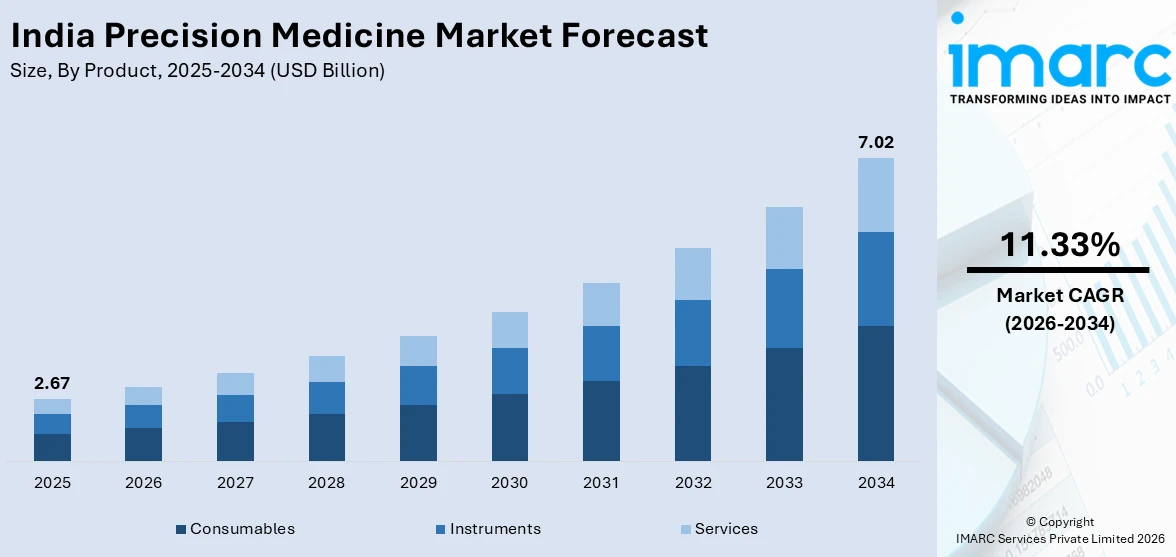
The India precision medicine market grew from USD 2.67 Billion in 2025 to USD 2.98 Billion in 2026 and is projected to reach USD 7.02 Billion by 2034, growing at a compound annual growth rate of 11.33% from 2026-2034.
The India precision medicine market is witnessing growth driven by rapid advances in genomic research, increasing adoption of targeted therapies, and strong government support for personalized healthcare initiatives. Rising prevalence of chronic and genetic diseases, the growing investments in biotechnology infrastructure, and expanding integration of artificial intelligence (AI) with clinical diagnostics are further bolstering the market momentum. The convergence of next-generation sequencing technologies, digital health platforms, and strategic industry collaborations is reshaping treatment paradigms, positioning India as an emerging hub for precision-driven healthcare innovation.
Key Takeaways and Insights:
- By Product: Consumables dominate the market with a share of 48% in 2025, driven by the expanding demand for reagents, assay kits, and sample preparation materials essential for genomic testing and molecular diagnostics across hospitals and research laboratories.
- By Technology: Gene sequencing leads the market with a share of 25% in 2025, supported by declining sequencing costs, rising adoption of next-generation sequencing platforms, and government-backed genomic research programs advancing personalized treatment across India.
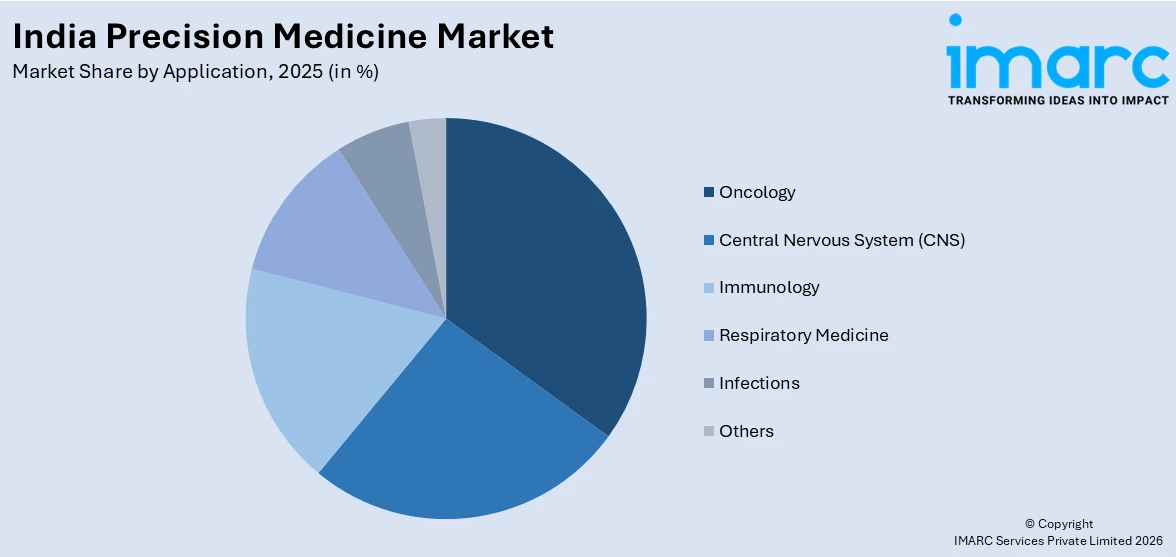
- By Application: Oncology represents the largest segment with a market share of 32% in 2025, fueled by the rising cancer burden and increasing utilization of genomic profiling for targeted therapy selection and treatment personalization.
- By End User: Hospitals and clinics dominate the market with a share of 40% in 2025, owing to the growing integration of precision diagnostics into clinical workflows, expanding infrastructure for molecular testing, and rising patient demand for personalized treatment approaches.
- Key Players: The India precision medicine market features a dynamic competitive landscape with domestic genomics companies, global diagnostics leaders, and pharmaceutical innovators collaborating to expand access to personalized healthcare solutions across the country.
To get more information on this market Request Sample
The precision medicine ecosystem in India is advancing rapidly as supportive government policies, expanding genomic research programs, digital health integration, and the growing private sector investments collectively accelerate the shift toward personalized healthcare delivery. Technological advancements in AI, next-generation sequencing, and data analytics are enabling clinicians to interpret complex molecular information with greater accuracy and speed. In 2024, Apollo Cancer Centers launched India’s first AI-Precision Oncology Centre in Bengaluru under Apollo Hospitals Enterprise Ltd, integrating genomic, clinical, and pathological data to facilitate targeted therapy selection, immunotherapy eligibility assessment, and real-time clinical insights. The center’s conversational AI tools and automated alerts enhance early intervention and patient engagement. Such institutional innovation, combined with rising cancer incidence, improved diagnostic infrastructure, and increasing awareness about individualized treatment benefits, is significantly strengthening India’s personalized medicine landscape.
India Precision Medicine Market Trends:
Rising Prevalence of Chronic and Genetic Disorders
The increasing burden of chronic diseases, rare disorders, and genetically influenced conditions in India is driving the demand for precision medicine. The growing incidence of oncology, cardiovascular diseases, metabolic syndromes, and inherited disorders necessitates targeted therapeutic approaches tailored to individual genetic profiles. According to data provided by the Indian Council of Medical Research and published in the Journal of the American Medical Association, India recorded an estimated 1.56 million new cancer cases in 2024, underscoring the magnitude of the clinical challenge. Precision medicine enables clinicians to identify disease subtypes, predict treatment response, and minimize adverse drug reactions. As disease complexity rises, conventional one-size-fits-all therapies are proving less effective, encouraging adoption of biomarker-based diagnostics and personalized interventions.
Establishment of National Biobanks and Genomic Research Infrastructure
The strengthening of national genomic research infrastructure is a key factor impelling the growth of the India precision medicine market. Large-scale biobanking initiatives enhance the availability of population-specific genetic, clinical, and lifestyle data necessary for developing targeted therapies and predictive diagnostics. For instance, in 2025, India unveiled the Phenome India National Biobank at the Institute of Genomics and Integrative Biology under the Council of Scientific and Industrial Research to conduct a nationwide longitudinal study of 10,000 individuals. By integrating genomics with AI–driven analytics, such initiatives support deeper understanding of gene-environment interactions and treatment responses, thereby accelerating the development of personalized healthcare solutions tailored to India’s diverse population.
Strategic Industry Collaborations to Expand Advanced Diagnostics
Strategic partnerships between genomics companies and diagnostic providers to share technologies and improve accessibility are significantly influencing the India precision medicine market. Collaborative models enable the integration of advanced sequencing technologies with established laboratory networks, thereby improving accessibility and scalability of personalized diagnostics. In 2025, Vgenomics and Meril Genomics announced a strategic partnership to expand access to precision medicine across India, enhancing the availability of Non-Invasive Prenatal Testing, targeted Next-Generation Sequencing for tuberculosis, and Whole Exome Sequencing for rare diseases. By combining AI-driven genomics with robust diagnostic infrastructure, such alliances facilitated early disease detection, accurate risk stratification, and individualized treatment planning, strengthening the country’s genomics-enabled healthcare ecosystem.
Market Outlook 2026-2034:
The India precision medicine market is poised for sustained growth throughout the forecast period, supported by government genomic research investments, evolving clinical adoption patterns, and increasing demand for personalized therapeutic solutions. The market generated a revenue of USD 2.67 Billion in 2025, which is expected to reach USD 2.98 Billion in 2026 and further grow to USD 7.02 Billion by 2034, at a compound annual growth rate of 11.33% during 2026-2034. Increasing cancer prevalence, expanding sequencing infrastructure, rising adoption of AI-powered diagnostics, and strengthening public-private collaborations are expected to drive higher revenue streams and establish a more mature and accessible precision medicine landscape across the country.
India Precision Medicine Market Report Segmentation:
| Segment Category | Leading Segment | Market Share |
|---|---|---|
|
Product |
Consumables |
48% |
|
Technology |
Gene Sequencing |
25% |
|
Application |
Oncology |
32% |
|
End User |
Hospitals and Clinics |
40% |
Product Insights:
- Consumables
- Instruments
- Services
Consumables dominate with a market share of 48% of the total India precision medicine market in 2025.
Consumables lead the market due to their recurring demand, essential role in diagnostics, and continuous usage across genomic and molecular testing workflows. Reagents, assay kits, sample preparation kits, and sequencing consumables are fundamental to conducting next-generation sequencing, polymerase chain reaction, and biomarker-based analyses. Unlike capital-intensive instruments, consumables require frequent replenishment, ensuring steady revenue generation and sustained market growth. Their compatibility with multiple diagnostic platforms and expanding applications in oncology, rare diseases, and pharmacogenomics further strengthen adoption. This consistent utilization across research laboratories, hospitals, and diagnostic centers positions consumables as the dominant product segment in India’s evolving precision medicine landscape.
The leadership of consumables is reinforced by increasing genetic testing awareness, rising cancer prevalence, and the growing investment in personalized healthcare solutions across India. Hospitals and diagnostic laboratories are expanding molecular testing capabilities, driving the demand for high-quality reagents and assay kits. Government initiatives supporting genomic research and biotechnology innovation further stimulate procurement of advanced consumables. Additionally, collaborations between global biotech firms and Indian research institutions accelerate product availability and technological advancement. As precision medicine adoption widens beyond metropolitan cities, the need for reliable, standardized, and cost-effective consumables continues to grow, sustaining their dominance within India’s rapidly advancing precision medicine market.
Technology Insights:
- Big Data Analytics
- Bioinformatics
- Gene Sequencing
- Drug Discovery
- Companion Diagnostics
- Others
Gene sequencing leads with a market share of 25% of the total India precision medicine market in 2025.
Gene sequencing represents the largest segment owing to its ability to provide comprehensive insights into genetic variations, disease susceptibility, and individualized treatment pathways. Advanced sequencing platforms, including next-generation sequencing, enable accurate identification of mutations, biomarkers, and inherited disorders across diverse patient populations. Gene sequencing offers higher precision, faster turnaround times, and broader genomic coverage, supporting targeted therapies and personalized drug selection. Its application in oncology, rare genetic disorders, and infectious disease management strengthens its clinical significance. This capacity to deliver data-driven, patient-specific insights positions gene sequencing as the dominant technology in India’s precision medicine landscape.
The leadership of gene sequencing is reinforced by increasing investment in genomic research, expanding biotechnology infrastructure, and growing awareness about personalized healthcare in India. Hospitals and diagnostic networks are increasingly integrating advanced sequencing platforms to enhance early diagnosis and optimize therapy selection. In 2025, Fortis Healthcare launched the Fortis Institute of Genomic Medicine, supported by Agilus Diagnostics, to deliver multidisciplinary, data-driven care across oncology and rare diseases. By leveraging next-generation sequencing, AI-enabled genomic reporting, and a genomics-informed health registry, such initiatives are redefining personalized clinical standards nationwide.
Application Insights:
Access the comprehensive market breakdown Request Sample
- Oncology
- Central Nervous System (CNS)
- Immunology
- Respiratory Medicine
- Infections
- Others
Oncology exhibits a clear dominance with a 32% share of the total India precision medicine market in 2025.
Oncology holds the biggest market share because of the rising cancer burden and the growing demand for targeted, patient-specific therapies. Precision medicine enables identification of genetic mutations, biomarkers, and molecular pathways that drive tumor development, allowing clinicians to select customized treatment strategies. Compared to conventional chemotherapy, precision oncology improves therapeutic effectiveness while reducing adverse effects. Advanced diagnostic tools such as genomic sequencing and biomarker testing support early detection and informed treatment planning. The increasing availability of targeted drugs and immunotherapies further strengthens oncology’s dominance. This ability to deliver personalized, evidence-based cancer care positions oncology as the leading application segment.
The leadership of oncology is reinforced by expanding cancer screening initiatives, stronger diagnostic capabilities, and rising acceptance of biomarker-guided therapies. Specialty hospitals are increasingly integrating molecular profiling and companion diagnostics to enable individualized treatment pathways and improve survival outcomes. In 2024, Aster DM Healthcare launched Precision Oncology Clinics, the Aster Cancer Grid, and Onco Collect software at the Aster Cancer Conclave, reinforcing a structured, data-driven approach to personalized cancer management. Such institutional advancements, combined with the growing incidence of lifestyle-related cancers and an aging population, are sustaining oncology’s dominance in precision medicine adoption across India.
End User Insights:
- Hospitals and Clinics
- Diagnostic Centers
- Pharma and Biotech Companies
- Healthcare IT Firms
- Others
Hospitals and clinics dominate with a market share of 40% of the total India precision medicine market in 2025.
Hospitals and clinics lead the market driven by their central role in diagnosis, treatment planning, and patient management. These healthcare facilities integrate genomic testing, molecular diagnostics, and biomarker analysis into routine clinical workflows to deliver personalized therapies. Compared to standalone research laboratories, hospitals and clinics have direct access to patient data, enabling faster interpretation of results and immediate therapeutic decisions. Their multidisciplinary teams, including oncologists, geneticists, and pathologists, support comprehensive precision care. Expanding infrastructure, advanced diagnostic equipment, and the growing adoption of targeted therapies further strengthen their dominance.
The segment's dominance is reinforced by the establishment of specialized precision medicine facilities within major hospital networks. For instance, in 2025, SunAct Cancer Institute and Smita Memorial Hospital launched a CAR T-Cell Therapy Centre in Kerala, emphasizing precision oncology, pediatric care, and international clinical trials, highlighting the growing institutional commitment to advanced personalized treatment delivery within the hospital setting. Government initiatives aimed at strengthening healthcare infrastructure and promoting genomic research also drive institutional adoption. Additionally, collaborations with biotechnology firms and diagnostic companies improve access to innovative testing solutions.
Regional Insights:
- North India
- West and Central India
- South India
- East and Northeast India
North India holds a significant share in the precision medicine market, driven by advanced healthcare infrastructure in Delhi NCR, Chandigarh, and Lucknow. Leading hospitals and research institutions increasingly adopt genomic sequencing and molecular diagnostics for oncology and rare disease management. Government-backed research initiatives and rising awareness of personalized healthcare further accelerate regional demand and clinical integration.
West and Central India, led by Maharashtra, Gujarat, and Madhya Pradesh, demonstrate strong growth due to expanding biotechnology hubs and multispecialty hospitals. Mumbai and Pune serve as key centers for genomic research and clinical trials. Increasing private healthcare investments and collaborations with diagnostic firms drive adoption of precision-based testing and targeted therapies.
South India remains a technology-driven leader in precision medicine, supported by robust IT infrastructure and renowned healthcare institutions in Bengaluru, Hyderabad, and Chennai. The region benefits from strong biotechnology research, advanced diagnostic laboratories, and early adoption of genomic technologies. The growing medical tourism and research collaborations further strengthen South India’s position in personalized healthcare advancement.
East and Northeast India are gradually emerging in the precision medicine market, supported by improving healthcare facilities in Kolkata, Bhubaneswar, and Guwahati. Increasing government focus on regional medical infrastructure and cancer care centers encourages adoption of molecular diagnostics. Government initiatives aimed at improving healthcare access and the growing awareness about personalized treatment approaches are gradually increasing precision medicine uptake across the region.
Market Dynamics:
Growth Drivers:
Why is the India Precision Medicine Market Growing?
Strengthening National Genomic Research for Indigenous Precision Therapies
A major factor driving the growth of the India precision medicine market is the increasing focus on developing indigenous genomic databases that accurately reflect the country’s diverse population structure. Building local genetic reference frameworks enhances diagnostic precision, improves prediction of drug response variability, and reduces dependence on Western-centric datasets. This approach enables more reliable identification of disease-associated variants specific to Indian populations, thereby supporting customized therapeutic strategies. For instance, in 2025, the Department of Biotechnology announced preliminary findings from the GenomeIndia Project, which sequenced 10,000 individuals. The initiative, involving institutions such as the All India Institute of Medical Sciences, identified significant genetic diversity across 83 population groups, reinforcing the need for population-specific precision healthcare solutions.
Decentralization of High-End Genomic Capabilities Across Regional Hubs
The decentralization of sophisticated genomic technologies beyond metropolitan centers is emerging as a distinct growth driver in the India precision medicine market. Establishing regionally distributed centers reduces dependency on limited urban facilities and shortens diagnostic turnaround times, thereby improving clinical decision-making efficiency. In 2025, AIIMS Jammu inaugurated the Centre for Advanced Genomics & Precision Medicine, equipped with the Illumina NextSeq 2000 and developed in collaboration with 4baseCare. By functioning as a national referral hub and extending advanced genomic testing to remote and underserved populations, such initiatives promote geographic inclusivity, strengthen institutional self-reliance, and accelerate the mainstream adoption of precision oncology services across India’s broader healthcare landscape.
Integration of Artificial Intelligence and Data Analytics
The incorporation of AI, ML, and advanced data analytics into healthcare systems is strengthening precision medicine capabilities in India. Large-scale clinical datasets, genomic information, and real-world evidence are being analyzed to identify patterns, optimize treatment pathways, and predict patient outcomes. AI-powered decision-support tools enhance diagnostic precision and therapeutic selection while reducing clinical uncertainty. Digital health records and interoperable platforms further facilitate seamless data exchange. As computational power and data infrastructure continue to improve, healthcare providers can deliver more accurate, personalized, and outcome-driven care, thereby accelerating the evolution of precision medicine frameworks nationwide.

Market Restraints:
What Challenges the India Precision Medicine Market is Facing?
High Cost of Genomic Testing Limiting Broader Accessibility
The prohibitive cost of advanced genomic testing and targeted therapies remains a significant barrier to widespread precision medicine adoption in India. Many patients, particularly those in lower-income segments and rural areas, lack the financial capacity to access comprehensive molecular profiling and personalized treatment regimens, constraining market penetration beyond urban tertiary care settings.
Limited Skilled Workforce in Genomics and Bioinformatics
The shortage of trained professionals in genomics, bioinformatics, and molecular diagnostics presents a critical challenge for scaling precision medicine across India. Interpreting complex genomic data requires specialized expertise that remains concentrated in select metropolitan institutions, limiting the decentralization of precision medicine services to smaller cities and rural healthcare facilities.
Regulatory and Data Privacy Uncertainties Impeding Market Growth
The evolving regulatory framework governing genomic data collection, storage, and sharing in India creates uncertainty for market participants. Concerns surrounding genetic data privacy, lack of standardized guidelines for genomic testing quality, and ambiguity in regulatory pathways for companion diagnostics continue to impede the pace of innovation and commercial deployment of precision medicine solutions.
Competitive Landscape:
The India precision medicine market features an increasingly dynamic and competitive landscape characterized by the presence of domestic genomics pioneers alongside established global diagnostics and pharmaceutical companies. Market participants are focusing on expanding genomic testing portfolios, strengthening bioinformatics capabilities, and forming strategic partnerships to enhance product offerings and clinical reach. Competition is further driven by investments in AI-powered diagnostic platforms, development of population-specific genomic panels, and efforts to make precision medicine more affordable and accessible across diverse healthcare settings. The market is witnessing growing emphasis on indigenous innovation, localized manufacturing of consumables, and cross-sector collaborations that are fostering a robust ecosystem for personalized healthcare delivery.
Recent Developments:
- October 2025: Gene Solutions Genomics Pte Ltd partnered with American Institute of Pathology and Laboratory Sciences (AMPATH) to launch an advanced genomics laboratory in Hyderabad, expanding access to next-generation sequencing (NGS) technologies in India. The facility will enhance precision medicine services, including non-invasive prenatal testing, early cancer screening, and personalized oncology solutions.
- July 2025: Believers Church Medical College Hospital, Thiruvalla, launched Kerala’s first integrated Precision Medicine services, combining Therapeutic Drug Monitoring, Pharmacogenomics, and Pharmacometrics to deliver personalized treatment. The initiative aimed to optimize drug dosage based on individual patient profiles, improving safety, effectiveness, and cost-efficiency.
India Precision Medicine Market Report Coverage:
| Report Features | Details |
|---|---|
| Base Year of the Analysis | 2025 |
| Historical Period | 2020-2025 |
| Forecast Period | 2026-2034 |
| Units | Billion USD |
| Scope of the Report | Exploration of Historical Trends and Market Outlook, Industry Catalysts and Challenges, Segment-Wise Historical and Future Market Assessment:
|
| Products Covered | Consumables, Instruments, Services |
| Technologies Covered | Big Data Analytics, Bioinformatics, Gene Sequencing, Drug Discovery, Companion Diagnostics, Others |
| Applications Covered | Oncology, Central Nervous System (CNS), Immunology, Respiratory Medicine, Infections, Others |
| End Users Covered | Hospitals and Clinics, Diagnostic Centers, Pharma and Biotech Companies, Healthcare IT Firms, Others |
| Regions Covered | North India, West and Central India, South India, East and Northeast India |
| Customization Scope | 10% Free Customization |
| Post-Sale Analyst Support | 10-12 Weeks |
| Delivery Format | PDF and Excel through Email (We can also provide the editable version of the report in PPT/Word format on special request) |
Frequently Asked Questions About the India Precision Medicine Market Report
The India precision medicine market size increased from USD 2.67 Billion in 2025 to USD 2.98 Billion in 2026.
The India precision medicine market is expected to grow at a compound annual growth rate of 11.33% from 2026-2034 to reach USD 7.02 Billion by 2034.
Consumables hold the largest revenue share of 48% in 2025, driven by the recurring and high-volume demand for reagents, assay kits, and sequencing cartridges essential for genomic testing and molecular diagnostics across healthcare and research settings.
Key factors driving the India precision medicine market include the rising burden of chronic and genetically influenced diseases requiring targeted therapies. According to the Indian Council of Medical Research and the Journal of the American Medical Association, India recorded 1.56 million new cancer cases in 2024, accelerating the demand for biomarker-based, personalized treatment approaches.
Major challenges include high costs of genomic testing limiting broader accessibility, shortage of trained professionals in genomics and bioinformatics, regulatory and data privacy uncertainties, limited infrastructure in rural areas, and low consumer awareness about precision medicine benefits.
Need more help?
- Speak to our experienced analysts for insights on the current market scenarios.
- Include additional segments and countries to customize the report as per your requirement.
- Gain an unparalleled competitive advantage in your domain by understanding how to utilize the report and positively impacting your operations and revenue.
- For further assistance, please connect with our analysts.
 Request Customization
 Speak to an Analyst
 Request Brochure
 Inquire Before Buying
Benefits of Customization
- Personalize this research
- Triangulate with your data
- Get data as per your format and definition
- Gain a deeper dive into a specific application, geography, customer, or competitor
- Any level of personalization
Get in Touch With Us
UNITED STATES
Phone: +1-201-971-6302
INDIA
Phone: +91-120-433-0800
UNITED KINGDOM
Phone: +44-753-714-6104
Email: [email protected]
Client Testimonials




.webp)




.webp)













Related Reports

Choose your plan
*Please note that the prices mentioned below are starting prices for each bundle type. Kindly contact our team for further details.*
Single User License
- 1 User License, Access on 2 Devices
- PDF Report + Excel Dataset (Password Protected)
- Lifetime Access
- No Printing Rights
- 10% Free Report Customization
- 10–12 Weeks of Analyst Support
Five User License
- Access for 5 Users, 2 Devices per User
- PDF Report + Excel Dataset (Password Protected)
- Lifetime Access
- Dedicated Account Manager
- 12–14 Weeks of Analyst Support
- No Printing Rights
- 15% Free Report Customization
- 25% Discount on Your Next Purchase
Corporate User License
- Unlimited User Access (Within Your Organization)
- PDF Report + Excel Dataset
- Lifetime Access
- Dedicated Account Manager
- 14–20 Weeks of Analyst Support
- No Printing Rights
- 20% Free Report Customization
- 30% Discount on Your Next Purchase
Essential Insights
What's included:
3 reports
- Lifetime Access
- PDF Reports
- Excel Datasets
- 2 Weeks of Free Analyst Support
- 2 User Licenses
- Access on 2 Devices
- Printing Rights
- Complimentary PowerPoint (PPT) Version
- Complimentary License Upgrade
Professional Access
What's included:
5 reports
- Lifetime Access
- PDF Reports
- Excel Datasets
- 8 Weeks of Free Analyst Support
- 2 User Licenses
- Access on 2 Devices
- Printing Rights
- Complimentary PowerPoint (PPT) Version
- Complimentary License Upgrade
Business Advantage
What's included:
8 reports
- Lifetime Access
- PDF Reports
- Excel Datasets
- 14 Weeks of Free Analyst Support
- 2 User Licenses
- Access on 2 Devices
- Printing Rights
- Complimentary PowerPoint (PPT) Version
- Complimentary License Upgrade
Enterprise Intelligence
What's included:
10 reports
- Lifetime Access
- PDF Reports
- Excel Datasets
- 20 Weeks of Free Analyst Support
- 2 User Licenses
- Access on 2 Devices
- Printing Rights
- Complimentary PowerPoint (PPT) Version
- Complimentary License Upgrade