
India Primary Battery Market Size, Share, Trends and Forecast by Type, End Use Industry, and Region, 2026-2034
India Primary Battery Market Summary:
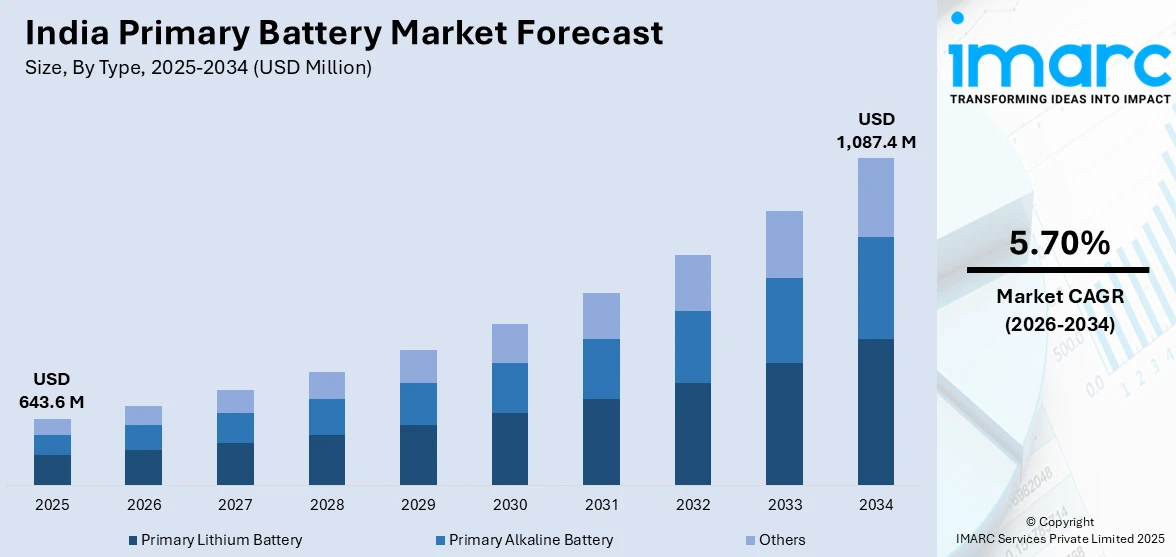
The India primary battery market size was valued at USD 643.6 Million in 2025 and is projected to reach USD 1,087.4 Million by 2034, growing at a compound annual growth rate of 5.70% from 2026-2034.
The India primary battery market is driven by rising demand across defense, medical, and aerospace applications where non-rechargeable power solutions offer critical operational advantages. Growing investments in healthcare infrastructure, increasing adoption of implantable medical devices, and expanding military modernization programs are propelling market expansion. Advancements in primary lithium battery technologies and broadening application scope are further strengthening the India primary battery market share.
Key Takeaways and Insights:
- By Type: Primary lithium battery captured the largest share in the market with 61.5% in 2025, fueled by their high energy density and long shelf life of up to ten years, and reliable voltage output that make it indispensable for critical applications across defense, medical, and aerospace sectors requiring long-lasting, maintenance-free power solutions.
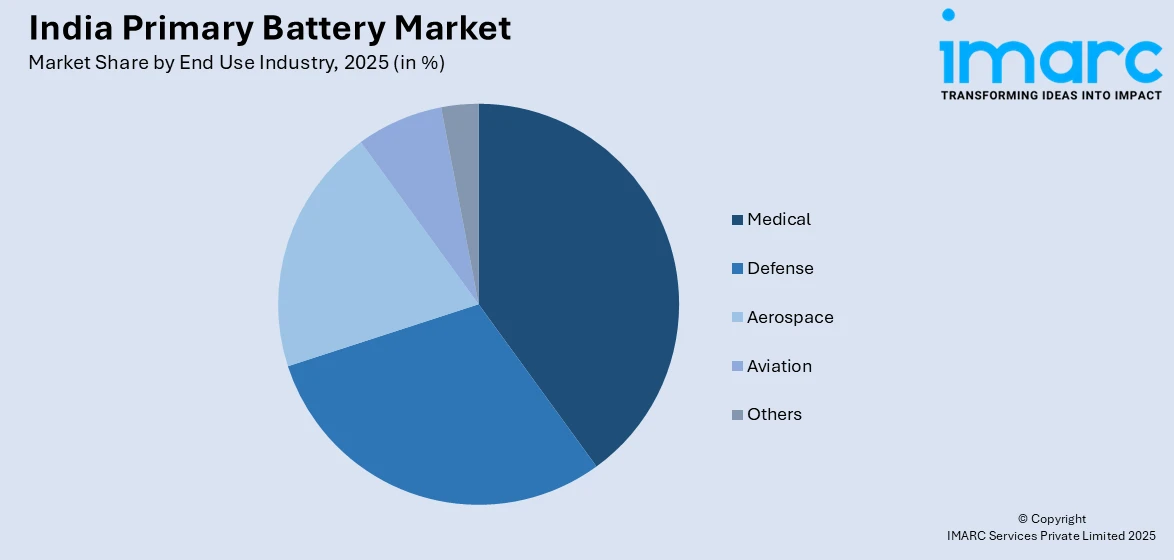
- By End Use Industry: Medical leads the market with a share of 38.4% in 2025, driven by growing demand for implantable cardiac devices, expanding healthcare infrastructure across tier two and tier three cities, and increasing prevalence of chronic diseases requiring continuous patient monitoring through battery-powered diagnostic and therapeutic equipment.
- By Region: South India comprises the largest region with 32.8% share in 2025, driven by the concentration of battery manufacturing facilities in Tamil Nadu, Karnataka, and Telangana, coupled with a thriving medical device ecosystem and robust defense research and development infrastructure supporting primary battery demand.
- Key Players: Key players drive the India primary battery market by investing in advanced lithium battery technologies, expanding domestic manufacturing capabilities, strengthening distribution networks, and forming strategic partnerships with defense and healthcare organizations to ensure reliable supply of specialized primary battery solutions across critical application segments.
To get more information on this market Request Sample
The India primary battery market is advancing as healthcare expansion, defense modernization, and aerospace development create sustained demand for reliable non-rechargeable power solutions. Primary batteries serve critical functions in implantable medical devices, military communication systems, and aviation safety equipment where recharging is impractical. India's defense budget for FY 2025-26 was allocated at INR 6.81 lakh crore, reflecting a 9.5% increase, reinforcing demand for specialized primary batteries across military applications. Additionally, the expansion of IoT-enabled devices, smart sensors, and emergency backup systems in industrial, consumer electronics, and renewable energy sectors is driving demand for high-performance, long-lasting primary batteries, supporting consistent market expansion. Apart from this, rising adoption of portable diagnostic equipment further underpins industry growth.
India Primary Battery Market Trends:
Growing Defense Modernization and Military Electronics Demand
India's defense sector is undergoing significant modernization, driving demand for high-performance primary batteries across military applications. Accordingly, India’s defense budget for FY2025-26, focused on modernization and indigenization, surpassed INR 6.8 Lakh Crore. Similarly, advanced communication systems unmanned aerial vehicles, guided munitions, and portable field equipment require reliable, long-lasting power sources that operate effectively in extreme environmental conditions. The emphasis on indigenous defense manufacturing and self-reliance in critical technologies is accelerating procurement of specialized primary batteries, particularly lithium-based chemistries designed for high-altitude, desert, and maritime deployment environments across the armed forces.
Expansion of Medical Device Manufacturing and Implantable Device Adoption
India's medical device sector is experiencing rapid expansion, bolstered by government initiatives promoting domestic manufacturing and reducing import dependence. The growing prevalence of cardiovascular diseases and the rising geriatric population are increasing demand for implantable devices such as cardiac pacemakers, defibrillators, and neurostimulators that rely on primary lithium batteries for sustained, maintenance-free operation. According to an industry report, India’s age-standardized CVD death rate is 272 per lakh, exceeding the global 235. Cardiovascular diseases account for 25–35.6% of deaths among individuals aged 30–54, with 50% of these fatalities occurring before the age of 50. Furthermore, expanding healthcare access in underserved regions and the establishment of dedicated medical device parks are further stimulating India primary battery market growth.
Rise of Portable Healthcare Equipment and Home Healthcare Solutions
The proliferation of portable medical equipment is reshaping healthcare delivery across India, driving significant demand for primary batteries. Home healthcare solutions, including portable glucose monitors, pulse oximeters, and handheld diagnostic devices, are gaining widespread adoption as patients increasingly seek convenient, cost-effective monitoring options. Primary batteries are preferred in these applications for their reliability, consistent voltage output, and extended shelf life, ensuring uninterrupted operation of critical medical equipment in settings where access to reliable electrical infrastructure remains limited.
Market Outlook 2026-2034:
The India primary battery market is positioned for sustained growth over the forecast period, driven by rising demand from defense, medical, and aerospace sectors. In tandem, increasing government investments in healthcare infrastructure, military modernization, and indigenous manufacturing capabilities are expected to create robust demand for specialized primary battery solutions. As such, under the Pradhan Mantri Ayushman Bharat Health Infrastructure Mission (PM-ABHIM), INR 4,770 Crore has been allocated in BE 2026–27, a 67.66% increase over FY 2025–26—to expand critical care blocks, public health laboratories, and district and sub-district hospital infrastructure. The expansion of medical device production under government incentive schemes, coupled with growing adoption of implantable cardiac devices and portable diagnostic equipment, is anticipated to be a major growth contributor. Additionally, continual advancements in primary lithium battery technologies, including improved energy densities and enhanced safety features, are poised to expand application possibilities across emerging industrial and consumer segments. The market generated a revenue of USD 643.6 Million in 2025 and is projected to reach a revenue of USD 1,087.4 Million by 2034, growing at a compound annual growth rate of 5.70% from 2026-2034.
India Primary Battery Market Report Segmentation:
|
Segment Category |
Leading Segment |
Market Share |
|
Type |
Primary Lithium Battery |
61.5% |
|
End Use Industry |
Medical |
38.4% |
|
Region |
South India |
32.8% |
Type Insights:
- Primary Alkaline Battery
- Primary Lithium Battery
- Others
Primary lithium battery dominates with a market share of 61.5% of the total India primary battery market in 2025.
Primary lithium batteries lead the India primary battery market owing to their exceptional energy density, stable voltage profiles, and shelf life extending up to ten years, making them the preferred choice for mission-critical applications. These batteries deliver reliable performance across extreme temperature ranges encountered in military and aerospace environments, ensuring consistent operation in high-altitude border regions and submarine systems.
The medical sector significantly contributes to primary lithium battery demand, as these batteries power critical implantable devices including cardiac pacemakers, defibrillators, cochlear implants, and neurostimulators requiring uninterrupted operation over extended periods. Lithium-thionyl chloride and lithium-manganese dioxide chemistries provide the high energy density and predictable discharge characteristics essential for life-sustaining medical equipment. In February 2025, MicroPort CRM, Andhra Pradesh MedTech Zone, and Purple MicroPort signed a memorandum of understanding to expand pacemaker manufacturing operations in India, directly supporting demand for specialized primary lithium batteries used in cardiac rhythm management devices.
End Use Industry Insights:
Access the comprehensive market breakdown Request Sample
- Defense
- Aerospace
- Medical
- Aviation
- Others
Medical leads with a share of 38.4% of the total India primary battery market in 2025.
The medical end use industry captures the largest share of the India primary battery market, fueled by the country's expanding healthcare infrastructure and rising burden of chronic diseases. Primary batteries are essential components in implantable cardiac devices, portable diagnostic equipment, and patient monitoring systems requiring reliable, long-lasting power without the possibility of recharging.
Government initiatives are accelerating domestic medical device manufacturing, creating robust demand for primary batteries integrated into locally produced equipment. For example, the Production-Linked Incentive scheme for medical devices has facilitated the commencement of 13 greenfield manufacturing plants producing equipment ranging from cardiac implants to advanced diagnostic systems. Expanding healthcare access to tier two and tier three cities is amplifying demand for portable, battery-powered medical equipment including handheld electrocardiogram monitors, glucose meters, and pulse oximeters. Dedicated medical device parks in Tamil Nadu and Andhra Pradesh are further strengthening the domestic supply chain.
Regional Insights:
- North India
- South India
- East India
- West India
South India exhibits a clear dominance with a 32.8% share of the total India primary battery market in 2025.
South India leads the market owing to its extensive battery manufacturing infrastructure and thriving medical device ecosystem across Tamil Nadu, Karnataka, Andhra Pradesh, and Telangana. The region hosts defense research establishments and specialized battery production facilities for aerospace and military applications. For instance, HBL Power Systems, headquartered in Hyderabad, operates 5 manufacturing plants across Telangana and Andhra Pradesh producing batteries for defense and aerospace. Technology hubs and medical device parks further reinforce regional leadership.
The region’s growing adoption of portable medical diagnostic equipment, implantable devices, and emergency power backup systems drives consistent consumption of reliable non-rechargeable batteries. Additionally, state-led initiatives promoting defense modernization and aerospace projects continue to attract investments in advanced battery technologies, fostering innovation and manufacturing expansion. Coupled with skilled workforce availability and strong logistics networks, these factors position South India as a strategic hub for both domestic consumption and exports of high-performance primary batteries.

Market Dynamics:
Growth Drivers:
Why is the India Primary Battery Market Growing?
Increasing Government Investment in Defense and Aerospace Modernization
India’s rising defense expenditure and focus on military modernization are driving demand for high-performance primary batteries in mission-critical operations. These batteries are essential for communication systems, night-vision devices, portable surveillance units, guided weapons, and unmanned aerial platforms that require immediate readiness without charging. Naval modernization, including submarine expansion and maritime aircraft upgrades, is increasing the need for specialized battery chemistries resilient to extreme pressure and temperature conditions. By 2040, India will operate four S5-class SSBNs and four Arihant-class submarines, alongside at least one Project-77 SSN, totaling ten nuclear submarines, surpassing the Royal Navy’s nine-boat all-nuclear fleet. High-altitude and desert deployments further require consistent performance under harsh climates, encouraging domestic research and development (R&D) in lithium-based primary battery technologies.
Rapid Growth in Medical Device Manufacturing and Healthcare Infrastructure
India’s expanding medical device manufacturing sector is driving strong demand for primary batteries in diagnostic, therapeutic, and implantable healthcare equipment. Furthermore, government incentives supporting domestic production are increasing the requirements for locally sourced battery components. The rising prevalence of cardiovascular, diabetic, and neurological disorders is driving the adoption of implantable devices, such as pacemakers, defibrillators, and cochlear implants, which rely on primary lithium batteries for long-life operation. NCBI research reports a 0.8% overall prevalence of neurodevelopmental disorders (NDDs) in South India, rising to 1.38% in children under 12, with epilepsy, learning disabilities, ADHD, language disorders, and autism being most common. Healthcare expansion in tier two and tier three cities is also increasing the usage of portable monitors, glucose meters, and handheld ultrasound systems for point-of-care diagnostics.
Expanding Aerospace and Aviation Sector Requirements
India’s rapidly growing aerospace and aviation industries are driving demand for specialized primary batteries capable of reliable performance under extreme conditions. Expansion of civil aviation fleets, regional airports, and air traffic is increasing requirements for batteries used in emergency systems, cockpit instruments, flight data recorders, locator transmitters, and cabin safety equipment. Indigenous aircraft programs, including fighter jets, transport planes, and helicopters, further support adoption. Space missions, satellite deployments, and launch vehicle development also require batteries resistant to vacuum, radiation, and temperature cycling, fostering domestic production investments.
Market Restraints:
What Challenges the India Primary Battery Market is Facing?
High Import Dependency for Critical Raw Materials
India's primary battery manufacturing sector faces significant challenges due to near-complete reliance on imported raw materials, particularly lithium, cobalt, and other critical minerals essential for battery production. The absence of commercially viable domestic mineral reserves creates supply chain vulnerabilities and exposes manufacturers to international price fluctuations and geopolitical disruptions. Extended timelines for establishing domestic mineral processing capabilities and securing overseas mining rights further complicate efforts to achieve raw material security, increasing production costs and limiting the industry's ability to scale manufacturing capacity efficiently in response to growing domestic demand.
Competition from Advanced Rechargeable Battery Technologies
The rapid advancement of secondary battery technologies, particularly lithium-ion and emerging solid-state chemistries, presents a growing competitive challenge to the primary battery market. Rechargeable batteries offer lower lifecycle costs, improved environmental sustainability, and enhanced performance characteristics that make them increasingly attractive alternatives across applications traditionally served by primary batteries. Ongoing research into novel rechargeable chemistries, including sodium-ion and lithium-sulphur technologies, threatens to further erode primary battery market share in applications where recharging infrastructure becomes more accessible and cost-effective for end users.
Environmental Concerns and Regulatory Compliance Pressures
Growing environmental awareness and increasingly stringent regulatory frameworks governing battery disposal and electronic waste management are creating compliance challenges for primary battery manufacturers. The single-use nature of primary batteries generates significant volumes of hazardous waste, attracting regulatory scrutiny and mandatory extended producer responsibility obligations. Developing adequate collection, processing, and recycling infrastructure to meet evolving environmental standards requires substantial capital investment. Rising consumer preference for sustainable, reusable energy solutions further pressures the primary battery market, compelling manufacturers to invest in developing environmentally friendly chemistries and recyclable battery designs to maintain market relevance.
Competitive Landscape:
The India primary battery market reflects a moderately consolidated competitive environment, with established domestic manufacturers and international players competing across technology categories and end-use sectors. Leading companies benefit from strong manufacturing capacity, wide distribution reach, and recognized brands, enabling dominance in consumer and industrial segments. Competition is also intensifying as firms invest in advanced lithium-based battery development, expand production facilities, and introduce specialized solutions for defense, medical devices, and aerospace applications. Furthermore, strategic focus on research and innovation is supporting the introduction of higher energy density batteries with extended shelf life and improved safety standards. Domestic players are also prioritizing backward integration and import substitution to strengthen cost competitiveness. Besides this, partnerships with defense agencies, healthcare providers, and aerospace organizations are fostering customized product development and reinforcing market positioning.
Recent Developments:
- In November 2025, Eveready Industries India launched its Ultima Lithium battery range featuring AA and AAA primary lithium batteries engineered for high-drain, tech-intensive devices. The batteries offer up to 15 times longer performance than standard alkaline batteries and an industry-leading shelf life of up to 15 years, targeting applications including drone remotes, gaming controllers, VR headsets, and security systems.
- In February 2025, MicroPort CRM, Andhra Pradesh MedTech Zone, and Purple MicroPort signed a memorandum of understanding to expand pacemaker manufacturing operations in India and surrounding nations. The strategic collaboration aims to meet increasing demand for cardiac rhythm management devices that rely on primary lithium batteries for sustained operation.
India Primary Battery Market Report Coverage:
|
Report Features |
Details |
|
Base Year of the Analysis |
2025 |
|
Historical Period |
2020-2025 |
|
Forecast Period |
2026-2034 |
|
Units |
USD Million |
|
Scope of the Report |
Exploration of Historical Trends and Market Outlook, Industry Catalysts and Challenges, Segment-Wise Historical and Future Market Assessment:
|
|
Types Covered |
Primary Alkaline Battery, Primary Lithium Battery, Others |
|
End Use Industries Covered |
Defense, Aerospace, Medical, Aviation, Others |
|
Regions Covered |
North India, South India, East India, West India |
|
Customization Scope |
10% Free Customization |
|
Post-Sale Analyst Support |
10-12 Weeks |
|
Delivery Format |
PDF and Excel through Email (We can also provide the editable version of the report in PPT/Word format on special request) |
Frequently Asked Questions About the India Primary Battery Market Report
The India primary battery market size was valued at USD 643.6 Million in 2025.
The India primary battery market is expected to grow at a compound annual growth rate of 5.70% from 2026-2034 to reach USD 1,087.4 Million by 2034.
Primary lithium battery dominated the market with a share of 61.5%, driven by its superior energy density, extended shelf life, and critical role in defense, medical, and aerospace applications requiring reliable non-rechargeable power solutions.
Key factors driving the India primary battery market include increasing defense modernization investments, expanding medical device manufacturing, growing healthcare infrastructure, rising adoption of implantable medical devices, and advancements in primary lithium battery technologies.
Major challenges include high import dependency for critical raw materials like lithium and cobalt, growing competition from advanced rechargeable battery technologies, environmental concerns related to single-use battery disposal, and increasing regulatory compliance pressures for waste management
Need more help?
- Speak to our experienced analysts for insights on the current market scenarios.
- Include additional segments and countries to customize the report as per your requirement.
- Gain an unparalleled competitive advantage in your domain by understanding how to utilize the report and positively impacting your operations and revenue.
- For further assistance, please connect with our analysts.
 Request Customization
 Speak to an Analyst
 Request Brochure
 Inquire Before Buying
Benefits of Customization
- Personalize this research
- Triangulate with your data
- Get data as per your format and definition
- Gain a deeper dive into a specific application, geography, customer, or competitor
- Any level of personalization
Get in Touch With Us
UNITED STATES
Phone: +1-201-971-6302
INDIA
Phone: +91-120-433-0800
UNITED KINGDOM
Phone: +44-753-714-6104
Email: [email protected]
Client Testimonials




.webp)




.webp)













Related Reports

Choose your plan
*Please note that the prices mentioned below are starting prices for each bundle type. Kindly contact our team for further details.*
Single User License
- 1 User License, Access on 2 Devices
- PDF Report + Excel Dataset (Password Protected)
- Lifetime Access
- No Printing Rights
- 10% Free Report Customization
- 10–12 Weeks of Analyst Support
Five User License
- Access for 5 Users, 2 Devices per User
- PDF Report + Excel Dataset (Password Protected)
- Lifetime Access
- Dedicated Account Manager
- 12–14 Weeks of Analyst Support
- No Printing Rights
- 15% Free Report Customization
- 25% Discount on Your Next Purchase
Corporate User License
- Unlimited User Access (Within Your Organization)
- PDF Report + Excel Dataset
- Lifetime Access
- Dedicated Account Manager
- 14–20 Weeks of Analyst Support
- No Printing Rights
- 20% Free Report Customization
- 30% Discount on Your Next Purchase
Essential Insights
What's included:
3 reports
- Lifetime Access
- PDF Reports
- Excel Datasets
- 2 Weeks of Free Analyst Support
- 2 User Licenses
- Access on 2 Devices
- Printing Rights
- Complimentary PowerPoint (PPT) Version
- Complimentary License Upgrade
Professional Access
What's included:
5 reports
- Lifetime Access
- PDF Reports
- Excel Datasets
- 8 Weeks of Free Analyst Support
- 2 User Licenses
- Access on 2 Devices
- Printing Rights
- Complimentary PowerPoint (PPT) Version
- Complimentary License Upgrade
Business Advantage
What's included:
8 reports
- Lifetime Access
- PDF Reports
- Excel Datasets
- 14 Weeks of Free Analyst Support
- 2 User Licenses
- Access on 2 Devices
- Printing Rights
- Complimentary PowerPoint (PPT) Version
- Complimentary License Upgrade
Enterprise Intelligence
What's included:
10 reports
- Lifetime Access
- PDF Reports
- Excel Datasets
- 20 Weeks of Free Analyst Support
- 2 User Licenses
- Access on 2 Devices
- Printing Rights
- Complimentary PowerPoint (PPT) Version
- Complimentary License Upgrade