
India Printer Market Size, Share, Trends and Forecast by Printer Type, Technology Type, Printer Interface, End User and Region, 2026-2034
India Printer Market Summary:
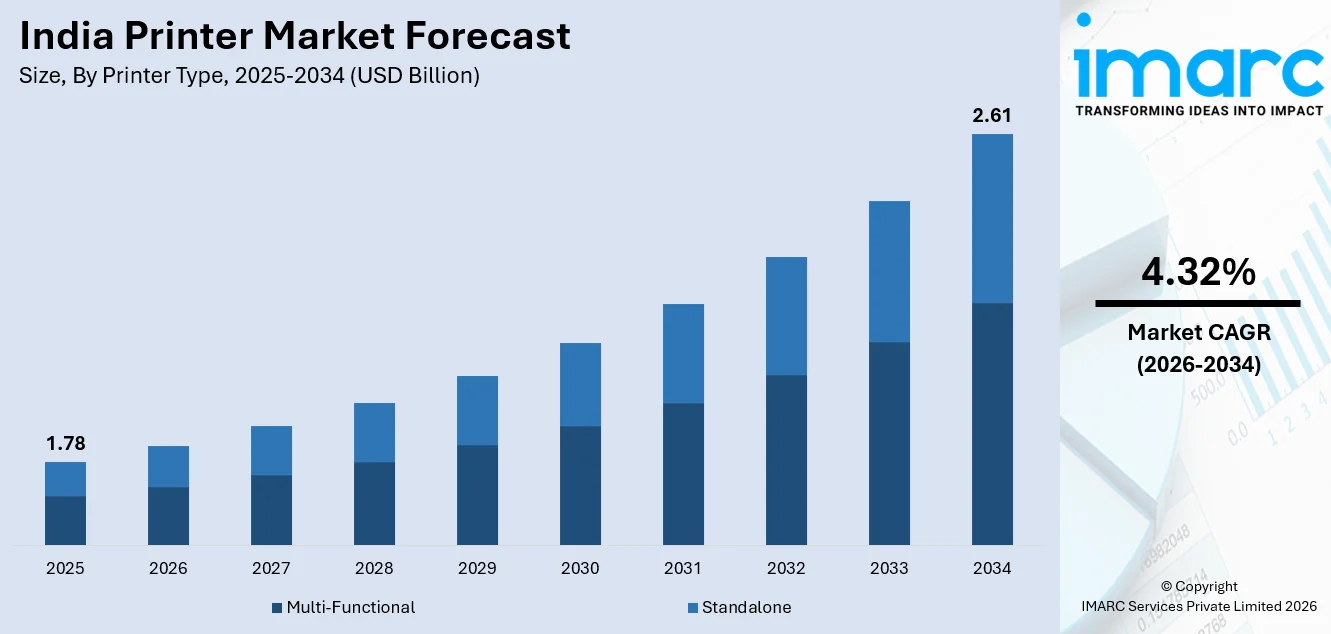
The India printer market grew from USD 1.78 Billion in 2025 to USD 1.86 Billion in 2026 and is projected to reach USD 2.61 Billion by 2034, growing at a compound annual growth rate of 4.32% from 2026-2034.
The India printer market is gaining strong momentum as businesses, educational institutions, and government bodies accelerate the adoption of advanced printing technologies. Rapid digitalization, expanding hybrid and remote work models, and growing e-commerce activity are collectively driving demand for diverse printing solutions. Increasing government investment in digitization programs, rising MSME documentation requirements, and the proliferation of multifunction printers integrating print, scan, copy, and fax capabilities in compact, cost-efficient devices are reinforcing the India printer market share. The shift toward wireless, cloud-enabled, and mobile printing is further reshaping how enterprises and individuals engage with printing infrastructure across the country.
Key Takeaways and Insights:
- By Printer Type: Multi-functional dominates the market with a share of 58% in 2025, preferred for integrating print, scan, copy, and fax capabilities in a single cost-efficient device.
- By Technology Type: Laser printer leads the market with a share of 40% in 2025, valued for high-speed, high-volume output and lower per-page costs in enterprise and institutional settings.
- By Printer Interface: Wired represents the largest segment with a market share of 55% in 2025, underpinned by stable, secure connectivity requirements across established enterprise and government networks.
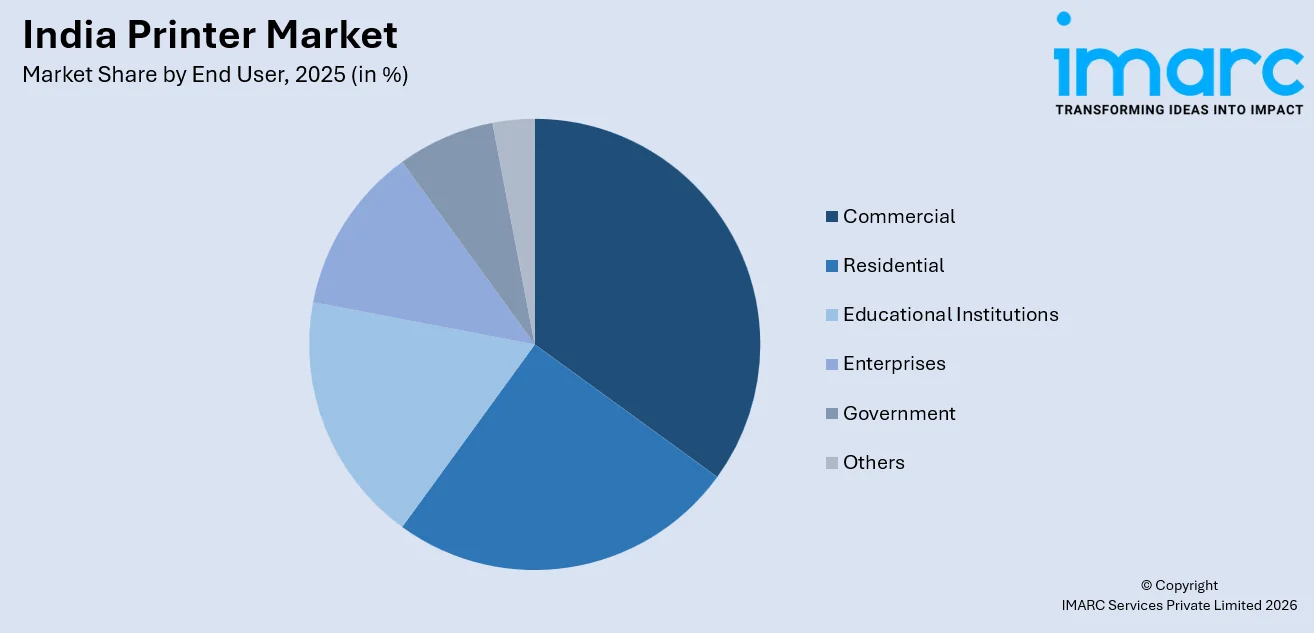
- By End User: Commercial dominate the market with a share of 32% in 2025, driven by large-scale digital documentation needs and multi-user printing infrastructure across corporate organizations.
- Key Players: The India printer market is highly competitive, with leading global and domestic players continuously expanding and diversifying their product portfolios, investing in local manufacturing capabilities under government-backed initiatives, and forming strategic partnerships to strengthen distribution networks and capture growing demand across enterprise, SME, educational, and residential end-user segments.
To get more information on this market Request Sample
The India printer market is advancing as the country undergoes rapid digital transformation backed by government-led initiatives and growing enterprise demand. The market is characterized by strong competition among global manufacturers actively localizing manufacturing and distribution. Notably, in July 2025, Seiko Epson Corporation inaugurated its first ink-tank printer manufacturing facility in Chennai to locally produce EcoTank printers, supporting the government’s ‘Make in India’ initiative and strengthening domestic supply capabilities. Rising adoption of eco-friendly ink-tank printers is reshaping purchasing behavior across SME and household segments, while multi-function devices that consolidate printing, scanning, copying, and faxing into compact units are seeing particularly strong uptake. Ongoing digitization programs for schools, government offices, and healthcare facilities are expanding the addressable base, supporting sustained India printer market growth across all regions and end-user categories.
India Printer Market Trends:
Rising Adoption of Multifunction Printers Across Enterprise and SOHO Segments
Demand for multifunction printers continues to be a prominent driver of India printer market growth. These all-in-one devices integrate printing, scanning, copying, and faxing in a single compact unit, offering cost-effectiveness and space efficiency valued by SMEs and home-office users. For instance, in November 2025, Canon India launched its imageFORCE multifunction printer series in India, featuring AI-enabled automation, cloud-ready integration, and advanced security to improve document workflows and workplace productivity. Advanced wireless connectivity, cloud printing, and mobile app integration are further accelerating adoption across enterprise and SOHO segments, as organizations increasingly prioritize productivity-enhancing, flexible office equipment that consolidates multiple functions without compromising performance.
Rapid Integration of Wireless and Cloud Printing Technologies
The Indian printing landscape is witnessing a marked shift toward wireless and cloud-enabled solutions, driven by smartphone proliferation, rising internet penetration, and expanding hybrid work models. Businesses are increasingly adopting mobile printing applications and cloud print services, propelling demand for printers equipped with Wi-Fi Direct, Bluetooth, and cloud connectivity features. For example, in July 2025, FUJIFILM India Pvt. Ltd. showcased its ApeosPro and Revoria multifunction printer series in India with seamless cloud integration, enabling secure remote printing, scanning, and workflow automation for modern office environments. This transition enables employees to print seamlessly from remote locations, making wireless-capable printers an essential component of modern, flexible workplace infrastructure across enterprises and commercial establishments.
Growing Demand for Eco-Friendly and Ink-Tank Printing Solutions
Environmental sustainability has become a key purchasing criterion in the India printer market, with enterprises and consumers increasingly favoring energy-efficient, low-footprint models. High-capacity ink-tank printers, which significantly reduce per-page costs and consumable waste compared to cartridge-based alternatives, are gaining widespread traction across SME and institutional segments. Reflecting this shift, in 2025, Canon Inc. announced plans to incorporate recycled steel into its multifunction devices and printers, enabling higher resource recycling rates while significantly reducing CO₂ emissions and reliance on new raw materials. India printer market growth is further supported by rising corporate adoption of recycled paper and vegetable-based inks, aligned with national sustainability goals and evolving environmental compliance requirements across industries.
Market Outlook 2026-2034:
Government-led digital programs, Make in India incentives attracting local manufacturing, and rising adoption of wireless and eco-efficient print technologies will serve as key growth catalysts over the forecast period. Expanding urban and rural digital infrastructure is expected to intensify demand for diverse printing solutions, from compact home-office models to industrial-grade units. Growing investments in education, healthcare, and public administration are further broadening the market's addressable base, supporting sustained momentum across India's diverse regions and end-user categories. The market generated a revenue of USD 1.78 Billion in 2025, which is expected to reach USD 1.86 Billion in 2026 and further grow to USD 2.61 Billion by 2034, at a compound annual growth rate of 4.32% during 2026-2034.
India Printer Market Report Segmentation:
| Segment Category | Leading Segment | Market Share |
|---|---|---|
|
Printer Type |
Multi-Functional |
58% |
|
Technology Type |
Laser Printer |
40% |
|
Printer Interface |
Wired |
55% |
|
End User |
Commercial |
32% |
Printer Type Insights:
- Multi-Functional
- Standalone
The multi-functional dominates with a market share of 58% of the total India printer market in 2025.
Multi-functional printers dominate the India printer market, commanding the largest share driven by their widespread adoption across SMEs, large enterprises, and home-office users seeking consolidated, space-efficient solutions. These all-in-one devices seamlessly integrate printing, scanning, copying, and faxing functionalities into a single compact unit, substantially reducing equipment footprint and operational expenditure. Their ability to streamline document workflows while minimizing infrastructure investments has made them an indispensable asset across diverse commercial, institutional, and government environments throughout the country.
The growing penetration of advanced features such as wireless connectivity, cloud-enabled printing, and mobile application compatibility has further accelerated multi-functional printer adoption across India's evolving digital workspace ecosystem. Businesses increasingly prioritize devices that offer seamless integration with remote work infrastructures and enterprise document management systems. Additionally, declining hardware costs combined with improved energy efficiency have lowered adoption barriers for cost-sensitive SME segments, reinforcing multi-functional printers as the preferred choice for organizations balancing operational productivity with long-term cost optimization across both metropolitan and emerging Tier-II and Tier-III markets.
Technology Type Insights:
- Dot Matrix Printer
- Inkjet Printer
- LED Printer
- Thermal Printer
- Laser Printer
The laser printer leads with a share of 40% of the total India printer market in 2025.
Laser printers account for the largest technology segment, driven by their widespread adoption across commercial, enterprise, and government end users that require high-speed, high-volume printing at competitive per-page costs. Their ability to deliver sharp monochrome and color output consistently across demanding workloads makes them the preferred choice for corporate offices, banking institutions, and public sector organizations processing large documentation volumes daily. For example, in September 2024, Canon India Pvt. Ltd. launched new imageCLASS A4 multifunction laser printers designed for corporates, SMEs, and government organizations, offering high-speed output, enhanced security, and workflow efficiency to support modern office automation needs. Ongoing product innovation is also enhancing laser printer energy efficiency, broadening their appeal among sustainability-conscious buyers.
The expanding adoption of managed print services and cloud-integrated laser printing solutions is increasingly reshaping procurement strategies across Indian enterprises. Organizations are transitioning from traditional device ownership models toward subscription-based frameworks that offer predictable cost structures, remote fleet monitoring, and proactive maintenance support. Additionally, rising demand for color laser printers within marketing, legal, and financial sectors is unlocking new revenue streams for manufacturers. Competitive pricing strategies targeting Tier-II and Tier-III city markets are further widening the addressable customer base, sustaining long-term volume growth across the segment.
Printer Interface Insights:
- Wired
- Wireless
The wired dominates with a market share of 55% of the total India printer market in 2025.
Wired connectivity remains the prevailing printer interface standard across large enterprises, government offices, educational institutions, and commercial establishments in India, where stable, secure, and consistent network printing is paramount. USB and Ethernet-connected printers deliver reliable performance with minimal latency and reduced vulnerability to connectivity disruptions, making them the default choice in environments where shared printing infrastructure is already well established. Corporate IT administrators also favor wired deployments for their simplified network management and enhanced cybersecurity compliance.
Despite growing wireless adoption, wired connectivity continues to retain its dominance in high-throughput printing environments where uninterrupted data transmission and network integrity are non-negotiable. The integration of Gigabit Ethernet interfaces in modern laser and multifunction printers has significantly enhanced data transfer speeds, supporting simultaneous multi-user printing across large organizational networks. Furthermore, stringent data security mandates within banking, defense, and public sector institutions continue to drive preference for wired configurations, as they inherently minimize exposure to unauthorized network access and wireless interception risks prevalent in shared digital environments.
End User Insights:
Access the comprehensive market breakdown Request Sample
- Residential
- Commercial
- Educational Institutions
- Enterprises
- Government
- Others
The commercial leads with a share of 32% of the total India printer market in 2025.
The commercial market is currently the largest in the India printer market, driven by the continued demand for high-volume document printing from the retail, healthcare, logistics, banking, financial services, and media industries. Commercial organizations demand a variety of printing solutions that range from high-speed laser printers for high-volume document printing to thermal printers for printing barcodes, labels, and receipts. The increased GST compliance requirements among businesses have further fueled the demand for printing in small and medium-sized commercial businesses across India.
The dominance of the commercial market is further fueled by the growing e-commerce industry, which has created a substantial new demand for commercial printers used in packaging, billing, and shipping label printing. Retailers, storage facilities, and last-mile delivery companies are increasingly setting up label and thermal printing solutions to efficiently handle the increasing number of orders. The healthcare and pharmaceutical industries are also driving the demand for commercial printers through prescription printing, patient record management, and regulatory compliance printing, thereby making the commercial market the largest and most resilient end-use segment in the India printer market.
Regional Insights:
- North India
- South India
- East India
- West India
North India holds the largest regional share of the India printer market, anchored by the high density of government ministries, large corporations, educational institutions, and commercial establishments across Delhi-NCR, Uttar Pradesh, and Punjab. Heavy government procurement for public administration, combined with a robust IT and banking sector presence, positions this region as the dominant market.
South India represents a significant and fast-growing regional market, driven by the concentration of IT companies, multinational corporations, and technology start-ups across Bengaluru, Hyderabad, and Chennai. These cities generate strong demand for advanced multifunction, wireless, and cloud-connected printing solutions. The region's expanding manufacturing base and large student population further contribute to printer adoption across enterprise, educational, and commercial segments, establishing South India as a key growth contributor to the overall India printer market.
East India, while comparatively smaller in market size, is witnessing gradual but consistent growth driven by expanding MSME activity, government-funded digital infrastructure programs, and rising urbanization across West Bengal, Odisha, and neighboring states. Increasing formalization of small businesses under GST compliance requirements is generating incremental demand for affordable desktop and multifunction printers, while state government procurement for public sector offices and educational institutions continues to support steady market development across the region.
West India benefits from its strong manufacturing, financial services, and trading ecosystem, particularly across Maharashtra and Gujarat, creating consistent enterprise and commercial demand for high-volume printing equipment. Mumbai's concentration of banking, insurance, and media companies drives adoption of advanced laser and multifunction solutions, while Gujarat's thriving MSME and export-oriented manufacturing sector sustains demand for industrial and commercial printers.

Market Dynamics:
Growth Drivers:
Why is the India Printer Market Growing?
Government Digitization Programs and Make in India Initiatives
India’s national digitization agenda is a key structural driver of the printer market, boosting documentation, compliance, and administrative printing across government and regulated sectors. GST compliance, MSME formalization, and digital governance initiatives have generated steady demand for printing solutions among small businesses and public organizations. Concurrently, Make in India incentives have encouraged global manufacturers to localize assembly and production, enhancing supply availability and reducing costs across product categories. Together, these factors are sustaining market growth while improving accessibility and affordability of printers nationwide.
Expansion of the Education Sector and Rising E-Commerce Packaging Demand
India's rapidly expanding education sector is generating sustained demand for printers across schools, colleges, and universities, supported by government infrastructure upgrades and institutional procurement of multifunction devices. For example, in November 2025, Sharp Business Systems (India) Pvt. Ltd. showcased its managed print solutions specifically designed for schools and universities at DIDAC India 2025, highlighting technologies aimed at improving document management, classroom collaboration, and administrative efficiency across educational institutions. Simultaneously, the explosive growth of the e-commerce sector is creating incremental demand for commercial and industrial printers serving packaging, labeling, and invoice printing requirements. The growing ecosystem of direct-to-consumer brands and small online sellers is further broadening demand for affordable desktop printing solutions across commercial and residential segments.
Rise of Hybrid Work Culture and Home Office Printing Demand
The structural shift toward hybrid and remote work arrangements has created a durable new demand segment for home-office printers across India. Professionals working from home require reliable, affordable, and versatile printing solutions offering wireless connectivity, mobile app compatibility, and low operating costs. In September 2025, Brother International India Pvt. Ltd. launched six new ink-tank printers in Delhi targeting home users, offices, and SMBs, featuring wireless connectivity, auto duplex printing, and spill-free refill technology to support flexible home and hybrid work environments. The proliferation of compact multifunction and ink-tank printers optimized for home-office environments has lowered the cost barrier to printer ownership, expanding the addressable residential market and establishing home-office printing as a structural component of India printer market growth.
Market Restraints:
What Challenges the India Printer Market is Facing?
Accelerating Shift Toward Paperless Digital Workflows
The increasing adoption of digital document management systems, e-signatures, cloud storage, and electronic invoicing is reducing print volumes across enterprise and commercial segments. As organizations implement end-to-end digital workflows minimizing the need for physical documentation, printer utilization rates are declining in certain sectors, particularly among large enterprises and technology companies. This structural trend poses a long-term challenge to sustained volume growth in the India printer market.
Supply Chain Vulnerabilities and Semiconductor Sourcing Constraints
Printer manufacturing relies heavily on semiconductor components for printhead control, connectivity modules, and embedded processing. Global semiconductor supply chain disruptions have introduced cost pressures and inventory risks for OEMs and distributors operating in the Indian market. These constraints can lead to product availability gaps, extended lead times, and upward pressure on retail prices, potentially dampening demand in price-sensitive consumer and SME segments where purchasing decisions are highly cost-driven.
E-Waste Regulations and Environmental Compliance Requirements
India's Extended Producer Responsibility framework and evolving e-waste regulations are imposing additional compliance costs and product redesign obligations on printer manufacturers and importers. Companies must invest in take-back programs, recycling infrastructure, and documentation systems to meet regulatory requirements, increasing operational complexity. For smaller distributors and resellers, meeting compliance obligations can strain margins and operational capacity, creating friction across the distribution chain.
Competitive Landscape:
The India printer market is characterized by intense competition among global technology manufacturers and select domestic players, collectively accounting for the majority of market revenue across consumer and enterprise segments. Leading OEMs compete on product innovation, pricing, after-sales service network reach, and local manufacturing capabilities, with several players investing in domestic production to leverage Make in India incentives and reduce import dependence. The competitive landscape is further shaped by managed print service offerings, subscription-based ink models, and expanding e-commerce distribution channels. Market participants are continuously refining their strategies to strengthen distribution networks, enhance product portfolios, and capture growing demand across the SME, educational, government, and residential segments throughout India.
Recent Developments:
- In February 2026, HP Inc. launched a new DeskJet All-in-One printer range in India starting at ₹6,999. The lineup includes DeskJet, Ink Advantage, and Ultra Ink Advantage models designed for students and home users. The launch highlights affordability, sustainability, and ease-of-use, reinforcing HP’s expansion in India’s fast-growing consumer printing market and supporting digital adoption nationwide today and growth.
India Printer Market Report Coverage:
| Report Features | Details |
|---|---|
| Base Year of the Analysis | 2025 |
| Historical Period | 2020-2025 |
| Forecast Period | 2026-2034 |
| Units | Billion USD |
| Scope of the Report |
Exploration of Historical Trends and Market Outlook, Industry Catalysts and Challenges, Segment-Wise Historical and Future Market Assessment:
|
| Printer Types Covered | Multi-Functional, Standalone |
| Technology Types Covered | Dot Matrix Printer, Inkjet Printer, LED Printer, Thermal Printer, Laser Printer |
| Printer Interfaces Covered | Wired, Wireless |
| End Users Covered | Residential, Commercial, Educational Institutions, Enterprises, Government, Others |
| Regions Covered | North India, South India, East India, West India |
| Customization Scope | 10% Free Customization |
| Post-Sale Analyst Support | 10-12 Weeks |
| Delivery Format | PDF and Excel through Email (We can also provide the editable version of the report in PPT/Word format on special request) |
Frequently Asked Questions About the India Printer Market Report
The India printer market size increased from USD 1.78 Billion in 2025 to USD 1.86 Billion in 2026.
The India printer market is expected to grow at a compound annual growth rate of 4.32% from 2026-2034 to reach USD 2.61 Billion by 2034.
Multi-functional hold the largest share, valued for their integrated capabilities, cost-efficiency, and suitability for enterprise, SME, and home-office users across India's diverse market segments.
Key factors driving the India printer market include government digitization programs, the Make in India initiative, expanding education and e-commerce sectors, hybrid work trends, rising MSME demand, and growing adoption of eco-friendly ink-tank printing solutions.
Major challenges include increasing adoption of paperless digital workflows reducing print volumes, semiconductor supply chain vulnerabilities raising component costs, and compliance requirements under India's e-waste and Extended Producer Responsibility regulations.
Need more help?
- Speak to our experienced analysts for insights on the current market scenarios.
- Include additional segments and countries to customize the report as per your requirement.
- Gain an unparalleled competitive advantage in your domain by understanding how to utilize the report and positively impacting your operations and revenue.
- For further assistance, please connect with our analysts.
 Request Customization
 Speak to an Analyst
 Request Brochure
 Inquire Before Buying
Benefits of Customization
- Personalize this research
- Triangulate with your data
- Get data as per your format and definition
- Gain a deeper dive into a specific application, geography, customer, or competitor
- Any level of personalization
Get in Touch With Us
UNITED STATES
Phone: +1-201-971-6302
INDIA
Phone: +91-120-433-0800
UNITED KINGDOM
Phone: +44-753-714-6104
Email: [email protected]
Client Testimonials




.webp)




.webp)













Related Reports

Choose your plan
*Please note that the prices mentioned below are starting prices for each bundle type. Kindly contact our team for further details.*
Single User License
- 1 User License, Access on 2 Devices
- PDF Report + Excel Dataset (Password Protected)
- Lifetime Access
- No Printing Rights
- 10% Free Report Customization
- 10–12 Weeks of Analyst Support
Five User License
- Access for 5 Users, 2 Devices per User
- PDF Report + Excel Dataset (Password Protected)
- Lifetime Access
- Dedicated Account Manager
- 12–14 Weeks of Analyst Support
- No Printing Rights
- 15% Free Report Customization
- 25% Discount on Your Next Purchase
Corporate User License
- Unlimited User Access (Within Your Organization)
- PDF Report + Excel Dataset
- Lifetime Access
- Dedicated Account Manager
- 14–20 Weeks of Analyst Support
- No Printing Rights
- 20% Free Report Customization
- 30% Discount on Your Next Purchase
Essential Insights
What's included:
3 reports
- Lifetime Access
- PDF Reports
- Excel Datasets
- 2 Weeks of Free Analyst Support
- 2 User Licenses
- Access on 2 Devices
- Printing Rights
- Complimentary PowerPoint (PPT) Version
- Complimentary License Upgrade
Professional Access
What's included:
5 reports
- Lifetime Access
- PDF Reports
- Excel Datasets
- 8 Weeks of Free Analyst Support
- 2 User Licenses
- Access on 2 Devices
- Printing Rights
- Complimentary PowerPoint (PPT) Version
- Complimentary License Upgrade
Business Advantage
What's included:
8 reports
- Lifetime Access
- PDF Reports
- Excel Datasets
- 14 Weeks of Free Analyst Support
- 2 User Licenses
- Access on 2 Devices
- Printing Rights
- Complimentary PowerPoint (PPT) Version
- Complimentary License Upgrade
Enterprise Intelligence
What's included:
10 reports
- Lifetime Access
- PDF Reports
- Excel Datasets
- 20 Weeks of Free Analyst Support
- 2 User Licenses
- Access on 2 Devices
- Printing Rights
- Complimentary PowerPoint (PPT) Version
- Complimentary License Upgrade