
India Protective Coatings Market Size, Share, Trends and Forecast by Technology, Resin Type, End Use Industry, and Region, 2026-2034
India Protective Coatings Market Size, Share, Trends & Forecast (2026-2034)
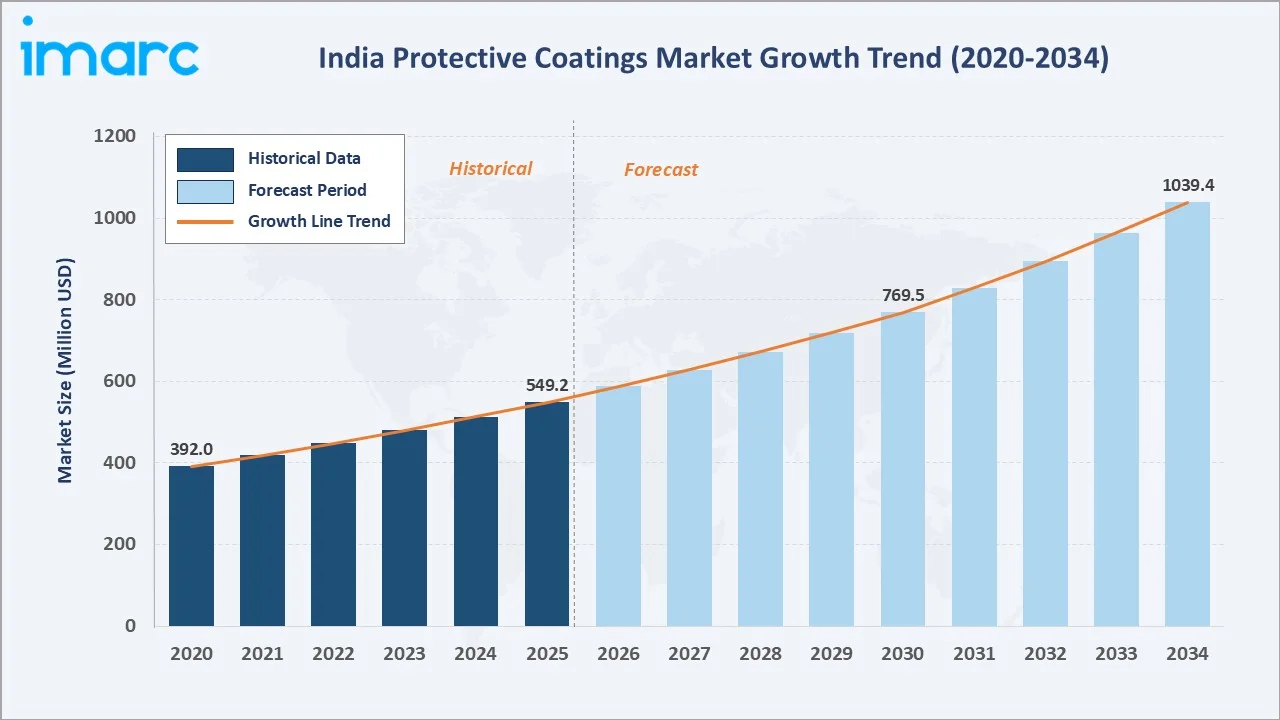
The India protective coatings market was valued at USD 549.2 Million in 2025 and is projected to reach USD 1,039.4 Million by 2034, exhibiting a CAGR of 6.98% during 2026-2034. Rising infrastructure investment, expanding oil, gas, and petrochemical capacity, and a steady shift toward water based and powder coating technologies are the primary drivers shaping the market growth.
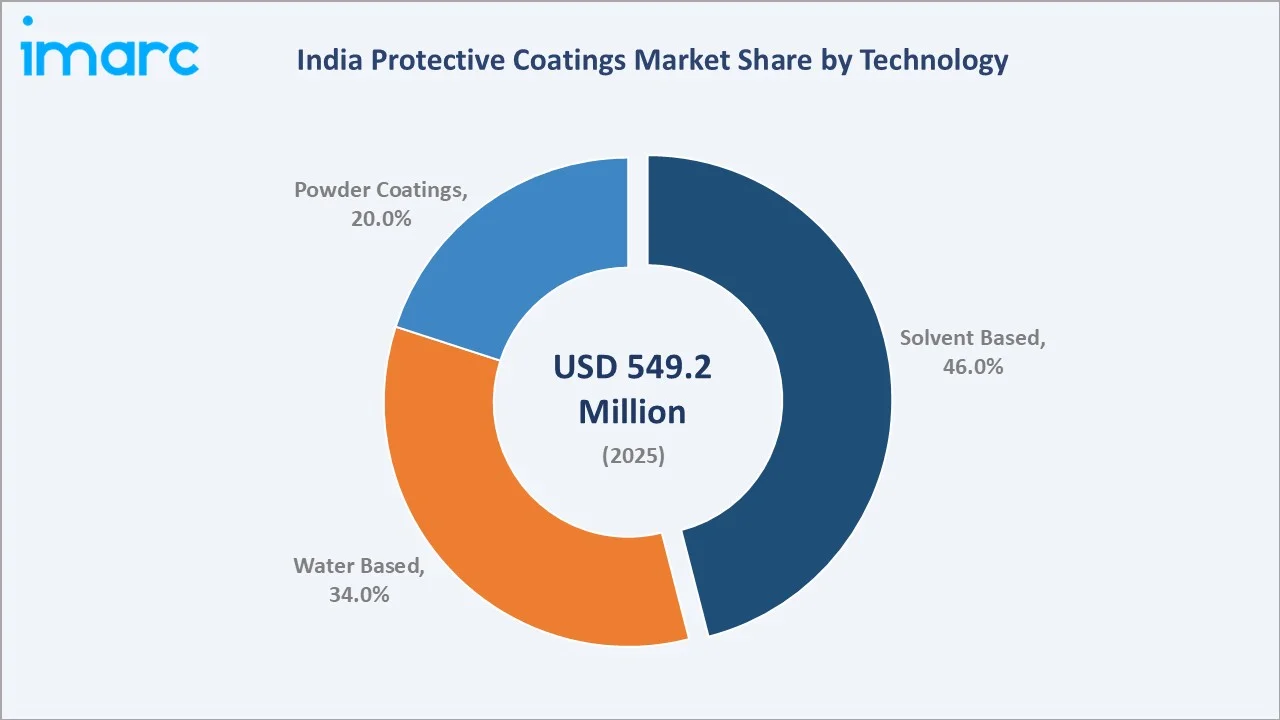
Solvent based leads the technology segment at 46.0%, epoxy dominates the resin type segment at 38.0%, and West India commands 35.0% regional share.
Market Snapshot
|
Metric |
Value |
|
Market Size (2025) |
USD 549.2 Million |
|
Forecast Market Size (2034) |
USD 1,039.4 Million |
|
CAGR (2026-2034) |
6.98% |
|
Base Year |
2025 |
|
Historical Period |
2020-2025 |
|
Forecast Period |
2026-2034 |
|
Largest Region |
West India (35.0%, 2025) |
|
Second Largest Region |
South India (28.0%, 2025) |
|
Leading Technology |
Solvent Based (46.0%, 2025) |
|
Leading Resin Type |
Epoxy (38.0%, 2025) |
The India protective coatings market expanded from USD 392.0 Million in 2020 to USD 549.2 Million in 2025, driven by steady infrastructure spending, growing industrial asset maintenance, and rising demand for corrosion protection. Anchored at USD 769.5 Million in 2030, the forecast to USD 1,039.4 Million by 2034 is supported by accelerating water based adoption, expanding marine coatings demand, and a more structured regulatory environment for surface coatings.
To get more information on this market, Request Sample
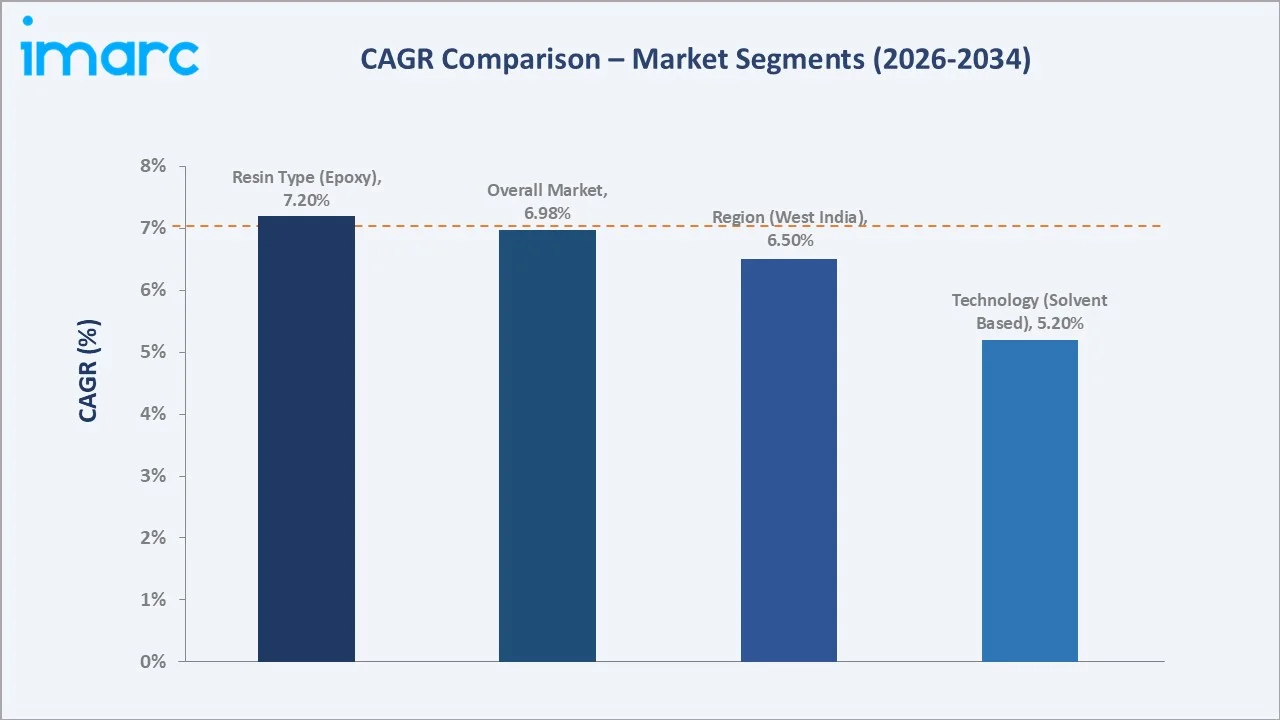
CAGR trajectories across technology, resin type, and regional sub-segments show water based and South India expanding faster than the overall 6.98% market CAGR, driven by tightening environmental regulations, rising capital expenditure, and growing industrial coating penetration across the country.
Executive Summary
The India protective coatings market is on a steady growth trajectory from USD 392.0 Million in 2020 to USD 1,039.4 Million by 2034. The segment has moved from basic anti-corrosive coverage toward technologically advanced, performance-driven formulations across oil and gas, power, marine, and infrastructure applications. Expanding industrial capacity, rising capital investment, and stricter corrosion management standards are encouraging asset owners to adopt higher-specification protective systems.
Solvent based dominates the technology segment at 46.0% in 2025, supported by proven performance in heavy-duty industrial environments, while epoxy leads the resin type segment at 38.0%, valued for its strong adhesion and chemical resistance. West India commands 35.0% of the regional share, led by concentrated refining, petrochemical, and port infrastructure.
Key Market Insights
|
Insight |
Data |
|
Leading Technology |
Solvent Based - 46.0% share (2025) |
|
Second Largest Technology |
Water Based - 34.0% share (2025) |
|
Leading Resin Type |
Epoxy - 38.0% share (2025) |
|
Second Largest Resin Type |
Polyurethane - 27.0% share (2025) |
|
Leading Region |
West India - 35.0% share (2025) |
|
Second Largest Region |
South India - 28.0% share (2025) |
|
Top Companies |
Asian Paints PPG Pvt. Ltd., Berger Paints India, Jotun, Shalimar Paints |
Key Analytical Observations Expanding On the Data Above:
- Solvent based dominance at 46.0% is anchored by proven long-term performance in heavy industrial and marine environments, wide contractor familiarity, and lower application sensitivity compared to newer chemistries.
- Water based at 34.0% is gaining share as environmental compliance requirements tighten and asset owners prioritize low-VOC formulations for occupied and enclosed facilities.
- Epoxy leadership at 38.0% reflects its widespread use as a primer and intermediate coat across tanks, pipelines, and structural steel, owing to excellent adhesion and chemical resistance.
- Polyurethane at 27.0% is expanding on the back of superior UV resistance and gloss retention, making it the preferred topcoat for exposed infrastructure and marine assets.
- West India at 35.0% leads regional share, anchored by refining and petrochemical clusters in Gujarat and Maharashtra alongside major port infrastructure.
India Protective Coatings Market Overview
Protective coatings refer to specialized paint and coating systems applied to metal, concrete, and composite surfaces to prevent corrosion, abrasion, and chemical degradation, extending asset life across industrial and infrastructure applications. The market spans solvent based, water based, and powder coating technologies, formulated using epoxy, polyurethane, acrylic, alkyd, and other resin systems for oil and gas, power, marine, infrastructure, and general industrial end uses.
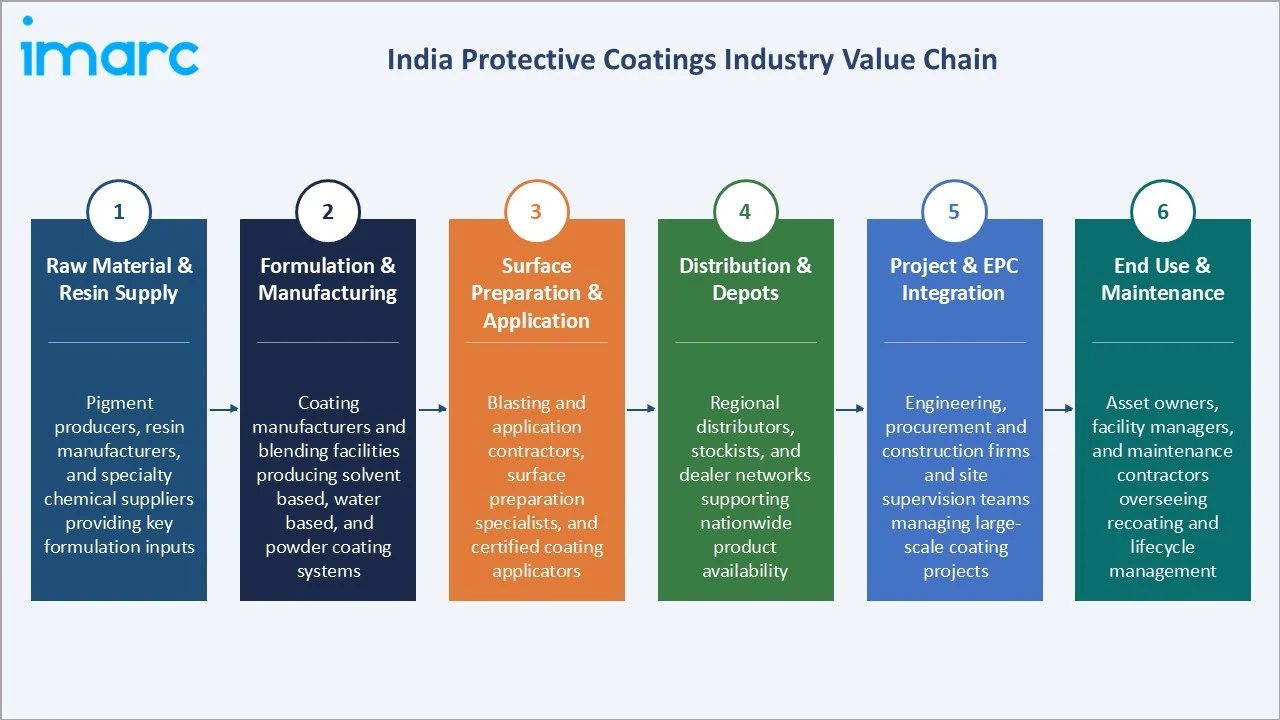
The Indian ecosystem integrates raw material and resin suppliers, coating manufacturers, surface preparation and application contractors, distributors and dealers, regulatory bodies, and end-use industries. Together, they enable delivery of corrosion protection solutions within an evolving compliance and sustainability framework.
Market Dynamics
To evaluate market opportunities, Request Sample
Market Drivers
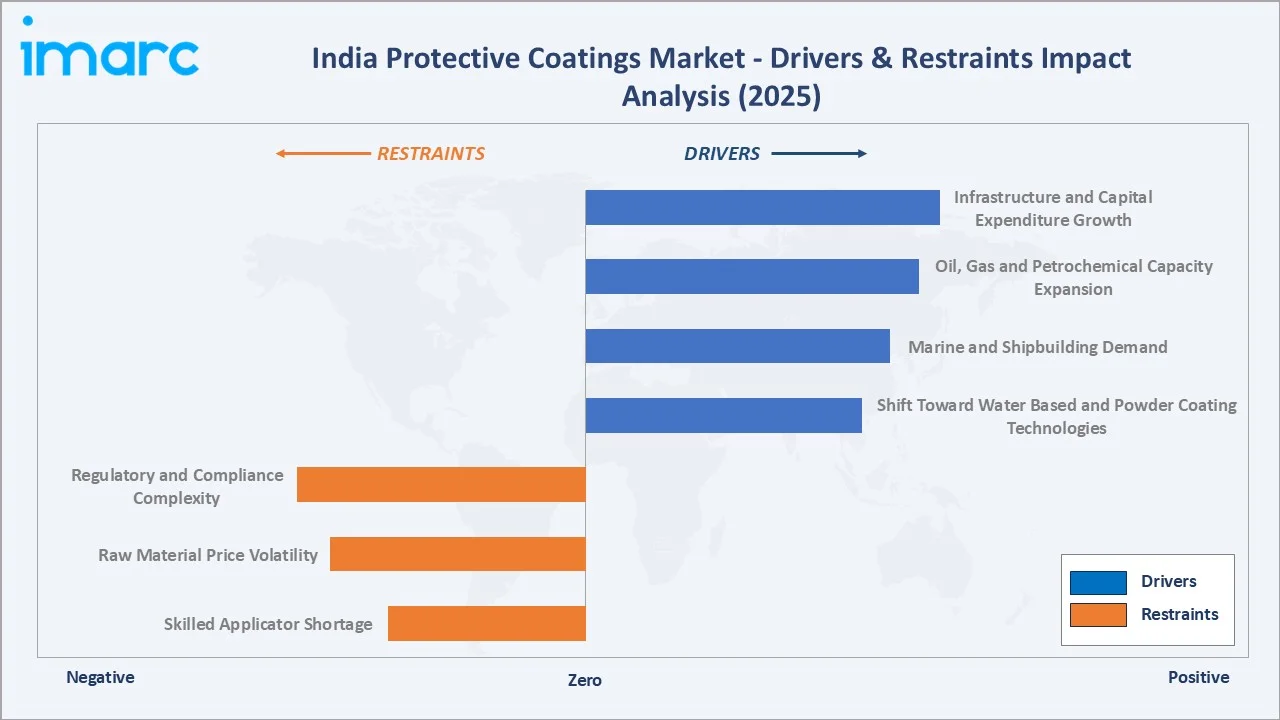
- Infrastructure and Capital Expenditure Growth: Sustained public and private investment in roads, energy, and industrial infrastructure is expanding the base of steel and concrete assets requiring long-term corrosion protection. The Union Budget for FY2026-27 raised public capital expenditure to about INR 12.2 Lakh Crore, up from INR 11.2 Lakh Crore a year earlier, reinforcing the infrastructure-led growth outlook.
- Oil, Gas and Petrochemical Capacity Expansion: Continued investment in refining, storage, and pipeline infrastructure is driving demand for high-performance anti-corrosive and chemical-resistant coating systems across upstream and downstream facilities.
- Marine and Shipbuilding Demand: Growing port modernization and shipbuilding activity are increasing consumption of specialized marine and protective coatings for hulls, tanks, and offshore structures.
- Shift Toward Water Based and Powder Coating Technologies: Tightening environmental norms and growing preference for low-VOC formulations are accelerating adoption of water based and powder coating systems across general industrial applications.
Market Restraints
- Raw Material Price Volatility: Protective coatings rely heavily on imported titanium dioxide and specialty additives, exposing manufacturers to global price swings.
- Regulatory and Compliance Complexity: Varying state-level environmental and safety norms for VOC emissions and hazardous material handling create compliance complexity for manufacturers and applicators operating across multiple states.
- Skilled Applicator Shortage: A shortage of trained surface preparation and application contractors constrains project timelines and can affect coating quality and long-term durability outcomes.
Market Opportunities
- Renewable Energy and Wind Infrastructure: Expanding wind and solar asset bases create new demand for specialized coatings that withstand extended outdoor exposure and require infrequent maintenance cycles.
- Green Hydrogen and Emerging Energy Infrastructure: Early-stage investment in hydrogen production and storage assets presents opportunities for specialty coatings engineered for extreme service conditions.
Market Challenges
- Import Dependence for Specialty Resins: Reliance on imported polyurethane and epoxy intermediates exposes domestic formulators to currency fluctuation and global supply disruption risk.
- Price Sensitivity Among Small Contractors: Cost-conscious procurement among smaller industrial and infrastructure contractors continues to favor lower-specification coatings over premium, longer-life systems.
Emerging Market Trends
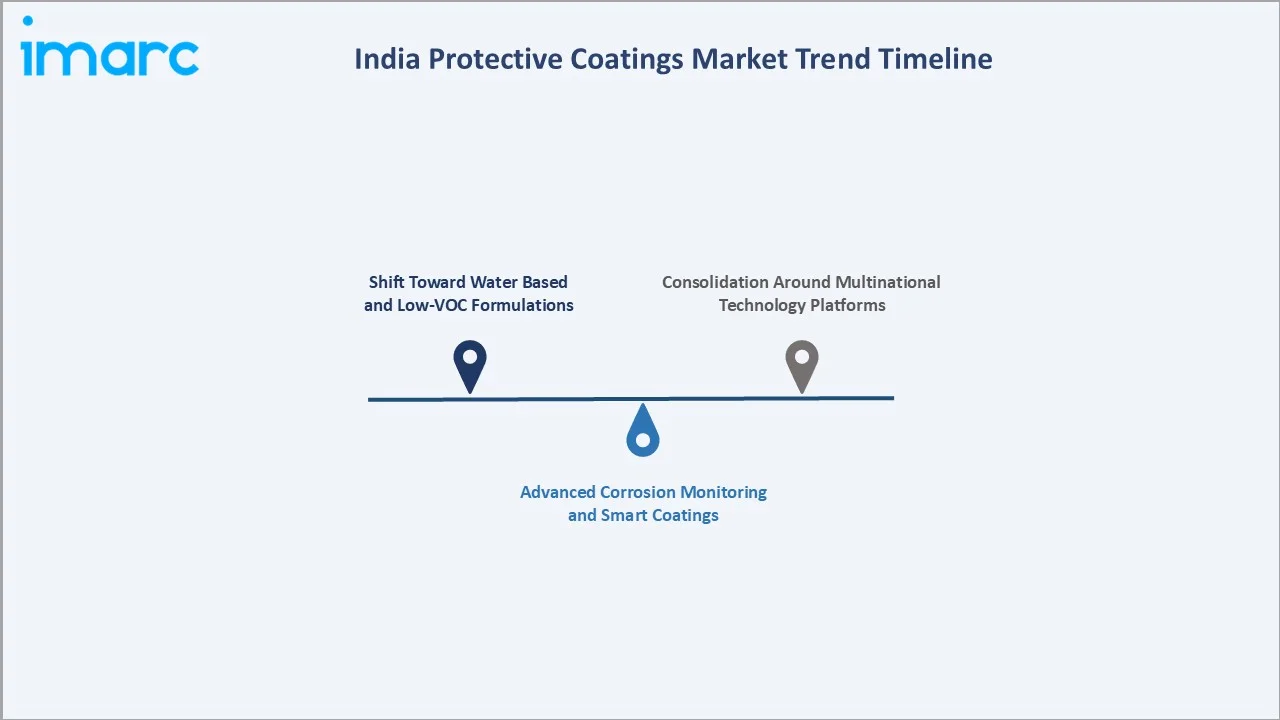
1. Shift Toward Water Based and Low-VOC Formulations
Manufacturers are reformulating heavy-duty coatings to reduce solvent content without compromising corrosion resistance, aligning with tightening emission norms. This transition is also driving investment in new resin chemistries and application equipment suited to water based systems.
2. Advanced Corrosion Monitoring and Smart Coatings
Asset owners are increasingly pairing protective coatings with sensor-based corrosion monitoring to plan maintenance proactively and extend recoating intervals across critical infrastructure.
3. Consolidation Around Multinational Technology Platforms
Global coating majors are deepening India manufacturing and R&D footprints through joint ventures and capacity expansion, bringing advanced formulation technology closer to domestic industrial and marine customers.
Industry Value Chain Analysis
The India protective coatings value chain spans six stages from raw material sourcing through end-use application and lifecycle maintenance. Formulation and application capabilities capture the highest value-add, while distribution reach and technical service increasingly determine competitive position in this performance-driven category.
|
Stage |
Key Players / Examples |
|
Raw Material & Resin Supply |
Pigment producers, resin manufacturers, and specialty chemical suppliers providing key formulation inputs |
|
Formulation & Manufacturing |
Coating manufacturers and blending facilities producing solvent based, water based, and powder coating systems |
|
Surface Preparation & Application |
Blasting and application contractors, surface preparation specialists, and certified coating applicators |
|
Distribution & Depots |
Regional distributors, stockists, and dealer networks supporting nationwide product availability |
|
Project & EPC Integration |
Engineering, procurement and construction firms and site supervision teams managing large-scale coating projects |
|
End Use & Maintenance |
Asset owners, facility managers, and maintenance contractors overseeing recoating and lifecycle management |
Vertically integrated players with proprietary resin technology and strong applicator networks are positioned to capture greater value than manufacturers reliant on third-party distribution and application partners.
Technology Landscape in the India Protective Coatings Industry
Advanced Resin and Formulation Technology
Formulators are developing high-solids and hybrid epoxy-polyurethane systems that deliver extended service life with fewer coating layers, reducing application time and lifecycle cost.
Application Equipment and Automation
Automated spray and robotic application systems are gaining traction on large infrastructure and marine projects, improving coating consistency and reducing material wastage.
Smart Coatings and Corrosion Monitoring
Integration of sensor-enabled monitoring with protective coating systems is allowing asset owners to track corrosion progression in real time, supporting predictive maintenance planning across critical industrial infrastructure.
Market Segmentation Analysis
The report covers the following segments:
|
Segment Category |
Leading Segment |
Market Share |
Year |
|
Technology |
Solvent Based |
46.0% |
2025 |
|
Resin Type |
Epoxy |
38.0% |
2025 |
|
End-Use Industry |
🔒 |
🔒 |
2025 |
|
Region |
West India |
35.0% |
2025 |

By Technology
Solvent based commands a 46.0% majority share in 2025, driven by proven anti-corrosive performance, wide contractor familiarity, and cost efficiency for large-surface industrial applications. The segment benefits from established application infrastructure across oil and gas, power, and marine end uses.
To access detailed market analysis, Request Sample
Water based at 34.0% is expanding fastest as VOC regulations tighten and asset owners in occupied facilities prioritize lower-emission formulations.
By Resin Type
Epoxy dominates with 38.0% share in 2025, reflecting its strong adhesion, chemical resistance, and widespread use as a primer and intermediate coat across tanks, pipelines, and structural steel.
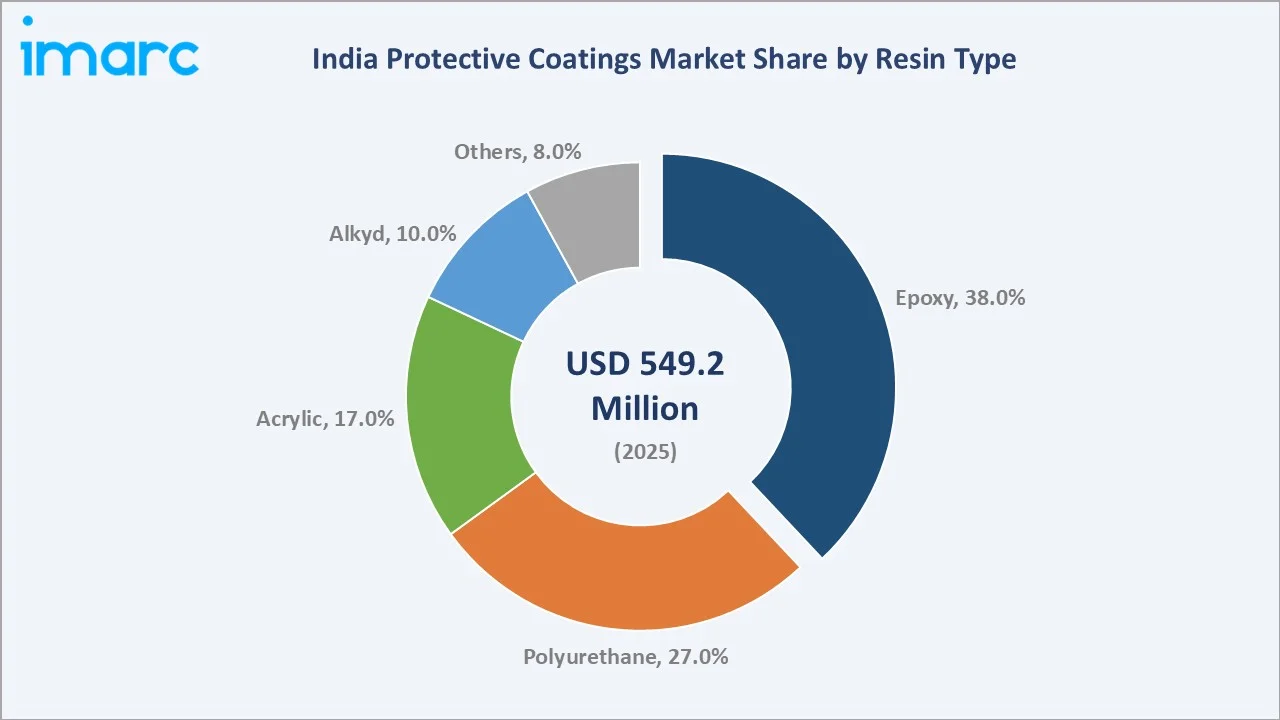
Polyurethane at 27.0% is gaining share as the preferred topcoat for UV-exposed and marine assets. Growing demand for long-lasting corrosion resistance and superior weatherability in infrastructure, industrial equipment, and offshore applications continues to strengthen polyurethane adoption across the market.
Regional Market Insights
|
Region |
Share (2025) |
Key Growth Drivers |
|
West India |
35.0% |
Concentrated refining and petrochemical capacity, major port infrastructure, and strong industrial manufacturing base |
|
South India |
28.0% |
Expanding industrial parks, automotive and engineering clusters, and rising infrastructure investment |
|
North India |
22.0% |
Growing power and infrastructure projects, expanding manufacturing corridors, and government capital expenditure |
|
East India |
15.0% |
Emerging industrial and mining activity, port modernization, and expanding steel and power capacity |
West India at 35.0% in 2025 leads the regional landscape, anchored by refining and petrochemical hubs in Gujarat and Maharashtra. Concentrated port infrastructure and a mature industrial base support sustained leadership across solvent based and epoxy coating systems.
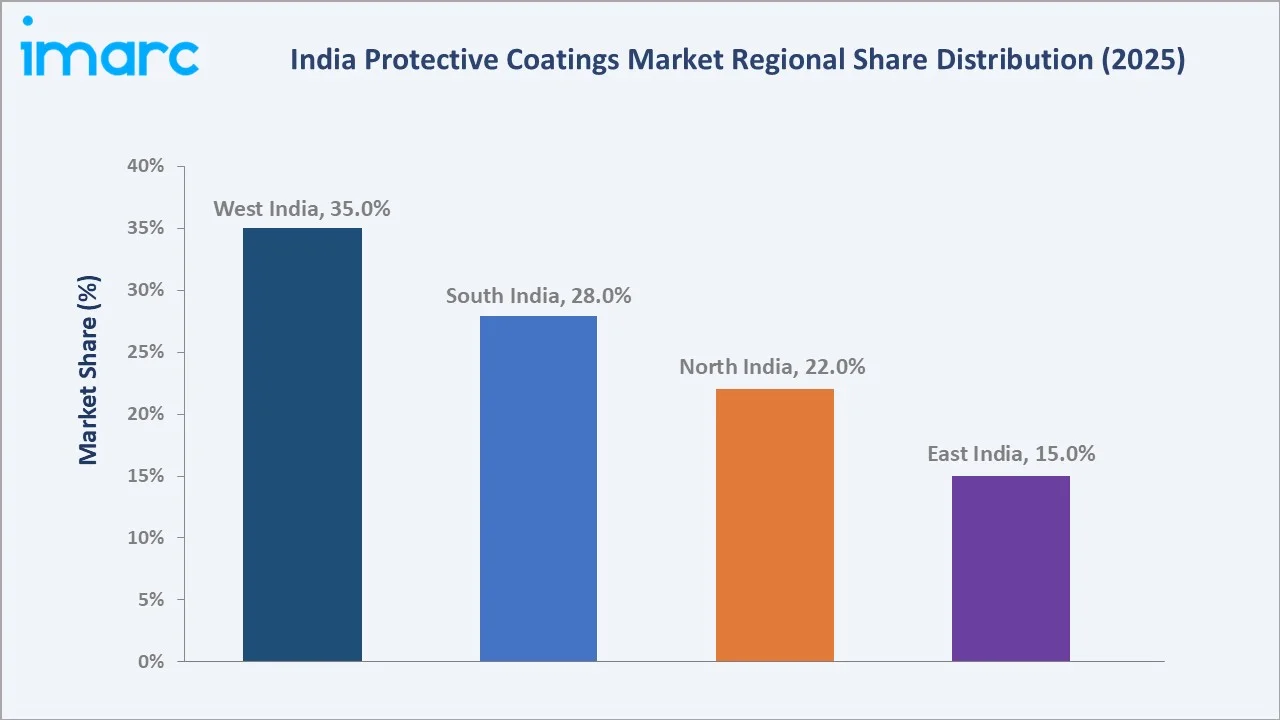
South India at 28.0% is the fastest growing region, supported by expanding industrial parks, growing automotive and engineering clusters, and accelerating infrastructure investment across the southern states through 2034.
Competitive Landscape
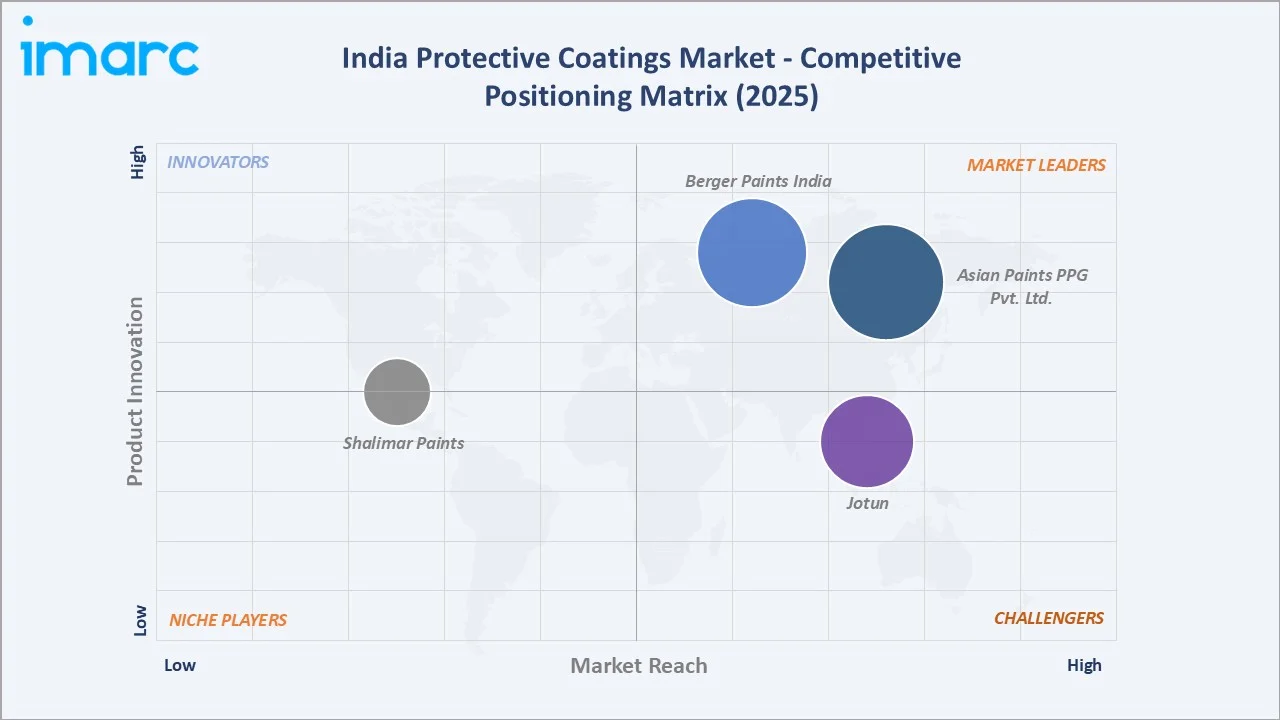
The India protective coatings market is moderately consolidated, with established multinational joint ventures and domestic majors leading technology depth and distribution reach, while regional players compete on price and local service. Brand strength, resin technology, and applicator networks form the key competitive moats across this performance-driven category.
|
Company Name |
Brand / Key Product |
Position |
Strategic Focus |
|
Asian Paints PPG Pvt. Ltd. |
Asian Paints PPG Protective Coatings |
Leader |
Expanding protective and powder coating capacity through continued technology collaboration and distribution reach |
|
Berger Paints India |
Berger Protecton |
Leader |
Growing protective coatings share through expanded manufacturing capacity and sector-focused product development |
|
Jotun |
Jotun Protective Coatings |
Challenger |
Expanding regional manufacturing and applicator training to strengthen protective and marine coatings reach |
|
Shalimar Paints |
Shalimar Paints Protective Coatings |
Emerging |
Leveraging century-long technical legacy to expand specialty industrial and infrastructure coating projects |
Key players include Asian Paints PPG Pvt. Ltd., Berger Paints India, Jotun, and Shalimar Paints, among others.
Key Company Profiles
Asian Paints PPG Pvt. Ltd.
Asian Paints PPG Pvt. Ltd. is a joint venture engaged in the manufacture and supply of protective and powder coating systems for industrial and infrastructure customers across India.
- Product Portfolio: Protective, floor, road marking, and powder coating systems serving industrial, infrastructure, and general manufacturing customers.
- Recent Developments: The firm has continued to enhance protective and powder coating offerings by expanding product capabilities and strengthening solutions for industrial, infrastructure, and energy applications.
- Strategic Focus: Expanding protective and powder coating capacity through continued technology collaboration and distribution reach.
Berger Paints India
Berger Paints India is one of the country's leading paint manufacturers, with an established presence in decorative and industrial coatings, including protective coating systems for infrastructure and industrial customers.
- Product Portfolio: Berger Protecton range of protective coating systems designed for industrial and infrastructure applications.
- Recent Developments: The company continues to strengthen its manufacturing footprint and distribution network in support of its protective coatings business.
- Strategic Focus: Growing protective coatings share through expanded manufacturing capacity and sector-focused product development.
Jotun
Jotun is a global coatings group with an established presence in India, offering protective, marine, decorative, and powder coating solutions to industrial and infrastructure customers.
- Product Portfolio: Jotun Protective Coatings range serving industrial, energy, and infrastructure applications.
- Recent Developments: The company continues to expand its protective coatings presence in India, supporting ongoing industrial and infrastructure projects.
- Strategic Focus: Expanding regional manufacturing and applicator training to strengthen protective and marine coatings reach.
Market Concentration Analysis
The India protective coatings market is moderately concentrated, with the top players - Asian Paints PPG Pvt. Ltd. and Berger Paints India - accounting for a meaningful share of organized industrial coatings demand alongside established multinational participants.
Barriers to entry include the need for proven long-term performance track records, applicator training infrastructure, and multi-state distribution capability. These factors favor well-capitalized incumbents with established technology and service networks.
Consolidation continues as multinational players deepen India manufacturing footprints through joint ventures and capacity expansion, while domestic majors invest in formulation technology and applicator training to defend share across protective and industrial coating segments.
Investment & Growth Opportunities
Fastest-Growing Segments
Water based is expanding the fastest among technology segments, driven by tightening VOC regulations and growing demand for low-emission formulations in occupied industrial facilities. Polyurethane is the next-fastest resin type segment, supported by superior UV resistance and gloss retention for exposed infrastructure.
Emerging Markets
South India is the fastest growing region, anchored by expanding industrial parks, growing automotive and engineering clusters, and rising infrastructure investment. The market represents significant opportunity for manufacturers able to expand regional applicator networks and technical service capacity.
Venture & Investment Trends
Investment is concentrated in resin innovation, low-VOC formulation technology, and applicator training infrastructure. Capital is also flowing into automated application equipment and sensor-enabled corrosion monitoring systems aligned with evolving asset management practices.
Future Market Outlook (2026-2034)
The India protective coatings market is forecast to expand from USD 549.2 Million in 2025 to USD 1,039.4 Million by 2034 at a CAGR of 6.98%, adding close to USD 490.2 Million in incremental market value over the forecast period.
Four forces will shape the market through 2034: sustained infrastructure and industrial capital expenditure; the shift toward water based and powder coating technologies; deeper integration of automated application and monitoring systems; and continued consolidation around technology-led multinational and domestic platforms.
By 2034, the India protective coatings market is expected to be defined by higher-specification, longer-life coating systems, with water based and powder technologies collectively accounting for a meaningfully higher share of overall demand. Regulatory tightening, infrastructure investment, and technology-led applicator practices are expected to further accelerate the evolution of the protective coatings ecosystem.
Research Methodology
Primary Research
Primary research included structured interviews with coating manufacturers, applicator contractors, distribution partners, and infrastructure project executives, validating market sizing, segment mix, and regional demand patterns.
Secondary Research
Secondary sources included Ministry of Steel and Ministry of Ports, Shipping and Waterways publications, Union Budget documents, industry association reports, and company annual reports, press releases, and investor presentations from listed and private coating manufacturers.
Forecasting Models
Market forecasts used top-down and bottom-up models combining industrial asset base growth, infrastructure capital expenditure trends, technology mix evolution, and regional demand variables. Scenario analysis addressed raw material price volatility, regulatory pace, and technology adoption timelines.
India Protective Coatings Market Report Coverage:
| Report Features | Details |
|---|---|
| Base Year of the Analysis | 2025 |
| Historical Period | 2020-2025 |
| Forecast Period | 2026-2034 |
| Units | Million USD |
| Scope of the Report |
Exploration of Historical Trends and Market Outlook, Industry Catalysts and Challenges, Segment-Wise Historical and Future Market Assessment:
|
| Technologies Covered | Solvent Based, Water Based, Powder Coatings |
| Resin Types Covered | Epoxy, Polyurethane, Acrylic, Alkyd, Others |
| End Use Industries Covered | Oil and Gas, Building and Construction, Automotive, Marine, Others |
| Regions Covered | North India, South India, East India, West India |
| Companies Covered | Asian Paints PPG Pvt. Ltd., Berger Paints India, Jotun, Shalimar Paints, etc. |
| Customization Scope | 10% Free Customization |
| Post-Sale Analyst Support | 10-12 Weeks |
| Delivery Format | PDF and Excel through Email (We can also provide the editable version of the report in PPT/Word format on special request) |
Key Benefits for Stakeholders:
- IMARC’s industry report offers a comprehensive quantitative analysis of various market segments, historical and current market trends, market forecasts, and dynamics of the India protective coatings market from 2020-2034.
- The research report provides the latest information on the market drivers, challenges, and opportunities in the India protective coatings market.
- Porter's five forces analysis assist stakeholders in assessing the impact of new entrants, competitive rivalry, supplier power, buyer power, and the threat of substitution. It helps stakeholders to analyze the level of competition within the India protective coatings industry and its attractiveness.
- Competitive landscape allows stakeholders to understand their competitive environment and provides an insight into the current positions of key players in the market.
Frequently Asked Questions About the India Protective Coatings Market Report
The India protective coatings market was valued at USD 549.2 Million in 2025, driven by infrastructure investment, industrial capacity expansion, and rising demand for corrosion protection across sectors.
The market is projected to grow at a CAGR of 6.98% from 2026-2034, reaching USD 1,039.4 Million, supported by water based technology adoption and infrastructure investment.
Solvent based leads the technology segment at 46.0% in 2025, valued for proven long-term performance, wide contractor familiarity, and cost efficiency in heavy-duty industrial and marine environments.
Epoxy dominates the resin type segment at 38.0% in 2025, owing to its strong adhesion, chemical resistance, and widespread use as a primer and intermediate coat across tanks, pipelines, and structural steel.
West India commands 35.0% in 2025, led by concentrated refining, petrochemical, and port infrastructure across Gujarat and Maharashtra.
Leading players include Asian Paints PPG Pvt. Ltd., Berger Paints India, Jotun, and Shalimar Paints, among others.
Sustained public and private capital expenditure in energy, transport, and industrial infrastructure is expanding the base of steel and concrete assets requiring long-term corrosion protection.
Tightening state-level VOC norms are accelerating adoption of water based and powder coating technologies while creating multi-state compliance complexity for manufacturers.
Need more help?
- Speak to our experienced analysts for insights on the current market scenarios.
- Include additional segments and countries to customize the report as per your requirement.
- Gain an unparalleled competitive advantage in your domain by understanding how to utilize the report and positively impacting your operations and revenue.
- For further assistance, please connect with our analysts.
 Request Customization
 Speak to an Analyst
 Request Brochure
 Inquire Before Buying
Benefits of Customization
- Personalize this research
- Triangulate with your data
- Get data as per your format and definition
- Gain a deeper dive into a specific application, geography, customer, or competitor
- Any level of personalization
Get in Touch With Us
UNITED STATES
Phone: +1-201-971-6302
INDIA
Phone: +91-120-433-0800
UNITED KINGDOM
Phone: +44-753-714-6104
Email: [email protected]
Client Testimonials




.webp)




.webp)













Related Reports

Choose your plan
*Please note that the prices mentioned below are starting prices for each bundle type. Kindly contact our team for further details.*
Single User License
- 1 User License, Access on 2 Devices
- PDF Report + Excel Dataset (Password Protected)
- Lifetime Access
- No Printing Rights
- 10% Free Report Customization
- 10–12 Weeks of Analyst Support
Five User License
- Access for 5 Users, 2 Devices per User
- PDF Report + Excel Dataset (Password Protected)
- Lifetime Access
- Dedicated Account Manager
- 12–14 Weeks of Analyst Support
- No Printing Rights
- 15% Free Report Customization
- 25% Discount on Your Next Purchase
Corporate User License
- Unlimited User Access (Within Your Organization)
- PDF Report + Excel Dataset
- Lifetime Access
- Dedicated Account Manager
- 14–20 Weeks of Analyst Support
- No Printing Rights
- 20% Free Report Customization
- 30% Discount on Your Next Purchase
Essential Insights
What's included:
3 reports
- Lifetime Access
- PDF Reports
- Excel Datasets
- 2 Weeks of Free Analyst Support
- 2 User Licenses
- Access on 2 Devices
- Printing Rights
- Complimentary PowerPoint (PPT) Version
- Complimentary License Upgrade
Professional Access
What's included:
5 reports
- Lifetime Access
- PDF Reports
- Excel Datasets
- 8 Weeks of Free Analyst Support
- 2 User Licenses
- Access on 2 Devices
- Printing Rights
- Complimentary PowerPoint (PPT) Version
- Complimentary License Upgrade
Business Advantage
What's included:
8 reports
- Lifetime Access
- PDF Reports
- Excel Datasets
- 14 Weeks of Free Analyst Support
- 2 User Licenses
- Access on 2 Devices
- Printing Rights
- Complimentary PowerPoint (PPT) Version
- Complimentary License Upgrade
Enterprise Intelligence
What's included:
10 reports
- Lifetime Access
- PDF Reports
- Excel Datasets
- 20 Weeks of Free Analyst Support
- 2 User Licenses
- Access on 2 Devices
- Printing Rights
- Complimentary PowerPoint (PPT) Version
- Complimentary License Upgrade