
India Quantum Computing Market Size, Share, Trends and Forecast by Offering, Deployment, Application, End User, and Region, 2026-2034
India Quantum Computing Market Summary:
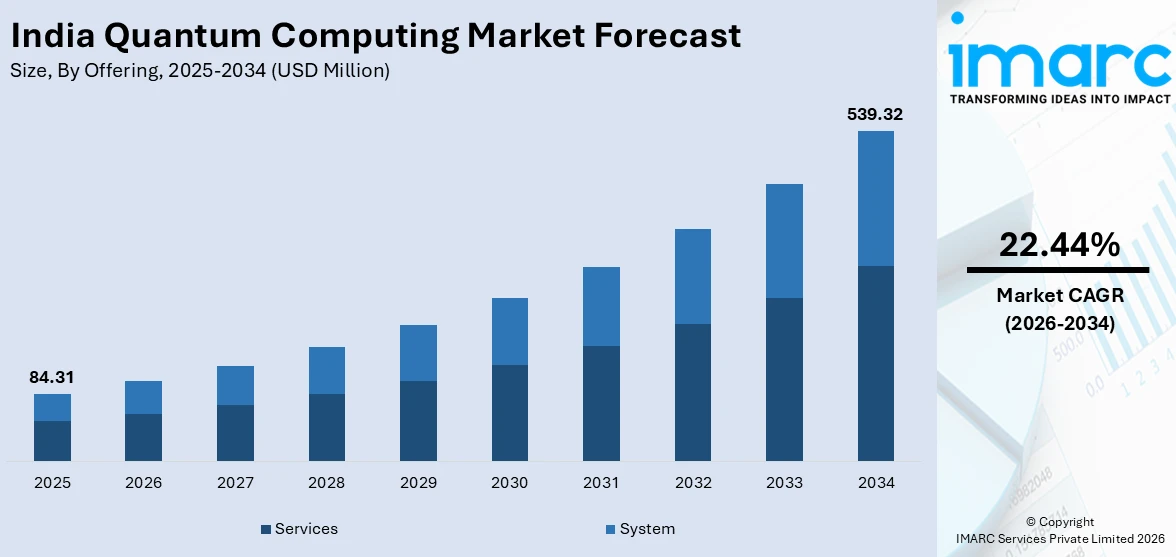
The India quantum computing market size was valued at USD 84.31 Million in 2025 and is projected to reach USD 539.32 Million by 2034, growing at a compound annual growth rate of 22.44% from 2026-2034.
The India quantum computing market is experiencing robust expansion driven by increasing government investment in quantum technologies, rising enterprise adoption across critical sectors, and the emergence of a vibrant startup ecosystem focused on indigenous innovation. Advancements in quantum hardware, growing demand for cloud-based quantum services, and the integration of artificial intelligence with quantum computing are accelerating development. Expanding research infrastructure, academic collaborations, and strategic public-private partnerships are further strengthening the foundation for sustained quantum computing market share.
Key Takeaways and Insights:
- By Offering: Services dominate the market with a share of 58.4% in 2025, owing to the growing preference for cloud-accessible quantum computing platforms that reduce the need for costly on-premises hardware investments. Increasing enterprise demand for quantum consulting and algorithm development is fueling expansion.
- By Deployment: Cloud leads the market with a share of 71.3% in 2025. This dominance is driven by the scalability, cost-efficiency, and accessibility offered by cloud-based quantum platforms, enabling organizations of all sizes to explore quantum capabilities without significant capital expenditure on dedicated infrastructure.
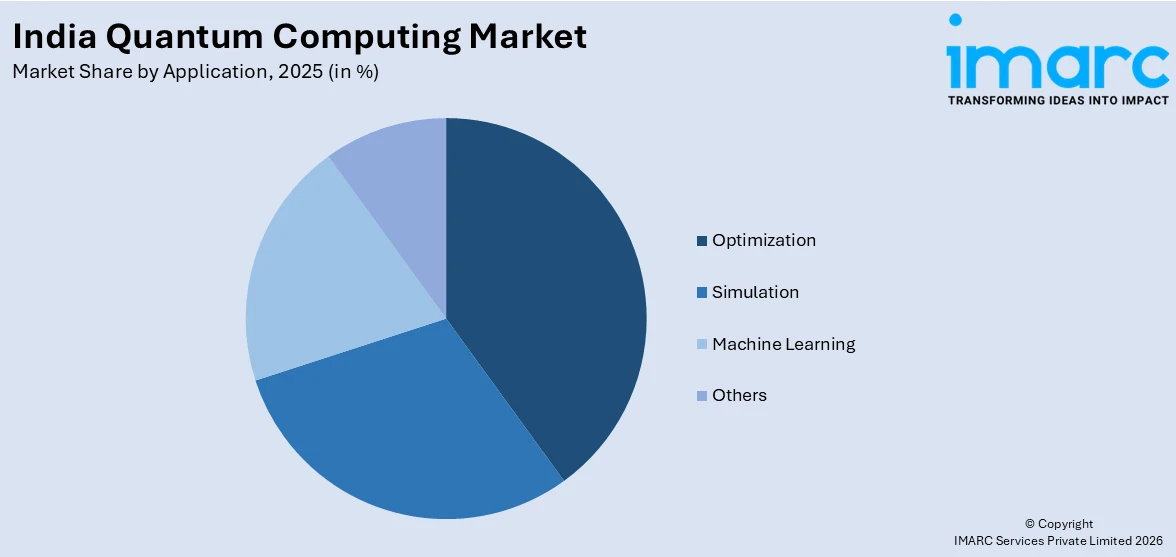
- By Application: Optimization represents the biggest segment with a market share of 31.7% in 2025, reflecting the growing deployment of quantum algorithms to solve complex combinatorial problems across supply chain management, portfolio optimization, and resource allocation in financial services and manufacturing sectors.
- By End User: Government exhibits a clear dominance in the market with 26.8% share in 2025, driven by substantial national investments in quantum research infrastructure, defense applications, and strategic initiatives to position the country as a global quantum technology leader.
- By Region: South India represents the largest region with 39.6% share in 2025, driven by the concentration of premier research institutions, technology startups, and industry hubs in Bengaluru, Hyderabad, and Chennai that form the backbone of the quantum computing ecosystem.
- Key Players: Key players drive the India quantum computing market by establishing dedicated quantum computing practices, investing in full-stack hardware development, forming strategic partnerships with global technology providers, and expanding cloud-based quantum service offerings to accelerate enterprise adoption across diverse industry verticals.
To get more information on this market Request Sample
The India quantum computing market is advancing rapidly as the nation strengthens its position in the global quantum technology landscape. The government has made quantum computing a strategic priority, allocating substantial funding through the National Quantum Mission with a total budget of INR 6,003.65 crore spanning from 2023 to 2031. This commitment has catalyzed the establishment of dedicated research hubs at premier academic institutions, attracted private investment into indigenous startups, and fostered collaborative frameworks between industry and academia. Enterprise adoption is expanding across banking, defense, healthcare, and energy sectors, where quantum solutions address computational challenges beyond classical capabilities. Major information technology services providers have established specialized quantum practices, while cloud platforms are democratizing access to quantum hardware for mid-sized organizations and research groups. The convergence of artificial intelligence and quantum computing is creating new opportunities for hybrid optimization workflows, further broadening commercial applications. As infrastructure develops and the talent pipeline grows, the market is poised for sustained long-term expansion.
India Quantum Computing Market Trends:
Rising Demand for Quantum-Safe Cybersecurity Solutions
The increasing vulnerability of classical encryption methods to future quantum attacks is driving significant investment in post-quantum cryptography and quantum key distribution technologies across India. Financial institutions and government agencies are proactively adopting quantum-safe communication networks to protect critical digital infrastructure. In September 2025, HDFC Bank invested in Bengaluru-based QNu Labs, a quantum-safe cybersecurity startup incubated at IIT Madras Research Park, concluding the company's Series A funding round and reinforcing sector-wide commitment to quantum-resilient security frameworks.
Expansion of Cloud-Based Quantum Computing Platforms
Cloud-based delivery models are rapidly expanding access to quantum computing capabilities for Indian enterprises and research institutions, eliminating the need for costly on-premises quantum hardware. Global and domestic providers are developing quantum computing as a service solutions tailored to the region, enabling organizations of varying sizes to experiment with quantum algorithms and hybrid workflows. The growing preference for cloud deployment reflects the high cost and technical complexity associated with maintaining dedicated quantum infrastructure, including specialized cryogenic cooling and controlled environments. This shift is democratizing quantum access and accelerating application discovery across diverse industry verticals throughout the country.
Convergence of Artificial Intelligence and Quantum Computing
The integration of artificial intelligence (AI) with quantum computing is currently emerging as a transformative trend, enabling enhanced optimization, accelerated machine learning workflows, and improved hybrid computational performance. Indian technology firms are building AI-driven quantum compilation and application-specific architectures. In April 2025, Bengaluru-based QpiAI launched the QpiAI-Indus 25-qubit superconducting quantum computer, which integrates advanced quantum processors with AI-enhanced hybrid optimization tools, thereby achieving faster simulations while reducing compute requirements significantly.
Market Outlook 2026-2034:
The India quantum computing market is poised for substantial growth as government funding, enterprise adoption, and indigenous innovation converge to build a comprehensive quantum ecosystem. Expanding research infrastructure through national thematic hubs and state-level quantum missions is strengthening the foundational capabilities required for commercial-scale deployment. The market generated a revenue of USD 84.31 Million in 2025 and is projected to reach a revenue of USD 539.32 Million by 2034, growing at a compound annual growth rate of 22.44% from 2026-2034. Cloud-based platforms are democratizing access to quantum hardware, enabling organizations across banking, defense, healthcare, and energy sectors to explore practical applications. The growing talent pipeline, supported by quantum education programs at premier institutions, is addressing workforce requirements. Strategic partnerships between global technology leaders and domestic enterprises are accelerating algorithm development, creating a favorable environment for sustained market expansion throughout the forecast period.
India Quantum Computing Market Report Segmentation:
|
Segment Category |
Leading Segment |
Market Share |
|
Offering |
Services |
58.4% |
|
Deployment |
Cloud |
71.3% |
|
Application |
Optimization |
31.7% |
|
End User |
Government |
26.8% |
|
Region |
South India |
39.6% |
Offering Insights:
- System
- Services
Services dominate with a market share of 58.4% of the total India quantum computing market in 2025.
Services lead the India quantum computing market as enterprises increasingly prefer managed quantum solutions over costly hardware procurement, driving demand for consulting, algorithm development, cloud access, and integration services. The complexity of quantum systems necessitates specialized expertise that most organizations lack internally, making third-party service providers essential for successful quantum adoption. In July 2025, QpiAI secured USD 32 million in Series A funding co-led by the National Quantum Mission and Avataar Ventures, underscoring investor confidence in the commercial viability of quantum computing service delivery models.
The services segment benefits from the growing ecosystem of indigenous quantum startups that are developing full-stack solutions combining hardware, software, and application layers. Major Indian information technology companies have established dedicated quantum computing practices to serve domestic and international clients, offering end-to-end quantum transformation capabilities. Cloud-based quantum service platforms are particularly attractive to mid-sized enterprises and academic institutions that require quantum processing power without the capital expenditure associated with system ownership. This democratization of quantum access through service-oriented delivery is expanding the addressable market beyond traditional research-intensive organizations.
Deployment Insights:
- On-premises
- Cloud
Cloud leads with a share of 71.3% of the total India quantum computing market in 2025.
Cloud deployment dominates the India quantum computing market by addressing the prohibitive costs and technical complexity associated with maintaining on-premises quantum hardware. Cloud platforms provide flexible, scalable access to quantum processors through pay-per-use models, enabling enterprises and researchers to experiment with quantum algorithms without significant infrastructure investment. In May 2025, IBM, Tata Consultancy Services, and the Government of Andhra Pradesh announced plans to deploy an IBM Quantum System Two with a 156-qubit Heron processor at the Quantum Valley Tech Park in Amaravati, offering cloud-based quantum access to regional users.
The preference for cloud-based quantum computing is further strengthened by the hybrid quantum-classical computing paradigm, which requires seamless integration between quantum processors and conventional high-performance computing resources. Cloud platforms facilitate this integration through software development kits, application programming interfaces, and managed execution environments that abstract hardware complexity. Indian organizations across financial services, pharmaceutical research, and logistics are leveraging cloud quantum platforms to explore optimization and simulation workloads. The growing availability of indigenous quantum-as-a-service offerings is complementing global cloud platforms, expanding deployment options for domestic enterprises.
Application Insights:
Access the comprehensive market breakdown Request Sample
- Optimization
- Simulation
- Machine Learning
- Others
Optimization exhibits a clear dominance with 31.7% share of the total India quantum computing market in 2025.
Optimization commands the largest application share as quantum algorithms demonstrate significant potential in solving complex combinatorial problems that remain intractable for classical computing systems. Indian enterprises in financial services, manufacturing, and logistics are deploying quantum optimization for portfolio management, supply chain routing, and resource allocation. The growing institutional focus on advancing quantum research is accelerating the development of optimization algorithms and practical quantum applications across government and industrial sectors. Quantum optimization is emerging as a priority use case where near-term computational advantages can be realized across diverse enterprise environments nationwide.
The optimization segment benefits from its relatively near-term commercial applicability compared to other quantum computing applications, as hybrid quantum-classical approaches can deliver meaningful improvements even with current noisy intermediate-scale quantum devices. Enterprises are leveraging quantum-inspired and quantum-enhanced optimization techniques for real-world problems including fleet management, energy grid balancing, and production scheduling. The growing number of industry-specific quantum software platforms targeting optimization workloads is broadening adoption beyond research institutions into mainstream enterprise environments, establishing optimization as the primary gateway application for organizations beginning their quantum computing journeys.
End User Insights:
- Aerospace and Defense
- BFSI
- Healthcare
- Automotive
- Energy and Power
- Chemical
- Government
- Others
Government prevails the market with a 26.8% share of the total India quantum computing market in 2025.
Government leads the end-user segment as federal and state administrations drive quantum computing adoption through strategic funding, research mandates, and infrastructure development programs. The national quantum initiative has established dedicated thematic hubs at premier institutions, engaging researchers from numerous institutions spanning multiple states and union territories to advance quantum computing, communication, sensing, and materials research. This comprehensive institutional framework, supported by substantial multi-year budget commitments, positions government as the primary catalyst for quantum ecosystem development and coordinates collaborative efforts between academia, industry, and public-sector organizations across the country.
Government investment extends beyond research funding to encompass workforce development, startup incubation, and international collaboration frameworks. State governments are establishing complementary quantum missions to strengthen regional capabilities and attract global partnerships. Defense and national security applications are driving government interest in quantum cryptography, quantum key distribution, and quantum sensing technologies that offer strategic advantages in secure communications and intelligence operations. The government sector also serves as an early adopter and anchor customer for indigenous quantum computing startups, providing validation and revenue streams that enable these companies to scale their operations.
Regional Insights:
- North India
- South India
- East India
- West India
South India represents the leading region with 39.6% share of the total India quantum computing market in 2025.
South India commands the largest regional share owing to the concentration of quantum computing startups, premier research institutions, and technology industry hubs across Bengaluru, Hyderabad, and Chennai. State governments in the region have launched dedicated quantum missions with ambitious plans to establish specialized quantum innovation zones featuring advanced research laboratories, hardware parks, cryogenic testing facilities, and deep-tech startup zones. These initiatives are designed to attract global partnerships and position the region as a leading destination for quantum research, development, and commercialization activities across both domestic and international quantum technology ecosystems.
The region's dominance is reinforced by the presence of leading national quantum research hubs that spearhead efforts to develop indigenous quantum processors and related technologies. Emerging quantum technology parks in the region are designed to house advanced quantum computing infrastructure and foster meaningful industry-academia collaboration. The deep-tech startup ecosystem in south India, supported by established venture capital networks and a strong talent pipeline from premier engineering institutions, continues to attract both domestic and international investment in quantum technologies, solidifying the region's position as the primary engine driving quantum computing growth throughout the country.

Market Dynamics:
Growth Drivers:
Why is the India Quantum Computing Market Growing?
Substantial Government Investment Through the National Quantum Mission
The Indian government has established quantum computing as a national strategic priority, committing comprehensive funding and institutional support through the National Quantum Mission. This mission encompasses the development of intermediate-scale quantum computers, satellite-based quantum communications, inter-city quantum key distribution networks, and advanced quantum sensing technologies. Four dedicated thematic hubs have been established at premier research institutions to drive innovation across quantum computing, communication, sensing and metrology, and materials and devices. The mission's structured approach connects fundamental research with industrial application through public-private partnerships, startup support programs, and international collaboration frameworks. State governments are complementing federal efforts by launching their own quantum initiatives, creating regional innovation hubs, establishing quantum education programs, and building infrastructure to attract global talent and investment. The comprehensive nature of this government commitment extends beyond direct research funding to include workforce development, regulatory frameworks, and commercialization pathways that collectively create a supportive environment for quantum technology advancement. This sustained institutional support is establishing the foundational infrastructure necessary for long-term market growth and positioning the country competitively in the global quantum landscape.
Growing Enterprise Adoption Across Critical Industry Sectors
Enterprise adoption of quantum computing is accelerating across multiple industry sectors in India as organizations recognize the technology's potential to solve complex computational challenges beyond classical capabilities. The banking and financial services sector is exploring quantum algorithms for portfolio optimization, fraud detection, risk analysis, and cryptographic security enhancement. Defense and aerospace organizations are investing in quantum sensing, secure communications, and simulation capabilities that offer strategic operational advantages. Healthcare and pharmaceutical companies are leveraging quantum computing for drug discovery simulations, molecular modeling, and genomic data analysis that require massive computational resources. Energy and chemical companies are applying quantum optimization to grid management, material discovery, and process engineering challenges. Major information technology services companies have established dedicated quantum computing practices to develop industry-specific solutions and serve as bridge organizations that translate quantum capabilities into enterprise-ready applications. The hybrid quantum-classical computing paradigm is making quantum solutions accessible for practical business problems even with current hardware limitations. This broad sectoral engagement is creating diverse demand channels that reduce market dependency on any single industry, establishing a resilient foundation for sustained growth across the forecast period.
Emergence of a Vibrant Indigenous Quantum Startup Ecosystem
India's quantum computing startup ecosystem is rapidly maturing, with indigenous companies developing full-stack quantum solutions spanning hardware, software, and application layers. These startups are building superconducting quantum processors, quantum control electronics, cryogenic infrastructure components, quantum cryptography systems, and specialized simulation software tailored to domestic and international markets. The National Quantum Mission has actively supported this ecosystem by selecting promising startups for targeted funding and infrastructure access, fostering indigenous innovation that reduces dependence on foreign quantum technology providers. Venture capital interest in Indian quantum startups has intensified significantly, with multiple companies securing substantial funding rounds that validate the commercial viability of their technology platforms. The startup ecosystem benefits from deep technical talent emerging from premier engineering and research institutions, combined with established technology industry infrastructure that supports rapid development and commercialization. Companies are developing diverse quantum applications across logistics, finance, materials science, pharmaceutical research, and cybersecurity, creating multiple pathways to commercial relevance. Incubation support from academic institutions, government-backed innovation programs, and corporate partnerships is nurturing early-stage companies through critical development phases, building a pipeline of indigenous quantum technology providers that strengthens national technological sovereignty.
Market Restraints:
What Challenges the India Quantum Computing Market is Facing?
Acute Shortage of Qualified Quantum Computing Workforce
The quantum computing sector requires highly specialized expertise spanning quantum physics, advanced mathematics, and specialized programming that remains scarce across the domestic talent pool. Universities and research institutions are only beginning to develop dedicated quantum computing curricula and training programs. The interdisciplinary nature of quantum technology necessitates professionals with combined knowledge in hardware engineering, algorithm design, and domain-specific applications. This workforce gap constrains the pace at which enterprises can develop and deploy quantum solutions, limiting market growth potential and extending project timelines for organizations seeking to integrate quantum capabilities.
Prohibitive Infrastructure and Hardware Development Costs
Establishing and maintaining quantum computing infrastructure demands substantial capital investment in specialized hardware components, cryogenic cooling systems, precision control electronics, and clean room environments. The extreme operating conditions required for superconducting quantum processors, including near-absolute-zero temperatures, create ongoing operational expenses that remain prohibitively high for most organizations. Limited domestic manufacturing capability for advanced quantum hardware components increases dependence on imports and extends procurement timelines. These cost barriers restrict quantum computing access primarily to well-funded government institutions and large corporations, constraining broader market adoption and slowing ecosystem development.
Limited Near-Term Commercialization of Practical Quantum Applications
Current quantum computing hardware remains in the noisy intermediate-scale quantum stage, limiting the range of problems where quantum processors demonstrate clear advantages over classical computing systems. Error rates, limited qubit counts, and short coherence times constrain the complexity and reliability of quantum computations achievable in practice. Many promising quantum applications in drug discovery, materials science, and financial modeling require fault-tolerant quantum computers that remain years from realization. This gap between theoretical potential and practical capability creates uncertainty among potential enterprise adopters, delaying investment decisions and slowing commercial market development.
Competitive Landscape:
The India quantum computing market features an increasingly dynamic competitive environment characterized by the convergence of global technology leaders, domestic information technology services providers, and a growing cohort of indigenous deep-tech startups. Market participants are competing across multiple dimensions including quantum hardware development, cloud-based service delivery, software platform creation, and application-specific solution development for enterprise clients. Strategic partnerships between international quantum hardware providers and Indian technology companies are creating collaborative frameworks that accelerate ecosystem development and expand market access. Competition is further intensified by state-level quantum initiatives that attract investment and foster regional innovation clusters. Companies are differentiating through vertical specialization, targeting specific industry applications in financial services, defense, healthcare, and logistics to establish domain expertise and secure early adopter partnerships. The competitive dynamics are evolving as participants move beyond research-oriented engagements toward commercially viable quantum solutions and service offerings.
India Quantum Computing Market Report Coverage:
|
Report Features |
Details |
|
Base Year of the Analysis |
2025 |
|
Historical Period |
2020-2025 |
|
Forecast Period |
2026-2034 |
|
Units |
Million USD |
|
Scope of the Report |
Exploration of Historical Trends and Market Outlook, Industry Catalysts and Challenges, Segment-Wise Historical and Future Market Assessment:
|
|
Offerings Covered |
System, Services |
|
Deployments Covered |
On-premises, Cloud |
|
Applications Covered |
Optimization, Simulation, Machine Learning, Others |
|
End Users Covered |
Aerospace and Defense, BFSI, Healthcare, Automotive, Energy and Power, Chemical, Government, Others |
|
Regions Covered |
North India, South India, East India, West India |
|
Customization Scope |
10% Free Customization |
|
Post-Sale Analyst Support |
10-12 Weeks |
|
Delivery Format |
PDF and Excel through Email (We can also provide the editable version of the report in PPT/Word format on special request) |
Frequently Asked Questions About the India Quantum Computing Market Report
The India quantum computing market size was valued at USD 84.31 Million in 2025.
The India quantum computing market is expected to grow at a compound annual growth rate of 22.44% from 2026-2034 to reach USD 539.32 Million by 2034.
Services dominated the market with a share of 58.4%, driven by the growing preference for cloud-accessible quantum computing platforms, consulting services, and algorithm development that reduce the need for costly on-premises hardware investments.
Key factors driving the India quantum computing market include substantial government investment through the National Quantum Mission, growing enterprise adoption across banking, defense, and healthcare sectors, and the emergence of indigenous quantum computing startups.
Major challenges include acute shortage of qualified quantum workforce, prohibitive infrastructure and hardware development costs, limited domestic manufacturing capabilities, short qubit coherence times, and the gap between theoretical quantum potential and practical commercial applications.
Need more help?
- Speak to our experienced analysts for insights on the current market scenarios.
- Include additional segments and countries to customize the report as per your requirement.
- Gain an unparalleled competitive advantage in your domain by understanding how to utilize the report and positively impacting your operations and revenue.
- For further assistance, please connect with our analysts.
 Request Customization
 Speak to an Analyst
 Request Brochure
 Inquire Before Buying
Benefits of Customization
- Personalize this research
- Triangulate with your data
- Get data as per your format and definition
- Gain a deeper dive into a specific application, geography, customer, or competitor
- Any level of personalization
Get in Touch With Us
UNITED STATES
Phone: +1-201-971-6302
INDIA
Phone: +91-120-433-0800
UNITED KINGDOM
Phone: +44-753-714-6104
Email: [email protected]
Client Testimonials




.webp)




.webp)













Related Reports

Choose your plan
*Please note that the prices mentioned below are starting prices for each bundle type. Kindly contact our team for further details.*
Single User License
- 1 User License, Access on 2 Devices
- PDF Report + Excel Dataset (Password Protected)
- Lifetime Access
- No Printing Rights
- 10% Free Report Customization
- 10–12 Weeks of Analyst Support
Five User License
- Access for 5 Users, 2 Devices per User
- PDF Report + Excel Dataset (Password Protected)
- Lifetime Access
- Dedicated Account Manager
- 12–14 Weeks of Analyst Support
- No Printing Rights
- 15% Free Report Customization
- 25% Discount on Your Next Purchase
Corporate User License
- Unlimited User Access (Within Your Organization)
- PDF Report + Excel Dataset
- Lifetime Access
- Dedicated Account Manager
- 14–20 Weeks of Analyst Support
- No Printing Rights
- 20% Free Report Customization
- 30% Discount on Your Next Purchase
Essential Insights
What's included:
3 reports
- Lifetime Access
- PDF Reports
- Excel Datasets
- 2 Weeks of Free Analyst Support
- 2 User Licenses
- Access on 2 Devices
- Printing Rights
- Complimentary PowerPoint (PPT) Version
- Complimentary License Upgrade
Professional Access
What's included:
5 reports
- Lifetime Access
- PDF Reports
- Excel Datasets
- 8 Weeks of Free Analyst Support
- 2 User Licenses
- Access on 2 Devices
- Printing Rights
- Complimentary PowerPoint (PPT) Version
- Complimentary License Upgrade
Business Advantage
What's included:
8 reports
- Lifetime Access
- PDF Reports
- Excel Datasets
- 14 Weeks of Free Analyst Support
- 2 User Licenses
- Access on 2 Devices
- Printing Rights
- Complimentary PowerPoint (PPT) Version
- Complimentary License Upgrade
Enterprise Intelligence
What's included:
10 reports
- Lifetime Access
- PDF Reports
- Excel Datasets
- 20 Weeks of Free Analyst Support
- 2 User Licenses
- Access on 2 Devices
- Printing Rights
- Complimentary PowerPoint (PPT) Version
- Complimentary License Upgrade