
India Reusable Sanitary Napkin Market Size, Share, Trends and Forecast by Material Type, Distribution Channel, and Region, 2026-2034
India Reusable Sanitary Napkin Market Summary:
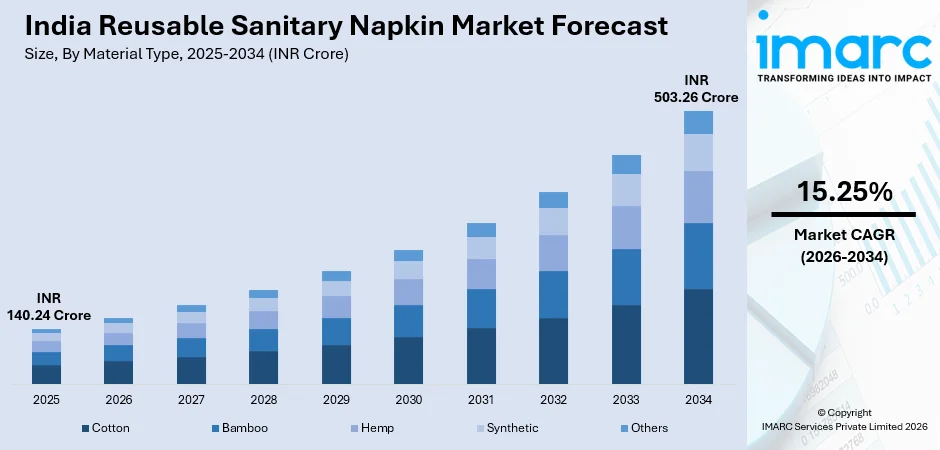
The India reusable sanitary napkin market size was valued at INR 140.24 Crore in 2025 and is projected to reach INR 503.26 Crore by 2034, growing at a compound annual growth rate of 15.25% from 2026-2034.
The India reusable sanitary napkin market is gaining significant traction as sustainability consciousness expands across urban and rural demographics. Rising environmental concerns over disposable pad waste, growing endorsement of chemical-free menstrual products, and supportive government menstrual hygiene programs are collectively accelerating adoption. Advances in organic fabric technology, expanding e-commerce accessibility, and increasing participation by social enterprises in menstrual health education are reinforcing the transition toward washable and reusable alternatives, positively influencing the India reusable sanitary napkin market share.
Key Takeaways and Insights:
- By Material Type: Cotton dominates the market with a share of 40% in 2025, driven by its superior absorbency, hypoallergenic properties, and widespread availability as a natural fiber across India.
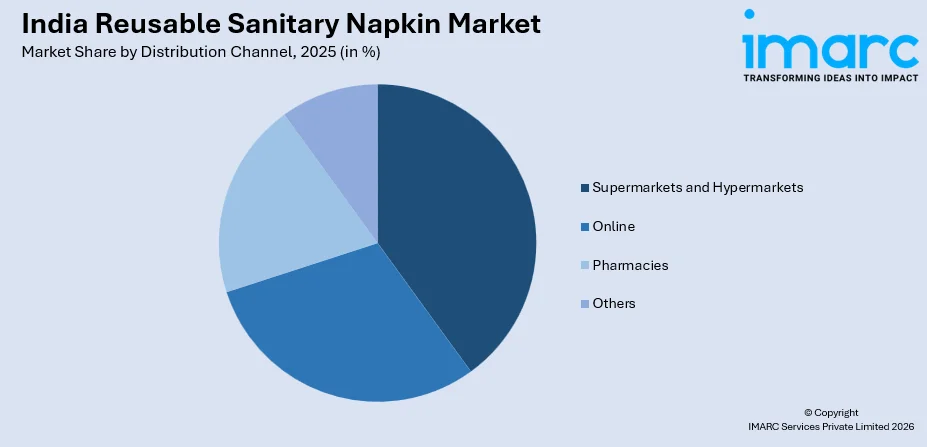
- By Distribution Channel: Supermarkets and hypermarkets lead the market with a share of 35% in 2025, supported by broad product visibility, competitive pricing, and increasing shelf space dedicated to sustainable feminine hygiene products.
- Key Players: The India reusable sanitary napkin market features a fragmented competitive landscape with mission-driven social enterprises and emerging direct-to-consumer brands competing on product innovation, organic certification, and community-based distribution to strengthen their positioning in the sustainable menstrual care segment. Some of the major players are Eco Femme, FabPad, Femy, iSWEVEN, Pee Safe (Redcliffe Hygiene Pvt. Ltd.), Re:Pad, Rebelle Pads, Reboot-U, Relief Line, Sanfe (Redroom Technology Pvt. Ltd.), Saukhyam, and Soch Green.
To get more information on this market Request Sample
The India reusable sanitary napkin market is experiencing a transformative shift driven by rising awareness about menstrual health and environmental sustainability. Consumers are increasingly moving away from disposable products that contribute to plastic waste, with estimates suggesting that India generates billions of non-biodegradable sanitary napkins annually. Government initiatives, including the Menstrual Hygiene Scheme and Pradhan Mantri Bhartiya Janaushadhi Pariyojana, have expanded awareness around menstrual hygiene across rural areas, indirectly encouraging the adoption of reusable alternatives. For instance, Project Laali, launched in Rajasthan in July 2024, provides free reusable menstrual pads and educational counseling sessions to girls and women in Dhaulpur district, demonstrating a scalable model for integrating reusable products into existing menstrual health programs. Social enterprises and D2C brands are leveraging organic certifications, e-commerce platforms, and educational outreach to drive market penetration across diverse socio-economic segments.
India Reusable Sanitary Napkin Market Trends:
Accelerating Adoption of Organic-Certified and Chemical-Free Materials
The India reusable sanitary napkin market growth is significantly influenced by the rising demand for certified organic and chemical-free menstrual products. Consumers are increasingly prioritizing products free from synthetic dyes, fragrances, and plastics, which has led manufacturers to adopt internationally recognized organic certifications for their fabric sourcing. This trend is reshaping product positioning across both premium and affordable market segments. For instance, in May 2025, UK-based Natracare launched its first reusable pad in collaboration with Eco Femme, a GOTS-certified organic cotton pad handmade by rural Indian women’s collectives, underscoring the growing international demand for ethically produced Indian reusable menstrual products.
Expansion of Direct-to-Consumer and E-Commerce Distribution Models
Digital platforms are transforming the distribution landscape for reusable sanitary napkins in India, with brands leveraging D2C websites, social media marketing, and marketplace integrations to reach consumers across tier-one, tier-two, and tier-three cities. E-commerce channels provide discreet purchasing options, detailed product education, and subscription-based models that improve customer retention and repeat purchases. The India e-commerce market size was valued at USD 129.72 Billion in 2025 and is projected to reach USD 651.10 Billion by 2034, growing at a compound annual growth rate of 19.63% from 2026-2034. For instance, Reliance Fresh broadened its feminine hygiene portfolio by adding environmentally friendly sanitary napkins from sustainable brands. This move enhanced the availability of reusable and biodegradable options for consumers in urban and semi-urban markets, leveraging organized retail channels to improve accessibility and visibility of eco-conscious menstrual hygiene products.
Integration of Reusable Products into Institutional Menstrual Health Programs
Institutional menstrual hygiene programs in India are increasingly incorporating reusable sanitary napkins alongside disposable alternatives, reflecting a broader shift toward sustainable health interventions. Schools, colleges, and community health organizations are distributing reusable pads as part of menstrual education workshops, promoting long-term behavioral change. For instance, in December 2024, the Indian Army established a biodegradable and reusable sanitary napkin manufacturing facility in Martselang village, Ladakh under Operation Sadbhavana, operated by local women to produce eco-friendly, affordable menstrual products while promoting menstrual hygiene awareness in remote regions.
Market Outlook 2026-2034:
The India reusable sanitary napkin market is expected to witness steady growth throughout the forecast period, supported by increasing environmental awareness and stronger advocacy for sustainable menstrual hygiene solutions. Government-led initiatives promoting eco-friendly alternatives, along with advancements in organic and skin-safe materials, are strengthening consumer confidence. Rapid urbanization, higher female workforce participation, and greater access to e-commerce platforms are further expanding market reach. As awareness improves across both urban and semi-urban areas, reusable sanitary products are likely to gain broader acceptance beyond early adopters. The market generated a revenue of INR 140.24 Crore in 2025 and is projected to reach a revenue of INR 503.26 Crore by 2034, growing at a compound annual growth rate of 15.25% from 2026-2034.
India Reusable Sanitary Napkin Market Report Segmentation:
| Segment Category | Leading Segment | Market Share |
|---|---|---|
|
Material Type |
Cotton |
40% |
|
Distribution Channel |
Supermarkets and Hypermarkets |
35% |
Material Type Insights:
- Cotton
- Bamboo
- Hemp
- Synthetic
- Others
Cotton dominates the market with a share of 40% of the total India reusable sanitary napkin market in 2025.
Cotton remains the material of choice for reusable sanitary napkins in India due to its breathability, gentle texture, and skin-friendly properties that help reduce irritation. As a naturally abundant fiber supported by established domestic supply networks, cotton enables cost-effective production. Its strong absorbent capacity and ease of cleaning enhance its suitability for repeated use. Women-led social enterprises and sustainable brands have further reinforced cotton’s position by adopting certified organic practices, positioning it as a trusted and environmentally responsible standard in reusable menstrual hygiene products.
The widespread consumer familiarity with cotton as a textile further supports its market leadership, as users trust its comfort and durability for extended menstrual product usage. Cotton-based reusable pads are also biodegradable at the end of their lifecycle, typically lasting between three to five years or approximately seventy-five to one hundred washes. This environmental advantage, combined with affordability and accessibility, positions cotton as the material of choice across both premium organic segments and budget-friendly product categories in the Indian market.
Distribution Channel Insights:
Access the comprehensive market breakdown Request Sample
- Online
- Pharmacies
- Supermarkets and Hypermarkets
- Others
Supermarkets and hypermarkets lead the market with a share of 35% of the total India reusable sanitary napkin market in 2025.
Supermarkets and hypermarkets hold the largest distribution channel share due to their extensive physical reach, competitive pricing structures, and ability to offer consumers direct product examination before purchase. Large retail chains across India have progressively expanded their feminine hygiene sections to include sustainable and reusable options alongside conventional disposable products. In 2024, Reliance Fresh broadened its feminine hygiene aisle by introducing eco-friendly sanitary napkins from sustainable brands, significantly improving the visibility and accessibility of reusable options for urban and semi-urban consumers.
The advantageous aspect of the organized retail format is that consumers have a history of trust and the convenience of the one-stop shopping experience that helps in impulse and trial purchases of reusable products. Consumer engagement is also being further promoted using promotional activities, in-store demonstrations, and specific shelf placements of sustainable menstrual care products. With the modern trade retailing business steadily penetrating the small cities and towns around India, the supermarket and hypermarket channel should be an important channel through which the introduction of the reusable sanitary Napkins can be made to first-time buyers.
Regional Insights:
- North India
- West and Central India
- South India
- East India
North India is a large market in terms of reusable sanitary napkins because of the high population density, strong government menstrual hygiene campaigns, and increased urbanization of these states, like Uttar Pradesh, Delhi, and Rajasthan. School and community-level programs support the use of sustainable menstrual products in the state, which increases awareness and uptake of these products in the area.
West and Central India benefit from strong industrial hubs and urban consumer bases in Maharashtra, Gujarat, and Madhya Pradesh that are receptive to eco-friendly personal care products. The presence of manufacturing clusters and social enterprise networks supports local production and distribution of reusable menstrual care products.
South India has become the center of innovation and social entrepreneurship in reusable sanitary napkins, and several pioneering manufacturers and female-led production facilities are in Tamil Nadu, Karnataka, and Kerala. The area enjoys increased literacy levels among the females and enlightened programs on menstrual health awareness.
East India is witnessing the gradual adoption of reusable sanitary napkins as government and NGO-driven menstrual hygiene programs expand across states such as West Bengal, Odisha, and Bihar. Improving awareness and distribution infrastructure are key factors supporting market growth in this region.

Market Dynamics:
Growth Drivers:
Why is the India Reusable Sanitary Napkin Market Growing?
Rising Environmental Awareness and Sustainable Consumption Patterns
Growing environmental consciousness among Indian consumers is a primary catalyst driving the reusable sanitary napkin market. India generates billions of disposable sanitary napkins annually, the majority of which are non-biodegradable and contribute significantly to landfill accumulation and water pollution. Increasing media coverage, social media advocacy, and educational campaigns about the environmental impact of single-use menstrual products are compelling consumers to seek sustainable alternatives. The shift toward circular economy principles is further reinforced by urban millennials and Gen Z consumers who prioritize eco-friendly purchasing decisions. For instance, in January 2025, CSIR-IICT Hyderabad partnered with Aakar Innovations to develop a Wealth out of Waste technology that converts agricultural waste like banana pseudostems into pulp for compostable sanitary products, demonstrating the innovation ecosystem supporting sustainable menstrual care.
Government Menstrual Hygiene Initiatives and Policy Support
The Indian government has implemented several strategic programs to improve menstrual hygiene access across the country, creating a supportive policy environment for reusable sanitary napkin adoption. The Menstrual Hygiene Scheme targets adolescent girls aged ten to nineteen in rural areas, while the Pradhan Mantri Bhartiya Janaushadhi Pariyojana provides affordable sanitary products through over 16000 Janaushadhi Kendras nationwide. State-level schemes, including Karnataka’s Shuchi Scheme reinstated in March 2024 to subsidize sanitary napkins for approximately nineteen lakh adolescent girls, and Madhya Pradesh’s Udita Yojana, are progressively incorporating reusable alternatives into their distribution frameworks. These government interventions are breaking cultural taboos, expanding first-time usage, and building long-term demand for sustainable menstrual products.
Material Innovation and Product Development Advancements
The quality, comfort, and price of reusable sanitary napkins are greatly improving due to some continuing improvements in fabric technology and manufacturing processes. Manufacturers are developing organic cotton, bamboo fibres, hemp mixes, and composite banana fibres to produce items that have better absorbency, breathability, and leak-proof qualities, as well as disposable products. Even more complex multi-layer constructions with protective laminate substrates and antimicrobial finishes are contributing to the mitigation of the anxieties regarding hygiene, leakage prevention, and general comfort. The new startups and research-based brands are launching new materials, including plant-based fibers and proprietary absorption technologies, to increase durability and user experience. These product innovations are reducing the relative differences in perceived performance of both reusable and disposable forms, thus enhancing confidence among consumers and stimulating their greater use by more diverse populations and income brackets.
Market Restraints:
What Challenges the India Reusable Sanitary Napkin Market is Facing?
Cultural Stigma and Social Taboos Surrounding Menstruation
The existence of strong cultural taboos and social misconceptions about menstruation still prevents open conversations about menstrual health in most of India. This is a cultural barrier to the spread of knowledge about reusable options, and women do not want to consider sustainable menstrual products. This has been especially acute in the rural and semi-urban regions where traditional beliefs are still being practiced and where menstrual health education is still sparse.
Maintenance Requirements and Hygiene Perceptions
Reusable sanitary napkins require regular washing, drying, and proper storage, which can be perceived as inconvenient compared to disposable alternatives. In areas with limited water access or inadequate drying spaces, maintaining hygiene standards for reusable products poses practical difficulties. Consumer perceptions about cleanliness and the effort involved in product maintenance remain significant barriers to broader adoption.
Limited Consumer Awareness in Underserved Markets
Despite growing urban awareness, large segments of the Indian population in rural and semi-urban regions remain unfamiliar with reusable sanitary napkins as a viable menstrual care option. Insufficient retail presence, limited marketing outreach, and the dominance of disposable products in existing distribution networks restrict consumer exposure to reusable alternatives and slow the pace of market penetration.
Competitive Landscape:
The India reusable sanitary napkin market exhibits a fragmented competitive structure characterized by the presence of mission-driven social enterprises, emerging D2C startups, and niche sustainable hygiene brands. Market participants differentiate through organic certifications, material innovation, community-based manufacturing models, and menstrual health education initiatives. Companies are leveraging GOTS and other international certifications to establish credibility and attract health-conscious consumers. Strategic collaborations between domestic manufacturers and international sustainable brands are expanding product portfolios and distribution reach. The competitive intensity is increasing as new entrants invest in digital marketing, subscription models, and rural distribution networks to capture the growing demand for eco-friendly menstrual care products. Some of the key players include:
- Eco Femme
- FabPad
- Femy
- iSWEVEN
- Pee Safe (Redcliffe Hygiene Pvt. Ltd.)
- Re:Pad
- Rebelle Pads
- Reboot-U
- Relief Line
- Sanfe (Redroom Technology Pvt. Ltd.)
- Saukhyam
- Soch Green
Recent Developments:
- February 2026: Rotarians, in collaboration with State Bank of India and Unipads Foundation, introduced Project Shakti, a program aimed at providing reusable sanitary pads to thousands of schoolgirls across Telangana. The initiative was formally launched on Monday at Veeranari Chakali Ilamma Women’s University in Koti by Hyderabad District Collector Hari Chandana Dasari. Backed by dedicated funding, the project seeks to promote menstrual hygiene awareness and improve access to sustainable sanitary solutions for young students.
- December 2025: The Baghpat District Administration rolled out NIRA, a new initiative to distribute eco-friendly cotton reusable menstrual pads to women and girls across the district, in collaboration with UNICEF and the Indian Red Cross Society. Announcing the programme, District Magistrate Asmita Lal stated that the initiative aims to tackle the escalating issue of menstrual waste while promoting safe, sustainable, and affordable alternatives to conventional disposable sanitary products.
India Reusable Sanitary Napkin Market Report Scope:
| Report Features | Details |
|---|---|
| Base Year of the Analysis | 2025 |
| Historical Period | 2020-2025 |
| Forecast Period | 2026-2034 |
| Units | INR Crore |
| Scope of the Report | Exploration of Historical and Forecast Trends, Industry Catalysts and Challenges, Segment-Wise Historical and Predictive Market Assessment:
|
| Material Types Covered | Cotton, Bamboo, Hemp, Synthetic, Others |
| Distribution Channels Covered | Online, Pharmacies, Supermarkets and Hypermarkets, Others |
| Regions Covered | South India, North India, West and Central India, East India |
| Companies Covered | Eco Femme, FabPad, Femy, Isweven, Pee Safe (Redcliffe Hygiene Pvt. Ltd.), Re:Pad, Rebelle Pads, Reboot-U, Relief Line, Sanfe (Redroom Technology Pvt. Ltd.), Saukhyam, Soch Green. etc. |
| Customization Scope | 10% Free Customization |
| Post-Sale Analyst Support | 10-12 Weeks |
| Delivery Format | PDF and Excel through Email (We can also provide the editable version of the report in PPT/Word format on special request) |
Frequently Asked Questions About the India Reusable Sanitary Napkin Market Report
The India reusable sanitary napkin market size was valued at INR 140.24 Crore in 2025.
The India reusable sanitary napkin market is expected to grow at a compound annual growth rate of 15.25% from 2026-2034 to reach INR 503.26 Crore by 2034.
Cotton, holding the largest market share of 40% in 2025, leads the India reusable sanitary napkin market owing to its natural absorbency, hypoallergenic properties, biodegradability, and wide availability as a domestically cultivated fiber across India.
Key factors driving the India reusable sanitary napkin market include rising environmental awareness, government menstrual hygiene programs, growing consumer preference for chemical-free products, material innovation, expanding e-commerce penetration, and increasing social enterprise activity.
Major challenges include cultural stigma and taboos surrounding menstruation, maintenance and hygiene perception barriers, limited consumer awareness in rural areas, insufficient retail penetration in underserved markets, and competition from established disposable sanitary product brands.
Need more help?
- Speak to our experienced analysts for insights on the current market scenarios.
- Include additional segments and countries to customize the report as per your requirement.
- Gain an unparalleled competitive advantage in your domain by understanding how to utilize the report and positively impacting your operations and revenue.
- For further assistance, please connect with our analysts.
 Request Customization
 Speak to an Analyst
 Request Brochure
 Inquire Before Buying
Benefits of Customization
- Personalize this research
- Triangulate with your data
- Get data as per your format and definition
- Gain a deeper dive into a specific application, geography, customer, or competitor
- Any level of personalization
Get in Touch With Us
UNITED STATES
Phone: +1-201-971-6302
INDIA
Phone: +91-120-433-0800
UNITED KINGDOM
Phone: +44-753-714-6104
Email: sales@imarcgroup.com
Client Testimonials




.webp)




.webp)













Related Reports

Choose your plan
*Please note that the prices mentioned below are starting prices for each bundle type. Kindly contact our team for further details.*
Single User License
- 1 User License, Access on 2 Devices
- PDF Report + Excel Dataset (Password Protected)
- Lifetime Access
- No Printing Rights
- 10% Free Report Customization
- 10–12 Weeks of Analyst Support
Five User License
- Access for 5 Users, 2 Devices per User
- PDF Report + Excel Dataset (Password Protected)
- Lifetime Access
- Dedicated Account Manager
- 12–14 Weeks of Analyst Support
- No Printing Rights
- 15% Free Report Customization
- 25% Discount on Your Next Purchase
Corporate User License
- Unlimited User Access (Within Your Organization)
- PDF Report + Excel Dataset
- Lifetime Access
- Dedicated Account Manager
- 14–20 Weeks of Analyst Support
- No Printing Rights
- 20% Free Report Customization
- 30% Discount on Your Next Purchase
Essential Insights
What's included:
3 reports
- Lifetime Access
- PDF Reports
- Excel Datasets
- 2 Weeks of Free Analyst Support
- 2 User Licenses
- Access on 2 Devices
- Printing Rights
- Complimentary PowerPoint (PPT) Version
- Complimentary License Upgrade
Professional Access
What's included:
5 reports
- Lifetime Access
- PDF Reports
- Excel Datasets
- 8 Weeks of Free Analyst Support
- 2 User Licenses
- Access on 2 Devices
- Printing Rights
- Complimentary PowerPoint (PPT) Version
- Complimentary License Upgrade
Business Advantage
What's included:
8 reports
- Lifetime Access
- PDF Reports
- Excel Datasets
- 14 Weeks of Free Analyst Support
- 2 User Licenses
- Access on 2 Devices
- Printing Rights
- Complimentary PowerPoint (PPT) Version
- Complimentary License Upgrade
Enterprise Intelligence
What's included:
10 reports
- Lifetime Access
- PDF Reports
- Excel Datasets
- 20 Weeks of Free Analyst Support
- 2 User Licenses
- Access on 2 Devices
- Printing Rights
- Complimentary PowerPoint (PPT) Version
- Complimentary License Upgrade