
India Road Construction Market Size, Share, Trends and Forecast by Type, Application, and Region, 2026-2034
India Road Construction Market Size, Share, Trends & Forecast (2026-2034)
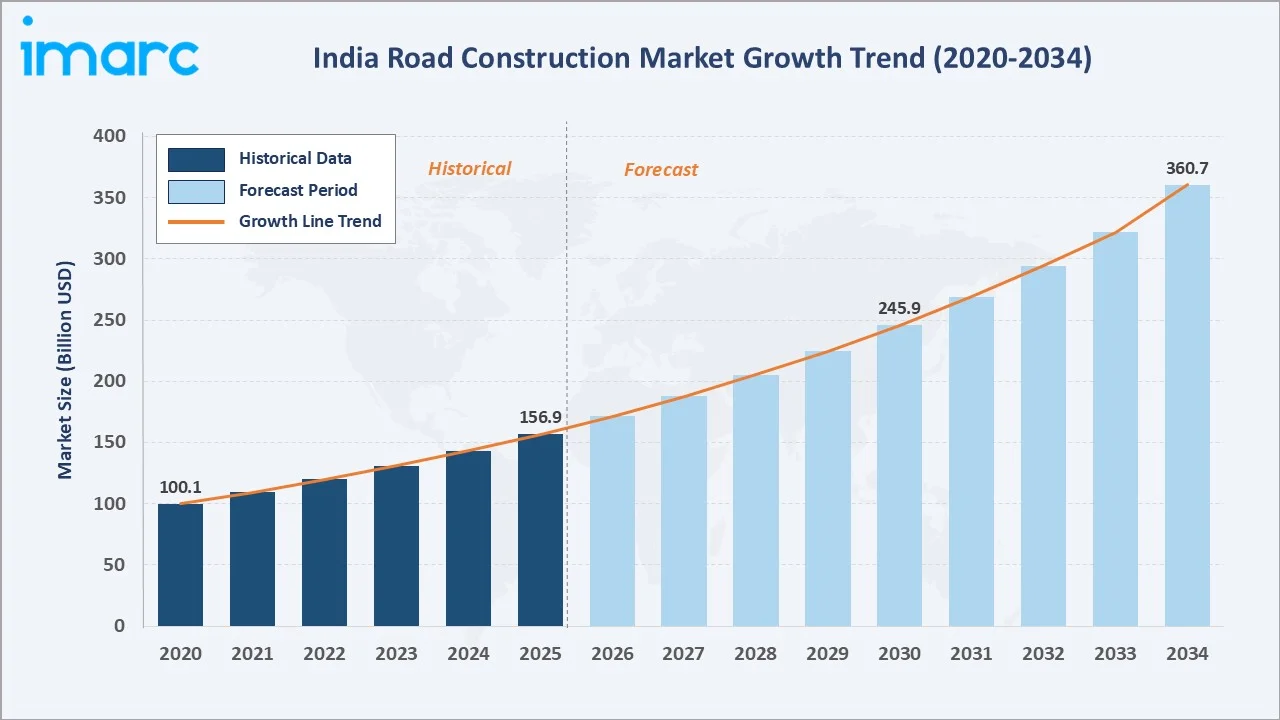
The India road construction market grew from USD 156.9 Billion in 2025 to USD 175.8 Billion in 2026 and is projected to reach USD 360.7 Billion by 2034, growing at a CAGR of 9.40% during 2026-2034. The market is driven by sustained government infrastructure investment programs, growing private sector participation through structured project delivery models, and increasing demand for improved road connectivity across all geographies. Paving Construction at 57.8% dominates by type. National Highways lead at 36.4% by application. North India commands the leading regional share at 31.8%.
Market Snapshot
|
Metric |
Value |
|
Base Year Market Size (2025) |
USD 156.9 Billion |
|
Market Size (2026) |
USD 175.8 Billion |
|
Forecast Market Size (2034) |
USD 360.7 Billion |
|
CAGR (2026-2034) |
9.40% |
|
Base Year |
2025 |
|
Historical Period |
2020-2025 |
|
Forecast Period |
2026-2034 |
|
Dominant Type |
Paving Construction (57.8%, 2025) |
|
Dominant Application |
National Highways (36.4%, 2025) |
|
Leading Region |
North India (31.8%, 2025) |
The market expanded from USD 100.1 Billion in 2020 to USD 156.9 Billion in 2025 and an estimated USD 175.8 Billion in 2026, anchored at USD 245.9 Billion in 2030 and forecast to reach USD 360.7 Billion by 2034.
To get more information on this market, Request Sample
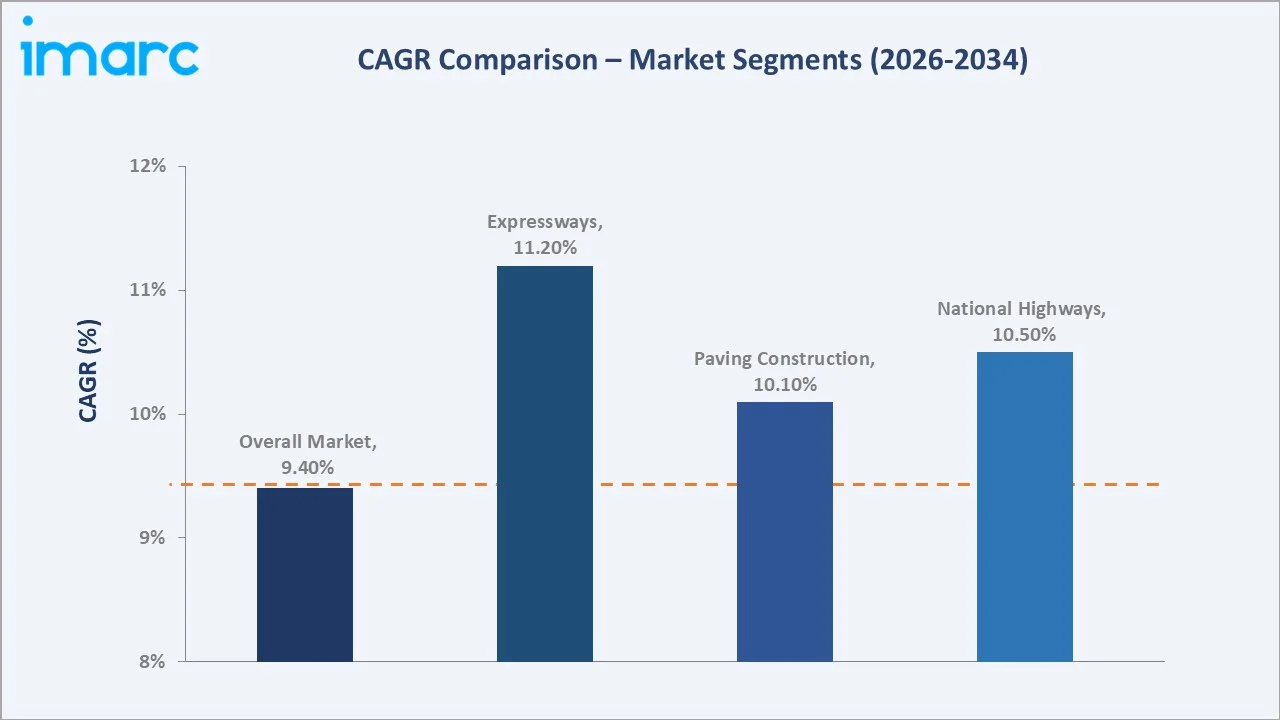
Expressways lead segment growth at ~11.2% CAGR driven by greenfield corridor development. Paving Construction at ~10.1% CAGR benefits from rising asphalt and concrete pavement demand across four-laning programmes. North India grows at ~9.8% CAGR led by expressway projects and national highway corridor development.
Executive Summary
The India road construction market, which increased from USD 156.9 Billion in 2025 to an estimated USD 175.8 Billion in 2026, representing the country's single-largest infrastructure investment category, driven by ambitious highway development targets and sustained private sector co-investment under hybrid delivery models. The market is projected to reach USD 360.7 Billion by 2034.
Paving Construction at 57.8% dominates by capturing the national highway and expressway development pipeline. National Highways at 36.4% lead by application through four-laning and six-laning programmes. North India at 31.8% commands the largest regional share through expressway corridors and urban ring road expansion across the northern states.
Key Market Insights
|
Insight |
Data |
|
Dominant Type |
Paving Construction – 57.8% share (2025) |
|
Dominant Application |
National Highways – 36.4% market share (2025) |
|
Leading Region |
North India – 31.8% market share (2025) |
|
Market Opportunity |
Expressway development; rural connectivity roads; strategic border roads; smart highway digitalization |
Key Analytical Observations Supporting the Above Data:
- Paving Construction at 57.8%: Paving Construction dominates as it encompasses the largest capital-intensive activity in road development, including flexible asphalt pavement, rigid cement concrete pavement, and surface dressing works on national and state highway corridors. Expanding four-laning and six-laning of national corridors and increasing asphalt and concrete pavement standards drive segment revenue. The push for high-quality durable road surfaces on expressways and national highways further sustains demand for advanced paving works.
- National Highways at 36.4%: National Highways lead by application through sustained lane-km addition targets and expressway upgradation pipelines. With an expanding national highway network and an active multi-year development programme, NH projects attract the highest per-km investment of any road category, sustaining revenue share. Investment intensity on NH projects is 3–5x higher per km than rural roads, ensuring NH application continues to anchor overall market value through the forecast period.
- North India at 31.8%: North India leads regionally through a large expressway development pipeline across northern states, national highway expansion in multiple states, and urban road network upgradation in major metropolitan regions. The combined construction value of expressway and NH projects in North India generates the highest annual road construction revenue of any region. Ongoing ring road and bypass development around tier-2 and tier-3 cities further reinforces North India's leading position through the forecast period.
India Road Construction Market Overview
The India road construction market encompasses the design, engineering, and construction of all road infrastructure categories, national highways, state highways, expressways, rural roads, and strategic border roads, across all geographies in India.
The ecosystem integrates raw material suppliers, equipment manufacturers, design consultants, EPC contractors, government bodies, financial institutions, and end users, including logistics operators, commuters, and defence authorities. Macroeconomic factors include rising infrastructure capital expenditure allocation, urbanization, logistics cost optimization targets, and growing emphasis on industrial corridor connectivity.
Market Dynamics
To evaluate market opportunities, Request Sample
Market Drivers
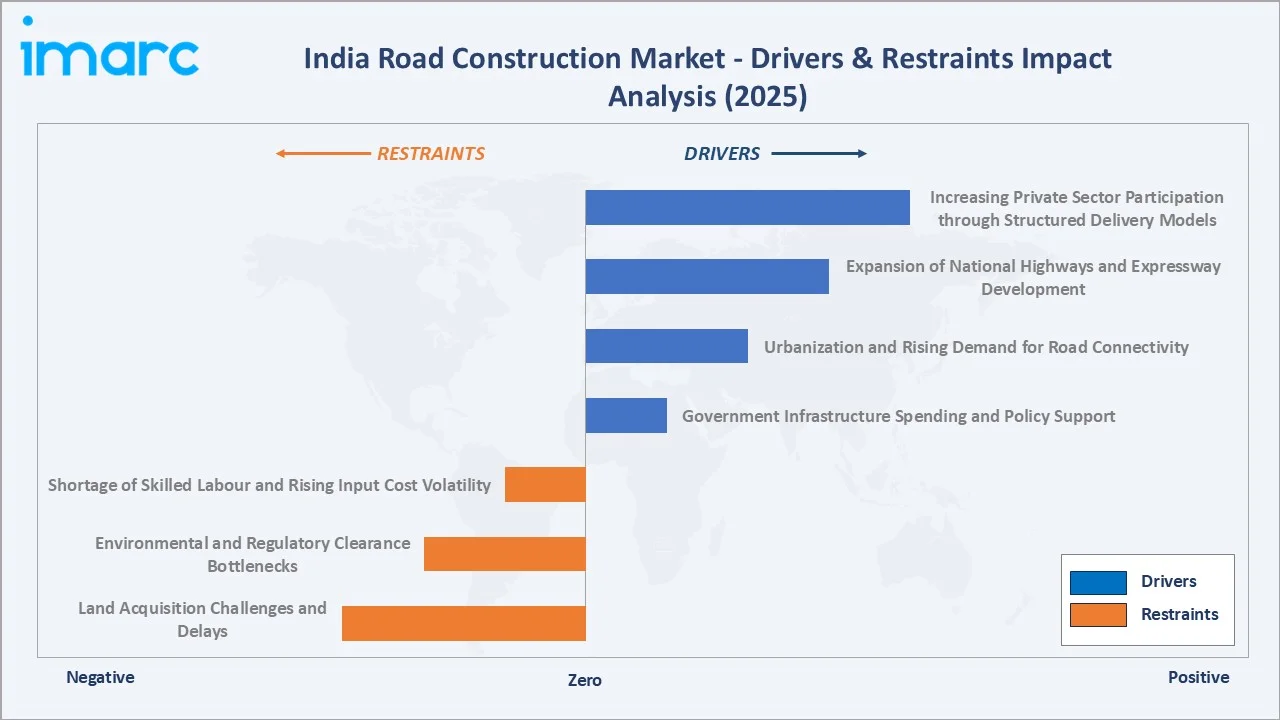
- Government Infrastructure Spending and Policy Support: Rising government capital expenditure on road infrastructure, supported by comprehensive national programs targeting economic corridors, ring roads, and inter-corridor highways, sustains multi-year construction order inflows for road contractors. Dedicated budget allocations for road development under successive national budgets and enabling policy frameworks have consistently expanded the scope and pace of highway construction.
- Urbanization and Rising Demand for Road Connectivity: Rapid urban population growth is generating sustained demand for urban ring roads, elevated highways, flyovers, and arterial road upgradation across tier-1, tier-2, and tier-3 cities nationwide. Urban development programs and city mobility plans are driving municipal road construction investments, while peri-urban growth corridors create demand for access-controlled highways connecting industrial estates and logistics hubs. The emergence of new industrial corridors and special economic zones across multiple regions further amplifies road construction demand, requiring dedicated access and connectivity infrastructure.
- Expansion of National Highways and Expressway Development: Active multi-year national highway network expansion programmes sustain high-value construction contracts commanding premium per-km execution rates. The growing national highway network, combined with ambitious targets for further expansion, requires sustained construction activity across all regions and road categories. State highway development corporations in multiple states are independently financing major expressway and ring road projects that supplement central government highway pipelines. The integration of multi-modal logistics parks and freight terminals along highway corridors is increasing the value and complexity of associated road infrastructure contracts.
- Increasing Private Sector Participation through Structured Delivery Models: Structured project delivery models that balance government fiscal exposure with private contractor risk have attracted sustained private capital into road construction and operation, with hybrid concession projects accounting for a growing share of annual highway awards. These models reduce upfront contractor risk by providing construction grants during project execution, enabling aggressive project bidding and accelerating completion timelines through performance-linked payment structures. The success of infrastructure investment trust structures in monetizing operational toll roads has created capital recycling frameworks that incentivize further private investment in road construction.
Market Restraints
- Land Acquisition Challenges and Delays: Land acquisition remains the most significant execution bottleneck for highway and expressway projects, with disputes over compensation and litigation frequently delaying project site possession by twelve to thirty-six months. Delays in land handover increase financial carrying costs for contractors and concessionaires, eroding project returns and triggering contract renegotiations with project authorities. Community resistance, particularly for expressway projects passing through agriculturally productive regions, has blocked construction for extended periods on several high-profile projects. Compensation escalation driven by market value benchmarking has also increased overall project costs, reducing the effective per-km construction budget available to contractors.
- Environmental and Regulatory Clearance Bottlenecks: Environmental impact assessment processes, forest clearances, and wildlife protection approvals add significant timelines to road projects passing through ecologically sensitive zones, with multi-stage approval requirements creating procedural delays. Projects in biodiversity-rich corridors and ecologically sensitive areas face particularly stringent scrutiny, requiring extensive mitigation planning before construction can commence. Simultaneous approvals from multiple regulatory bodies are sometimes required for a single project, creating coordination complexity that extends pre-construction timelines well beyond planned schedules. The increasing integration of climate resilience and environmental sustainability requirements into project design adds to the engineering specification burden on contractors.
- Shortage of Skilled Labour and Rising Input Cost Volatility: Road construction faces a structural shortage of trained machine operators, civil engineers, and site supervisors, particularly for mechanized paving and specialized tunnelling operations, limiting construction speed even when financing and land are not constraints. Simultaneous escalation in key construction materials during recent years eroded contractor margins and triggered disputes on fixed-price contracts, with several large contractors seeking price-variation relief from project authorities.
Market Opportunities
- Smart Highway and Digital Infrastructure Development: Integration of electronic toll collection, automated traffic management systems, and digital corridor monitoring into road construction projects is creating value-added contract opportunities that command higher margins than conventional civil construction. Smart highway specifications in new national highway projects mandate intelligent transport system installations, enabling road construction companies to diversify revenue by capturing technology integration work alongside traditional earthwork and paving contracts. The vision for a digitally enabled highway network covering all national highways by the end of this decade is expected to generate substantial incremental investment in ITS and digital infrastructure.
- Strategic Road and Border Connectivity Projects: Strategic road connectivity projects in border regions and remote areas offer a sustained pipeline of construction contracts that command premium execution rates due to terrain complexity and defense-driven urgency. Sustained government commitment to completing all-weather connectivity to border areas and strategic locations has accelerated investment allocation, with annual capital expenditure on strategic roads maintaining an upward trend. Recent project inaugurations across multiple states and union territories demonstrate the scale and regularity of strategic road investment. Regional connectivity programmes under national development initiatives are further augmenting the strategic road pipeline with additional economic corridors and trade route linkages.
Market Challenges
- Contractor Financial Stress and Dispute Resolution Delays: A significant proportion of road contractors carry elevated debt levels from execution delays, material cost escalations, and prolonged dispute resolution timelines, which collectively constrain fresh bidding capacity and project mobilization capability. Outstanding arbitration and dispute claims tied up across multiple ongoing cases represent a significant working capital constraint, with long resolution timelines restricting contractors' ability to finance new project mobilizations.
- Construction Quality Standards and Asset Longevity: Premature distress of road surfaces on high-traffic highway sections reflects persistent gaps in material quality control, inadequate compaction, and poor drainage design that undermine the value of infrastructure investment. Recurring maintenance costs reduce the effective economic return on construction investments and fuel scrutiny of project execution standards, prompting authorities to impose more stringent performance guarantees and warranty obligations on new contracts. The move toward long-term performance warranties on new construction contracts has increased contractor exposure to post-completion cost risk, discouraging aggressive bidding from smaller players and concentrating awards among larger technically capable firms.
Emerging Market Trends
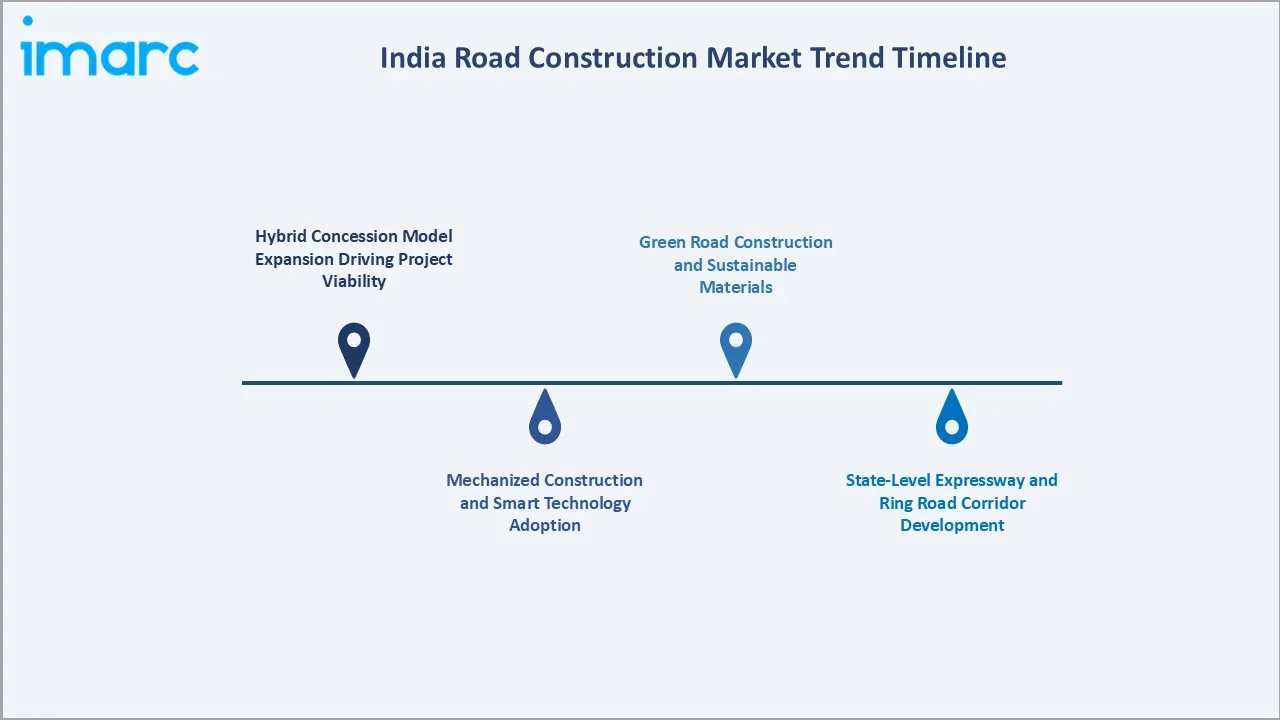
1. Hybrid Concession Model Expansion Driving Project Viability
Structured hybrid concession models have become the preferred project delivery mode for national highway development, balancing government fiscal exposure with contractor risk by providing upfront construction grants combined with long-term annuity payments. With this model accounting for a growing share of annual project awards by value, it is directly accelerating the construction pace across major highway development programmes and enabling mid-tier contractors to access large-value projects with manageable balance sheet risk.
2. Mechanized Construction and Smart Technology Adoption
Modern concrete and asphalt paving trains, GPS-guided motor graders, and intelligent compaction equipment are transforming road construction productivity and quality on national highway and expressway projects. Adoption of three-dimensional machine control, drone-based surveying, and digital project management tools is reducing rework, improving quality certification compliance, and enabling more accurate tracking of construction progress against milestones.
3. Green Road Construction and Sustainable Materials
Use of recycled pavement materials, industrial by-products, waste aggregates, and other sustainable construction materials in road construction is gaining regulatory and contractual traction, driven by circular economy mandates for highway projects. Mandates for the use of recycled and waste materials in bituminous road construction across urban areas are creating structural demand for waste-integrated construction materials among contractors working on government-sanctioned road projects.
4. State-Level Expressway and Ring Road Corridor Development
State governments are independently financing expressway and ring road projects through state road development corporations, supplementing central government highway pipelines and broadening the addressable market for road construction contractors. Multiple state-level road development corporations are executing large-value expressway and ring road projects that collectively represent a significant secondary tier of construction contracts with reliable government counterparty support and structured financing frameworks.
Industry Value Chain Analysis
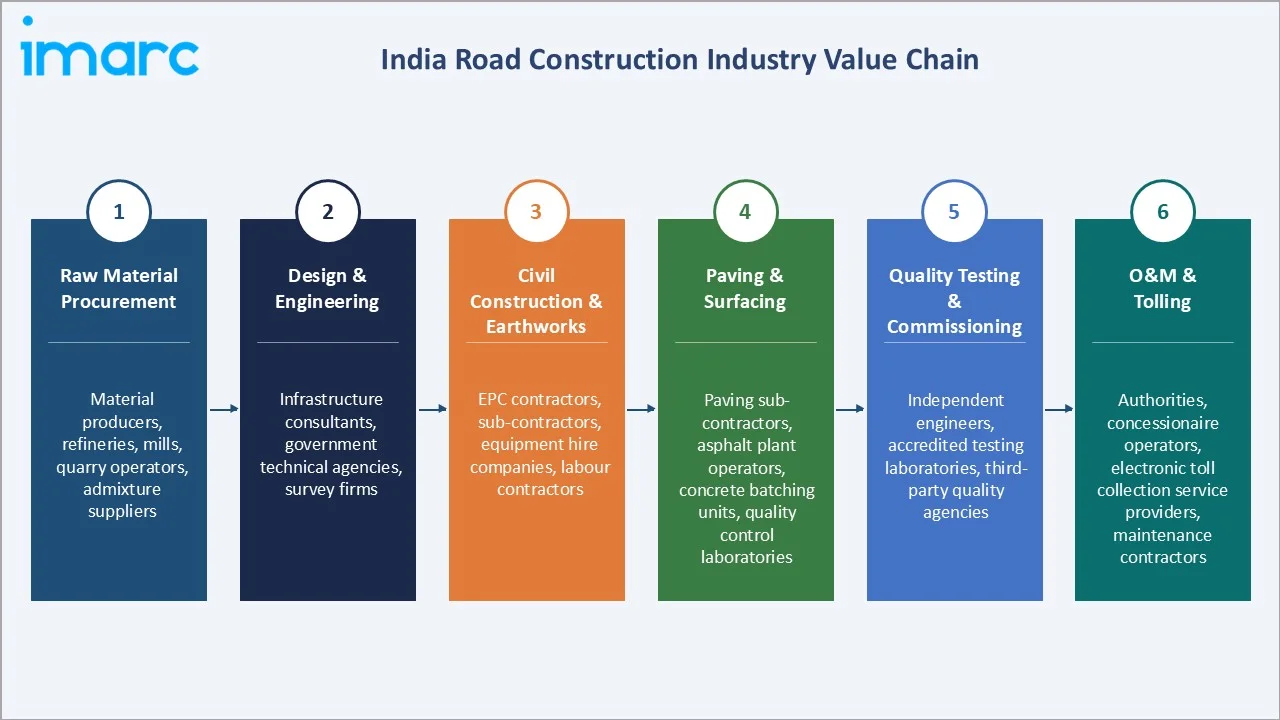
The road construction value chain integrates raw material procurement, design and engineering, civil construction and earthworks, paving and surfacing, quality testing and commissioning, and operations and maintenance. The value chain's commercial architecture is progressively consolidating toward integrated construction-plus-operations contracts as the primary delivery format.
|
Stage |
Key Participants |
|
Raw Material Procurement |
Material producers, refineries, mills, quarry operators, admixture suppliers |
|
Design & Engineering |
Infrastructure consultants, government technical agencies, survey firms |
|
Civil Construction & Earthworks |
EPC contractors, sub-contractors, equipment hire companies, labour contractors |
|
Paving & Surfacing |
Paving sub-contractors, asphalt plant operators, concrete batching units, quality control laboratories |
|
Quality Testing & Commissioning |
Independent engineers, accredited testing laboratories, third-party quality agencies |
|
O&M & Tolling |
Authorities, concessionaire operators, electronic toll collection service providers, maintenance contractors |
The raw material procurement stage is the most price-sensitive tier, with bitumen and steel collectively accounting for a significant portion of total road project cost. The paving and surfacing stage is experiencing the fastest technology transition as rigid concrete pavement gains share over flexible bitumen pavement on high-traffic expressway corridors.
Technology Landscape in the India Road Construction Industry
Building Information Modelling (BIM) Technology
BIM adoption in road construction is enabling three-dimensional digital modelling of highway alignments, cross-sections, drainage structures, and road safety features, improving design accuracy and significantly reducing field-level rework and construction variation orders. Mandating of BIM for large road projects is driving measurable adoption among major EPC contractors across national highway programmes and greenfield expressway development.
Intelligent Compaction and Mechanized Paving Technology
GPS-guided intelligent compaction equipment with real-time density mapping is improving pavement quality consistency on high-traffic highway corridors, reducing construction defects, and improving post-completion road surface longevity. These technologies are increasingly specified in technical contracts for expressway and multi-lane highway projects, with adoption accelerating as contractors seek to reduce post-construction warranty liability under performance guarantee clauses.
Electronic Toll Collection and Intelligent Transport System Integration
Electronic toll collection systems have achieved near-complete penetration across the tolled national highway network, processing tens of millions of daily transactions and demonstrating the successful integration of digital payment infrastructure into highway operations. Integration of ITS components including incident detection, variable message signs, and emergency call systems into new highway construction contracts is adding a technology services component to traditional road construction projects, increasing per-contract value and margin potential for technically capable contractors.
Market Segmentation Analysis
The report covers the following segments:
|
Segment Category |
Leading Segment |
Market Share |
Year |
|
Type |
Paving Construction |
57.8% |
2025 |
|
Application |
National Highways |
36.4% |
2025 |
|
Region |
North India |
31.8% |
2025 |

By Type
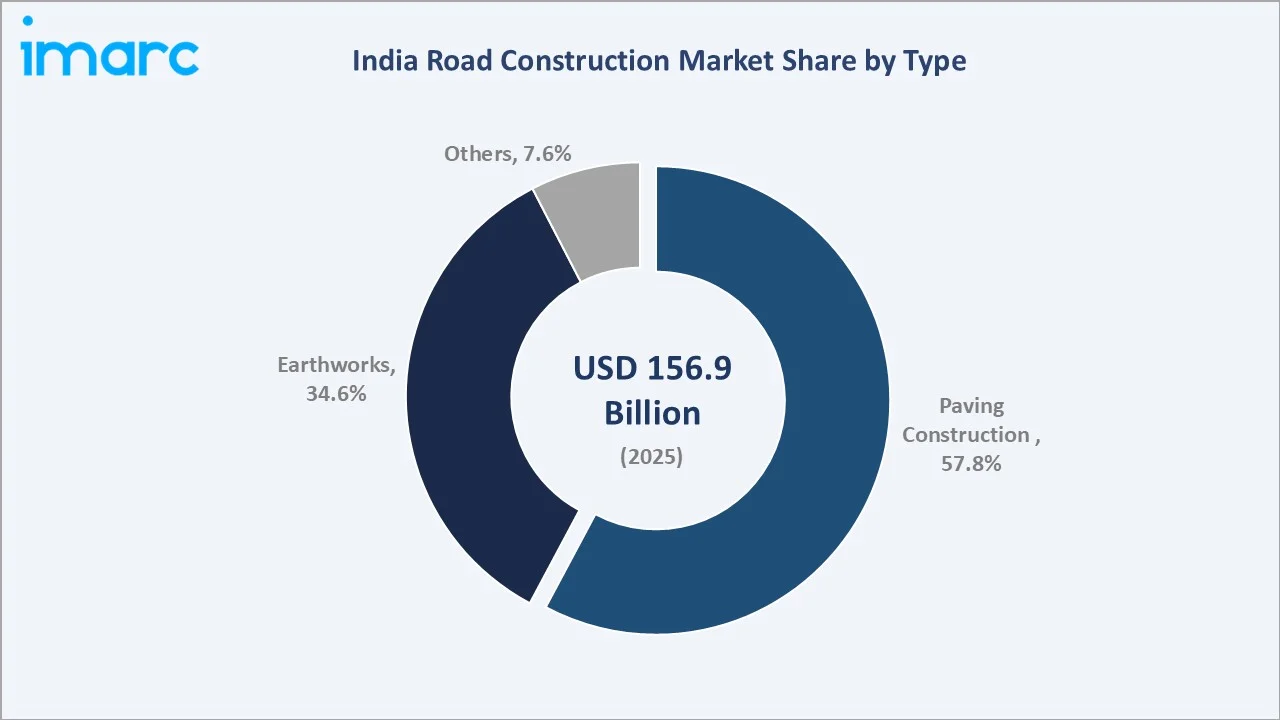
Paving Construction leads at 57.8% in 2025, encompassing the highest capital-intensity activity in road development including flexible asphalt pavement, rigid cement concrete pavement, and surface dressing works on national and state highway corridors.
To access detailed market analysis, Request Sample
Earthworks at 34.6% capture foundation preparation, embankment formation, and cutting activities essential for new highway and expressway construction, particularly on greenfield alignments.
By Application
National Highways lead at 36.4% through sustained four-laning and six-laning programmes and the highest per-km investment of any road category, generating multi-year construction revenue across the national highway development pipeline.
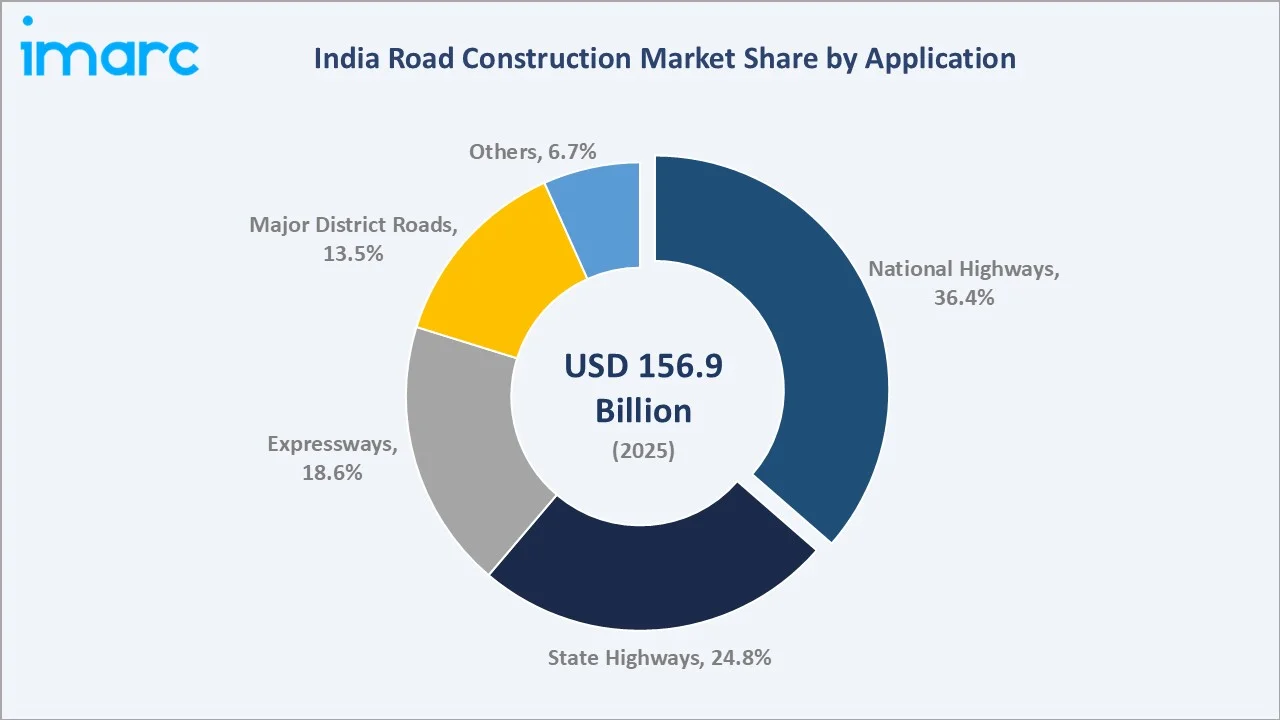
State Highways at 24.8% reflect state government road development corporation investments and multilateral development bank-funded state road improvement projects.
Regional Market Insights
|
Region |
Share (2025) |
Key Road Construction Market Drivers & Characteristics |
|
North India |
31.8% |
Driven by large expressway development pipeline across northern states, national highway corridor expansion, and urban ring road upgradation in major metropolitan regions |
|
West India |
27.6% |
Led by state-funded expressway development, coastal road projects, and greenfield highway network expansion under state industrial corridor programmes |
|
South India |
24.3% |
Supported by highway upgradation programmes, satellite town connectivity roads, and peripheral ring road development around major southern cities |
|
East India |
16.3% |
Driven by national highway widening, strategic border road connectivity in northeastern states, and access-controlled highway development across eastern corridors |
North India at 31.8% leads through the largest expressway development programme in the country and multi-modal infrastructure investment across northern metropolitan regions. West India at 27.6% reflects industrial corridor road networks and large-scale expressway and coastal highway investments by state road development corporations.
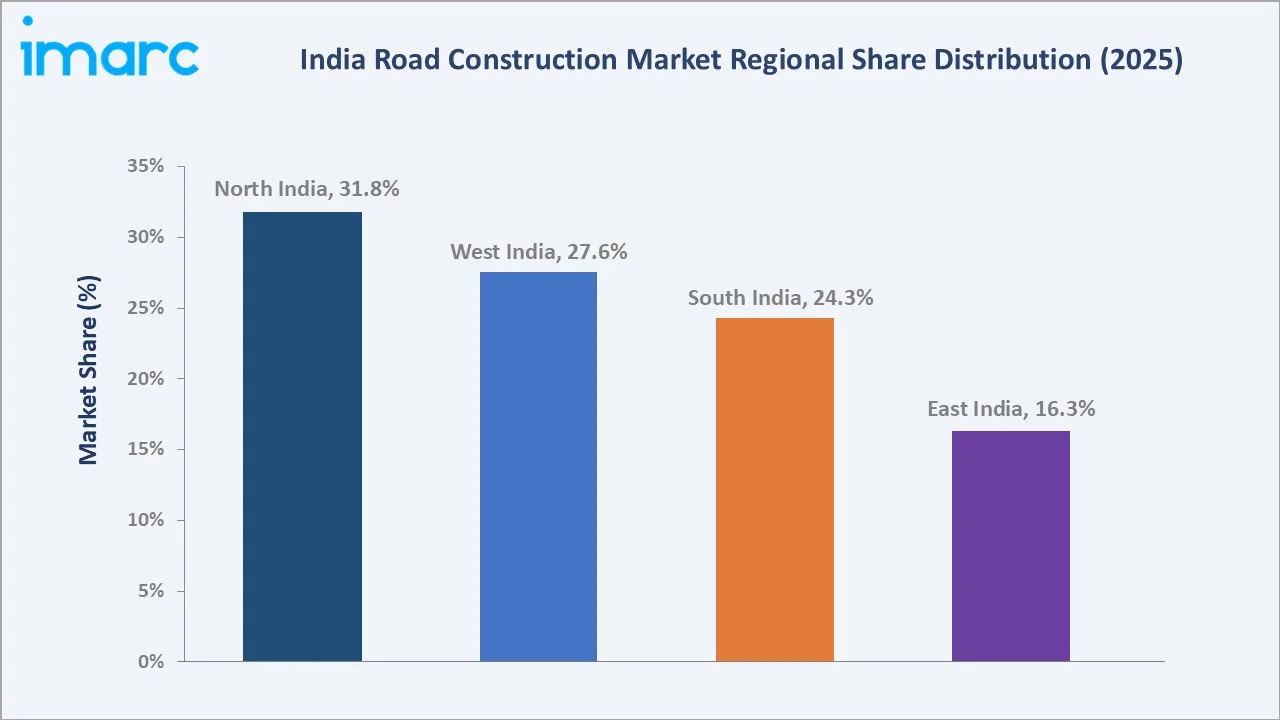
South India at 24.3% benefits from outer ring road expansion, peripheral ring roads, and satellite town connectivity highways across major southern cities.
Competitive Landscape
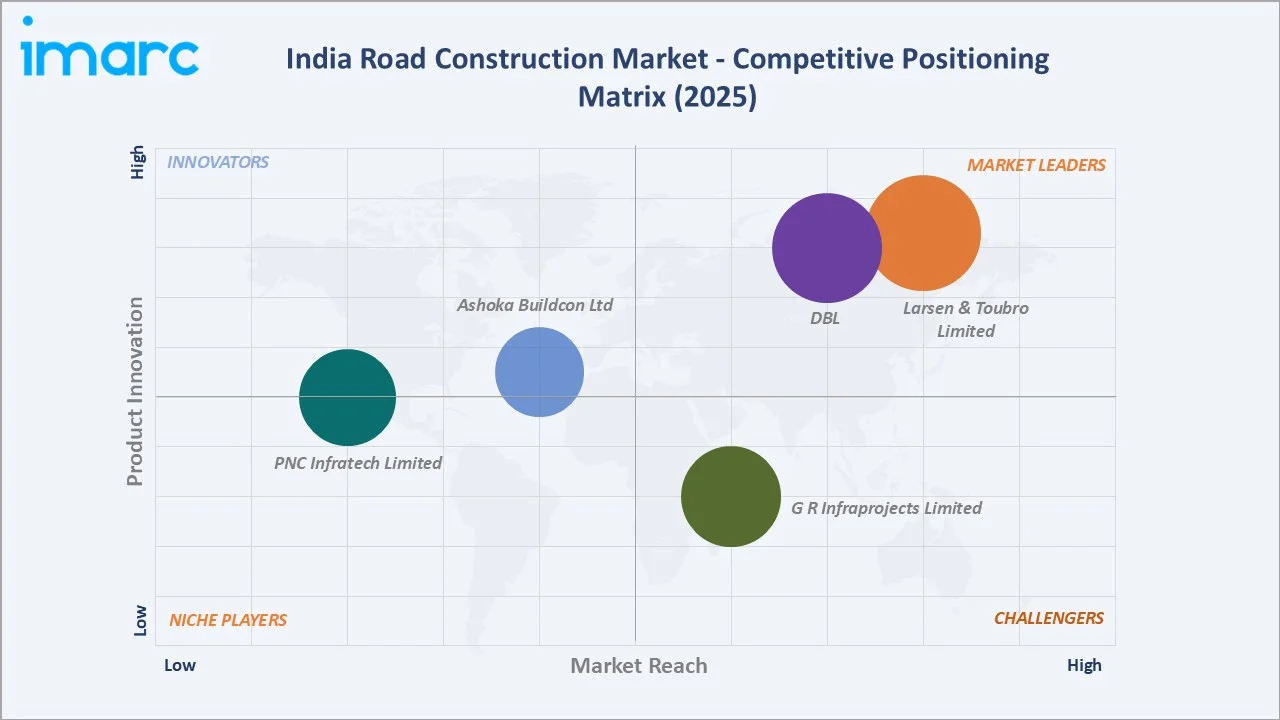
The India road construction market competitive landscape is moderately consolidated at the large EPC tier, with three distinct competitive tiers: national Tier-1 EPC leaders, mid-tier concession specialists, and state-focused regional contractors competing primarily in state PWD and rural road tenders.
|
Company Name |
Key Products |
Market Position |
Core Strength |
|
Larsen & Toubro Limited |
Expressways, Elevated Highways, Urban Roads |
Market Leader |
The company specializes in large-scale EPC road and infrastructure delivery with unmatched project execution capability, equipment fleet, and multi-geography presence across all road categories. |
|
DBL |
NH Four-Laning, Rural Roads, Concession Highways |
Market Leader |
DBL specializes in speed-execution road construction with a large, owned construction vehicle fleet and a strong early completion bonus track record on national highway projects. |
|
G R Infraprojects Limited |
Concession Highways, Greenfield Expressways |
Strong Challenger |
GR Infraprojects specializes in concession highway development with consistent on-time delivery and a dominant presence in expressway corridors across northern India. |
|
Ashoka Buildcon Ltd |
EPC Roads, Concession Highways, Bridges |
Established Player |
Ashoka Buildcon specializes in EPC road and bridge construction with an extensive lane-km portfolio and an active national and state highway project pipeline. |
|
PNC Infratech Limited |
NH Projects, Rural Roads, Bridges |
Established Player |
PNC Infratech specializes in mid-size road and bridge EPC contracts with a diversified project portfolio across multiple northern and central Indian states. |
Key players include Larsen & Toubro Limited, DBL, G R Infraprojects Limited, Ashoka Buildcon Ltd, PNC Infratech Limited, and others.
Key Company Profiles
Larsen & Toubro Limited
Larsen & Toubro Limited is India's largest engineering and construction conglomerate, with its Infrastructure segment being a dominant force in the India road construction market through national highway, expressway, elevated road, and urban road development across all regions.
- Key Products: Expressways, elevated urban highways, NH four-laning and six-laning, complex interchange construction, and multi-modal transport infrastructure.
- Strategic Focus: Expanding integrated construction-plus-operations highway solutions combining design, construction, and asset management; scaling digital construction technologies across the national highway project portfolio; deepening engagement with upcoming Bharatmala Phase II contract pipeline; and growing its position in elevated urban infrastructure and tunnel road projects in metro regions. The company is also focused on further differentiating its technical capabilities in complex highway interchange construction and multi-modal logistics hub access road development, which command premium contract values.
G R Infraprojects Limited
G R Infraprojects Limited is a highway construction company recognized as a leading concession model specialist, with a strong track record of on-time or ahead-of-schedule project delivery across greenfield highway corridors and national highway packages.
- Key Products: Concession highway development, greenfield expressway construction, national highway four-laning packages, and annuity concession road projects.
- Strategic Focus: Scaling its concession portfolio through selective bidding on high-annuity-cash-flow expressway packages; expanding into new geographic regions to broaden presence; leveraging annuity revenue streams for balance sheet strengthening and financing of new project mobilizations; and building capability in technically complex highway projects including elevated sections, tunnels, and large bridge structures. The company is also focused on developing in-house engineering and design capabilities to reduce reliance on external consultants and shorten pre-construction timelines.
Market Concentration Analysis
The India road construction market is moderately concentrated at the Tier-1 EPC level, with leading contractors collectively capturing an estimated 30–40% of centrally awarded contract value. State PWD and rural road markets are more fragmented, with a large number of regional contractors participating in lower-value tenders.
Market concentration is expected to increase moderately over the forecast period. Financial challenges among mid-tier contractors may drive consolidation, while structured concession models continue to favour well-capitalized Tier-1 contractors with strong balance sheets and project financing capability.
Investment & Growth Opportunities
Highest Growth Segments
Expressways (~11.2% CAGR), Paving Construction (~10.1% CAGR), National Highways (~10.5% CAGR), North India construction (~9.8% CAGR), strategic connectivity roads, and smart highway ITS integration represent the highest-return investment vectors through 2034.
Emerging Investment Opportunities
Tunnel road construction represents the India road market's highest per-km value emerging opportunity, as mountain terrain highway development in challenging geographies requires technically complex and high-margin construction work commanding significantly higher per-km revenue than surface highway construction.
Investment Themes
- Concession portfolio aggregation for asset monetization: Contractors with multiple operational concession assets can aggregate projects into infrastructure investment trust structures post-construction, unlocking capital recycling opportunities that reinvest in new project development and create a self-reinforcing growth model.
- Smart highway technology integration as a margin expansion lever: Contractors offering digital monitoring, ITS integration, and intelligent construction management alongside civil construction can command premium margins on technology-mandated contracts, creating a differentiated value proposition beyond conventional EPC pricing.
Future Market Outlook (2026-2034)
The India road construction market is projected to grow from USD 156.9 Billion in 2025 to USD 175.8 Billion in 2026 and further to USD 360.7 Billion by 2034, delivering a 9.40% CAGR over the forecast period. The market's anchor value of approximately USD 245.9 Billion in 2030 marks India's road construction at its most transformative execution phase, with major highway programmes nearing completion and new development phases being initiated.
Three structural forces define India road construction market growth through 2034 with high confidence: national infrastructure investment commitments that position road and highway development as the largest single-sector allocation across planning periods; the demonstrated success of hybrid concession models in attracting private capital and accelerating project delivery; and India's logistics cost optimization imperative requiring sustained multi-corridor road investment spanning the full forecast period.
Research Methodology
Primary Research
Primary research comprised structured interviews with 50+ industry stakeholders (2025), including project directors, EPC contractor CFOs, road construction equipment manufacturers, public works engineering heads, and construction material procurement specialists.
Secondary Research
Secondary research encompassed government annual reports, road transport and highways ministry data, national infrastructure pipeline reports, multilateral development bank transport sector documentation, company annual reports, industry body surveys, and sector data providers. Over 60 secondary sources reviewed.
Forecasting Models
Market revenue forecasts developed using a project pipeline-based bottom-up model incorporating annual project award and construction data by road category, average per-km construction cost adjustments, project execution timeline factors, and ancillary construction works multipliers for bridges, drainage, tunnels, and ITS components.
India Road Construction Market Report Coverage:
| Report Features | Details |
|---|---|
| Base Year of the Analysis | 2025 |
| Historical Period | 2020-2025 |
| Forecast Period | 2026-2034 |
| Units | Billion USD |
| Scope of the Report |
Exploration of Historical Trends and Market Outlook, Industry Catalysts and Challenges, Segment-Wise Historical and Future Market Assessment:
|
| Types Covered | Earthworks, Paving Construction, Others |
| Applications Covered | Expressways, National Highways, State Highways, Major District Road, Others |
| Regions Covered | North India, South India, East India, West India |
| Companies Covered | Larsen & Toubro Limited, DBL, G R Infraprojects Limited, Ashoka Buildcon Ltd, PNC Infratech Limited, etc. |
| Customization Scope | 10% Free Customization |
| Post-Sale Analyst Support | 10-12 Weeks |
| Delivery Format | PDF and Excel through Email (We can also provide the editable version of the report in PPT/Word format on special request) |
Key Benefits for Stakeholders:
- IMARC’s industry report offers a comprehensive quantitative analysis of various market segments, historical and current market trends, market forecasts, and dynamics of the India road construction market from 2020-2034.
- The research report provides the latest information on the market drivers, challenges, and opportunities in the India road construction market.
- Porter's five forces analysis assist stakeholders in assessing the impact of new entrants, competitive rivalry, supplier power, buyer power, and the threat of substitution. It helps stakeholders to analyze the level of competition within the India road construction industry and its attractiveness.
- Competitive landscape allows stakeholders to understand their competitive environment and provides an insight into the current positions of key players in the market.
Frequently Asked Questions About the India Road Construction Market Report
The India road construction market size increased from USD 156.9 Billion in 2025 to USD 175.8 Bilion in 2026, driven by Paving Construction at 57.8%, National Highways at 36.4%, North India leading at 31.8%, and a sustained annual highway construction pace under national development programmes and the National Infrastructure Pipeline.
The India road construction market is expected to reach USD 360.7 Billion by 2034, exhibiting a CAGR of 9.40% during 2026-2034. Growth is driven by national highway programme completions, hybrid concession model expansion, state-level expressway development, and India's logistics cost optimization mandate requiring sustained multi-corridor road investment.
The India road construction market grows at 9.40% CAGR during 2026-2034, reaching USD 360.7 Billion by 2034. This growth reflects national infrastructure pipeline commitments, hybrid concession model expansion, new expressway development pipelines, and accelerating state-government-led ring road and connectivity investments.
Paving Construction at 57.8% leads the type segment by capturing the highest capital-intensity activity in road development, including asphalt and concrete pavement works on national and state highways and expressways. Its share is sustained by mandatory quality pavement standards on all major road projects and the ongoing national highway multi-laning programme.
National Highways lead at 36.4% through sustained corridor development programmes, the national highway expansion pipeline, and the highest per-km investment of any road category at USD 8–20 million per km for multi-lane construction. National Highways also attract the largest share of private investment under hybrid concession and build-operate-transfer models.
North India leads at 31.8% through a large expressway development programme across northern states, national highway corridor expansion, and urban road network upgradation in major metropolitan regions, collectively generating the highest annual road construction value of any region in India.
Leading companies include Larsen & Toubro Limited, DBL, G R Infraprojects Limited, Ashoka Buildcon Ltd, PNC Infratech Limited, and others.
Need more help?
- Speak to our experienced analysts for insights on the current market scenarios.
- Include additional segments and countries to customize the report as per your requirement.
- Gain an unparalleled competitive advantage in your domain by understanding how to utilize the report and positively impacting your operations and revenue.
- For further assistance, please connect with our analysts.
 Request Customization
 Speak to an Analyst
 Request Brochure
 Inquire Before Buying
Benefits of Customization
- Personalize this research
- Triangulate with your data
- Get data as per your format and definition
- Gain a deeper dive into a specific application, geography, customer, or competitor
- Any level of personalization
Get in Touch With Us
UNITED STATES
Phone: +1-201-971-6302
INDIA
Phone: +91-120-433-0800
UNITED KINGDOM
Phone: +44-753-714-6104
Email: [email protected]
Client Testimonials




.webp)




.webp)













Related Reports

Choose your plan
*Please note that the prices mentioned below are starting prices for each bundle type. Kindly contact our team for further details.*
Single User License
- 1 User License, Access on 2 Devices
- PDF Report + Excel Dataset (Password Protected)
- Lifetime Access
- No Printing Rights
- 10% Free Report Customization
- 10–12 Weeks of Analyst Support
Five User License
- Access for 5 Users, 2 Devices per User
- PDF Report + Excel Dataset (Password Protected)
- Lifetime Access
- Dedicated Account Manager
- 12–14 Weeks of Analyst Support
- No Printing Rights
- 15% Free Report Customization
- 25% Discount on Your Next Purchase
Corporate User License
- Unlimited User Access (Within Your Organization)
- PDF Report + Excel Dataset
- Lifetime Access
- Dedicated Account Manager
- 14–20 Weeks of Analyst Support
- No Printing Rights
- 20% Free Report Customization
- 30% Discount on Your Next Purchase
Essential Insights
What's included:
3 reports
- Lifetime Access
- PDF Reports
- Excel Datasets
- 2 Weeks of Free Analyst Support
- 2 User Licenses
- Access on 2 Devices
- Printing Rights
- Complimentary PowerPoint (PPT) Version
- Complimentary License Upgrade
Professional Access
What's included:
5 reports
- Lifetime Access
- PDF Reports
- Excel Datasets
- 8 Weeks of Free Analyst Support
- 2 User Licenses
- Access on 2 Devices
- Printing Rights
- Complimentary PowerPoint (PPT) Version
- Complimentary License Upgrade
Business Advantage
What's included:
8 reports
- Lifetime Access
- PDF Reports
- Excel Datasets
- 14 Weeks of Free Analyst Support
- 2 User Licenses
- Access on 2 Devices
- Printing Rights
- Complimentary PowerPoint (PPT) Version
- Complimentary License Upgrade
Enterprise Intelligence
What's included:
10 reports
- Lifetime Access
- PDF Reports
- Excel Datasets
- 20 Weeks of Free Analyst Support
- 2 User Licenses
- Access on 2 Devices
- Printing Rights
- Complimentary PowerPoint (PPT) Version
- Complimentary License Upgrade