
India Rubber Hose Market Size, Share, Trends and Forecast by Product Type, Media, Pressure Rating, Application, and Region, 2026-2034
India Rubber Hose Market Summary:
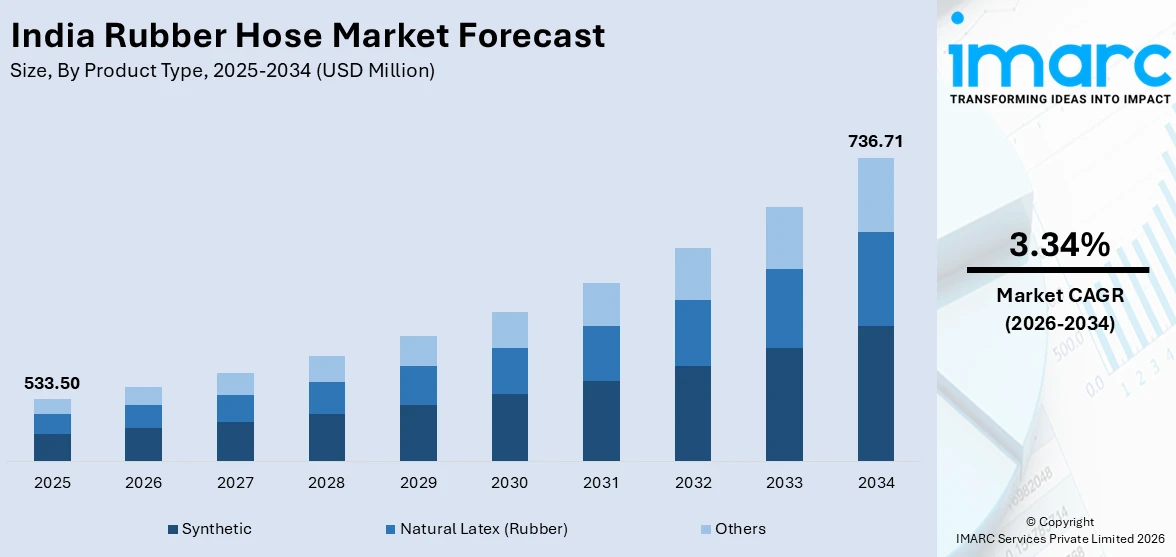
The India rubber hose market grew from USD 533.50 Million in 2025 to USD 566.26 Million in 2026 and is projected to reach USD 736.71 Million by 2034, growing at a compound annual growth rate of 3.34% from 2026-2034.
The India rubber hose market is driven by rapid industrialization, expanding automotive sector, and increasing agricultural mechanization. Growing infrastructure investments and the widespread adoption of irrigation systems across the country further propel demand for rubber hoses. The market also benefits from the rising installation of heating, ventilation, and air conditioning (HVAC) systems, heightened focus on water conservation, and increasing utilization across diverse industrial applications.
Key Takeaways and Insights:
- By Product Type: Synthetic dominates the market with a share of 58.8% in 2025, because of its excellent resistance to chemicals, extreme temperatures, and wear, which makes it perfect for industrial and automotive uses. Technological advancements in synthetic rubber formulations further reinforce its widespread adoption across diverse sectors.
- By Media: Water leads the market with a share of 32.5% in 2025. This dominance is attributed to extensive deployment in agricultural irrigation systems, municipal water distribution networks, and residential water supply, driven by growing water conservation initiatives and infrastructure investments across India.
- By Pressure Rating: Medium exhibits a clear dominance in the market with a 47.6% share in 2025, driven by its versatility across critical applications, including farm mechanization, industrial fluid transfer, and municipal utility services, offering an optimal balance between durability and cost-effectiveness.
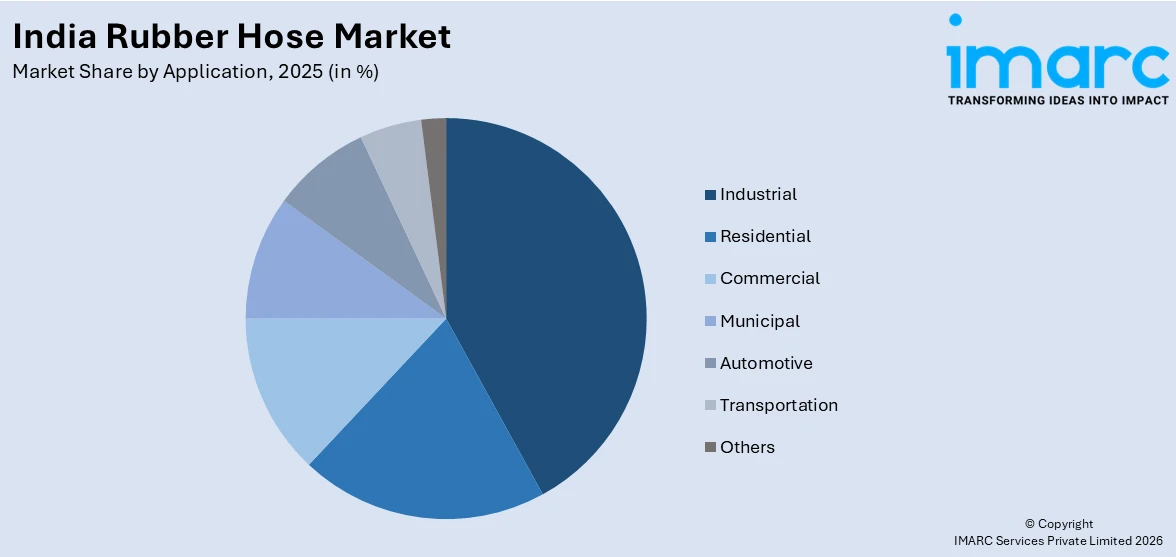
- By Application: Industrial represents the largest segment with a market share of 41.2% in 2025, reflecting the deep integration of rubber hoses in manufacturing, construction, mining, and chemical processing operations, supported by India's rapid industrial expansion and diversified production base.
- By Region: West and Central India comprises the largest region with 35.5% share in 2025, driven by the concentration of automotive manufacturing clusters, chemical processing industries, and extensive industrial infrastructure across Maharashtra, Gujarat, and Madhya Pradesh.
- Key Players: Key players in the India rubber hose market drive growth by expanding product portfolios, investing in advanced manufacturing technologies, and strengthening distribution networks. Their focus on quality certifications, strategic partnerships, and research and development (R&D) initiatives ensures consistent product availability and accelerates adoption across diverse industrial and commercial segments.
To get more information on this market Request Sample
The India rubber hose market is experiencing sustained growth, supported by the country's rapidly expanding industrial base, robust automotive production, and progressive agricultural modernization. Rubber hoses play an indispensable role across diverse sectors, ranging from construction and chemical processing to irrigation and HVAC installations. India's continued emphasis on infrastructure development, including road networks, industrial corridors, and urban utility systems, has significantly amplified the demand for durable fluid conveyance solutions. In 2023-24, the government of India allocated INR 3.98 Lakh Crore for road development. The rising adoption of smart irrigation practices has further accelerated deployment of rubber hoses across agricultural landscapes. Furthermore, advancements in synthetic rubber formulations have broadened the functional range of hoses, enabling deployment in extreme-temperature and chemically aggressive environments.
India Rubber Hose Market Trends:
Growing Adoption of Smart Irrigation Systems
India's agricultural sector is increasingly transitioning towards smart and precision irrigation technologies, significantly expanding deployment of rubber hoses across farmlands. Government initiatives promoting micro and drip irrigation have encouraged farmers to adopt flexible, durable water conveyance solutions. Rubber hoses, owing to their natural flexibility, abrasion resistance, and compatibility with diverse irrigation equipment, have become the preferred choice for water delivery systems. This growing integration of modern irrigation infrastructure continues to drive sustained demand for rubber hoses across India's diverse agricultural regions.
Rising Integration in Automotive Manufacturing
India's expanding automotive manufacturing sector is driving growing demand for rubber hoses used in cooling systems, fuel delivery, and HVAC components. As vehicle production continues to scale, manufacturers rely on high-performance rubber hoses engineered to withstand elevated temperatures and pressures. As per Trading Economics, car manufacturing in India rose to 2,927,394 units in January 2026, up from 2,633,506 units in December 2025. Advancements in synthetic rubber compounds have enabled production of lightweight yet durable automotive hoses that comply with stringent original equipment manufacturer (OEM) specifications. This deepening integration within automotive applications is emerging as a defining trend in the India rubber hose market.
Expansion of Industrial and Infrastructure Applications
India's accelerating infrastructure development and industrial expansion are reshaping the rubber hose landscape, with growing adoption across the construction, chemical processing, oil and gas, and power generation sectors. The increasing mechanization of construction activities necessitates reliable hoses for concrete pumping, water delivery, and fluid handling. The proliferation of manufacturing hubs and industrial parks across the country sustains consistent demand for specialized rubber hoses. In 2025, India had more than 4500 documented industrial parks spread across states and Union Territories, encompassing around 7.70 Lakh hectares of land. Customized formulations offering chemical resistance, flame retardancy, and anti-static properties are gaining considerable traction among diverse industrial end users nationwide.
Market Outlook 2026-2034:
The market is expected to experience market expansion, driven by sustained industrial growth, escalating infrastructure investments, and progressive agricultural modernization. Rubber hoses will continue to be integral components across automotive manufacturing, construction operations, chemical processing, and municipal utility services. Rising vehicle production, expanding irrigation networks, and the growing installation of HVAC systems across commercial and residential buildings are set to generate steady demand. The market generated a revenue of USD 533.50 Million in 2025, which is expected to reach USD 566.26 Million in 2026 and further grow to USD 736.71 Million by 2034, at a compound annual growth rate of 3.34% from 2026-2034. Technological advancements in synthetic rubber formulations, enabling the production of specialized high-performance hoses, will further expand the addressable market.
India Rubber Hose Market Report Segmentation:
| Segment Category | Leading Segment | Market Share |
|---|---|---|
|
Product Type |
Synthetic |
58.8% |
|
Media |
Water |
32.5% |
|
Pressure Rating |
Medium |
47.6% |
|
Application |
Industrial |
41.2% |
|
Region |
West and Central India |
35.5% |
Product Type Insights:
- Natural Latex (Rubber)
- Synthetic
- Others
Synthetic dominates the market with a market share of 58.8% of the total India rubber hose market in 2025.
Synthetic has established a commanding presence in the India rubber hose market because of its exceptional performance qualities in demanding industrial and automotive settings. Synthetic hoses are essential in a variety of applications, from chemical transfer lines to hydraulic systems, as they are more resistant to oil, chemicals, and extreme temperatures than their natural latex counterparts. Synthetic variations are more widely applicable in India due to their capacity to be customized for particular pressure ratings, media compatibility, and climatic conditions.
The predominance of synthetic rubber hoses in the manufacturing, construction, and infrastructure sectors has been greatly strengthened by India's increasing industrialization. Synthetic versions are the recommended option for industrial fluid conveyance applications, owing to their remarkable endurance, low maintenance needs, and compatibility with harsh chemical media. Additionally, the functional envelope of these hoses has been enlarged to satisfy increasingly demanding performance criteria across a variety of end-use sectors, due to developments in synthetic rubber compounds, such as nitrile and styrene-butadiene compositions.
Media Insights:
- Water
- Oil
- Hot Water and Steam
- Air/Gas
- Food and Beverage
- Chemical
Water leads with a share of 32.5% of the total India rubber hose market in 2025.
Water occupies the largest segment within the India rubber hose market, driven by its extensive use in agriculture, construction, and industrial applications for efficient water transfer and irrigation operations. India's ambitious irrigation expansion programs have created robust demand for flexible, durable water hoses across farmland networks. The hoses' flexibility, pressure tolerance, and compatibility with clean water standards make them ideal for this critical application. Additionally, the widespread need for reliable water conveyance across diverse climatic and terrain conditions further strengthens demand for rubber hoses in water-related applications.
The dominance of water-media rubber hoses is further reinforced by growing municipal infrastructure projects, including the development of water supply networks across urban and peri-urban areas under government schemes promoting universal water access. In residential and commercial buildings, rubber hoses serve critical roles in connecting plumbing fixtures, cooling towers, and firefighting systems. Their resistance to biological degradation, ultraviolet (UV) exposure, and mechanical stress ensures long-term reliability in outdoor and semi-exposed environments.
Pressure Rating Insights:
- Low
- Medium
- High
Medium exhibits a clear dominance with a 47.6% share of the total India rubber hose market in 2025.
Medium occupies the largest segment in the India rubber hose market, owing to its versatility across a broad spectrum of applications, from agricultural mechanization and municipal utility services to light industrial fluid transfer operations. The ability of medium-pressure rubber hoses to balance performance with cost-effectiveness positions them as the preferred choice for the majority of end users. These hoses provide adequate durability and pressure-handling capacity for routine operational needs without the higher costs associated with heavy-duty alternatives.
The widespread adoption of medium-pressure hoses extends beyond agriculture into construction, HVAC installation, and municipal cleaning services, where consistent fluid delivery at moderate pressure levels is a standard operational requirement. These hoses offer reliable performance across diverse media, including water, air, and light chemicals, making them applicable across a wide range of industries. The ongoing expansion of India's urban infrastructure, including sewage management, water supply augmentation, and industrial estate development, continues to generate substantial demand for medium-pressure rubber hoses. Their superior adaptability and competitive pricing reinforce their dominant position in the India rubber hose market.
Application Insights:
Access the comprehensive market breakdown Request Sample
- Residential
- Commercial
- Industrial
- Municipal
- Automotive
- Transportation
- Others
Industrial represents the leading segment with a 41.2% share of the total India rubber hose market in 2025.
The industrial segment commands the largest share of the India rubber hose market, reflecting the deep integration of rubber hoses across manufacturing, mining, chemical processing, and construction operations. India's industrial ecosystem continues to expand rapidly, with new industrial parks and manufacturing corridors generating consistent demand for fluid conveyance solutions. The rising establishment of production facilities across sectors, such as automotive, metals, and energy, further amplifies the need for reliable and durable hose systems.
Industrial rubber hoses serve critical functions in suction and discharge operations, coolant circulation, compressed air delivery, chemical transfer, and material handling, making them fundamental to plant operations across virtually every manufacturing vertical. The growing adoption of automated and mechanized production processes has intensified reliance on high-performance hoses capable of withstanding demanding operating conditions, including elevated pressures, aggressive chemical environments, and extreme temperature fluctuations. Additionally, the increasing focus on workplace safety and operational efficiency has driven uptake of specialized industrial hoses equipped with reinforced construction and advanced sealing capabilities, further consolidating the segment's leading position.
Regional Insights:
- North India
- West and Central India
- South India
- East India
West and Central India comprises the largest region with a 35.5% share of the total India rubber hose market in 2025.
West and Central India dominates the India rubber hose market regionally, anchored by the concentration of automotive manufacturing clusters, chemical processing facilities, and industrial infrastructure across Maharashtra, Gujarat, and Madhya Pradesh. In the quarter from October to December 2025, India recorded sales of 12.76 Lakh passenger vehicles, with Maharashtra contributing the highest state share at 1.58 Lakh units, emphasizing Western India's ongoing leadership in the nation's automobile sector. The region serves as a pivotal hub for rubber hose demand, supported by active economic corridors.
The region's industrial diversity, spanning automotive components, petrochemicals, pharmaceuticals, and heavy manufacturing, sustains multifaceted demand for rubber hoses across standard and specialized applications. Maharashtra's expansive port infrastructure and Gujarat's chemical industrial zones create additional consumption avenues for oil, chemical, and steam-media rubber hoses. The growing development of industrial parks and logistics corridors under national development programs continues to expand investment and strengthen the addressable rubber hose market throughout West and Central India.

Market Dynamics:
Growth Drivers:
Why is the India Rubber Hose Market Growing?
Rapid Industrialization and Infrastructure Development
India's industrial landscape is undergoing a significant transformation, driven by large-scale investments in manufacturing, construction, chemical processing, and energy infrastructure. This sustained industrial expansion has generated robust and diversified demand for rubber hoses, which serve as essential fluid conveyance components across virtually every major production vertical. Manufacturing facilities rely on rubber hoses for coolant circulation, compressed air delivery, suction and discharge operations, and chemical transfer, underscoring their indispensable role in industrial workflows. The government's ambitious infrastructure development programs have further amplified this demand, creating new consumption channels across road construction, railway development, urban utility installation, and industrial park establishment. Rubber hoses facilitate operations at construction sites through concrete pumping, water delivery, and pneumatic tool supply, making them fundamental to project execution. The growing development of industrial corridors and manufacturing zones across India's heartland is establishing new demand centers, particularly in regions previously underserved by large-scale manufacturing activity.
Growing Agricultural Modernization and Irrigation Expansion
India's agricultural sector, one of the country's most significant economic pillars, is undergoing a substantial modernization drive, with widespread adoption of precision farming techniques and advanced irrigation systems fueling considerable demand for rubber hoses. As per IMARC Group, the India precision agriculture market size reached USD 334.2 Million in 2025. The transition from traditional flood irrigation to micro-irrigation methodologies, including drip and sprinkler systems, has dramatically expanded the deployment of rubber hoses as flexible and durable fluid delivery conduits across diverse farmland landscapes. Government-backed schemes promoting water-efficient agricultural practices have incentivized farmers to invest in modern irrigation infrastructure, where rubber hoses serve as the primary water transport medium between source and field. Their natural flexibility, resistance to environmental degradation, and compatibility with a wide range of irrigation fittings make them uniquely suited to agricultural applications across diverse terrain and climate conditions. The increasing deployment of agricultural machinery, including tractors, harvesters, and spray equipment, also relies on rubber hoses for hydraulic power transmission and fluid delivery across fields.
Expanding Automotive Sector and HVAC Integration
India's automotive industry is one of the most dynamic contributors to rubber hose demand, driven by expanding vehicle production, evolving OEM specifications, and increasing integration of complex fluid management systems within modern vehicles. Rubber hoses are critical components in automotive cooling, fuel delivery, air conditioning, braking, and power steering systems, with each vehicle requiring numerous hose assemblies for reliable operation. As India's vehicle production capacity continues to grow, the resulting demand for automotive rubber hoses is expected to follow a consistent upward trajectory. The increasing penetration of passenger vehicles, commercial trucks, and two-wheelers across both urban and rural markets is amplifying aggregate demand for replacement and original equipment hoses. Furthermore, the growing adoption of electric vehicles (EVs) is introducing new application requirements, with specialized hoses needed for battery cooling circuits and thermal management systems. By Q2 FY26, India’s EV sales hit 5,80,664 units, accounting for 9.98% of total automotive sales.
Market Restraints:
What Challenges the India Rubber Hose Market is Facing?
Volatility in Raw Material Prices
The India rubber hose market faces significant challenges arising from the inherent volatility of raw material prices, particularly natural rubber and petroleum-derived synthetic rubber compounds. Price fluctuations driven by supply chain disruptions, crude oil price movements, and seasonal variations in natural rubber output can adversely impact production costs and compress manufacturer margins. This price instability complicates long-term procurement planning and can erode the competitiveness of domestic hose manufacturers, particularly in price-sensitive market segments where cost pressure is most acute.
Competition from Alternative Materials
The increasing adoption of thermoplastic and composite hose materials presents a sustained competitive challenge for rubber hose manufacturers in India. Thermoplastic hoses offer advantages, including lighter weight, improved chemical resistance in specific applications, and competitive pricing, making them an attractive alternative in certain end use segments. As industries seek to optimize operational efficiency and reduce maintenance costs, the gradual substitution of rubber hoses with thermoplastic variants in suitable applications may moderate the rate of growth across specific product categories within the India rubber hose market.
Quality and Compliance Challenges
Meeting the diverse and often stringent quality and compliance requirements across industries, such as food and beverage (F&B), pharmaceuticals, oil and gas, and automotive presents considerable operational challenges for rubber hose manufacturers in India. Adherence to international standards demands significant investment in testing infrastructure, quality control systems, and specialized material formulations. Smaller manufacturers may struggle to absorb these compliance costs, limiting their ability to access premium market segments and restricting competitive participation in export-oriented and high-specification application areas.
Competitive Landscape:
The India rubber hose market is characterized by a moderately fragmented competitive landscape, with established multinational players coexisting alongside a diverse array of domestic manufacturers. Competition is driven primarily by product quality, technical expertise, compliance with international standards, and the depth of distribution networks. Leading players differentiate themselves through proprietary rubber formulations, specialized product portfolios, and the ability to serve multiple application segments with customized solutions. Domestic manufacturers benefit from cost-competitive production capabilities and well-established relationships with regional distributors, while multinational companies leverage global R&D resources and advanced manufacturing technologies. The market has witnessed increasing focus on quality certifications and international compliance, enabling Indian manufacturers to progressively expand their export footprints. Strategic investments in manufacturing capacity expansion, product innovation, and after-sales technical support are emerging as key competitive differentiators.
India Rubber Hose Market Report Coverage:
| Report Features | Details |
|---|---|
| Base Year of the Analysis | 2025 |
| Historical Period | 2020-2025 |
| Forecast Period | 2026-2034 |
| Units | Million USD |
| Scope of the Report |
Exploration of Historical Trends and Market Outlook, Industry Catalysts and Challenges, Segment-Wise Historical and Future Market Assessment:
|
| Product Types | Natural Latex (Rubber), Synthetic, Others |
| Medias Covered | Water, Oil, Hot Water and Steam, Air/Gas, Food and Beverage, Chemical |
| Pressure Ratings Covered | Low, Medium, High |
| Applications Covered | Residential, Commercial, Industrial, Municipal, Automotive, Transportation, Others |
| Region Covered | North India, West and Central India, South India, East India |
| Customization Scope | 10% Free Customization |
| Post-Sale Analyst Support | 10-12 Weeks |
| Delivery Format | PDF and Excel through Email (We can also provide the editable version of the report in PPT/Word format on special request) |
Frequently Asked Questions About the India Rubber Hose Market Report
The India rubber hose market size increased from USD 533.50 Million in 2025 to USD 566.26 Million in 2026.
The India rubber hose market is expected to grow at a compound annual growth rate of 3.34% from 2026-2034 to reach USD 736.71 Million by 2034.
Synthetic dominated the market with a share of 58.8%, owing to its superior resistance to chemicals, extreme temperatures, and abrasion, making it an ideal choice for both industrial and automotive applications across India.
Key factors driving the India rubber hose market include rapid industrialization and infrastructure development, growing agricultural mechanization and irrigation expansion, and the expanding automotive manufacturing sector alongside increasing HVAC system installations across the country.
Major challenges include volatility in raw material prices, growing competition from thermoplastic and composite alternative materials, and increasing compliance requirements across quality and safety standards in diverse industrial application segments.
Need more help?
- Speak to our experienced analysts for insights on the current market scenarios.
- Include additional segments and countries to customize the report as per your requirement.
- Gain an unparalleled competitive advantage in your domain by understanding how to utilize the report and positively impacting your operations and revenue.
- For further assistance, please connect with our analysts.
 Request Customization
 Speak to an Analyst
 Request Brochure
 Inquire Before Buying
Benefits of Customization
- Personalize this research
- Triangulate with your data
- Get data as per your format and definition
- Gain a deeper dive into a specific application, geography, customer, or competitor
- Any level of personalization
Get in Touch With Us
UNITED STATES
Phone: +1-201-971-6302
INDIA
Phone: +91-120-433-0800
UNITED KINGDOM
Phone: +44-753-714-6104
Email: [email protected]
Client Testimonials




.webp)




.webp)













Related Reports

Choose your plan
*Please note that the prices mentioned below are starting prices for each bundle type. Kindly contact our team for further details.*
Single User License
- 1 User License, Access on 2 Devices
- PDF Report + Excel Dataset (Password Protected)
- Lifetime Access
- No Printing Rights
- 10% Free Report Customization
- 10–12 Weeks of Analyst Support
Five User License
- Access for 5 Users, 2 Devices per User
- PDF Report + Excel Dataset (Password Protected)
- Lifetime Access
- Dedicated Account Manager
- 12–14 Weeks of Analyst Support
- No Printing Rights
- 15% Free Report Customization
- 25% Discount on Your Next Purchase
Corporate User License
- Unlimited User Access (Within Your Organization)
- PDF Report + Excel Dataset
- Lifetime Access
- Dedicated Account Manager
- 14–20 Weeks of Analyst Support
- No Printing Rights
- 20% Free Report Customization
- 30% Discount on Your Next Purchase
Essential Insights
What's included:
3 reports
- Lifetime Access
- PDF Reports
- Excel Datasets
- 2 Weeks of Free Analyst Support
- 2 User Licenses
- Access on 2 Devices
- Printing Rights
- Complimentary PowerPoint (PPT) Version
- Complimentary License Upgrade
Professional Access
What's included:
5 reports
- Lifetime Access
- PDF Reports
- Excel Datasets
- 8 Weeks of Free Analyst Support
- 2 User Licenses
- Access on 2 Devices
- Printing Rights
- Complimentary PowerPoint (PPT) Version
- Complimentary License Upgrade
Business Advantage
What's included:
8 reports
- Lifetime Access
- PDF Reports
- Excel Datasets
- 14 Weeks of Free Analyst Support
- 2 User Licenses
- Access on 2 Devices
- Printing Rights
- Complimentary PowerPoint (PPT) Version
- Complimentary License Upgrade
Enterprise Intelligence
What's included:
10 reports
- Lifetime Access
- PDF Reports
- Excel Datasets
- 20 Weeks of Free Analyst Support
- 2 User Licenses
- Access on 2 Devices
- Printing Rights
- Complimentary PowerPoint (PPT) Version
- Complimentary License Upgrade