
India Safety Eyewear Market Size, Share, Trends and Forecast by Product, Application, Distribution Channel, and Region, 2026-2034
India Safety Eyewear Market Summary:
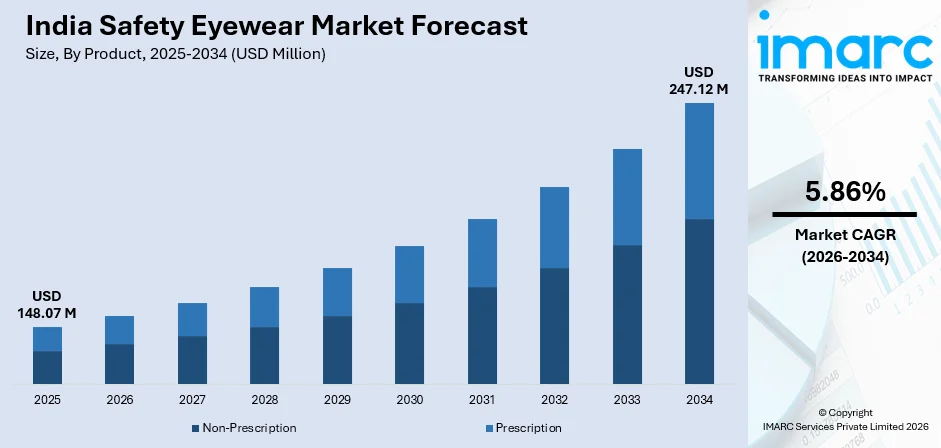
The India safety eyewear market size was valued at USD 148.07 Million in 2025 and is projected to reach USD 247.12 Million by 2034, growing at a compound annual growth rate of 5.86% from 2026-2034.
India’s safety eyewear market is growing quickly, driven by rapid industrialization, major infrastructure projects, and stronger focus on workplace safety. Implementation of the Occupational Safety, Health and Working Conditions Code is pushing employers to provide certified protective gear in construction, manufacturing, mining, and oil and gas. Demand is also rising for advanced lenses with anti-fog, scratch-resistant, and UV-protective coatings. Furthermore, investments in smart manufacturing, digital procurement platforms, and ergonomic designs are accelerating adoption and market share.
Key Takeaways and Insights:
- By Product: Non-prescription dominates the market with a share of 58.6% in 2025, owing to its universal applicability across diverse industrial settings, cost-effectiveness for bulk procurement, and ease of deployment without requiring individual customization or vision assessments.
- By Application: Construction leads the market with a share of 33.8% in 2025. This dominance is driven by the expansive infrastructure development programs across India, mandatory personal protective equipment requirements on construction sites, and growing enforcement of workplace safety regulations.
- By Distribution Channel: Business to business (B2B) exhibits a clear dominance in the market with 61.9% share in 2025, reflecting the institutional procurement model where employers and industrial enterprises acquire safety eyewear in bulk to ensure regulatory compliance and protect their workforce.
- By Region: West India comprises the largest region with 34.7% share in 2025, driven by the concentration of major industrial hubs in Maharashtra and Gujarat, substantial infrastructure spending, and the presence of leading manufacturing and petrochemical facilities across the region.
- Key Players: The market is moderately fragmented, with global PPE brands competing alongside strong domestic manufacturers and regional distributors. Competition centers on BIS/IS compliance, pricing, product breadth, and supply reliability, while premium players differentiate through coatings, comfort-led designs, and enterprise procurement tie-ups.
To get more information on this market Request Sample
The India safety eyewear market is propelled by a convergence of regulatory, industrial, and technological forces reshaping the occupational safety landscape across the country. Similarly, the ongoing implementation of comprehensive labor codes mandareing certified protective equipment for workers in factories, construction sites, and mines is creating sustained institutional demand for compliant safety eyewear. India’s expansive infrastructure push under the National Infrastructure Pipeline, coupled with the Make in India initiative, is driving massive construction and manufacturing activity that necessitates consistent procurement of personal protective equipment. In 2025, India’s construction sector market size was projected to reach approximately USD 740 Billion, underscoring the scale of safety eyewear demand across thousands of active job sites. Technological advancements including anti-fog coatings, ultraviolet protection, impact-resistant polycarbonate lenses, and lightweight ergonomic frames are enhancing product appeal and worker compliance. Moreover, the growing digitalization of procurement through business-to-business e-commerce platforms is streamlining supply chains and improving accessibility for enterprises of all sizes across the country.
India Safety Eyewear Market Trends:
Integration of Smart Safety Eyewear Technologies
India is witnessing growing adoption of technologically advanced safety eyewear incorporating features such as heads-up displays, sensor-driven hazard alerts, and augmented reality overlays designed for industrial environments. Manufacturers are collaborating with technology firms to develop intelligent protective eyewear that enhances real-time worker safety and enables data-driven compliance monitoring. For instance, in February 2026, Oakley and Meta launched Vanguard AI smart glasses in India for athletes, featuring IP67 durability, PRIZM sport lenses, voice-controlled Meta AI, fitness integrations, 3K video capture, open-ear audio, and prices starting at INR 52,300. These innovations are positioning India’s safety eyewear sector for advanced, connected workplace protection.
Rising Demand for Ergonomic and Lightweight Designs
Comfort-driven innovation is reshaping safety eyewear preferences across Indian industries as workers demand lighter frames, adjustable nose pads, and wraparound designs that enable extended wear without fatigue. This trend is driven by the recognition that uncomfortable protective equipment leads to lower compliance rates and increased injury risk. For example, Mallcom India, a leading integrated PPE manufacturer since 1983, supplies head-to-toe safety solutions including helmets and protective eyewear. With strong global reach, innovation-led product development, expanding facilities, and certified compliance, it continues driving India’s workplace safety growth. Advanced materials such as polycarbonate and bio-based nylon are replacing heavier alternatives, offering superior impact resistance while reducing overall product weight.
Expansion of Digital B2B Procurement Platforms
The digitalization of industrial procurement is transforming how enterprises acquire safety eyewear across India. Online business-to-business marketplaces are enabling faster quotation-to-order cycles, virtual product catalogs, and streamlined bulk purchasing for construction firms, manufacturing plants, and mining operations. Globally, revenues from group purchasing organization-mediated e-sourcing of personal protective equipment reached approximately USD 6.3 billion in 2024, reflecting the growing shift toward digital channels. In India, leading safety equipment providers are revamping their e-commerce platforms to directly connect with institutional and retail buyers, enhancing product accessibility and supply chain efficiency.

Market Outlook 2026-2034:
India’s safety eyewear market is poised for sustained expansion, underpinned by continued regulatory enforcement, large-scale infrastructure development, and growing employer commitment to workplace safety. With nearly 10,000 factory deaths and over 60,000 injuries recorded by the Labour Bureau during 2008–2021, and more than 240 accidents causing 400+ fatalities in 2024 reported by IndustriALL, safety gaps will influence India’s safety eyewear market outlook. In line with this, the rise in country’s construction output, will remain a primary demand catalyst in the market. Increasing domestic manufacturing capabilities for personal protective equipment, coupled with advancements in lens coatings, smart eyewear integration, and ergonomic design, are expected to drive higher revenue streams and foster a more competitive and mature safety eyewear landscape across the region. The market generated a revenue of USD 148.07 Million in 2025 and is projected to reach a revenue of USD 247.12 Million by 2034, growing at a compound annual growth rate of 5.86% from 2026-2034.
India Safety Eyewear Market Report Segmentation:
|
Segment Category |
Leading Segment |
Market Share |
|
Product |
Non-Prescription |
58.6% |
|
Application |
Construction |
33.8% |
|
Distribution Channel |
Business to Business (B2B) |
61.9% |
|
Region |
West India |
34.7% |
Product Insights:
- Prescription
- Up to USD 10
- USD 10 to USD 20
- USD 20 to USD 40
- USD 40 to USD 70
- Above USD 70
- Non-Prescription
- Up to USD 25
- USD 25 to USD 50
- USD 50 to USD 100
- USD 100 to USD 150
- Above USD 150
Non-prescription dominates with a market share of 58.6% of the total India safety eyewear market in 2025.
Non-prescription safety eyewear holds the largest revenue share in India’s market, driven by its universal applicability across diverse industrial settings without requiring individual vision customization. These products are widely deployed in construction, manufacturing, and oil and gas sectors where employers must equip large workforces with standardized protective equipment. Non-prescription safety glasses offer cost-effective compliance with occupational safety mandates under the Factories Act and Mines Act, making them the preferred procurement choice for bulk industrial orders. Globally, non-prescription safety eyewear accounted for approximately 67% of total safety eyewear revenues in 2024, reflecting the broad preference for versatile, ready-to-use eye protection solutions.
The segment’s growth is further supported by continuous advancements in lens technologies that enhance protection without the need for prescription customization. Manufacturers are offering non-prescription safety glasses with anti-fog coatings, ultraviolet protection, impact-resistant polycarbonate lenses, and scratch-resistant finishes designed for India’s diverse climatic and industrial conditions. The accessibility of these products through both traditional business-to-business distribution and emerging digital procurement channels ensures broad market penetration across tier-one and tier-two industrial centers. Rising employer awareness regarding occupational eye injury prevention and mandatory personal protective equipment requirements continue to reinforce non-prescription safety eyewear as the most demanded product category.
Application Insights:
Access the comprehensive market breakdown Request Sample
- Oil & Gas
- Construction
- Industrial Manufacturing
- Military
- Public Sectors
- Others
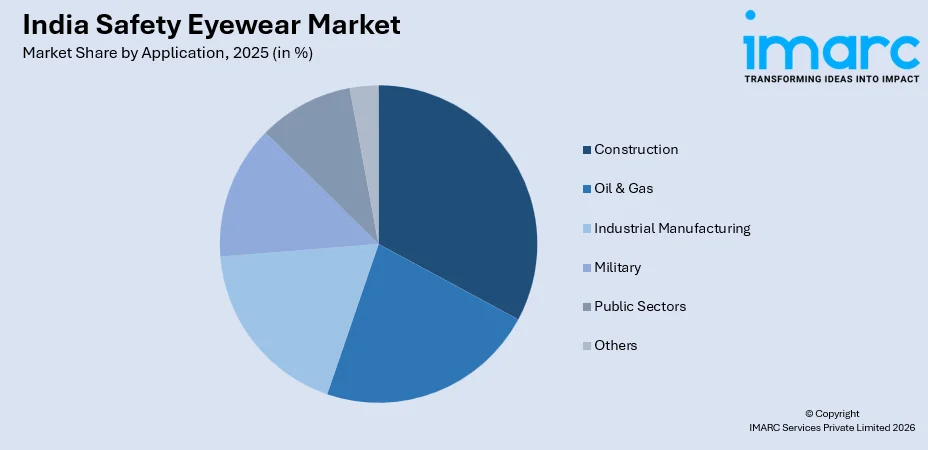
Construction leads with a share of 33.8% of the total India safety eyewear market in 2025.
The construction sector commands the largest application share in India’s safety eyewear market, reflecting the immense scale of infrastructure development and mandatory personal protective equipment requirements across thousands of active job sites. Workers on construction sites face constant exposure to flying debris, dust particles, chemical splashes, and hazardous light radiation, creating a sustained need for certified eye protection. Likewise, aggressive government spending under the National Infrastructure Pipeline and flagship initiatives spanning roads, railways, urban transit, and renewable energy corridors, are impelling the market.
The enforcement of occupational safety regulations under the Building and Other Construction Workers Act and the Occupational Safety, Health and Working Conditions Code further strengthens demand for safety eyewear in this sector. Employers are required to provide appropriate personal protective equipment including safety glasses and goggles to workers operating at heights, performing welding tasks, or working in proximity to grinding and cutting operations. The expansion of mega-projects such as highways, metro rail networks, airports, and smart city developments across India ensures consistent procurement cycles. Growing adoption of ergonomic, anti-fog, and impact-resistant safety eyewear designs tailored for outdoor construction environments is further accelerating product uptake across the sector.
Distribution Channel Insights:
- Business to Business (B2B)
- Direct to Consumers (D2C)
- Others
Business to business (B2B) is the largest segment, accounting for 61.9% of the total India safety eyewear market in 2025.
The business-to-business distribution channel holds the dominant market share, reflecting the institutional procurement model through which employers, industrial enterprises, and government bodies acquire safety eyewear in bulk. Strict workplace safety regulations mandate that employers provide certified eye protection to all workers exposed to occupational hazards, driving large-scale procurement contracts through established B2B networks. Manufacturers and distributors offer customized solutions including safety assessments, prescription eyewear programs, training services, and maintenance support to strengthen long-term corporate client relationships.
The B2B channel’s dominance in India is further reinforced by the growing digitalization of procurement processes. Industrial enterprises are increasingly leveraging online business-to-business marketplaces and digital catalogs to streamline bulk purchasing, compare specifications, and manage compliance documentation. Major construction firms, manufacturing conglomerates, and public sector organizations rely on B2B procurement to maintain consistent safety standards across multiple project sites and facilities. The ability to negotiate volume-based pricing, access value-added services, and ensure timely delivery through established distribution partnerships makes the B2B channel the most efficient and preferred route for safety eyewear acquisition in India’s industrial landscape.
Regional Insights:
- North India
- South India
- East India
- West India
West India holds the largest share at 34.7% of the total India safety eyewear market in 2025.
West India commands the leading regional share in the safety eyewear market, underpinned by the concentration of major industrial and manufacturing hubs in Maharashtra, Gujarat, and Goa. The region benefits from robust petrochemical, pharmaceutical, and automotive manufacturing clusters that generate sustained demand for certified personal protective equipment. Maharashtra’s expansive infrastructure blueprint, valued at approximately USD 47 Billion, encompasses large-scale transportation, urban development, and industrial construction projects that require consistent safety eyewear procurement across thousands of active sites. Furthermore, Gujarat OSHWC Rules 2025, effective 12 June 2025, require registration within 7 days, safety committees for 250+ workers, and mandatory PPE compliance with accident reporting within 12 hours, strengthyening demand for certified safety eyewear across industrial workplaces.
The presence of well-established industrial supply chains, multinational manufacturing facilities, and leading personal protective equipment distributors further reinforces West India’s market dominance. The region’s ports and logistics corridors facilitate efficient distribution of safety eyewear products to industrial clients across the western seaboard. Additionally, the expansion of special economic zones and greenfield industrial projects in Gujarat and Maharashtra continues to attract both domestic and foreign direct investment, creating new demand centers for workplace safety equipment. West India’s combination of high industrial density, regulatory enforcement, and infrastructure-led growth positions it as the most significant revenue contributor to the national safety eyewear market.
Market Dynamics:
Growth Drivers:
Why is the India Safety Eyewear Market Growing?
Strengthening Regulatory Framework for Occupational Safety
India’s regulatory landscape for workplace safety is undergoing a transformative shift with the consolidation of 29 separate labor laws into four unified codes, including the Occupational Safety, Health and Working Conditions Code that mandates certified protective equipment across factories, construction sites, mines, and logistics facilities. This regulatory modernization is creating sustained institutional demand for compliant safety eyewear as employers face heightened accountability for worker protection. Multiple state governments are actively implementing these codes with region-specific enforcement mechanisms. For instance, the enforcement environment is strengthened by Karnataka’s implementation of the Factories Safety Audit Rules in 2024, which instituted stricter mandates on facility occupiers and safety auditors. These regulatory developments are creating a compliance-driven procurement cycle that benefits safety eyewear manufacturers and distributors. Additionally, the growing involvement of national and state-level safety boards in advising on standards ensures consistent elevation of workplace protection benchmarks across industries.
Accelerating Infrastructure Development and Construction Activity
India’s massive infrastructure push represents a fundamental demand driver for safety eyewear as millions of workers across construction sites require mandatory eye protection. The National Infrastructure Pipeline, targeting investments worth approximately USD 1.34 Trillion, is fueling unprecedented construction activity spanning highways, railways, airports, metro systems, and urban transit projects. In addition, the expansion of mega-infrastructure projects such as the Delhi-Mumbai Expressway, Bharatmala highway network spanning over 26,000 kilometers, and new metro rail systems in cities including Surat, Patna, and Agra is generating multi-year procurement requirements for personal protective equipment. Construction workers engaged in welding, grinding, demolition, and overhead operations require certified safety eyewear to prevent injuries from flying debris, sparks, and chemical exposure. This sustained infrastructure pipeline ensures consistent long-term demand for safety eyewear across India’s construction sector.
Growing Industrial Manufacturing and Make in India Initiative
The rapid expansion of India’s industrial manufacturing base under the Make in India initiative is significantly driving safety eyewear demand as factories and production facilities must equip workers with certified protective equipment. Industrial manufacturing operations involving processing, assembling, welding, and finishing expose workers to hazards including dust particles, harmful chemicals, and dangerous light radiation. Nearly three million workplace eye injuries occur annually in India, with approximately 61% of these incidents taking place at manufacturing or construction sites, underscoring the critical need for protective eyewear across industrial settings. Furthermore, the establishment of new manufacturing zones and the expansion of existing facilities are creating additional demand centers for safety eyewear. In India and Southeast Asia, more than 120 new production units for protective gear, including safety eyewear, were commissioned between 2022 and 2024, reflecting the growing localization of personal protective equipment manufacturing. The integration of automation and quality control technologies in production lines is enhancing product consistency and reducing defect rates, while enabling quicker fulfillment of customized orders for industrial clients.
Market Restraints:
What Challenges the India Safety Eyewear Market is Facing?
High Cost of Advanced Protective Eyewear
The elevated price of technologically advanced safety eyewear featuring premium anti-fog coatings, prescription integration, ultraviolet protection, and impact-resistant polycarbonate lenses presents a significant adoption barrier, particularly among small and medium enterprises operating with constrained budgets. Many smaller construction firms and manufacturing units prioritize cost minimization over premium eye protection, limiting the penetration of high-performance safety eyewear. While long-term benefits of advanced protective equipment are well established, the upfront cost differential compared to basic alternatives continues to restrict broader market adoption across price-sensitive industrial segments.
Prevalence of Counterfeit and Substandard Products
The circulation of counterfeit and non-certified safety eyewear in India’s market undermines product credibility and worker safety outcomes. These substandard products often fail to meet the impact resistance, optical clarity, and ultraviolet protection standards required by occupational safety regulations, exposing workers to preventable eye injuries. The prevalence of unorganized sector manufacturing and fragmented distribution channels, particularly in tier-two and tier-three markets, creates pathways for counterfeit products to enter the supply chain. This challenge erodes consumer confidence in safety eyewear quality and complicates enforcement efforts by regulatory authorities.
Inconsistent Safety Enforcement Across Regions
Despite the regulatory modernization through unified labor codes, the enforcement of workplace safety standards remains inconsistent across Indian states and industrial sectors. With more than 80% of India’s workforce operating within the informal sector, enforcement of personal protective equipment mandates is inherently challenging due to limited inspection personnel, weak monitoring infrastructure, and resource-constrained regulatory agencies. This disparity between regulatory intent and on-ground enforcement reduces the compliance-driven demand for certified safety eyewear, particularly in smaller enterprises and rural construction sites where oversight remains limited.
Competitive Landscape:
The India safety eyewear market features an increasingly competitive landscape characterized by the presence of both multinational corporations and domestic manufacturers vying for market share through product innovation, distribution expansion, and strategic partnerships. Competition is driven by investments in advanced lens technologies, ergonomic design improvements, and localized manufacturing capabilities that enable faster delivery and cost optimization. Companies are strengthening their presence through expanded distribution networks, collaborating with industrial suppliers, and developing digital procurement platforms to reach a broader customer base. Strategic acquisitions and partnerships are accelerating portfolio diversification, while compliance with evolving safety standards and certifications remains a critical differentiator for market participants seeking to establish long-term relationships with institutional buyers across India’s industrial sectors.
Recent Developments:
- In May 2025, Ray-Ban Meta Smart Glasses launched in India, combining iconic frames with Meta AI, hands-free camera, audio, and voice control. Featuring 12MP capture, 32GB storage, IPX4 splash resistance, and prescription compatibility, they highlight growing demand for protective, tech-enabled eyewear in India.
- In May 2025, BIS Chennai hosted Manak Manthan on a draft Indian Standard guiding PPE selection for waste handling. The guide highlights eye protection such as safety goggles and face shields, aligning with IS 8521 and other standards. With 125+ stakeholders attending, it strengthens demand for certified protective eyewear across hazardous work environments.
India Safety Eyewear Market Report Coverage:
|
Report Features |
Details |
|
Base Year of the Analysis |
2025 |
|
Historical Period |
2020-2025 |
|
Forecast Period |
2026-2034 |
|
Units |
Million USD |
|
Scope of the Report |
Exploration of Historical Trends and Market Outlook, Industry Catalysts and Challenges, Segment-Wise Historical and Future Market Assessment:
|
|
Products Covered |
|
|
Applications Covered |
Oil & Gas, Construction, Industrial Manufacturing, Military, Public Sectors, Others |
|
Distribution Channels Covered |
Business to Business (B2B), Direct to Consumers (D2C), Others |
|
Regions Covered |
North India, South India, East India, West India |
|
Customization Scope |
10% Free Customization |
|
Post-Sale Analyst Support |
10-12 Weeks |
|
Delivery Format |
PDF and Excel through Email (We can also provide the editable version of the report in PPT/Word format on special request) |
Frequently Asked Questions About the India Safety Eyewear Market Report
The India safety eyewear market size was valued at USD 148.07 Million in 2025.
The India safety eyewear market is expected to grow at a compound annual growth rate of 5.86% from 2026-2034 to reach USD 247.12 Million by 2034.
Non-prescription dominated the market with a share of 58.6%, driven by its universal applicability across industrial settings, cost-effectiveness for bulk procurement, and ease of deployment without individual vision customization requirements.
Key factors driving the India safety eyewear market include strengthening occupational safety regulations, accelerating infrastructure development, expanding industrial manufacturing, growing employer awareness, and advancing lens technologies.
Major challenges include high costs of advanced protective eyewear, prevalence of counterfeit and substandard products, inconsistent safety enforcement across regions, limited awareness in the informal sector, and supply chain constraints.
Need more help?
- Speak to our experienced analysts for insights on the current market scenarios.
- Include additional segments and countries to customize the report as per your requirement.
- Gain an unparalleled competitive advantage in your domain by understanding how to utilize the report and positively impacting your operations and revenue.
- For further assistance, please connect with our analysts.
 Request Customization
 Speak to an Analyst
 Request Brochure
 Inquire Before Buying
Benefits of Customization
- Personalize this research
- Triangulate with your data
- Get data as per your format and definition
- Gain a deeper dive into a specific application, geography, customer, or competitor
- Any level of personalization
Get in Touch With Us
UNITED STATES
Phone: +1-201-971-6302
INDIA
Phone: +91-120-433-0800
UNITED KINGDOM
Phone: +44-753-714-6104
Email: [email protected]
Client Testimonials




.webp)




.webp)













Related Reports

Choose your plan
*Please note that the prices mentioned below are starting prices for each bundle type. Kindly contact our team for further details.*
Single User License
- 1 User License, Access on 2 Devices
- PDF Report + Excel Dataset (Password Protected)
- Lifetime Access
- No Printing Rights
- 10% Free Report Customization
- 10–12 Weeks of Analyst Support
Five User License
- Access for 5 Users, 2 Devices per User
- PDF Report + Excel Dataset (Password Protected)
- Lifetime Access
- Dedicated Account Manager
- 12–14 Weeks of Analyst Support
- No Printing Rights
- 15% Free Report Customization
- 25% Discount on Your Next Purchase
Corporate User License
- Unlimited User Access (Within Your Organization)
- PDF Report + Excel Dataset
- Lifetime Access
- Dedicated Account Manager
- 14–20 Weeks of Analyst Support
- No Printing Rights
- 20% Free Report Customization
- 30% Discount on Your Next Purchase
Essential Insights
What's included:
3 reports
- Lifetime Access
- PDF Reports
- Excel Datasets
- 2 Weeks of Free Analyst Support
- 2 User Licenses
- Access on 2 Devices
- Printing Rights
- Complimentary PowerPoint (PPT) Version
- Complimentary License Upgrade
Professional Access
What's included:
5 reports
- Lifetime Access
- PDF Reports
- Excel Datasets
- 8 Weeks of Free Analyst Support
- 2 User Licenses
- Access on 2 Devices
- Printing Rights
- Complimentary PowerPoint (PPT) Version
- Complimentary License Upgrade
Business Advantage
What's included:
8 reports
- Lifetime Access
- PDF Reports
- Excel Datasets
- 14 Weeks of Free Analyst Support
- 2 User Licenses
- Access on 2 Devices
- Printing Rights
- Complimentary PowerPoint (PPT) Version
- Complimentary License Upgrade
Enterprise Intelligence
What's included:
10 reports
- Lifetime Access
- PDF Reports
- Excel Datasets
- 20 Weeks of Free Analyst Support
- 2 User Licenses
- Access on 2 Devices
- Printing Rights
- Complimentary PowerPoint (PPT) Version
- Complimentary License Upgrade