
India Seasoning Market Size, Share, Trends and Forecast by Product Type, Sales Channel, and Region, 2026-2034
India Seasoning Market Size, Share, Trends & Forecast (2026-2034)
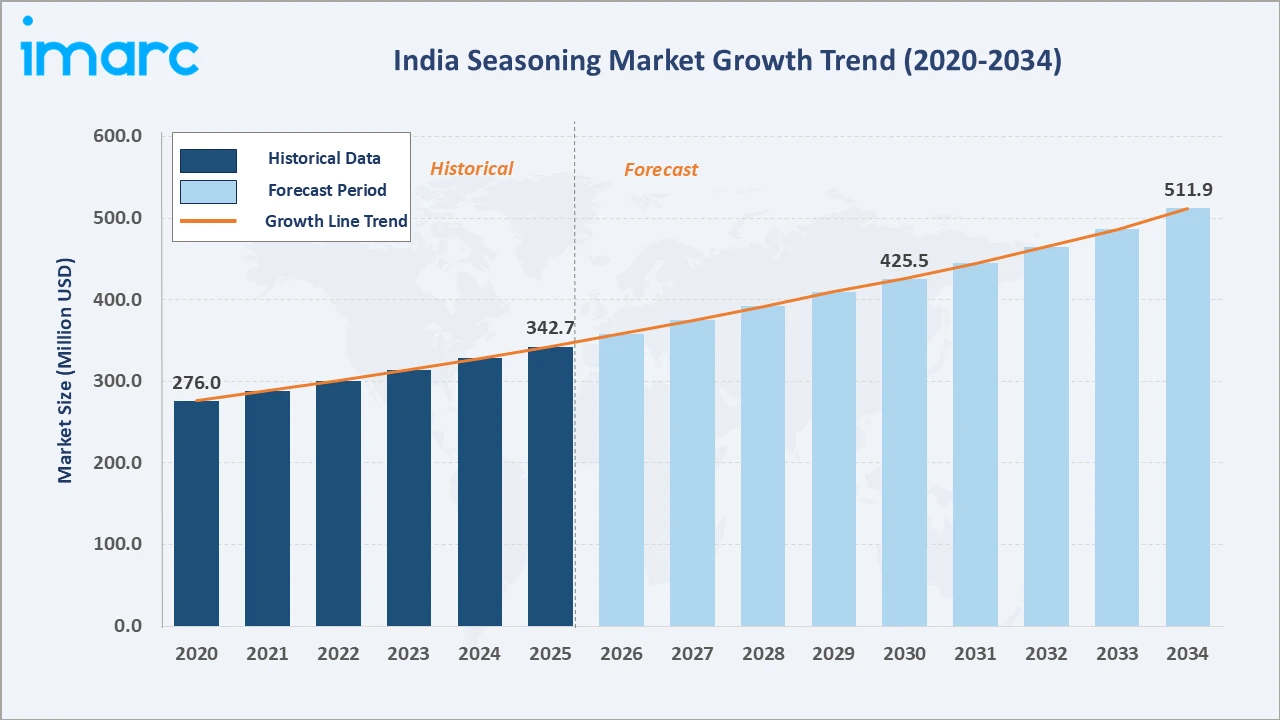
The India seasoning market size increased from USD 342.7 Million in 2025 to USD 362.1 Million in 2026 and is projected to reach USD 511.9 Million by 2034, growing at a CAGR of 4.42% during 2026-2034. Growth is driven by rising demand for regional and authentic flavors, increasing health-conscious seasoning choices, and expanding convenience-oriented, ready-to-use product formats. Salt dominates the product landscape at 34.0% share, reflecting its universal culinary and industrial application across Indian households and food processors. Pepper follows at 24.0%, supported by India's traditional spice-processing base.
Supermarket and hypermarket channels lead distribution at 39.0% share, while online retail is emerging as the fastest-growing channel on the back of India's expanding e-commerce and D2C ecosystem. North India commands the largest regional share at 32.0%, followed closely by West India at 29.0%, reflecting concentrated urban food processing and retail density in these regions.
Market Snapshot
|
Metric |
Value |
|
Base Year Market Size (2025) |
USD 342.7 Million |
| Market Size (2026) | USD 362.1 Million |
|
Forecast Market Size (2034) |
USD 511.9 Million |
|
CAGR (2026-2034) |
4.42% |
|
Base Year |
2025 |
|
Historical Period |
2020-2025 |
|
Forecast Period |
2026-2034 |
|
Dominant Product Type |
Salt (34.0%, 2025) |
|
Dominant Sales Channel |
Supermarket/Hypermarket (39.0%, 2025) |
|
Leading Region |
North India (32.0%, 2025) |
The India seasoning market expanded from USD 276.0 Million in 2020 to USD 342.7 Million in 2025 and an estimated USD 362.1 Million in 2026, is anchored at USD 425.5 Million in 2030 and forecast to reach USD 511.9 Million by 2034. This steady progression reflects the market's transition from a largely unbranded, loose-sold category toward an increasingly organized, branded, and value-added seasoning industry catering to both households and institutional food processors.
To get more information on this market, Request Sample
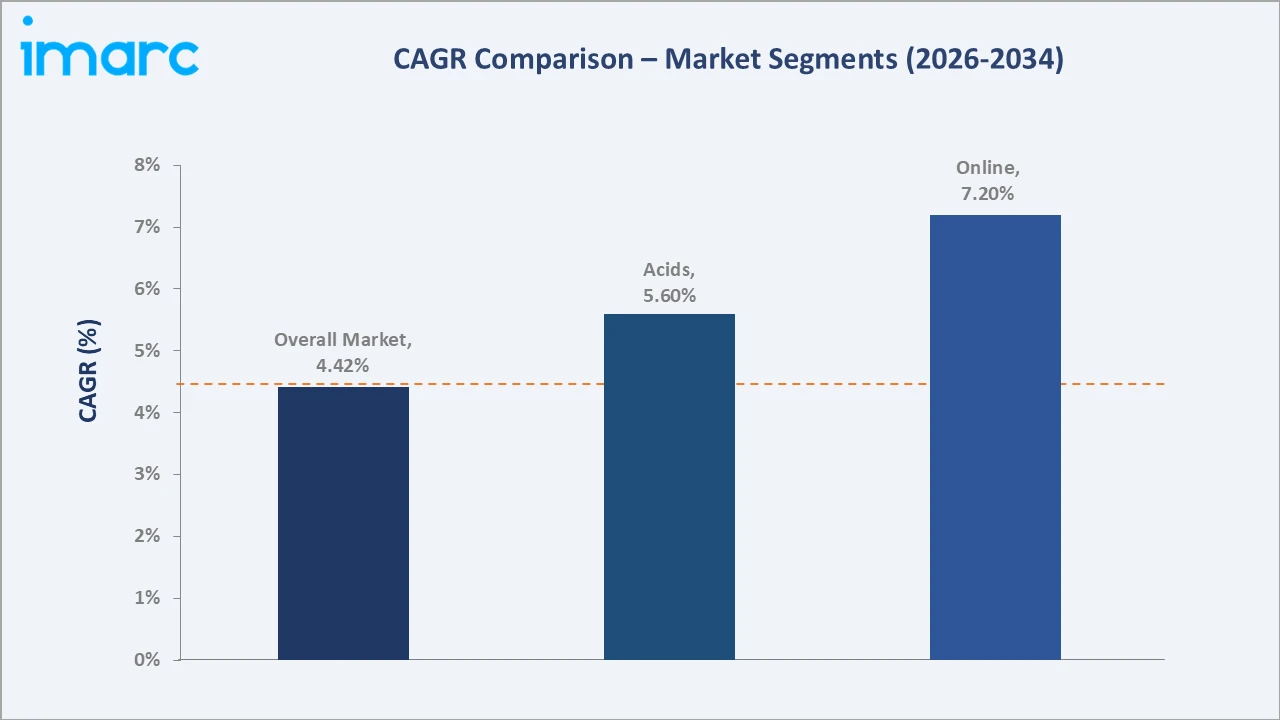
Acids grow fastest among product types at an estimated ~5.6% CAGR, supported by rising demand for clean-label preservation and flavor-enhancement solutions in packaged foods. Among sales channels, online retail leads at an estimated ~7.2% CAGR, as India's food and grocery e-commerce penetration continues to expand beyond metro cities into tier-2 and tier-3 markets.
Executive Summary
The India seasoning market, which increased from USD 342.7 Million in 2025 to an estimated USD 362.1 Million in 2026, represents a maturing segment within the country's broader food ingredients industry. The market is projected to reach USD 511.9 Million by 2034, growing at a CAGR of 4.42% during 2026-2034. Growth is underpinned by increasing consumer preference for authentic regional flavors, a decisive shift toward health-conscious and low-sodium seasoning formats, and rising adoption of ready-to-use spice and seasoning blends among time-constrained urban households.
Salt remains the dominant product type at 34.0% share in 2025, given its ubiquitous use across cooking, preservation, and industrial food processing. Pepper follows at 24.0% share, while sugar and light flavored sweeteners account for 18.0%, reflecting sustained demand from bakery, beverage, and confectionery end-uses. Acids, though the smallest major category at 14.0%, are gaining share fastest as manufacturers reformulate products with natural preservation systems.
Supermarkets and hypermarkets remain the leading sales channel at 39.0% share, while online retail is rapidly scaling on the back of India's expanding digital grocery infrastructure. Regionally, North India leads with 32.0% share, driven by dense food processing clusters and strong organized retail penetration, followed by West India at 29.0%. The market outlook through 2034 remains constructive, supported by urbanization, rising disposable incomes, and continued premiumization across India's packaged food and seasoning landscape.
Key Market Insights
|
Insight |
Data |
|
Dominant Product Type |
Salt - 34.0% share (2025) |
|
Dominant Sales Channel |
Supermarket/Hypermarket - 39.0% share (2025) |
|
Leading Region |
North India - 32.0% share (2025) |
|
Fastest-Growing Product Type |
Acids - ~5.6% CAGR (2026-2034) |
|
Fastest-Growing Channel |
Online - ~7.2% CAGR (2026-2034) |
|
Market Opportunity |
Clean-label acid-based preservation systems, D2C and quick-commerce seasoning formats, regional flavor premiumization, and Tier-2/Tier-3 organized retail expansion |
Key Analytical Observations Supporting The Above Data:
- Salt at 34.0%: The salt segment leads on the back of its universal culinary necessity, industrial food-processing applications, and deep penetration across every income tier and region of India, sustained by iodization and value-added low-sodium innovation.
- Pepper at 24.0%: Pepper's strong share is anchored in India's established spice-processing and oleoresin export base, particularly in South India, where black pepper cultivation and extraction infrastructure are concentrated.
- Supermarket/Hypermarket at 39.0%: Organized retail continues to command the largest channel share due to wider assortment, trusted branding, and growing urban footprint of large-format grocery chains across metro and Tier-1 cities.
- Online at 19.0% and rising fastest: E-commerce and quick-commerce platforms are lowering the barrier to purchase for niche and premium seasoning formats, particularly benefiting brands targeting younger, digitally native consumers.
- North India at 32.0%: The region's leadership reflects a dense concentration of food processing units, higher urbanization, and strong organized retail and quick-commerce penetration in the Delhi-NCR corridor.
- Acids segment momentum: Rising formulation demand for citric and other food acids in packaged and beverage products is positioning the category as the fastest-growing product type through 2034.
India Seasoning Market Overview
The India seasoning market encompasses salt, pepper, sugar and light flavored sweeteners, acids, and other seasoning ingredients used across household cooking, food service, and industrial food processing. The industry's ecosystem spans raw material suppliers, processing and formulation units, packaging and branding operations, and a diversified distribution network reaching supermarkets, departmental stores, online platforms, and other retail formats. Macroeconomic tailwinds, including rising disposable incomes, urbanization, and growing demand for packaged and convenience foods, continue to widen the addressable base for branded seasoning products across India.
Market Dynamics
To evaluate market opportunities, Request Sample
Market Drivers
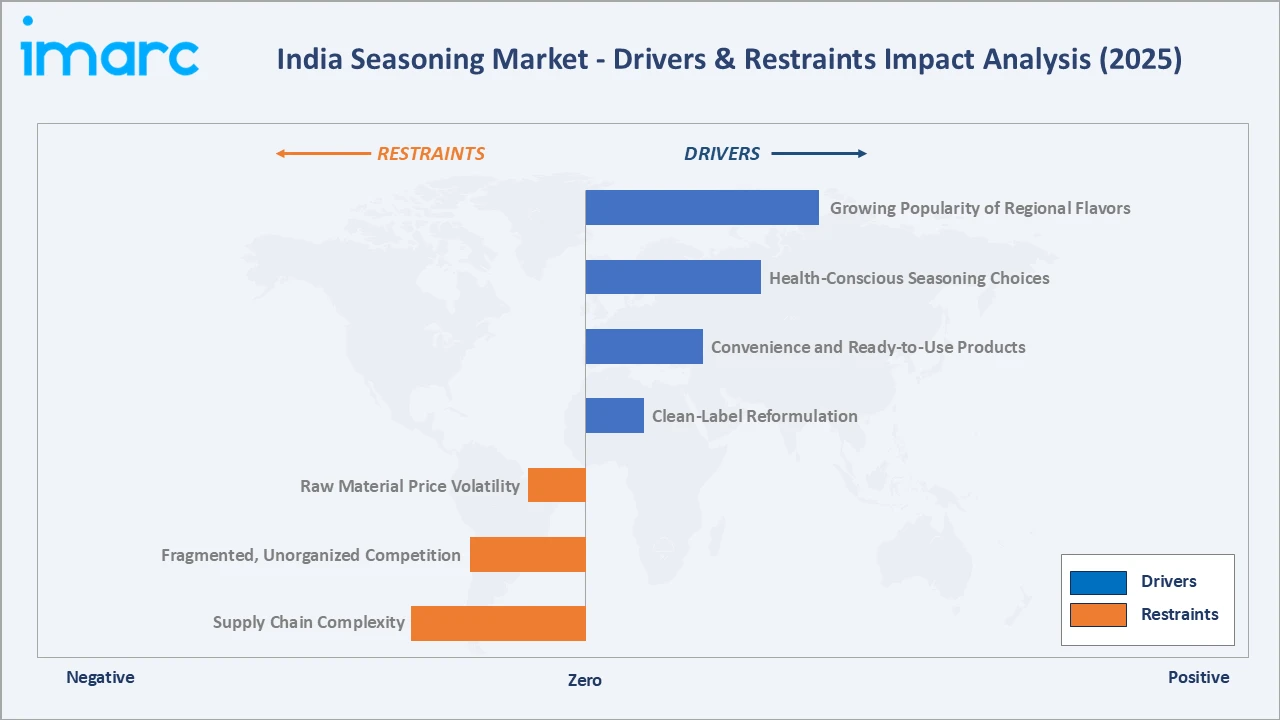
- Growing Popularity of Regional Flavors: Consumers across India's urban centers are increasingly seeking authentic regional spice and seasoning blends, from garam masala to sambar and rasam powders, as culinary curiosity and food travel expose households to diverse regional cuisines. This trend is prompting seasoning manufacturers to expand regional product lines, deepening category penetration.
- Health-Conscious Seasoning Choices: Rising awareness of sodium intake and additive-free eating is driving demand for low-sodium, organic, and clean-label seasoning products. Consumers following plant-based and gluten-free diets are also seeking functional seasonings infused with turmeric, ginger, and cumin for their perceived health benefits.
- Convenience and Ready-to-Use Products: India's accelerating pace of urban life is fueling demand for ready-to-use seasoning mixes and pre-measured spice blends that reduce meal preparation time without compromising flavor, particularly among dual-income households and working professionals.
Market Restraints
- Raw Material Price Volatility: Prices of key agricultural inputs such as pepper, sugarcane, and salt are subject to seasonal and climatic variability, creating cost pressure and margin volatility for seasoning manufacturers reliant on consistent input pricing.
- Fragmented, Unorganized Competition: A significant share of India's seasoning consumption still flows through unbranded, loose-sold channels, particularly in rural and semi-urban markets, limiting the addressable base for organized, branded players.
Market Opportunities
- Clean-Label Reformulation: Growing consumer preference for natural preservation and flavor systems creates a structural opportunity for acid-based and functional seasoning ingredient innovation.
- Tier-2 and Tier-3 Retail Expansion: Organized retail and quick-commerce penetration into smaller Indian cities presents a substantial white-space opportunity for branded seasoning products beyond metro markets.
Market Challenges
- Supply Chain Complexity: Sourcing consistent, high-quality raw spices and ingredients across India's diverse agro-climatic zones remains operationally challenging for manufacturers scaling branded portfolios.
- Price Sensitivity in Rural Markets: A large share of price-sensitive consumers in rural and semi-urban India continues to favor unbranded, lower-cost seasoning products over premium branded alternatives.
Emerging Market Trends
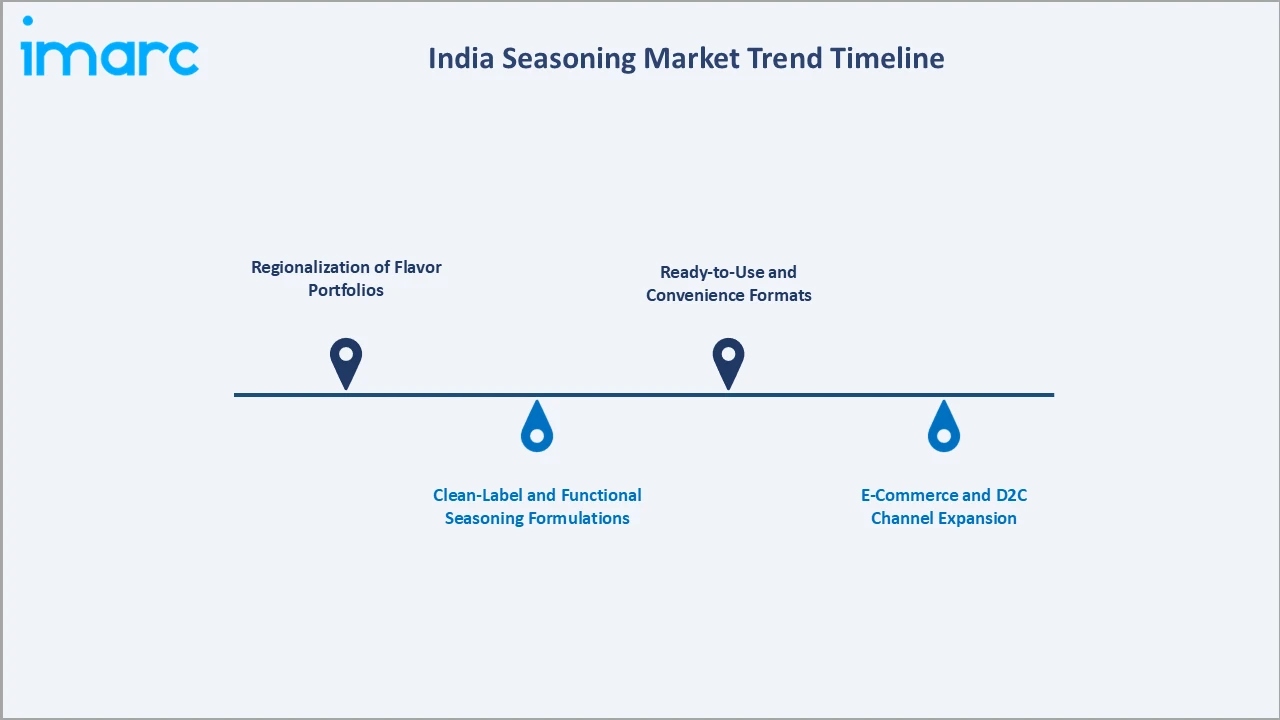
1. Regionalization of Flavor Portfolios
Seasoning brands are expanding regional product lines to capture India's diverse culinary preferences. In January 2023, Tata Sampann introduced blended spices in Karnataka, including Puliyogare and Sambar Masala, to provide authentic South Indian tastes, illustrating how national brands are localizing portfolios to compete with regional players.
2. Clean-Label and Functional Seasoning Formulations
Seasoning manufacturers are reformulating products around natural, additive-free, and functional ingredients such as turmeric and ginger, responding to rising consumer demand for wellness-oriented food choices. This trend is extending into the acids segment, where natural preservation systems are gaining preference over synthetic alternatives.
3. Ready-to-Use and Convenience Formats
Pre-packaged seasoning mixes and portion-controlled formats are becoming a necessity for India's growing base of working professionals. In October 2024, VRB Consumer Products rolled out WokTok, featuring Chinese and Pan-Asian sauces and seasoning blends, distributed nationwide through retail and e-commerce channels.
4. E-Commerce and D2C Channel Expansion
Digital-first seasoning brands are leveraging e-commerce and quick-commerce platforms to reach urban consumers directly, accelerating category discovery and enabling niche, premium seasoning formats to scale nationally without dependence on traditional retail infrastructure.
Industry Value Chain Analysis
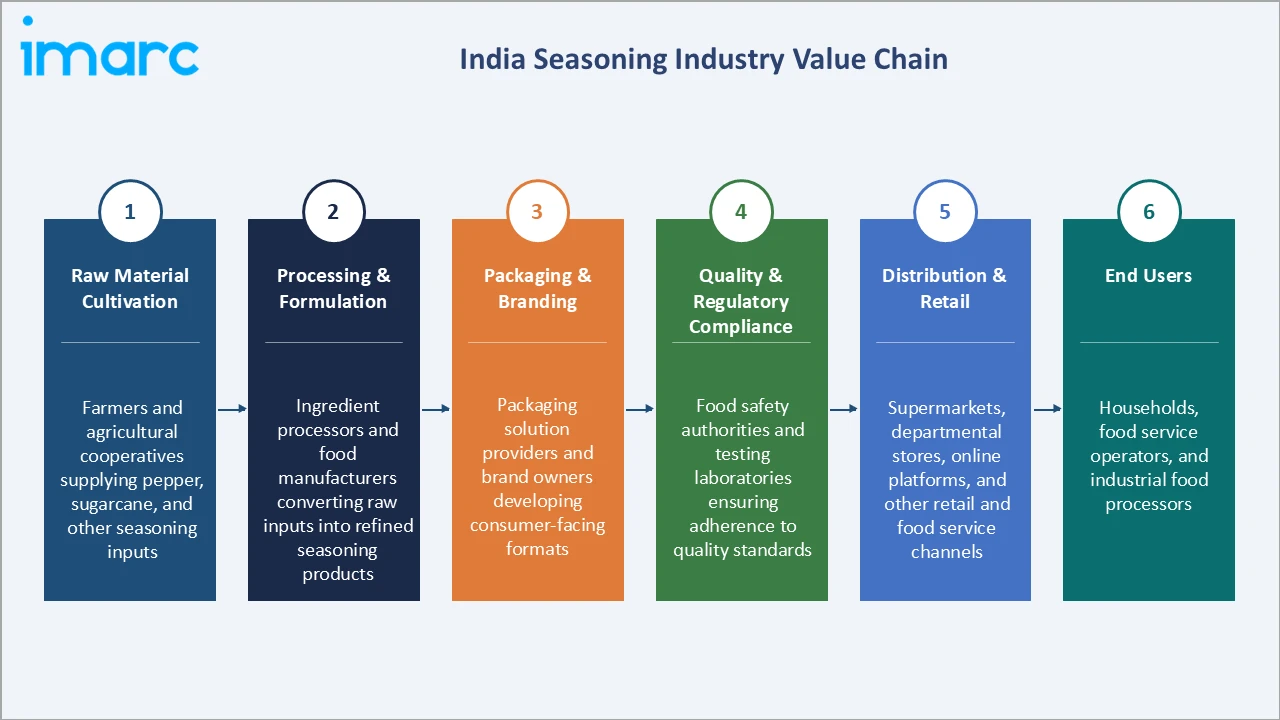
The India seasoning value chain spans raw material cultivation and sourcing, processing and formulation, packaging and branding, and multi-channel distribution to end consumers. Each stage plays a distinct role in shaping product quality, cost structure, and ultimate market reach across India's diverse consumer base.
|
Stage |
Key Players |
|
Raw Material Cultivation |
Farmers and agricultural cooperatives supplying pepper, sugarcane, and other seasoning inputs |
|
Processing & Formulation |
Ingredient processors and food manufacturers converting raw inputs into refined seasoning products |
|
Packaging & Branding |
Packaging solution providers and brand owners developing consumer-facing formats |
|
Quality & Regulatory Compliance |
Food safety authorities and testing laboratories ensuring adherence to quality standards |
|
Distribution & Retail |
Supermarkets, departmental stores, online platforms, and other retail and food service channels |
|
End Users |
Households, food service operators, and industrial food processors |
Processing and formulation represent the value chain's most commercially significant stage, where raw agricultural inputs are transformed into standardized, quality-assured seasoning products. Manufacturers investing in formulation capability and clean-label reformulation are best positioned to capture premium pricing as India's seasoning market shifts toward branded, value-added offerings.
Technology Landscape in the India Seasoning Industry
Processing and Extraction Technology
Advanced extraction and processing technologies, including oleoresin extraction for pepper and other spices, are enabling manufacturers to deliver standardized flavor intensity and shelf-stable seasoning formats at industrial scale, supporting both domestic consumption and export applications.
Natural Preservation and Clean-Label Innovation
Formulation technology is increasingly focused on natural acid-based preservation systems that replace synthetic additives, aligning with rising consumer demand for clean-label packaged foods without compromising shelf life or food safety.
Packaging Innovation
Moisture-resistant, resealable, and portion-controlled packaging formats are extending shelf life and improving convenience, particularly for ready-to-use seasoning blends sold through modern retail and e-commerce channels.
Traceability and Quality Assurance
Digital traceability systems are being adopted across processing units to ensure consistent quality control and regulatory compliance, strengthening consumer trust in branded seasoning products amid growing awareness of food adulteration risks.
Market Segmentation Analysis
The report covers the following segments:
|
Segment Category |
Leading Segment |
Market Share |
Year |
|
Product Type |
Salt |
34.0% |
2025 |
|
Sales Channel |
Supermarket/Hypermarket |
39.0% |
2025 |
|
Region |
North India |
32.0% |
2025 |

By Product Type
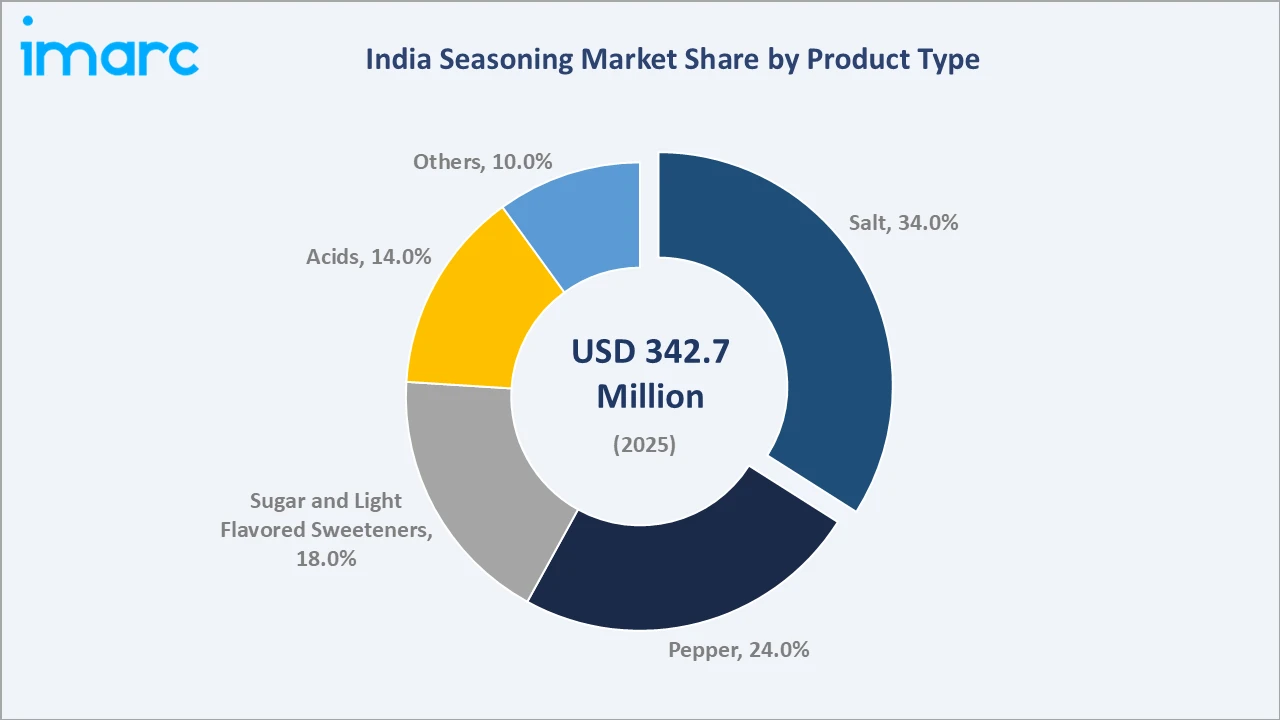
Salt leads the product type segmentation at 34.0% share in 2025, reflecting its indispensable role across household cooking, food preservation, and industrial food processing applications throughout India.
To access detailed market analysis, Request Sample
Pepper follows at 24.0% share, underpinned by India's established spice cultivation and oleoresin processing base. Sugar and light flavored sweeteners hold 18.0% share, driven by steady demand from bakery, beverage, and confectionery applications, while acids account for 14.0% and represent the fastest-growing product category as clean-label reformulation accelerates. Others, comprising a range of specialty seasoning ingredients, hold the remaining 10.0% share.
By Sales Channel
Supermarket and hypermarket channels lead sales channel segmentation at 39.0% share in 2025, supported by wide product assortment and growing organized retail footprint across urban India.
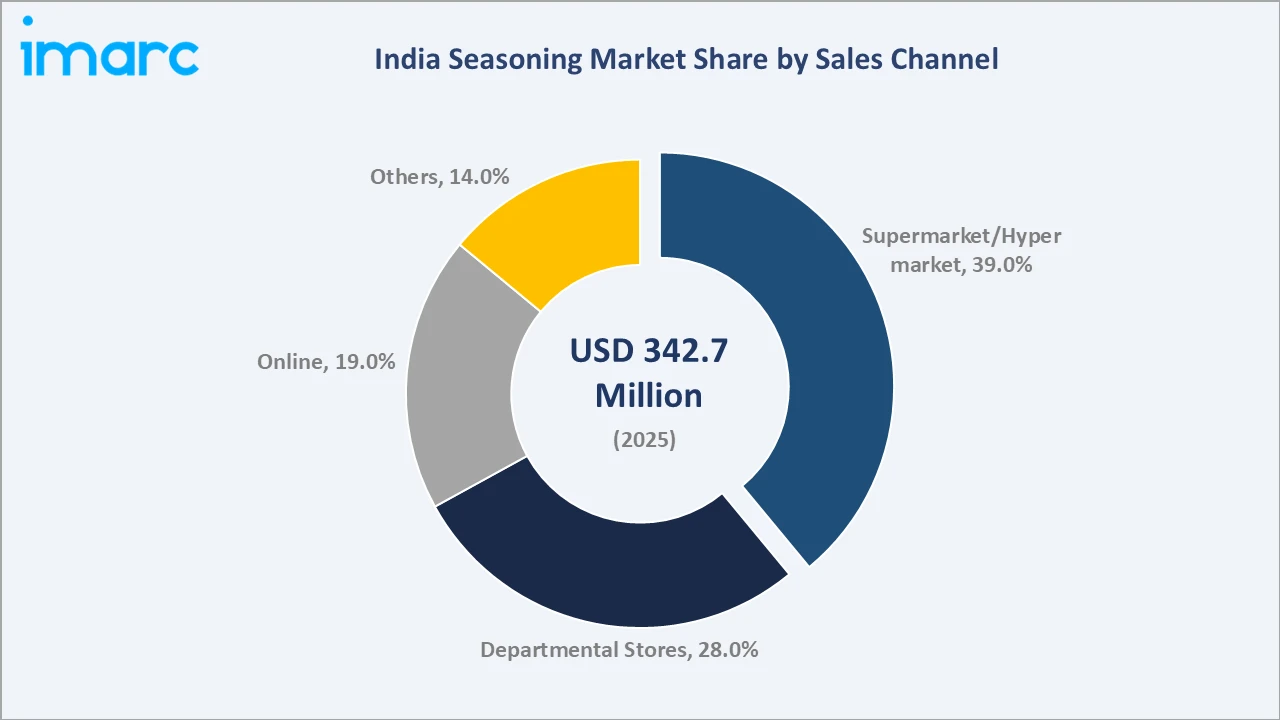
Departmental stores hold 28.0% share, remaining a preferred format for regular household grocery purchases. Online retail, at 19.0% share, is the fastest-growing channel as India's food and grocery e-commerce ecosystem expands into smaller cities, while other channels, including food service and institutional sales, account for the remaining 14.0% share.
Regional Market Insights
|
Region |
Share (2025) |
Key Market Drivers & Characteristics |
|
North India |
32.0% |
Driven by dense food processing clusters, higher urbanization, and strong organized retail and quick-commerce penetration in the Delhi-NCR corridor. |
|
West India |
29.0% |
Supported by Mumbai and Pune's large food manufacturing base and well-developed modern retail and export infrastructure. |
|
South India |
24.0% |
Anchored by the region's spice cultivation heritage, strong pepper processing base, and deep-rooted regional flavor preferences. |
|
East India |
15.0% |
Gradually expanding on rising disposable incomes and increasing exposure to branded, packaged seasoning products in Tier-2 cities. |
North India's 32.0% market leadership reflects its concentration of food processing industries and the Delhi-NCR region's advanced organized retail and logistics infrastructure. West India's 29.0% share is anchored in Mumbai and Pune's manufacturing density and export-oriented food processing capacity.
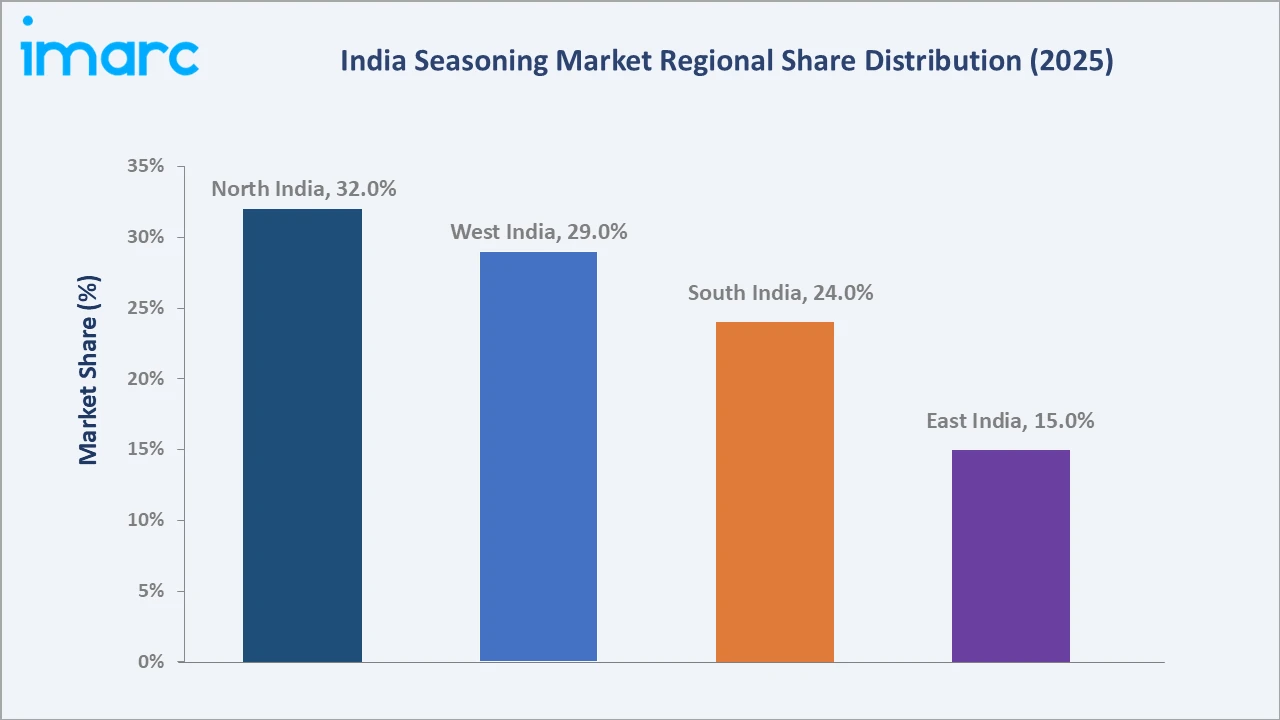
South India's 24.0% share is underpinned by the region's deep culinary tradition and its position as India's primary pepper and spice cultivation and processing hub. East India, at 15.0%, remains the most underdeveloped region but is growing steadily as rising incomes and expanding organized retail create incremental demand for branded seasoning products.
Competitive Landscape
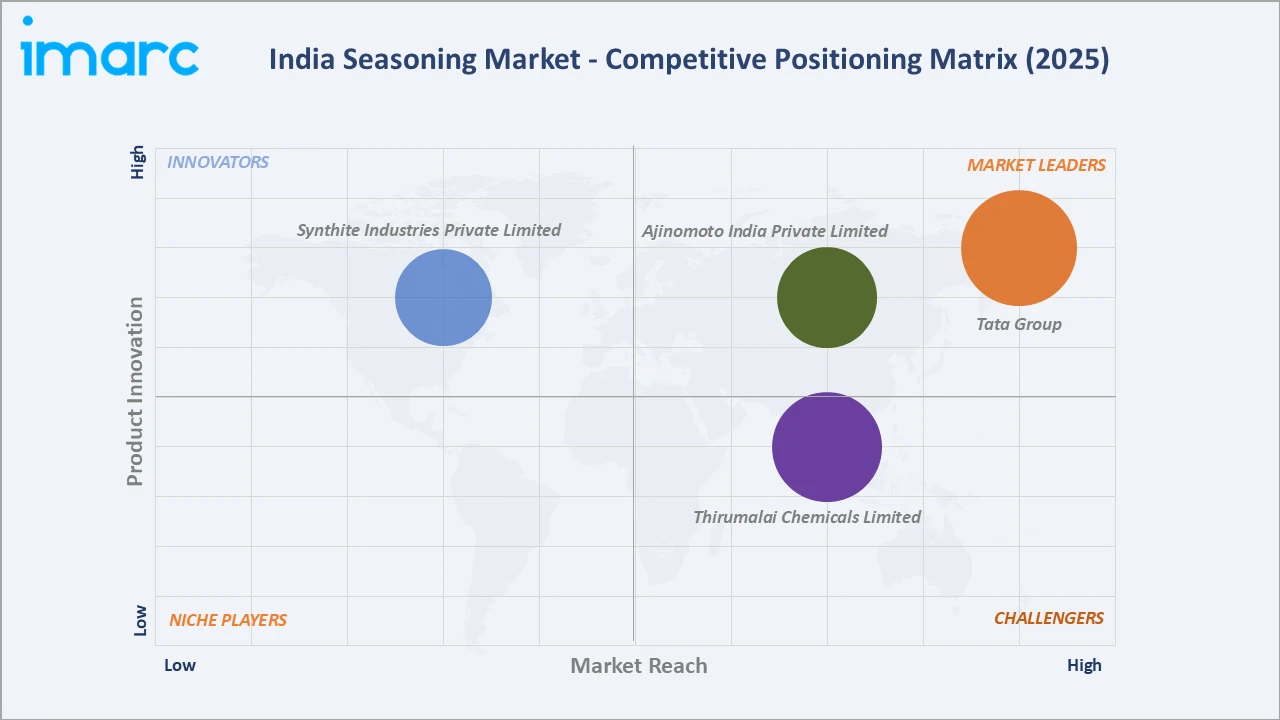
The India seasoning market's competitive landscape spans diversified FMCG conglomerates, specialty ingredient processors, and agro-industrial manufacturers. Competition is intensifying as branded players expand across salt, pepper, sugar, and acid-based seasoning categories, while regional and unorganized players continue to compete on price in rural and semi-urban markets.
|
Company |
Key Brands/ Product Lines |
Market Position |
Core Strength |
|
Tata Group |
Tata Sampann, Tata Salt |
Market Leader |
Active in the market via Tata Consumer Products Limited, India's largest branded salt player with an extensive distribution network and continuous low-sodium and premiumization innovation |
|
Ajinomoto India Private Limited |
AJI-NO-MOTO, Hapima |
Market Leader |
Proprietary amino acid and natural fermentation technologies, deep brand recognition as an umami pioneer, and targeted culinary adaptations like specialized seasoning mixes for Indo-Chinese and local cuisines |
|
Thirumalai Chemicals Limited |
Malic Acid, Fumaric Acid |
Strong Challenger |
Integrated manufacturing, global-grade quality compliance, and reliable domestic supply chain integration |
|
Synthite Industries Private Limited |
Kitchen Treasures, Sprig, Symega |
Innovator |
World-prominent producer of pepper and spice oleoresins, supplying global flavor houses from its Kerala processing base |
The competitive landscape's most significant dynamic is the ongoing shift from unbranded, loose seasoning sales toward organized, branded consumption, creating headroom for established FMCG players to expand share through continued investment in health-oriented reformulation and distribution depth.
Key Company Profiles
Tata Group
Tata Group, which operates Tata Consumer Products Limited, is one of India's largest FMCG companies and the market leader in branded iodized salt through its Tata Salt franchise, alongside a diversified spices and seasoning portfolio under Tata Sampann.
- Key Brands: Tata Sampann, Tata Salt.
- Strategic Focus: Strengthening category leadership through continued low-sodium innovation, regional product expansion, and deeper omni-channel distribution.
Synthite Industries Private Limited
Synthite Industries Private Limited is a Kerala-based specialty ingredient manufacturer and the world's largest producer of spice oleoresins, including pepper extracts, supplying flavor houses and food manufacturers across more than 90 countries.
- Key Brands: Kitchen Treasures, Sprig, Symega, and others.
- Strategic Focus: Scaling India's domestic ingredient business while maintaining global leadership in pepper and spice oleoresin exports.
Market Concentration Analysis
The India seasoning market is moderately fragmented, with the leading branded players concentrated in the salt segment while pepper, sugar, and acids categories remain more distributed across specialty processors and regional manufacturers. Tata Group holds the most commercially dominant single-company position within the branded salt category, supported by its extensive distribution network and sustained low-sodium product innovation.
A significant share of India's overall seasoning consumption continues to flow through unbranded and loose-sold channels, particularly in rural and semi-urban markets, creating structural de-concentration pressure that limits any single branded player's effective share of the total addressable market. Consolidation is expected to accelerate gradually as organized retail penetration deepens and clean-label reformulation raises entry barriers for smaller, unbranded competitors.
Investment & Growth Opportunities
Highest Growth Segments
The acids product category (~5.6% CAGR through clean-label reformulation demand), pepper and spice extracts (~5.3% CAGR through export and domestic oleoresin demand), and the online sales channel (~7.2% CAGR through e-commerce expansion) represent India's highest-growth seasoning investment vectors through 2034.
Emerging Investment Opportunities
India's clean-label, natural preservation ingredient segment represents a structurally attractive investment opportunity as packaged food manufacturers accelerate reformulation away from synthetic additives. Quick-commerce seasoning distribution is also emerging as a high-growth channel, enabling niche and premium seasoning brands to scale rapidly without dependence on traditional retail infrastructure.
Investment Themes
- Tier-2 and Tier-3 organized retail expansion: Branded seasoning penetration remains comparatively low outside India's major metro markets, creating a substantial white-space opportunity for retail and distribution investment.
- Clean-label acid and preservation ingredient platforms: Investment in natural, functional seasoning ingredient manufacturing capacity positions companies to capture premium pricing as reformulation accelerates across India's packaged food industry.
Future Market Outlook (2026-2034)
The India seasoning market is projected to grow from USD 342.7 Million in 2025 to USD 362.1 Million in 2026, reaching USD 511.9 Million by 2034, registering a CAGR of 4.42% during 2026-2034. The market's anchor value of USD 425.5 Million in 2030 reflects a steady, structurally supported growth trajectory rather than a cyclical expansion, underpinned by rising urbanization, health-conscious reformulation, and continued premiumization across India's packaged food landscape.
Three structural forces are expected to define India seasoning market growth through 2034: continued regionalization of flavor portfolios as brands localize products for India's diverse culinary preferences; accelerating clean-label reformulation as consumers and regulators prioritize natural, additive-free ingredients; and deepening e-commerce and quick-commerce penetration, which is expected to democratize access to premium and niche seasoning formats across India's Tier-2 and Tier-3 cities.
Research Methodology
Primary Research
Primary research comprised structured interviews with India seasoning industry stakeholders, including manufacturing executives, category managers at organized retail chains, e-commerce platform representatives, and food processing industry procurement leads across North, South, East, and West India.
Secondary Research
Secondary research encompassed company annual reports, industry association publications, government trade and agricultural data, food processing industry reports, and import-export data relevant to India's salt, pepper, sugar, and food acid categories.
Forecasting Models
Market revenue forecasts were developed using a bottom-up and top-down triangulation approach, combining historical consumption trends, regional demand patterns, and macroeconomic indicators including urbanization and disposable income growth to project category-wise and regional market size through 2034.
India Seasoning Market Report Coverage:
| Report Features | Details |
|---|---|
| Base Year of the Analysis | 2025 |
| Historical Period | 2020-2025 |
| Forecast Period | 2026-2034 |
| Units | Million USD |
| Scope of the Report |
Exploration of Historical Trends and Market Outlook, Industry Catalysts and Challenges, Segment-Wise Historical and Future Market Assessment:
|
| Product Types Covered | Salt, Pepper, Sugar and Light Flavored Sweeteners, Acids, Others |
| Sales Channels Covered | Supermarket/Hypermarket, Departmental Stores, Online, Others |
| Regions Covered | North India, South India, East India, West India |
| Companies Covered | Tata Group, Ajinomoto India Private Limited, Thirumalai Chemicals Limited, Synthite Industries Private Limited, etc. |
| Customization Scope | 10% Free Customization |
| Post-Sale Analyst Support | 10-12 Weeks |
| Delivery Format | PDF and Excel through Email (We can also provide the editable version of the report in PPT/Word format on special request) |
Key Benefits for Stakeholders:
- IMARC’s industry report offers a comprehensive quantitative analysis of various market segments, historical and current market trends, market forecasts, and dynamics of the India seasoning market from 2020-2034.
- The research report provides the latest information on the market drivers, challenges, and opportunities in the India seasoning market.
- Porter's five forces analysis assist stakeholders in assessing the impact of new entrants, competitive rivalry, supplier power, buyer power, and the threat of substitution. It helps stakeholders to analyze the level of competition within the India seasoning industry and its attractiveness.
- Competitive landscape allows stakeholders to understand their competitive environment and provides an insight into the current positions of key players in the market.
Frequently Asked Questions About the India Seasoning Market Report
The India seasoning market size increased from USD 342.7 Million in 2025 to USD 362.1 Million in 2026, driven by rising demand for regional flavors, health-conscious seasoning choices, and convenient ready-to-use products across urban and semi-urban India.
The India seasoning market grows at a 4.42% CAGR during 2026-2034, reaching USD 511.9 Million by 2034, supported by urbanization, premiumization, and expanding organized retail penetration.
Salt leads at 34.0% share in 2025, reflecting its universal culinary and industrial application across every region and income segment of India.
Acids are estimated to grow fastest at approximately 5.6% CAGR through 2034, driven by rising demand for clean-label, natural preservation ingredients.
Supermarket and hypermarket channels lead at 39.0% share in 2025, supported by wide assortment and expanding organized retail footprint across urban India.
North India leads at 32.0% share, driven by dense food processing clusters and strong organized retail and quick-commerce penetration in the Delhi-NCR corridor.
Leading companies include Tata Group, Ajinomoto India Private Limited, Thirumalai Chemicals Limited, and Synthite Industries Private Limited, among others.
The India seasoning market is projected to reach approximately USD 425.5 Million by 2030, anchored by continued urbanization and premiumization trends.
Key drivers include rising demand for regional and authentic flavors, growing health-conscious seasoning preferences, and increasing adoption of convenient, ready-to-use seasoning formats.
Key restraints include volatility in raw material and agricultural commodity prices, along with continued competition from fragmented, unorganized, and unbranded seasoning sellers.
Need more help?
- Speak to our experienced analysts for insights on the current market scenarios.
- Include additional segments and countries to customize the report as per your requirement.
- Gain an unparalleled competitive advantage in your domain by understanding how to utilize the report and positively impacting your operations and revenue.
- For further assistance, please connect with our analysts.
 Request Customization
 Speak to an Analyst
 Request Brochure
 Inquire Before Buying
Benefits of Customization
- Personalize this research
- Triangulate with your data
- Get data as per your format and definition
- Gain a deeper dive into a specific application, geography, customer, or competitor
- Any level of personalization
Get in Touch With Us
UNITED STATES
Phone: +1-201-971-6302
INDIA
Phone: +91-120-433-0800
UNITED KINGDOM
Phone: +44-753-714-6104
Email: [email protected]
Client Testimonials




.webp)




.webp)













Related Reports

Choose your plan
*Please note that the prices mentioned below are starting prices for each bundle type. Kindly contact our team for further details.*
Single User License
- 1 User License, Access on 2 Devices
- PDF Report + Excel Dataset (Password Protected)
- Lifetime Access
- No Printing Rights
- 10% Free Report Customization
- 10–12 Weeks of Analyst Support
Five User License
- Access for 5 Users, 2 Devices per User
- PDF Report + Excel Dataset (Password Protected)
- Lifetime Access
- Dedicated Account Manager
- 12–14 Weeks of Analyst Support
- No Printing Rights
- 15% Free Report Customization
- 25% Discount on Your Next Purchase
Corporate User License
- Unlimited User Access (Within Your Organization)
- PDF Report + Excel Dataset
- Lifetime Access
- Dedicated Account Manager
- 14–20 Weeks of Analyst Support
- No Printing Rights
- 20% Free Report Customization
- 30% Discount on Your Next Purchase
Essential Insights
What's included:
3 reports
- Lifetime Access
- PDF Reports
- Excel Datasets
- 2 Weeks of Free Analyst Support
- 2 User Licenses
- Access on 2 Devices
- Printing Rights
- Complimentary PowerPoint (PPT) Version
- Complimentary License Upgrade
Professional Access
What's included:
5 reports
- Lifetime Access
- PDF Reports
- Excel Datasets
- 8 Weeks of Free Analyst Support
- 2 User Licenses
- Access on 2 Devices
- Printing Rights
- Complimentary PowerPoint (PPT) Version
- Complimentary License Upgrade
Business Advantage
What's included:
8 reports
- Lifetime Access
- PDF Reports
- Excel Datasets
- 14 Weeks of Free Analyst Support
- 2 User Licenses
- Access on 2 Devices
- Printing Rights
- Complimentary PowerPoint (PPT) Version
- Complimentary License Upgrade
Enterprise Intelligence
What's included:
10 reports
- Lifetime Access
- PDF Reports
- Excel Datasets
- 20 Weeks of Free Analyst Support
- 2 User Licenses
- Access on 2 Devices
- Printing Rights
- Complimentary PowerPoint (PPT) Version
- Complimentary License Upgrade