
India Servo Motors and Drives Market Size, Share, Trends and Forecast by Product Type, Voltage Range, System, Communication Protocol, End Use Industry, and Region, 2026-2034
India Servo Motors and Drives Market Summary:
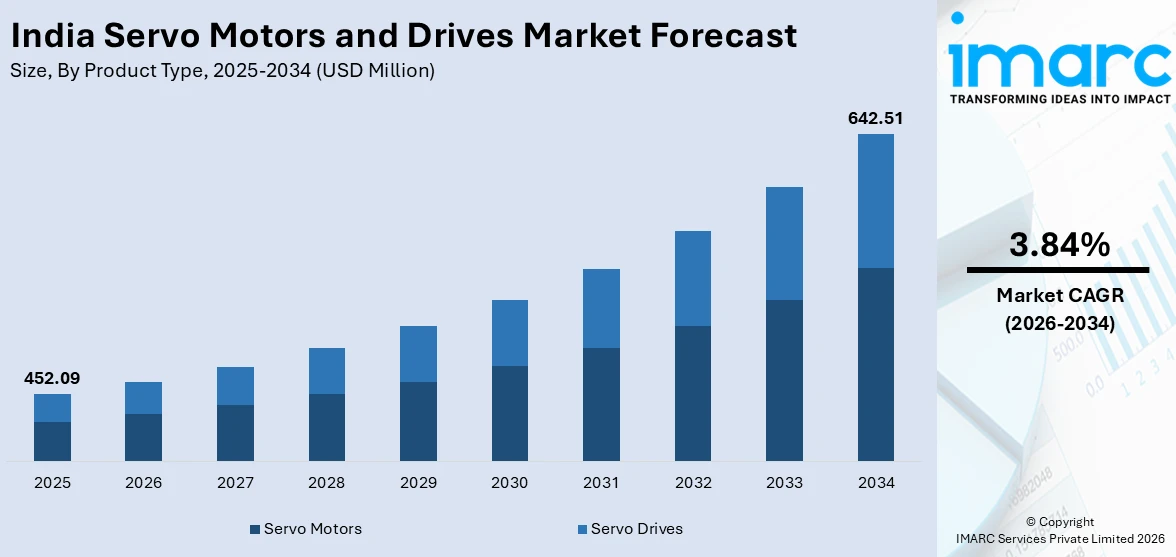
The India servo motors and drives market grew from USD 452.09 Million in 2025 to USD 475.29 Million in 2026 and is projected to reach USD 642.51 Million by 2034, growing at a compound annual growth rate of 3.84% from 2026-2034.
The India servo motors and drives market is witnessing robust expansion driven by the accelerating adoption of industrial automation, increasing deployment of robotics and CNC machinery, and growing integration of precision motion control solutions across diverse manufacturing sectors. Government-backed initiatives promoting domestic manufacturing, combined with rising demand for energy-efficient drive systems and smart factory deployments, are creating a highly favorable environment for market growth. Expanding applications in electric vehicles, renewable energy infrastructure, and semiconductor fabrication are further broadening the scope of the India servo motors and drives market share.
Key Takeaways and Insights:
- By Product Type: Servo motors dominate the market with a share of 54.5% in 2025, driven by widespread deployment in CNC machines, robotic arms, and precision manufacturing equipment requiring high-torque closed-loop motion control.
- By Voltage Range: Low voltage leads with a 72.5% share in 2025, owing to its broad compatibility with standard industrial equipment, lower installation cost, and suitability for small-to-medium scale automation systems across India.
- By System: Rotary system represents the largest segment with a market share of 68.5% in 2025, reflecting the widespread use of rotary servo motors in conveyor systems, packaging lines, and multi-axis robotic applications.
- By Communication Protocol: Industrial ethernet dominate the market with a share of 48.2% in 2025, as manufacturers increasingly adopt high-speed, deterministic networks for real-time motion synchronization and IIoT integration.
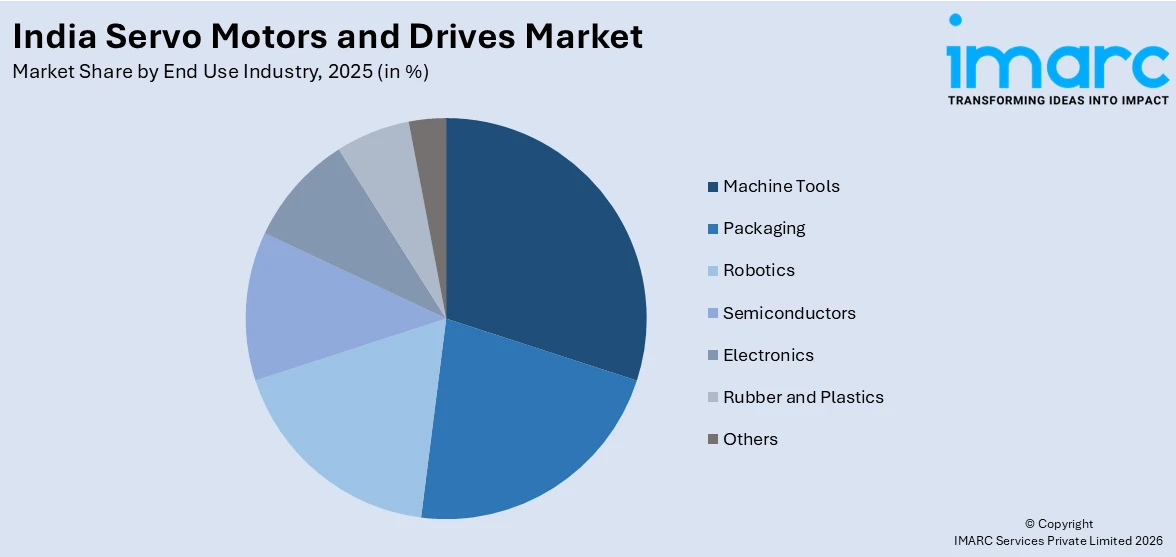
- By End Use Industry: Machine tools represent the largest share of 24.5% in 2025, reflecting strong demand from India's expanding CNC machining, metalworking, and precision component manufacturing sectors.
- By Region: West India dominates the market with a 30.2% share in 2025, underpinned by the concentration of automotive, electronics, and engineering manufacturing clusters across Maharashtra and Gujarat.
- Key Players: The India servo motors and drives market is highly competitive, characterized by the presence of global automation leaders and regional specialists. Competition is driven by technological innovation, precision performance, product reliability, and strong after-sales service support across industrial applications.
To get more information on this market Request Sample
The India servo motors and drives market is undergoing a transformative phase as Indian industry transitions toward smart, connected, and energy-efficient manufacturing ecosystems. The rapid expansion of the automotive sector, driven by both conventional and electric vehicle production, has elevated demand for precision servo systems in robotic welding, assembly, and powertrain testing operations. The semiconductor and electronics manufacturing segments, bolstered by India's Production-Linked Incentive scheme, are generating significant demand for high-precision, low-latency servo drives. Additionally, the proliferation of packaging automation, particularly in pharmaceuticals, food processing, and fast-moving consumer goods, is driving continuous upgrades to servo-controlled filling, labeling, and cartoning machinery. The integration of Industrial Ethernet protocols and IIoT-enabled servo systems is enabling manufacturers to leverage predictive maintenance and real-time process optimization, further reinforcing investment in advanced motion control solutions.
India Servo Motors and Drives Market Trends:
Integration of AI and IIoT in Servo Systems
The convergence of artificial intelligence and the Industrial Internet of Things with servo motor and drive technology is fundamentally reshaping the operational landscape of Indian manufacturing facilities. Servo systems embedded with AI-driven tuning algorithms can autonomously optimize motion parameters, reducing setup time and minimizing reliance on skilled technicians. IIoT connectivity enables continuous performance monitoring, predictive fault detection, and remote diagnostics, allowing plant operators to address potential failures before they cause costly downtime. This trend is particularly pronounced in semiconductor fabrication and electronics assembly, where ultra-precise positioning and synchronized multi-axis operation are critical to product quality and throughput, contributing significantly to India servo motors and drives market growth.
Surge in Demand from Electric Vehicle and Renewable Energy Sectors
The rapid scaling of India's electric vehicle ecosystem and the ambitious expansion of solar and wind energy infrastructure are generating substantial demand for high-performance servo motors and drives. Servo systems play a pivotal role in EV manufacturing, from battery cell handling and robotic assembly lines to powertrain component testing and quality verification. In the renewable energy domain, servo drives are critical to solar panel single-axis and dual-axis tracking systems that maximize energy capture. Wind turbine blade pitch control systems rely on robust rotary servo motors capable of precise angular adjustments under variable atmospheric conditions. These sectoral tailwinds are drawing manufacturers to deploy advanced servo solutions that balance precision, energy efficiency, and durability in demanding operational environments.
Adoption of Industrial Ethernet and Advanced Communication Protocols
Indian manufacturers are increasingly replacing traditional Fieldbus networks with Industrial Ethernet architectures such as EtherCAT, PROFINET, and EtherNet/IP to enable deterministic, high-speed communication across multi-axis servo systems. Industrial Ethernet supports real-time synchronization of dozens of servo axes simultaneously, reducing cycle times and improving production consistency across complex automated lines in automotive, packaging, and machine tool applications. The transition is also driven by the need for seamless integration with Manufacturing Execution Systems and ERP platforms, enabling data-rich production environments. As Industry 4.0 deployments accelerate across Indian industry, the demand for servo drives with native Industrial Ethernet support is expected to intensify across both greenfield installations and retrofitted legacy facilities.
Market Outlook 2026-2034:
The India servo motors and drives market is positioned for sustained growth through the forecast period, underpinned by expanding investments in factory automation, the emergence of semiconductor fabrication facilities, and the continued maturation of electric vehicle and renewable energy supply chains. Accelerating CNC machine tool installations, the scaling of collaborative robotics in mid-size enterprises, and government-backed manufacturing incentives are broadening the addressable market base. Additionally, ongoing advancements in precision control technologies and digital integration are expected to enhance system efficiency and drive deeper adoption across high-performance industrial applications. The market generated a revenue of USD 452.09 Million in 2025, which is expected to reach USD 475.29 Million in 2026 and further grow to USD 642.51 Million by 2034, at a compound annual growth rate of 3.84% during 2026-2034.
India Servo Motors and Drives Market Report Segmentation:
| Segment Category | Leading Segment | Market Share |
|---|---|---|
|
Product Type |
Servo Motors |
54.5% |
|
Voltage Range |
Low Voltage |
72.5% |
|
System |
Rotary System |
68.5% |
|
Communication Protocol |
Industrial Ethernet |
48.2% |
|
End Use Industry |
Machine Tools |
24.5% |
|
Region |
West India |
30.2% |
Product Type Insights:
- Servo Motors
- Servo Drives
Servo motors lead the market share of 54.5% of the total India servo motors and drives market in 2025.
Servo motors represent the foundational motion control element across nearly every automated manufacturing process in India, delivering precise speed, torque, and position regulation through closed-loop feedback mechanisms. Their deployment spans CNC machining centers, industrial robots, packaging lines, and semiconductor handling equipment, where high-resolution positioning and dynamic response are non-negotiable performance requirements. The growing adoption of permanent magnet AC servo motors, which offer superior power density, compact form factors, and energy efficiency compared to traditional induction alternatives, has further cemented servo motors as the preferred choice for new automation installations across India's manufacturing base. As Indian industries upgrade from basic motor drives to intelligent servo systems with embedded diagnostics, the servo motor segment is expected to maintain its structural dominance throughout the forecast period.
The machine tool sector remains the single largest consumer of servo motors in India, where multi-axis CNC machining centers require high-precision servo systems for coordinated linear and rotary motion. The integration of servo motors in turn-mill combination machines and five-axis machining centers has enabled manufacturers to produce complex aerospace and automotive components with tighter tolerances and shorter cycle times. Jyoti CNC Automation's expansion of its Rajkot facility, adding over 200 machining centers, exemplifies the scale of CNC investment driving servo motor demand. Simultaneously, the rise of collaborative robots in electronics assembly and automotive sub-component manufacturing is creating growing demand for compact, torque-dense servo motors capable of operating safely in proximity to human workers.
Voltage Range Insights:
- Low Voltage
- Medium and High Voltage
Low voltage represents the largest share at 72.5% of the total of India servo motors and drives market in 2025.
Low voltage servo motors and drives account for the largest share in India due to their extensive use across a wide range of industrial automation applications. Sectors such as packaging, textiles, electronics assembly, and machine tools predominantly operate on low voltage systems because they offer adequate power for precision tasks while maintaining energy efficiency. Their compatibility with standard industrial power infrastructure and ease of integration into existing production lines make them a preferred choice for manufacturers aiming to optimize performance without significant capital investment.
Additionally, the rapid growth of small and medium-sized enterprises (SMEs) and increasing adoption of compact, cost-effective automation solutions further strengthen the dominance of low voltage systems. These motors and drives typically have lower upfront and operational costs compared to medium and high voltage alternatives, making them more accessible to a broader base of users. Their suitability for high-speed, high-precision operations in applications such as robotics and CNC machinery also supports their widespread adoption across diverse end-use industries in India.
System Insights:
- Linear System
- Rotary System
Rotary system dominates with a market share of 68.5% of the total of India servo motors and drives market in 2025.
Rotary systems account for the largest share of the India servo motors and drives market due to their widespread applicability across core industrial processes. Most machinery used in manufacturing—such as CNC machines, conveyors, packaging equipment, and robotics—relies on rotational motion for operation. Rotary servo systems provide high precision, speed control, and torque efficiency, making them essential for applications requiring continuous and repeatable motion. Their versatility across industries like automotive, electronics, and food processing ensures consistent demand and reinforces their dominant position in the market.
Additionally, rotary servo systems benefit from mature technology, easier installation, and lower maintenance complexity compared to linear alternatives. They are more readily available and compatible with a wide range of standard industrial components, reducing integration challenges for manufacturers. Cost advantages, along with their ability to handle diverse load conditions and operating environments, further support their preference among end users. As automation adoption expands across both large enterprises and SMEs, rotary systems continue to be the default choice for motion control applications.
Communication Protocol Insights:
- Fieldbus
- Industrial Ethernet
- Wireless
Industrial ethernet leads the highest revenue share at 48.2% of the total India servo motors and drives market in 2025.
Industrial Ethernet accounts for the largest share in India’s servo motors and drives market due to its ability to enable high-speed, real-time communication between automation components. The current manufacturing settings demand accurate synchronization of examples of servo drives, controllers, and sensors and the Industrial Ethernet protocols are good at facilitating this. Its high level of data bandwidth, low latency, and reliability qualify it to be used in complex motion control systems in other types of industries such as automotive, electronics, and packaging, where precision and coordination are essential in ensuring productivity and quality.
Moreover, the rise of Industry 4.0 practices and intelligent manufacturing solutions is increasing in India and shifting towards an Ethernet-based communication system. Digital platforms, remote monitoring, and advanced analytics, Industrial Ethernet will promote the seamless integration of digital tools, support better operational visibility, and control. Its scalability and flexibility also enable manufacturers to upgrade and easily expand automation systems, and thus it has made it a favorite over traditional fieldbus systems to strengthen its dominance in the market.
End Use Industry Insights:
Access the comprehensive market breakdown Request Sample
- Machine Tools
- Packaging
- Robotics
- Semiconductors
- Electronics
- Rubber and Plastics
- Others
Machine tools represent the highest share with 24.5% of the total India servo motors and drives market in 2025.
Machine tools account for the largest share of the India servo motors and drives market due to their critical reliance on high-precision motion control for operations such as cutting, milling, drilling, and shaping. Servo systems enable accurate positioning, repeatability, and speed control, which are essential for maintaining product quality and minimizing material wastage. The widespread deployment of CNC-based machinery across automotive, aerospace, and general manufacturing sectors further drives consistent demand, as these systems depend heavily on advanced servo motors and drives for efficient and reliable performance.
Additionally, the ongoing modernization of manufacturing facilities and increasing adoption of automated production processes are reinforcing the dominance of machine tools. As industries focus on improving productivity and reducing human intervention, the integration of multi-axis CNC machines and advanced machining centers continues to expand. Servo motors and drives play a vital role in enabling complex operations and enhancing operational efficiency, making them indispensable in high-volume and precision-driven manufacturing environments across India.
Regional Insights:
- North India
- South India
- East India
- West India
West India exhibits a clear dominance with a 30.2% share of the total India servo motors and drives market in 2025.
West India holds the largest share of the servo motors and drives market due to its strong industrial base and concentration of manufacturing clusters across sectors such as automotive, chemicals, pharmaceuticals, and engineering. States like Maharashtra and Gujarat host a high density of factories and industrial zones, many of which are rapidly adopting automation technologies to improve productivity and precision. The presence of well-developed infrastructure, including ports and logistics networks, further supports industrial expansion and drives demand for advanced motion control systems.
Additionally, West India benefits from proactive state-level industrial policies and significant investments in smart manufacturing and industrial automation. The region has witnessed increasing adoption of robotics, CNC machinery, and process automation across both large enterprises and SMEs, accelerating the uptake of servo motors and drives. Strong ecosystem support, including skilled labor availability and proximity to key supply chains, enhances operational efficiency and encourages further automation adoption, reinforcing the region’s dominant position in the overall market.

Market Dynamics:
Growth Drivers:
Why is the India Servo Motors and Drives Market Growing?
Rising Demand for Industrial Automation and Smart Manufacturing
India's industrial sector is undergoing a fundamental shift toward automation, with manufacturers across automotive, electronics, pharmaceuticals, and textiles upgrading legacy systems to servo-controlled production lines in pursuit of higher throughput, reduced waste, and improved product quality. The integration of programmable logic controllers, IIoT-connected servo drives, and real-time production monitoring platforms is enabling manufacturers to achieve consistent output while reducing dependence on manual intervention. Government programs such as Make in India and the National Manufacturing Policy are providing strategic and financial encouragement for domestic manufacturers to invest in advanced automation infrastructure. The growing adoption of Industry 4.0 principles, including digital twins, edge computing, and cloud-connected manufacturing execution systems, is creating an ecosystem where intelligent servo drives serve as critical data-generating nodes. For instance, Mitsubishi Electric's INR 2,200 million investment toward local servo and automation assembly lines in India reflects the scale of commitment that global players are making to serve this rapidly automating market.
Expansion of Electric Vehicle and Renewable Energy Industries
India's ambitious targets for electric vehicle adoption and renewable energy capacity are creating powerful new demand vectors for high-performance servo systems. In the EV manufacturing domain, servo motors and drives are integral to battery module assembly, robotic welding of structural components, motor and inverter testing, and precision quality inspection operations. As India's EV production scales from early assembly operations toward full-scale manufacturing, the technical requirements for servo systems in terms of speed, accuracy, and uptime are increasing commensurately. In the renewable energy sector, the nationwide rollout of utility-scale solar parks requires servo-driven single-axis and dual-axis tracking systems to optimize panel orientation and maximize energy yield throughout the day. Wind turbine installations, particularly in high-wind coastal and elevated regions, rely on servo-based pitch control systems to regulate blade angle and protect turbines during variable wind conditions. The strategic partnership between Nidec Motor Corporation and Ashok Leyland in October 2024 to co-develop next-generation E-Drives for commercial electric vehicles exemplifies the growing demand for servo technology within India's EV transition.
Government Initiatives and Production-Linked Incentive Schemes
India's Production-Linked Incentive scheme, spanning sectors including semiconductors, electronics, automotive components, pharmaceuticals, and advanced chemistry cells, is driving unprecedented capital investment in new manufacturing facilities that require sophisticated servo-driven automation. PLI-funded investments in mobile device assembly, EV battery production, and semiconductor packaging are creating large-scale, precision-critical production environments where servo systems must deliver consistent nanometer-to-micrometer accuracy across high-volume runs. The scheme's multi-year incentive structure encourages manufacturers to invest in best-in-class automation technology rather than cost-compromised alternatives. Simultaneously, Make in India initiatives are incentivizing global servo technology vendors to establish local manufacturing and engineering support capabilities, improving product availability, reducing lead times, and lowering the total cost of ownership for Indian manufacturers. These coordinated policy tailwinds are expected to sustain above-trend growth in servo market investment throughout the forecast horizon.
Market Restraints:
What Challenges the India Servo Motors and Drives Market is Facing?
High Initial Capital Cost and Affordability Constraints
Advanced servo motor and drive systems, particularly those with integrated IIoT connectivity, multi-axis coordination, and high-resolution encoders, carry substantial upfront procurement costs that remain a significant barrier for small and medium-sized enterprises across India. Compared to simpler alternatives such as stepper motors or variable frequency drives, servo systems involve not only higher component costs but also additional investment in programming, commissioning, and operator training. Budget-constrained manufacturers in tier-2 and tier-3 industrial clusters frequently defer servo automation upgrades despite clear long-term productivity benefits, limiting broader market penetration.
Dependence on Imported Components and Supply Chain Vulnerability
India's servo motors and drives market remains significantly reliant on imported components, including rare-earth permanent magnets, high-resolution encoder chips, power semiconductors, and precision mechanical elements, the majority of which are sourced from China, Japan, and Germany. This import dependence creates exposure to geopolitical disruptions, currency fluctuation, and logistics delays that can affect product availability and pricing stability. China's introduction of export licensing requirements for rare-earth neodymium magnets in early 2025 highlighted the supply chain vulnerability faced by servo manufacturers globally, including those operating in India, potentially leading to cost increases and constrained supply of high-performance servo motors.
Shortage of Skilled Workforce for Advanced Servo System Integration
The deployment, commissioning, and maintenance of modern servo motor and drive systems require a technically skilled workforce proficient in motion control programming, Industrial Ethernet configuration, PLC integration, and advanced diagnostics. India's current supply of such specialized automation technicians and engineers falls short of the rapidly growing demand from expanding manufacturing facilities. The fragmented system integrator ecosystem, where many smaller firms lack deep expertise in AI-embedded servo systems, multi-axis coordination, and Industry 4.0 platforms, limits the pace at which Indian manufacturers can adopt and effectively utilize the latest generation of servo technologies, particularly in technically complex applications.
Competitive Landscape:
The India servo motors and drives market is characterized by a highly competitive structure dominated by global automation leaders operating through well-established local distribution and service networks. Major international corporations compete on the basis of technological differentiation, application-specific product portfolios, localized technical support, and brand reputation built over decades of industrial automation engagement in India. Competition is most intense in the machine tools, automotive, and packaging segments, where product performance benchmarks are clearly defined and switching costs are meaningful. Vendors are increasingly differentiating through embedded software capabilities, including AI-driven auto-tuning, predictive maintenance algorithms, and seamless IIoT platform integration, to create value beyond hardware specifications. Strategic investments in local manufacturing, application engineering centers, and authorized system integrator networks are enabling key players to deepen their market presence and capture growing demand from India's diversifying industrial base.
Recent Developments:
- In July 2025, Panasonic Industry division launched the MINAS E7 servo system in India, inheriting the company's upgraded A7 core control algorithm to deliver automatic parameter optimization in under one minute. The system features a high-speed response frequency of 3.0 kHz, a maximum rotation speed of 6,000 rpm, and a 20-bit encoder resolution, with a compact design up to 27% smaller than previous same-class models, targeting packaging, semiconductor, and material handling applications.
- In June 2024, Panasonic Life Solutions India introduced the MINAS A7 servo system, India's first AI-equipped servo system for industrial OEMs. Powered by precAIse TUNING technology, the system delivers a speed response frequency of 4.0 kHz and a 27-bit encoder resolution, reducing expert-level manual tuning time by up to 90%, with target applications spanning machine tools, semiconductor equipment, and precision industrial robots.
India Servo Motors and Drives Market Report Coverage:
| Report Features | Details |
|---|---|
| Base Year of the Analysis | 2025 |
| Historical Period | 2020-2025 |
| Forecast Period | 2026-2034 |
| Units | Million USD |
| Scope of the Report | Exploration of Historical Trends and Market Outlook, Industry Catalysts and Challenges, Segment-Wise Historical and Future Market Assessment:
|
| Product Types Covered | Servo Motors, Servo Drives |
| Voltage Ranges Covered | Low Voltage, Medium and High Voltage |
| Systems Covered | Linear System, Rotary System |
| Communication Protocols Covered | Fieldbus, Industrial Ethernet, Wireless |
| End Use Industries Covered | Machine Tools, Packaging, Robotics, Semiconductors, Electronics, Rubber and Plastics, Others |
| Regions Covered | North India, South India, East India, West India |
| Customization Scope | 10% Free Customization |
| Post-Sale Analyst Support | 10-12 Weeks |
| Delivery Format | PDF and Excel through Email (We can also provide the editable version of the report in PPT/Word format on special request) |
Frequently Asked Questions About the India Servo Motors and Drives Market Report
The India servo motors and drives market size increased from USD 452.09 Million in 2025 to USD 475.29 Million in 2026.
The India servo motors and drives market is expected to grow at a compound annual growth rate of 3.84% from 2026-2034 to reach USD 642.51 Million by 2034.
Servo motors held the largest product type share at 54.5% in 2025, driven by widespread adoption in CNC machining, robotic automation, and precision manufacturing applications requiring closed-loop motion control with high torque density and dynamic response.
Key factors driving the India servo motors and drives market include rising industrial automation adoption under Make in India initiatives, expanding EV and renewable energy manufacturing, PLI-driven growth in semiconductor and electronics production, increasing deployment of Industrial Ethernet-enabled servo systems, and growing demand from machine tools, packaging, and robotics end use sectors.
Major challenges include high upfront capital costs limiting SME adoption, heavy reliance on imported rare-earth magnets and precision electronic components creating supply chain vulnerabilities, a shortage of skilled automation engineers for servo system integration, and limited turnkey service infrastructure in tier-2 and tier-3 industrial clusters across India.
Need more help?
- Speak to our experienced analysts for insights on the current market scenarios.
- Include additional segments and countries to customize the report as per your requirement.
- Gain an unparalleled competitive advantage in your domain by understanding how to utilize the report and positively impacting your operations and revenue.
- For further assistance, please connect with our analysts.
 Request Customization
 Speak to an Analyst
 Request Brochure
 Inquire Before Buying
Benefits of Customization
- Personalize this research
- Triangulate with your data
- Get data as per your format and definition
- Gain a deeper dive into a specific application, geography, customer, or competitor
- Any level of personalization
Get in Touch With Us
UNITED STATES
Phone: +1-201-971-6302
INDIA
Phone: +91-120-433-0800
UNITED KINGDOM
Phone: +44-753-714-6104
Email: [email protected]
Client Testimonials




.webp)




.webp)













Related Reports

Choose your plan
*Please note that the prices mentioned below are starting prices for each bundle type. Kindly contact our team for further details.*
Single User License
- 1 User License, Access on 2 Devices
- PDF Report + Excel Dataset (Password Protected)
- Lifetime Access
- No Printing Rights
- 10% Free Report Customization
- 10–12 Weeks of Analyst Support
Five User License
- Access for 5 Users, 2 Devices per User
- PDF Report + Excel Dataset (Password Protected)
- Lifetime Access
- Dedicated Account Manager
- 12–14 Weeks of Analyst Support
- No Printing Rights
- 15% Free Report Customization
- 25% Discount on Your Next Purchase
Corporate User License
- Unlimited User Access (Within Your Organization)
- PDF Report + Excel Dataset
- Lifetime Access
- Dedicated Account Manager
- 14–20 Weeks of Analyst Support
- No Printing Rights
- 20% Free Report Customization
- 30% Discount on Your Next Purchase
Essential Insights
What's included:
3 reports
- Lifetime Access
- PDF Reports
- Excel Datasets
- 2 Weeks of Free Analyst Support
- 2 User Licenses
- Access on 2 Devices
- Printing Rights
- Complimentary PowerPoint (PPT) Version
- Complimentary License Upgrade
Professional Access
What's included:
5 reports
- Lifetime Access
- PDF Reports
- Excel Datasets
- 8 Weeks of Free Analyst Support
- 2 User Licenses
- Access on 2 Devices
- Printing Rights
- Complimentary PowerPoint (PPT) Version
- Complimentary License Upgrade
Business Advantage
What's included:
8 reports
- Lifetime Access
- PDF Reports
- Excel Datasets
- 14 Weeks of Free Analyst Support
- 2 User Licenses
- Access on 2 Devices
- Printing Rights
- Complimentary PowerPoint (PPT) Version
- Complimentary License Upgrade
Enterprise Intelligence
What's included:
10 reports
- Lifetime Access
- PDF Reports
- Excel Datasets
- 20 Weeks of Free Analyst Support
- 2 User Licenses
- Access on 2 Devices
- Printing Rights
- Complimentary PowerPoint (PPT) Version
- Complimentary License Upgrade