
India Silica Sand Market Size, Share, Trends and Forecast by End Use, and Region, 2026-2034
India Silica Sand Market Size, Share, Trends & Forecast (2026-2034)
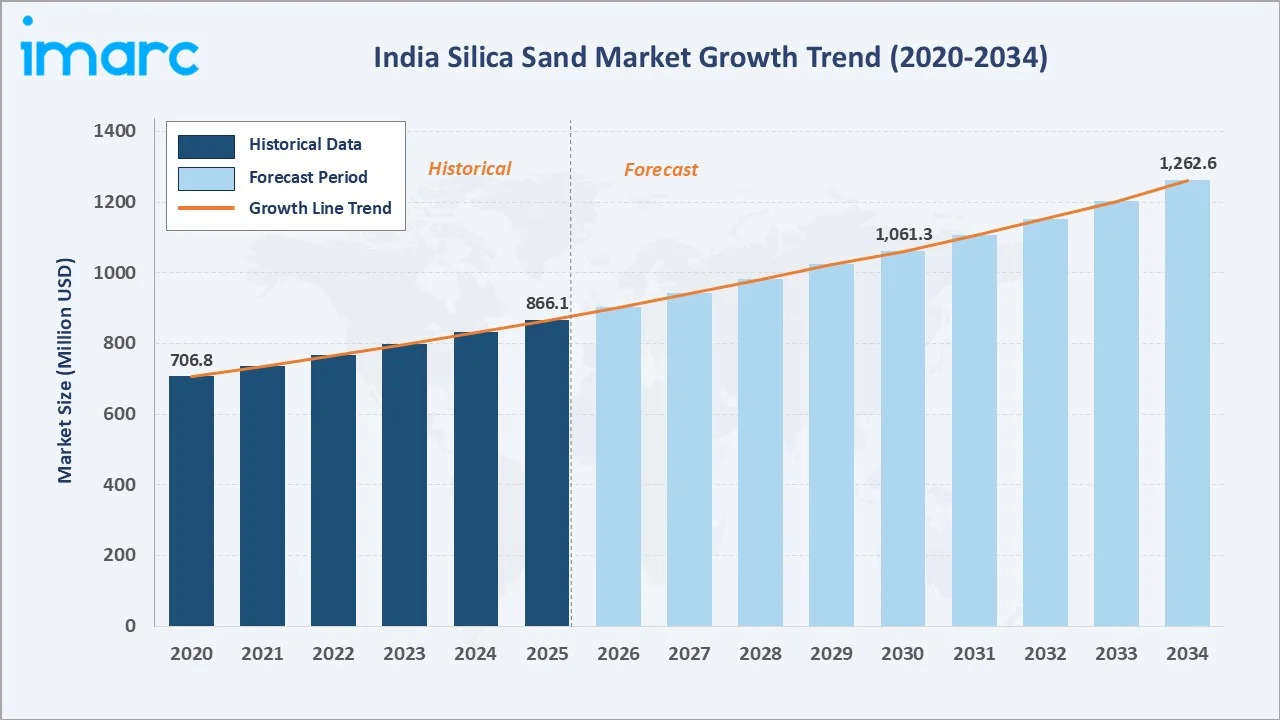
The India silica sand market reached USD 866.1 Million in 2025 and is projected to reach USD 1,262.6 Million by 2034, growing at a CAGR of 4.15% during 2026-2034. The market is driven by rising demand from the glass industry linked to construction and solar energy expansion and expanding water filtration infrastructure investment. India exported approximately 395,923 kg of silica and quartz sands in 2024, with an export value of around USD 63.88 thousand. Growing export opportunities can encourage producers to improve product quality, expand beneficiation capacity, and serve higher-value applications such as glass manufacturing, foundry operations, construction materials, and industrial processing, thereby supporting growth in the India silica sand market. The glass industry leads end use at 39.8%. West and Central India leads regionally at 36.9%.
Market Snapshot
|
Metric |
Value |
|
Market Size (2025) |
USD 866.1 Million |
|
Forecast Market Size (2034) |
USD 1,262.6 Million |
|
CAGR (2026-2034) |
4.15% |
|
Base Year |
2025 |
|
Historical Period |
2020-2025 |
|
Forecast Period |
2026-2034 |
|
Dominant End Use |
Glass Industry (39.8%, 2025) |
|
Leading Region |
West and Central India (36.9%, 2025) |
The India silica sand market has demonstrated steady growth, increasing from USD 706.8 Million in 2020 to USD 866.1 Million in 2025, reflecting consistent industrial demand across glass, foundry, and filtration applications. The market is projected to reach USD 1,061.3 Million by 2030 and further grow to USD 1,262.6 Million by 2034, supported by India's booming construction sector, solar glass manufacturing under the National Solar Mission, and expanding oil and gas sector hydraulic fracturing operations.
To get more information on this market, Request Sample
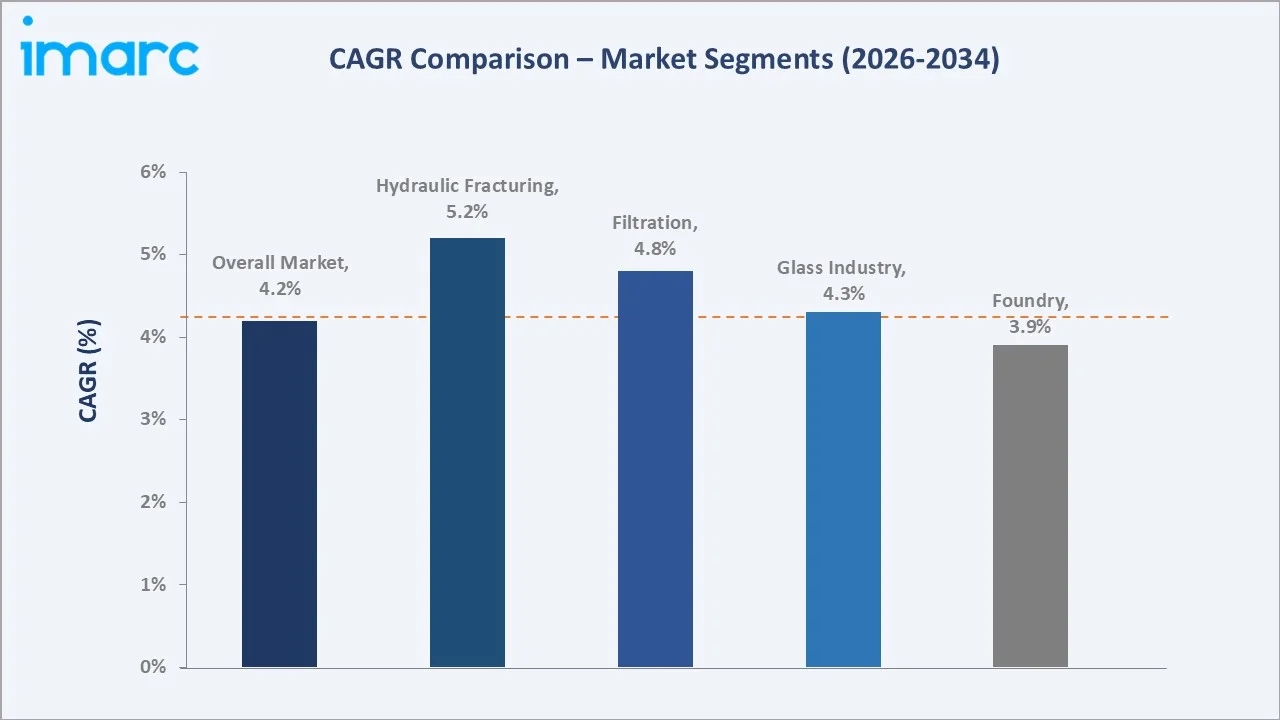
Hydraulic fracturing is growing fastest with a CAGR of ~5.2% through expanding domestic oil and gas exploration activity. Filtration grows at ~4.8% CAGR through Jal Jeevan Mission and water treatment infrastructure investment. The glass industry grows at ~4.3% CAGR through solar glass and construction glass demand expansion.
Executive Summary
The India silica sand market is witnessing steady growth, supported by robust demand from the glass manufacturing industry, driven by the construction sector's structural growth and India's ambitious solar energy expansion targets, growing foundry sector requirements under the Make in India initiative, and expanding water treatment filtration infrastructure under Jal Jeevan Mission. India's vast silica sand reserves provide a significant competitive advantage in production cost relative to import-dependent peers, while progressive mining sector reforms are improving production organization and quality standards. The glass industry leads at 39.8% through construction and solar glass dominance. West and Central India leads at 36.9% through Rajasthan and Gujarat mining concentration.
Key Market Insights
|
Insight |
Data |
|
Dominant End Use |
Glass Industry – 39.8% share (2025) |
|
Leading Region |
West and Central India – 36.9% share (2025) |
|
Market Opportunity |
High-purity silica for solar glass; semiconductor-grade silica; Jal Jeevan Mission filtration demand; O&G hydraulic fracturing proppant; export market development for processed silica |
Key Analytical Observations Supporting the Above Data:
- Glass Industry at 39.8%: Glass manufacturing dominates silica sand consumption as it is the primary raw material for flat glass (used in construction and automotive glazing), container glass (bottles, jars), and specialty glass (solar panels, laboratory glass). India's construction sector boom, rapid urban housing development, and the government's ambitious solar panel manufacturing targets under the PLI scheme for solar modules are driving strong and sustained glass manufacturing expansion, directly increasing silica sand demand from this largest end-use segment.
- West and Central India at 36.9%: West and Central India leads due to Rajasthan's status as India's largest silica sand producing state combined with Gujarat's significant silica sand deposits and both states' proximity to glass and ceramic manufacturing clusters.
India Silica Sand Market Overview
The India silica sand market encompasses the mining, beneficiation, processing, and supply of high-silica content sand for industrial applications across glass manufacturing, foundry metal casting, hydraulic fracturing, water filtration, abrasives, and other applications. The market covers diverse silica sand grades from standard industrial grade through high-purity grades required for solar glass and semiconductor applications. India's silica sand industry operates across mining and quarrying operations, primary beneficiation (washing, desliming), secondary processing (drying, sizing, magnetic separation), and distribution to end-use industries.
Market Dynamics
To evaluate market opportunities, Request Sample
Market Drivers
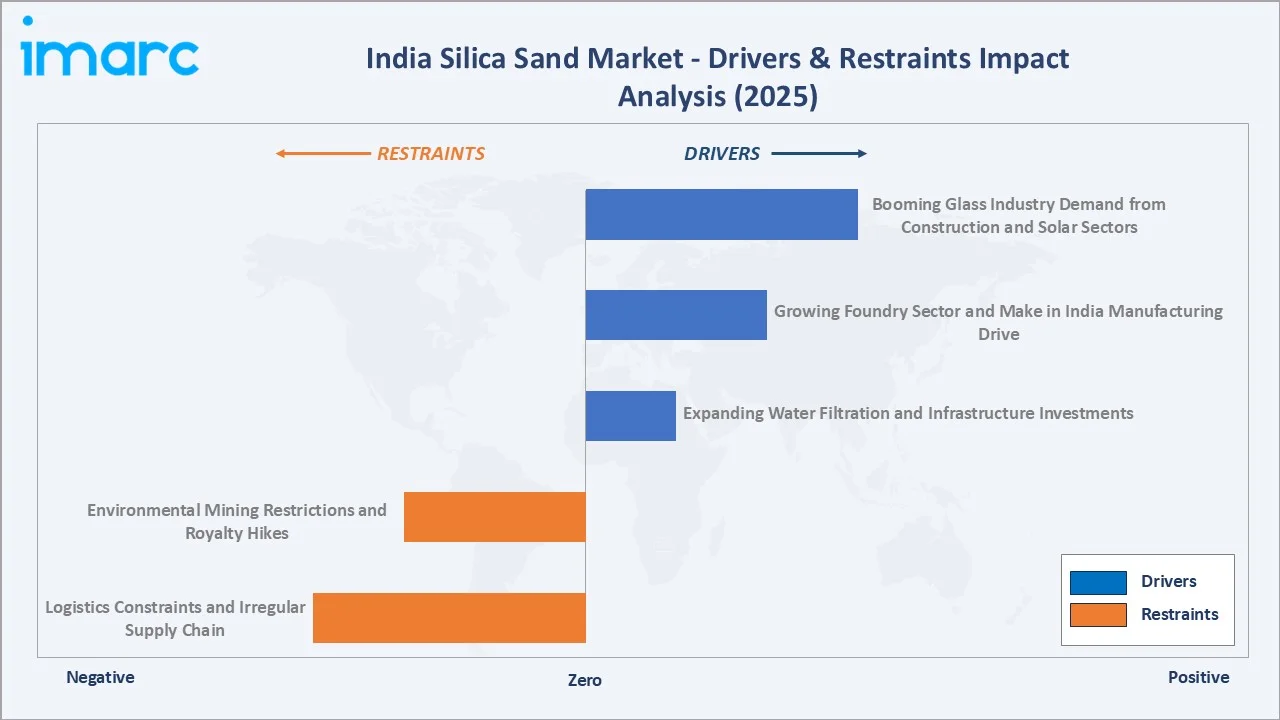
- Booming Glass Industry Demand from Construction and Solar Sectors: India’s per capita glass consumption stands at approximately 1.4 kg for container glass, primarily used in bottles and jars, and around 0.8 kg for flat glass, which is widely utilized in the construction and automotive sectors. Rising consumption of container and flat glass is increasing demand for high-purity silica sand, a key raw material used in glass manufacturing. Simultaneously, India's solar power capacity addition target of 500 GW by 2030 is creating significant demand for solar-grade silica sand suitable for photovoltaic glass manufacturing.
- Growing Foundry Sector and Make in India Manufacturing Drive: India's foundry industry consumes silica sand as the primary mold-making material for metal casting. Growing automotive component manufacturing, capital goods production, and defense manufacturing are driving foundry sector expansion. India's PLI schemes across automotive, electronics, and industrial machinery sectors are creating consistent incremental silica sand demand from the foundry segment.
- Expanding Water Filtration and Infrastructure Investments: Since the launch of the Jal Jeevan Mission (JJM), more than 12.68 crore additional rural households have received tap water connections, requiring significant water treatment infrastructure, including sand filtration systems that consume industrial-grade silica sand. India's growing urban water treatment plants, industrial effluent treatment requirements, and swimming pool filtration market are creating diverse filtration-grade silica sand demand across multiple infrastructure investment programs.
Market Restraints
- Environmental Mining Restrictions and Royalty Hikes: State government restrictions on silica sand mining, driven by environmental concerns including dust, water table depletion, and land degradation, have led to periodic mining suspensions and increased compliance requirements across major producing states. Royalty rate increases have increased production costs for organized miners, while informal operations continue outside the regulatory framework.
- Logistics Constraints and Irregular Supply Chain: Silica sand is a bulk commodity with a relatively low value-to-weight ratio, making transportation costs a significant proportion of delivered cost to end users. Limited rail connectivity to key mining areas, road weight restrictions during monsoon season, and inadequate loading infrastructure at mining sites create supply chain bottlenecks that disrupt reliable delivery to glass manufacturers and foundry clients with production schedule requirements.
Market Opportunities
- High-Purity Silica for Solar Glass and Semiconductor Applications: India's National Solar Mission and PLI-linked solar module manufacturing capacity additions create significant demand for high-purity silica sand suitable for photovoltaic glass manufacturing. Additionally, India's semiconductor mission targeting domestic chip fabrication requires ultra-high-purity silica for quartz crucibles, silicon carbide substrates, and other semiconductor process consumables. These premium applications command price multiples over standard glass-grade silica, creating significant revenue opportunity for producers investing in beneficiation technology upgrades.
- Silica Sand for Construction and Sports Turf Applications: India's rapid urban infrastructure expansion, growing sports facility development, and expanding golf course construction are creating new silica sand consumption categories, including concrete admixtures, artificial turf infill material, and golf course bunker sand, each requiring specific grain size and purity characteristics that organized processors can supply at premium pricing relative to construction-grade bulk material.
Market Challenges
- Informal Sector Competition and Price Undercutting: India's silica sand market includes a large informal quarrying sector operating without mining leases, environmental clearances, or royalty compliance, enabling significantly lower operating costs that undercut organized sector pricing in regional markets. Informal sector competition limits organized producers' ability to command quality premiums in price-sensitive foundry and construction glass markets where procurement managers prioritize delivered cost over certification.
- Quality Consistency and Beneficiation Technology Limitations: Many Indian silica sand producers operate without advanced beneficiation equipment required to consistently achieve the purity specifications demanded by glass, frac sand, and high-tech application buyers. Quality variability between production batches limits Indian silica sand's competitive positioning in premium markets that maintain tighter SiO₂ content and grain size distribution specifications.
Emerging Market Trends
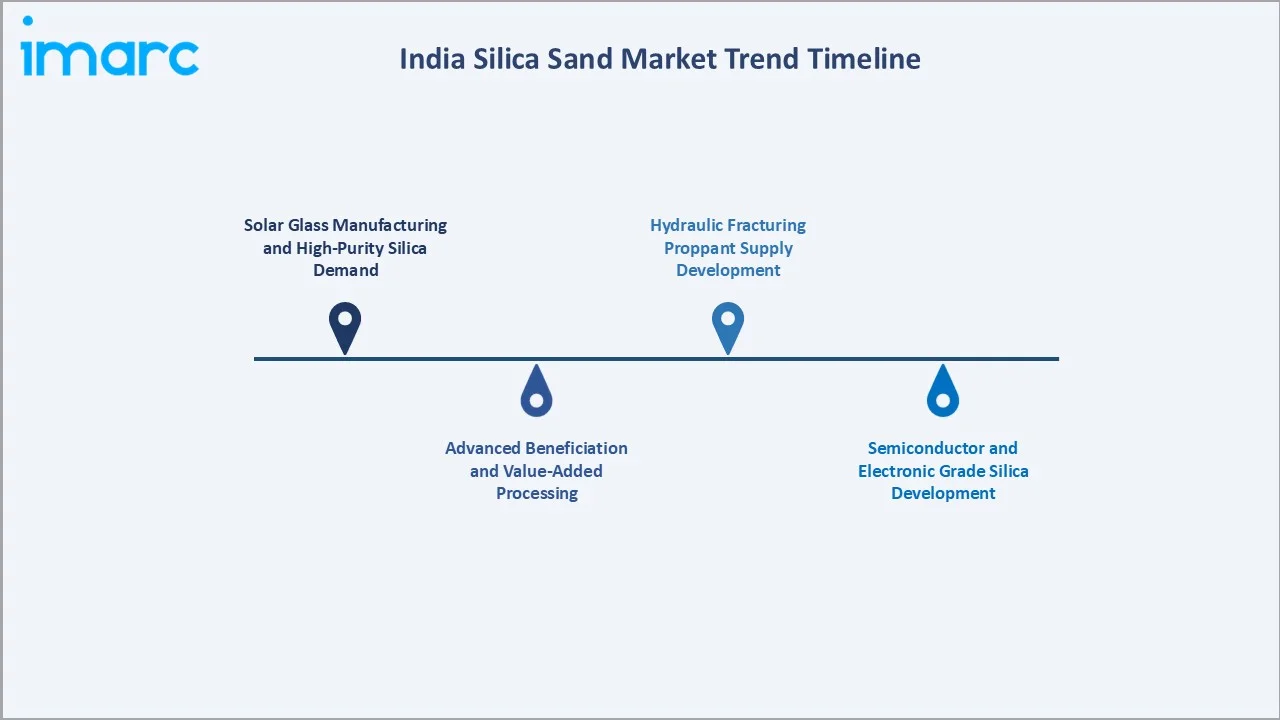
1. Solar Glass Manufacturing and High-Purity Silica Demand
India's solar energy capacity addition target and PLI-linked solar module manufacturing expansion are creating structural demand for solar-grade silica sand with >99% SiO₂ content, low iron, and specific grain size distribution suitable for photovoltaic glass. Producers are investing in advanced magnetic separation, flotation, and acid leaching beneficiation to produce solar-grade quality from existing deposits, positioning India to supply growing domestic solar glass manufacturing requirements currently served partly by imports.
2. Advanced Beneficiation and Value-Added Processing
Leading Indian silica sand producers are investing in advanced beneficiation technology to produce premium-grade silica sand products commanding price premiums over run-of-mine material. In June 2026, Puresil India commissioned India’s first fully integrated vertical processing facility for high-purity silica sand and kaolin, with an annual production capacity of 450,000 tonnes. The plant uses advanced beneficiation, washing, classification, magnetic separation, and drying technologies to produce low-iron, ultra-high-purity materials.
3. Hydraulic Fracturing Proppant Supply Development
Unconventional well stimulation programs and private block operators' hydraulic fracturing activity are creating demand for domestic frac-grade silica sand proppant that currently depends partly on imported material. Indian silica sand deposits have proppant-quality silica potential that producers are beginning to develop through crush-strength testing, grain sphericity analysis, and API specification compliance investment, creating an opportunity to displace imported proppant with domestic supply.
4. Semiconductor and Electronic Grade Silica Development
India's National Semiconductor Mission targeting domestic chip fabrication under the CHIPS-like incentive structure creates long-term demand for ultra-high-purity quartz and silica products, including high-purity silica powder for quartz glass crucibles, silica tube manufacture, and advanced ceramics used in semiconductor fabrication equipment. While current domestic production of semiconductor-grade silica is limited, the mission creates strategic long-term development opportunities for producers willing to invest in advanced purification technology to meet purity specifications.
Industry Value Chain Analysis
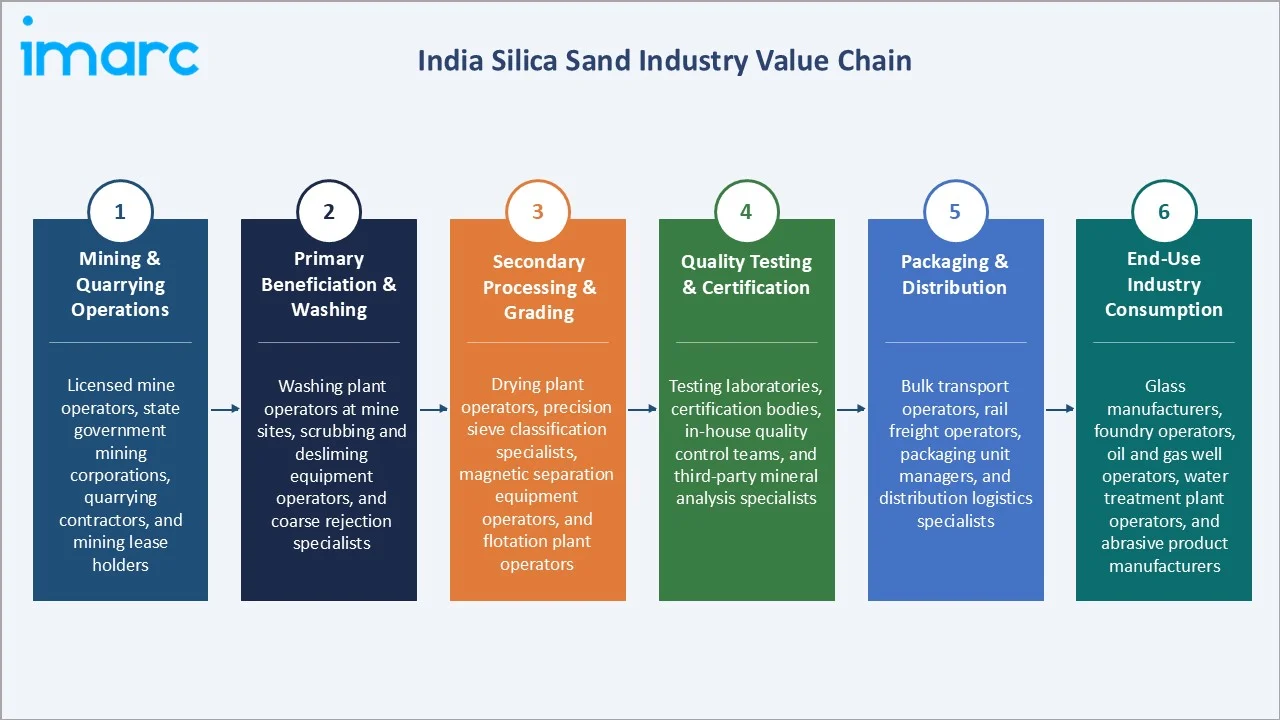
The India silica sand market value chain integrates mining and quarrying operations, primary beneficiation and washing, secondary processing and grading, quality testing and certification, packaging and distribution, and end-use industry consumption.
|
Stage |
Key Participants |
|
Mining & Quarrying Operations |
Licensed mine operators, state government mining corporations, quarrying contractors, and mining lease holders. |
|
Primary Beneficiation & Washing |
Washing plant operators at mine sites, scrubbing and desliming equipment operators, and coarse rejection specialists. |
|
Secondary Processing & Grading |
Drying plant operators, precision sieve classification specialists, magnetic separation equipment operators, and flotation plant operators. |
|
Quality Testing & Certification |
Testing laboratories, certification bodies, in-house quality control teams, and third-party mineral analysis specialists. |
|
Packaging & Distribution |
Bulk transport operators, rail freight operators, packaging unit managers, and distribution logistics specialists. |
|
End-Use Industry Consumption |
Glass manufacturers, foundry operators, oil and gas well operators, water treatment plant operators, and abrasive product manufacturers. |
Secondary processing and grading represent the most value-added stage in the India silica sand value chain, as it directly determines product purity, grain size consistency, and suitability for premium applications including solar glass, frac sand, and filtration grades. Investment in this stage through advanced beneficiation equipment is the primary source of competitive differentiation among organized producers.
Technology Landscape in the India Silica Sand Industry
Beneficiation and Processing Technology
Modern silica sand beneficiation in India is evolving from simple washing and screening toward multi-stage processes including hydraulic classification, high-shear scrubbing, froth flotation for feldspar and clay removal, wet high-intensity magnetic separation for iron oxide reduction, and controlled drying. Advanced beneficiation enables producers to upgrade standard-grade deposits to glass, solar, or frac sand specifications, multiplying product value without requiring new mining sites.
Quality Assurance and Testing Technology
X-ray fluorescence (XRF) analysis for rapid SiO₂ and contaminant quantification, automated particle size analysis systems, grain shape measurement for frac sand roundness and sphericity, and acid solubility testing are increasingly standard quality assurance tools at organized Indian silica sand processing plants. Accredited laboratories provide third-party certification against customer-specific specifications that enable organized producers to differentiate from informal sector competitors on verifiable quality credentials.
Environmental Management Technology
Water recycling systems at silica sand washing plants are being adopted by leading producers under state pollution control board directives. Dust suppression systems, including wet scrubbers, enclosed conveyors, and mine site water sprinklers, are mandatory at organized operations under environmental clearance conditions. Mined land reclamation programs and progressive rehabilitation plans are increasingly required components of environmental impact assessments for new silica mining lease applications.
Market Segmentation Analysis
The report covers the following segments:
|
Segment Category |
Leading Segment |
Market Share |
Year |
|
End Use |
Glass Industry |
39.8% |
2025 |
|
Region |
West and Central India |
36.9% |
2025 |

By End Use
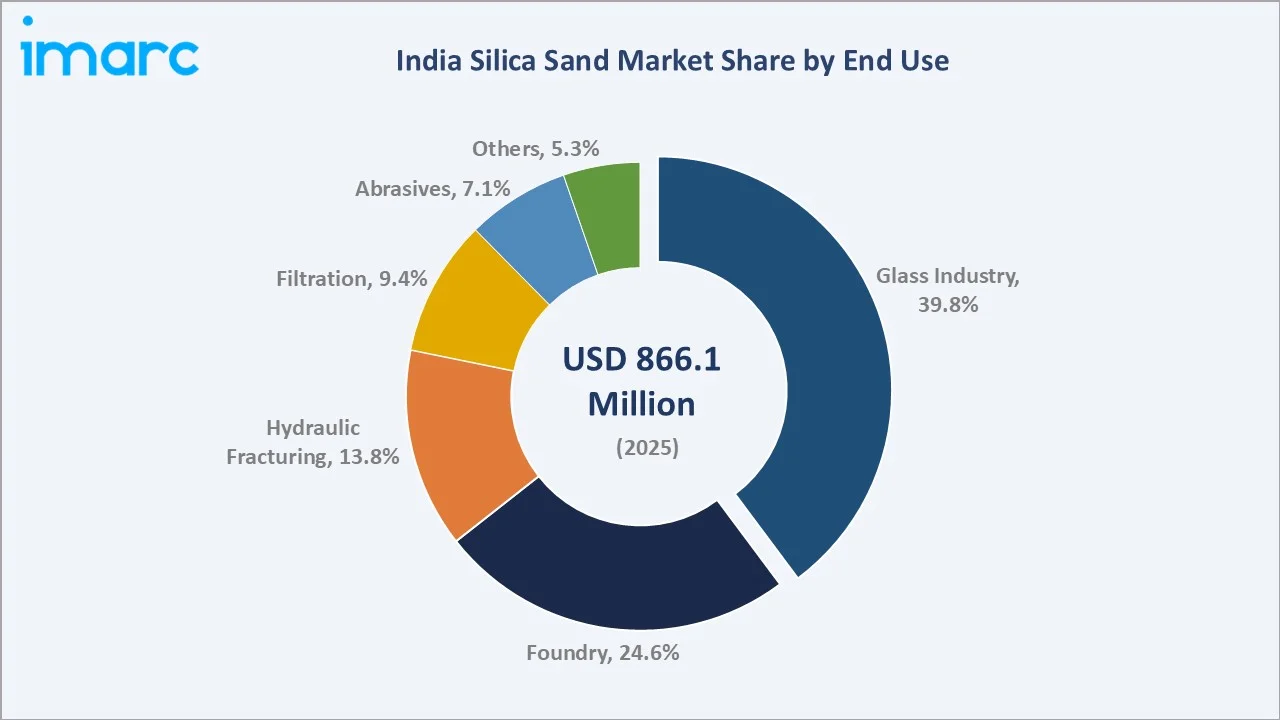
Glass industry leads at 39.8% (2025), reflecting silica sand's role as the primary raw material for flat, container, and specialty glass manufacturing. India's construction glass demand, driven by rapid urbanization and real estate development, and solar glass requirements for photovoltaic panel manufacturing collectively drive this dominant end-use segment.
To access detailed market analysis, Request Sample
Foundry holds 24.6%, consuming silica sand as the primary mold-making material for iron, steel, and non-ferrous metal casting. Hydraulic fracturing accounts for 13.8%, growing fastest at 5.2% CAGR through expanding O&G exploration. Filtration represents 9.4%, abrasives 7.1%, and others 5.3%.
Regional Market Insights
|
Region |
Share (2025) |
Key India Silica Sand Market Drivers & Characteristics |
|
West & Central India |
36.9% |
Largest market driven by Rajasthan's dominant silica sand reserves and production base and Gujarat's significant silica deposits and glass and ceramic manufacturing clusters. |
|
North India |
27.8% |
Major market anchored by Uttar Pradesh's foundry industry and Firozabad's glass bangle and glassware manufacturing cluster. |
|
South India |
21.6% |
Significant market driven by Andhra Pradesh and Telangana's silica sand deposits, Tamil Nadu's glass and ceramic industry, and Karnataka's growing construction sector. |
|
East & Northeast India |
13.7% |
Emerging market with growing construction sector demand in West Bengal and Odisha and Jharkhand's mineral-rich geology supporting silica extraction. |
West and Central India's 36.9% dominance is underpinned by Rajasthan's unrivaled silica sand reserve base combined with Gujarat's well-developed glass and ceramic manufacturing ecosystem, creating both supply (mining) and demand (consumption) concentration. North India's 27.8% reflects the Firozabad glass cluster's massive consumption requirements, supplemented by Uttar Pradesh and Madhya Pradesh's foundry and construction sectors.
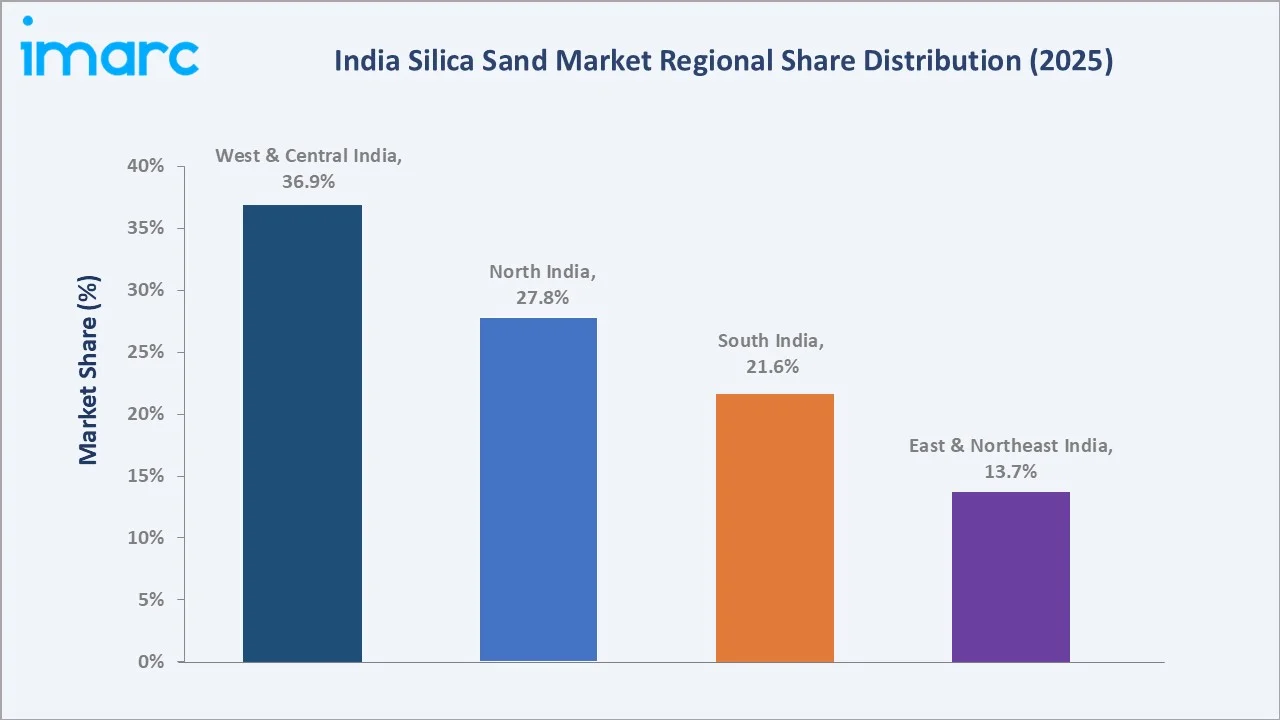
South India at 21.6% is driven by Andhra Pradesh and Telangana's significant silica sand deposits supporting glass and construction sectors, while the region's oil and gas exploration activity creates growing demand for premium frac-grade silica. East and Northeast India at 13.7% represents the highest-growth region, with Odisha and West Bengal's rapid industrialization and construction activity.
Competitive Landscape
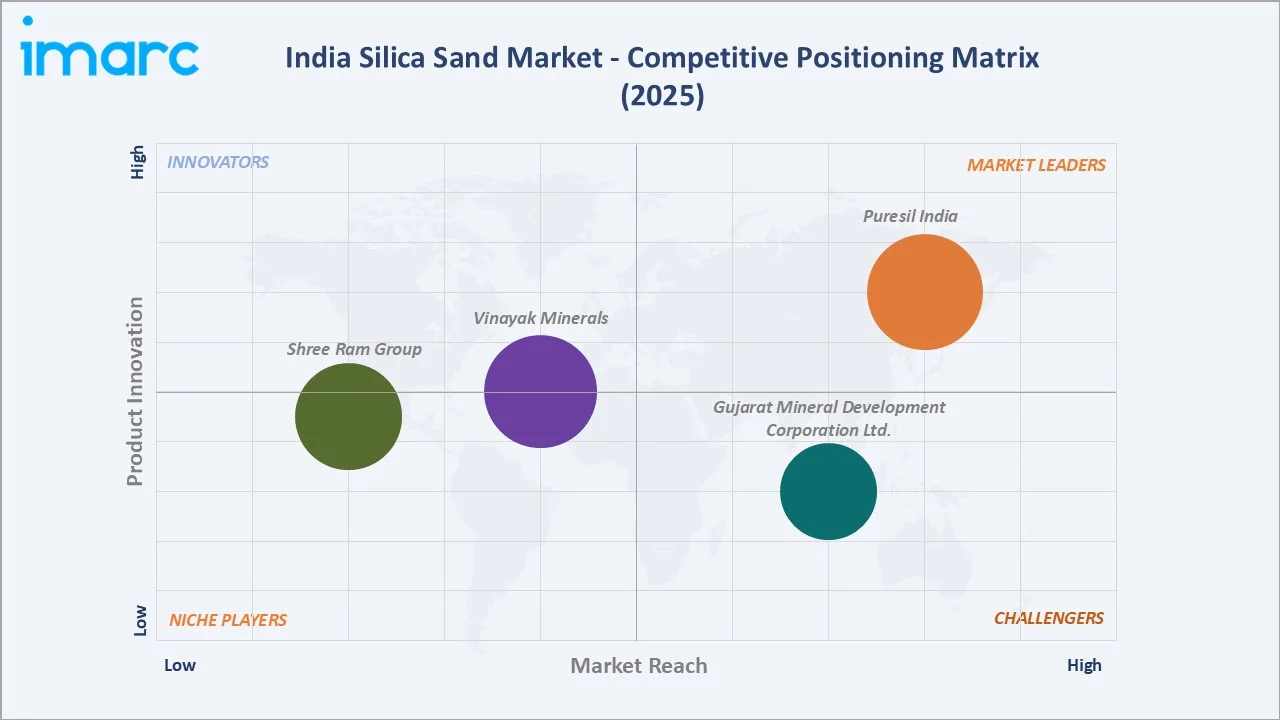
The India silica sand market is highly fragmented, with a large number of small-scale and medium-scale mining and processing operators coexisting alongside a small number of organized producers with advanced beneficiation capability and quality certification credentials. Market participants compete on silica purity grades, grain size consistency, delivery reliability, compliance certification, and pricing relative to unorganized sector alternatives.
|
Company |
Key Products |
Market Position |
Core Strength |
|
Puresil India |
High-Purity Silica Sand |
Market Leader |
Puresil India plays a transformative role in the Indian silica sand industry by operating the country's first fully integrated vertical processing plant. |
|
Vinayak Minerals |
Raw Silica Sand |
Established Player |
Vinayak Minerals plays a key role as a manufacturer, supplier, and exporter of industrial-grade silica sand and quartz sand in India. |
|
Shree Ram Group |
Silica Sand |
Established Player |
The Shree Ram Group (operating as Shree Ram Kaolin and Shree Ram Minerals) plays a major role in the Indian silica sand and industrial minerals industry. |
|
Gujarat Mineral Development Corporation Ltd. |
Silica Sand |
Challenger |
GMDC's silica sand reserves are primarily located at Rajpardi in the Bharuch district of Gujarat, which is one of the state's key mineral belts. |
Companies are also investing in advanced beneficiation technology, quality certifications, and logistics infrastructure to differentiate from informal sector competition. The market is expected to see progressive consolidation as mining sector reforms increase compliance requirements, and as premium-grade silica demand rewards organized producers with consistent quality capability.
Key Company Profiles
Puresil India
Puresil India is an India-based industrial minerals company engaged in the processing and supply of high-purity silica sand and related mineral products. In the India silica sand market, the company serves applications such as glass manufacturing, foundry, construction, and specialty industrial processing, with a focus on consistent quality and advanced mineral beneficiation.
- Key Products: High-Purity Silica Sand.
- Key Developments: In June 2026, Puresil India commissioned India’s first fully integrated vertical processing facility for high-purity silica sand and kaolin, with an annual production capacity of 450,000 tonnes. The plant incorporates beneficiation, washing, classification, magnetic separation, and drying systems to produce low-iron, ultra-high-purity materials.
- Strategic Focus: Focuses on high-purity and consistently graded silica sand for value-added applications such as solar glass, architectural glass, container glass, ceramics, and foundries. Its strategy emphasizes advanced beneficiation and vertical processing, customized grades, stringent in-house quality control, and large-scale supply capabilities, while expanding its presence across domestic and export markets.
Vinayak Minerals
Vinayak Minerals is an India-based industrial minerals supplier engaged in the processing and distribution of silica sand, quartz, and related mineral products. In the India silica sand market, the company serves sectors such as glass, foundry, construction, ceramics, and other industrial applications, with a focus on consistent quality and application-specific grades.
- Key Products: Raw Silica Sand.
- Strategic Focus: Focuses on raw silica sand, quartz sand, and quartz powder tailored to specific industrial requirements. Its strategy emphasizes product customization, consistent quality, reliable delivery, and application-specific mineral solutions, supported by processing infrastructure and quality-control capabilities.
Market Concentration Analysis
The India silica sand market is highly fragmented, with registered mining lease holders and significantly more informal operators contributing to total national production. Organized sector producers are defined as those with valid mining leases, environmental clearances, beneficiation facilities, and quality certifications, with the remainder produced and sold through informal, semi-organized channels. Market consolidation is expected to accelerate as mining sector regulatory enforcement strengthens, as premium glass and solar glass manufacturers demand quality certifications that informal producers cannot provide, and as economies of scale in beneficiation technology investment favor larger organized operators. State mineral corporations are also expanding their share of organized production through government reserve development programs.
Investment & Growth Opportunities
Highest Growth Segments
Hydraulic fracturing silica (~5.2% CAGR through O&G sector expansion), filtration-grade silica (~4.8% CAGR through Jal Jeevan Mission infrastructure), high-purity solar glass silica (~6%+ CAGR from emerging semiconductor mission base), South India and East India regional market expansion, and processed silica export development represent the highest-growth investment vectors through 2034.
Investment Themes
- High-purity beneficiation for solar glass and semiconductor applications: Investment in magnetic separation, froth flotation, and acid leaching beneficiation to produce solar-grade silica sand positions producers to supply India's rapidly growing solar module manufacturing sector and nascent semiconductor industry at commodity price multiples, creating high-margin product streams from existing high-quality reserve bases.
- Frac-grade silica development for domestic O&G supply: Domestic production of API-specification frac-grade proppant creates an import substitution opportunity with a significant price premium over industrial-grade silica. Producers with access to high-roundness, high-crush-strength silica deposits and willingness to invest in the required quality testing and certification infrastructure can capture growing domestic O&G sector demand.
Future Market Outlook (2026-2034)
The India silica sand market is projected to grow from USD 866.1 Million in 2025 to USD 1,262.6 Million by 2034, delivering a 4.15% CAGR over the forecast period through rising glass industry demand linked to construction and solar energy expansion, growing foundry sector under Make in India manufacturing programs, expanding water filtration infrastructure investment, and increasing hydraulic fracturing activity in India's oil and gas sector. The market's anchor value of USD 1,061.3 Million in 2030 represents India's silica sand ecosystem at an organized sector maturation inflection and premium-grade beneficiation mainstream adoption across the organized producer base.
Three structural forces are expected to define the growth of the India silica sand market through 2034. First, India's sustained construction sector growth will continue to be the primary demand driver for glass and construction-grade silica sand, supplemented by solar energy expansion requiring solar glass-grade silica and the automotive sector's growing flat glass requirements, collectively maintaining the Glass Industry and related end-use segments as the market's largest and most growth-stable consumption base. Second, the progressive formalization and consolidation of India's fragmented silica sand mining sector will shift market share from informal to organized producers, enabling price and margin improvement for compliant organized operators. Third, the emergence of high-value specialty silica demand from India's semiconductor mission, solar module manufacturing PLI, and unconventional oil and gas hydraulic fracturing programs will create new premium product segments.
Research Methodology
Primary Research
Primary research comprised in-depth interviews with senior executives from silica sand mining and processing companies, glass manufacturers, foundry operators, oil and gas sector procurement specialists, and water treatment infrastructure developers. Discussions validated market size estimates, assessed demand trends across end-use segments, evaluated competitive dynamics, and provided insights into regulatory developments, quality standard evolution, and long-term growth opportunities in the India silica sand market.
Secondary Research
Secondary research encompassed annual mineral production statistics, geological survey reports on silica sand reserves, state mining department publications, glass and foundry industry association reports, and credible industrial mineral analyst publications. These sources supported demand segment analysis, regional production data, quality standard assessment, and end-use industry growth forecasting across India's silica sand market.
Forecasting Models
Forecasting models were developed using historical market revenue data, end-use industry growth trajectories, infrastructure investment program projections, oil and gas exploration activity forecasts, and macroeconomic indicators. Both supply-side and demand-side approaches were applied and validated through primary expert consultations. Environmental regulation impact scenarios, mining sector formalization trajectories, and premium-grade demand penetration rates were incorporated to generate reliable forecasts through 2034.
India Silica Sand Market Report Coverage:
| Report Features | Details |
|---|---|
| Base Year of the Analysis | 2025 |
| Historical Period | 2020-2025 |
| Forecast Period | 2026-2034 |
| Units | Million USD |
| Scope of the Report | Exploration of Historical Trends and Market Outlook, Industry Catalysts and Challenges, Segment-Wise Historical and Future Market Assessment:
|
| End Uses Covered | Glass Industry, Foundry, Hydraulic Fracturing, Filtration, Abrasives, Others |
| Regions Covered | North India, West and Central India, South India, East and Northeast India |
| Companies Covered | Puresil India, Vinayak Minerals, Shree Ram Group, Gujarat Mineral Development Corporation Ltd., etc |
| Customization Scope | 10% Free Customization |
| Post-Sale Analyst Support | 10-12 Weeks |
| Delivery Format | PDF and Excel through Email (We can also provide the editable version of the report in PPT/Word format on special request) |
Key Benefits for Stakeholders:
- IMARC’s industry report offers a comprehensive quantitative analysis of various market segments, historical and current market trends, market forecasts, and dynamics of the India silica sand market from 2020-2034.
- The research report provides the latest information on the market drivers, challenges, and opportunities in the India silica sand market.
- Porter's five forces analysis assist stakeholders in assessing the impact of new entrants, competitive rivalry, supplier power, buyer power, and the threat of substitution. It helps stakeholders to analyze the level of competition within the India silica sand industry and its attractiveness.
- Competitive landscape allows stakeholders to understand their competitive environment and provides an insight into the current positions of key players in the market.
Frequently Asked Questions About the India Silica Sand Market Report
The India silica sand market reached USD 866.1 Million in 2025, driven by rising glass industry demand from construction and solar sectors, growing foundry applications under Make in India, and expanding water filtration infrastructure. Progressive mining sector formalization and growing premium-grade demand are further supporting market value growth.
The India silica sand market grows at 4.15% CAGR during 2026-2034, reaching USD 1,262.6 Million by 2034. The CAGR reflects steady industrial demand growth, expanding premium-grade silica demand from solar glass and semiconductor applications, and growing hydraulic fracturing activity.
The glass industry leads at 39.8% (2025), driven by India's construction boom requiring flat glass, solar module manufacturing requiring photovoltaic glass, and automotive sector glazing demand. The segment's combination of volume scale and growing solar glass premium demand makes it the dominant and growth-anchoring end-use category.
Hydraulic fracturing leads growth at ~5.2% CAGR (2026-2034), driven by private operator expansion of unconventional oil and gas exploration programs requiring frac-grade proppant silica sand. The segment commands significant price premiums over industrial-grade silica due to strict API specification requirements for crush strength, roundness, and sphericity.
West and Central India lead at 36.9% (2025), anchored by Rajasthan's dominance as India's largest silica sand-producing state with vast high-quality deposits, combined with Gujarat's significant silica reserves and both states' proximity to major glass and ceramic manufacturing clusters.
Leading companies include Puresil India, Vinayak Minerals, Shree Ram Group, and Gujarat Mineral Development Corporation Ltd., among others.
The market is projected to reach approximately USD 1,061.3 Million by 2030, representing organized sector maturation and premium-grade beneficiation mainstream adoption. Growth will be anchored by sustained glass industry demand, growing Jal Jeevan Mission filtration infrastructure, and expanding O&G hydraulic fracturing activity.
Priority investment opportunities include high-purity beneficiation technology for solar glass and semiconductor-grade silica at industrial-grade price multiples, frac-grade silica development for domestic O&G proppant supply, processed silica export development targeting Southeast Asian and Middle Eastern buyers, and organized production capacity expansion to displace informal sector supply as regulatory enforcement strengthens.
Need more help?
- Speak to our experienced analysts for insights on the current market scenarios.
- Include additional segments and countries to customize the report as per your requirement.
- Gain an unparalleled competitive advantage in your domain by understanding how to utilize the report and positively impacting your operations and revenue.
- For further assistance, please connect with our analysts.
 Request Customization
 Speak to an Analyst
 Request Brochure
 Inquire Before Buying
Benefits of Customization
- Personalize this research
- Triangulate with your data
- Get data as per your format and definition
- Gain a deeper dive into a specific application, geography, customer, or competitor
- Any level of personalization
Get in Touch With Us
UNITED STATES
Phone: +1-201-971-6302
INDIA
Phone: +91-120-433-0800
UNITED KINGDOM
Phone: +44-753-714-6104
Email: [email protected]
Client Testimonials




.webp)




.webp)













Related Reports

Choose your plan
*Please note that the prices mentioned below are starting prices for each bundle type. Kindly contact our team for further details.*
Single User License
- 1 User License, Access on 2 Devices
- PDF Report + Excel Dataset (Password Protected)
- Lifetime Access
- No Printing Rights
- 10% Free Report Customization
- 10–12 Weeks of Analyst Support
Five User License
- Access for 5 Users, 2 Devices per User
- PDF Report + Excel Dataset (Password Protected)
- Lifetime Access
- Dedicated Account Manager
- 12–14 Weeks of Analyst Support
- No Printing Rights
- 15% Free Report Customization
- 25% Discount on Your Next Purchase
Corporate User License
- Unlimited User Access (Within Your Organization)
- PDF Report + Excel Dataset
- Lifetime Access
- Dedicated Account Manager
- 14–20 Weeks of Analyst Support
- No Printing Rights
- 20% Free Report Customization
- 30% Discount on Your Next Purchase
Essential Insights
What's included:
3 reports
- Lifetime Access
- PDF Reports
- Excel Datasets
- 2 Weeks of Free Analyst Support
- 2 User Licenses
- Access on 2 Devices
- Printing Rights
- Complimentary PowerPoint (PPT) Version
- Complimentary License Upgrade
Professional Access
What's included:
5 reports
- Lifetime Access
- PDF Reports
- Excel Datasets
- 8 Weeks of Free Analyst Support
- 2 User Licenses
- Access on 2 Devices
- Printing Rights
- Complimentary PowerPoint (PPT) Version
- Complimentary License Upgrade
Business Advantage
What's included:
8 reports
- Lifetime Access
- PDF Reports
- Excel Datasets
- 14 Weeks of Free Analyst Support
- 2 User Licenses
- Access on 2 Devices
- Printing Rights
- Complimentary PowerPoint (PPT) Version
- Complimentary License Upgrade
Enterprise Intelligence
What's included:
10 reports
- Lifetime Access
- PDF Reports
- Excel Datasets
- 20 Weeks of Free Analyst Support
- 2 User Licenses
- Access on 2 Devices
- Printing Rights
- Complimentary PowerPoint (PPT) Version
- Complimentary License Upgrade