
India Skincare Market Size, Share, Trends and Forecast by Category, Ingredient Type, Gender, Distribution Channel, and Region, 2026-2034
India Skincare Market Summary:
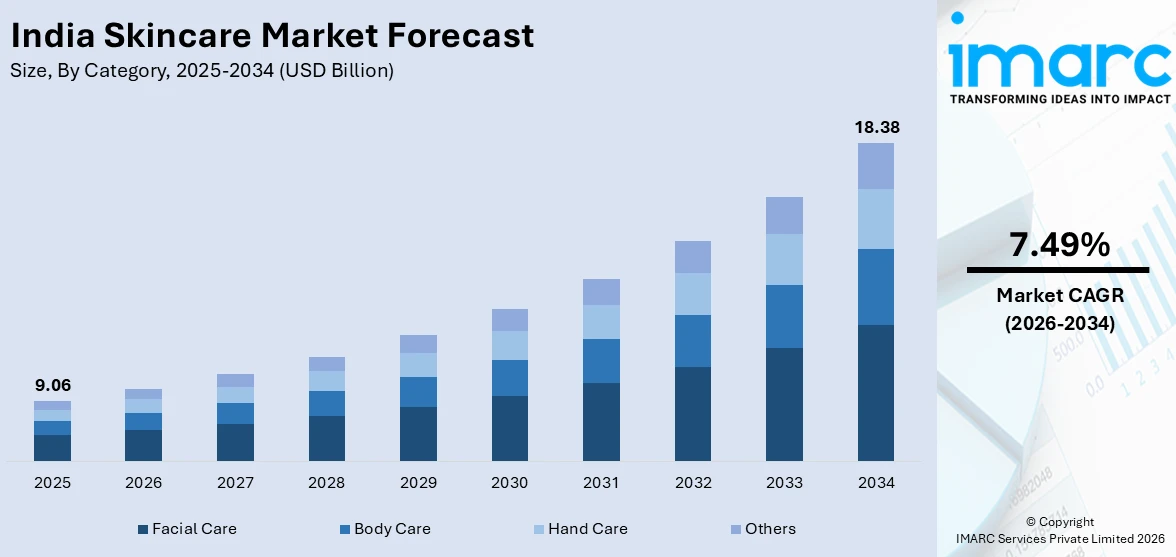
The India skincare market grew from USD 9.06 Billion in 2025 to USD 10.32 Billion in 2026 and is projected to reach USD 18.38 Billion by 2034, growing at a compound annual growth rate of 7.49% during 2026-2034.
The skincare market in India is gaining powerful momentum, driven by a convergence of rising disposable incomes, heightened personal grooming awareness, and deepening user affinity for natural and Ayurvedic formulations. Increasing demand from female users and an emerging male grooming culture are further broadening the addressable market across diverse demographic and geographic segments. The growing influence of social media beauty trends, rapid e-commerce penetration into Tier 2 and 3 cities, and an expanding portfolio of science-backed product offerings are collectively contributing to the India skincare market share.
Key Takeaways and Insights:
- By Category: Facial care leads the market with a share of 42.5% in 2025, fueled by the growing user focus on acne management, pigmentation correction, anti-aging, and hydration, alongside the proliferation of specialized facial serums, moisturizers, and cleansers.
- By Ingredient Type: Natural dominates the market with a share of 61.3% in 2025, reflecting India's deep cultural affinity for herbal and Ayurvedic formulations and a user-driven shift toward clean, toxin-free, and plant-based skincare solutions.
- By Gender: Female represents the largest segment with a market share of 58.4% in 2025, underpinned by higher product adoption rates, a growing self-care culture, and strong preference for targeted anti-aging, brightening, and sun protection formulations among Indian women.
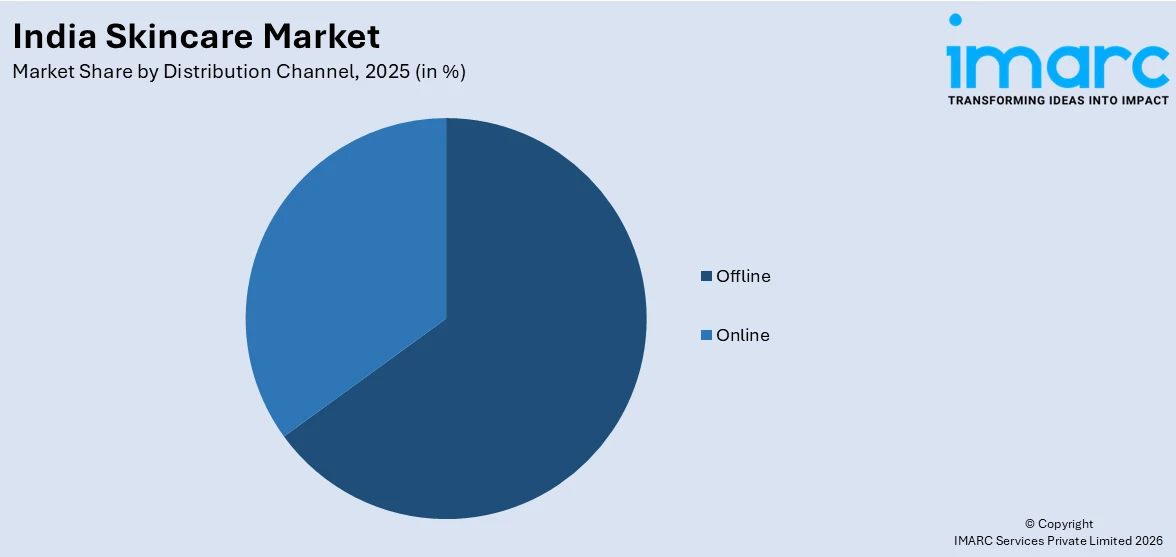
- By Distribution Channel: Offline leads the market with a share of 62.5% in 2025, supported by the broad retail network of pharmacies, supermarkets, specialty beauty stores, and cosmetic outlets that enable in-person product evaluation and trusted brand access.
- By Region: West and Central India dominate the market with a share of 32.6% in 2025, driven by the economic dynamism of Mumbai, Pune, Ahmedabad, and Indore, alongside high urban users purchasing power and cosmopolitan beauty awareness.
- Key Players: The India skincare market features a dynamic competitive landscape of established multinational companies, homegrown Ayurvedic brands, and rapidly scaling science-backed direct-to-consumer (DTC) startups competing across categories, price points, and digital and offline distribution channels.
To get more information on this market Request Sample
The India skincare market is growing steadily due to rising demand for personalized solutions, increasing digital influence, and evolving individual awareness around skin health and appearance. People, especially younger demographics, are seeking products tailored to their specific skin concerns, supported by technology, such as artificial intelligence (AI)-based diagnostics and virtual consultations. The expansion of DTC channels and omni-channel retail is also improving accessibility and engagement, allowing brands to connect more directly with users. In addition, higher disposable incomes and exposure to global beauty trends are encouraging experimentation with new products and routines. Reflecting this shift, in 2025, Naturals Salon launched its D2C skincare brand NXTFACE, targeting younger users with personalized and tech-enabled solutions. The brand offered a range of products supported by AI-based skin analysis and omni-channel distribution across online platforms and salon stores. This move strengthened Naturals’ presence in the skincare segment, tapping into the growing demand for customized and digital-first beauty experiences.
India Skincare Market Trends:
Rising Demand for Therapeutic and Dermatology-Driven Skincare
There is a noticeable shift toward skincare products designed to address specific skin conditions through clinically validated and dermatology-led formulations. People are increasingly prioritizing skin health and seeking solutions that offer both safety and effectiveness. In 2024, Bayer introduced its global brand Bepanthen in India, targeting dry and sensitive skin concerns with science-backed products aligned with user needs and awareness gaps. This trend reflects rising demand for therapeutic skincare that goes beyond cosmetic appeal, with brands focusing on medical credibility, functional benefits, and dermatologist endorsement to differentiate their offerings and cater to evolving individual expectations around skin treatment and care.
Increasing Role of Celebrity Influence in Product Adoption
Celebrity collaborations are playing a significant role in enhancing brand visibility and accelerating product adoption across diverse user groups, particularly in a digitally connected market. Skincare brands are leveraging well-known personalities to build trust, create relatability, and influence purchasing behavior through aspirational appeal. In 2025, Nivea India partnered with Samantha Ruth Prabhu to promote its Luminous Even Glow skincare range, reinforcing product credibility and strengthening brand positioning through a trusted public figure. This trend reflects the growing reliance on influencer-driven marketing strategies, where endorsements validate product effectiveness, amplify reach across platforms, and encourage both trial and repeat purchases in an increasingly competitive and brand-conscious skincare market.
Adoption of Technology-Integrated, High-Performance Skincare
The market is witnessing increasing demand for advanced skincare solutions that combine clinical efficacy with technology-enabled personalization, particularly among urban users seeking targeted treatments. Individuals are showing a clear preference for data-driven, result-oriented products tailored to individual skin concerns and lifestyles. In 2025, GlowBareSkin launched as a science-backed luxury skincare brand offering dermatologist-led formulations alongside AI-driven personalization features, such as skin analysis and rapid delivery services, highlighting this transition. This development underscores the growing importance of precision skincare, where brands integrate digital tools and medical expertise to enhance outcomes, strengthen user confidence, and drive long-term engagement with premium, customized skincare solutions.
Market Outlook 2026-2034:
The India skincare market is poised for sustained growth throughout the forecast period, supported by rising per capita incomes, widening product accessibility, and an increasingly sophisticated user base. The market generated a revenue of USD 9.06 Billion in 2025, which is expected to reach USD 10.32 Billion in 2026 and further grow to USD 18.38 Billion by 2034, at a compound annual growth rate (CAGR) of 7.49% during 2026-2034. Continued innovation in natural and premium formulations, accelerating e-commerce penetration, and the expanding male grooming segment will further diversify the user base and reinforce demand across all categories and regions.

India Skincare Market Report Segmentation:
| Segment Category | Leading Segment | Market Share |
|---|---|---|
|
Category |
Facial Care |
42.5% |
|
Ingredient Type |
Natural |
61.3% |
|
Gender |
Female |
58.4% |
|
Distribution Channel |
Offline |
62.5% |
|
Region |
West and Central India |
32.6% |
Category Insights:
- Body Care
- Facial Care
- Hand Care
- Others
The facial care exhibits a clear dominance with a 42.5% share of the total India skincare market in 2025.
Facial care dominates the market owing to its central role in daily grooming routines and high user awareness around facial appearance. Products such as cleansers, creams, serums, and sunscreens witness frequent usage, supported by rising concerns related to pollution, acne, and premature aging. In 2025, AFFOREST introduced a jackfruit-based skincare range targeting pigmentation and ageing concerns with vitamin-rich botanical ingredients, reflecting growing demand for targeted facial treatments. Additionally, increasing influence of social media, dermatological guidance, and expanding product innovation continues to drive user engagement, repeat purchases, and premiumization within this segment.
The leadership of facial care segment is also supported by the continuous product innovation and expanding individual interest in targeted treatments. The category benefits from a wide range of offerings tailored to specific skin concerns, including hydration, brightening, anti-aging, and sun protection. Urban dwellers, in particular, are adopting advanced skincare formats, such as serums, masks, and exfoliators, boosting category growth. Easy accessibility through online platforms and organized retail further supports product penetration. Moreover, increasing disposable incomes and willingness to invest in personal appearance drive premiumization within facial care, reinforcing its leading position compared to other skincare segments in the country.
Ingredient Type Insights:
- Natural
- Chemical
Natural dominates with a market share of 61.3% of the total India skincare market in 2025.
Natural holds the biggest market share attribute to the increasing user preference for safe, chemical-free, and plant-based formulations. The growing awareness regarding the adverse effects of synthetic ingredients is shifting demand toward products enriched with herbal extracts and traditional ingredients. In 2024, AFFOREST launched India’s first jackfruit-based skincare range targeting pigmentation and ageing concerns using vitamin-rich botanical ingredients, reflecting rising interest in ingredient-led solutions. Additionally, strong influence of Ayurveda and expanding clean-label portfolios among brands continue to reinforce user trust and drive sustained adoption across urban and semi-urban markets.
Natural ingredients continue to dominate the market due to increasing demand for transparency, sustainability, and environmentally responsible products. People are paying closer attention to product labels and sourcing practices, favoring brands that emphasize organic, cruelty-free, and eco-friendly positioning. The rise of digital platforms is increasing awareness around clean beauty trends, accelerating the shift toward natural formulations. Additionally, local brands leveraging traditional knowledge combined with modern science are gaining traction among younger individual. Expanding availability through e-commerce and specialty stores has improved accessibility, while continuous innovation in textures and formulations ensures that natural skincare remains competitive with conventional alternatives in performance and appeal.
Gender Insights:
- Male
- Female
- Unisex
The female leads with a market share of 58.4% of the total India skincare market in 2025.
Female represents the largest segment driven by higher engagement with daily skincare routines and stronger awareness of product benefits across categories. Women actively use a wider range of products, including cleansers, moisturizers, serums, sunscreens, and anti-aging solutions, driving consistent demand. Increasing participation in the workforce and rising disposable incomes have further enabled higher spending on personal care. Additionally, exposure to beauty content through social media, influencers, and digital platforms has enhanced product knowledge and experimentation. Brands also target female users with specialized formulations and marketing campaigns, strengthening loyalty and repeat purchases across both premium and mass skincare segments in India.
Female continues to dominate the market because evolving beauty standards, increased focus on self-care, and the growing demand for targeted skincare solutions. Concerns related to aging, pigmentation, acne, and sun protection encourage regular product usage and category expansion. Urban female users, in particular, are more inclined toward premium and ingredient-based products, including organic and dermatologically tested formulations. The influence of global beauty trends and easy access to international brands through e-commerce platforms further supports adoption. Moreover, product innovation tailored to specific skin types and conditions ensures continued engagement, reinforcing female users as the primary drivers of growth in the industry.
Distribution Channel Insights:
Access the comprehensive market breakdown Request Sample
- Offline
- Online
Offline exhibits a clear dominance with a 62.5% share of the total India skincare market in 2025.
Offline retail channels maintain their commanding position in India's skincare distribution landscape, reflecting the continued importance of physical product discovery, in-person consultation, and tactile evaluation in user purchase decisions. Pharmacies, supermarkets, hypermarkets, specialty beauty stores, and cosmetic outlets collectively provide individuals with immediate product access, transparent packaging review, and real-time assistance from trained staff. Established retail chains in metropolitan areas and the growing modern trade expansion into Tier 2 cities continue to reinforce offline channel dominance across diverse user segments.
The offline channel's dominance is also supported by individual trust built through long-standing brand presence at traditional retail touchpoints. Many Indian skincare users, particularly in semi-urban and rural markets, prefer to purchase products from familiar neighborhood stores and pharmacies where they can seek product recommendations and authenticate product quality. The India Brand Equity Foundation reported that India's organized retail sector is projected to reach INR19,70,870 Crore by 2030, reflecting expanding modern trade infrastructure that reinforces offline channel access for skincare users across the country.
Regional Insights:
- North India
- West and Central India
- South India
- East and Northeast India
West and Central India dominates with a market share of 32.6% of the total India skincare market in 2025.
West and Central India leads the market due to its strong urban base, higher disposable incomes, and early adoption of premium personal care products. Cities, such as Mumbai, Pune, Ahmedabad, and Indore, drive consistent demand across mass and premium segments, supported by organized retail expansion and e-commerce penetration. People in these regions show higher awareness about ingredient-based skincare, sun protection, and anti-aging solutions, leading to higher product turnover. Additionally, the presence of major distribution hubs, marketing channels, and brand headquarters strengthens product availability and visibility, enabling faster launches and deeper market reach compared to other regions.
West and Central India benefit from a well-established network of dermatologists, aesthetic clinics, and salons that actively promote advanced skincare treatments and professional-grade routines. This ecosystem supports higher user awareness and encourages adoption of specialized products. In 2025, Impiana Skincare, a Germany-backed science-led brand, launched in Mumbai, introducing clinically proven, high-performance formulations developed by experienced specialists, reflecting rising demand for globally influenced skincare. Additionally, strong marketing initiatives, increased influencer engagement, and a greater willingness among younger users to experiment with new brands continue to drive sustained product uptake across the region.
Market Dynamics:
Growth Drivers:
Why is the India Skincare Market Growing?
Increasing Preference for Clean and Organic Skincare Products
The market is experiencing growing demand for clean, organic, and toxin-free skincare products driven by heightened awareness about ingredient safety and long-term skin health. People are actively seeking formulations that align with wellness-oriented lifestyles. In line with this, in 2025, KORA Organics re-entered the Indian market through a partnership with Beautindia, launching exclusively on Nykaa. The brand offered certified organic, botanically driven skincare products aligned with rising demand for clean beauty. This move strengthens access to premium, toxin-free skincare in India while tapping into the growing user preference for natural and results-oriented formulations.
Expansion of Affordable, Results-Driven Skincare Offerings
The demand for cost-effective yet performance-oriented skincare is encouraging brands to introduce formulations that deliver visible results without significantly higher price points. People are increasingly prioritizing value-driven products that combine efficacy with affordability, particularly in emerging urban and semi-urban markets. In 2025, Swiss Beauty entered the skincare segment with Swiss Beauty Care, offering science-backed formulations blended with natural ingredients across hydration and brightening categories, reflecting this shift. This trend highlights the growing importance of accessible skincare solutions, where brands aim to broaden their user base by balancing quality and price, intensifying competition and driving innovation within the mid-range skincare segment.
Rising Demand for Ingredient-Centric and Targeted Skincare Solutions
Individuals in India are becoming more informed about product composition, leading to a growing preference for skincare solutions built around specific ingredients and targeted benefits. Transparency, formulation clarity, and efficacy are increasingly influencing purchase decisions, particularly among younger users. In 2024, Cosmus Skincare launched in India with science-backed, holistic formulations designed to address concerns, such as pigmentation, ageing, and acne, reflecting rising demand for tailored skincare solutions. This trend highlights a shift toward ingredient-focused positioning, where brands emphasize active components and proven benefits, enabling people to make more informed choices while driving the demand for specialized and purpose-driven skincare products.
Market Restraints:
What Challenges the India Skincare Market is Facing?
Proliferation of Counterfeit and Substandard Products Undermining User Confidence
The rapid growth of India's skincare market has attracted a parallel proliferation of counterfeit, adulterated, and substandard products circulating through unregulated informal retail channels and unverified online marketplaces. These products pose significant risks to user health and erode trust in branded skincare, particularly among first-time buyers in price-sensitive market segments. The challenge is compounded by inconsistent enforcement of cosmetic quality standards across India's fragmented retail landscape, slowing the broader premiumization of the market.
Price Sensitivity and Affordability Barriers Limiting Premium Segment Penetration
Despite growing individual aspiration for premium and specialized skincare products, price sensitivity remains a significant structural constraint for a substantial portion of India's user base. In lower-income households and rural markets, basic hygiene and soap products continue to take priority over branded skincare formulations. This affordability barrier limits the penetration of higher-margin premium and specialty products and restricts the pace at which mass-market users can upgrade to value-added skincare categories.
Complex Regulatory Landscape Increasing Compliance Burden for Market Participants
India's evolving regulatory framework for cosmetics and personal care products under the Drugs and Cosmetics Act and its subsequent amendments introduces compliance complexities that can slow product launches, increase operational costs, and create market entry barriers for smaller and international brands. Frequent updates to labeling requirements, ingredient restrictions, and testing standards require sustained investment in regulatory affairs capabilities and may delay the introduction of new formulations to the Indian market.
Competitive Landscape:
The India skincare market is characterized by a dynamic and rapidly intensifying competitive landscape, with established multinational corporations, homegrown Ayurvedic and herbal brands, and a new generation of digital-first DTC startups competing across categories, formulations, and price segments. Large incumbents are responding to the rise of science-backed challengers through strategic acquisitions, premium sub-brand launches, and accelerated e-commerce investment. Competitive differentiation is increasingly driven by ingredient transparency, clinical efficacy claims, sustainable packaging, and personalized skincare solutions enabled by artificial intelligence and data analytics. The market's competitive evolution reflects India's emergence as one of the most strategically important beauty markets globally.
Recent Developments:
- February 2026: Nykaa partnered with South Korea’s APR Corporation to launch medicube in India, expanding its Korean skincare portfolio. The brand debuted across Nykaa’s online platform and select offline stores, offering clinically backed, results-driven products. This move strengthens Nykaa’s position as a key entry platform for global K-beauty brands amid rising demand for ingredient-focused skincare in India.
- January 2026: The Ordinary launched on Amazon India’s Luxury Beauty Store, marking its first retail event in Delhi and the first Estée Lauder Companies brand debut on the platform. The event in Gurugram showcased its science-led Prep–Treat–Seal skincare approach through personalized consultations. This launch expands access to ingredient-focused skincare nationwide, supported by Amazon’s premiumization push and strong e-commerce growth in beauty.
India Skincare Market Report Coverage:
| Report Features | Details |
|---|---|
| Base Year of the Analysis | 2025 |
| Historical Period | 2020-2025 |
| Forecast Period | 2026-2034 |
| Units | Billion USD |
| Scope of the Report | Exploration of Historical Trends and Market Outlook, Industry Catalysts and Challenges, Segment-Wise Historical and Future Market Assessment:
|
| Categories Covered | Body Care, Facial Care, Hand Care, Others |
| Ingredient Types Covered | Natural, Chemical |
| Genders Covered | Male, Female, Unisex |
| Distribution Channels Covered | Offline, Online |
| Regions Covered | North India, West and Central India, South India, East and Northeast India |
| Customization Scope | 10% Free Customization |
| Post-Sale Analyst Support | 10-12 Weeks |
| Delivery Format | PDF and Excel through Email (We can also provide the editable version of the report in PPT/Word format on special request) |
Frequently Asked Questions About the India Skincare Market Report
The India skincare market size increased from USD 9.06 Billion in 2025 to USD 10.32 Billion in 2026.
The India skincare market is expected to grow at a compound annual growth rate of 7.49% during 2026-2034 to reach USD 18.38 Billion by 2034.
Facial care holds the largest revenue share of 42.5% in 2025, driven by the growing user focus on targeted skin concerns, premiumization of facial routines, and the proliferation of specialized serums, sunscreens, and treatment products.
Key factors driving the India skincare market include rising demand for clinically effective, personalized solutions supported by technology and data-driven insights. In 2025, GlowBareSkin launched with AI-driven skin analysis and dermatologist-led formulations, reflecting increasing user preference for precision skincare and customized treatment approaches.
Major challenges include the proliferation of counterfeit and substandard products eroding user trust, price sensitivity limiting premium segment penetration in rural and lower-income markets, and a complex and evolving regulatory environment increasing compliance costs for both domestic and international market participants.
Need more help?
- Speak to our experienced analysts for insights on the current market scenarios.
- Include additional segments and countries to customize the report as per your requirement.
- Gain an unparalleled competitive advantage in your domain by understanding how to utilize the report and positively impacting your operations and revenue.
- For further assistance, please connect with our analysts.
 Request Customization
 Speak to an Analyst
 Request Brochure
 Inquire Before Buying
Benefits of Customization
- Personalize this research
- Triangulate with your data
- Get data as per your format and definition
- Gain a deeper dive into a specific application, geography, customer, or competitor
- Any level of personalization
Get in Touch With Us
UNITED STATES
Phone: +1-201-971-6302
INDIA
Phone: +91-120-433-0800
UNITED KINGDOM
Phone: +44-753-714-6104
Email: [email protected]
Client Testimonials




.webp)




.webp)













Related Reports

Choose your plan
*Please note that the prices mentioned below are starting prices for each bundle type. Kindly contact our team for further details.*
Single User License
- 1 User License, Access on 2 Devices
- PDF Report + Excel Dataset (Password Protected)
- Lifetime Access
- No Printing Rights
- 10% Free Report Customization
- 10–12 Weeks of Analyst Support
Five User License
- Access for 5 Users, 2 Devices per User
- PDF Report + Excel Dataset (Password Protected)
- Lifetime Access
- Dedicated Account Manager
- 12–14 Weeks of Analyst Support
- No Printing Rights
- 15% Free Report Customization
- 25% Discount on Your Next Purchase
Corporate User License
- Unlimited User Access (Within Your Organization)
- PDF Report + Excel Dataset
- Lifetime Access
- Dedicated Account Manager
- 14–20 Weeks of Analyst Support
- No Printing Rights
- 20% Free Report Customization
- 30% Discount on Your Next Purchase
Essential Insights
What's included:
3 reports
- Lifetime Access
- PDF Reports
- Excel Datasets
- 2 Weeks of Free Analyst Support
- 2 User Licenses
- Access on 2 Devices
- Printing Rights
- Complimentary PowerPoint (PPT) Version
- Complimentary License Upgrade
Professional Access
What's included:
5 reports
- Lifetime Access
- PDF Reports
- Excel Datasets
- 8 Weeks of Free Analyst Support
- 2 User Licenses
- Access on 2 Devices
- Printing Rights
- Complimentary PowerPoint (PPT) Version
- Complimentary License Upgrade
Business Advantage
What's included:
8 reports
- Lifetime Access
- PDF Reports
- Excel Datasets
- 14 Weeks of Free Analyst Support
- 2 User Licenses
- Access on 2 Devices
- Printing Rights
- Complimentary PowerPoint (PPT) Version
- Complimentary License Upgrade
Enterprise Intelligence
What's included:
10 reports
- Lifetime Access
- PDF Reports
- Excel Datasets
- 20 Weeks of Free Analyst Support
- 2 User Licenses
- Access on 2 Devices
- Printing Rights
- Complimentary PowerPoint (PPT) Version
- Complimentary License Upgrade