
India Smokeless Tobacco Market Size, Share, Trends and Forecast by Type, Form, Route, Distribution Channel, and Region, 2026-2034
India Smokeless Tobacco Market Overview:
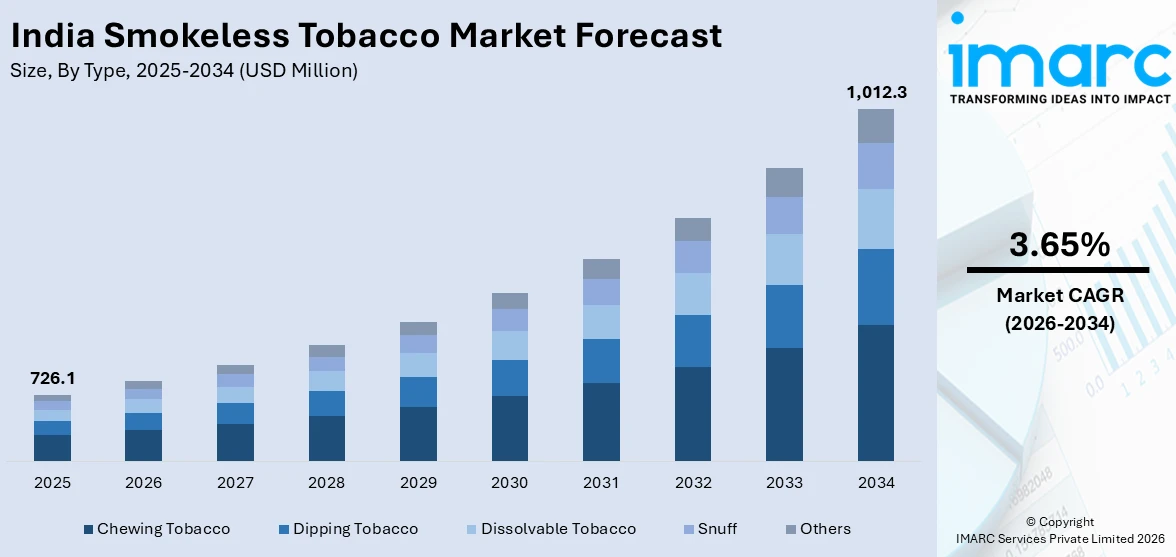
The India smokeless tobacco market size reached USD 726.1 Million in 2025. Looking forward, the market is expected to reach USD 1,012.3 Million by 2034, exhibiting a growth rate (CAGR) of 3.65% during 2026-2034. The market is driven by deep-rooted cultural usage, rising demand in rural areas, and the availability of varied product forms such as khaini, gutka, and pan masala. Despite growing health concerns, affordability and accessibility sustain consumption patterns, shaping the competitive landscape of the India smokeless tobacco market share.
|
Report Attribute
|
Key Statistics
|
|---|---|
|
Base Year
|
2025
|
|
Forecast Years
|
2026-2034
|
|
Historical Years
|
2020-2025
|
|
Market Size in 2025
|
USD 726.1 Million |
|
Market Forecast in 2034
|
USD 1,012.3 Million |
| Market Growth Rate (2026-2034) | 3.65% |
India Smokeless Tobacco Market Trends:
Strong Cultural Acceptance and Traditional Usage
One of the key drivers for the market is its profound cultural penetration and extensive popularity in numerous regions. Products such as khaini, gutka, pan masala, and betel quid have been consumed for decades in a traditional manner and are identified with social and cultural rituals. This deeply ingrained habit maintains vigorous demand, particularly in rural and semi-urban regions where smokeless tobacco is an integral part of daily life. The tradition tends to pass from generation to generation, yet another factor driving consumption. Smokeless forms compare to cigarettes as more inconspicuous and convenient, again enhancing desire. This cultural affinity guarantees that smokeless tobacco demand is constant in the face of increased health concerns and regulatory limitations.
To get more information on this market Request Sample
Affordability and Easy Accessibility
Another key factor supporting India smokeless tobacco market growth is the affordability and widespread availability of smokeless tobacco products across India. These products are typically priced much lower than cigarettes or other smoking alternatives, making them attractive to low and middle-income consumers. Moreover, they are conveniently sold at small shops, kiosks, and roadside stalls, ensuring accessibility even in remote areas. The ready availability of single-use or small sachets makes them cost-effective for daily consumption, which appeals to consumers with limited disposable income. This affordability-driven demand, combined with a vast retail network, ensures that smokeless tobacco continues to penetrate diverse consumer groups. As a result, accessibility and low cost remain strong pillars driving sustained consumption across both urban and rural markets.
Product Variety and Consumer Preference
The wide range of smokeless tobacco products available in India is also a major driver of market growth. Variants such as khaini, gutka, zarda, pan masala with tobacco, and betel quid cater to diverse consumer tastes and regional preferences. Manufacturers continue to introduce flavored and blended options, appealing to younger demographics while maintaining traditional offerings for long-term users. This product diversification allows companies to reach different socio-economic groups, from rural laborers to urban consumers seeking affordable alternatives. Additionally, the convenience of ready-to-use packaged formats has fueled growth, especially among consumers seeking quick and discreet options. By addressing varied consumption patterns and preferences, the industry ensures a sustained customer base, further strengthening the demand for smokeless tobacco in India.

India Smokeless Tobacco Market Segmentation:
IMARC Group provides an analysis of the key trends in each segment of the market, along with forecasts at the country and regional levels for 2026-2034. Our report has categorized the market based on type, form, route, and distribution channel.
Type Insights:
- Chewing Tobacco
- Dipping Tobacco
- Dissolvable Tobacco
- Snuff
- Others
The report has provided a detailed breakup and analysis of the market based on the type. This includes chewing tobacco, dipping tobacco, dissolvable tobacco, snuff, and others.
Form Insights:
- Dry
- Moist
A detailed breakup and analysis of the market based on the form have also been provided in the report. This includes dry and moist.
Route Insights:
- Oral
- Nasal
A detailed breakup and analysis of the market based on the route have also been provided in the report. This includes oral and nasal.
Distribution Channel Insights:
Access the comprehensive market breakdown Request Sample
- Supermarkets and Hypermarkets
- Tobacco Stores
- Online Stores
- Others
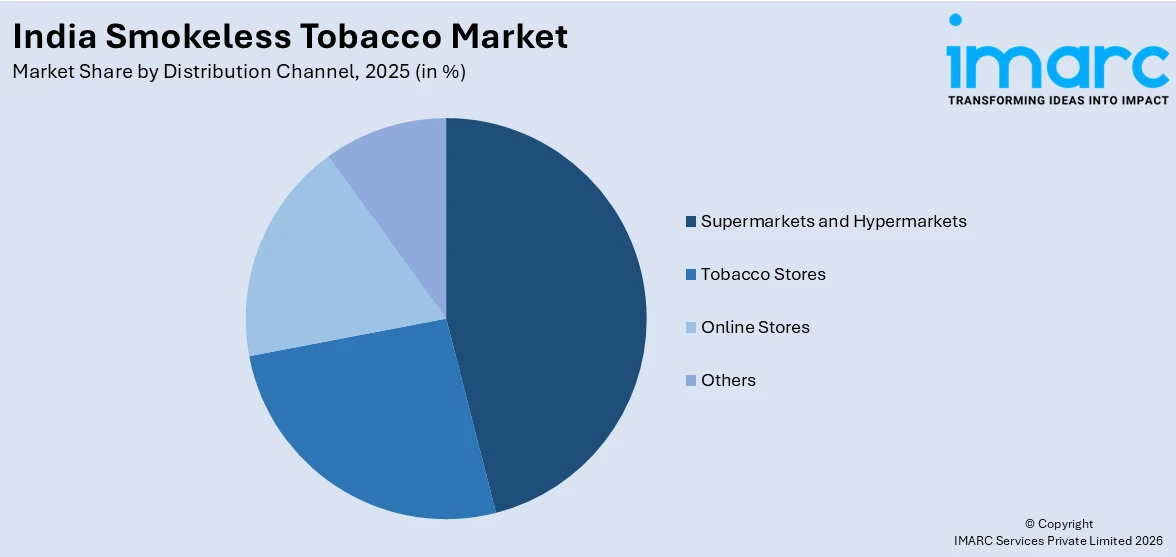
A detailed breakup and analysis of the market based on the distribution channel have also been provided in the report. This includes supermarkets and hypermarkets, tobacco stores, online stores, and others.
Regional Insights:
- North India
- South India
- East India
- West India
The report has also provided a comprehensive analysis of all the major regional markets, which include North India, South India, East India, and West India.
Competitive Landscape:
The market research report has also provided a comprehensive analysis of the competitive landscape. Competitive analysis such as market structure, key player positioning, top winning strategies, competitive dashboard, and company evaluation quadrant has been covered in the report. Also, detailed profiles of all major companies have been provided.
India Smokeless Tobacco Market Report Coverage:
| Report Features | Details |
|---|---|
| Base Year of the Analysis | 2025 |
| Historical Period | 2020-2025 |
| Forecast Period | 2026-2034 |
| Units | Million USD |
| Scope of the Report | Exploration of Historical Trends and Market Outlook, Industry Catalysts and Challenges, Segment-Wise Historical and Future Market Assessment:
|
| Types Covered | Chewing Tobacco, Dipping Tobacco, Dissolvable Tobacco, Snuff, Others |
| Forms Covered | Dry, Moist |
| Routes Covered | Oral, Nasal |
| Distribution Channels Covered | Supermarkets and Hypermarkets, Tobacco Stores, Online Stores, Others |
| Regions Covered | North India, South India, East India, West India |
| Customization Scope | 10% Free Customization |
| Post-Sale Analyst Support | 10-12 Weeks |
| Delivery Format | PDF and Excel through Email (We can also provide the editable version of the report in PPT/Word format on special request) |
Key Questions Answered in This Report:
- How has the India smokeless tobacco market performed so far and how will it perform in the coming years?
- What is the breakup of the India smokeless tobacco market on the basis of type?
- What is the breakup of the India smokeless tobacco market on the basis of form?
- What is the breakup of the India smokeless tobacco market on the basis of route?
- What is the breakup of the India smokeless tobacco market on the basis of distribution channel?
- What is the breakup of the India smokeless tobacco market on the basis of region?
- What are the various stages in the value chain of the India smokeless tobacco market?
- What are the key driving factors and challenges in the India smokeless tobacco market?
- What is the structure of the India smokeless tobacco market and who are the key players?
- What is the degree of competition in the India smokeless tobacco market?
Key Benefits for Stakeholders:
- IMARC’s industry report offers a comprehensive quantitative analysis of various market segments, historical and current market trends, market forecasts, and dynamics of the India smokeless tobacco market from 2020-2034.
- The research report provides the latest information on the market drivers, challenges, and opportunities in the India smokeless tobacco market.
- Porter's five forces analysis assist stakeholders in assessing the impact of new entrants, competitive rivalry, supplier power, buyer power, and the threat of substitution. It helps stakeholders to analyze the level of competition within the India smokeless tobacco industry and its attractiveness.
- Competitive landscape allows stakeholders to understand their competitive environment and provides an insight into the current positions of key players in the market.
Need more help?
- Speak to our experienced analysts for insights on the current market scenarios.
- Include additional segments and countries to customize the report as per your requirement.
- Gain an unparalleled competitive advantage in your domain by understanding how to utilize the report and positively impacting your operations and revenue.
- For further assistance, please connect with our analysts.
 Request Customization
 Speak to an Analyst
 Request Brochure
 Inquire Before Buying
Benefits of Customization
- Personalize this research
- Triangulate with your data
- Get data as per your format and definition
- Gain a deeper dive into a specific application, geography, customer, or competitor
- Any level of personalization
Get in Touch With Us
UNITED STATES
Phone: +1-201-971-6302
INDIA
Phone: +91-120-433-0800
UNITED KINGDOM
Phone: +44-753-714-6104
Email: [email protected]
Client Testimonials




.webp)




.webp)













Related Reports

Choose your plan
*Please note that the prices mentioned below are starting prices for each bundle type. Kindly contact our team for further details.*
Single User License
- 1 User License, Access on 2 Devices
- PDF Report + Excel Dataset (Password Protected)
- Lifetime Access
- No Printing Rights
- 10% Free Report Customization
- 10–12 Weeks of Analyst Support
Five User License
- Access for 5 Users, 2 Devices per User
- PDF Report + Excel Dataset (Password Protected)
- Lifetime Access
- Dedicated Account Manager
- 12–14 Weeks of Analyst Support
- No Printing Rights
- 15% Free Report Customization
- 25% Discount on Your Next Purchase
Corporate User License
- Unlimited User Access (Within Your Organization)
- PDF Report + Excel Dataset
- Lifetime Access
- Dedicated Account Manager
- 14–20 Weeks of Analyst Support
- No Printing Rights
- 20% Free Report Customization
- 30% Discount on Your Next Purchase
Essential Insights
What's included:
3 reports
- Lifetime Access
- PDF Reports
- Excel Datasets
- 2 Weeks of Free Analyst Support
- 2 User Licenses
- Access on 2 Devices
- Printing Rights
- Complimentary PowerPoint (PPT) Version
- Complimentary License Upgrade
Professional Access
What's included:
5 reports
- Lifetime Access
- PDF Reports
- Excel Datasets
- 8 Weeks of Free Analyst Support
- 2 User Licenses
- Access on 2 Devices
- Printing Rights
- Complimentary PowerPoint (PPT) Version
- Complimentary License Upgrade
Business Advantage
What's included:
8 reports
- Lifetime Access
- PDF Reports
- Excel Datasets
- 14 Weeks of Free Analyst Support
- 2 User Licenses
- Access on 2 Devices
- Printing Rights
- Complimentary PowerPoint (PPT) Version
- Complimentary License Upgrade
Enterprise Intelligence
What's included:
10 reports
- Lifetime Access
- PDF Reports
- Excel Datasets
- 20 Weeks of Free Analyst Support
- 2 User Licenses
- Access on 2 Devices
- Printing Rights
- Complimentary PowerPoint (PPT) Version
- Complimentary License Upgrade