
India Soft Drinks Market Size, Share, Trends and Forecast by Product, Distribution Channel, and Region, 2026-2034
India Soft Drinks Market Size, Share, Trends & Forecast (2026-2034)
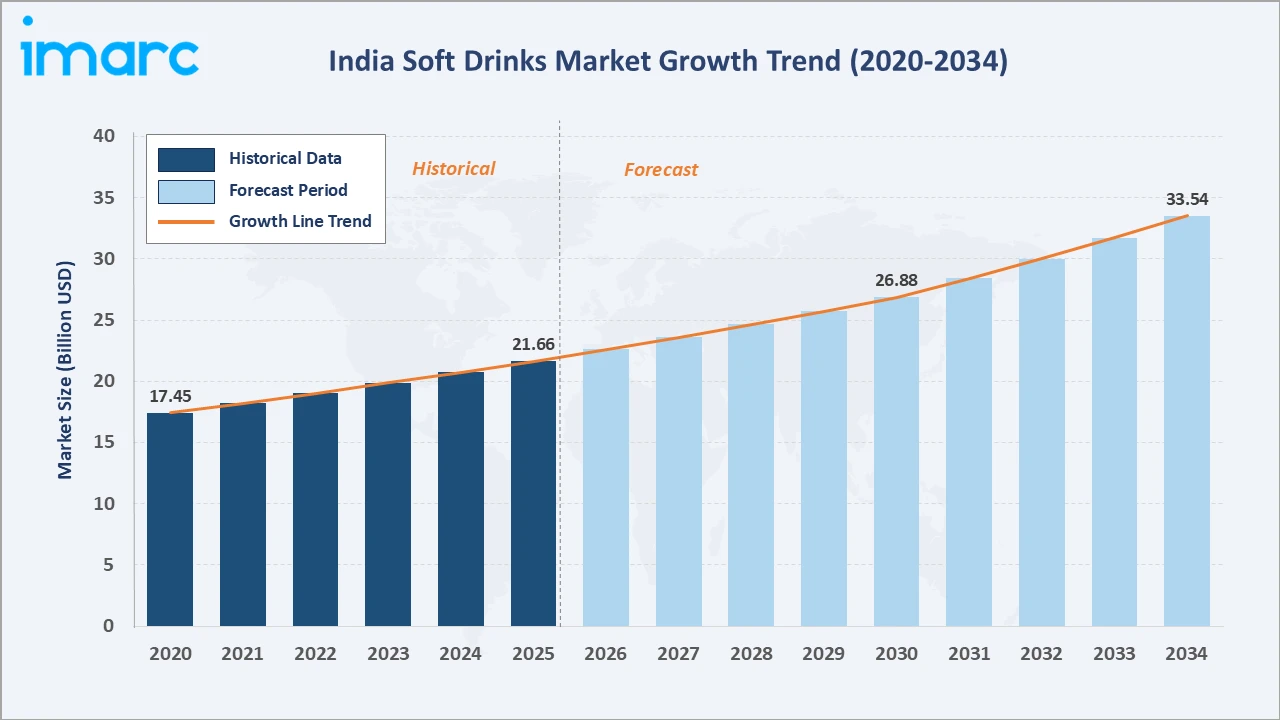
The India soft drinks market grew from USD 21.66 Billion in 2025 to USD 23.74 Billion in 2026 and is projected to reach USD 33.54 Billion by 2034, exhibiting a CAGR of 4.42% during 2026-2034. The market is driven by rising consumer demand for convenient beverages, expanding retail distribution, and growing product diversification across carbonated and non-carbonated drinks.
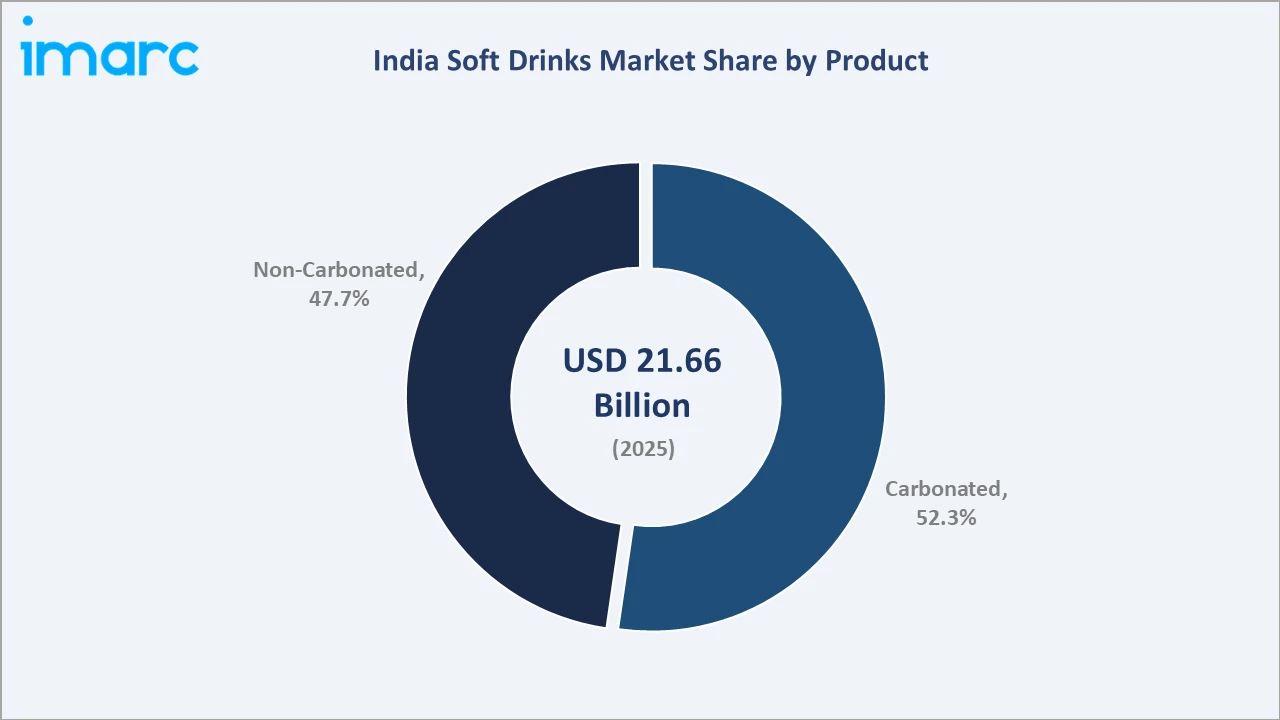
Carbonated leads the product segment at 52.3%, convenience store dominates distribution channel at 38.4%, and West and Central India commands 32.5% of the regional share in 2025.
Market Snapshot
|
Metric |
Value |
|
Base Year Market Size (2025) |
USD 21.66 Billion |
|
Market Size (2026) |
USD 23.74 Billion |
|
Forecast Market Size (2034) |
USD 33.54 Billion |
|
CAGR (2026-2034) |
4.42% |
|
Base Year |
2025 |
|
Historical Period |
2020-2025 |
|
Forecast Period |
2026-2034 |
|
Largest Region |
West and Central India (32.5%, 2025) |
|
Second Largest Region |
North India (28.4%, 2025) |
|
Leading Product |
Carbonated (52.3%, 2025) |
|
Leading Distribution Channel |
Convenience Store (38.4%, 2025) |
The India soft drinks market expanded from USD 17.45 Billion in 2020 to USD 21.66 Billion in 2025 and an estimated USD 23.74 Billion in 2026, driven by widening urban retail access, growing modern trade penetration, and rising per-capita beverage consumption across metro and tier-2 cities. Anchored at USD 26.88 Billion in 2030, the forecast to USD 33.54 Billion by 2034 is supported by accelerating non-carbonated adoption, expanding online retail, and sustained premiumization across flavored and functional beverage categories.
To get more information on this market, Request Sample
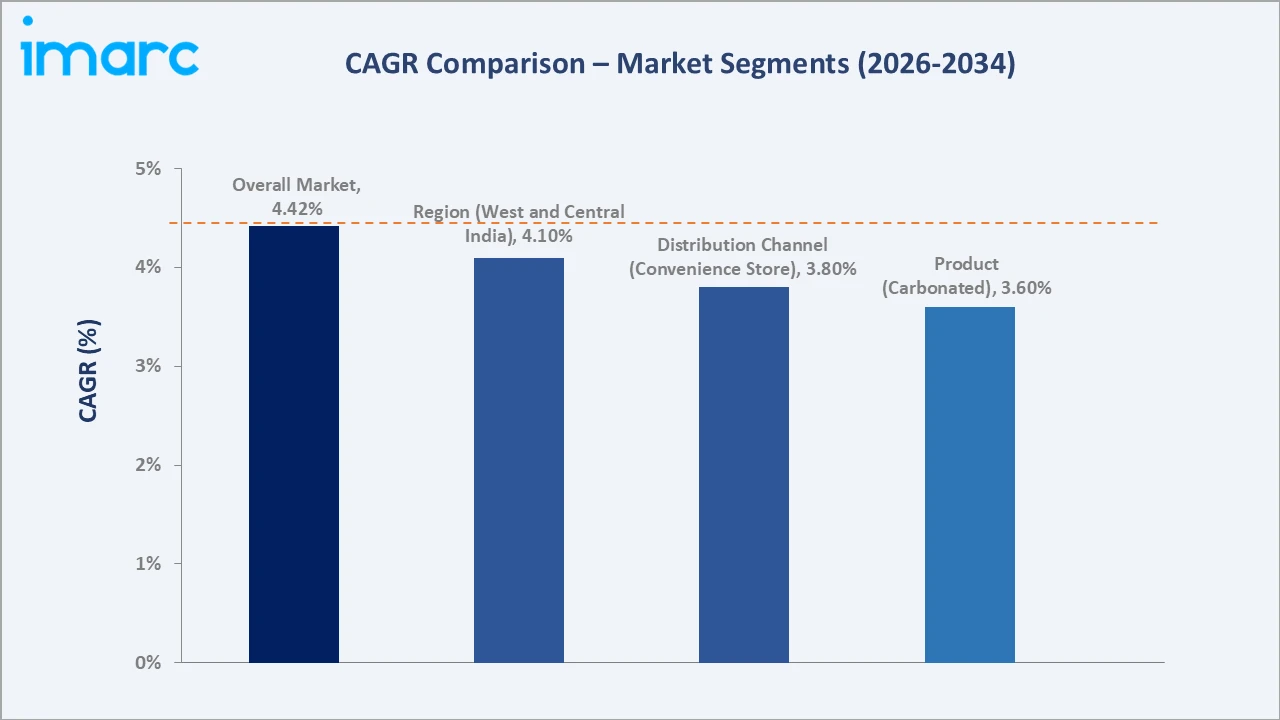
CAGR trajectories across product and distribution channel sub-segments show online and non-carbonated expanding faster than the overall 4.42% market CAGR, driven by digital-first retail adoption, health-conscious purchasing behavior, and broader last-mile delivery infrastructure across urban and semi-urban India.
Executive Summary
The India soft drinks market is on a steady growth trajectory from USD 17.45 Billion in 2020 to an estimated USD 23.74 Billion in 2026 and is projected to reach USD 33.54 Billion by 2034. The industry has evolved from a carbonated-led, single-channel category into a diversified portfolio spanning flavored waters, juices, energy drinks, and functional beverages sold across modern trade, general trade, and online platforms. Rising urbanization, expanding organized retail, and a growing appetite for healthier formulations are reshaping consumption patterns nationwide.
Carbonated continues to lead the product segment at 52.3% in 2025, supported by strong brand loyalty and wide availability across convenience outlets. Convenience store remains the leading distribution channel at 38.4% in 2025, fueled by its accessibility, extended operating hours, and growing consumer preference for quick purchases. West and Central India commands 32.5% of the regional share, anchored by dense urban retail networks and high per-capita consumption.
Key Market Insights
|
Insight |
Data |
|
Leading Product |
Carbonated - 52.3% share (2025) |
|
Second Largest Product |
Non-Carbonated - 47.7% share (2025) |
|
Leading Distribution Channel |
Convenience Store - 38.4% share (2025) |
|
Second Largest Distribution Channel |
Hypermarkets and Supermarkets - 28.6% share (2025) |
|
Leading Region |
West and Central India - 32.5% share (2025) |
|
Second Largest Region |
North India - 28.4% share (2025) |
|
Top Companies |
The Coca-Cola Company, PepsiCo, Inc., Parle Agro Private Limited, Bisleri International Pvt. Ltd., Dabur India Limited |
Key Analytical Observations Supporting the Above Data:
- Carbonated dominance at 52.3% is supported by deep-rooted brand loyalty, wide retail availability, and strong festive and summer-season demand across cola, lemon, and orange flavor categories.
- Non-carbonated share at 47.7% is expanding steadily as juices, flavored waters, and functional drinks gain traction among health-conscious urban consumers.
- Convenience store leadership at 38.4% is reinforced by dense neighborhood retail networks. Its proximity to residential areas and extended operating hours make it a preferred channel for frequent, on-the-go beverage purchases.
- Hypermarkets and supermarkets at 28.6% are driven by their broad product assortment, promotional offers, and increasing consumer preference for convenient one-stop shopping experiences.
- West and Central India share at 32.5% is anchored by Mumbai, Pune, and Ahmedabad's dense retail and hospitality networks.
India Soft Drinks Market Overview
Soft drinks refer to non-alcoholic beverages that are typically carbonated or non-carbonated, encompassing colas, lemon and orange-flavored sodas, packaged fruit juices, flavored and functional waters, energy drinks, and ready-to-drink teas and coffees sold through retail and food service channels. The category spans manufacturing, bottling, distribution, and retail activities regulated under India's food safety framework.
The Indian ecosystem integrates raw material and ingredient suppliers, beverage manufacturers and bottlers, cold-chain and logistics providers, retail and distribution partners, regulatory bodies such as FSSAI, packaging vendors, and marketing agencies. Together, these participants enable the delivery of soft drinks to a wide and increasingly health-conscious consumer base across urban and rural India.
Market Dynamics
To evaluate market opportunities, Request Sample
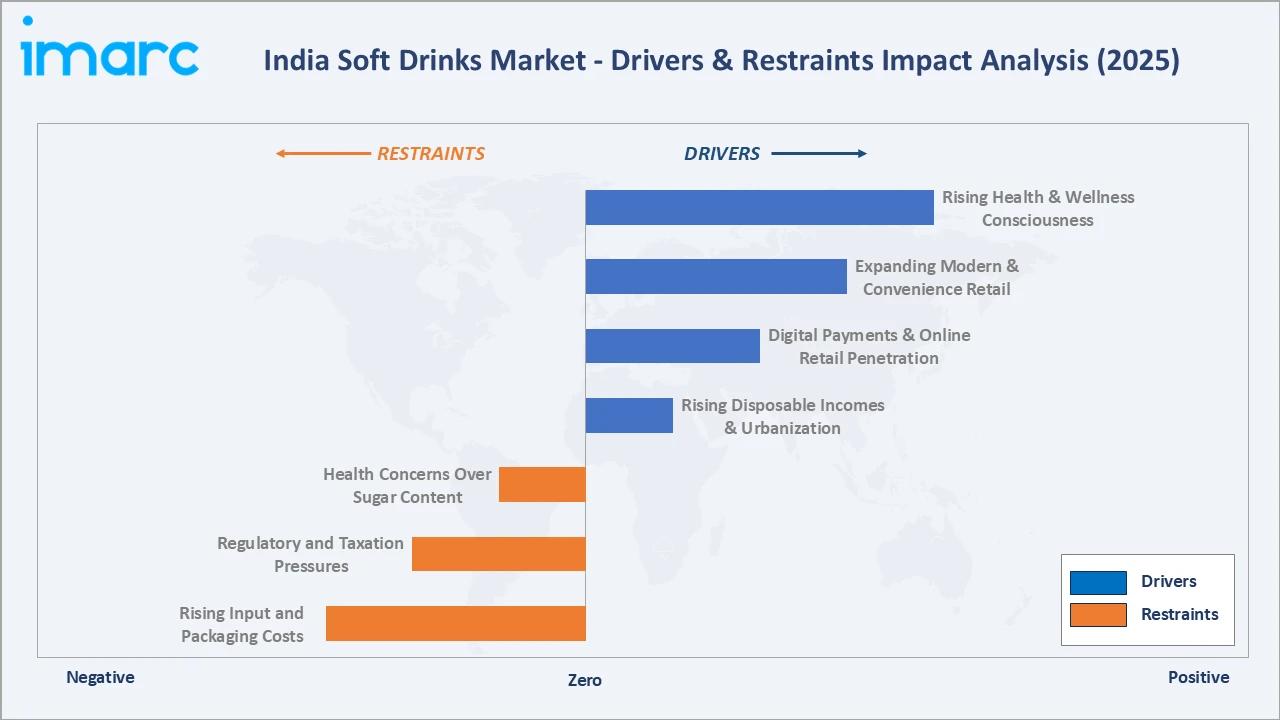
Market Drivers
- Rising Health and Wellness Consciousness: As per IMARC Group, the India health and wellness market size was valued at USD 164.35 Billion in 2025. Growing awareness of sugar-related health risks is steering consumers toward non-carbonated, low-sugar, and functional beverage options across urban and semi-urban India.
- Expanding Modern and Convenience Retail: The rapid rollout of convenience stores, supermarkets, and quick-commerce dark stores is widening branded beverage availability beyond traditional general trade outlets.
- Digital Payments and Online Retail Penetration: Widespread digital payment adoption is easing online and app-based beverage purchases. Per National Payments Corporation of India (NPCI) data, UPI processed over 24,162 Crore transactions in FY2025-26, up from just 2 Crore in FY2016-17, reflecting deepening digital commerce infrastructure nationwide.
- Rising Disposable Incomes and Urbanization: Growing middle-class incomes and expanding urban consumption are supporting steady growth in out-of-home and impulse beverage purchases, influencing the carbonated soft drink market share in India.
Market Restraints
- Health Concerns Over Sugar Content: Growing consumer and regulatory scrutiny of added sugar in carbonated beverages is prompting reformulation pressure and cautious category growth for traditional cola and soda variants.
- Regulatory and Taxation Pressures: Evolving labeling requirements, high GST and related taxation on aerated and carbonated beverages, and compliance standards can increase operating costs and influence pricing across the beverage industry.
- Rising Input and Packaging Costs: Fluctuating prices for sugar, PET resin, and aluminum are adding cost pressure across the value chain, particularly for smaller regional bottlers with limited pricing power.
Market Opportunities
- Functional and Fortified Beverages: Rising interest in vitamin-enriched, probiotic, and energy-boosting drinks creates new premium revenue pools beyond traditional carbonated and juice categories.
- Rural and Tier-2/3 City Expansion: Improving cold-chain infrastructure and distribution reach are opening underpenetrated rural and smaller-city markets to branded beverage players.
Market Challenges
- Intense Price-Based Competition: Numerous regional and unbranded players compete aggressively on price, pressuring margins for established national brands.
- Seasonal Demand Volatility: Soft drink consumption remains highly seasonal, concentrated around summer months and festive periods, creating inventory and demand-planning challenges for manufacturers.
Emerging Market Trends
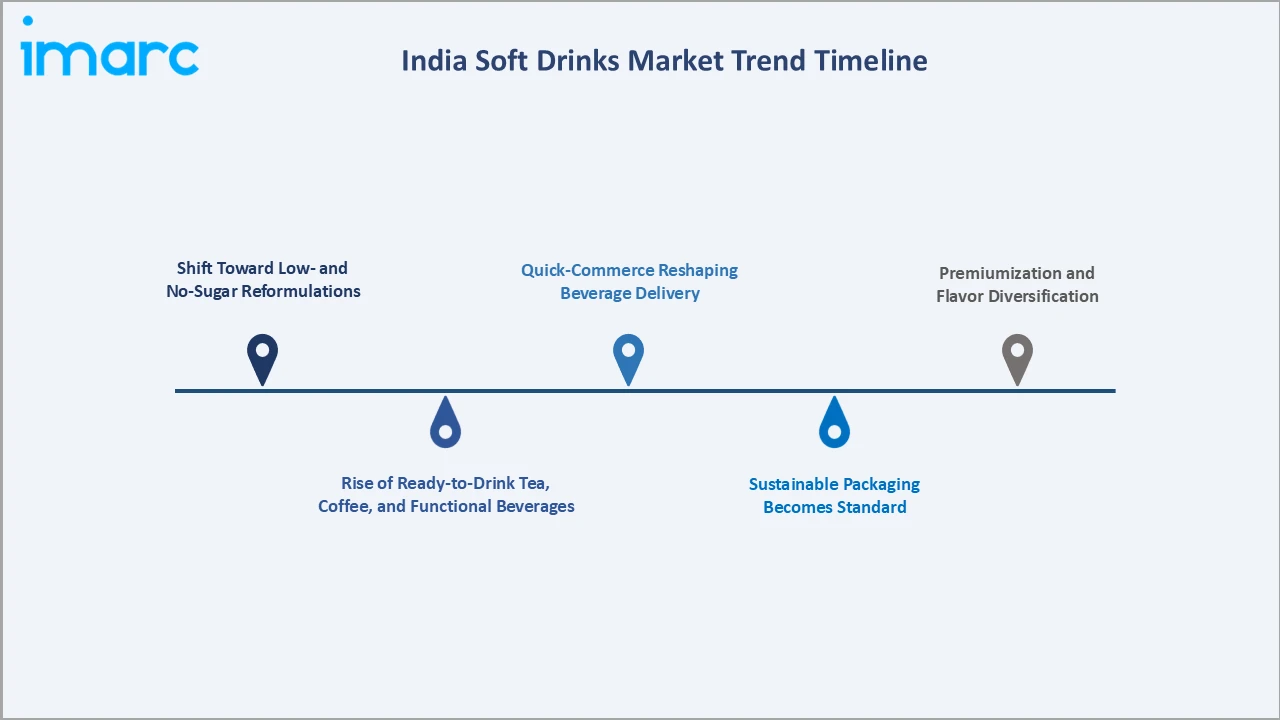
1. Shift Toward Low- and No-Sugar Reformulations
Manufacturers are reformulating flagship colas and sodas with natural sweeteners and reduced sugar content to align with evolving health preferences and regulatory scrutiny. This transition is also accelerating investment in stevia-based and zero-calorie product lines across major brand portfolios.
2. Rise of Ready-to-Drink Tea, Coffee, and Functional Beverages
Ready-to-drink tea, coffee, and functional drinks are gaining shelf space as consumers seek convenient, on-the-go alternatives to traditional carbonated options, supporting category diversification beyond cola and lemon-flavored sodas.
3. Quick-Commerce Reshaping Beverage Delivery
Ten-to-thirty-minute delivery platforms are transforming how urban consumers purchase soft drinks, shortening replenishment cycles and enabling smaller, more frequent basket sizes.
4. Sustainable Packaging Becomes Standard
Manufacturers are increasingly adopting recycled PET, lightweight packaging, and recyclable materials to reduce environmental impact and respond to growing consumer and regulatory emphasis on packaging sustainability.
5. Premiumization and Flavor Diversification
Consumers are increasingly favoring exotic flavors, regional variants, and premium packaging formats, encouraging brands to expand limited-edition and region-specific product lines. These developments are broadening consumer choice and supporting continued expansion in the carbonated soft drink market size in India.
Industry Value Chain Analysis
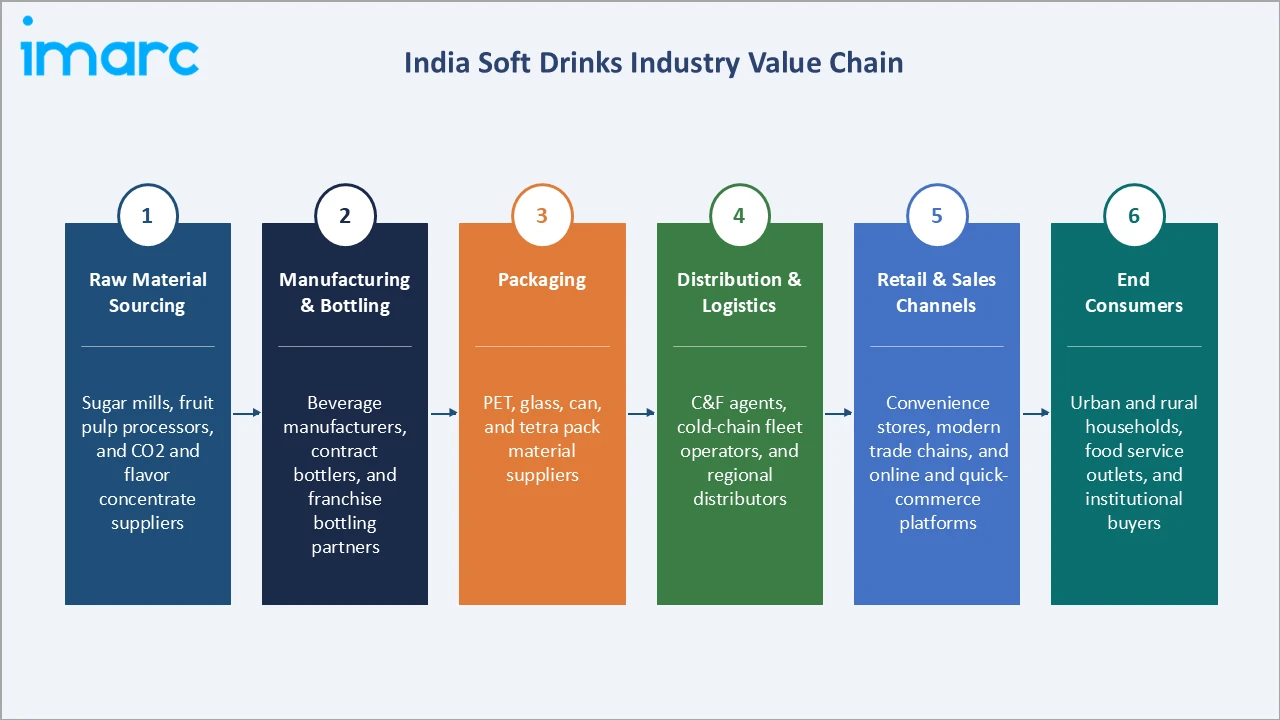
The India soft drinks value chain spans six stages from raw material sourcing through end-consumer delivery. Manufacturing, packaging, and distribution capture the highest value-add, while compliance with food safety and packaging regulations increasingly shapes competitive positioning across the category.
|
Stage |
Key Players / Examples |
|
Raw Material Sourcing |
Sugar mills, fruit pulp processors, and CO2 and flavor concentrate suppliers |
|
Manufacturing & Bottling |
Beverage manufacturers, contract bottlers, and franchise bottling partners |
|
Packaging |
PET, glass, can, and aseptic carton material suppliers |
|
Distribution & Logistics |
C&F agents, cold-chain fleet operators, and regional distributors |
|
Retail & Sales Channels |
Convenience stores, modern trade chains, and online and quick-commerce platforms |
|
End Consumers |
Urban and rural households, food service outlets, and institutional buyers |
Vertically integrated players with proprietary bottling capacity, direct distribution networks, and established brand portfolios are positioned to capture greater value than partners reliant on third-party infrastructure.
Technology Landscape in the India Soft Drinks Industry
Packaging Innovation and Sustainable Materials
Beverage manufacturers are increasingly adopting lightweight PET and recycled-content bottles to meet regulatory recycled-content mandates and reduce packaging costs. Advances in bottle design are also improving shelf stability and transport efficiency across distribution networks.
Formulation and Natural Ingredient Innovation
Natural sweeteners, functional additives, and reduced-sugar formulations are being deployed across both carbonated and non-carbonated portfolios, enabling brands to respond to shifting consumer health preferences while maintaining taste and product appeal. These innovations are also influencing the evolving structure and growth of the carbonated soft drinks market in India.
Cold Chain and Smart Distribution
Investments in temperature-controlled logistics and route optimization software are improving product freshness and reducing spoilage, particularly for dairy-based and juice-based beverage categories with shorter shelf lives.
Digital Commerce and Smart Vending
Quick-commerce integration, app-based ordering, and smart vending machines with cashless payment capability are expanding impulse-purchase touchpoints, particularly across metro transit hubs, offices, and educational institutions.
Market Segmentation Analysis
The report covers the following segments:
|
Segment Category |
Leading Segment |
Market Share |
Year |
|
Product |
Carbonated |
52.3% |
2025 |
|
Distribution Channel |
Convenience Store |
38.4% |
2025 |
|
Region |
West and Central India |
32.5% |
2025 |

By Product
Carbonated commands a 52.3% share of the India soft drinks market in 2025, led by cola, lemon, and orange-flavored variants sold through both modern and general trade. Strong brand loyalty, aggressive marketing during summer and festive seasons, and wide retail availability continue to underpin the segment's leadership.
To access detailed market analysis, Request Sample
Non-carbonated accounts for 47.7% of the market in 2025, spanning packaged juices, flavored waters, and functional drinks. The segment benefits from health-conscious purchasing behavior and is expected to narrow the gap with carbonated products over the forecast period, supported by continued product innovation and premiumization.
By Distribution Channel
Convenience store leads distribution channel with a 38.4% share in 2025, reflecting its dense neighborhood presence and role as the primary purchase point for impulse beverage consumption across urban and semi-urban India. The channel's proximity-driven model continues to underpin its leadership position.
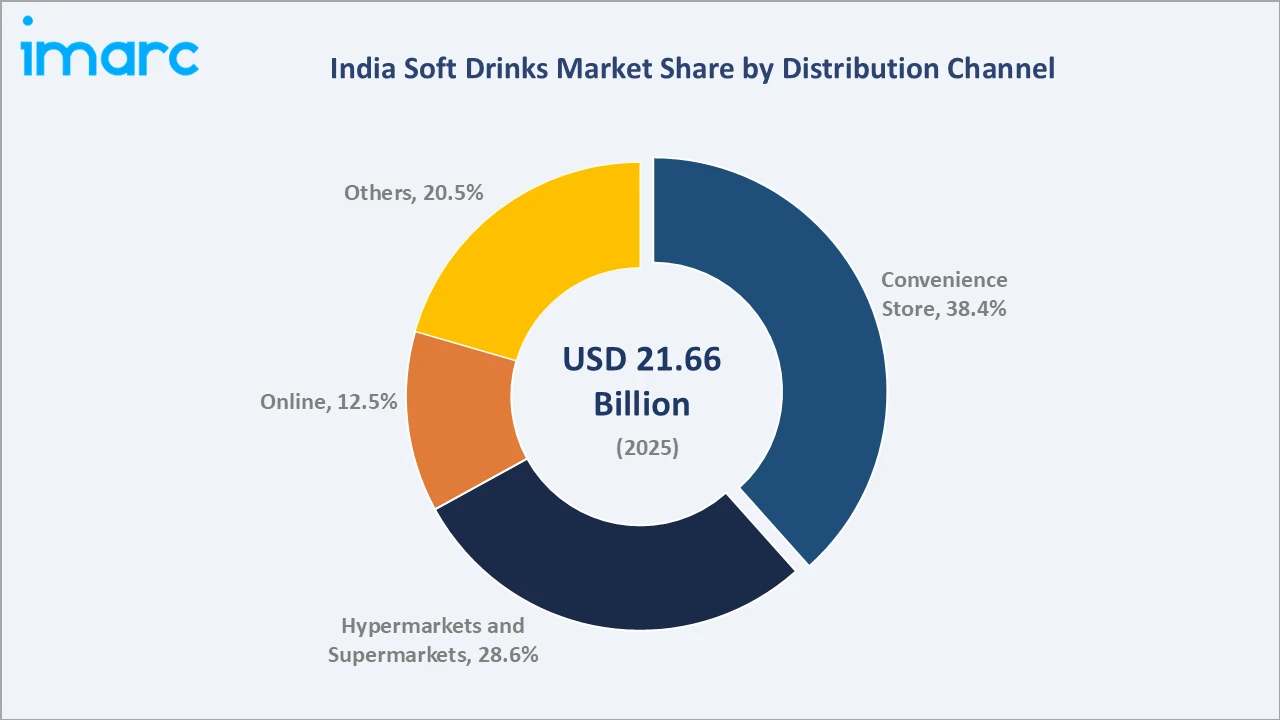
Hypermarkets and supermarkets hold 28.6% share, supported by bulk purchasing and wider product assortments. Their established presence in urban areas also provides consumers with greater access to diverse soft drink brands and pack sizes.
Regional Market Insights
|
Region |
Share (2025) |
Key Growth Drivers |
|
West and Central India |
32.5% |
Large urban population, dense retail infrastructure, strong industrial and hospitality demand, and established distribution networks |
|
North India |
28.4% |
High population density, expanding modern trade, growing quick-commerce penetration, and strong festive-season consumption |
|
South India |
24.6% |
Rising disposable incomes, expanding IT-driven urban workforce, growing health-conscious consumption, and strong hospitality sector demand |
|
East and Northeast India |
14.5% |
Emerging modern retail penetration, improving cold-chain infrastructure, and rising urban consumption in tier-2 cities |
West and Central India leads the regional landscape with 32.5% share in 2025, anchored by Mumbai, Pune, and Ahmedabad's dense urban retail networks and strong hospitality-sector demand. A mature distribution ecosystem and high per-capita beverage consumption support sustained regional leadership.
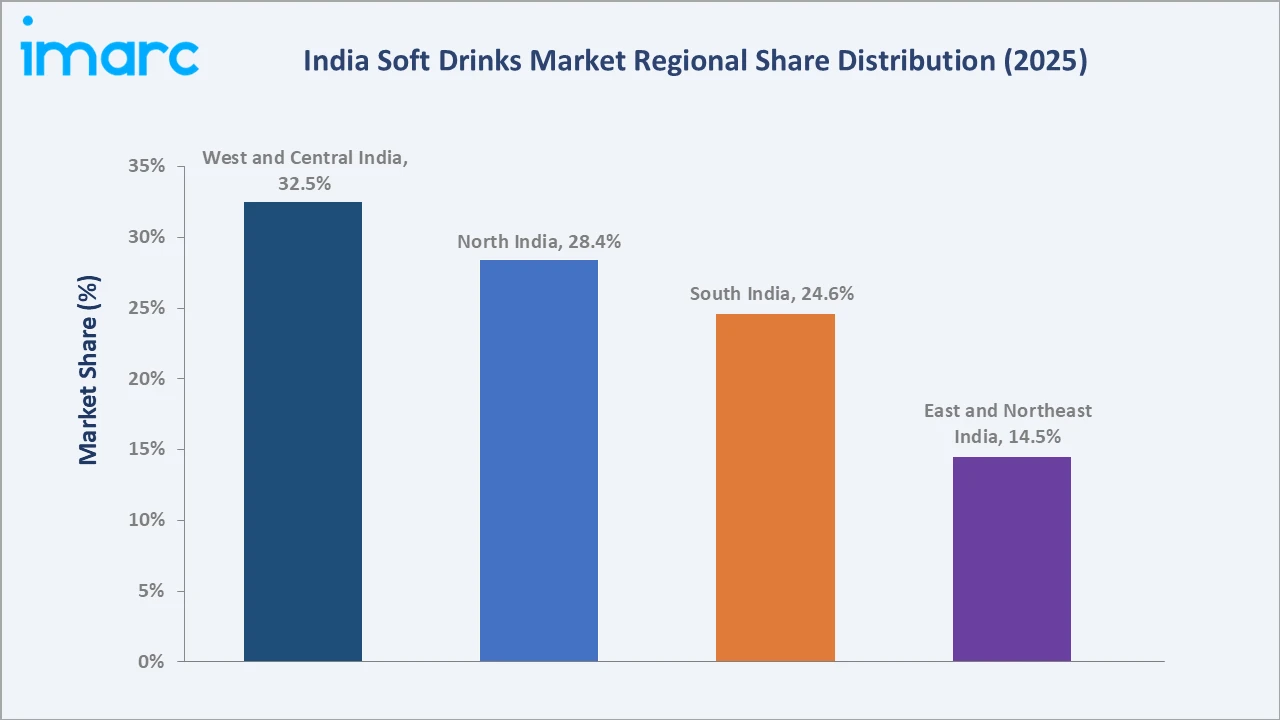
East and Northeast India, though the smallest region at 14.5% share, is expected to be the fastest-growing through 2034 as modern retail penetration deepens and cold-chain infrastructure investment expands beverage availability across tier-2 and tier-3 cities.
Competitive Landscape
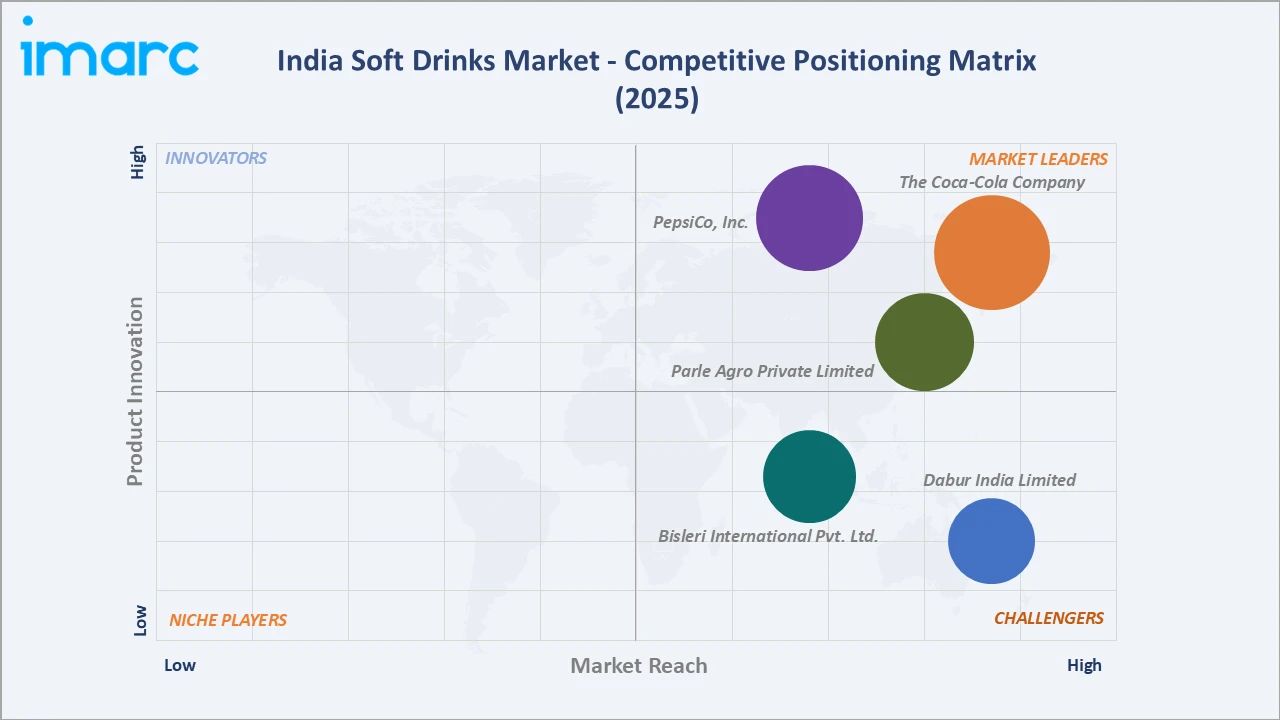
The India soft drinks market is moderately consolidated, with a small number of multinational and domestic players commanding the majority of branded volume, while regional bottlers and unbranded players compete on price in general trade channels. Brand strength, distribution depth, and bottling infrastructure form the primary competitive moats across the category.
|
Company Name |
Brand / Key Product |
Position |
Strategic Focus |
|
The Coca-Cola Compan |
Coca-Cola, Thums Up, Limca, Sprite |
Leader |
Expanding portfolio depth and strengthening nationwide distribution reach |
|
PepsiCo, Inc. |
Pepsi, Mountain Dew |
Leader |
Broadening beverage portfolio with continued investment in local manufacturing capacity |
|
Parle Agro Private Limited |
Frooti, Bailley |
Leader |
Expanding regional presence and diversifying into new beverage categories |
|
Bisleri International Pvt. Ltd. |
Bisleri, Vedica |
Challenger |
Strengthening packaged water and beverage distribution network |
|
Dabur India Limited |
Réal |
Challenger |
Expanding fruit-based beverage portfolio through health-oriented positioning |
Key players include The Coca-Cola Company, PepsiCo, Inc., Parle Agro Private Limited, Bisleri International Pvt. Ltd., and Dabur India Limited, among others.
Key Company Profiles
The Coca-Cola Company
The Coca-Cola Company is a global beverage corporation headquartered in Atlanta, United States, with an extensive presence in India through carbonated soft drinks and non-carbonated beverage brands manufactured via a network of company-owned and franchise bottling partners.
- Product Portfolio: Coca-Cola, Thums Up, Limca, and Sprite, spanning carbonated and non-carbonated categories.
- Recent Developments: The company continues to strengthen its beverage operations in India by expanding distribution, supporting local manufacturing, and increasing the availability of its beverage portfolio across urban and rural markets.
- Strategic Focus: Enhancing product offerings, expanding distribution coverage, and advancing packaging and operational sustainability initiatives.
PepsiCo, Inc.
PepsiCo, Inc. is a global food and beverage company headquartered in Purchase, New York, United States, operating in India through carbonated soft drinks, with beverage manufacturing supported by franchise bottling partners.
- Product Portfolio: Pepsi and Mountain Dew, its principal carbonated beverage brands in India.
- Recent Developments: The company continues to invest in local manufacturing capacity and expand its beverage distribution network across India.
- Strategic Focus: Increasing production capabilities, strengthening distribution networks, and improving market penetration across emerging urban and rural markets.
Parle Agro Private Limited
Parle Agro Private Limited is an Indian beverage company headquartered in Mumbai, known for its strong presence across both carbonated and non-carbonated beverage categories in the domestic market.
- Product Portfolio: Frooti and Bailley, spanning fruit-based and packaged water categories.
- Recent Developments: The company continues to expand its manufacturing footprint and strengthen its regional distribution network across India.
- Strategic Focus: Strengthening its presence across regional markets, broadening its beverage portfolio, and exploring opportunities in emerging product segments.
Market Concentration Analysis
The India soft drinks market is moderately fragmented, with a mix of multinational beverage companies, established domestic players, and regional brands competing across diverse product categories and distribution channels.
Barriers to entry include the high capital intensity of bottling infrastructure, the need for extensive cold-chain and distribution networks, and the marketing investment required to build brand recognition in a crowded category. These factors favor well-capitalized incumbents with established manufacturing and distribution capacity.
Consolidation continues as regional and unbranded players face rising compliance and input cost pressures, while larger players expand bottling capacity and acquire niche and regional brands to broaden portfolio depth and strengthen distribution reach across underpenetrated markets.
Investment & Growth Opportunities
Fastest-Growing Segments
Non-carbonated is attracting investment as brands expand juice, flavored water, and functional drink portfolios to capture health-conscious demand. Online is similarly drawing investment, as quick-commerce platforms scale beverage delivery capabilities.
Emerging Markets
East and Northeast India, though currently the smallest region by share, represents significant untapped opportunity for operators able to expand cold-chain infrastructure and distribution reach into tier-2 and tier-3 cities. Rising disposable incomes, expanding modern retail, and increasing urbanization are expected to support soft drink consumption.
Venture & Investment Trends
Investment is concentrated in functional and better-for-you beverage startups, sustainable packaging technology, and direct-to-consumer beverage brands, reflecting the category's broader shift toward health-oriented and digitally native business models.
Future Market Outlook (2026-2034)
The India soft drinks market is forecast to expand from USD 21.66 Billion in 2025 to USD 23.74 Billion in 2026 and further to USD 33.54 Billion by 2034 at a CAGR of 4.42%, adding significant incremental market value over the forecast period.
Three forces will shape the market through 2034: continued reformulation toward low- and no-sugar products, deepening penetration of organized and online retail channels, and evolving packaging regulations that push the category toward greater sustainability.
By 2034, the India soft drinks market is expected to be defined by a more balanced mix between carbonated and non-carbonated products, wider rural and tier-2/3 city penetration, and stronger integration between physical retail and digital commerce channels.
Research Methodology
Primary Research
Primary research included structured interviews with beverage manufacturers, bottling partners, distribution and retail executives, and packaging suppliers, validating market sizing, segment mix, and regional demand patterns.
Secondary Research
Secondary sources included FSSAI publications, Ministry of Environment plastic waste management notifications, GST Council announcements, industry body publications, and company annual reports and investor presentations.
Forecasting Models
Market forecasts used top-down and bottom-up models combining per-capita beverage consumption trends, retail channel expansion, regulatory transition scenarios, and macroeconomic variables, with scenario analysis addressing taxation changes and input cost volatility.
India Soft Drinks Market Report Coverage:
| Report Features | Details |
|---|---|
| Base Year of the Analysis | 2025 |
| Historical Period | 2020-2025 |
| Forecast Period | 2026-2034 |
| Units | Billion USD |
| Scope of the Report | Exploration of Historical and Forecast Trends, Industry Catalysts and Challenges, Segment-Wise Historical and Predictive Market Assessment:
|
| Products Covered | Carbonated, Non- Carbonated |
| Distribution Channels Covered | Hypermarkets and Supermarkets, Convenience Store, Online, Others |
| Regions Covered | North India, West and Central India, South India, East and Northeast India |
| Companies Covered | The Coca-Cola Company, PepsiCo, Inc., Parle Agro Private Limited, Bisleri International Pvt. Ltd., Dabur India Limited, etc. |
| Customization Scope | 10% Free Customization |
| Post-Sale Analyst Support | 10-12 Weeks |
| Delivery Format | PDF and Excel through Email (We can also provide the editable version of the report in PPT/Word format on special request) |
Frequently Asked Questions About the India Soft Drinks Market Report
The India soft drinks market size is estimated at USD 23.74 Billion in 2026, driven by expanding retail access, rising disposable incomes, and growing demand for both carbonated and non-carbonated beverages.
The market is projected to grow at a CAGR of 4.42% from 2026-2034, reaching USD 33.54 Billion, supported by expanding distribution and rising non-carbonated demand.
Carbonated dominates the product segment at 52.3% in 2025, led by cola, lemon, and orange-flavored variants supported by strong brand loyalty and wide retail availability.
Convenience store leads distribution channel at 38.4% in 2025, supported by its accessibility, neighborhood presence, and convenience for frequent beverage purchases.
West and Central India commands 32.5% share in 2025, led by dense urban retail networks, strong hospitality demand, and high per-capita beverage consumption.
Leading players include The Coca-Cola Company, PepsiCo, Inc., Parle Agro Private Limited, Bisleri International Pvt. Ltd., and Dabur India Limited, among others.
East and Northeast India is expected to be the fastest-growing region through 2034, supported by improving cold-chain infrastructure and expanding modern retail penetration.
Key trends include low- and no-sugar reformulation, ready-to-drink tea and coffee expansion, quick-commerce delivery growth, and sustainable packaging adoption across major brand portfolios.
Need more help?
- Speak to our experienced analysts for insights on the current market scenarios.
- Include additional segments and countries to customize the report as per your requirement.
- Gain an unparalleled competitive advantage in your domain by understanding how to utilize the report and positively impacting your operations and revenue.
- For further assistance, please connect with our analysts.
 Request Customization
 Speak to an Analyst
 Request Brochure
 Inquire Before Buying
Benefits of Customization
- Personalize this research
- Triangulate with your data
- Get data as per your format and definition
- Gain a deeper dive into a specific application, geography, customer, or competitor
- Any level of personalization
Get in Touch With Us
UNITED STATES
Phone: +1-201-971-6302
INDIA
Phone: +91-120-433-0800
UNITED KINGDOM
Phone: +44-753-714-6104
Email: [email protected]
Client Testimonials




.webp)




.webp)













Related Reports

Choose your plan
*Please note that the prices mentioned below are starting prices for each bundle type. Kindly contact our team for further details.*
Single User License
- 1 User License, Access on 2 Devices
- PDF Report + Excel Dataset (Password Protected)
- Lifetime Access
- No Printing Rights
- 10% Free Report Customization
- 10–12 Weeks of Analyst Support
Five User License
- Access for 5 Users, 2 Devices per User
- PDF Report + Excel Dataset (Password Protected)
- Lifetime Access
- Dedicated Account Manager
- 12–14 Weeks of Analyst Support
- No Printing Rights
- 15% Free Report Customization
- 25% Discount on Your Next Purchase
Corporate User License
- Unlimited User Access (Within Your Organization)
- PDF Report + Excel Dataset
- Lifetime Access
- Dedicated Account Manager
- 14–20 Weeks of Analyst Support
- No Printing Rights
- 20% Free Report Customization
- 30% Discount on Your Next Purchase
Essential Insights
What's included:
3 reports
- Lifetime Access
- PDF Reports
- Excel Datasets
- 2 Weeks of Free Analyst Support
- 2 User Licenses
- Access on 2 Devices
- Printing Rights
- Complimentary PowerPoint (PPT) Version
- Complimentary License Upgrade
Professional Access
What's included:
5 reports
- Lifetime Access
- PDF Reports
- Excel Datasets
- 8 Weeks of Free Analyst Support
- 2 User Licenses
- Access on 2 Devices
- Printing Rights
- Complimentary PowerPoint (PPT) Version
- Complimentary License Upgrade
Business Advantage
What's included:
8 reports
- Lifetime Access
- PDF Reports
- Excel Datasets
- 14 Weeks of Free Analyst Support
- 2 User Licenses
- Access on 2 Devices
- Printing Rights
- Complimentary PowerPoint (PPT) Version
- Complimentary License Upgrade
Enterprise Intelligence
What's included:
10 reports
- Lifetime Access
- PDF Reports
- Excel Datasets
- 20 Weeks of Free Analyst Support
- 2 User Licenses
- Access on 2 Devices
- Printing Rights
- Complimentary PowerPoint (PPT) Version
- Complimentary License Upgrade